
You've probably seen three different claims about massachusetts magic mushrooms in the same week. One article says they're “decriminalized.” Another says they're still illegal. A social post talks like dispensaries are right around the corner. If you're trying to figure out what you can do in Massachusetts right now, that mix of headlines is confusing for a reason.
The short version is simple. Massachusetts does not have a legal psilocybin retail market. You can't walk into a licensed mushroom dispensary the way you can with cannabis. But that still doesn't fully answer the primary question, which is what the risk looks like today, what changed after the failed 2024 ballot measure, and where legal access might appear next.
The most important update is that the conversation has shifted. Instead of moving toward broad adult-use retail sales, Massachusetts lawmakers have shown interest in narrower therapeutic and medical-style access. That matters because it changes what residents should watch for. The near future may look less like storefront sales and more like supervised programs, pilot sites, and treatment-focused rules.
Your Guide to Magic Mushrooms in Massachusetts
A Massachusetts resident can hear three different answers to the same question in a single day. A friend says mushrooms are basically decriminalized. A post online suggests licensed access is coming soon. A lawyer or clinician says possession is still illegal. All three are pointing at part of the picture, which is why the topic feels so confusing.
The better starting question is not, “Are magic mushrooms legal?” The useful question is, “What does access look like in Massachusetts right now, after the 2024 ballot measure failed?”
That shift in focus changes everything. The state does not have a normal retail path for psilocybin, and the most visible policy energy now points more toward supervised therapeutic or medical-style access than toward storefront sales. For consumers, that means expectations need to match the current situation, not the headlines people hoped would become true.
A simple analogy helps. Decriminalization works like a city deciding jaywalking is a low enforcement priority. Legalization works like adding crosswalks, signals, and written rules everyone can rely on. Massachusetts is much closer to a patchwork of enforcement choices and policy debate than to a fully built system for lawful consumer sales.
So the practical questions are different from the ones people often ask first. Residents usually need to know whether local enforcement is strict, whether any service is operating with real clinical oversight, whether a facilitator is making claims they cannot legally back up, and whether a product has any trustworthy safety controls at all.
That last point is easy to miss.
A substance can remain illegal under state and federal law, receive lower enforcement attention in some places, and still be unsafe to buy because there is no licensed retail testing system. Gray market products can look polished online and still give you no reliable proof of identity, potency, contamination screening, or dosage consistency.
This guide is built around that reality. It explains the legal patchwork, the failed ballot measure's practical effect, how to evaluate safety in a gray market, and why the next plausible path in Massachusetts may resemble supervised care more than a dispensary model. If you want a point of comparison, this contrast is easier to see in state-by-state guides on whether magic mushrooms are illegal in Florida, where the rules and expectations follow a different pattern.
The goal is not hype or fear. It is to help you understand the actual situation, sort myths from facts, and judge what kinds of access may realistically emerge next in Massachusetts.
Are Magic Mushrooms Legal in Massachusetts
A Massachusetts resident might hear two things in the same week: a city has deprioritized enforcement around entheogens, and someone online is offering mushroom products or “guided” experiences. That combination sounds close to legality, but it is not the same thing.
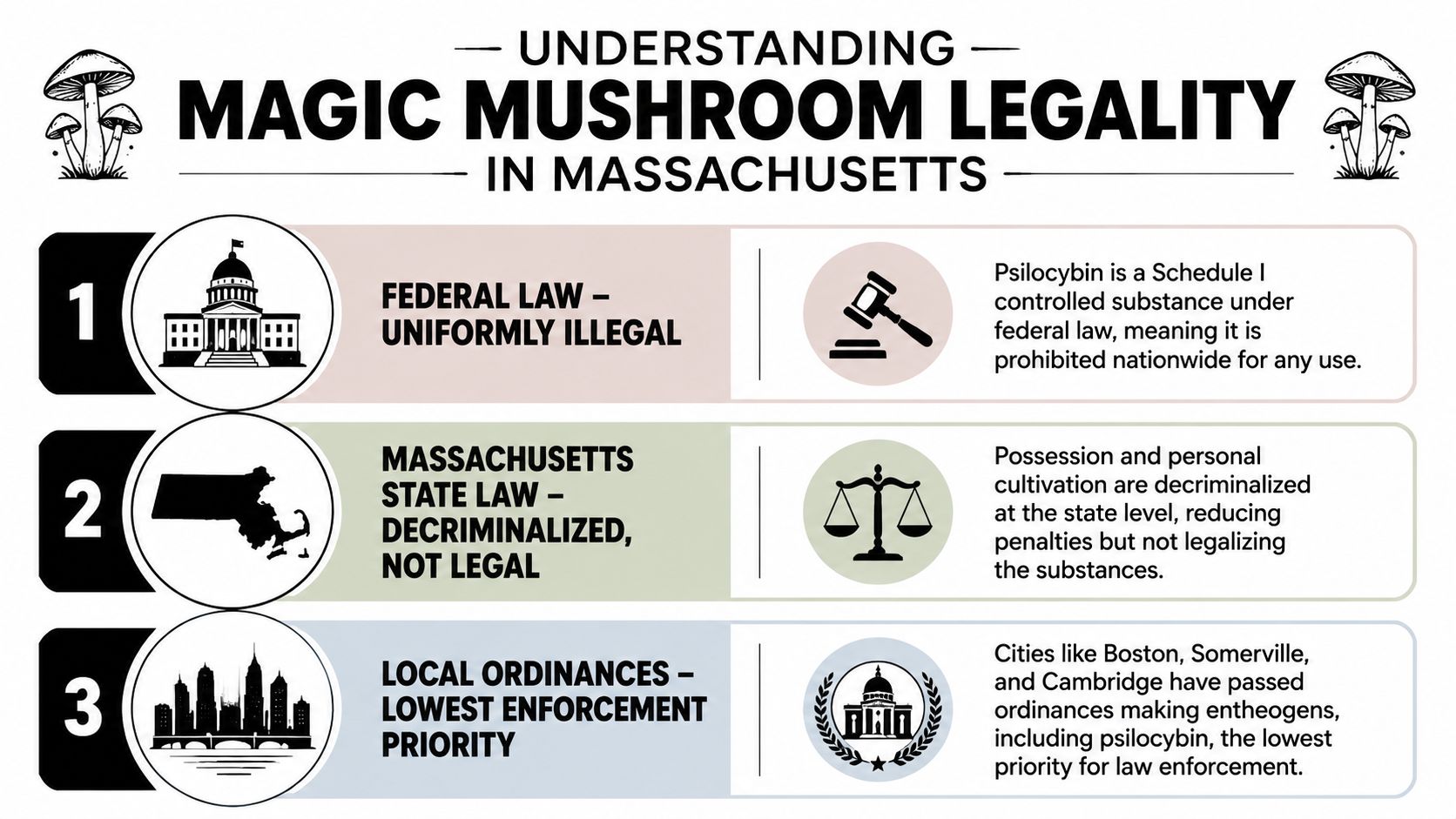
The clear answer is this. Magic mushrooms are not legal in Massachusetts in any statewide retail or dispensary sense. There is no licensed psilocybin store system, no approved adult-use sales channel, and no broad state law that makes ordinary buying and selling lawful.
Federal law
Psilocybin remains illegal under federal law. For a consumer, that means any change at the city or state level only affects local enforcement or state rules. It does not erase federal risk.
That point causes a lot of confusion. A state can soften penalties or create a narrow program, while federal law still treats the substance as illegal. Both can be true at once.
State reality after the 2024 ballot defeat
Massachusetts did not adopt the statewide system that many voters were asked to consider in 2024. In practical terms, that means the state did not move into a licensed model for supervised access sites, retail-style access, or a clearly regulated consumer channel.
That failed measure matters because it changed the likely path ahead. Instead of a broad adult-use framework, the discussion now leans more toward therapeutic and medical-style access, with more attention on supervised care, clinical oversight, and tightly controlled settings. For consumers, that is a very different future from walking into a dispensary.
Decriminalization and legalization are different tools
Decriminalization works like a city telling police, "treat this as a low priority." Legalization works like the state creating rules for licensed businesses, inspections, labeling, and permitted sales.
Those are different systems with different consequences.
A speeding analogy helps. If a town tells officers not to stop drivers for minor speeding unless something else is wrong, the speed limit still exists. The town has changed enforcement behavior, not erased the rule. Local decriminalization around entheogens works in a similar way. It may reduce the chance of arrest in some settings, but it does not create legal storefronts, product testing rules, or statewide permission to sell mushrooms.
If you want a comparison point, this guide on whether magic mushrooms are illegal in Florida shows how easily people can confuse limited access signals with actual legality.
What residents should assume right now
For day-to-day decision-making, the safest baseline is simple:
- Massachusetts does not have legal psilocybin dispensaries
- Buying and selling mushrooms is not part of a licensed statewide market
- Local decriminalization does not equal legal retail access
- The more realistic near-term path appears to be supervised therapeutic access, not ordinary consumer sales
That is the current legal reality in Massachusetts.
Finding Safe Services in a Gray Market
A common Massachusetts scenario looks like this: someone hears about a “private circle,” a “gift,” or an “education event” and assumes that means there is some approved path to access.
Usually, it means the opposite. It means you are dealing with an unregulated transaction dressed in softer language.
That distinction matters more after the 2024 ballot measure failed. Instead of a licensed consumer market, Massachusetts is still in an in-between stage. Local decriminalization efforts may lower enforcement priority in some places, while the more realistic long-term direction appears to be supervised therapeutic access rather than ordinary retail sales. For consumers, that means there is still no statewide system doing the safety checks for you.
What is missing without a licensed system
A regulated market would add clear rules about who can sell, what standards apply, and who is accountable when something goes wrong. Massachusetts does not have that system for psilocybin.
So the gray market runs on trust signals, not public oversight.
That is like buying medicine from a bottle with no pharmacy label, no batch record, and no way to verify who filled it. The product might be what you were told it is. You also might have no practical way to check. If you are new to psychedelics, it helps to first read about how psilocybin affects the brain so you can separate legitimate education from vague sales language.
How to screen a service, group, or source
Start with the attitude of the person offering access. Responsible people tend to slow things down. Risky people tend to make everything sound casual, mystical, or urgent.
Use this checklist:
- They discuss legal risk plainly. A careful source does not pretend that a club, gift, or membership makes state law disappear.
- They offer real education. Look for clear discussion of mindset, setting, duration, possible distress, and reasons someone should wait or abstain.
- They answer direct product questions. Ask what the item is, whether it is dried mushroom material or an edible, and whether any independent testing exists. Evasive answers mean more uncertainty.
- They avoid big promises. Be cautious with claims about guaranteed healing, certain diagnoses, or life-changing results.
- They respect boundaries. No pressure, no upselling stronger experiences, no push to combine substances, no attempt to create dependence on a leader or group.
- They have a stable local reputation. Quiet word-of-mouth from people you trust is more useful than polished branding or social media hype.
One warning sign deserves special attention. If someone is excellent at marketing but poor at answering basic safety questions, that is a bad trade.
Terms that sound safer than they are
People often confuse softer words with lower risk. In practice, these labels usually describe presentation, not legal status.
| Term | What it usually means | What it does not mean |
|---|---|---|
| Gifting | The transfer is framed as something other than a normal sale | State-approved legal retail access |
| Private membership | Access is limited to members of a group or club | Protection from state or federal law |
| Educational event | Information or community discussion is part of the gathering | Verified product quality or licensed distribution |
Use a simple test. If there is no state license, no inspection process, and no verified lab system attached to the transaction, treat it as unregulated no matter how professional it looks.
That is the practical reality in Massachusetts right now.
Essential Harm Reduction and Safety Practices
Once a product is in your hands, legality stops being the only issue. Safety becomes the bigger one. With massachusetts magic mushrooms still outside a regulated retail system, the main risk isn't just getting the law wrong. It's getting the product wrong.
Oregon State researchers found that many commercial mushroom edibles contained no psilocybin and instead included undisclosed active ingredients, according to Oregon State's report on magic mushroom edible analysis. The same report notes that psilocybin levels in Psilocybe cubensis samples ranged from trace amounts up to 19.9 mg/g, with psilocin sometimes undetectable.
That means labels, strain names, and edible branding are weak guides.
Set and setting matter more than people think
“Set” means your mindset. “Setting” means your environment. These two variables shape a large part of whether an experience feels manageable or chaotic.
Good conditions usually look like this:
- A calm headspace: Don't take psychedelics when you're panicked, very upset, or trying to overpower a bad week.
- A predictable place: Home or another quiet, controlled setting is usually safer than parties, crowds, or public spaces.
- Enough time: Don't build an experience into a busy schedule. Rushing creates avoidable stress.
- One trusted sober person nearby: First-time users especially benefit from a calm sitter who can help with water, reassurance, and practical decisions.
Why “start low and go slow” isn't a cliché
Because the product itself may be inconsistent, a conservative approach is the most reliable protection you control.
Start with less than you think you need. You can take more later in a future session. You can't untake an unexpectedly strong dose.
That's especially important with edibles. If a chocolate bar or gummy contains something other than psilocybin, the experience may not match what the packaging suggests. If dried mushrooms vary widely in potency, two similar-looking amounts can hit very differently.
A short safety floor
Before any use, ask yourself these questions:
- Do I know what this product is?
- Am I in a stable mood today?
- Do I have a safe place to stay for the full experience?
- Is a sober, trusted person available if needed?
- Am I mixing this with alcohol or anything else that could complicate things?
If several answers are no, delay the experience.
People curious about how psilocybin changes perception, mood, and cognition can also read this plain-language guide on psilocybin effects on the brain. Understanding the mental side helps people make better practical decisions before they ever touch a product.
A Practical Guide to Psilocybin Dosing
Dosing language can sound more precise than it really is. Terms like “microdose” or “heroic dose” are common, but they often get used casually, without enough respect for product variability.
Because potency can differ significantly across mushroom material, any dosing chart should be treated as a general orientation tool, not a promise of exact effects. This is especially true in unregulated markets.
Common dose categories in plain English
A microdose is meant to be sub-perceptual or barely noticeable. People generally don't take it to have a full psychedelic experience.
A museum dose is a light dose. The idea is that you may notice a shift in mood, color, or attention while still staying fairly grounded.
A moderate dose is where a fuller psychedelic experience usually begins. This is not casual territory for most beginners.
A heroic dose refers to a profound immersive experience and is not appropriate for inexperienced users, unstable settings, or uncertain products.
Psilocybin mushroom dosing guidelines
Psilocybin Mushroom Dosing Guidelines (Dried Psilocybe cubensis)
| Dose Level | Dried Mushroom Amount | Typical Effects |
|---|---|---|
| Microdose | Very small amount | Little to no obvious psychedelic effect, subtle shift at most |
| Museum dose | Light amount | Gentle sensory changes, mild emotional shift, still fairly functional for some people |
| Moderate dose | Medium amount | Clear psychedelic effects, stronger perception changes, emotional intensity, reduced ability to manage public settings |
| Heroic dose | Very large amount | Deep immersion, major perceptual changes, loss of normal control and orientation, only for highly experienced users in carefully supported settings |
How to use this chart safely
The chart is useful only if you pair it with humility.
- Don't assume one batch matches another
- Don't redose quickly
- Don't treat strain names as precision tools
- Don't use a first experience as an experiment in intensity
If you don't know the source quality, it's smart to think in categories rather than chasing exact outcomes. The goal is to avoid accidental overconsumption, not to optimize for the strongest possible experience.
For many adults, the safest decision is to stay in the low end and learn how their body responds over time.
The Emerging Path to Therapeutic Psilocybin Access
The most interesting change in Massachusetts isn't retail growth. It's the political move toward therapeutic access.
After the broader ballot effort failed, lawmakers did not stop talking about psychedelics. They changed the frame. In 2025, Massachusetts lawmakers filed 12 psychedelics-related bills, including a proposal for a five-site therapeutic psilocybin pilot program and broader legislation tied to therapeutic pathways, according to Marijuana Moment's report on Massachusetts psychedelics bills.
Why this shift matters
This is a different model from “open adult-use sales.” A therapeutic framework is narrower and more controlled. It centers supervised use, treatment settings, research, and regulated patient access.
That means if legal psilocybin access expands in Massachusetts, the first version may not look like a mushroom storefront at all. It may look more like intake screening, clinical oversight, trained facilitators, and site-based administration.
For readers, that changes expectations. If you're waiting for a retail dispensary model, current signals don't point there first.
What future access might look like
A therapeutic pathway usually raises different questions than a retail one:
- Who qualifies
- Which conditions are included
- Where sessions can happen
- What kind of supervision is required
- How products are sourced and handled
That's one reason the phrase “legalization” can be misleading. Massachusetts may move toward access without embracing a broad consumer market.
People who want to understand this care model in more depth can read a helpful primer on what psychedelic therapy is.
A short explainer is worth watching here:
The practical takeaway
If you live in Massachusetts and want to track what's next, pay more attention to pilot programs, therapeutic bills, and clinical infrastructure than to rumors about recreational dispensaries.
The strongest near-term opening in Massachusetts appears to be supervised treatment access, not ordinary retail sales.
That doesn't mean change is guaranteed. It means the state's conversation now points more toward healthcare-style systems than toward a cannabis-style storefront rollout.
Connecting with the Massachusetts Psychedelic Community
A lot of people interested in psychedelics aren't looking for a party scene. They're looking for education, harm reduction, and sane conversation. In Massachusetts, that kind of community matters because the legal situation is still unsettled.
A useful starting point is to seek out organizations focused on support rather than sales. National harm reduction groups like Zendo Project and DanceSafe are often better first stops than social channels filled with legal rumors or product hype. Local psychedelic societies, integration circles, and educational meetups can also help people learn the language, risks, and ethics of this space without jumping straight into use.
Why the community may be larger than people assume
Massachusetts already has a large adult population familiar with regulated intoxicants. A 2026 state report found that 43% of Massachusetts residents reported past-year cannabis use in the 2023 sample, and the highest rates were among adults ages 18 to 34, according to the Massachusetts Cannabis Control Commission research summary.
That doesn't mean cannabis users automatically become psychedelic users. It does suggest that Massachusetts has a substantial base of adults who already understand ideas like product categories, regulated access, responsible adult use, and the gap between legality and safety.
Good community signs
Look for groups that do these things well:
- Teach risk clearly
- Respect consent and boundaries
- Avoid miracle-cure language
- Encourage integration and reflection
- Separate education from pressure to consume
Healthy communities make caution feel normal. That's what you want.
Frequently Asked Questions About Magic Mushrooms in MA
Can I buy magic mushrooms at a dispensary in Massachusetts
No. Massachusetts does not have legal psilocybin dispensaries.
Did the 2024 ballot question legalize mushrooms
No. Voters rejected the major 2024 measure, so the proposed system for broader adult access, supervised centers, and home cultivation did not take effect.
Does decriminalization mean I can safely buy or sell them
No. Decriminalization and low-priority enforcement do not create a lawful retail market. They also don't guarantee product safety.
Can I grow mushrooms at home in Massachusetts
There is no statewide legal home-grow system in effect for psilocybin. The proposed 2024 change that would have allowed home cultivation did not pass.
If a city is more relaxed, does that protect me everywhere else
No. Local enforcement attitudes can vary by location, and they don't erase state or federal law.
Is it safe to trust mushroom edibles sold online or through informal channels
Not automatically. Product labels can be misleading, and some mushroom edibles have been found to contain no psilocybin or undisclosed ingredients. If you can't verify what's in it, treat it as uncertain.
What is the safest general rule for first-time use
Keep the dose low, stay in a calm private setting, avoid mixing substances, and have a sober trusted person available.
Is Massachusetts moving toward legal access at all
Possibly, but the visible direction has shifted toward therapeutic and pilot-style access rather than open retail sales.
Should I expect a cannabis-style mushroom market soon
Current policy signals don't support that expectation. If access expands first, it may come through supervised treatment models.
If you're looking for a trusted adult-use source outside Massachusetts, Metro Mush offers psilocybin products, educational content, and menu access for eligible customers in its service areas, with a focus on clear options for both experienced and cautious consumers.