
When looking into magic mushrooms new jersey, a mess of headlines likely appears. One says New Jersey "legalized" psilocybin. Another says mushrooms are still illegal. A third talks about medical access, but doesn't explain who can get it. For a cautious adult trying to stay out of trouble, that isn't useful.
The honest answer is narrower than the headlines make it sound. New Jersey has changed its approach to psilocybin, but it has not opened a retail market, it has not made recreational use legal, and it has not created a general right for residents to buy or grow mushrooms. What it has done is move in stages, from reduced penalties for some possession cases to a tightly controlled medical pilot.
That distinction matters. A lot of people read "legalization" and assume dispensaries, broad access, or some kind of low-risk gray market. That's not the situation on the ground in 2026. The practical situation is stricter, slower, and much more limited.
Navigating the Shifting Landscape of Psilocybin in NJ
Those interested in magic mushrooms new jersey aren't looking for theory. They're trying to answer a simple question before they make a decision that could affect their record, job, travel, or health.
They've heard that New Jersey softened penalties. They've seen coverage about therapeutic access. They may also know that federal law still treats psilocybin as illegal. When all of that gets collapsed into one headline, the result is confusion.
What the headlines often miss
New Jersey's psilocybin story is not a one-step legalization story. It's a staged policy shift.
That means you have to separate three different issues:
- Possession law: What happens if someone is caught outside any medical framework.
- Medical policy: Whether the state has authorized any supervised therapeutic use.
- Real-world access: Whether an ordinary adult can obtain treatment now.
Those aren't the same thing, and too many guides blur them together.
Practical rule: If a headline doesn't tell you who qualifies, where treatment happens, and whether retail sales exist, it's probably oversimplifying the law.
What matters for a cautious adult
The safest way to read New Jersey's current position is this: the state has become more permissive in some respects, but it's still operating under a controlled model. That creates a lot of false confidence for readers who only skim the news.
Here's the frame that works in practice:
| Question | Short answer |
|---|---|
| Are mushrooms broadly legal in New Jersey? | No |
| Has New Jersey reduced some penalties? | Yes |
| Is there a medical path? | Yes, but it's limited |
| Can most adults walk into a dispensary and buy psilocybin? | No |
If you keep that framework in mind, the rest of the law makes a lot more sense.
The Current Legal Status of Psilocybin in New Jersey
The baseline is straightforward. Psilocybin remains a Schedule I substance under federal law, which means possession, distribution, and manufacture are still illegal under the Controlled Substances Act, as explained in this overview of psilocybin's federal legal status.
That federal status is the backdrop for everything else. State reform can reduce some local penalties or create limited programs, but it doesn't erase federal control.
The key New Jersey threshold
New Jersey's biggest practical change came in February 2021, when the state reduced possession of up to 1 ounce of psilocybin mushrooms from a third-degree crime to a disorderly persons offense. The maximum penalty became 6 months in jail and/or a fine of up to $1,000. Possession of more than 1 ounce can still bring up to 5 years in prison and fines as high as $35,000, according to this breakdown of New Jersey mushroom possession penalties.
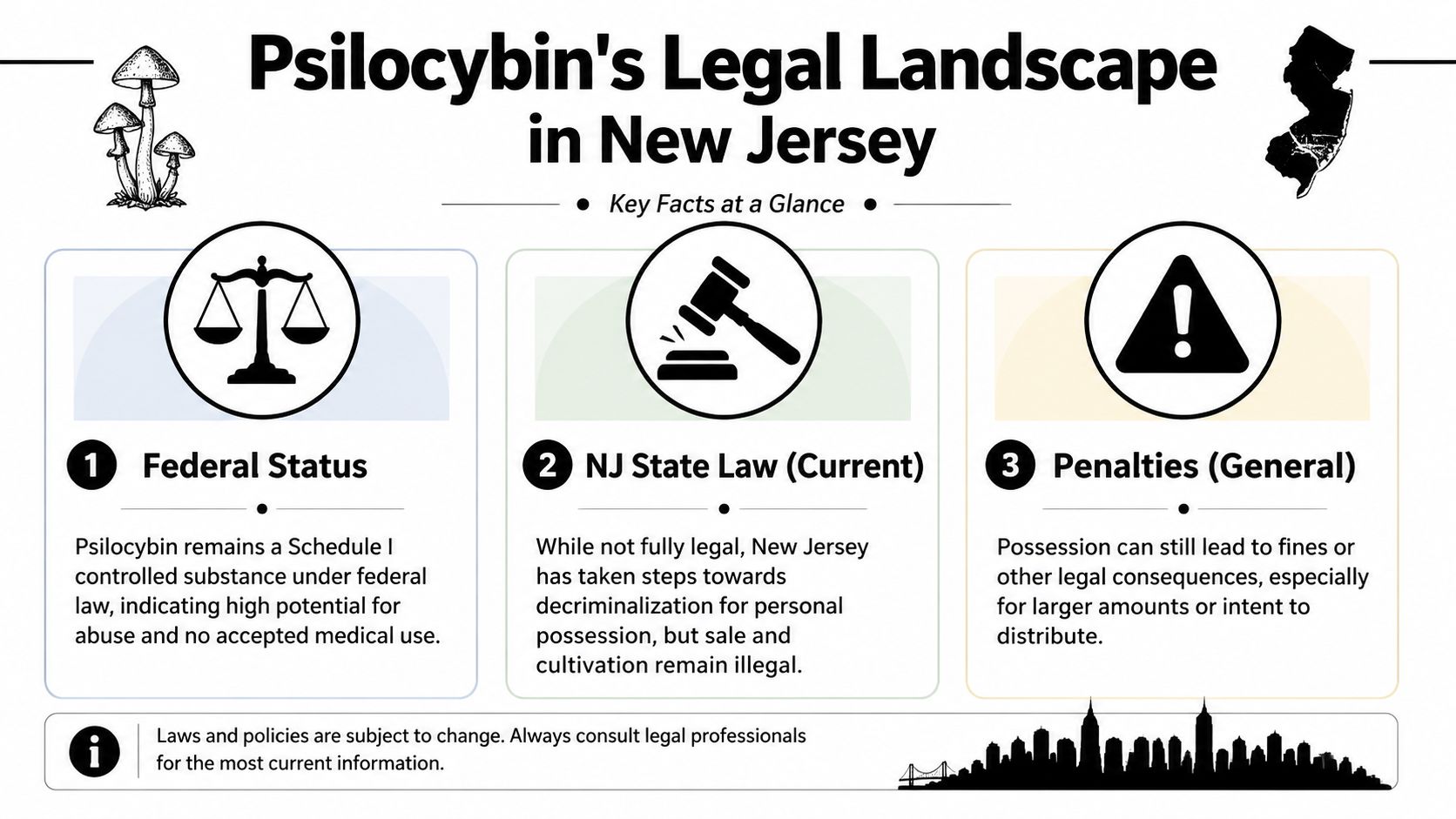
That 1-ounce line is the part many readers miss. People hear "decriminalized" and assume the state has mostly backed off. It hasn't. The state changed the consequence for smaller possession cases. It did not remove criminal exposure across the board.
What that means in real life
For a cautious adult, the current law works more like a stepped risk system than a green light.
- Small-amount possession: Still illegal. The penalty is lower than it used to be, but lower doesn't mean harmless.
- Larger amounts: Still treated much more seriously.
- Sales, sharing, and cultivation: Readers often assume these changed too. That's a bad assumption.
A disorderly persons offense is not the same thing as "nothing happens." It can still mean arrest, court time, legal fees, stress, and a record issue that follows you.
Lower penalties reduce exposure. They don't create safety.
The cleanest way to think about current law
Use this table as your working model:
| Situation | Legal status in NJ |
|---|---|
| Possession of up to 1 ounce | Illegal, lower-level offense |
| Possession of more than 1 ounce | Illegal, much more serious offense |
| Retail purchase | Not generally authorized |
| Open recreational use | Not legal |
| Federal legality | Still illegal |
If you're trying to make a real-world decision, that's the baseline. Everything else in New Jersey is built on top of it.
Understanding New Jersey's New Medical Psilocybin Laws
The next layer is where most of the confusion starts. People hear about a medical bill and translate it into "mushrooms are legal now." That's not what New Jersey built.
Between 2024 and 2025, lawmakers advanced S2283, the Psilocybin Behavioral Health Access and Services Act, which would authorize production and use of psilocybin in therapeutic settings, decriminalize related conduct within that system, and expunge certain past convictions, according to the bill text for S2283 on LegiScan.
What "behavioral health access" actually means
This language points to a regulated therapeutic model, not a casual consumer model. The design is closer to supervised treatment than to the retail cannabis framework many people instinctively picture.
That distinction matters because the legal category changes with the setting. In a medical-style framework, the state is not saying, "Adults can buy mushrooms." It's saying, "A controlled system may authorize use under defined conditions."
If you're new to the treatment side of this topic, it helps to understand how psychedelic therapy works in practice. The key point is that therapy-centered access is built around screening, supervision, and structured use. It isn't built around open-ended possession.
What this law is trying to do
A useful way to read S2283 is to focus on its architecture:
- Therapeutic authorization: Psilocybin use would happen inside a regulated health framework.
- System-based decriminalization: Certain conduct would be decriminalized within that authorized system, not as a blanket public right.
- Expungement: The proposal also points toward cleaning up some past psilocybin-related convictions.
That's a meaningful policy shift. But it's not the same as broad legalization.
When lawmakers build a supply chain, licensing structure, and supervised use model, they're not creating a recreational market. They're creating controlled access.
The trade-off built into New Jersey's approach
This model has clear strengths and clear limits.
On the one hand, a supervised system can reduce some of the chaos that comes with underground sourcing and unsupervised use. On the other hand, it usually means slower rollout, narrower eligibility, and far less access for ordinary adults who don't fit the program's rules.
That's why medical-only headlines can mislead. The state may be opening one door while keeping several others shut.
The Reality of NJ's Medical Psilocybin Pilot Program
At this point, the gap between headlines and reality becomes obvious.
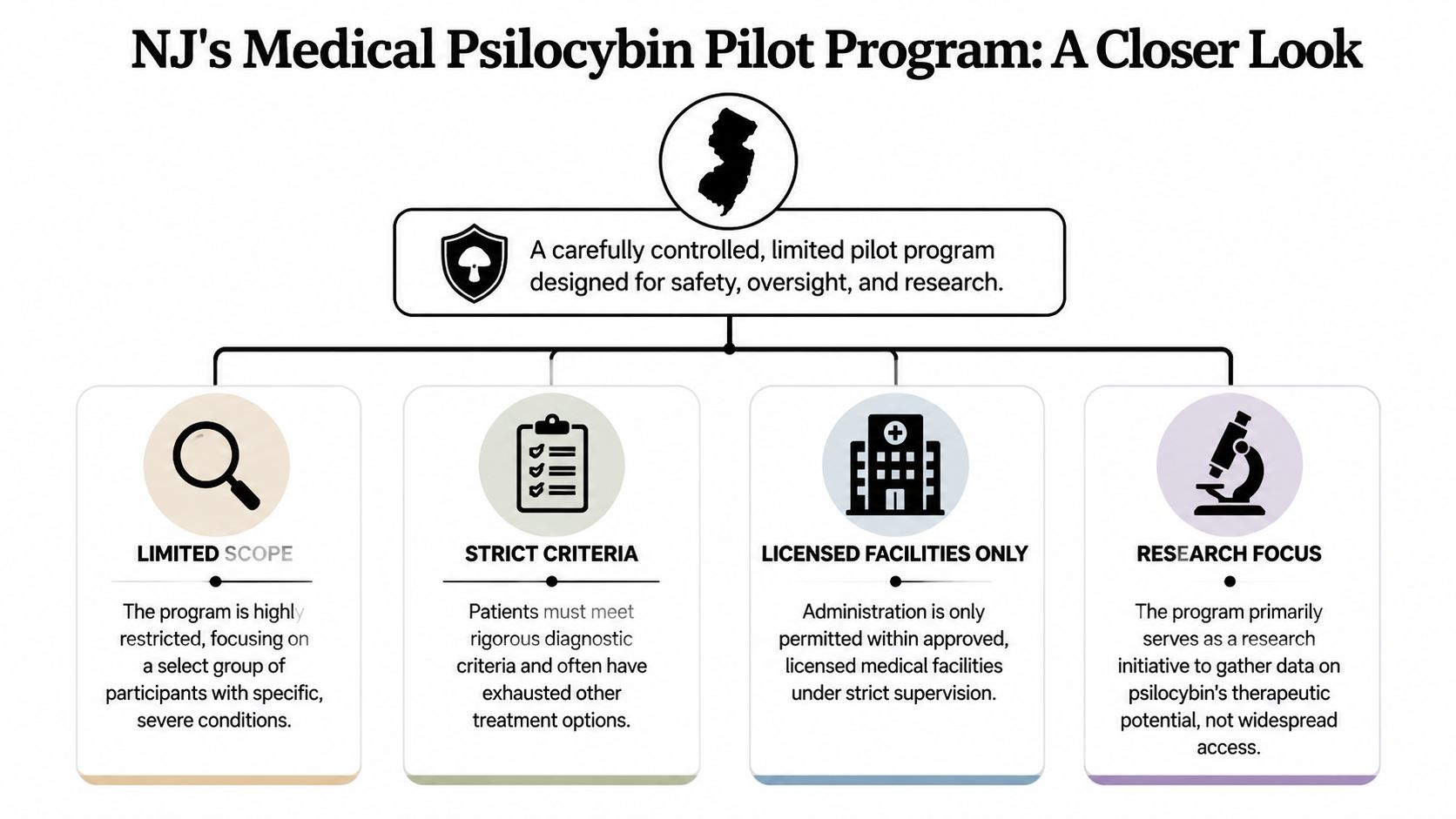
New Jersey's psilocybin program, enacted in January 2026, is not a commercial rollout. It's a narrow pilot limited to three hospitals, with $2 million allocated per hospital, and participation restricted to adults 21+ with qualifying conditions. All treatment must occur in a structured therapeutic setting under medical supervision, as detailed in McCarter's summary of the New Jersey psilocybin pilot program.
What the program does not create
This is the part that should be in every headline, but often isn't.
The pilot does not create:
- Dispensaries
- Retail access
- General adult-use legality
- A statewide open enrollment system
If you're an ordinary resident reading that New Jersey "legalized medical magic mushrooms," the practical answer is still likely, "That doesn't mean you can get them."
Why the pilot is so limited
A pilot is meant to test a model under close control. New Jersey chose a hospital-based, medically supervised path rather than a broad access path.
That tells you something about the state's priorities. Lawmakers are treating psilocybin more like a monitored clinical intervention than a normal consumer product.
The phrase "medical psilocybin is legal" hides the harder truth. Access is narrow, site-specific, and controlled by program rules.
What a cautious reader should assume in 2026
For most adults, the useful assumption is that medical psilocybin is not broadly available yet. Whether someone can access the program depends on the qualifying condition, the selected site, medical oversight, and the pace of implementation.
Here are the facts in plain terms:
| Common assumption | Actual situation |
|---|---|
| "NJ legalized mushrooms" | No broad legalization |
| "I can probably find a dispensary" | No dispensary model |
| "Medical access means doctors can just prescribe it" | Access is confined to structured therapeutic settings |
| "If it's legal medically, regular possession must be fine" | Outside the pilot, separate legal risks still apply |
The result is frustrating but clear. New Jersey has moved forward, but it has moved forward cautiously.
Procurement and Possession Risks for NJ Residents
The hardest part of the magic mushrooms new jersey conversation is that many people take limited reform as a signal that sourcing is now low-risk. It isn't.
The legal risk starts with possession, but it doesn't stop there. Once a person starts trying to obtain psilocybin outside a formal medical setting, they also take on market risk, travel risk, and record risk.
What legal exposure still looks like
Even where a state loosens some rules, federal law still sits above that framework. That means state reform does not eliminate the possibility of prosecution for possession, distribution, or manufacturing under federal law.
For residents, the practical takeaway is simple. If you're outside a lawful supervised framework, you shouldn't assume the state's evolving posture protects you.
The risks people underestimate
A lot of adults focus only on whether a small amount might lead to a reduced state-level penalty. That's too narrow.
The actual risk list is wider:
- Court and record issues: Even a lower-level charge can create stress, expense, and consequences that outlast the incident.
- Unregulated sourcing: Underground products can be misidentified, contaminated, or misrepresented.
- Potency uncertainty: One batch can feel very different from another, especially with dried fungi and homemade edibles.
- Travel problems: Crossing state lines adds another layer of legal exposure. What felt "local" stops being local fast.
If you're getting psilocybin from an unregulated source, you're taking both legal risk and product risk at the same time.
Travel is where people make avoidable mistakes
People often reason that if one state is changing its laws, moving product between states must be a minor issue. That's the wrong lens.
State lines matter. So do airports, public transit systems, mailed packages, and vehicles stopped for unrelated reasons. A person may think they're carrying a wellness product. Law enforcement may see a federally controlled substance.
What works better than wishful thinking
The adults who avoid the worst outcomes usually do one thing well. They separate headlines from enforceable rules.
That means asking:
- Is this access channel authorized?
- Am I relying on rumor rather than policy?
- Would I still feel confident explaining this decision to a lawyer?
If the answer to the first question is unclear, that's already a warning sign.
Essential Harm Reduction and Safety Guidance
A New Jersey adult reads a headline about psilocybin reform, assumes the risk is low, and treats the first experience like a casual wellness purchase. That is where people get hurt. The law is still tight for ordinary possession, and the product market outside regulated medicine is still unregulated, so safety starts with accepting both realities at once.
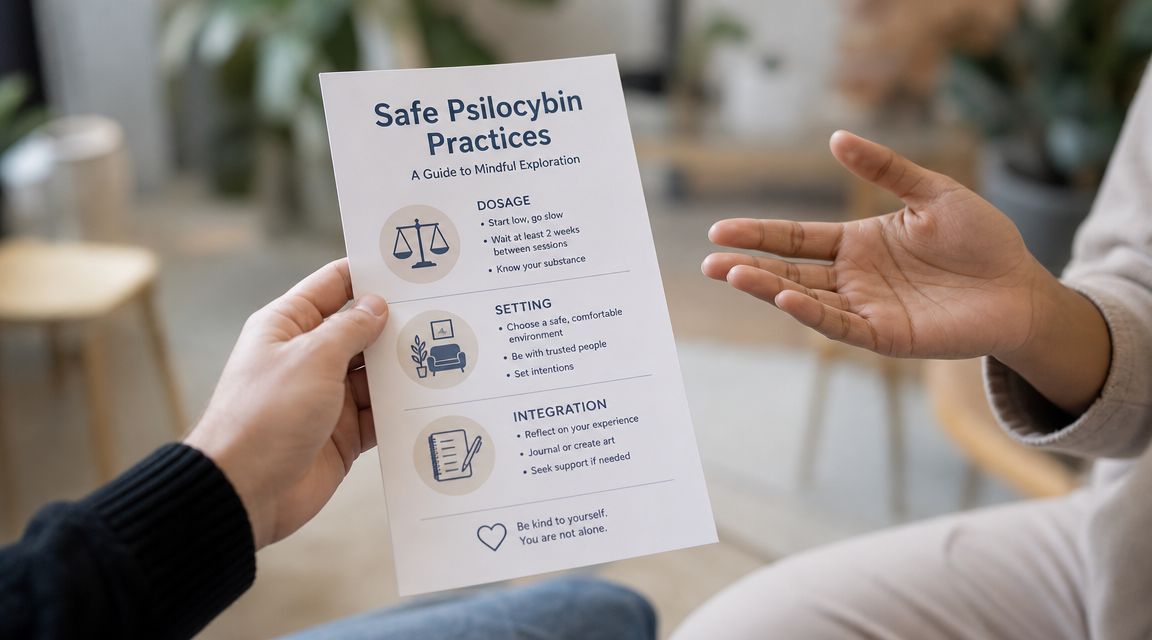
Start with set and setting
Set and setting shape the experience more than beginners tend to expect.
Set is your state of mind before you take anything. If you're panicked, sleep-deprived, grieving, depressed, or chasing a dramatic breakthrough because a hard week pushed you there, the session is more likely to turn unstable.
Setting is the room, the people, the noise level, and the amount of control you have over the next several hours. Private, quiet, familiar spaces are safer than public settings, parties, or any plan that depends on keeping it together around strangers.
A few habits reduce risk fast:
- Choose one trusted sober person: A calm sitter who can stay present is more useful than several inexperienced friends.
- Keep the environment simple: Water, a bathroom nearby, a place to lie down, low stimulation, and no reason to leave.
- Clear your schedule: No driving, no childcare duties, no work calls, no need to act normal on command.
- Postpone if your head is crowded: Delay is often the safest choice.
Dose conservatively and avoid mixing
The most common mistakes are impatience and overconfidence. People redose too early, trust a label they cannot verify, or combine psilocybin with alcohol, cannabis, stimulants, or prescription drugs without understanding the interaction.
A better approach is plain and restrained:
- Start low: That matters even more with unfamiliar material or homemade edibles.
- Wait long enough: Early effects can feel mild before they build.
- Use one substance at a time: Mixing makes the outcome harder to predict and harder to manage.
- Respect the format: Dried mushrooms, chocolates, capsules, and beverages can differ in onset, intensity, and consistency.
Product form matters. Potency can vary widely across batches, especially in unregulated products. A chocolate bar may feel measured and polished, but if you do not know who made it or what is in it, the packaging means very little.
If you want preparation basics before a session, this guide on how to avoid bad trips is a useful place to start.
The safer plan is usually the less exciting one. Known place, low dose, sober support, no mixing, no driving.
A practical walkthrough can also help:
Know when not to proceed
Do not proceed if the basics are shaky.
Postpone if:
- Your mood is unstable or you feel emotionally cornered
- You are not confident about what the product is
- You cannot stay in one safe place for the full duration
- Someone else is pressuring you
- You may need to drive, work, or handle family responsibilities
- You have a history of psychosis or serious mental health instability and have not spoken with a qualified clinician
That is not moralizing. It is risk management.
The biggest gap in New Jersey right now is the one between public perception and real-world access. Headlines can make psilocybin sound close to ordinary legal use. For almost everyone in the state, it is not. Harm reduction starts with understanding that the medical pilot is narrow, underground sourcing remains risky, and a cautious decision to wait is often the smartest call.
The Future of Magic Mushrooms in New Jersey
A cautious adult in New Jersey can read a headline about psilocybin reform and come away with the wrong idea fast. The policy direction has changed, but day-to-day reality has not changed much for the average resident. That gap matters more than the headline.
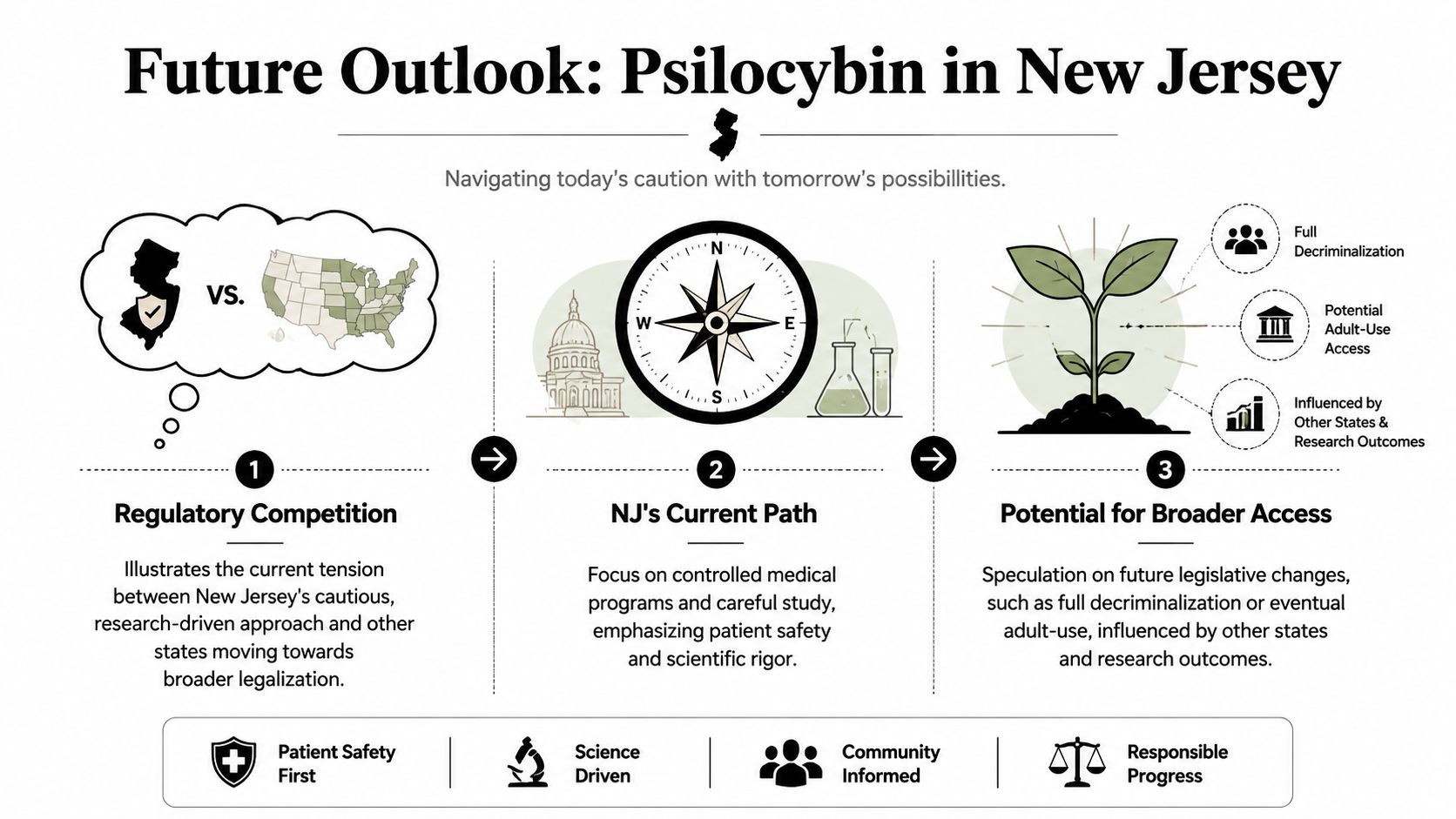
Right now, New Jersey is testing a tightly controlled, hospital-based approach. A competing reform push would create a broader system with psilocybin service centers and clearer treatment of fungi-based products, as explained in this analysis of New Jersey's competing psilocybin models. For readers trying to separate reform talk from actual access, that is the main fault line to watch.
Two very different futures
These are not small policy details. They decide who can get access, where treatment happens, and whether psilocybin stays limited to medical institutions or expands into a regulated access model that looks more like Oregon's service-center system.
| Model | What it means for adults |
|---|---|
| Hospital-focused pilot | Access stays narrow, clinical gatekeeping stays high, and rollout is slow |
| Broader service-center framework | Access could widen, but only inside a regulated system with licensing, rules, and ongoing political pushback |
The practical question is not whether New Jersey has "legalized mushrooms." It has not, in any broad public sense. The key question is whether lawmakers keep psilocybin inside a medical program that serves a limited group of patients, or build a second path that ordinary adults might realistically use.
What to watch next
A few signals will tell you whether New Jersey is changing in a meaningful way or just generating more optimistic coverage:
- Who qualifies for treatment. A narrow diagnosis list keeps access limited even if the program technically exists.
- Where sessions can happen. Hospital-only access is a very different reality from licensed service centers.
- How fungi are treated in the law. Clear language around cultivation and mushroom-based products would signal a bigger shift than pharmaceutical-only rules.
- How agencies write the rules. A bill can sound expansive on paper and still produce a restrictive program in practice.
State comparisons help cut through the confusion. This review of how Florida treats magic mushrooms under current law shows how reform conversations and actual legal access often diverge.
My practical read is simple. New Jersey is no longer standing still, but it is still far from broad legal adult use. For 2026, the honest expectation is slow change, narrow implementation, and plenty of misleading headlines in between.
If you want straightforward information about psilocybin products, formats, and practical consumer education from a retailer operating in Michigan, visit Metro Mush. Their site covers product categories, psychedelic basics, and related guides that can help you separate hype from usable information.