
Magic mushrooms are illegal in Florida. Possession of actual psilocybin mushrooms or the psilocybin compound is a third-degree felony punishable by up to five years in prison and a $5,000 fine, and Florida's 2025 law also made many spore and mycelium transactions a first-degree misdemeanor punishable by up to one year in jail and a $1,000 fine.
That's why so many people end up confused when they search are magic mushrooms illegal in florida. They've heard older advice, seen discussions from other states, or read that spores used to be legal because they didn't contain psilocybin yet. In Florida, that older rule can now mislead you.
If you're a resident, a traveler, or someone comparing Florida to places with looser psychedelic rules, the safest starting point is simple: Florida treats psilocybin seriously. The main risk isn't just the mushroom itself. It's also how state law now treats the materials used to grow it, and how little room there is for relying on outdated internet advice.
Your Quick Guide to Florida's Psilocybin Laws
Florida's answer is straightforward. Magic mushrooms are illegal in Florida, and state law treats possession of psilocybin-containing mushrooms as a felony. If you're thinking in everyday terms, that means this is not handled like a minor ticket or a casual warning.
People usually get tripped up on three points.
- The mushroom vs. the spore: Mature psilocybin mushrooms and psilocybin itself carry felony risk. Spores and mycelium used to sit in a gray area, but Florida changed that in 2025.
- Old internet guides: A lot of articles still repeat the pre-2025 idea that spores were legal if they didn't contain psilocybin at the time of sale.
- Wild mushrooms: Florida has a narrow historical wrinkle involving whether someone knew a wild mushroom contained a controlled substance. That doesn't make mushrooms broadly legal.
Practical rule: If a product, material, or grow-related item is tied to producing psilocybin mushrooms in Florida, you should assume legal risk exists unless a qualified Florida lawyer tells you otherwise.
There's also a difference between criminal liability and internet culture. Online forums often talk about spores, cultivation, and “for microscopy only” language as if those phrases solve the problem. Florida's newer law changed the legal environment enough that those shortcuts are not reliable.
A cautious way to think about the issue is this:
- Possessing actual psilocybin mushrooms creates the highest obvious risk discussed here.
- Selling, transporting, or giving away spores or mycelium is now its own legal problem under Florida law.
- Wild-foraged mushrooms can raise complicated questions about knowledge and intent, but that's a defense issue, not a permission slip.
Understanding Florida's Felony Classification for Psilocybin
A common question is, “What if I just have a small amount?” In Florida, that question starts from the wrong place. The legal issue is not whether the amount feels minor. The issue is whether the substance is psilocybin or psilocybin-containing mushrooms.
Under Florida law, actual psilocybin mushrooms are treated as a felony-level controlled substance matter. For a non-lawyer, the practical takeaway is simple. Possessing the finished mushroom is in a very different category from the older online discussion about spores, microscopy kits, or cultivation materials discussed in many guides to mushroom spores.
What “third-degree felony” means in plain English
A third-degree felony is not a ticket-level problem or a low-stakes possession issue. It is a criminal charge that can carry jail or prison exposure, fines, and a record that can keep affecting someone after the court case ends.
A useful way to frame it is this: the felony label acts like a legal threshold. Once conduct falls on that side of the line, the stakes rise fast. Employers, landlords, licensing boards, schools, and future courts may all care about the result, not just the person handling the current case.
That is why casual language can be misleading here.
Someone may describe mushrooms as “just for personal use” or “just a home grow.” Florida law does not turn those facts into a safe category. If the end product is psilocybin mushrooms, the risk analysis changes sharply.
Where readers often get confused
Confusion usually comes from mixing together different stages of the mushroom process.
Spores, mycelium, cultivation, and harvested mushrooms are related, but they are not treated the same way in every statute. The key point for this section is narrower. Once you are talking about actual psilocybin mushrooms or psilocybin itself, you are in felony territory, not a gray-area debate about inputs or hobby activity.
That distinction matters because older articles often blur the line. They may spend so much time on spore legality that readers miss the bigger point. Florida has long treated the finished psilocybin product as a serious criminal issue.
Why the felony classification matters in real life
The court penalty is only part of the risk.
A felony charge can affect:
- employment background checks
- housing applications
- professional and occupational licensing
- student aid or school discipline issues
- how later criminal charges are viewed
In other words, the legal classification does more than describe the offense. It changes the consequences that can follow a person outside the courtroom.
The cautious reading is straightforward. In Florida, possessing actual psilocybin mushrooms should be treated as high legal risk, even if someone views the amount as small or the use as private.
The 2025 Law Targeting Spores and Mycelium
A Florida resident orders mushroom spores online after reading an older guide that says spores are legal because they do not contain psilocybin. That advice is exactly where many people now get into trouble. Florida changed the rule in 2025, and older articles often miss the update.
As of 2025, Florida law makes it unlawful to transport, import, sell, offer for sale, furnish, or give away spores or mycelium capable of producing mushrooms that contain psilocybin during their life cycle. Florida classifies that conduct as a first-degree misdemeanor, as noted earlier.
What changed, in plain English
The old argument focused on chemistry at a single moment in time. Spores do not contain psilocybin yet, so some people treated them as outside the main drug-law risk.
Florida's 2025 law shifts the focus from current chemical content to what the material can produce. A simple comparison helps here. The law now looks less at whether the seed has fruit on it today, and more at whether it can grow into a prohibited crop. That is why spores and mycelium now need their own risk analysis instead of being treated as a loophole.
Individuals often combine different phases and presume the initial phase is naturally more secure.
Conduct the 2025 law reaches
The wording is broader than a basic storefront sale. It reaches several common scenarios that older guides often treated casually:
- transporting spores or mycelium in Florida
- importing them into Florida from another state or seller
- selling or offering them for sale
- furnishing or giving them away, even outside a formal business setup
That last point trips people up. A transaction does not need to look commercial to create exposure.
For readers comparing older hobby-grow discussions with current Florida law, this guide to magic mushroom spores is one example of how consumer-facing spore discussions frame the issue. The legal takeaway is narrower and more cautious. In Florida, the state now directly targets certain spore and mycelium conduct.
Why older online advice is riskier now
A lot of internet content on psilocybin spores was written before 2025. That makes a big difference. If a post still repeats the line that spores are legal because they contain no psilocybin, it may be describing a prior gap in the law rather than the current rule.
The safest way to read the change is this: in Florida, spores and mycelium are no longer just background materials in a legal gray area if they are capable of producing psilocybin mushrooms. They are now named in a statute that creates separate criminal exposure from the finished mushroom itself.
This short video gives additional context on the shift in Florida law.
Potential Penalties and Legal Consequences in Florida
Once you separate actual mushrooms from spores and mycelium, the next question is practical: what does the risk look like on paper? In Florida, the legal consequences differ by category, and the gap matters.
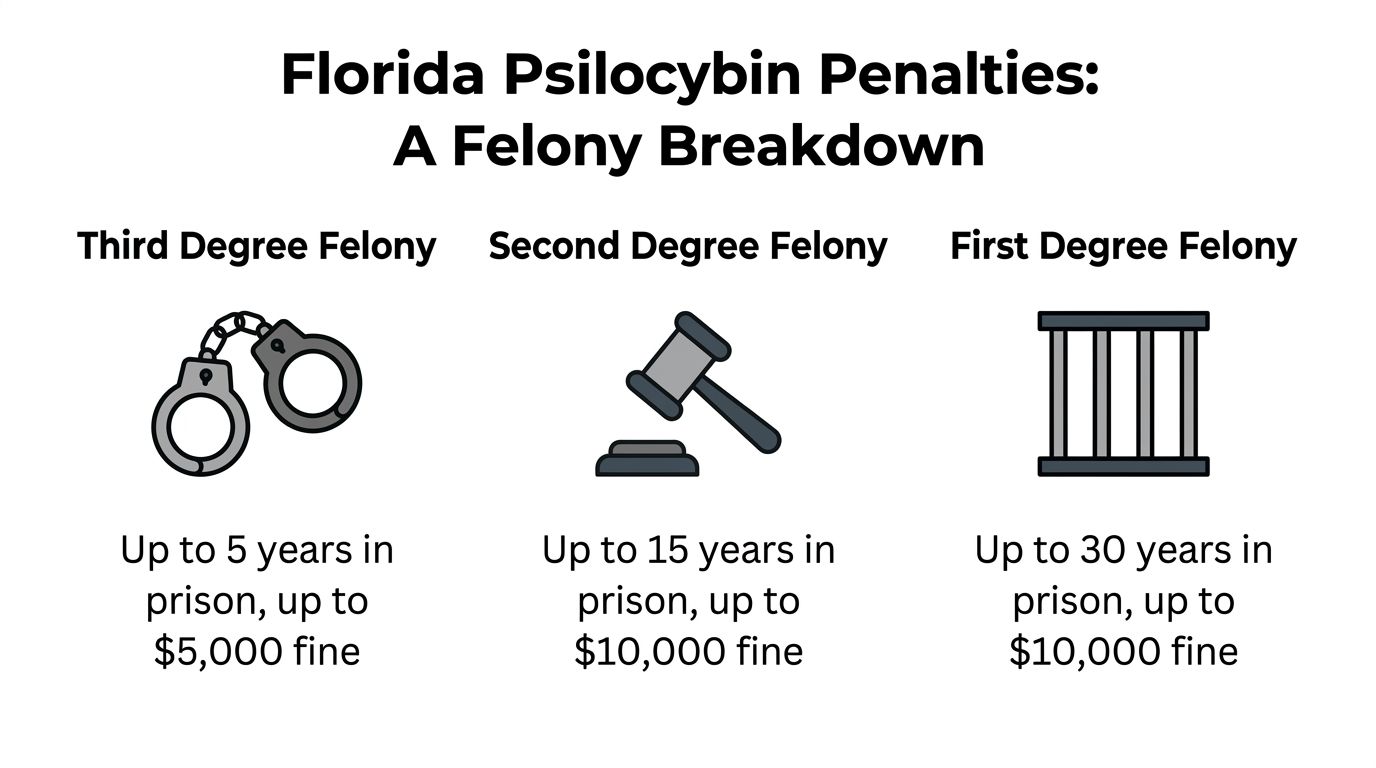
Side by side comparison
| Conduct | Florida classification | Maximum custody exposure | Maximum fine |
|---|---|---|---|
| Possession of actual psilocybin mushrooms or psilocybin | Third-degree felony | Up to five years in prison | $5,000 |
| Transport, import, sell, offer for sale, furnish, or give away psilocybin spores or mycelium capable of producing psilocybin mushrooms | First-degree misdemeanor | Up to one year in jail | $1,000 |
The felony figures above come from Marijuana Moment's reporting on Florida's psilocybin penalties. The spore and mycelium classification comes from Florida Statutes section 500.75, as noted earlier.
What these penalties mean in real life
A chart can make the law look neat. Real cases aren't neat. Arrest, booking, bond conditions, defense costs, and a criminal record issue can all become part of the problem even before a case is resolved.
The difference between a misdemeanor and a felony matters, but neither category should be treated casually.
Another point people miss is that wild mushrooms can create factual disputes about what someone knew. Florida legal analysis has noted that criminal intent can matter if a person did not know wild mushrooms contained a controlled substance, as discussed in this Florida psilocybin legal analysis. That nuance may matter in a defense context, especially with naturally occurring mushrooms, but it doesn't reduce the general risk of possessing suspected psilocybin mushrooms in Florida.
Risk assessment for ordinary readers
If you're trying to judge your exposure, keep the categories separate:
- Actual mushrooms: Highest direct criminal risk in this article.
- Spore or mycelium transactions: Still criminal exposure, even though the charge level is lower.
- Wild-foraged situations: Fact-sensitive and legally messy. People shouldn't assume innocence will be obvious to police or prosecutors.
How Florida's Psilocybin Laws Have Evolved
Florida's current posture makes more sense once you look backward. For a long time, the law around naturally occurring mushrooms carried a strange wrinkle that many people still repeat without the later context.
In Fiske v. State (366 So. 2d 423), a 1978 Florida Supreme Court decision, the court ruled that mere possession of psilocybin mushrooms was not illegal if the person did not know the mushrooms contained psilocybin, according to this discussion of Fiske v. State and its later limits. That decision became important because wild mushrooms can resemble legal varieties, and the state had to prove more than simple possession in some cases.
Why Fiske mattered
Fiske introduced a knowledge problem into mushroom prosecutions. If a person found mushrooms growing naturally, the state couldn't always assume criminal awareness from the mushrooms alone. That distinction made enforcement harder and left Florida with a legal gray area around naturally occurring hallucinogenic mushrooms.
For ordinary readers, the historical takeaway is simple. Florida once had more ambiguity than many people realize.
That's one reason old conversations about mushrooms in Florida can sound softer or more uncertain than current law does.
Why Fiske doesn't tell the full story anymore
The trap is assuming the old rule still describes the modern environment. It doesn't. Florida's later legal developments, including the 2025 spore law discussed above, pushed the state toward a much stricter framework.
So the older history is still relevant, but only in a narrow way:
- It helps explain the old gray area around naturally occurring mushrooms.
- It may still matter in some knowledge-based defenses involving wild mushrooms.
- It does not mean mushrooms are broadly legal now.
That's especially important for readers coming from places with different local cultures around psilocybin. Metro Mush, for example, operates in a very different environment in Michigan, and its page on magic mushrooms in Michigan reflects a setting that isn't comparable to Florida's statewide criminal framework.
Florida's history moved from ambiguity toward tighter control. If you rely on old folklore about what used to be allowed, you can misjudge present-day risk.
What This Means for Residents and Travelers
If you live in Florida, visit often, or drive in from another state, the safest conclusion is caution. Florida does not offer the kind of local decriminalization cushion that some people associate with places like Ann Arbor. Something tolerated, deprioritized, or openly sold somewhere else can become a serious legal problem once you're in Florida.
That matters most with transportation. If a person crosses into Florida with psilocybin products, the fact that the item came from a place with a looser local approach doesn't neutralize Florida law. The state looks at what the substance is and what conduct happened in Florida.
A practical way to think about your exposure
Ask the simple questions first.
- Are you in Florida right now? If yes, Florida law controls the immediate risk.
- Are you carrying actual psilocybin mushrooms? That puts you in felony territory.
- Are you moving, gifting, or ordering spores or mycelium? That now creates separate risk under Florida law.
- Are you relying on something you read years ago? That's a warning sign, not reassurance.
Some readers are also looking at the issue through a wellness lens rather than a criminal one. If that's you, it helps to separate therapeutic discussion from Florida legality. A page like this overview of psychedelic therapy may help explain the broader concept, but it doesn't change Florida's criminal rules on possession and related conduct.
When to get legal help
If police have already contacted you, searched your property, arrested you, or seized mushrooms, spores, or cultivation materials, the next move shouldn't be internet research alone. You should speak with a qualified Florida criminal defense attorney who handles controlled substance cases.
This article is for educational purposes only. It isn't legal advice, and it isn't a strategy guide for avoiding prosecution.
If you're based in Southeast Michigan and want to learn more about the local psilocybin environment where Metro Mush operates, visit Metro Mush. The site includes product information, educational pages, and location-specific context that can help adults understand how Michigan's situation differs from Florida's far stricter rules.