
You've probably seen some version of the headline already. Oregon made psychedelic therapy legal. Then the questions start. Is it medical treatment? Is it just a nicer name for recreational mushroom use? Do you need a diagnosis? Who's in the room with you? What happens if you get scared halfway through?
Those are the right questions.
A lot of writing about oregon psychedelic therapy stays at the law-and-policy level. That matters, but it doesn't help much when you're trying to picture the actual path a person takes from curiosity to a real appointment. Individuals exploring this option don't require additional buzzwords. They seek a plain-language map of how this system works in practice, what it asks of you, and where caution fits in.
Oregon's framework is unusual because it created a legal, supervised path for adults to use psilocybin in licensed settings without requiring a medical diagnosis. That makes it more accessible than many people expect, but it also means you need to understand the structure before you decide whether it's a fit.
Welcome to Oregon's New Era of Psychedelic Therapy
You read that Oregon allows psilocybin services, and your first reaction is probably practical, not philosophical. What would I do first? Who would I talk to? Is this closer to therapy, a wellness service, or something else entirely?
Those questions matter because Oregon created a legal path that is structured in a very specific way.
Voters approved Ballot Measure 109 in 2020, and Oregon later put the program into state law under ORS 475A. The result is a regulated psilocybin services model for adults in licensed settings. For someone who is curious but cautious, the easiest way to understand it is this: Oregon set up a process, not a storefront. You do not walk in, buy mushrooms, and leave. You move through preparation with a licensed facilitator, have your session at a licensed service center, and spend time afterward making sense of what came up.
If you are still getting oriented, this primer on what psychedelic therapy means in practice helps clarify the difference between an unsupported experience and a structured, supervised one.
What makes Oregon different
Oregon's model is built around guided use in a licensed setting. That single fact clears up a lot of confusion.
A facilitator is part of the process from the beginning. Their role is to help you prepare, support the administration session at the service center, and help with integration afterward, depending on the services offered. It works more like a carefully guided experience than a standard medical appointment, but it is also much more formal than using psilocybin on your own.
A helpful comparison is a trail system. Oregon did not open every path and tell people to figure it out alone. It marked a specific route, set rules for who can guide, and limited where the experience can take place.
Practical rule: If someone describes Oregon psilocybin as casual, quick, or almost friction-free, slow down and ask more questions.
Why people get confused
The confusion usually starts with language.
- Psilocybin services means Oregon's state-regulated adult-use program in licensed settings.
- Psychedelic therapy is a broader phrase that can refer to many kinds of guided psychedelic work.
- Medical treatment is a separate category, and Oregon's psilocybin program is not set up like a standard prescription-based healthcare path.
That difference can feel subtle at first, but it changes the whole experience. A person exploring Oregon psilocybin services is not starting with, “What diagnosis do I have?” They are often starting with, “Am I eligible, what are the safety steps, who will support me, and what will the day be like?”
That is the frame to keep in mind as you learn how this process works.
Psilocybin Services vs Ketamine Therapy in Oregon
When people say “psychedelic therapy in Oregon,” they may be talking about two very different routes. One is Oregon's state-regulated psilocybin services model. The other is ketamine-assisted therapy, which works through the medical system.
If you're deciding where to focus your research, this distinction matters more than almost anything else.
Psilocybin Services vs. Ketamine Therapy at a Glance
| Feature | Psilocybin Services (Measure 109) | Ketamine-Assisted Therapy |
|---|---|---|
| Legal basis | Oregon state-regulated psilocybin services under Measure 109 and ORS 475A | Medical treatment pathway |
| Substance used | Psilocybin | Ketamine |
| Diagnosis required | No medical diagnosis required for eligible adults | Typically tied to medical evaluation and treatment planning |
| Session environment | Licensed psilocybin service center with a licensed facilitator | Medical or clinical setting |
| Oversight body | Oregon Health Authority psilocybin services framework | Medical oversight system |
How the psilocybin path feels different
The Oregon psilocybin model is designed as supported adult use. The focus is not, “What disorder do you have?” The focus is more like, “Are you eligible, are there safety concerns, what are your intentions, and can this be done safely in a licensed setting?”
That alone changes the tone of the process. People who don't want to pathologize their interest often find that framework easier to approach. At the same time, it means you have to take more responsibility for clarifying your goals. You're not entering a standard diagnosis-treatment-prescription loop.
A good way to understand that difference is to look at how psilocybin works at a high level in the brain. This plain-language explainer on psilocybin effects on the brain is useful background before comparing it to ketamine models.
How the ketamine path feels different
Ketamine-assisted therapy usually starts from a more familiar healthcare structure. You're more likely to encounter clinical evaluation, medical decision-making, and treatment language from the first contact onward.
For some people, that feels reassuring. They want a doctor-led framework. They may also prefer a treatment that already sits inside established medical practice. Others find that model less attractive if they're seeking a broader experience centered on personal meaning, spirituality, or life reflection rather than a clearly medicalized intervention.
The best fit often comes down to one question. Do you want a non-medical supported-use experience, or do you want a conventional medical framework?
A simple decision filter
Use these questions to sort your options:
Do you want access without a diagnosis
Oregon psilocybin services may feel more aligned.Do you want a clinician-driven treatment plan
Ketamine therapy may feel more familiar.Is your goal symptom relief, exploration, or both
Your answer changes which environment may feel safer and more appropriate.Do you prefer state-regulated service centers or medical offices
The setting itself affects comfort, expectations, and logistics.
Neither path is automatically “better.” They're different containers for different needs. The mistake is assuming they're interchangeable.
What an Oregon Psilocybin Journey Actually Involves
You hear about Oregon's psilocybin program, read a little, and wonder what happens if you decide to try it. The clearest way to understand oregon psychedelic therapy is to follow the experience as a participant would. First contact. Preparation. The session itself. Then the part many people overlook, making sense of it afterward.
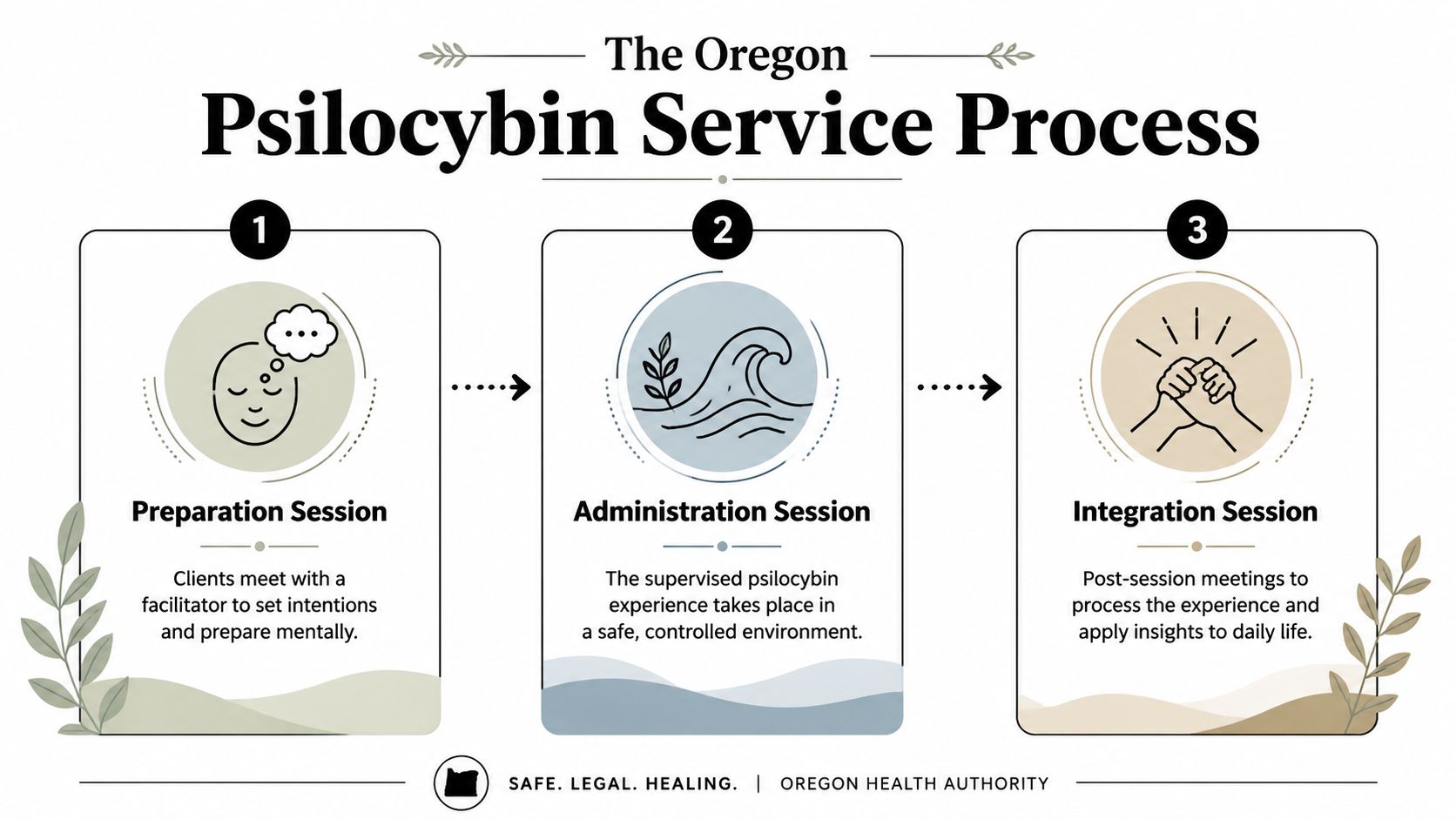
Oregon's model is built around three stages: preparation, administration, and integration. That structure matters because psilocybin services are not set up as a drop-in experience. They work more like a guided process with a beginning, a middle, and a follow-up, so you are not left alone to figure out a powerful experience on your own.
Step one usually starts with more conversation than people expect
Preparation is the on-ramp. Before the session day, you meet with a facilitator to talk through your history, your reasons for coming, your concerns, and the kind of support you may need. If you were expecting either a casual intake or a full psychotherapy hour, the actual experience usually sits between those two.
A good preparation session has a practical tone. You discuss what the setting will be like, how to respond if fear or grief shows up, and what helps you feel grounded. That matters because psilocybin can intensify whatever is already present. Preparation helps you enter the session with fewer surprises and better tools.
Some people arrive worrying that they need to say the right thing or have a perfect intention. You do not. It is enough to be honest about what brings you there and what feels uncertain.
Step two is the administration session
This is the actual psilocybin session at a licensed service center. The setting is designed to be controlled, quiet, and supportive. Under Oregon law, administration happens onsite with a licensed facilitator present, not at home and not in an informal social space. A legal review of Oregon's framework in the National Center for Biotechnology Information also describes the state's dosing limits, including a maximum of 50 mg for an individual administration session and lower limits in some group settings.
That detail can sound technical, but the logic is simple. The state is trying to match dose and supervision to the actual conditions in the room. More intensity calls for more support. More people can limit how much attention one facilitator can give at a time.
The session itself can feel calm, emotional, strange, meaningful, or unsettled. Sometimes all of those in one day. A facilitator is not there to steer your mind toward a scripted breakthrough. Their role is to support safety, orientation, and steadiness while the experience unfolds.
A cautious reader usually asks the same question here. What if I panic?
That concern is reasonable. Preparation reduces the chance of feeling blindsided, and the setting is built to lower avoidable stress. If you want plain-language guidance before a session, this article on how to avoid bad trips explains how mindset, environment, and dose awareness shape the experience.
A well-run session does not promise that every minute will feel comfortable. It gives difficult moments structure, support, and room to pass without turning into disorder.
Step three is integration
Integration is the part that helps the experience become useful instead of just memorable. After the acute effects wear off, you meet again to talk through what happened, what felt important, what still feels confusing, and what belongs in everyday life.
This can be a relief for people who worry that psilocybin services are all buildup and no follow-through. Integration slows things down. It helps you sort signal from noise.
Here is a simple example. Someone may leave a session with a strong feeling that they have been ignoring burnout, grief, or weak boundaries. Integration helps turn that impression into a concrete next step, such as changing a routine, having a needed conversation, or seeking more support. Without that step, it is easy to either dismiss the experience or turn it into a dramatic story that never becomes action.
That is what the Oregon journey often feels like in practice. Less like a single dramatic event, more like walking through a carefully held process, one stage at a time.
Are You Eligible and What Are the Safety Screenings
You read about Oregon's system, feel curious, and start wondering whether you could do this. The first answer is straightforward. You must be 21 or older.
After that, the process becomes more personal. Oregon's psilocybin services do not require you to bring a formal mental health diagnosis. The Oregon Health Authority explains that adults can access services without needing a doctor to certify a specific condition, which you can confirm in the state's psilocybin services information and client guidance.
That tends to surprise people. Many health-related systems begin with paperwork that tries to fit you into a category. Oregon starts in a different place. It asks whether this service is appropriate and safe for you now.
What screening is trying to do
A screening is not a test you pass by saying the right things. It works more like a safety check before a long hike. The goal is to spot conditions, medications, or recent experiences that could make the session less safe or less appropriate.
Facilitators are expected to review your health information and identify reasons to pause, refer out, or decline to proceed. Oregon's administrative rules describe screening and informed consent requirements for licensed psilocybin services, including situations where a client may need more evaluation or should not receive services in that setting, as outlined in the state's psilocybin services rules.
Who may be told to wait or seek a different kind of care
Some concerns come up often because they can raise risk during an altered state. Examples include a history of psychotic disorders, active suicidality, or certain medications that may create added safety concerns.
Lithium is one example people should disclose clearly. It has been widely discussed in psychedelic safety guidance because of seizure risk concerns in combination with classic psychedelics, and Oregon facilitators are expected to take medication review seriously.
Timing matters too. A person can be interested in psilocybin and still not be in the right window for it. Someone in the middle of a severe mental health crisis, recent destabilization, or intense life upheaval may need a different level of support than a service center can provide.
Questions you should expect
The conversation usually covers practical topics, not just abstract mental health labels:
Your mental health history
Past episodes of psychosis, mania, severe dissociation, or psychiatric hospitalization can change the risk picture.Current medications and supplements
The facilitator needs a real list, not a partial one.Your current level of stability
Sleep, substance use, panic, grief, recent trauma, and daily functioning all matter.Physical health factors
Cardiovascular issues, neurological concerns, and other medical conditions may affect whether the setting is appropriate.Support after the session
The day does not end when the effects wear off. You may feel open, raw, relieved, confused, or tired, and it helps to know what support you have in place.
One honest answer can change the plan, and that is the point.
What this often feels like as a client
A cautious person may worry that screening means being judged. In a good intake conversation, it feels more like sorting than judging. You are figuring out whether this setting matches your needs.
That distinction matters. If a facilitator says, “This may not be the right fit right now,” that is not a moral verdict or a sign that you failed eligibility. It usually means the system is doing what it was built to do, separate broad adult access from situations that call for more protection or a different kind of care.
A better question than “Can I get approved?”
Ask, “Is this a good fit for me, in this season of my life, with my history and my support system?”
That question usually leads to better decisions. It also makes the screening process easier to use well. If you feel pressure to hide a diagnosis, minimize symptoms, or leave out a medication so you can get through the door, pause there. The safest path starts with full disclosure.
Finding Your Guide Licensed Facilitators and Centers
Once you decide the Oregon model is worth exploring, the next challenge is more ordinary and more important. You need to find the right people.
A facilitator is the trained professional who works with you before, during, and often after the session. A service center is the licensed place where the administration session happens. Those roles connect, but they aren't the same thing.

A growing Oregon workforce has taken shape around this model. A published review reports a diverse facilitator base with specialties including trauma, consciousness exploration, and spirituality, and notes that nearly 8,000 legal sessions had taken place since launch, while prospective facilitators planned an average session price of $1,388, as described in this study of Oregon's facilitator ecosystem.
Start with the official directory
The safest first move is to use the Oregon Health Authority's official provider listings rather than relying on social media impressions or word-of-mouth alone.
You're looking for confirmation that both the person and the location are properly licensed. That may sound obvious, but it's easy for newcomers to focus on a provider's personality and forget that the legal structure matters just as much as the vibe.
What to ask a facilitator
A short consultation can tell you a lot if you ask direct questions.
What kind of clients do you work with most often
A facilitator who often works with grief, trauma, spirituality, or life transitions may approach sessions differently.How do you handle difficult moments during administration
You want a concrete answer, not reassuring slogans.How do you approach preparation
Some facilitators are more structured. Others are more open-ended.What does integration look like with you
This question reveals whether the work continues in a grounded way after the session.What kind of environment does the center offer
Comfort, privacy, and atmosphere affect how safe a person feels.
A short video overview can help you build a clearer mental picture of the facilitator role before you reach out.
Green flags and caution signs
A strong provider usually communicates clearly about boundaries, screening, preparation, and what they can't promise. They make room for your questions without trying to sell certainty.
Less reassuring signs are easier to miss. Be careful with anyone who acts as if every session is automatically healing, minimizes screening, or treats your anxiety as a marketing objection rather than a real concern.
You're not only choosing a legal provider. You're choosing the person who will shape the emotional container around one of the most vulnerable experiences you may ever have.
The Financial Realities of Costs and Insurance
A common moment goes like this. You finally understand what an Oregon psilocybin session involves, you find a center that feels trustworthy, and then you ask the price.
For many people, that is the first real pause.
Oregon's psilocybin services are usually paid out of pocket, and the total cost for an individual session can be high enough to change the decision from “Am I interested?” to “Can I realistically do this?” The Oregon Health Authority explains that psilocybin services are a regulated service model under state law, not a typical prescription benefit, which helps explain why standard insurance coverage is generally not part of the system, according to the Oregon Psilocybin Services program page.

Why the price is high
The bill covers much more than the mushroom product itself.
A center has to operate under Oregon's rules. A facilitator spends time on preparation, the administration session itself, and follow-up integration. The setting has to be licensed and staffed. In plain terms, you are paying for time, oversight, and a controlled environment, not just for access to psilocybin.
It helps to compare it to a guided wilderness trip rather than a bus ticket. The destination matters, but so do the route, the safety plan, and the person responsible for you along the way.
Why insurance usually does not help
This part confuses many readers because the service can sound medical, therapeutic, and highly structured.
But insurance systems usually reimburse established medical treatments delivered through familiar billing pathways. Oregon psilocybin services sit in a different category. They are legal under state law, yet they do not function like a standard covered office visit or pharmacy claim. For the person paying, that often means saving up, asking for a package breakdown, or deciding the timing just is not workable right now.
What may improve access
Some support options are starting to appear. The nonprofit Psilocybin Access Rights and Harm Reduction initiative describes the Psilocybin Access Fund, which opened applications in 2024 to help some Oregonians with service costs.
Researchers are also studying whether different delivery formats could reduce price. A published cost analysis in Frontiers in Psychiatry examined group psilocybin-assisted therapy and found that staffing time was a major driver of total cost. That matters because group models can sound cheaper at first glance, but the economics depend heavily on how much trained support each participant needs.
So the practical takeaway is simple. Lower-cost access may improve over time, but today it still takes planning.
Better questions to ask before you book
A price quote means very little unless you know what sits inside it.
Ask:
- How many preparation meetings are included
- How long is the administration session
- Is integration included, and if so, how many sessions
- Are there separate facility or product fees
- Do you offer payment plans, sliding scale spots, or fund-supported openings
Those questions help you compare centers the way you would compare surgery estimates or intensive retreat programs. The top-line number matters, but the structure matters too.
A clear quote can lower anxiety even when the cost stays high. It gives you something solid to evaluate, which is often what a cautious person needs most at this stage.
Safety Evidence and Your Next Steps
The strongest case for Oregon's model is that it created a legal framework where supervised psilocybin use could generate real-world safety data rather than speculation alone. The earliest picture is encouraging, but it's still early.
A balanced view matters here. Some Oregon studies and reports point to meaningful quality-of-life improvements in the short term, while also noting that some benefits can diminish by the 3-month mark, according to the Oregon Health Authority page on psilocybin services and related research. That same source says OHSU is conducting a 5-year study on 15,000 participants to better understand outcomes, especially for substance use disorders.
What a cautious reader should take from that
First, Oregon's system appears serious about safety, screening, and structured support. Second, promising does not mean settled. A good psilocybin experience isn't the same thing as a guaranteed lasting result.
That's not a flaw in the program. It's what honest emerging evidence looks like.
Your next steps if you're considering Oregon
A practical path looks like this:
Read Oregon Health Authority materials directly
Start with the official program pages and provider listings.Clarify your reason for going
Relief, exploration, grief work, spiritual curiosity, or life transition lead to different questions.Screen yourself before anyone else does
If you know you have major safety concerns, don't treat that as a technicality.Interview providers carefully
Choose for competence, fit, and clarity, not branding.Plan for integration before the session happens
The days after matter.
Oregon's real innovation isn't just legal access. It's the attempt to turn a high-intensity experience into a structured, accountable process that ordinary adults can navigate with eyes open.
If you continue your research, stay close to official sources and licensed providers. That keeps your understanding anchored in the official system rather than in internet folklore about psychedelics.
If you're exploring psilocybin more broadly and want to learn about products, education, and adult-use options in the Detroit and Ann Arbor area, visit Metro Mush. Their site is a useful starting point for adults who want to browse curated mushroom products, see current offerings, and stay informed about local availability.