You might be in that very common spot right now. You’ve heard friends talk about mushrooms. You’ve seen more open discussion around entheogenic plants in Michigan. Maybe you’re curious about a low-dose edible, or maybe you’ve had a stronger psychedelic experience before and want to understand what was happening in your head.
That mix of interest and caution is healthy.
Psilocybin gets talked about in two very different ways. One version is casual and oversimplified. The other is so scientific that it stops being useful for ordinary adults trying to make informed decisions. The truth sits in the middle. The brain science is real, but it becomes much easier to grasp when you translate it into everyday experience.
The phrase psilocybin effects on the brain can mean several things at once. It can mean the chemistry of how the compound starts working. It can mean the way brain networks communicate differently during a trip. It can also mean the emotional and cognitive changes some people notice afterward, from a shift in perspective to a period of greater openness or introspection.
This guide keeps those pieces connected. It explains the science in plain language, uses practical examples, and keeps one foot in research and the other in real-world use.
Understanding the Renewed Interest in Psilocybin
Psilocybin used to live mostly in the shadows of culture. People either treated it as dangerous, mystical, or something not worth discussing openly. That’s changed. Adults now hear about it from therapists, veterans, wellness-minded friends, and people who say a mushroom experience helped them see their life differently.
That shift didn’t come from hype alone. Researchers started looking more closely at how psilocybin affects mood, cognition, and brain connectivity. Instead of asking only whether people hallucinate, they’ve asked better questions. What changes in the brain during the experience? What parts return to baseline afterward? Which effects may matter for depression, trauma, or rigid patterns of thought?
Why ordinary adults are paying attention
For many people, the renewed interest isn’t abstract. It’s personal.
Someone might be dealing with repetitive, stuck thoughts. Another person may want a gentle, low-dose experience that feels more approachable than a full psychedelic journey. Someone else may already know the difference between a mellow edible and a potent strain, but still wants a clearer picture of why those experiences feel so different.
A few common reasons people start researching psilocybin include:
- Curiosity about mental effects: People want to know why colors, sounds, and thoughts can feel more vivid or emotionally charged.
- Interest in therapeutic potential: Many adults have heard psilocybin discussed alongside depression, anxiety, and trauma.
- Safer decision-making: First-timers want to avoid going in blind. Experienced users want a better framework for dose, setting, and product choice.
- A desire to separate fact from folklore: There’s a big difference between “I heard mushrooms rewire your brain” and understanding its true implications.
Practical rule: Curiosity is a good starting point. Blind confidence isn’t.
Why the science matters to everyday use
A lot of confusion comes from one simple mistake. People talk about psilocybin as if it has one single effect. It doesn’t.
The experience depends on dose, product type, mindset, environment, prior experience, and individual sensitivity. A low-dose chocolate can feel like a gentle shift in attention and mood. A potent dried mushroom strain can produce a much deeper interruption of normal thought patterns, including strong introspection and a temporary loosening of the usual sense of self.
Research helps explain those differences without pretending every experience is identical. It gives us a map, not a script.
That’s the useful lens here. Not “mushrooms are good” or “mushrooms are bad,” but a grounded question: what happens in the brain, and how might that show up in real life?
How Psilocybin Interacts with Your Brain Chemistry
At the chemical level, psilocybin doesn’t do the main job by itself. Think of it as a package your body opens first.
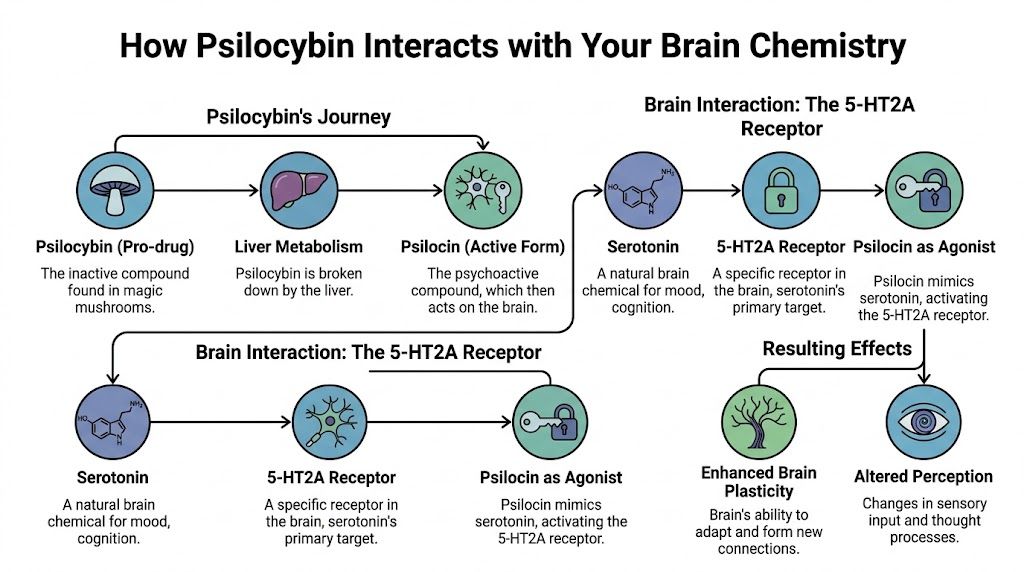
When you consume psilocybin, your body converts it into psilocin, which is the form that actively interacts with the brain. A simple way to picture it is this: psilocybin is the boxed product, and psilocin is the working tool inside.
The key and lock model
Psilocin is often easiest to understand as a key that fits certain locks in the brain. Those locks are serotonin receptors, especially the 5-HT2A receptor.
Serotonin is one of the brain’s natural chemical messengers. It helps regulate mood, perception, and aspects of cognition. Psilocin resembles serotonin closely enough that it can activate some of the same receptor systems, especially 5-HT2A. That receptor shows up in brain regions involved in meaning-making, sensory processing, and higher-order thinking.
When people ask why mushrooms can change perception so dramatically, this receptor is a big part of the answer.
Why that receptor matters
Activating 5-HT2A doesn’t just “turn on visuals.” It starts a much wider cascade.
That cascade helps explain why a psychedelic experience can affect multiple layers of consciousness at once:
- Perception can shift: Colors may seem richer. Music can feel immersive. Familiar objects can appear newly interesting.
- Thought patterns can loosen: Mental loops may break open. New associations can form more easily.
- Emotion may feel amplified: Some people feel wonder, grief, relief, tenderness, or fear more directly than usual.
- Attention can move differently: Instead of staying tightly organized around daily tasks, the mind may become more fluid and exploratory.
This is also why two products with the same broad ingredient category can still feel very different in practice. Potency, total dose, and how fast the effects come on all influence how strongly this receptor-driven cascade gets expressed. If you’ve browsed different Psilocybe cubensis strain profiles, you’ve already seen that users often describe meaningful differences in intensity and character.
What “brain disruption” really means
The word disruption can sound alarming, but in neuroscience it often just means a temporary departure from normal patterns.
A peer-reviewed paper in PMC explains psilocybin’s acute desynchronization of brain activity and reports that its functional connectivity changes were over three times greater than those from methylphenidate, while also reducing network modularity and increasing chaotic neuronal firing in regions such as the anterior cingulate cortex. In plainer language, the brain becomes less neatly segmented and more dynamically mixed during the experience.
That sounds technical, but the lived version is familiar to many users. Your ordinary mental filing system stops feeling so rigid. Boundaries between thoughts, feelings, memories, and sensory impressions can blur.
When people say a trip felt “more open” or “less filtered,” they’re often describing this change in brain organization, not just stronger emotion.
Why this can feel gentle or overwhelming
Here’s where beginners often get confused. If the same core chemistry is involved, why can one experience feel subtle and another feel life-altering?
The answer is intensity.
A lower dose may nudge those receptor systems enough to create mild sensory enhancement, a softer inner monologue, or a slightly more flexible mood state. A higher dose can recruit much broader changes, making ordinary mental structure feel temporarily less stable. That’s often where people report deep introspection, unusual symbolism, or a sense that their usual “self” has gone quiet.
A useful way to think about it is a dimmer switch, not an on-off switch.
What chemistry can’t predict on its own
Chemistry starts the process, but it doesn’t fully determine the outcome. Two people can take similar products and have different experiences because the brain isn’t a machine with one identical response. Personal history, emotional state, expectations, and surroundings all shape how those neurochemical effects are interpreted.
That’s why psilocybin science matters most when it’s paired with common sense. The receptor story explains the ignition. It doesn’t write the whole journey.
Reshaping Brain Communication Networks
If brain chemistry is the spark, brain networks are the traffic system that changes next.
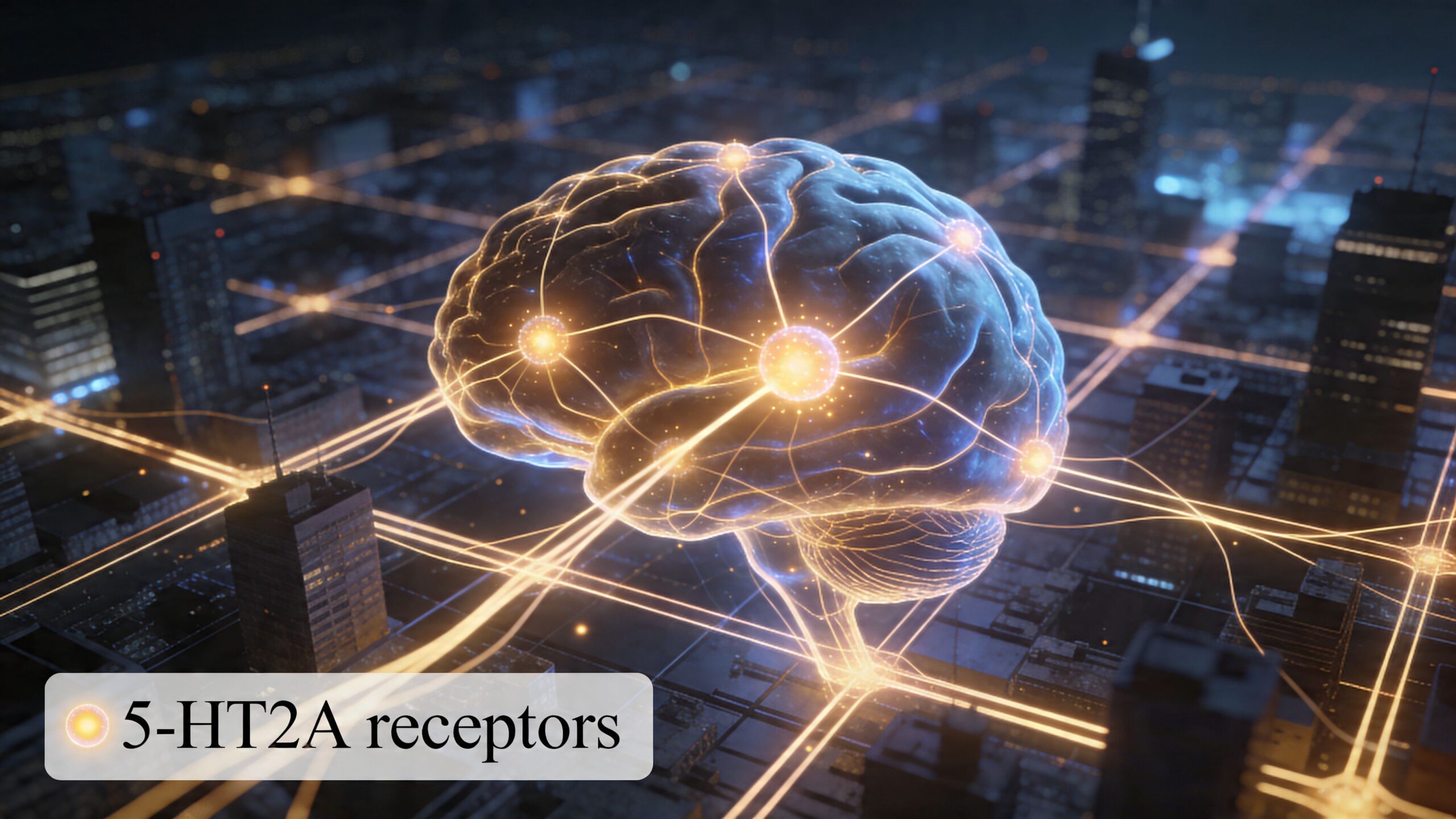
A good way to picture this is a city at rush hour. On a normal day, certain highways carry the same kinds of traffic over and over. The routes are familiar, efficient, and repetitive. Under psilocybin, some of those major routes become less dominant, and communication starts moving along less predictable paths.
The role of the default mode network
One of the most discussed systems here is the default mode network, often shortened to DMN.
You can think of the DMN as part of the brain’s internal autopilot. It’s heavily involved in self-referential thinking. That includes the running story in your head about who you are, what happened yesterday, what might happen tomorrow, and how everything relates back to “me.” In everyday life, that network helps create continuity. But when it becomes too rigid, it may also support rumination and repetitive thought loops.
Under psilocybin, that usual organization loosens.
A report summarizing neuroimaging findings in News Medical describes reduced brain network modularity under psilocybin. It also notes that while the DMN re-establishes itself after the acute effects wear off, small differences, especially in DMN-hippocampus connectivity, can persist for up to three weeks.
What reduced modularity feels like
“Reduced modularity” is not everyday language, so here’s the practical version.
Normally, different brain systems stay in their lanes. Sensory systems, memory systems, emotional systems, and executive systems each have their preferred jobs. Psilocybin temporarily reduces the usual separation between those systems. That can make the mind feel less compartmentalized.
People may experience that as:
- Unusual connections: A memory suddenly links with a piece of music, a bodily sensation, or an insight.
- A softer sense of self-boundary: Thoughts don’t always feel like they’re being narrated by the usual inner voice.
- Time distortion: Minutes can feel expanded or strangely elastic.
- Greater emotional permeability: Feelings may come forward without the usual defenses.
This is one reason a potent strain can feel qualitatively different from a lighter edible. The stronger the network-level shift, the more likely you are to notice not just brighter perception, but a real departure from ordinary mental structure.
Why “ego dissolution” makes more sense in this framework
The phrase ego dissolution can sound dramatic or mystical, but the network model makes it easier to understand. If the systems that normally keep your self-story coherent become less dominant for a while, the sense of being a tightly bounded, constantly narrating self may soften too.
That doesn’t always mean losing control. Sometimes it feels more like getting a break from the usual internal commentator.
For some people, that’s relieving. For others, especially if they’re unprepared, it can feel disorienting.
The following overview helps show how researchers and educators discuss these changes visually and conceptually:
What returns and what may linger
Most of the dramatic network changes are temporary. People generally come back to ordinary consciousness as the acute effects fade. The main highways reopen, so to speak.
But the research above suggests some subtle changes don’t vanish immediately. The hippocampus is deeply involved in memory and context. When its connection with the DMN stays somewhat altered for a period after the experience, that may help explain why some people continue reflecting differently on themselves or their past for days or weeks.
The key point isn’t that psilocybin permanently breaks the brain. It’s that it can temporarily reorganize communication patterns, and some of the aftereffects may outlast the trip itself.
A practical translation for users
This network model helps decode the difference between “I felt lightly uplifted” and “I had a profound experience.”
If someone takes a very modest amount, they may notice more sensory vividness than identity-level change. If they take a strong dose of a potent mushroom, they’re more likely to encounter the deeper network-level effects associated with introspection, symbolic thinking, and a temporary loosening of self-structure.
That’s why dose and product choice matter so much. They don’t just change how strong the visuals are. They change how far the brain moves away from its normal communication pattern.
The Psychological and Therapeutic Effects of Psilocybin
The most important question for many adults isn’t whether psilocybin changes the brain. It’s how those brain changes show up in lived experience.
That translation matters. A shift in connectivity only becomes meaningful when you connect it to things people experience, such as relief from repetitive thoughts, stronger emotional access, a fresh perspective on relationships, or a feeling that old mental grooves aren’t gripping quite as hard.
What the experience can feel like in real time
Acute psilocybin effects often blend several layers at once. Sensory changes are the most obvious to outsiders, but many users say the deeper shift is cognitive and emotional.
A person may feel more aware of background emotions that usually stay buried. They may notice a memory from years ago suddenly carrying new meaning. Some people describe a widening of perspective, where everyday worries seem less central for a while.
Common psychological effects during the experience can include:
- Heightened emotional access: Feelings may arrive faster and with less avoidance.
- Novel thought patterns: Problems can seem less fixed, and new interpretations may appear.
- Increased symbolic thinking: Music, images, or ordinary events may feel unusually meaningful.
- Greater receptivity: Some people feel more compassion toward themselves or others.
- Vulnerability to anxiety: If the setting feels unsafe, that same openness can tip into fear or overwhelm.
That last point matters. The same loosening of mental structure that can feel healing in one environment can feel destabilizing in another.
What the research says about cognition
Psilocybin gets framed both as a mind-expander and as something that scrambles cognition. The evidence suggests a more nuanced picture.
A systematic review on psilocybin and cognitive function found that global cognitive function often remains unchanged, while studies reported improvements in sustained attention, working memory, and executive function, particularly in patients with treatment-resistant depression. The same review also noted that research has primarily focused on macrodoses, with 85% of studies using doses ranging from 45 μg/kg to 30 mg/70 kg.
That helps clear up a common misunderstanding. Psilocybin doesn’t appear to improve every kind of cognition across the board. Instead, the findings suggest that certain domains may improve in some settings, especially when someone begins from a place of depression-related rigidity or impairment.
Why emotional processing may change
Some of the most interesting effects are emotional rather than intellectual.
If the brain becomes less locked into familiar predictive loops, a person may respond to their own thoughts and memories with more flexibility. That may be part of why some people feel they can approach painful material with less automatic defensiveness. Research has also pointed to positive effects on emotional processing, especially in people with treatment-resistant depression.
A useful analogy is a snow-covered hill. Repetitive thoughts can become sled tracks. The more often the sled goes down the same groove, the deeper it gets. Psilocybin may temporarily soften the snow. It doesn’t erase the hill, but it may make new paths possible.
Some people don’t come away with “answers.” They come away with more room to think, feel, and respond differently.
Where therapeutic hope fits, and where caution belongs
The therapeutic conversation around psilocybin is compelling because many mental health struggles involve rigidity. Depression can trap people in repetitive self-criticism. Trauma can lock attention onto threat. Anxiety can make the future feel closed and predetermined.
In that context, a temporary increase in psychological flexibility is meaningful. It offers a possible mechanism for why some people report relief, renewed openness, or a shift in self-perception after a well-supported experience.
Still, it’s important not to turn that into a blanket promise.
Psilocybin is not emotionally neutral. It can surface grief, confusion, fear, and unresolved material. For some people, that’s part of the value. For others, especially without preparation or support, it can be too much.
A simple way to connect brain changes to felt changes
This chart can help tie the science to real experience:
| Brain-level change | What a person may notice |
|---|---|
| Less rigid self-focused network activity | Relief from mental looping, softer self-judgment |
| More cross-talk between systems | Unexpected insights, creativity, emotional mixing |
| Increased openness to internal material | Strong memories, tears, tenderness, or catharsis |
| Short-term disruption of usual filters | Wonder, confusion, fear, awe, or all of them together |
For a cautious first-time user, this often means the goal shouldn’t be “go as deep as possible.” A more useful goal is to choose an intensity that matches your readiness.
For an experienced user, the takeaway is different. Stronger experiences may offer more profound introspection, but they also ask more of your nervous system, your environment, and your preparation.
Guiding Your Experience with Doses and Products
When people talk about psilocybin as if every product works the same way, they miss the practical side of the experience. The format matters. Potency matters. Your intent matters too.
A low-dose edible and a potent dried mushroom strain may both contain psilocybin, but they often lead to very different kinds of experiences. One may gently loosen the edges of ordinary thinking. The other may push you into a far more immersive shift in perception and self-awareness.
Comparing gentle entry points and stronger routes
A practical way to think about products is to group them by the kind of experience they’re more likely to support.
| Product type | Often suited for | Typical user goal |
|---|---|---|
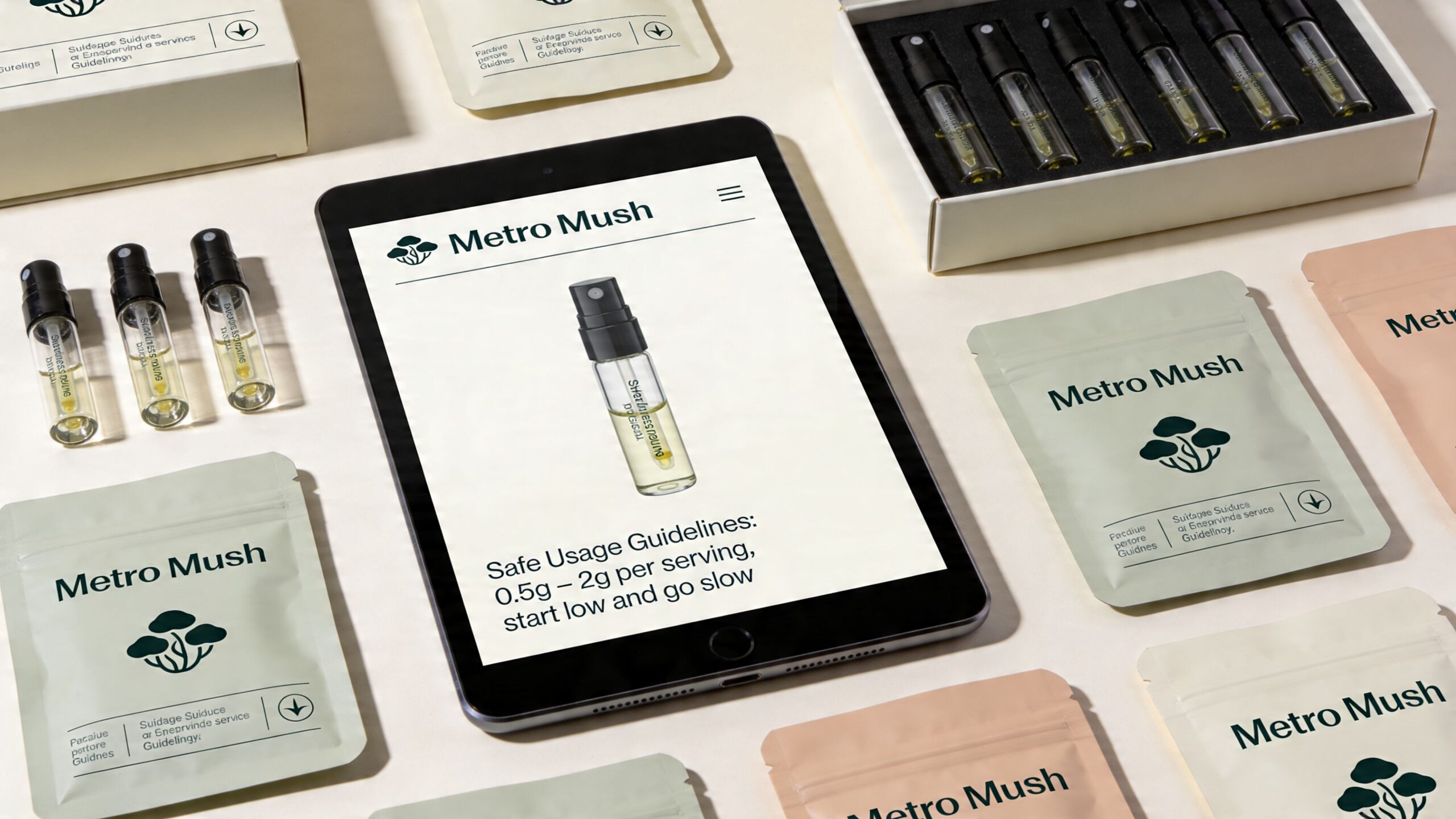
| Low-dose edible such as a Moon Bar | Newer or cautious users | Ease in gradually, feel manageable changes |
| Chocolate bars or drinks at moderate intensity | Users with some comfort level | Blend convenience with a more noticeable shift |
| Potent dried strains such as Penis Envy | Experienced users | Deep introspection, stronger perceptual and psychological effects |
That doesn’t mean one category is “better.” It means each one asks something different from you.
What a low-dose product often feels like
For many adults, a low-dose edible is the most approachable place to begin. The appeal isn’t just convenience. It’s that the experience may stay close enough to baseline that you can observe how your mind and body respond without feeling swept away.
People often choose this route when they want:
- A gentler onset: They want to test sensitivity rather than commit to a major experience.
- Less intensity around self-boundary shifts: They’re curious about mood and perception, not ego dissolution.
- More predictable structure: Pre-portioned formats can help people avoid the “too much, too fast” mistake.
If that’s your starting point, a guide on how to microdose with magic mushrooms can help frame the difference between subtle experimentation and a full psychedelic dose.
What stronger strains can bring
A potent strain like Penis Envy tends to attract people who already know they want more than a slight nudge. These experiences are more likely to involve the deeper network changes associated with immersive introspection, altered sense of time, emotional release, and a much looser grip on ordinary mental structure.
That can be meaningful. It can also be demanding.
The key difference is not just “more visuals.” Stronger strains are more likely to affect the whole architecture of the experience:
- perception
- emotional intensity
- body load
- inner narrative
- sense of self
Preparation ceases to be optional.
Why product choice changes the emotional tone
The brain doesn’t experience dose in a vacuum. The same person may respond differently to a low edible taken on a relaxed afternoon than to a potent mushroom strain used with the expectation of a breakthrough.
Research discussed by the Allen Institute on psilocybin-related prefrontal rewiring describes neuron-type-specific synaptic rewiring and reduced amygdala modulation of the visual cortex in response to threats. That gives a plausible mechanism for why psilocybin is being discussed in relation to anxiety and PTSD, while also reminding us that emotional processing is part of the experience, not a side note.
A product isn’t just a delivery method. It shapes how much room the experience has to reorganize your thoughts, emotions, and attention.
A simple decision frame
If you’re choosing between an approachable edible and a stronger dried product, ask yourself these questions:
Do I want to observe, or do I want to surrender?
Observation fits lower-intensity formats better. Surrender belongs to stronger ones.Am I comfortable with emotional unpredictability?
Stronger doses are more likely to bring unresolved material forward.Is my setting built for depth?
A casual environment may work for a light experience. It’s usually a poor match for a powerful one.Do I have support if the experience turns challenging?
This matters for everyone, but especially for first-timers and anyone carrying stress or trauma.
For many people, the wisest move isn’t chasing intensity. It’s matching the product to the kind of inner experience they’re prepared to have.
Important Safety and Interaction Guidelines
The safest way to approach psilocybin is to respect that it can change perception, emotion, and self-experience in ways that are not fully predictable. That doesn’t make it uniquely dangerous in every case. It does mean casual overconfidence is a poor strategy.
Safety begins before the experience starts. It includes who should avoid psilocybin, what other substances may change the experience, and whether your setting supports calm rather than chaos.
Who should be especially cautious
Psilocybin is not a fit for everyone. People with a personal or family history of psychosis should approach with extreme caution or avoid it entirely. The same goes for people in a highly unstable mental state, people already struggling to tell internal experience from external reality, or those who are under major acute stress and hoping mushrooms will “fix” it.
A few situations where extra caution is wise:
- Psychosis risk: If psychotic disorders are part of your personal or family history, psilocybin may not be appropriate.
- Severe current instability: Intense panic, crisis, or recent major upheaval can make a hard experience more likely.
- Pressure to perform: Taking psilocybin to impress friends or “force” a breakthrough is a bad setup.
- No safe environment: A crowded, demanding, or unpredictable setting can amplify distress.
Drug interactions and combinations
People often ask about combining psilocybin with other substances, especially cannabis or prescription medications. The honest answer is that combinations can change the emotional and perceptual tone of the experience, sometimes sharply.
Cannabis can intensify the experience for some users. That may sound appealing until it pushes anxiety, confusion, or bodily unease higher than expected. A person who feels steady on psilocybin alone may feel much less steady after adding cannabis.
SSRIs are discussed frequently because some users report muted psychedelic effects while taking them. That doesn’t make the combination simple or risk-free. Medication questions belong with a qualified medical professional who understands your history.
Safety improves when you remove variables, not when you stack them.
If you want a grounded harm-reduction framework, this guide on how to avoid bad trips is a useful practical companion.
Set and setting are not optional
“Set and setting” can sound like a cliché until you’ve seen how much it matters.
Set means your mindset. Are you calm, exhausted, grieving, resentful, curious, or terrified? Setting means your environment. Are you somewhere quiet, familiar, and supportive, or are you in a place that asks you to stay socially composed while your inner world is changing?
People sometimes focus so hard on dose that they ignore the container around the dose. That’s backwards. A moderate experience in a safe environment is often easier than a smaller one in a stressful or chaotic setting.
A basic checklist helps:
- Mindset check: Don’t go in during a crisis if you can avoid it.
- Environmental check: Choose a place where you can sit, lie down, cry, laugh, or be quiet without pressure.
- Support check: Have a sober, trusted person available for stronger experiences.
- Obligation check: Clear the day. Don’t stack a psychedelic experience on top of responsibilities.
Why caution still matters after the trip
Even after the acute effects fade, the story may not be finished.
An NIH summary on how psychedelic drugs alter brain connectivity notes that while many acute effects on the default mode network mostly normalize in days, reductions in DMN-hippocampus functional connectivity can last for three weeks or more, and the long-term implications for memory and self-perception are still under investigation.
That doesn’t mean people should panic after using psilocybin. It means humility is appropriate. If an experience feels meaningful or disorienting afterward, give it space. Journal. Rest. Talk to someone grounded. Avoid rushing into repeated high-intensity sessions because the first one felt profound.
The safest mindset to carry forward
The most reliable harm-reduction habit is simple. Treat psilocybin like something that deserves preparation, not improvisation.
That means respecting timing, company, emotional readiness, and combinations. It means understanding that a challenging experience isn’t always caused by “bad mushrooms.” Often it comes from poor fit between the dose, the setting, and the person taking it.
Your Path to Responsible Psilocybin Exploration
The clearest way to understand psilocybin effects on the brain is to hold two truths at once. First, the science is real. Psilocybin changes receptor activity, alters communication between brain networks, and can affect how people think, feel, and process their own lives. Second, those effects are never just abstract neuroscience. They become real through the dose, the product, the setting, and the person.
That’s why responsible exploration starts with matching intention to intensity.
A low-dose edible may be enough for someone who wants to learn how their mind responds without entering a fully immersive state. A potent strain may be more appropriate for an experienced user who understands that deeper introspection also means deeper unpredictability. Neither choice is automatically wise or unwise on its own. The fit is what matters.
It also helps to stay honest about what research can and can’t say. There are promising findings around emotional processing, attention, working memory, executive function, and flexibility in certain clinical contexts. At the same time, there are still open questions about lasting brain changes, individual variability, and who may be more vulnerable to difficult outcomes.
A grounded path usually looks like this:
- Learn before you dose
- Start lower than your ego wants
- Choose a setting that reduces pressure
- Avoid unnecessary substance combinations
- Give the experience time to settle before repeating it
Psilocybin can be insightful, beautiful, unsettling, clarifying, or all of those in one day. Knowledge doesn’t eliminate that complexity. It helps you meet it with better judgment.
If you’re an adult in Southeast Michigan looking for a thoughtful place to continue learning, browse Metro Mush for product options, educational resources, and local access to dried mushrooms, chocolates, drinks, and community updates.