
You might be reading this because you're curious, excited, and a little uneasy. Maybe you've heard beautiful stories about insight and connection, then also heard someone say a trip “went bad” and spiraled into fear. That mix of curiosity and caution is healthy.
A difficult psychedelic experience usually doesn't come out of nowhere. In most cases, there are understandable causes. When you know what they are, the whole topic becomes less mysterious and less frightening. You can prepare better, spot risk earlier, and respond more calmly if things get hard.
The short version is this. What causes bad trips is rarely just one thing. It's usually a combination of mindset, environment, dose, personal vulnerability, and one factor people often overlook: resistance. That last piece matters because some people do many things “right” and still run into trouble when they start fighting the experience itself.
Understanding a Challenging Psychedelic Experience
A “bad trip” is a common phrase, but it can be misleading. It makes the experience sound simple, like there are only two outcomes: good or bad. Real life is messier than that.
A more useful phrase is challenging experience. That includes moments of intense fear, confusion, panic, paranoia, emotional overwhelm, or the sense that you're losing control. Those states can feel very real and very serious in the moment.
What it often feels like
For one person, a challenging trip might begin with racing thoughts. For another, it's a body sensation that suddenly feels alarming. Someone else may become convinced that a temporary feeling will last forever.
Common examples include:
- Anxiety that snowballs: A small moment of discomfort turns into “Something is wrong.”
- Paranoia: Neutral sounds, expressions, or thoughts start to feel threatening.
- Time distortion: A few difficult minutes can feel endless.
- Loss of control: Changes in perception or identity can feel frightening if you weren't ready for them.
A challenging trip often feels dangerous before it actually is. That difference matters, because panic can grow when you treat every strange sensation as proof of catastrophe.
Why the term matters
Calling it a challenging experience doesn't minimize it. It puts the focus where it belongs. On what's happening, why it may be happening, and what helps.
That shift is useful for harm reduction because shame doesn't help anyone. If a person thinks “I failed” or “I broke my brain,” fear gets stronger. If they think “I'm overwhelmed, this is temporary, and there are reasons this happens,” they have a better chance of settling.
Not every hard moment is the same
Some difficult moments pass with reassurance, quieter music, and a reminder to breathe. Other situations are more serious and need outside help. Both can fall under the broad label of a bad trip, which is why the term can confuse people.
The most practical approach is to stay curious. Ask: What am I feeling? What might be amplifying it? Am I physically safe right now? That mindset turns a vague fear into something you can work with.
The Core Trio of Causes Set Setting and Dose
A person takes a dose that felt fine for a friend, sits down in a cluttered apartment with two people they do not fully trust, and tries to push past a week of bottled-up stress. The substance did not create all of the danger by itself. It amplified what was already in the room and in the mind.
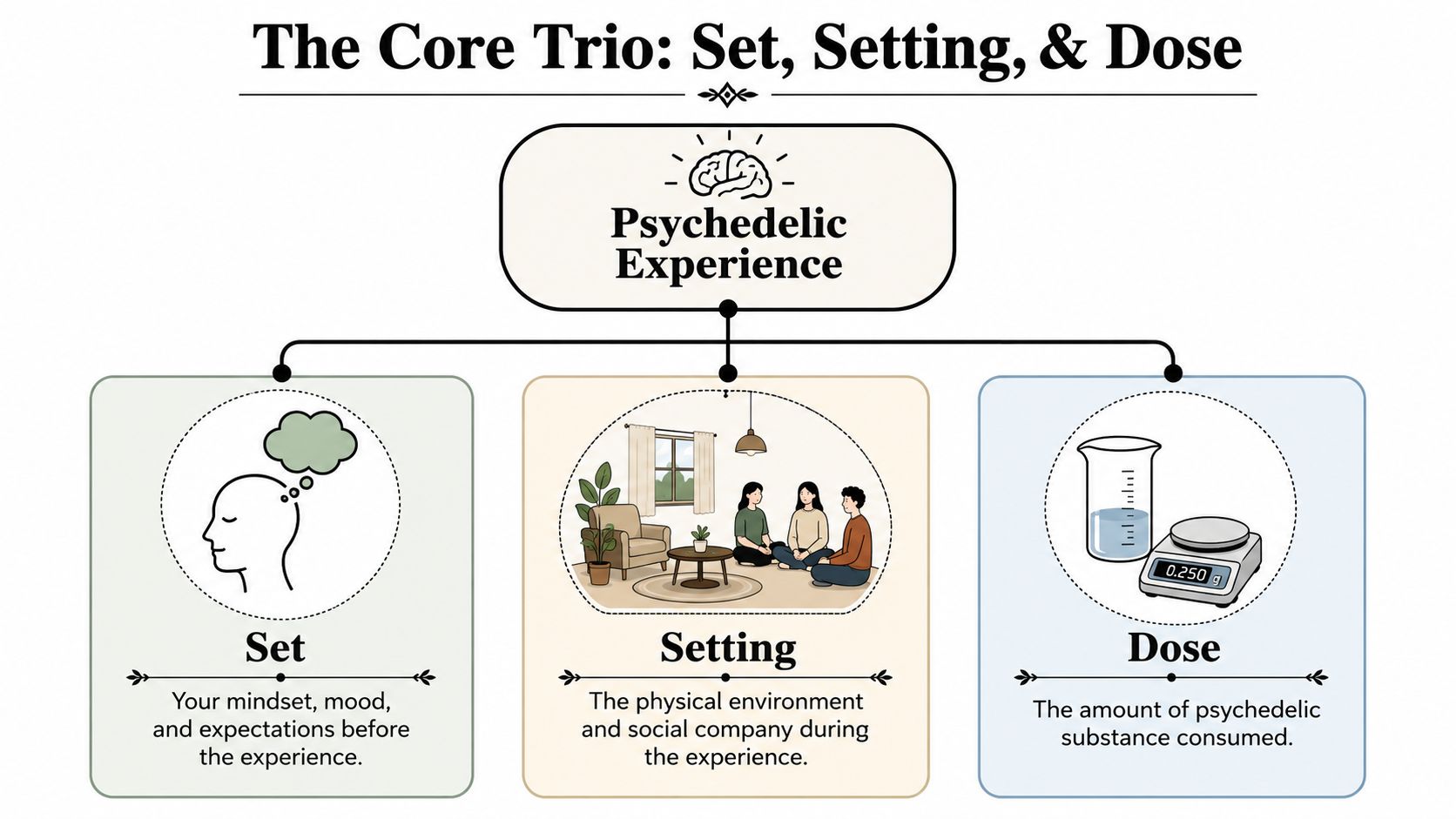
Set, setting, and dose are the three variables that shape how a trip unfolds. They work like weather, terrain, and speed on a drive. If one factor gets harder to manage, the others matter even more. And if resistance enters the picture, such as trying to suppress fear, force insight, or control every sensation, trouble can escalate fast even in a decent environment.
Set means your inner starting point
“Set” refers to the state of mind you bring with you. Mood, expectations, recent stress, unresolved conflict, sleep, and intention all belong here.
If someone goes in anxious, grief-stricken, exhausted, or secretly hoping the experience will fix everything in one night, the mind often has less flexibility when intense effects begin. Preparation matters here too. Going in without much reflection, without emotional support, or right after a major life disruption can leave a person more reactive and easier to overwhelm.
A simple check-in helps: What am I already carrying today, and how do I usually respond when I feel out of control?
That second question matters because set is not just about whether you feel calm. It is also about whether you tend to resist discomfort when it shows up.
Setting means the nervous system's surroundings
“Setting” is the environment around you. The space, the sounds, the people present, the social tone, and whether your body reads the situation as safe.
A familiar room with soft lighting, water nearby, and one trusted sober person can lower the number of things your brain has to monitor. A loud party, tension between friends, surprise visitors, or an unfamiliar place does the opposite. Under psychedelics, ordinary signals can feel loaded with meaning. A small awkward comment or a slammed door can suddenly seem enormous.
Here is a practical way to judge risk:
| Factor | Lower-risk version | Higher-risk version |
|---|---|---|
| Place | Quiet, familiar, comfortable | Crowded, loud, unpredictable |
| People | Trusted, calm, supportive | Strangers, conflict, judgment |
| Preparation | Plan in place, basic supplies ready | No plan, no sitter, uncertainty |
Good setting does not guarantee an easy trip. It does give difficult moments less fuel.
Dose changes more than strength
Dose is often treated like a volume knob. In practice, it can behave more like a threshold. A small increase may produce a much larger jump in intensity, confusion, or loss of orientation than a person expected.
Research published in Scientific Reports on predictors of challenging psilocybin experiences found that high doses were strongly associated with anxiety, panic, and distress in some participants. That fits what harm reduction workers see in real life. People usually struggle most when intensity rises faster than their ability to accept and make sense of it.
Uncertainty counts too. If you do not know the potency, the source, or the actual amount, you are not working with a small detail. You are adding a major unknown.
If you want more background on why shifts in intensity can change perception so sharply, this overview of how psilocybin affects the brain gives useful context.
Why the trio is only part of the story
Set, setting, and dose explain a lot. They do not explain everything.
Two people can take a similar amount in the same room and have very different experiences. One gets frightened by a wave of ego loss and starts mentally fighting it. The other notices the same wave, feels scared, but allows it to pass through without treating it as a threat. That difference in response often shapes whether discomfort becomes panic.
So yes, start with the trio. Then add one more question: If this experience becomes intense, will I try to control it, or will I let it move while I stay grounded and safe?
Your Brain on a Bad Trip Explained
Sometimes people think a bad trip is “all in your head” in the dismissive sense. That isn't accurate. It is in your head in the literal sense, because your brain is doing real work under the influence of a powerful substance.

Serotonin changes perception
Psilocybin acts as a serotonin agonist. That matters because serotonin systems help shape mood, meaning, and perception. This is part of why ordinary thoughts, feelings, and sensations can suddenly feel amplified or symbolically important.
That doesn't automatically create panic. It does make the mind more sensitive, more fluid, and sometimes less anchored to everyday reference points. If you want a broader overview of these mechanisms, this guide on psilocybin effects on the brain gives useful background.
Glutamate may press the panic button
A more specific piece of the puzzle involves glutamate in the medial prefrontal cortex, often shortened to mPFC. Verified background provided for this article states that increased glutamate levels in the medial prefrontal cortex are a primary neurobiological predictor of bad trips, specifically correlating with negative ego dissolution and increased anxiety, as described in this discussion of the mPFC glutamate response.
One plain-language way to understand this is to think of glutamate as a strong “go” signal in the brain. In some people, in some conditions, that signal can intensify stress circuits instead of producing curiosity or openness.
Why fear can feel so convincing
When perception is altered and the brain's alarm systems are more active, small concerns can become huge. A normal bodily sensation may feel ominous. A passing thought may seem absolute. A temporary loss of ego boundaries may feel like permanent collapse.
That's part of why reassurance matters so much. A person in distress isn't necessarily being irrational in a casual sense. Their brain may be generating a very forceful threat experience.
- Body sensations become louder
- Thoughts may loop
- Meaning gets amplified
- The ability to reality-check can weaken
When someone says, “I know this sounds strange, but it feels real,” believe the second half of that sentence. It does feel real to them.
Understanding the brain side of a difficult trip can reduce self-blame. It reminds you that prevention isn't about toughness. It's about reducing conditions that push the nervous system toward overload.
The Psychology of Resistance Why Fighting Backfires
This is the part many guides leave out. Set, setting, and dose matter. But they don't explain everything. One person can have a hard wave and move through it. Another can hit the same kind of wave and spiral. The difference is often resistance.
Verified narrative analysis suggests that people who fight the experience or try to control ego dissolution are more likely to experience acute distress, indicating that the reaction to fear can be a primary cause of a bad trip, as discussed in this narrative analysis of difficult psychedelic experiences.
What resistance looks like
Resistance doesn't always look dramatic. It can be subtle and internal.
It might sound like:
- “I need this to stop right now.”
- “I can't feel this.”
- “I have to stay in control.”
- “If I let go, something terrible will happen.”
Those thoughts are understandable. The problem is that psychedelics often intensify whatever you push against. If fear appears and you then add a second layer of fear about the fear, the whole system tightens.
Why “surrender” is often misunderstood
People hear “surrender” and think it means passivity. It doesn't. It means dropping the struggle with what is already happening.
That can look like noticing a wave of emotion and saying, “This is intense, but I don't have to wrestle it.” It can mean letting a strange visual effect be strange without assigning catastrophe to it. It can mean asking for support instead of trying to win a private battle in silence.
Here's a simple contrast:
| Internal response | Likely effect |
|---|---|
| Clenching against the experience | More fear, more monitoring, more escalation |
| Allowing the experience while staying safe | More room for the wave to pass |
Why people get confused here
Many careful people still have challenging trips because their preparation is mostly external. They clean the room, choose music, and measure the dose. All of that helps.
But if the deeper attitude is “I'm okay as long as nothing uncomfortable happens,” the mind is still bargaining for control. Psychedelics often expose that bargain. When the experience becomes emotionally demanding, the hidden rule breaks, and panic starts.
“Letting go” doesn't mean liking every moment. It means stopping the fight that turns discomfort into crisis.
Resistance is one of the most useful lenses for understanding what causes bad trips, because it explains why two people in similar conditions can have very different outcomes. One feels fear and meets it. The other feels fear and goes to war with it.
Identifying Your Personal Risk Factors
Anyone can have a difficult experience. Still, risk isn't evenly distributed. Some people are walking in with more strain on the system before anything begins.
One verified summary is worth keeping in mind: a bad trip is driven by a combination of individual psychological vulnerability, negative set and setting variables, and high dosage, and 10.7% of surveyed users reported putting themselves or others at risk for physical harm during their worst experience in reporting highlighted by Johns Hopkins University. That doesn't mean panic is inevitable. It means honest screening matters.
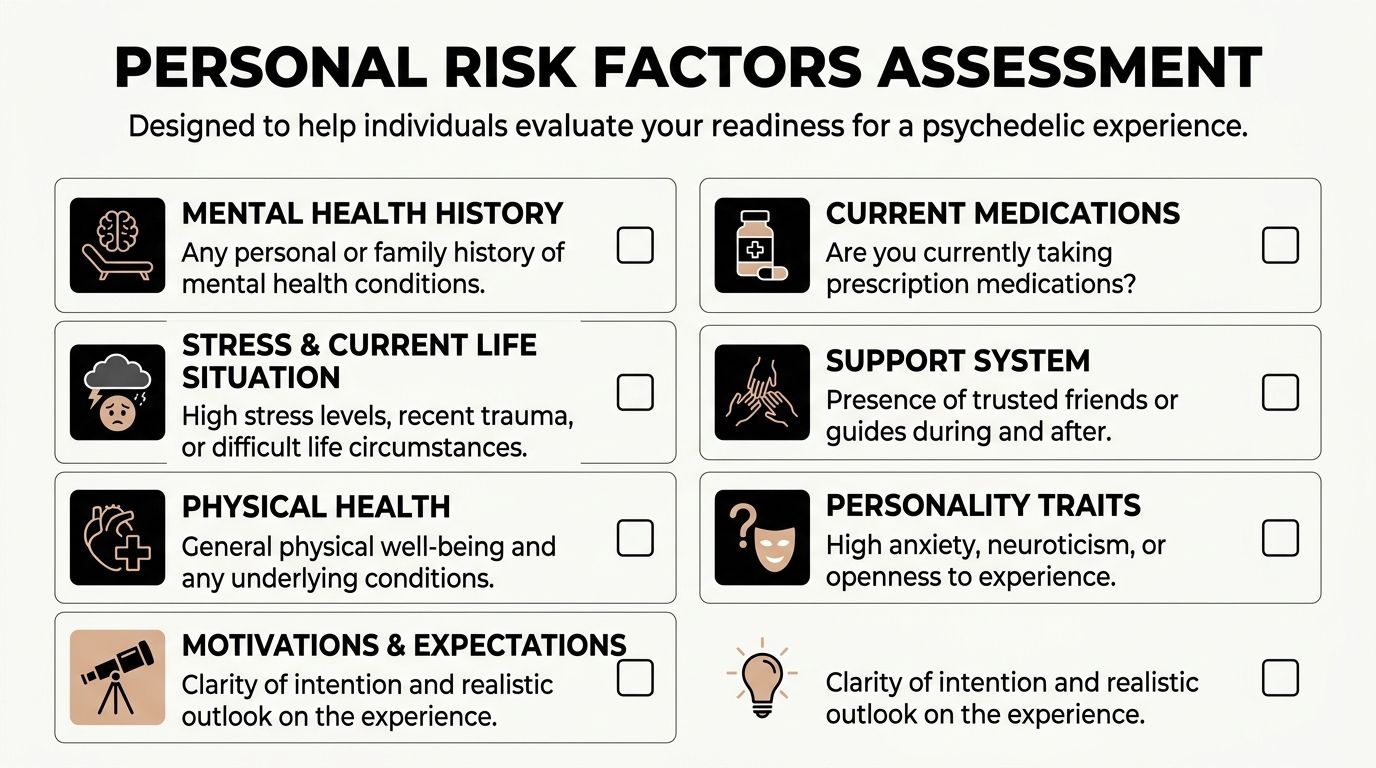
Questions worth asking yourself
Before using psychedelics, pause and run through a personal check.
- Mental health first: Are you currently dealing with high anxiety, depression, panic, or intense emotional instability?
- Recent life stress: Have you had a breakup, loss, conflict, or major shock that still feels raw?
- Support available: Will a calm, trusted person be reachable if things become difficult?
- Body state: Are you exhausted, sleep-deprived, dehydrated, or generally run down?
- Medication and interaction concerns: If you take prescription medication, especially mood-related medication, review reliable information such as this article on shrooms and antidepressants.
A simple readiness check
You don't need perfect conditions. You do need enough stability that you can bend without snapping.
Ask yourself:
- Do I feel grounded enough for an intense emotional experience?
- Can I tolerate uncertainty without immediately panicking?
- Do I have a safe place and a safe person?
- If hard feelings arise, am I open to meeting them instead of suppressing them?
If several of those answers are “not really,” waiting is often the wiser call.
Personal check: The right time for a psychedelic experience isn't when you're desperate for it to fix you. It's when you have enough support and steadiness to face what it may reveal.
Risk factors are not moral failures
This matters. Needing to postpone doesn't mean you're weak. Having anxiety doesn't mean you're disqualified from every future experience. It means your preparation may need to be more careful, or that now isn't the right moment.
That kind of honesty prevents a lot of preventable suffering.
Practical Prevention and Harm Reduction Strategies
A difficult trip often starts before the substance takes effect. Someone takes more than they can gauge, enters a room full of noise or interruptions, and then feels a wave of fear. At that point, the mind can start pushing against the experience instead of working with it.
Good prevention lowers the chance of that spiral. The goal is not to control every feeling. The goal is to reduce avoidable stress so you have more room to respond calmly if something intense comes up.
Start lower than your ego wants to
Overconfidence creates a lot of preventable problems. A person may feel emotionally tough, assume experience with cannabis or alcohol will carry over, or chase a dramatic breakthrough. Psychedelics do not reward bravado very well.
A lower starting dose gives you more margin for error. That matters even more if you are new, trying a different product, or unsure how strongly you respond. Measured products can reduce guesswork compared with eyeballing dried material. Metro Mush offers options such as OuterSpore Milk Chocolate Bars, Mush Love Chocolate Bars, Rocket Fuel shroom drinks, and Moon Bars through its guide on how to avoid bad trips.
Lower and slower is not boring. It is skilled.
Set up the space so your nervous system has less to fight
A distressed brain scans for danger the way a smoke alarm scans for heat. If the room is chaotic, cold, loud, or full of interruptions, the mind has more raw material for fear.
Prepare the environment before anything starts:
- Comfort: Water, layers, a place to sit or lie down, and easy bathroom access
- Low stimulation: Soft light, familiar music, and fewer sudden noises
- Safety: Put away car keys, sharp objects, and anything that could trigger panic
- Simple logistics: Charge your phone, silence unnecessary notifications, and avoid unexpected visitors
These details matter because resistance often grows when basic discomfort gets misread as danger. Thirst can feel ominous. A loud sound can feel threatening. Preparation removes some of those false alarms.
Prepare for the moment when your mind wants to push back
This part gets missed often. People hear "set, setting, and dose," but many challenging trips turn on one extra factor: resistance.
Resistance is the inner move of saying, "This cannot be happening," "I need this feeling gone right now," or "I have to get control back immediately." That struggle can tighten fear into panic. It works like trying to swim against a strong current. The harder you thrash, the more exhausted and frightened you become.
Before the experience, practice a few simple responses:
- Name the wave: "This is intense, but intensity is not the same as danger."
- Loosen the fight: "I do not need to solve this feeling right now."
- Return to the body: Feel the floor, hold a blanket, sip water, and slow your exhale
- Keep expectations soft: Curiosity is usually safer than demanding healing, insight, or revelation on command
You are not trying to force surrender. You are giving yourself a gentler script to use if the mind starts clenching.
Choose support on purpose
A good sitter helps regulate the room. Calm is contagious. So is alarm.
The most helpful support person is steady, patient, and comfortable with silence. They do not interrogate you, argue about what is real, or pile on interpretations. They help with small, grounding actions and remind you that difficult moments pass.
Useful qualities include:
- A calm voice
- Short, reassuring phrases
- Willingness to adjust light, sound, or temperature
- Respect for your space without disappearing
The safest sessions often look uneventful from the outside. That is a good sign. When the basics are handled well, you have less pressure on your body, less chaos in the room, and less need to fight what you are feeling.
This video offers a useful visual primer on safer preparation and mindset.
Navigating a Difficult Moment and When to Get Help
A difficult trip can escalate fast. Someone gets scared, tries to push the experience away, and that struggle adds more fear on top of the original fear. The immediate goal is to lower the sense of threat so the mind has less to fight against.
A useful comparison is a panic spike in water. Thrashing burns energy and deepens the alarm. Small, steady actions help the nervous system find footing again.
What helps in the moment
Start by making the space simpler and quieter. Reduce bright light, loud sound, extra people, and confusing conversation. If possible, move to a calmer room and stay with one steady support person.
Then help the person orient without overwhelming them. Gentle reminders can help re-establish context: their name, where they are, that they took a substance, and that the effects will pass. Keep your voice slow and plain. Long explanations often add pressure when someone is already overloaded.
Physical grounding can interrupt the loop of fear and resistance. Encourage them to sit or lie down, feel the floor or chair beneath them, hold something familiar, sip water if they can, and lengthen the exhale. The point is not to force calm. The point is to give the body signals of safety while the mind is having a hard time.
Short phrases work better than debate:
- "You are safe right now."
- "I am here with you."
- "You do not need to figure this out."
- "Let this pass one moment at a time."
If they are caught in frightening thoughts, avoid arguing about whether those thoughts are true. Meet the emotion first. A person who feels trapped usually needs less stimulation, less interpretation, and less pressure to "get better" immediately.
When outside help is the right call
Many hard moments settle with calm support, but some situations need medical or emergency help. The clearest sign is loss of safety.
Seek urgent help if someone is:
- At risk of self-harm
- Threatening or attempting to harm other people
- So disoriented that they cannot be redirected at all
- Unresponsive, having trouble breathing, having a seizure, overheating, or showing other concerning medical symptoms
Safety comes first. Privacy, embarrassment, and ideology can wait.
It is also reasonable to call for help before things become extreme. If the person is getting harder to contain, cannot follow simple guidance, or the people present do not feel able to keep everyone safe, bring in medical support. Early help is often safer than waiting for a crisis.
If you're in Detroit or Ann Arbor and want a more measured, informed approach to psilocybin, Metro Mush offers adult consumers a menu of dried mushrooms, chocolates, and drinks that can make dose planning more deliberate. Whatever product you choose, the safer path is the same: know your mindset, shape your environment, start lower than you think you need, and treat support as part of the plan, not an afterthought.