
“Golden Mammoth” isn't a laboratory-verified potency tier, and the label alone can't tell you how much psilocybin a product contains. It's generally used for a cultivated variety of Psilocybe cubensis, with informal origin stories and meaningful variation between grows, harvests, and products.
That distinction matters in Detroit and Ann Arbor, where a familiar strain name can make a product seem more predictable than it really is. A safer approach is to treat the name as a starting point, then evaluate identification, batch information, serving size, format, storage, and your own setting. The practical question isn't whether Golden Mammoth is “strong.” It's whether you know what you're taking and have a plan for uncertainty.
What Golden Mammoth Mushrooms Actually Are
Golden Mammoth is often marketed as a standardized, especially potent strain. The better-supported description is narrower: it is a market name generally used for a cultivated variety of Psilocybe cubensis, not a separately recognized species or a formally validated cultivar. Available documentation does not establish one authoritative genetic lineage through a registry or peer-reviewed study. A review of psilocybin mushrooms and their chemistry helps distinguish informal strain names from biological classifications.
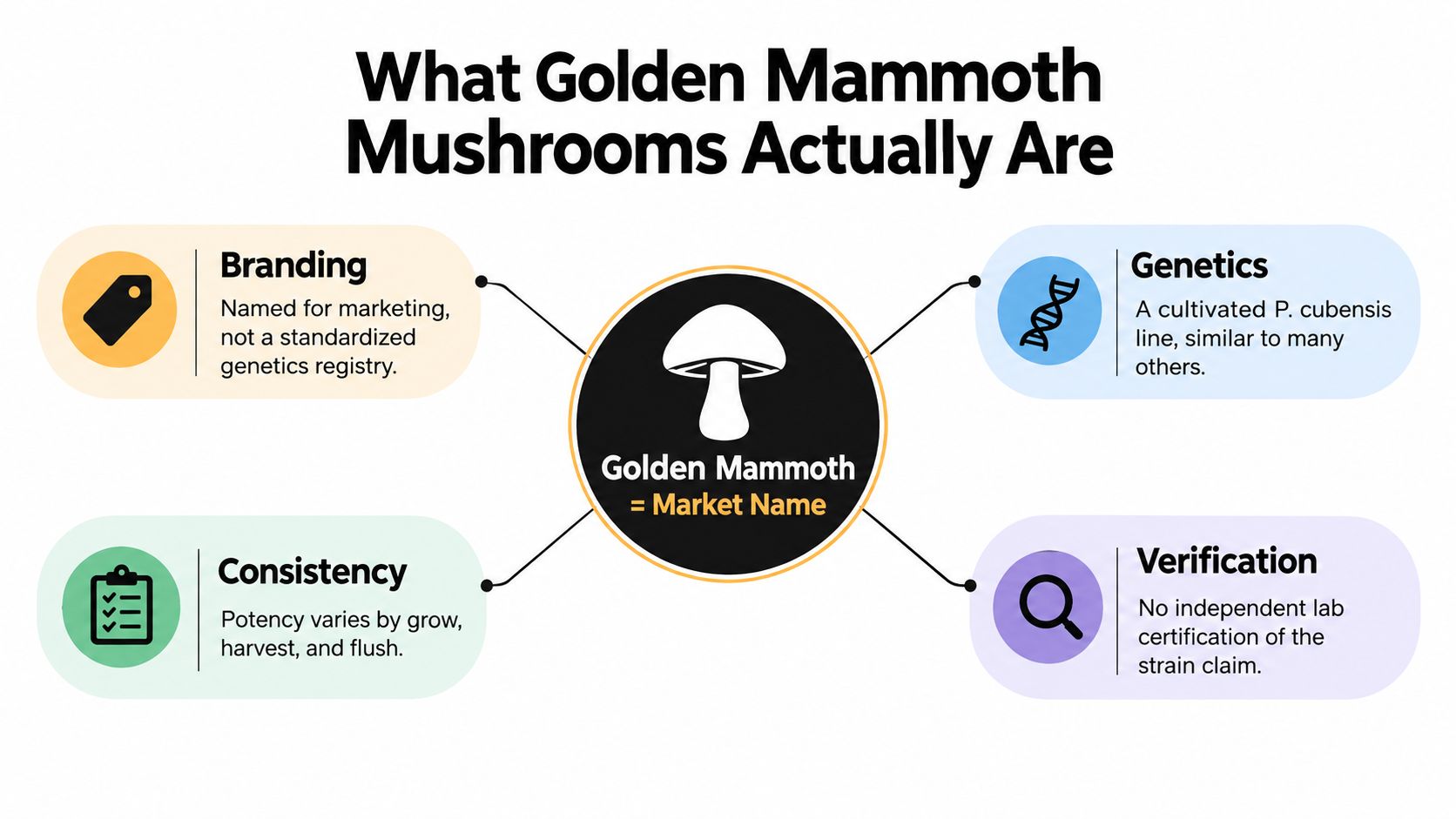
Community accounts commonly place Golden Mammoth's development in Canada during the late 1990s or early 2000s, with deliberate selection by a Canadian mycologist. These accounts mention aims such as genetic consistency, contamination resistance, and predictable fruiting. The story differs across sources and remains poorly documented, so it provides background rather than proof of a defined chemical profile.
The label is useful, but limited
Psilocybe cubensis is widely recognized as the most widespread species in the Psilocybe genus. More than 100 mushroom species are reported to produce psilocybin, yet that broader fact does not turn every commercial name into a standardized category. A product sold as Golden Mammoth might represent a cultivated line, a seller's naming choice, or genetics maintained by a particular grower.
For buyers in Detroit, Ann Arbor, and nearby communities, read menu language carefully:
- “Golden Mammoth” identifies a market variety, not a guaranteed concentration.
- “High potency” needs evidence, preferably batch-specific analytical testing.
- “Consistent genetics” is a cultivation claim, not independent certification.
- A familiar appearance does not verify chemistry, identity, or serving strength.
Practical rule: Treat Golden Mammoth as a product name first and a potency prediction second.
The same label can appear on products with different exposure. Genetics, substrate, cultivation conditions, maturity, drying, storage, and laboratory methods may all affect measured alkaloid content. A dried mushroom can also lose quality through poor storage, while a seller may use the name without documenting the underlying line.
Compare tested batches and clearly defined servings, not strain names alone. If testing, identity, or serving information is missing, treat the product as uncertain rather than assuming the Golden Mammoth label provides a reliable potency tier.
Origin, Appearance, and Cultivation Background
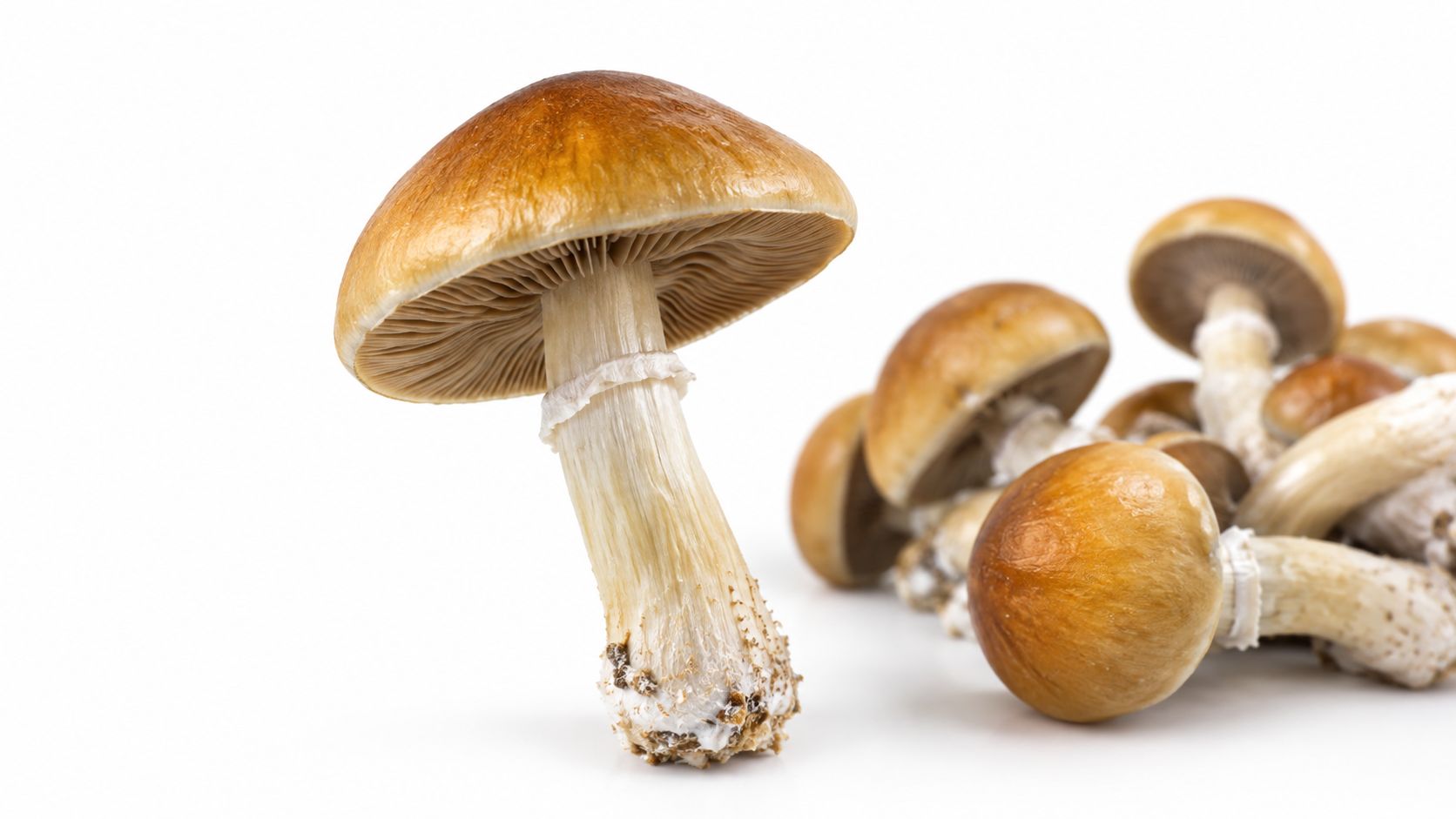
Golden Mammoth is usually presented as a sturdy cultivated form of P. cubensis. Informal descriptions often emphasize large fruiting bodies, golden or caramel-colored caps, thick pale stems, and dark purple-brown spores. These traits may help a buyer understand how the variety is commonly described, but they aren't a substitute for verified identification. Wild mushroom lookalikes can be dangerous, and visual similarity alone isn't enough to establish that a mushroom is safe or correctly labeled.
What growers are trying to achieve
Cultivation accounts commonly describe Golden Mammoth as selected for large fruiting bodies, consistency, and resistance to contamination. Reported production conditions include approximately 24–28°C and high relative humidity around 90–95%, figures discussed in an overview of Golden Mammoth cultivation claims. Those conditions describe how growers may target successful production. They don't predict the psilocybin concentration of a finished batch.
That difference is easy to miss. A mushroom can grow successfully, look uniform, and still vary chemically from another mushroom produced under similar conditions. Maturity, drying, storage, and the distribution of alkaloids within the material remain relevant to the final exposure.
A variety inside a larger history
Golden Mammoth's story makes more sense against the wider history of psilocybin research. In 1957, R. Gordon Wasson published a widely influential Life magazine account of Indigenous mushroom ceremonies in Mexico. Wasson supplied specimens to Swiss chemist Albert Hofmann, whose isolation and identification of psilocybin and psilocin provided a chemical foundation for later research.
The research environment then changed sharply. The U.S. Food and Drug Administration pushed to close most psychedelic research programs in 1966, and the United States enacted the Controlled Substances Act in 1970, placing psilocybin in Schedule I. Academic interest later returned. A 2021 review in CNS Spectrums reported more than 27,000 scientific articles on psychedelic drugs, including over 1,000 focused specifically on psilocybin, and nearly 550 psychedelic-research grants awarded between 2015 and 2020. By August 20, 2023, ClinicalTrials.gov reportedly listed 127 approved studies worldwide examining psilocybin.
Those milestones explain why public interest is rising. They don't validate Golden Mammoth as a clinical or pharmaceutical product.
Potency, Effects, and What Actually Drives the Experience
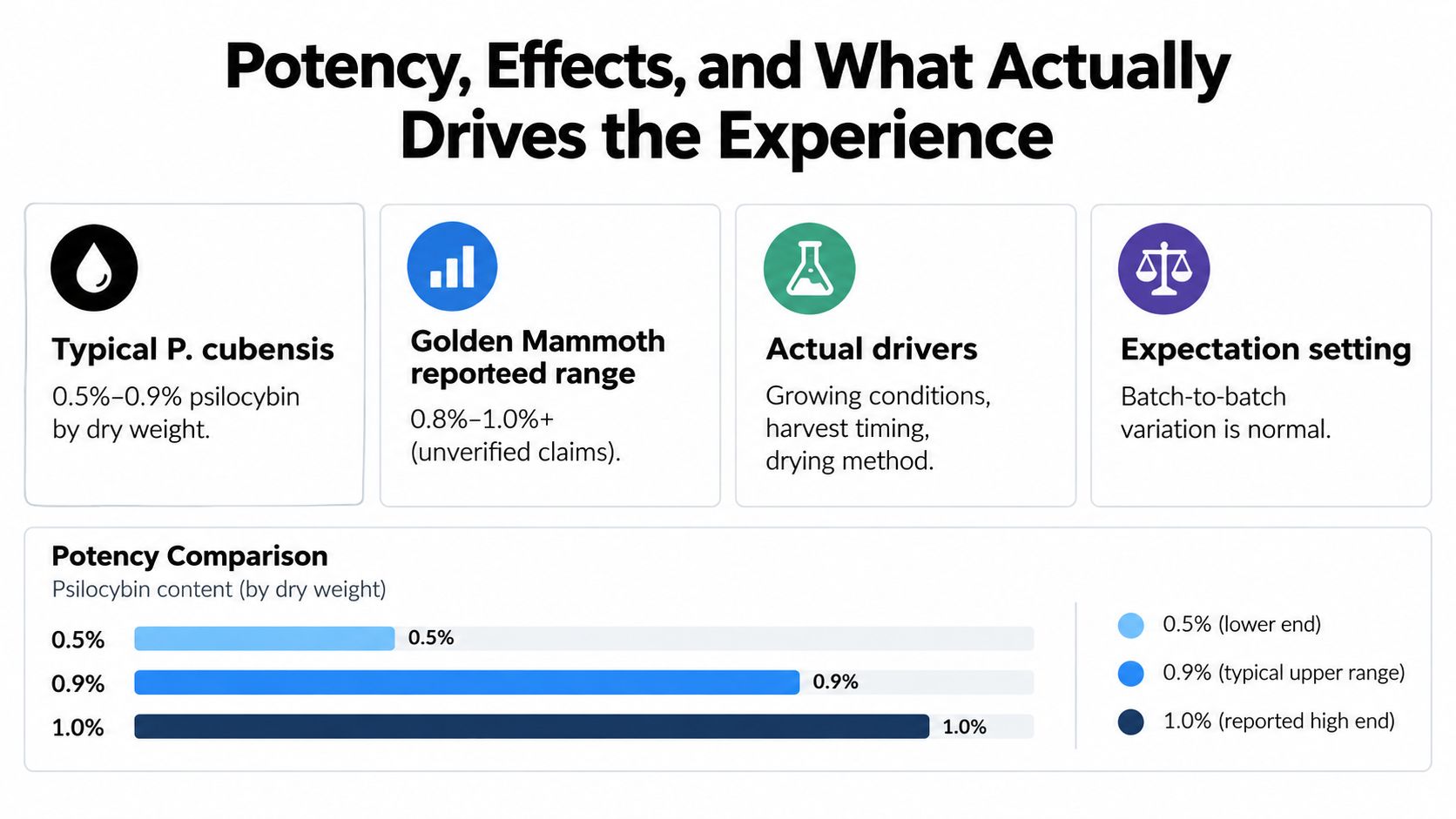
Golden Mammoth is often marketed as a potency tier, but its name cannot function like a laboratory result. Typical P. cubensis is sometimes described at 0.5%–0.9% total psilocybin by dry weight, while Golden Mammoth is sometimes advertised at 0.8%–1.0% or higher. Those Golden Mammoth figures remain unverified estimates, not reliable product specifications. Alkaloid content can shift with genetics, cultivation, maturity, drying, storage, and testing methods.
Why the advertised range can mislead
A broader recent review reports dried-weight psilocybin concentrations from approximately 0.01% to 3.04% across psilocybin-producing mushrooms, with substantial variation even within well-characterized species such as P. cubensis. That review also identifies misidentification as a safety concern and calls for better public education and potency testing.
This range does not mean every Golden Mammoth sample could fall anywhere within it. The practical point is narrower: a strain name cannot resolve uncertainty. Two mushrooms from one batch may contain different alkaloid concentrations, and two batches sold under the same name may produce noticeably different results.
For a buyer in Detroit or Ann Arbor, treat “Golden Mammoth” like a farm or product label, not a fixed strength rating. Ask whether the seller can identify the batch, explain how it was dried and stored, and provide credible testing. If those details are unavailable, the label offers little protection against variation.
Effects depend on more than the mushroom
The experience reflects actual dose, individual physiology, previous experience, expectations, mood, environment, and other substances. A familiar, calm room can feel very different from a crowded or stressful setting. Sleep, food, anxiety, and personal sensitivity also shape the experience before effects begin.
Cannabis requires particular caution. Combining it with psilocybin may increase anxiety, confusion, or perceptual intensity, especially for someone trying the combination for the first time. Prescription medicines and mental health history matter as well. Anyone taking psychiatric medication or living with a relevant condition should consult a qualified clinician instead of relying on a strain description.
A safer expectation is simple: this batch may be stronger or weaker than its label suggests, and your response may differ from another person's.
Dosing Framework and Harm Reduction Basics
A gram-based dose ladder can help organize a conversation, but it can't eliminate chemical variability. The table below is a planning framework, not a guarantee. It applies only to measured, dried whole mushrooms, not chocolate, drinks, capsules, or extracts.
| Dose Tier | Dried Weight | Expected Effect |
|---|---|---|
| Threshold | Very small amount | Subtle or barely noticeable changes, with effects that may be difficult to predict |
| Light | Low measured amount | Mild perceptual and emotional changes, while remaining more connected to ordinary surroundings |
| Common | Moderate measured amount | Clear alterations in perception, mood, time, and attention |
| Strong | High measured amount | Potentially overwhelming changes, with greater need for support and a controlled setting |
The table intentionally avoids pretending that a particular weight produces a universal result. Reported potency estimates for Golden Mammoth aren't independently verified, and scientific reviews document substantial variation in dried mushroom concentrations. Read this harm-reduction overview for the broader principle: reduce uncertainty where you can, and don't confuse a familiar label with a measured dose.
Build a safer first-session protocol
- Weigh the material. Counting caps or pieces is unreliable because individual mushrooms differ in size and alkaloid distribution.
- Choose the lowest reasonable tier for your experience level. Don't use an untested batch to recreate a past experience from another product.
- Keep the setting simple. Use a familiar, calm space and avoid driving, swimming, heights, or responsibilities that require judgment.
- Have a sober, trusted person available for a first experience or uncertain batch. They should know what was taken and how to contact emergency help.
- Avoid mixing substances. In particular, don't add heavy cannabis use, alcohol, or another intoxicant while you're still learning how the batch affects you.
- Don't redose quickly. Delayed effects can lead people to take more before the first amount has fully developed. Wait until you've clearly assessed the initial experience rather than chasing an expected timeline.
Seek urgent medical help for severe agitation, dangerous behavior, loss of physical safety, persistent confusion, suspected poisoning, trouble breathing, seizures, or thoughts of self-harm. Keep the packaging or product information available for responders, and don't leave a distressed person alone.
Chocolate bars, drinks, and capsules require a separate calculation. The relevant unit is the labeled amount per serving, not the weight of the chocolate or the number of pieces. If the label doesn't clearly state serving information or batch details, you can't reliably translate a piece into mushroom exposure.
How Golden Mammoth Compares to Other Popular Strains
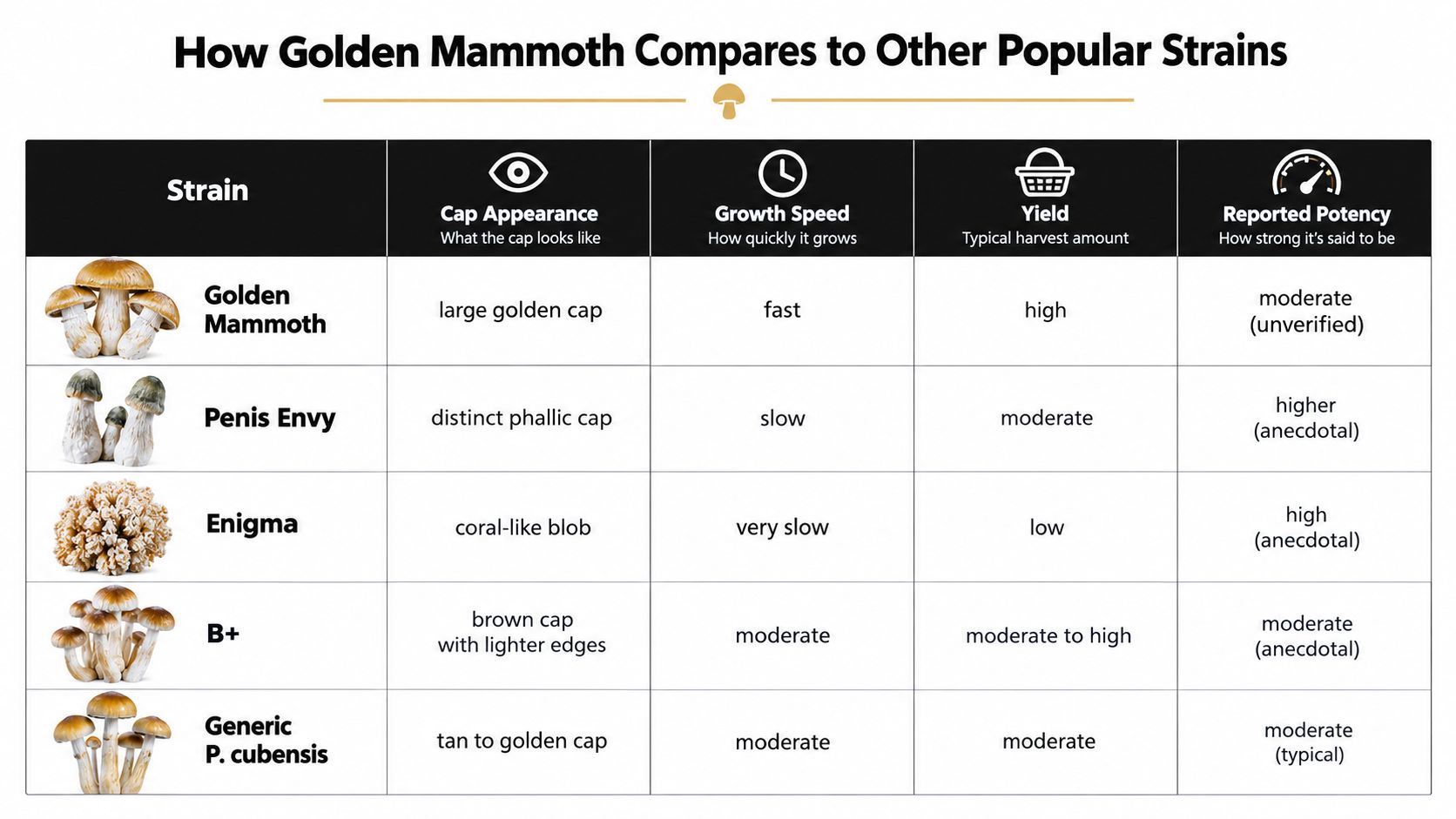
Strain comparisons are useful for understanding market language, but they're often mistaken for laboratory rankings. Golden Mammoth, Penis Envy, Enigma, B+, and generic P. cubensis are discussed differently in cultivation and user communities, yet those reputations don't establish a reliable potency order. A guide to P. cubensis strain terminology can help decode the names without treating them as standardized chemical categories.
A practical comparison
| Market name | Commonly discussed appearance | Cultivation reputation | Community potency reputation | What a buyer should conclude |
|---|---|---|---|---|
| Golden Mammoth | Large golden cap | Often described as consistent and productive | Moderate to high, unverified | Ask for batch information rather than trusting the name |
| Penis Envy | Distinctive thick, unusual fruiting form | Often described as more demanding | Higher, anecdotal | Don't assume the reputation applies to every batch |
| Enigma | Coral-like or irregular growth | Often described as slow and unusual | High, anecdotal | Appearance and reputation don't replace testing |
| B+ | Conventional P. cubensis appearance | Commonly described as approachable to cultivate | Moderate, anecdotal | Still subject to natural variation |
| Generic P. cubensis | Broad range of appearances | Depends on the specific line and grow | Variable | The name provides the least useful potency detail |
Choosing by objective, not mythology
A buyer seeking a visually distinctive dried mushroom may prefer one market variety, while someone prioritizing straightforward serving information may be better served by a clearly labeled edible or capsule. Someone with limited experience should avoid using a reputation for “strong” as a challenge. A less dramatic label can still produce an intense experience if the batch is concentrated or the serving is larger than expected.
Price positioning also shouldn't be treated as a potency certificate. A higher price may reflect scarcity, cultivation complexity, branding, or format. It doesn't independently prove greater psilocybin content. Ask what the seller knows about the batch, how servings are defined, whether testing is available, and whether the product has been stored properly.
Pairing Golden Mammoth With Edibles and Drink Formats
Edibles change the decision from “how many grams?” to “how much is in one serving, and how many servings are in the package?” Chocolate bars such as OuterSpore Milk Chocolate Bars, Mush Love Chocolate Bars, and Moon Bars distribute their contents across pieces, while Rocket Fuel drinks and capsules may use a labeled serving format. The packaging should make that division clear before you take anything.
A useful guide to mushroom chocolate bars can help buyers think through format, serving size, and storage. But no product format removes the need for caution. If a bar doesn't identify the serving size or the amount per piece, treat that as missing information rather than filling in the gap yourself.
Timing is where many people misjudge edibles
Mushroom edibles can take longer to feel than someone expects. A practical planning window is approximately 45 to 90 minutes for onset, though the experience can vary with the product, the person, and whether they've eaten recently. That timing comes from the supplied product guidance and should be treated as an estimate, not a promise.
The most common mistake is redosing because nothing seems to be happening. The initial serving may still be developing, and a second serving can arrive on top of it. For a first trial, use one clearly defined serving, stay in a controlled setting, and give the experience time before considering any change.
Keep combinations simple
Don't pair a new mushroom edible with a cannabis edible on the same day if you're trying to understand your response. The combination can make the experience more intense and less predictable, and cannabis may amplify anxiety or confusion for some people. Alcohol adds another layer of impairment and makes it harder to monitor how you're feeling.
Plan the session around delayed effects:
- Read the entire label before opening the package.
- Identify the amount in one serving and the number of servings.
- Avoid taking another serving while you're still waiting for the first.
- Keep water and a calm place nearby.
- Don't drive or make important decisions.
- Have a sober support person available if you're inexperienced or uncertain.
Capsules may offer easier portioning than loose mushrooms, but only if the label clearly defines the contents. Drinks can be convenient, yet their onset and serving interpretation still deserve the same care as chocolate.
Buying, Storage, and Staying Safe in Detroit and Ann Arbor
A careful purchase starts with the product description, not the strain name. Look for a clear format, serving definition, ingredient list where applicable, batch or preparation information, and storage guidance. If the description only promises that Golden Mammoth is “strong,” “premium,” or “consistent,” ask what evidence supports that wording.
A useful conversation with a seller includes specific questions:
- Is this dried whole mushroom, chocolate, drink, capsule, or extract?
- What does one serving mean?
- Is there batch-specific testing?
- When was it packaged?
- How should it be stored?
- Does the product contain other psychoactive ingredients?
- What should an adult do if the experience becomes distressing?
Storage protects quality, not certainty
Keep dried mushrooms cool, dark, dry, and sealed, away from heat and direct sunlight. Chocolate also needs protection from heat, moisture, and sunlight. Follow the product's instructions, and don't use material that shows concerning contamination, unusual moisture, or damaged packaging.
Storage can preserve a product's condition, but it can't make an untested batch standardized. It also can't correct mislabeling. Keep original packaging so you can identify the product and provide accurate information if medical help becomes necessary.
Understand the local legal distinction
State and federal law still treat psilocybin as a controlled substance. Ann Arbor's 2020 decriminalization resolution made enforcement a low priority, and Detroit has moved in a similar direction, but neither development equals full legalization. Local enforcement priorities and retail availability can change, so adults should verify current rules and understand that decriminalization is not the same as a legal commercial market.
For Southeast Michigan buyers, the safest checklist is straightforward:
- Confirm the product format and serving information.
- Ask whether batch testing is available.
- Avoid potency claims that lack supporting details.
- Use a scale for dried material, or follow labeled servings for edibles.
- Store products securely away from children, pets, heat, and sunlight.
- Don't drive or transport products in ways that create additional legal risk.
- Keep emergency information and packaging accessible.
Putting It All Together and Getting Started
Golden Mammoth can be a useful market label, but it isn't a reliable potency measurement. Start by choosing a format you understand, then select a conservative serving plan, prepare a calm setting, avoid combinations, and wait before making any decision to take more. If testing or serving information is missing, treat that uncertainty as part of the risk.
For first-time or cautious adults, a clearly portioned chocolate, drink, or capsule may be easier to interpret than loose mushrooms, provided the label is specific. Experienced users shouldn't use familiarity as permission to skip batch checks. A previous experience with one Golden Mammoth product doesn't predict the next one.
Quick answers
Is Golden Mammoth safe for a first-timer?
The name alone doesn't answer that. A first-timer should prioritize verified identity, clear serving information, a conservative plan, a safe setting, and sober support.
How does it compare with a cannabis edible?
The experiences differ. Both can be delayed and difficult to reverse after taking too much, but psilocybin may produce more pronounced changes in perception, thought, emotion, and time.
How long does a session last?
Timing varies by person, dose, product, food, and setting. Don't schedule driving, work, childcare, or other responsibilities around an exact promised endpoint.
If you're ordering locally, the minimum order is $75. Detroit Metro customers can text 734-691-6122, and Ann Arbor Metro customers can text 734-280-2868. Mix & Match Saturdays combine any three chocolate bars or drinks for $100, fire, police, and veterans receive 10% off, and the Discord community offers a 20% discount for members.
Metro Mush offers Detroit and Ann Arbor adults dried mushroom varieties, chocolate bars, drinks, and capsule-style formats, with local ordering and product information to help you compare options carefully. Visit Metro Mush to review the current menu, check coverage, and choose a format that matches your experience level and harm-reduction plan.