You're looking at a mushroom menu in Detroit or Ann Arbor, trying to decide what a sensible first purchase looks like. The dried mushrooms are listed in grams, the chocolate comes in squares, and a drink promises a conveniently portioned experience. You don't want an overwhelming trip, but the packaging doesn't necessarily tell you how these choices compare.
The most useful starting point for magic mushroom dosage for beginners isn't a universal gram number. It's understanding what's been measured, what remains uncertain, and whether you have a plan for an unexpectedly strong response. Choosing not to use an unverified product is a valid harm-reduction decision, too.
Why a Single Gram Number Is the Wrong Place to Start
A gram tells you how much mushroom material you're buying. It doesn't, by itself, tell you how much psilocybin, the psychedelic compound, you'll consume. That distinction matters even when the package carries a familiar strain name.
Think about choosing between dried mushrooms and a chocolate bar. The mushroom package might tell you its total weight, while the chocolate wrapper might describe how much mushroom material went into the bar. Neither statement necessarily identifies the active compound per serving.
Understand what clinical numbers mean
Clinical researchers can work with standardized psilocybin rather than estimating exposure from mushroom weight. In a trial involving 233 adults with treatment-resistant depression, researchers compared synthetic-psilocybin doses of 1 mg, 10 mg, and 25 mg, alongside psychological support, as described in this clinical research review.
Those amounts aren't a recreational beginner prescription. Participants were screened, the compound was standardized, and support was part of the intervention. Taking a number from a clinical study and applying it to an untested edible removes the safeguards that make the number interpretable.
The practical question isn't whether a product resembles something used in research. It's whether you know what your particular serving contains.
Ask at the counter: Does this label measure mushroom material, extract, or tested psilocybin content per serving?
Know what a useful answer includes
Ask to see the product's laboratory results, not just a description such as “beginner-friendly.” A useful answer should connect the test to the product you're considering and explain whether the reported amount applies to the whole package or an individual serving.
- Identify the ingredient. Ask what the milligram figure measures.
- Check the serving. Make sure the package total and serving amount aren't being confused.
- Respect uncertainty. If the seller can't explain the potency information, don't substitute a guess.
A clear label can reduce uncertainty. It can't promise that a particular amount will feel comfortable for you.
The Four Dose Tiers Every Beginner Should Know
A label may call a serving a microdose, low dose, mid dose, or high dose. These terms describe intended intensity, not measured psilocybin content or a guaranteed effect. For a beginner, they work as broad vocabulary, not as a serving guide.
The coffee comparison gives a rough sense of scale: a microdose is like a sip, a low dose like a small cup, a mid dose like a full cup, and a high dose like the whole pot. It only illustrates increasing exposure. Mushrooms are not coffee, and an unknown amount of active compound makes the contents of each “cup” uncertain.
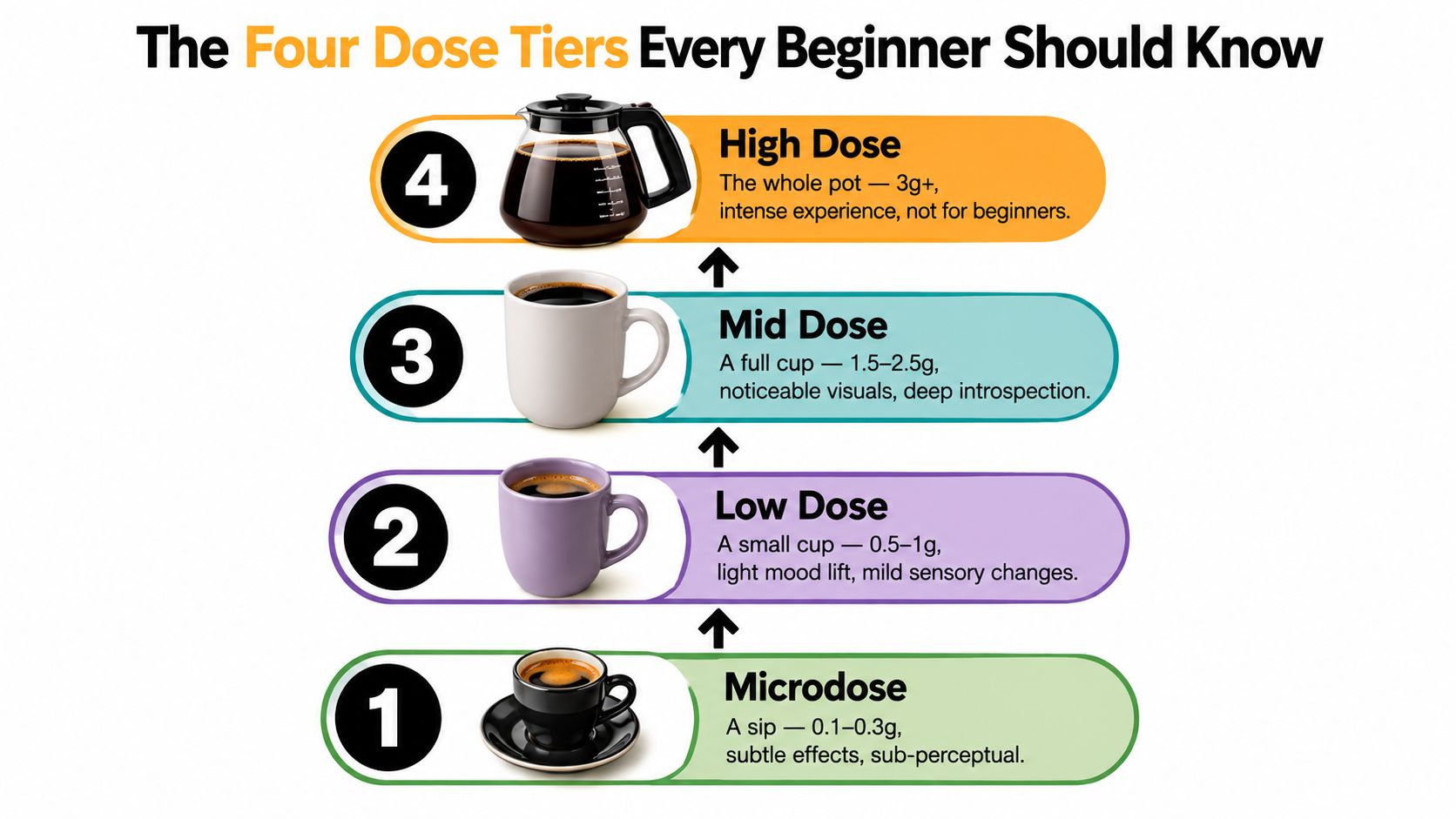
The graphic shows how the categories are commonly arranged. Its gram ranges aren't verified beginner recommendations, and its effect descriptions cannot guarantee what a person will experience.
A microdose usually means an amount intended to avoid an overt psychedelic experience. The label doesn't prove that the effect will be imperceptible, especially if the product's active content hasn't been tested. It describes the intended experience, not a test result.
A low dose is intended to produce less intensity than a fuller psychedelic experience. “Low” does not mean safe to drive or work, or that your emotional response will be predictable. The category name alone tells you little about what a serving contains.
Greater intensity isn't a beginner goal
A mid dose generally refers to a more noticeably psychedelic experience. A high dose suggests substantially greater intensity, making it an unsuitable first-session target. Experience with mushrooms also cannot make an unusually potent product predictable or remove medical risks.
Gram boundaries can suggest more certainty than the evidence supports. An analysis of cultivated mushroom variability reported more than a 7.8-fold difference in total tryptamine concentrations across 14 cultivated strains, with further differences among individual mushrooms. Total tryptamines are not interchangeable with a label that reports psilocybin alone.
Treat the tiers as vocabulary, not a dosing calculator. A higher category is not a better choice because it sounds more meaningful or therapeutic. If you proceed, use the lowest labeled serving of a verified product rather than trying to match another person's experience.
No scientifically established retail dose can guarantee a gentle first experience for every adult. That uncertainty matters more than a tidy chart or a reassuring category name.
How Strain and Potency Change the Same Number on Paper
Two dried portions can weigh exactly the same and still contain different amounts of active compounds. A scale measures the material's weight, not its chemical content. Those are separate measurements, much like weighing two cups of fruit does not reveal how much sugar each contains.
In a controlled analytical study, researchers estimated that a nominal 3 g dried portion contained approximately 19.8 to 46.2 mg of combined psilocybin and psilocin, a range of more than twofold. The findings appear in analytical research on cultivated mushroom potency.
Those figures describe an example from analysis, not a recommended serving. They also refer to combined psilocybin and psilocin, which is not the same as an equal amount of psilocybin alone. For a beginner, the practical point is that a gram-based estimate can conceal substantial uncertainty about chemical exposure.
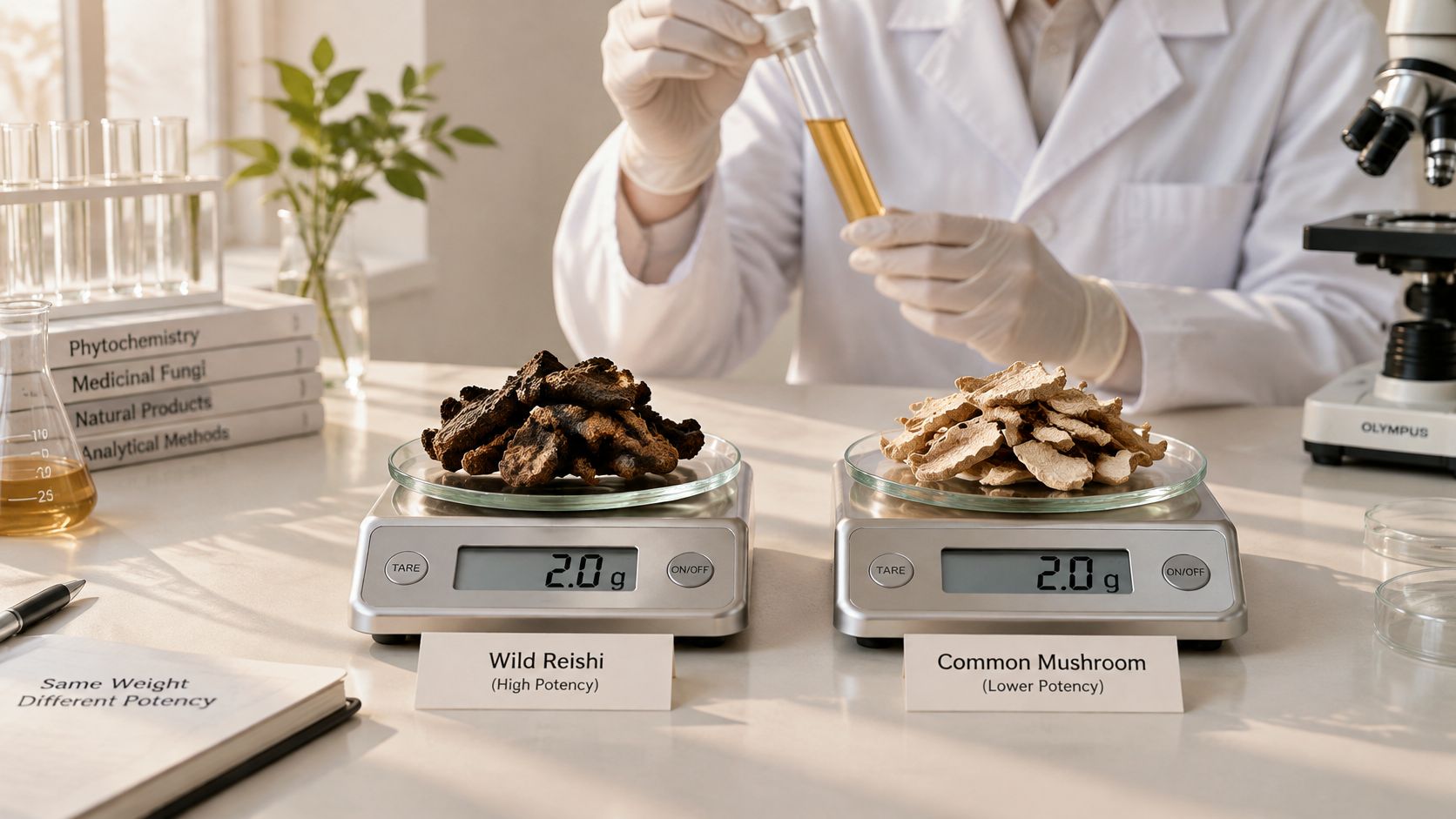
A strain name describes how a product is identified or marketed. It does not establish the potency of a specific batch. Appearance and reputation are also poor substitutes for a chemical test. Reading about mushrooms marketed as the strongest should encourage caution, not confidence that a strain name can predict an individual serving.
Weight tells you how much material there is. Tested active content answers a different dosage question.
Processing does not resolve the uncertainty by itself. Grinding mushrooms into chocolate or mixing them into a drink may make portions easier to divide, but it does not prove that active compounds are distributed evenly. Serving information is meaningful only when credible testing applies to the finished product and its portions are sufficiently consistent.
If a product includes a test report, check three things before treating its label as useful:
- Batch: Does the report match the batch being sold?
- Compounds: Does it measure psilocybin, psilocin, combined alkaloids, or total mushroom material?
- Serving: Is the stated amount for one square, a measured volume, or the whole container?
A “gram” of mushroom material still does not tell you the active-compound amount. The useful comparison is not which format or strain sounds more reliable, but whether the finished product's composition has been verified. When that information is missing, the chemical dose remains uncertain, whatever the package says.
Choosing Between Dried Mushrooms, Chocolates, and Drinks
A scale, a chocolate square, and a marked drink measure can each make a portion look precise. They measure different things, though: weight or volume does not establish how much active compound a serving contains. Choose a format based on what you can verify and measure, not on which one seems easiest to use.
There is no product-specific evidence here to support assuming a drink acts faster than chocolate, or that dried mushrooms offer better value per milligram. For a beginner, the useful question is whether the serving's contents and instructions are clear.
| Format | What you can measure | What remains uncertain |
|---|---|---|
| Dried mushrooms | The material's weight | Active content and timing |
| Chocolates | A square or other portion | Whether portions contain consistent, verified amounts |
| Drinks | A measured volume | Concentration and whether the liquid is evenly mixed |
With dried mushrooms, a scale measures the amount of material, not its active-compound dose. Without testing, a precise weight can still leave the potency uncertain.
Chocolates offer visible portion boundaries, which may help with dividing a product. OuterSpore Milk Chocolate Bars, Mush Love Chocolate Bars, and Moon Bars are examples of products a shopper may encounter, not proof that each square has verified contents. When comparing magic mushroom chocolate bars, consider the product information, not just its flavor or packaging.
For a drink, a measuring tool can show how much liquid you pour. It cannot establish the active amount unless the concentration is known, and casual sips are not reliable servings just because the product is liquid. Rocket Fuel is one product marketed as a drink; its name alone does not establish what a serving contains.
Before choosing, check the label and any supporting documentation. Can you identify the ingredients? Does testing apply to the product's active-content claim? Are the serving instructions clear enough to follow without guessing?
A square is not automatically a beginner dose, and a bottle is not automatically one serving. If you decide to proceed, the practical starting point is the lowest clearly labeled serving of a verified product. A package's physical divisions are not medical guidance.
If credible potency information is unavailable, switching from dried mushrooms to chocolate or a drink does not make the dose known. Postponing is safer than guessing.
Set, Setting, and the First Three Hours
A first-session plan should cover what happens after consumption, not just what goes into your mouth. Decide in advance who will stay with you, where you'll remain, and what you'll do if the experience feels stronger than expected.
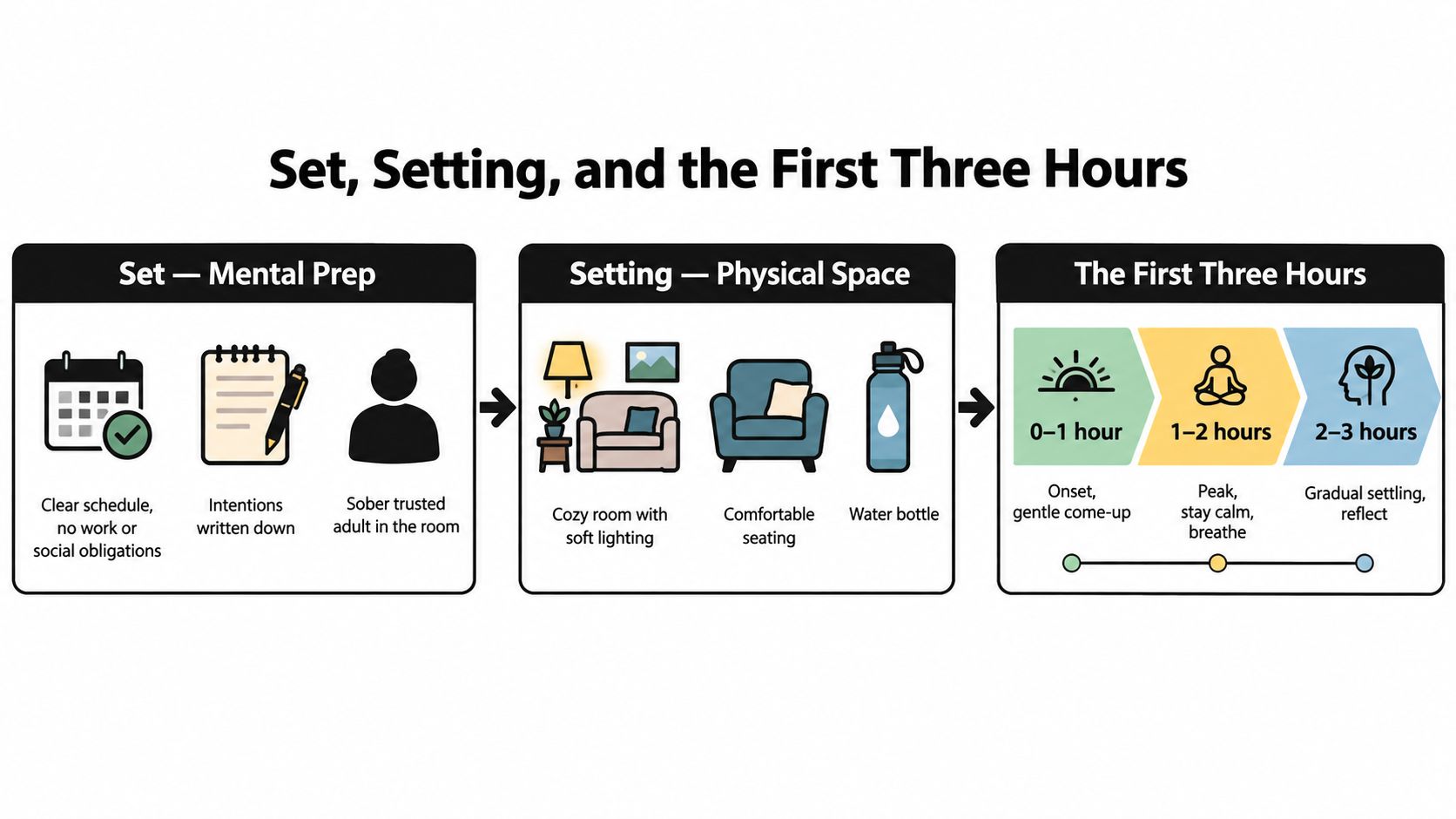
This preparation graphic offers a visual reminder, but its timeline is simplified. Don't treat the pictured settling phase as a promise that effects will be fading on schedule.
Prepare your mind and your space
Set means your mental starting point. Don't schedule the experience around work, caregiving, an argument, or pressure to demonstrate that you can handle it. Write down a simple intention if that helps, but don't turn the session into a test you have to pass.
Setting means the environment and support around you. Choose a familiar room, comfortable seating, adjustable lighting, and easy access to water and a bathroom. Keep a phone available for emergencies even if notifications are silenced.
- Arrange sober support. Choose a trusted adult who agrees to remain sober and stay present.
- Remove obligations. Don't make driving, work, or social performance part of the plan.
- Reduce hazards. Stay away from swimming, machinery, traffic, heights, and other situations that require unimpaired judgment.
Let the experience develop without adding more
In controlled oral-psilocybin research, average peak psilocin concentrations occurred at approximately 2 hours, and exposure increased with dose, according to this human pharmacokinetic study. An average laboratory peak isn't a personal countdown or a retail-product timing guarantee.
Effects may begin before the maximum concentration is reached. That creates an easy beginner mistake: feeling only a little, deciding the product isn't working, and adding more while the original amount is still developing.
First-session boundary: Don't take additional doses during the same session.
Have the sitter hold that boundary with you rather than renegotiating it once you're impaired. Don't assume you'll be ready to leave, drive, or resume responsibilities because a graphic's timeline has ended.
If discomfort develops, the sitter should speak slowly, reduce unnecessary noise, and offer simple reassurance that a substance was taken and the effects can change with time. They shouldn't argue about perceptions, demand an explanation, or use physical restraint as a routine calming technique.
An optional video resource is embedded below, but it doesn't replace individualized medical advice or the emergency plan.
Interactions, Contraindications, and Mixing Risks
“Start low, go slow” leaves out a key question: Should this person use psilocybin at all without medical guidance? A conservative serving doesn't remove a cardiovascular concern, resolve a psychiatric vulnerability, or establish that a medication combination is appropriate.
Psilocybin can raise heart rate and blood pressure, and acute effects can include fear, confusion, anxiety, nausea, vomiting, headache, and fatigue, according to NIDA's psilocybin safety information. That makes health screening more than a formality.
Get individualized advice before proceeding
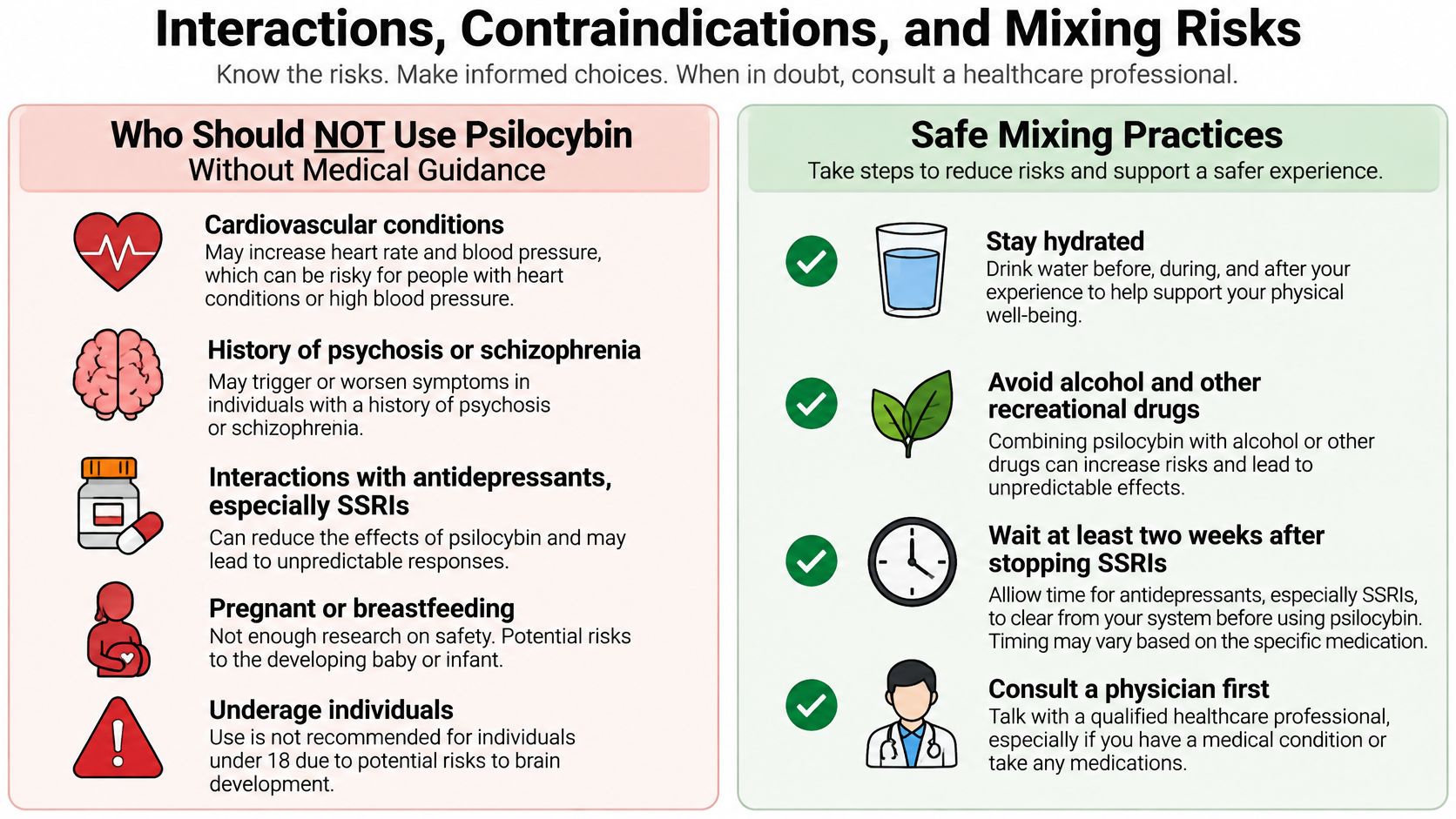
People with significant heart conditions, blood-pressure concerns, psychiatric conditions, or a personal or family history of psychotic disorders should seek qualified medical advice before use. A shop employee or an online dosage chart can't provide that assessment.
Medication questions also require a clinician or pharmacist who can review the actual drug, dose, and medical history. Don't stop, skip, taper, or replace prescribed treatment to make room for a psychedelic experience.
The following graphic contains an unsafe oversimplification: its suggested fixed waiting period after stopping antidepressants is not guidance to follow. There's no universal medication-stop interval established here, and stopping medication without professional supervision can create its own risks.
Keep other substances out of the session
Avoid combining psilocybin with alcohol, cannabis, stimulants, or other psychoactive drugs. Don't use another substance as a home remedy for anxiety or as a way to strengthen an experience that seems mild.
- Bring a complete list. Tell your clinician about prescriptions, nonprescription medicines, supplements, and recreational substances.
- Ask about your own circumstances. A general discussion of psilocybin drug interactions can help prepare questions, but it can't clear a combination for you.
- Don't compensate. If you suspect medication may affect the experience, don't increase the mushroom amount to overcome it.
The absence of an obvious problem at the start doesn't establish safety. When health history or medication compatibility remains unresolved, the sensible next step is a medical conversation, not a trial session.
Your First-Session Checklist and When to Call for Help
Before proceeding, make sure the dosage, environment, and support decisions are settled while you're sober.
- Product verified. You understand the active-content label and have chosen the lowest labeled serving.
- Health questions resolved. Relevant conditions and medications have been reviewed with a qualified professional.
- Support arranged. A trusted sober adult will remain with you in a familiar space.
- Boundaries agreed. No additional doses, substance combinations, driving, swimming, or machinery.
- Recovery prepared. Water, simple food, rest, and freedom from immediate obligations are available.
Recognize an emergency
Call emergency services for severe agitation that can't be safely managed, chest pain, loss of consciousness, seizures, dangerous behavior, or persistent confusion. These warning signs are consistent with the escalation guidance in the Washington State psilocybin research brief.
Don't assume a medical emergency is merely a “bad trip.” Tell responders what was taken, share the packaging if available, and disclose any other substances or medications involved.
A cautious first experience isn't an intensity contest. The priority is staying safe, recognizing uncertainty, and learning about your response without treating distress as something you're supposed to endure.
Metro Mush offers dried mushrooms, chocolates, and drinks for adult consumers in the Detroit and Ann Arbor areas. Visit Metro Mush to browse the menu, then ask about batch testing, active content per serving, and portion instructions before deciding whether a product fits your first-session plan.