



The most popular advice about a business delivery service is to make it faster, cheaper, and easier to order. That's incomplete advice for ordinary retail and the wrong starting point for a legally sensitive category. Before promising a shorter delivery window, decide what you can lawfully sell, what you can verify, and what happens when a customer reports a problem.
For a business associated with psilocybin products, decriminalization isn't a substitute for authorization to sell or transport them. The operating models below apply to goods and services that counsel has confirmed are lawful. Product-risk education belongs alongside that legal review, not in place of it.
Delivery Is a Trust Product, Not a Logistics Feature
A courier and a tracking page don't make a trustworthy delivery operation. They tell you who moves the package and where it might be. They don't establish whether the order was authorized, whether the contents match the label, or who takes responsibility when something goes wrong.
Treat delivery as a customer promise with defined boundaries. The customer should understand what the business has agreed to provide, what verification is necessary, and how to contact someone who can resolve an exception.
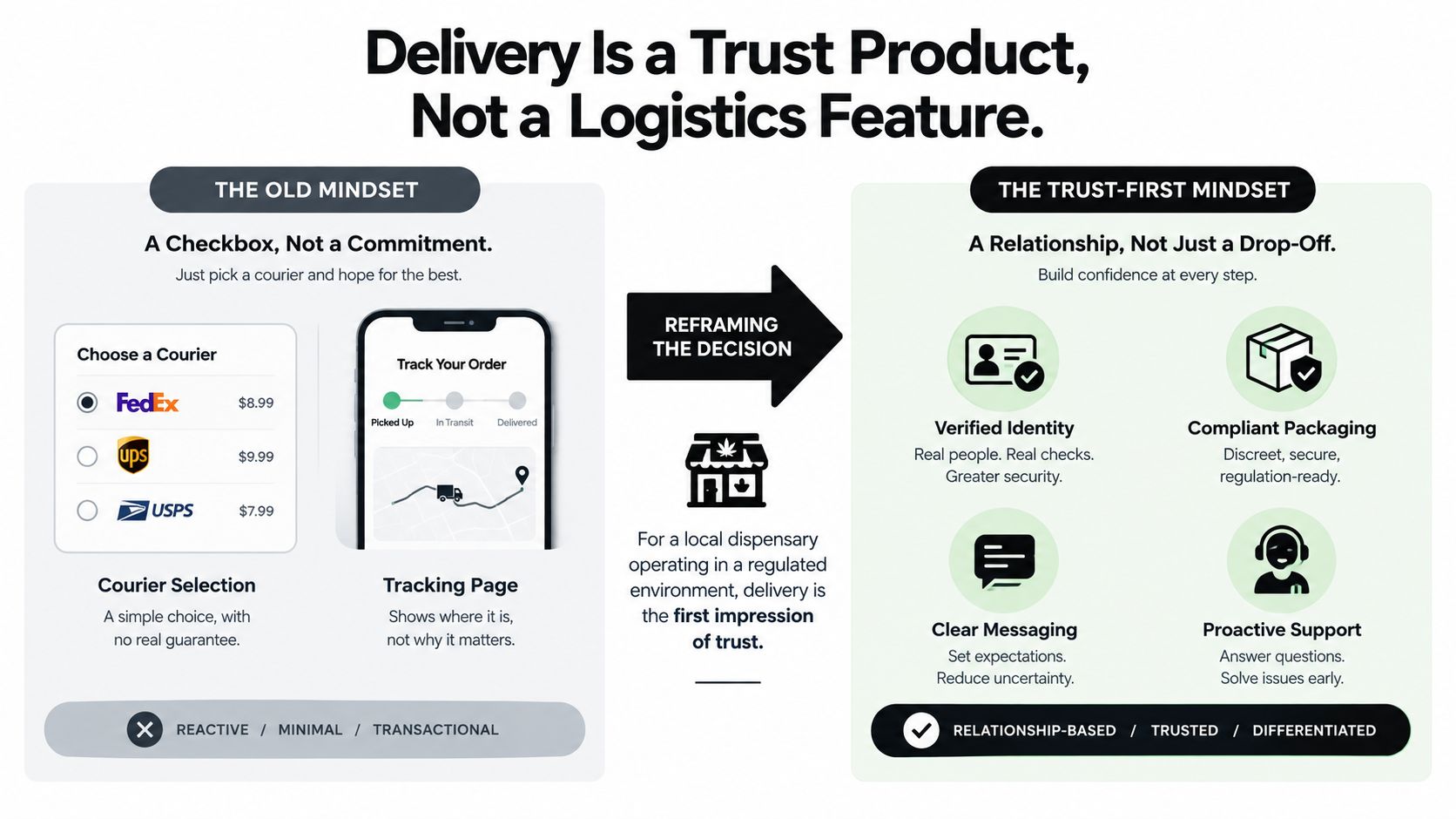
Set the promise before choosing the provider
For lawful consumer goods, define the minimum order, service window, chain of custody, and verification step before comparing courier quotes. Each answers a different question: Is the order economically viable? When will it arrive? Who handled it? What must happen before release?
Delivery Decisions by Business Priority
| Priority | What to Optimize For | Avoid |
|---|---|---|
| Customer trust | Accurate promises and accessible support | Speed claims staff can't consistently honor |
| Legal exposure | Documented authorization and clear restrictions | Treating availability as proof of legality |
| Product integrity | Traceability and appropriate handling | Unrecorded substitutions |
| Margin | Contribution after complete service costs | Pricing against fuel alone |
| Privacy | Necessary information with limited access | Sharing customer details indiscriminately |
Practical rule: Don't advertise a service promise until someone owns the process for handling its failure.
A serious labeling or legal failure deserves more attention than an ordinary delay. That doesn't mean every package needs an elaborate bureaucracy. It means the business must distinguish inconvenience from an incident requiring immediate escalation.
My recommendation is straightforward: choose the delivery model that preserves accountability, then improve speed inside that boundary. A slightly narrower promise is preferable to a broader one that drivers, support staff, and customers interpret differently.
The Three Delivery Models and Their Real Trade-offs
Online purchasing is a substantial retail channel: the Census Bureau estimated $1.2337 trillion in U.S. retail e-commerce sales during 2025, representing 16.4% of retail sales, although those purchases include pickup and other fulfillment arrangements rather than delivery alone (Census retail e-commerce estimates). That scale supports taking fulfillment seriously. It doesn't tell you which delivery model fits your business.
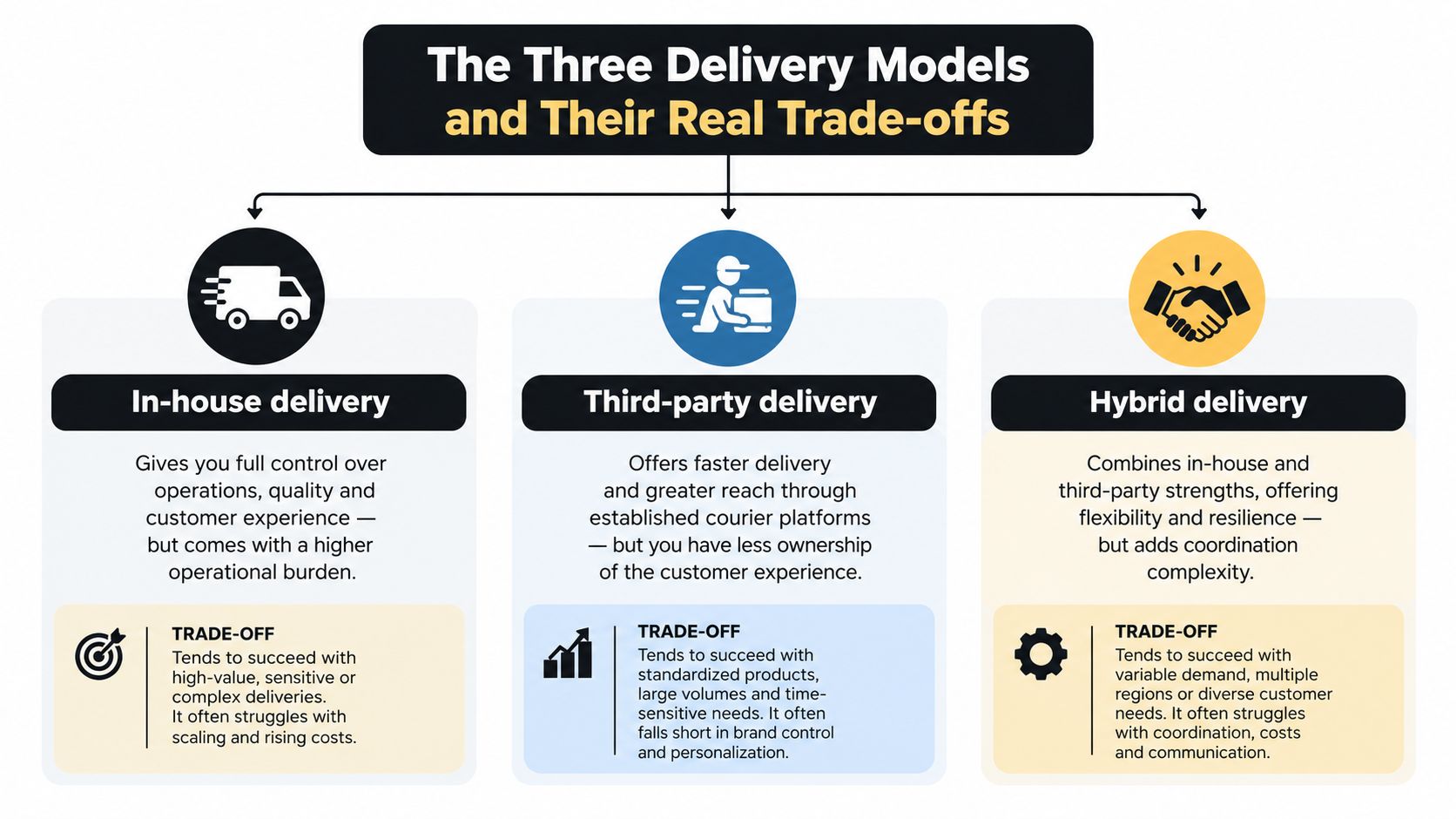
In-house ownership versus contracted capacity
In-house delivery puts staffing, dispatch, customer communication, and vehicle arrangements under direct management. Choose it for lawful goods when handling requirements justify close supervision and demand supports a dedicated operation.
Don't choose it merely because an employee owns a car. Assign a coordinator, confirm insurance suitability, and establish who can approve exceptions. Otherwise, the owner becomes the dispatcher whenever anything changes.
Third-party delivery buys capacity without requiring the retailer to manage every driver. It's a sensible option for ordinary lawful goods when a provider's contract explicitly accepts the products and service requirements.
Evaluate more than the quoted fee:
- Customer access: Confirm whether your support team can retrieve delivery records.
- Responsibility: Specify who investigates loss, damage, or failed handoffs.
- Data use: Understand what customer information the provider retains.
- Product acceptance: Get written confirmation rather than relying on a salesperson's assurance.
Hybrid delivery needs a single accountable owner
A hybrid model combines an internal core with contracted overflow. It's my preferred starting point for lawful specialty retail when demand varies, but only if both channels follow compatible controls.
Don't let overflow become an exception to your standards. A provider that can't meet the required handling or documentation conditions isn't usable backup capacity.
Recurring-order formats, such as the mushroom subscription box page, also deserve separate scrutiny. Recurrence must never bypass current product authorization, customer consent, or applicable restrictions. Predictable scheduling is useful only after those conditions are satisfied.
Cost Drivers and Pricing Strategies That Actually Move Margin
Copying another retailer's delivery fee is not a pricing strategy. You don't know its labor arrangements, refund burden, geographic density, or willingness to subsidize fulfillment.
Global scale doesn't solve that problem. Pitney Bowes reported 161 billion parcels in 2022, compared with 64 billion in 2016, with the United States, China, and Japan accounting for 87% of measured volume (Pitney Bowes Global Parcel Shipping Index). A local retailer still needs its own cost ledger.
Build the cost ledger before setting the fee
For lawful goods, separate costs that occur on every completed delivery from costs that appear only when staff review the operation.
| Cost Layer | What to Include | Common Omission |
|---|---|---|
| Direct fulfillment | Driver labor, mileage, packaging, processing | Time spent waiting |
| Operating overhead | Insurance, coordination, training, systems | Owner management time |
| Exceptions | Failed attempts, rework, refunds, support | Investigation and replacement handling |
| Governance | Recordkeeping, legal review, privacy controls | Updating procedures after changes |
Use contribution after fulfillment, not basket revenue, as the decision metric.
Contribution = collected revenue minus product cost, discounts, processing, fulfillment, and allocated exception costs.
That's an operating calculation, not a promise that every expense can be forecast perfectly. Review actual completed orders and reconcile estimates against recorded costs.
A delivery fee can look competitive while the underlying service loses money. Measure what the customer's order leaves behind, not just what the customer pays.
Minimum orders should reflect the contribution required to serve a route, not encourage unnecessary purchases. Where a minimum doesn't fit customer demand, a clearly disclosed fee or a narrower service area may be the better choice.
Evaluate bundles and loyalty discounts against the same contribution floor. Don't stack promotions without checking the final result, and don't use discounts to encourage greater consumption of intoxicating products. Commercial incentives should never override safety messaging or legal restrictions.
The Operational Workflow From Order to Verified Handoff
A useful workflow lets an employee explain what happened without reconstructing the order from scattered messages. For lawful goods, maintain a consistent order record, attach the relevant handling information, and make unresolved exceptions visible.
The objective isn't maximum data collection. It's enough reliable information to establish authorization, product identity, handling, and resolution without retaining unnecessary personal details.
Make each transition explicit
Delivery Workflow Stages and Controls
| Stage | Action | Required Control |
|---|---|---|
| Order capture | Record the request | Approved product and service eligibility |
| Confirmation | Confirm the agreed terms | Customer acknowledgment where required |
| Selection | Match stock to the order | Product identifier and applicable date checks |
| Packaging | Prepare the goods | Package integrity and handling instructions |
| Dispatch | Assign authorized custody | Recorded transfer and responsible person |
| Handoff | Complete the permitted release | Required verification and delivery record |
| Exception handling | Resolve an unsuccessful delivery | Named owner and documented disposition |
Text-based ordering deserves the same record discipline as a checkout system. A text-message ordering system should be evaluated for how it captures consent, protects personal information, and transfers a request into an auditable process, not merely for convenience.
Match environmental controls to the product
For foods requiring time and temperature control, the cited Washington food-safety rule specifies cold holding at 41°F (5°C) or below (Washington cold-holding requirements). Don't apply that threshold indiscriminately to every chocolate or beverage. Determine the requirements for the actual formulation and validated storage conditions.
Use first-expire, first-out stock rotation where dates apply. Record relevant batch information and quarantine damaged, leaking, or otherwise compromised stock rather than asking a driver to decide whether it's acceptable.
The exception process needs equal attention. Define who can stop release, authorize a replacement, approve a refund, or escalate a suspected product issue. Drivers shouldn't improvise quality decisions at the doorstep.
These are general controls for authorized retail activity. Documentation doesn't make an otherwise prohibited transaction lawful.
Potency Variability and Why Transparency Beats Variety
A large menu isn't evidence of predictable products. For psilocybin risk education, that distinction matters more than premium-sounding names or attractive packaging.
A recent review reports more than 20-fold variability in psilocybin potency across tested mushrooms, alongside inconsistent levels of other tryptamines (review of mushroom potency variability). That finding supports a conservative conclusion: a strain label alone isn't a reliable assurance of strength or individual effects.
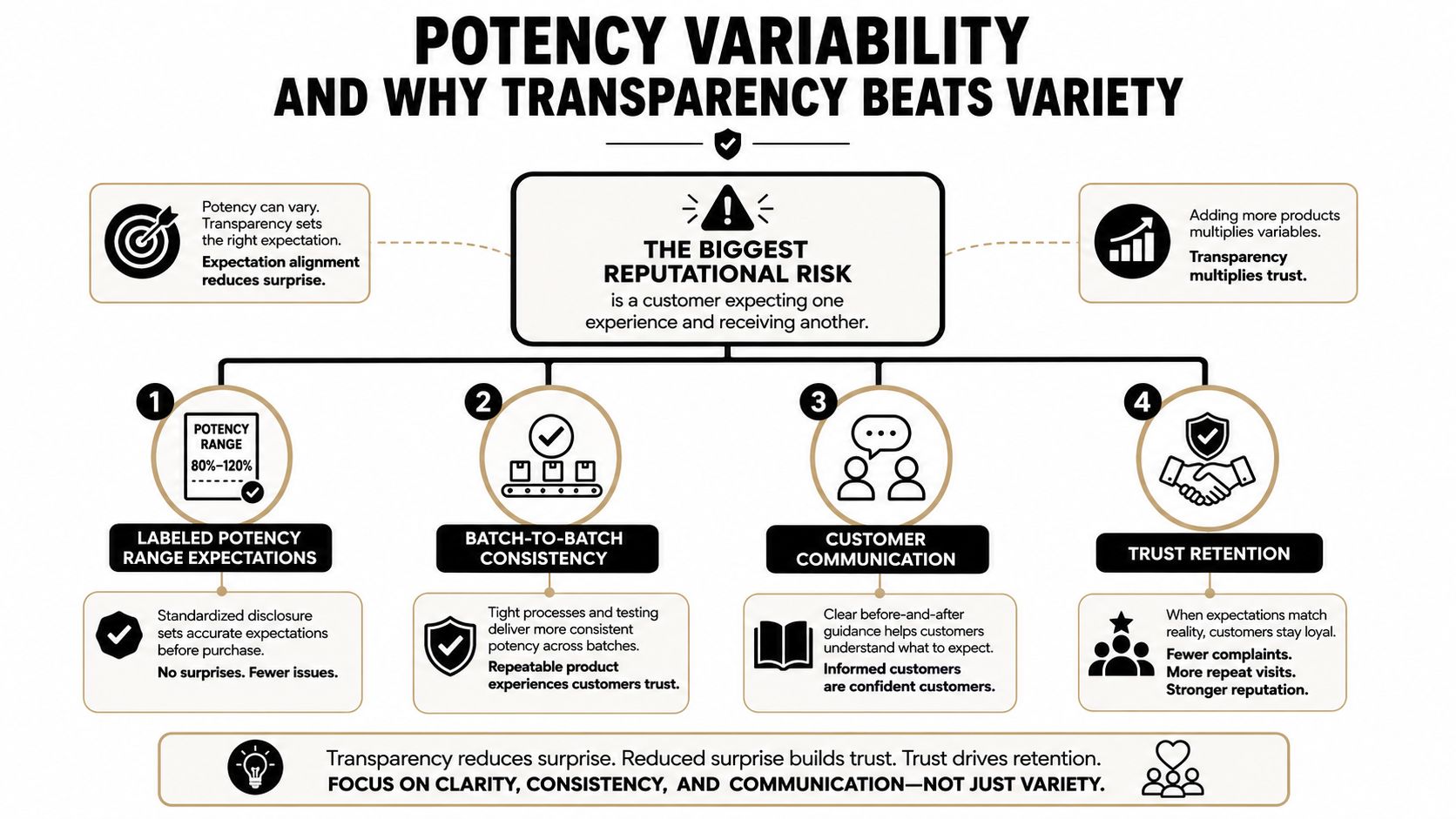
Ask what the label actually establishes
Mushroom weight and measured active-compound content aren't interchangeable descriptions. A label describing material weight doesn't, by itself, establish how much psilocybin is present. Consumers shouldn't have to infer that distinction from branding.
For consumer-protection review, ask:
- Batch relevance: Does any laboratory documentation correspond to the actual batch?
- Testing scope: What substances did the laboratory measure, and what remains untested?
- Ingredient disclosure: Can the reader identify the declared ingredients without interpreting marketing language?
- Package interpretation: Is it clear whether a statement concerns the whole package or an individual portion?
- Uncertainty: Does the business acknowledge limitations rather than imply a guaranteed experience?
Prefer evidence over assortment
Compare an operation that emphasizes numerous named varieties with one that provides understandable, batch-linked documentation. I'd place more confidence in the documentation, provided it's authentic, relevant, and independently interpretable.
That isn't a guarantee of safety. Testing cannot establish that a product is appropriate for a particular person, and clear labeling doesn't resolve legality.
The operational lesson is narrower and more useful: traceability should connect the product, its documentation, and the customer's question. A support representative should be able to investigate a concern without guessing which batch the customer received.
Don't convert uncertainty into a marketing opportunity. If the business can't substantiate a potency statement, remove the statement. Expanding the menu won't fix missing evidence.
Local Compliance, Pharmacokinetics, and Responsible Messaging
For a Detroit–Ann Arbor business, the first compliance question isn't whether people describe the category as decriminalized. It's whether the specific activity is permitted at the origin, destination, and throughout the proposed transaction.
Don't describe local policy changes as blanket permission. Possession, sale, commercial delivery, and transport require separate legal analysis. Availability on a website isn't a legal determination, and a customer visiting from another state shouldn't receive assurances about taking products home without qualified advice.

Separate legal review from health education
Ask qualified counsel to document the activities the business may conduct and the circumstances requiring a stop or fresh review. Avoid unsupported claims about the present effect of a named local proposal or ordinance.
Health communication needs similar discipline. A clinical review describes typical subjective onset after oral administration at approximately 20–40 minutes, peak effects around 60–90 minutes, and active effects lasting 4–6 hours, with psilocin detectable in plasma around 30 minutes (clinical review of psilocybin pharmacology). These are general observations, not a timetable an individual can rely on.
Write warnings that people can act on
Consumer-facing safety information should be plain and non-promotional:
- Delayed effects: Don't interpret an absence of immediate effects as evidence that taking more is safe.
- Impairment: Don't drive or operate machinery after use.
- Other substances: Avoid combining intoxicating products with alcohol, cannabis, or other drugs.
- Storage: Keep products secured away from children and pets.
- Urgent symptoms: Seek emergency medical help for chest pain, seizures, dangerous behavior, severe confusion, or persistent vomiting.
Responsible messaging describes uncertainty honestly. It doesn't promise a pleasant experience, a therapeutic result, or a predictable return to normal activity.
Keep emergency guidance separate from routine customer support. A support inbox is not medical care, and employees shouldn't attempt diagnosis.
Choosing Your Delivery Model in One Side-by-Side View
Choose the model by identifying your non-negotiable constraints, not by counting attractive features. For lawful specialty retail, my default recommendation is an internal accountable owner with contracted capacity only where the provider meets the same requirements.
Compare control rather than headline price
| Decision Dimension | In-House | Third-Party | Hybrid |
|---|---|---|---|
| Customer relationship | Directly managed | Depends on contract and platform access | Direct ownership is possible |
| Compliance oversight | Direct supervision | Requires provider diligence | Requires consistent standards |
| Capacity changes | Requires staffing decisions | Depends on provider availability | Can combine available resources |
| Fully loaded cost | Labor and vehicle commitments | Fees plus internal coordination | Both cost structures need review |
| Launch preparation | Hiring, training, and systems | Contract and integration review | Internal and external preparation |
| Main management burden | Running the operation | Monitoring the provider | Coordinating both channels |
Pure in-house wins when authorized goods require close handling supervision and the business can support the staffing commitment. It also avoids pretending that a loosely controlled provider offers equivalent oversight.
Pure third-party wins when ordinary lawful products fit an established provider's accepted categories and the retailer doesn't need specialized release controls. Contract terms still matter.
Hybrid is preferable when flexibility is useful, not merely because it sounds balanced. If managing overflow creates more exceptions than it resolves, simplify.
Treat geography as a constraint
A delivery-area map is a starting point for understanding advertised coverage, not proof of legal permission or a guarantee that every address is serviceable.
Keep commercial reach separate from approved reach. Before adding an area, confirm product authorization, provider acceptance, insurance suitability, and customer-support ownership. Don't expand a service boundary just because a driver can reach it.
A 30-Day Tightening Checklist for Your Delivery Service
Use the coming month to close unresolved decisions rather than launch a sweeping rebuild. Give each task an owner, retain evidence of completion, and stop activities whose legal basis remains unclear.
Week one and week two
- Establish the legal boundary: Obtain a written assessment of permitted products and activities. Remove unsupported legality claims from customer-facing material.
- Review the records: For authorized goods, inspect whether staff can connect an order with its product documentation and final disposition.
- Check physical controls: Compare packaging and storage practices with actual product requirements. Resolve discrepancies before adding capacity.
- Assign exception authority: Name who can suspend release, investigate a complaint, and approve a remedy.
Week three and week four
- Revise safety language: Have qualified reviewers assess warnings, escalation instructions, and any health-related statements.
- Reconcile inventory: Compare physical stock with published availability and remove unresolved discrepancies.
- Test accountability: Run a mock complaint through support and document where responsibility becomes unclear.
- Review economics: Recalculate contribution using actual labor, support, and exception costs. Withdraw promotions that fail the agreed margin floor.
The policy background is still changing: an April 2025 roundup described more than three dozen psychedelic-related bills across more than a dozen states during that legislative session (state psychedelic policy roundup). Treat legal review as an ongoing responsibility, not a launch checkbox.
Finish the month with an explicit decision for every unresolved item: approve it with evidence, change it, or stop it. An open issue without an owner isn't a control.
Metro Mush provides an online menu, service-area information, and text-based customer contact for its Detroit–Ann Arbor operation. Visit Metro Mush to review its published information and ask about product documentation, service restrictions, and safety guidance, while independently confirming what local law permits.