

You've got your cart ready, you know what you want, and then the practical question hits. Can you get delivery at your address? That's usually the moment people stop browsing and start second-guessing everything.
That's normal. A delivery area map can look simple on the surface, but it affects almost every part of your order. It determines whether your address qualifies, how fast a driver can realistically reach you, and why two places that seem close on a standard map might be treated very differently for delivery.
If you're in Southeast Michigan, the main service conversation usually starts around Detroit and Ann Arbor. From there, the details matter. Street access matters. Drive time matters. Local traffic patterns matter. If you're still deciding what to order, you can browse where to buy shrooms near Detroit and Ann Arbor and then come back to confirm whether delivery works for your location.
Your Guide to Metro Mush Delivery
Most first-time customers ask the same thing in slightly different ways. “Do you deliver to me?” “Why does my friend get delivery but I don't?” “What if I'm right outside the city?” Those are good questions because a delivery area map isn't just a drawing. It's a service rule.
The easiest way to think about it is this. A delivery map helps a business decide where it can serve customers reliably, not just where it can technically drive. That reliability matters because nobody wants to place an order only to learn later that the route takes too long or falls outside the service zone.
What the map is really doing
A lot of people assume delivery zones are simple circles. They're often not. Delivery areas for service-based businesses can be calculated dynamically using spatial analysis methods that define catchment areas by distance or time thresholds, and those methods can apply a distance decay function so the usefulness of a store drops as distance grows. In that approach, each area can receive an accessibility score based on nearby supply and travel conditions, then be normalized across locations, as described in the Grocery Gap Atlas data methodology.
That sounds technical, but the takeaway is simple. Good delivery maps reflect real movement, not just straight lines.
Practical rule: If a business takes its map seriously, it's thinking about travel conditions, route efficiency, and service consistency before you ever place the order.
What you need to know first
Before you order, focus on three things:
- Your exact address matters: A neighborhood might be covered while one nearby street isn't.
- The map is a starting point: It gives you the broad service footprint, but your precise address is what confirms eligibility.
- Rules work together: Delivery area, order minimum, and route planning are connected.
If you treat the delivery area map as your first checkpoint, the rest of the process gets a lot easier.
Exploring Our Delivery Area Map
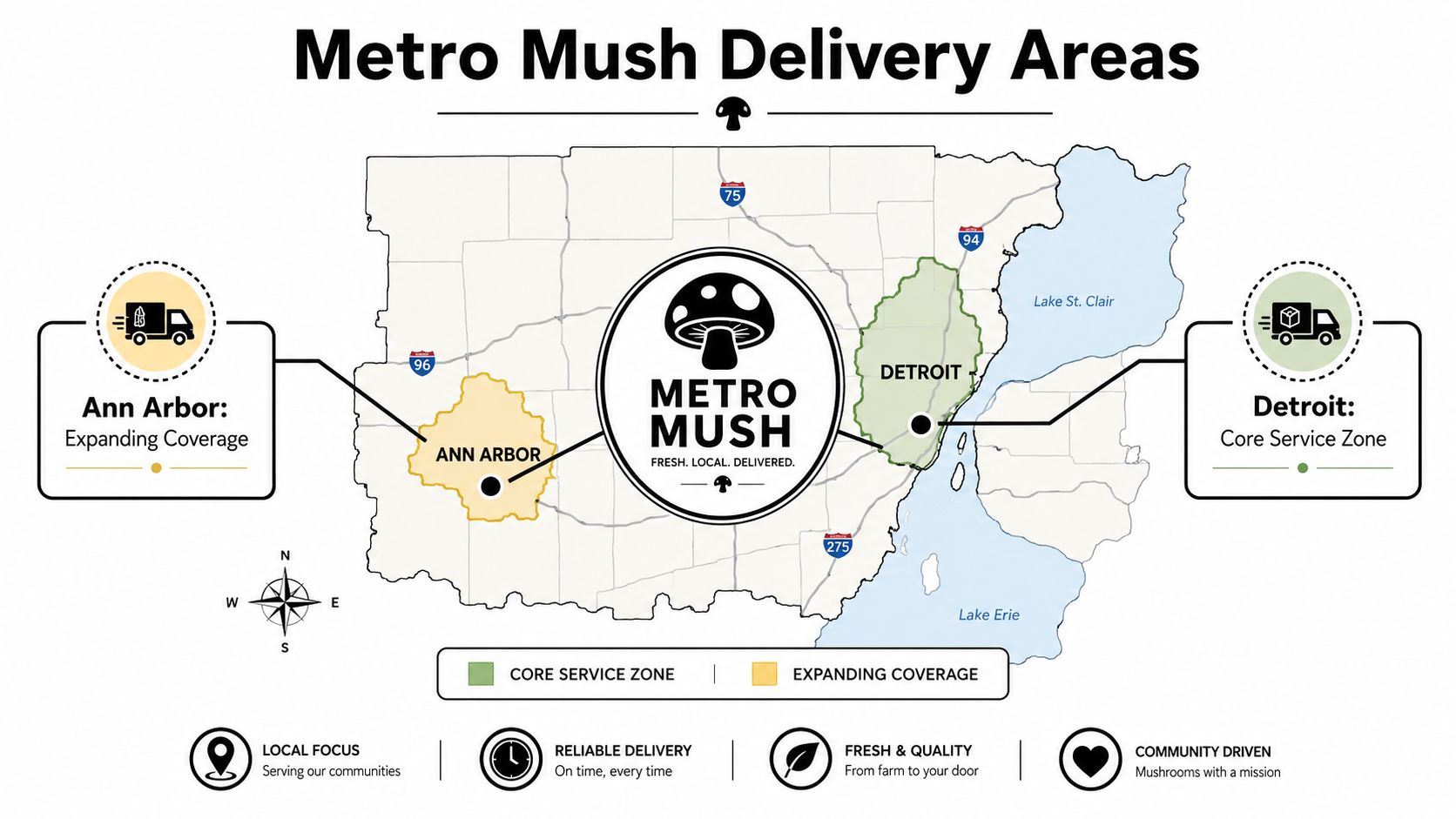
The broad service footprint centers on Detroit and Ann Arbor. Those are the two anchors most customers should have in mind when they're checking whether delivery is possible.
To make that footprint easier to understand, start with the visual below.
Why the boundaries don't look like a perfect circle
A common misunderstanding is that delivery should work like “everything within X miles.” In practice, that's not how strong delivery planning works. Isochrone territory mapping defines service zones by drive time rather than simple distance. A 30-minute isochrone map can account for traffic and road geometry so drivers can complete round trips within a target duration, which is more useful for dependable service than a basic radius, according to Smappen's explanation of isochrone territory mapping.
That's why a place that looks close on a map might still fall outside the zone. A short straight-line distance can turn into a slower real-world route if traffic patterns, road access, or turn restrictions work against it.
Detroit and Ann Arbor work differently on the road
Detroit routes and Ann Arbor routes can feel different even when the mileage looks similar. Dense streets, congestion, construction patterns, and the way neighborhoods connect to major roads all shape how a driver moves through the area.
That matters because customers usually care about one thing above all else. They want their order to arrive within a reasonable, dependable window. A drive-time map helps set those expectations accurately.
A delivery area map is less about geography on paper and more about travel time on actual roads.
Why some mapping terms can be confusing
You may also see ZIP codes used in delivery tools, which can create confusion. In ArcGIS Business Analyst's June 2026 release, Esri explains that ZIP codes are used to assess street networks and housing units for delivery routes, but they are not standard census geographic areas for data analysis. By contrast, ZIP Code Tabulation Areas (ZCTAs) are generalized area representations built using 2020 Census tabulation blocks, and the release notes also say census tract-level data will be available in workflows that use the data browser, improving mapping granularity for business use cases in that release, as outlined in Esri's geographic boundaries update.
You don't need to memorize that terminology. The plain-English version is that not every “ZIP-based” map is equally precise. A strong delivery area map uses location data carefully so the service boundary matches the roads people use.
How to Check Your Specific Address
A broad map helps you understand the region. Your exact address is what gives you the precise answer.
Use the address checker instead of guessing from city borders or assuming your ZIP code tells the whole story. If you're browsing options first, the mushrooms near me page can help you orient yourself before you verify your location.
The fastest way to confirm eligibility
Enter the full address exactly as you'd use it for delivery. That usually means street number, street name, city, and ZIP code. Small details matter more than people expect, especially in apartment complexes, new developments, or places near service edges.
Here's the cleanest way to do it:
- Type your full street address rather than only the ZIP code.
- Double-check spelling and unit details if your building has multiple entrances.
- Submit the address and wait for the result before building your final order.
- If the result seems off, ask for clarification instead of assuming the tool is wrong.
Borderline addresses need extra attention
Some customers live in areas where the answer isn't obvious. Maybe your town borders a covered area. Maybe your route crosses a traffic-heavy corridor. Maybe your mailing address says one city, but your actual access road works more like another zone.
In those cases, don't rely on a visual guess. Use the checker first, then confirm with customer support if needed. That approach avoids the most common first-order mistake, which is planning your purchase around an address that hasn't been verified.
If your address is close to the edge of the zone, the address checker matters more than the map image.
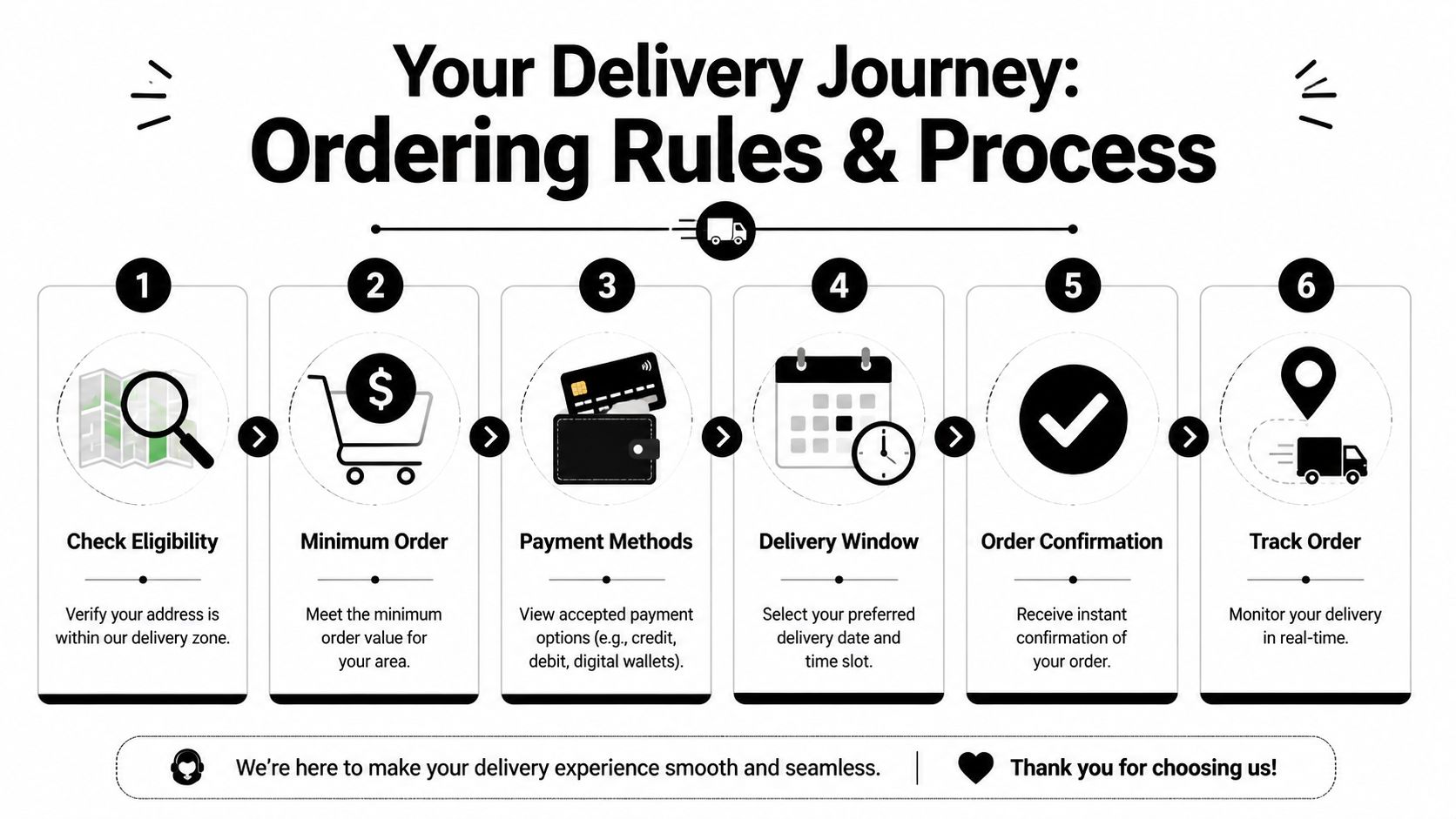
Ordering Rules and Delivery Process
Once your address qualifies, the process gets straightforward. The key is understanding that delivery rules exist to keep service predictable for both customers and drivers.
The main rule to know
The $75 minimum order and the delivery zone work together. That isn't arbitrary. Industry benchmarks described by RadiusMapper's delivery area guidance note that delivery zones are typically defined by drive time, with many on-demand services targeting 30 to 45 minute isochrones to balance coverage and speed. The same source explains that drive-time mapping helps businesses keep minimum order values aligned with a workable delivery window.
In plain terms, the order minimum helps support a delivery model that doesn't stretch too far or promise more than the route can handle.
What the process looks like
For a first order, think in this sequence:
- Confirm the address first: Don't place the order and hope the route works out later.
- Meet the minimum: Your cart needs to reach $75.
- Use the correct contact line: Detroit Metro orders go to 734-691-6122. Ann Arbor Metro orders go to 734-280-2868.
- Be ready to respond: If the team needs to confirm details, a quick reply helps avoid delays.
A simple reference table
| Area | Ordering method | Contact |
|---|---|---|
| Detroit Metro | Text to order | 734-691-6122 |
| Ann Arbor Metro | Text to order | 734-280-2868 |
What to expect at delivery
When the driver arrives, the smoothest handoff usually comes down to basic preparation.
- Have your ID ready: Don't wait until the driver is outside to start looking for it.
- Watch your phone: Delivery updates and arrival coordination often happen quickly.
- Choose a clear drop-off point: Gate codes, side entrances, and apartment instructions help.
- Stay realistic about timing: Road conditions can affect routes even when the order is properly placed.
The most successful deliveries happen when the customer treats the process like a scheduled handoff, not a vague arrival sometime later.
Tips for Your First Delivery
First orders go best when you keep them simple. Pick products you understand, verify your address before you get attached to a cart, and make the handoff easy when the driver arrives.
Make your first order easier on yourself
Some customers build a huge cart their first time because they don't want to “mess up” the order. Others go too vague and don't know what to choose. A better middle ground is to start with familiar formats.
If you prefer measured, approachable options, edibles and drinks tend to feel easier to evaluate than jumping straight into a strain decision. Products like OuterSpore Milk Chocolate Bars, Mush Love Chocolate Bars, Rocket Fuel shroom drinks, and Moon Bars are easier for many first-time shoppers to compare because the format is immediately recognizable.
Use the promos that fit how you shop
Good ordering habits aren't only about logistics. They're also about value.
A few offers are especially useful for a first purchase:
- Mix & Match Saturdays: You can combine any three chocolate bars or drinks for $100, with savings of up to $40.
- Discord community discount: Joining the community provides 20% off and keeps you updated on new drops and promotions.
- Community thank-you discount: Fire, police, and veterans receive 10% off.
Those details can help you build a cart that reaches the minimum without feeling random.
Small planning choices make a first delivery feel smooth. Choose products in a format you already understand, keep your phone nearby, and make sure your address details are accurate.
Keep the handoff low-stress
Customers often worry most about the last few minutes. In reality, that part is usually the simplest. Be available, keep your phone on, and know where you want the delivery to happen.
If you live in an apartment or a building with restricted entry, send clear instructions early. If your house is hard to identify at night, a porch light helps. Tiny details like that save time and reduce confusion.
Frequently Asked Questions
Why am I close to a covered area but still outside the zone
Because delivery zones are commercial service decisions, not simple neighborhood outlines. A place can sit near a covered area and still fall outside the service boundary if the route doesn't support consistent delivery.
That can feel unfair at first glance, but it's usually a reliability decision rather than an oversight.
Does a delivery area map match underserved government service areas
No. A delivery area map is not the same thing as an official government access designation. According to HRSA shortage area information, people often confuse commercial delivery coverage with medically underserved or shortage-area designations. The verified guidance for this topic is clear that a delivery area map is a commercial tool and does not directly correlate with MUA/P zones, even though parts of Wayne and Oakland counties include those designated areas.
That distinction matters because customers sometimes assume a government-designated need area should automatically receive delivery coverage. Commercial delivery doesn't work that way.
Do delivery maps update in real time during weather or closures
Customers often expect that they do. In reality, public delivery maps usually don't explain update frequency very well. That gap creates confusion during storms, road closures, or temporary disruptions.
If conditions change suddenly, don't assume a map image has already adjusted. The safest move is to confirm directly through customer service contact options before placing or finalizing the order.
Why does ZIP code information sometimes seem inconsistent
Because mailing boundaries and delivery logic aren't always the same thing. A ZIP code is useful, but it isn't always the final word on route eligibility. That's why a full-address check is more reliable than trying to judge your status from ZIP alone.
What's the best way to avoid a first-order problem
Use this checklist:
- Check the exact address
- Build a cart that meets the minimum
- Text the right number for your area
- Keep your ID ready
- Watch your phone near arrival
That's usually all it takes to make the process feel easy.
If you're ready to place your first order, Metro Mush makes it easy to browse products, confirm your area, and text your order for Detroit Metro or Ann Arbor delivery. Start with your address, choose products that fit your comfort level, and order with confidence.