You're probably here because you saw PolkaDot mushroom gummies in a smoke shop, gas station, or online store and wanted a straight answer before trying them. The packaging looks polished. The names sound familiar. Some products even look like they belong next to ordinary candy.
That's the problem.
With these gummies, the label, the branding, and the actual contents often don't match. For an adult consumer in Detroit or Ann Arbor, curiosity is understandable. But curiosity needs a hard reality check when a product category is tied to recalls, hospitalizations, and warnings from public health agencies.
This guide is meant to do one thing clearly. Help you understand what PolkaDot gummies are supposed to be, why many products sold under that name are risky, and why a tested, transparent alternative is a safer path than buying mystery edibles from the gray market.
The Growing Curiosity Around Polkadot Gummies
A lot of people encounter these products the same way. They're standing at a checkout counter, scanning shelves of vapes, hemp products, novelty snacks, and mushroom items. Then they spot a colorful box of gummies with the word PolkaDot on it. The packaging suggests a mellow, almost wellness-style experience. It doesn't look threatening. It looks familiar.
That familiarity lowers people's guard.
The confusion usually starts with one basic question. Are these the same thing as magic mushrooms? In many cases, the answer is no. But that doesn't make them safer. In fact, the gap between what buyers think they're purchasing and what may be inside is where danger starts.
Why people get misled
Most shoppers aren't chemists. They rely on labels, packaging, and store placement. If a product is sitting near legal supplements or common smoke shop items, many people assume someone has checked it. They assume there's a manufacturer behind the brand, a consistent formula, and at least some quality control.
That assumption can be very costly.
Practical rule: If a mushroom gummy looks like candy and gives you no clear, verifiable chain of custody, treat it as untrusted from the start.
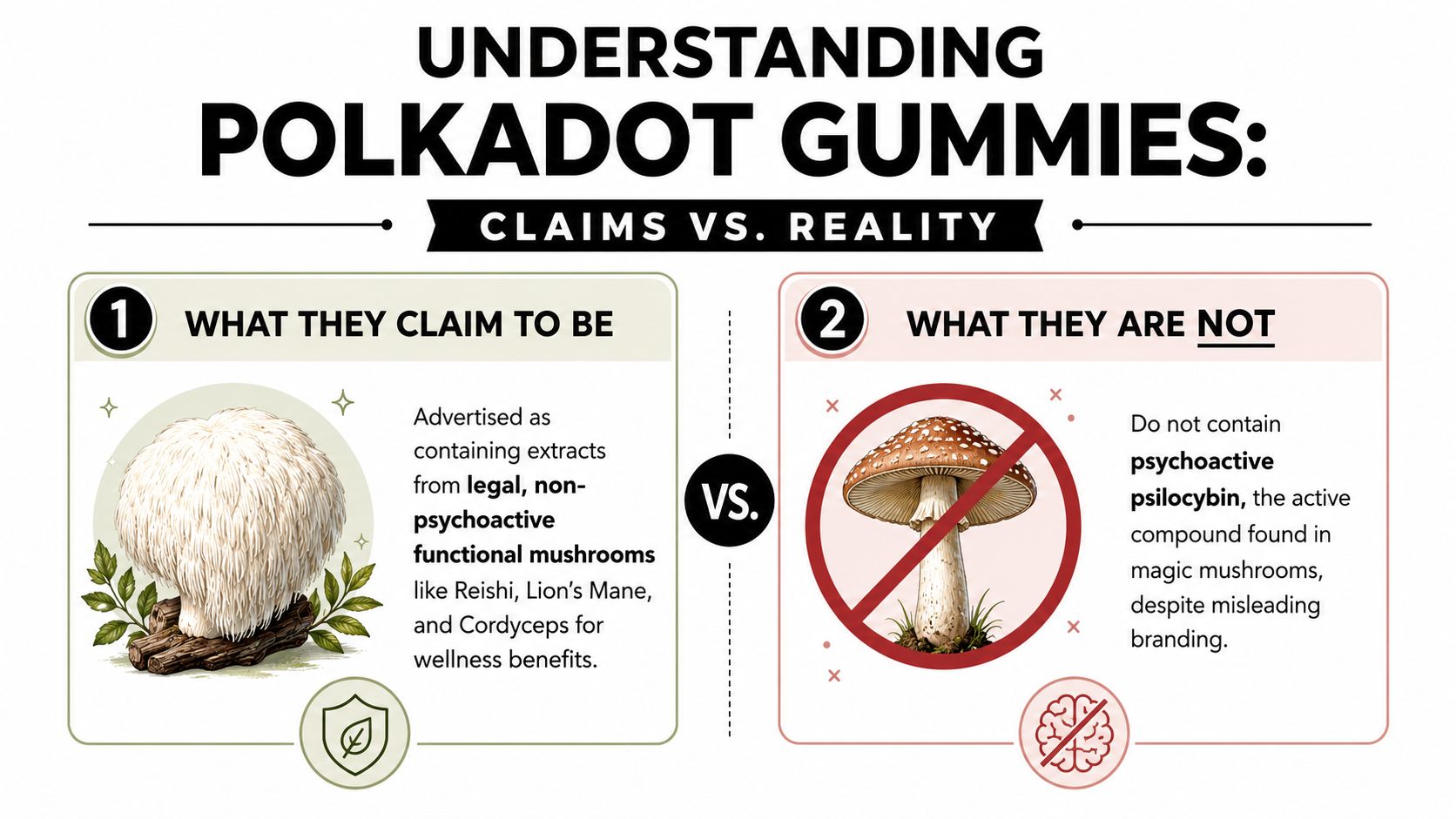
Some buyers also assume that “mushroom” means one of two things. Either it's a harmless wellness blend with lion's mane or reishi, or it's psilocybin. PolkaDot products often sit in the middle of that confusion. The branding hints at a mind-altering effect, but the ingredients and actual chemistry may be something else entirely.
Why this matters locally
In Southeast Michigan, people looking for mushroom products often want one of two things. They want a gentle, controlled first experience, or they want a known psychoactive experience with a product they can understand. PolkaDot gummies are risky because they don't reliably deliver either one.
For first-time buyers, that's especially dangerous. A person might think they're taking a low-key mushroom edible, but they are consuming an unregulated product with unknown compounds. That's not experimentation. That's gambling with your nervous system.
What Are Polkadot Gummies Supposed to Be
On paper, PolkaDot gummies are often presented as Amanita muscaria products, not psilocybin products. That difference matters because these mushrooms act very differently in the body and brain.
Amanita muscaria is the red-and-white mushroom many people recognize from fairy tales and video games. Its main psychoactive compound is muscimol. Legitimate formulas in this category often focus on a specific profile, with around 250 mg of Amanita Muscaria extract per gummy plus 1 mg of pure Muscimol Isolate, and safer preparations aim for 0% Ibotenic Acid because ibotenic acid is the compound's neurotoxic precursor, according to the California Department of Public Health warning.
Amanita is not psilocybin
It's common for readers to get tripped up on this distinction: Psilocybin and muscimol are not interchangeable. They don't act on the same systems in the same way, and they don't usually produce the same kind of experience.
A simple way to think about it is this:
| Compound | Usually associated with | General feel |
|---|---|---|
| Psilocybin | Serotonin-related psychedelic effects | More perceptual, emotional, introspective |
| Muscimol | GABA-related psychoactive effects | More sedating, dreamlike, dissociative |
That table is a simplification, but it helps. If psilocybin tends to shift perception and thought patterns, muscimol often feels more like a strange dream state, sometimes heavy, foggy, or disorienting.
Why ibotenic acid matters
Amanita discussions often mention ibotenic acid because it's a serious quality issue. In safer preparations, processors try to reduce or eliminate it. If that step isn't done properly, the product may carry more physical and neurological risk.
That's why “mushroom gummy” isn't enough information. You need to know which mushroom, which active compounds, and whether the product was made with any real chemical control. Without that, the label is mostly decoration.
A package can say “mushroom blend” and still tell you almost nothing useful about what experience or risk you're buying.
The Dangerous Reality of Unregulated Gummies
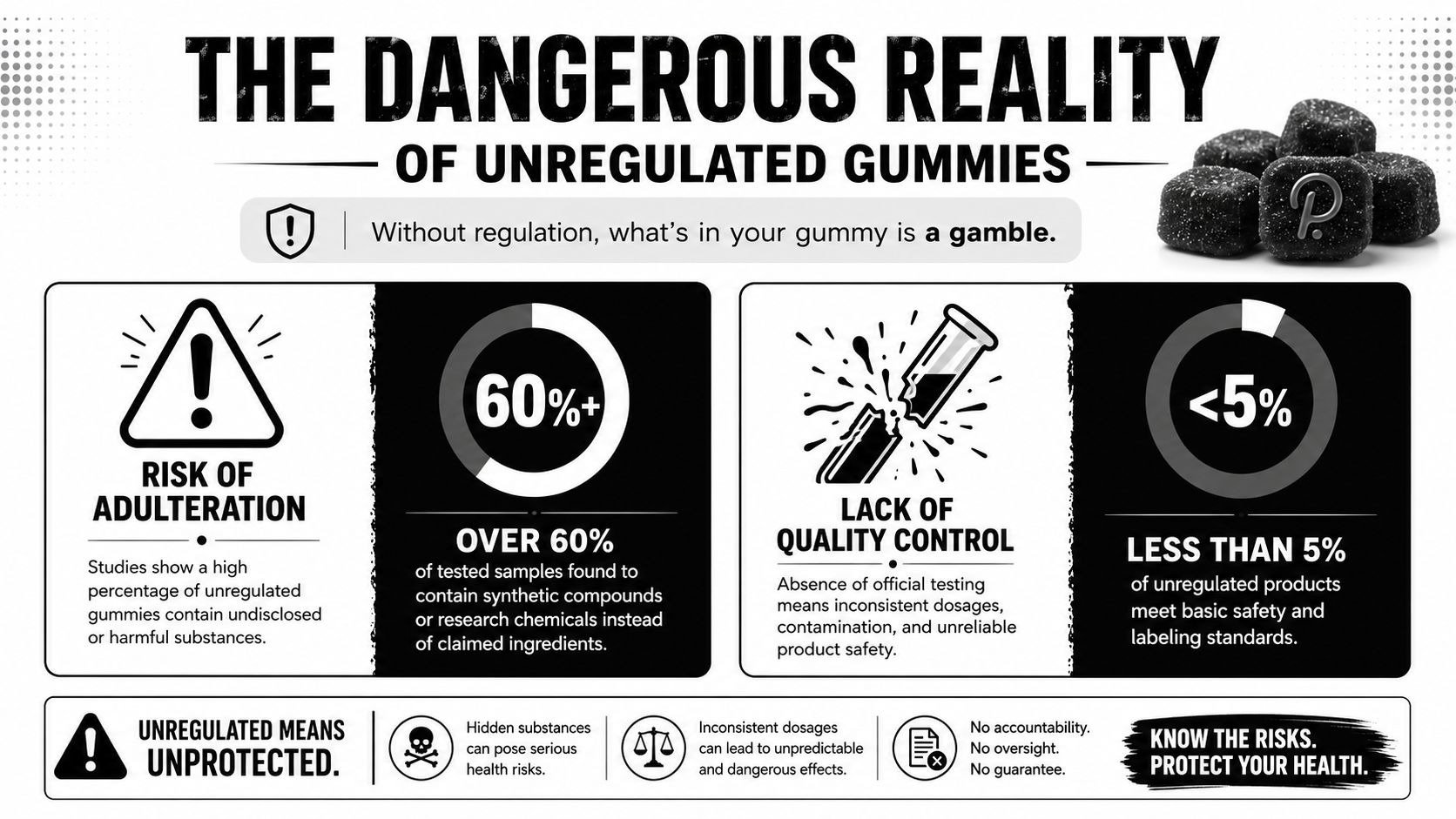
The safest way to understand this market is to stop thinking of PolkaDot as a single trustworthy maker. In practice, it often behaves more like a packaging style than a verified manufacturer. Similar wrappers can circulate through unrelated sellers, and the contents can vary widely.
That's not just a theoretical concern. It has already shown up in public health alerts and enforcement actions.
According to FDA-linked reporting by ABC News, as of July 23, 2024, 74 confirmed illnesses across 28 states were linked to recalled mushroom-based chocolate and gummy products, including PolkaDot-branded items. 62 of the 74 people sought medical care, and 38 were hospitalized. The same report says the illnesses were tied to psychoactive contaminants, including synthetic tryptamines not commonly found in legitimate psilocybin edibles.
The label may not match the chemistry
That's the core risk. A buyer may think they're getting an Amanita gummy, or a harmless “functional mushroom” product, when the product may contain something else entirely.
The danger isn't only that the ingredients are strong. It's that they're undisclosed and inconsistent.
A package might suggest lion's mane, reishi, or cordyceps. The actual edible may contain synthetic psychoactive compounds. It may also differ from batch to batch, store to store, or city to city. For consumers, that means there's no dependable baseline for effect, dose, onset, or interaction risk.
Why smoke shop availability doesn't mean safety
People often read shelf placement as proof. If a product is sold openly, they assume someone vetted it. But unregulated products can still reach retail shelves.
That's why “I bought it in a store” isn't a meaningful safety check.
If you're trying to understand what a more transparent edible category looks like, compare that chaos with products built around disclosed ingredients and clearer sourcing, such as freeze-dried mushroom edibles from Metro Mush. The difference isn't branding. It's traceability.
Red flags that should stop you
- Vague mushroom language: Labels that say “blend” without naming active compounds.
- No verifiable maker: You can't confirm who produced it, tested it, or distributed it.
- Candy-style presentation: The more it resembles ordinary sweets, the easier it is to underestimate.
- Claims without proof: “Lab tested” on packaging means little if the seller can't show a credible test tied to that exact product.
If you can't answer “who made this, what's in it, and how was it verified,” you don't have enough information to consume it responsibly.
Expected Effects Dosing and Timelines
If a gummy were a clean, accurately labeled muscimol product, the experience could still be unusual and hard to predict for new users. People often describe that type of effect as dreamy, heavy, detached, or oddly cyclical. Time can feel off. Thoughts can loop. Body coordination may feel less reliable.
That's already far from the picture many buyers have in mind.
Some people expect a classic psychedelic arc, meaning brighter visuals, emotional openness, and a recognizable psilocybin-style progression. A muscimol-driven experience can feel different enough that first-time users may think something is wrong because the effect profile doesn't match their expectations.
Why printed dosage can't be trusted
With unregulated PolkaDot gummies, dosage guidance on the package may be the least useful information on the box. If the contents vary, then “take one” or “start with half” isn't a dependable instruction. It's just printing.
That creates a serious problem for anyone trying to be cautious. A person may believe they're “starting low” while still taking a risky amount of an undisclosed compound. Another person may take the same branded gummy from a different source and get a completely different result.
Here's where readers often get confused. They assume uncertainty means the product might just be weaker or stronger than advertised. The bigger issue is broader than potency. The issue is that the substance itself may not be what you think it is.
What unpredictability looks like in practice
Instead of a stable timeline, people can face a messy range of reactions:
- Unexpected physical distress: nausea, shaking, weakness, or feeling suddenly unwell
- A mental state that turns hard to manage: anxiety, confusion, panic, or dissociation
- An uneven onset: little effect at first, followed by a sharp shift later
- A duration that doesn't match the label: shorter than expected, longer than expected, or strangely inconsistent
Start-low advice only works when the product itself is known. With mystery gummies, low dose does not mean low risk.
That's why dosing discussions around PolkaDot gummies often create false confidence. In a regulated setting, dosage is a measurement. In an unregulated setting, it can become guesswork dressed up as precision.
Polkadot Gummies vs Psilocybin Edibles A Critical Comparison
For many adults, the choice isn't “Should I try mushrooms at all?” It's “What kind of product gives me the clearest idea of what I'm taking?” That's the right question.
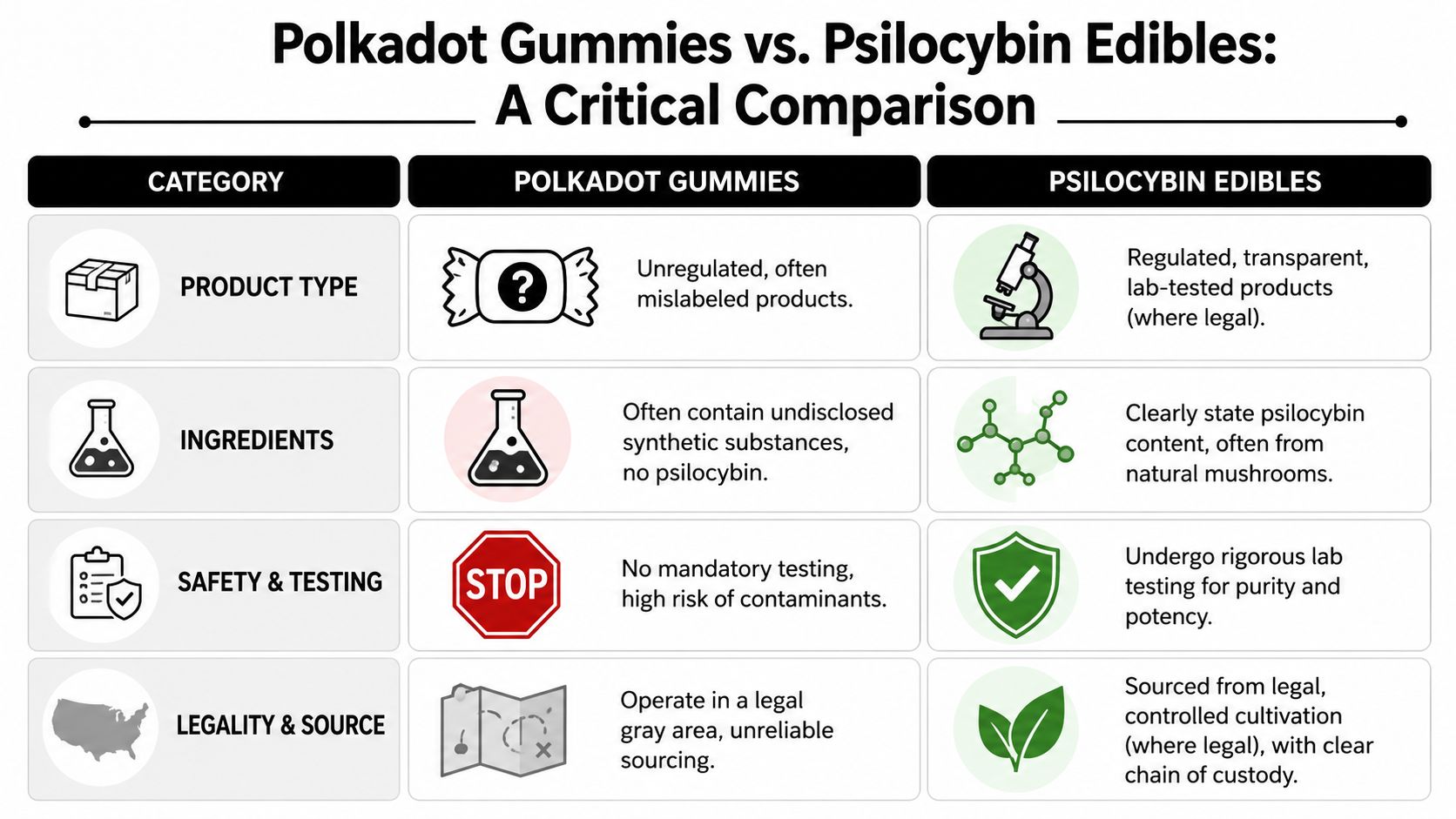
PolkaDot gummies fail that test because the category has become associated with mislabeling, adulteration, and unclear sourcing. In Denver, inspectors seized over $3 million in unregulated PolkaDot products that were falsely labeled as containing only non-hallucinogenic mushrooms like lion's mane, and lab tests found illegal psychoactive components including synthetic psilocybin analogs, according to The Conversation's reporting on the Colorado enforcement action.
A simpler way to compare them
| Question | PolkaDot gummies | Psilocybin edibles |
|---|---|---|
| What's the active ingredient? | Often unclear or unreliable | More straightforward when properly disclosed |
| Where did it come from? | Often difficult to verify | Easier to verify when sourced through a transparent local provider |
| What should the experience feel like? | Unpredictable | More commonly understood and easier to discuss responsibly |
| Can you compare one batch to another? | Not with confidence | More consistent when product standards are clear |
That doesn't mean psilocybin products are casual or risk-free. They still require respect, careful setting, and responsible use. But there's a huge difference between a known psychoactive category and a candy-branded product that may contain undisclosed synthetics.
Why transparency beats novelty
A lot of buyers get drawn to PolkaDot gummies because they seem convenient. No prep. No grinder. No mushroom taste. But convenience doesn't help if the product itself is a black box.
That's why many experienced consumers prefer products with disclosed ingredients and a more stable edible format, including psilocybin chocolate bars from Metro Mush. The point isn't that chocolate is necessarily safer than gummies. The point is that transparency is safer than mystery.
The safer choice usually looks less flashy. It tells you what it is instead of making you guess.
If your goal is a deliberate mushroom experience, an unknown gummy sold through the gray market is a poor tool for that job.
Harm Reduction and Responsible Choices
If someone is still considering PolkaDot mushroom gummies after all of this, the most honest guidance is blunt. The best harm reduction choice is to skip them.
Public health warnings have stressed that consumers have very little reliable guidance for verifying product safety, and identical packaging kits from unconnected entities can lead to major variation in composition. Those warnings also note a serious risk for children who may mistake these products for regular candy, as described in the California enforcement and warning summary published by CSLEA.
If someone ignores that advice
A few practical steps can reduce the chance of a crisis, even though they can't make an unregulated product safe:
- Don't use it alone: Another adult should stay present and sober.
- Don't mix it: Alcohol and other substances make a bad situation harder to read and harder to manage.
- Keep it away from children: Store it like a hazardous item, not like a snack.
- Stop at the first sign of physical distress: If someone develops severe confusion, alarming symptoms, or rapid decline, seek medical help.
What responsible use really means
People sometimes talk about harm reduction as if it starts after the purchase. With products like this, it starts before the purchase. It starts with refusing to treat branding as evidence.
If a product has no trustworthy chain of custody, no clear chemistry, and no reliable verification, responsibility means walking away. That's not fear. That's basic judgment.
An adult choice isn't just about deciding to consume something. It's also deciding what isn't worth the risk.
Find Safer Alternatives in Detroit and Ann Arbor
For adults in Southeast Michigan, the practical answer is simple. Avoid PolkaDot products and choose options with clearer sourcing, better product transparency, and a format that doesn't rely on mystery branding.
Metro Mush does not carry PolkaDot gummies. Instead, it focuses on a curated menu of psilocybin products for adult consumers in the Detroit and Ann Arbor areas, including dried mushroom strains and edibles such as OuterSpore Milk Chocolate Bars, Mush Love Chocolate Bars, Rocket Fuel shroom drinks, and Moon Bars.
How local ordering works
If you want a clearer path than smoke shop roulette, start with the Metro Mush location and buying guide. From there, adult customers can browse the menu and place orders by text.
For Detroit Metro, text 734-691-6122.
For Ann Arbor Metro, text 734-280-2868.
A few practical details also help:
- Minimum order: $75
- Mix & Match Saturdays: any 3 bars or drinks for $100
- Service discount: fire, police, and veterans get 10% off
- Community discount: Discord members can get 20% off
Those details matter because safer purchasing isn't only about chemistry. It's also about buying from a local service that tells you what it sells, how ordering works, and what products are on the menu.
If you want a safer, more transparent alternative to PolkaDot mushroom gummies, browse the menu and order directly from Metro Mush. It's a clearer way for Detroit and Ann Arbor adults to find curated psilocybin products without gambling on unregulated candy-style packaging.