You're hearing more people talk about psychedelics, decriminalization, microdosing, and “safer use,” but the term harm reduction can still feel fuzzy. Individuals typically don't walk into a shop or search online seeking a public health lecture. They want practical answers. If I'm curious about psilocybin, what helps me lower risk? What should I avoid? What does “safer” mean in real life?
That's where harm reduction becomes useful. It gives you a way to think clearly about substance use without moralizing, panic, or all-or-nothing rules. It asks a simple question first: How do we reduce the chance of something going wrong?
That question matters far beyond any one substance. The 2024 Global State of Harm Reduction report found that 93 countries provide at least one needle and syringe programme, and 108 countries include harm reduction in national policies. That tells you this isn't some fringe idea. It's an established public health framework that many countries now use in policy and services.
For people exploring psychedelics, that broader view is helpful. Harm reduction isn't just about crisis response. It also includes everyday decisions about dose, setting, support, product knowledge, and knowing when to wait. If you're also trying to understand how supported use fits into mental health conversations, Metro Mush's guide to what psychedelic therapy is can help clarify that separate topic.
Introduction A New Conversation About Safety
A lot of adults in Detroit and Ann Arbor are in the same position. They're not looking for a slogan. They're looking for grounded information that respects their choices and helps them avoid preventable mistakes.
That's why what is harm reduction is such an important question. It shifts the conversation from “Is this good or bad?” to “What lowers risk right now?” In practical terms, that can mean understanding your product, planning your environment, not mixing substances casually, and having a trusted person nearby if you're taking something that may alter perception.
Why the term matters now
The phrase can sound clinical, but the idea is plain. Harm reduction means people deserve support, information, and safer options whether or not they're committed to abstinence.
That approach has become mainstream in public health because it focuses on real harms people face, not idealized behavior. Once you understand that, the concept becomes much easier to apply to psychedelics.
Harm reduction starts with reality. People use substances. Good safety advice has to begin there.
Why it matters for psilocybin users
Psilocybin isn't discussed the same way as opioids, and the risks aren't the same. But the logic still applies. If a person plans to use mushrooms, they need practical steps that reduce the chance of panic, confusion, unsafe behavior, or an emotionally overwhelming experience.
Those steps often get skipped because people assume “natural” means simple. It doesn't. Psilocybin can produce intense effects, and safer use depends on preparation more than optimism.
Defining Harm Reduction What It Is and Isn't
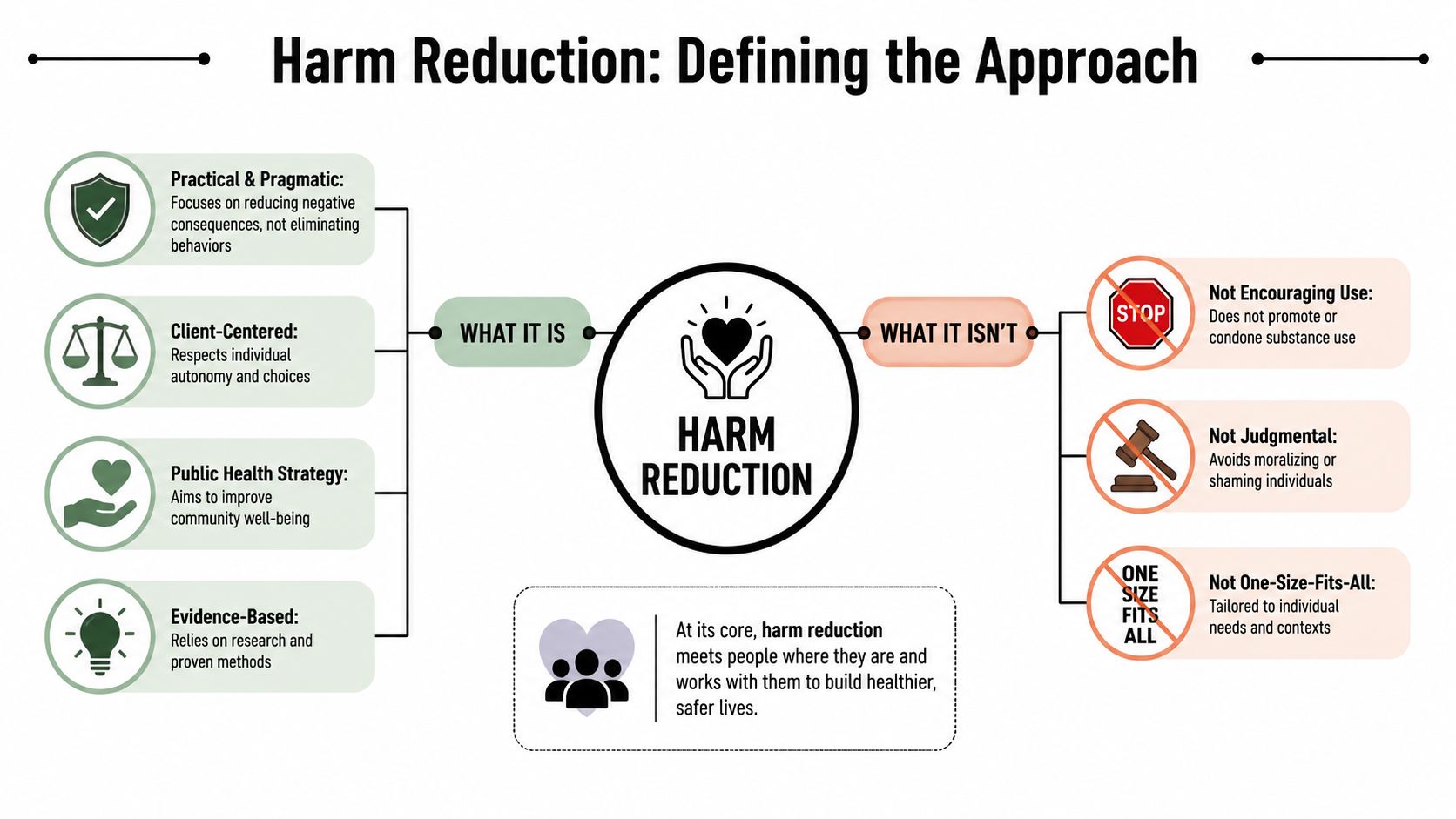
Harm reduction is a public health approach that tries to reduce the harmful consequences of substance use rather than requiring someone to stop before they deserve support. That's the heart of it.
The key point many readers miss is this: harm reduction isn't the opposite of recovery, and it isn't a campaign to encourage drug use. It's a practical way to lower danger, preserve dignity, and keep people connected to care.
What it is
A classic description from the literature says harm reduction is neutral about long-term goals, prioritizes “short-term realizable goals,” and developed in response to “zero tolerance” approaches in the field, as described in this PubMed-indexed article on harm reduction principles.
That sounds abstract until you translate it into ordinary language:
- It meets people where they are. If someone wants to quit, harm reduction can support that. If someone isn't ready to quit, harm reduction still tries to keep them safer.
- It focuses on immediate risk. Fewer infections, fewer overdoses, fewer dangerous situations, fewer preventable crises.
- It treats people as decision-makers. Advice works better when it respects autonomy instead of using shame.
What it isn't
Harm reduction is often misunderstood because people assume only two positions exist: total abstinence or careless use. Real life is more complicated.
It is not:
| Misunderstanding | Better explanation |
|---|---|
| “It tells people drug use is fine.” | It accepts reality and tries to reduce preventable harm. |
| “It blocks recovery.” | It can exist alongside treatment, therapy, and future abstinence goals. |
| “It's only for severe addiction.” | It applies anywhere risk can be lowered, including occasional or experimental use. |
Practical rule: If advice helps a person stay safer, stay healthier, or make a more informed choice, it fits the harm reduction mindset.
Why this distinction matters for psilocybin
This is especially relevant with mushrooms because many adults aren't asking, “How do I enter treatment?” They're asking, “How do I make a thoughtful decision if I choose to use this substance?”
Harm reduction gives a better answer than silence. It doesn't pretend all use is risk-free, and it doesn't pretend that shame is a safety strategy.
The Core Principles of Harm Reduction
The easiest way to understand harm reduction is to think of it as an operating system for safer decisions. It doesn't tell every person to do the exact same thing. It gives you principles that guide better choices in the moment.

Pragmatism over fantasy
The first principle is simple. People use substances, and safety advice has to start from that fact.
A harm reduction approach asks what lowers the intensity of exposure and what reduces uncertainty. A NIH-hosted review on harm reduction tools explains that the technical mechanism is lowering exposure intensity and reducing contaminated-supply uncertainty. It also notes that drug checking identifies chemicals in illicit products, which can support behavior change and counseling when risk is highest.
For psilocybin users, that same logic means trying to reduce unknowns. Unknown potency, unknown identity, unknown interactions, and unknown environment all raise risk.
Dignity and autonomy
People make better decisions when they aren't being shamed. Harm reduction respects that adults need honest information more than lectures.
That doesn't mean “anything goes.” It means guidance should help a person act more carefully. For a mushroom user, that could mean deciding to take less, waiting for a better day, staying home instead of going out, or choosing not to mix with alcohol.
Participation and honesty
Good harm reduction advice comes from real situations, not abstract slogans. It asks what people do and what support would help.
A few examples show how this principle works:
- If people misjudge potency, the answer is clearer labeling, smaller starting amounts, and patience before redosing.
- If people panic when effects rise, the answer is preparation, a calm space, and a trusted sober support person.
- If people combine substances casually, the answer is better education on interactions and why “stacking” can make an experience less predictable.
The safest plan is often the one that removes uncertainty before the experience starts.
Harm Reduction in Action Common Examples
Harm reduction becomes easier to understand when you stop treating it like a theory and start looking at what it does. In public health, it shows up as tools, services, and small interventions that prevent bigger emergencies.
Near the center of that work is overdose prevention. In the United States, overdose deaths surpassed 100,000 in 2021, according to this review on public health impacts and harm reduction evidence. The same review summarizes evidence showing that people in needle and syringe programs had a 34% risk reduction of HIV transmission, and supervised injection facilities have been associated with net reductions in deaths as high as 26% in their vicinity.
Common tools people recognize
Some examples are now familiar even to people outside public health:
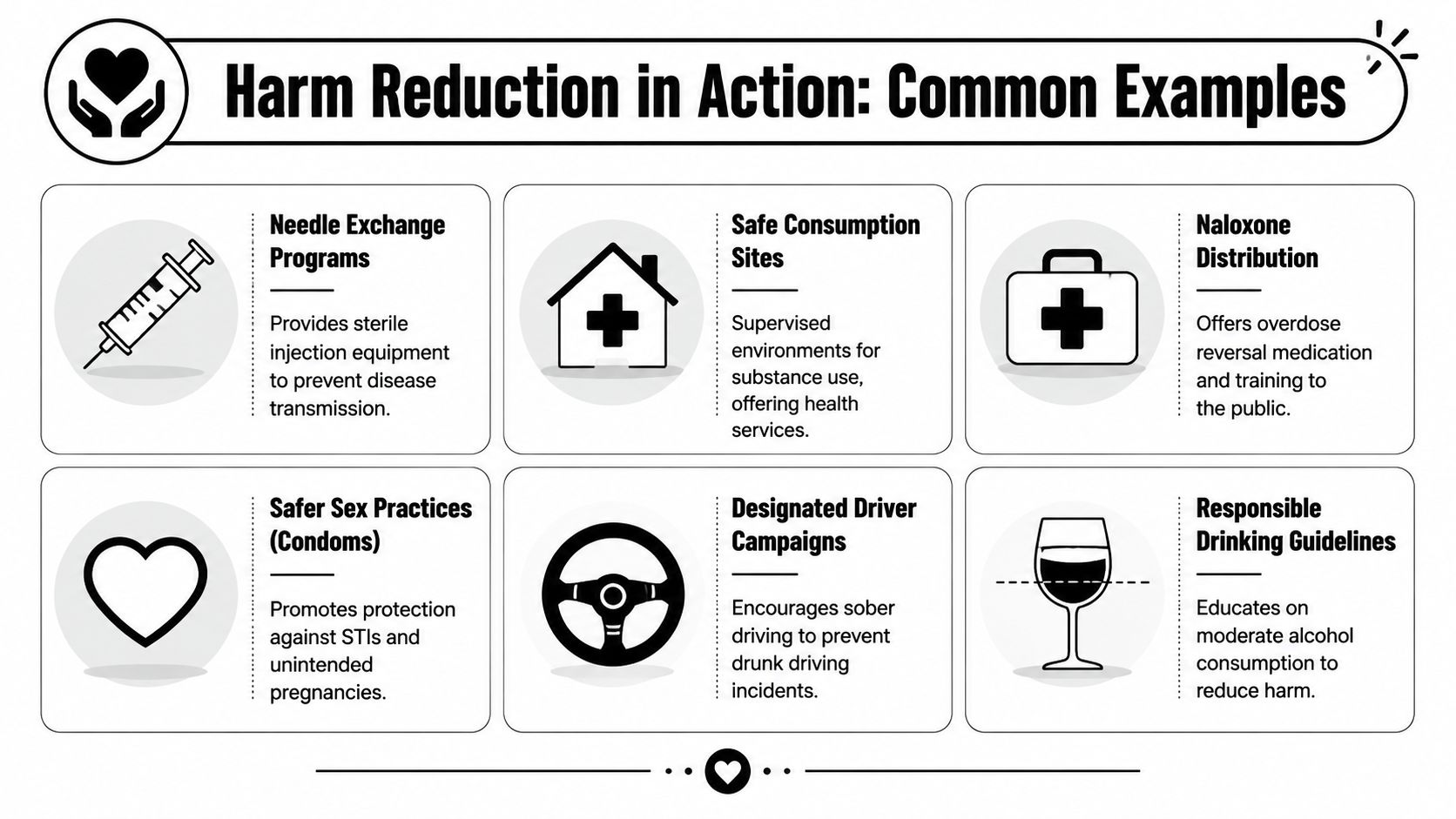
- Naloxone distribution: Gives people access to overdose reversal medication and training.
- Syringe services programs: Provide sterile equipment to reduce infectious disease transmission.
- Drug checking: Helps people learn what's in a substance before use.
- Supervised consumption settings: Offer monitoring, emergency response, and connection to services.
Each of those tools follows the same basic logic. Reduce uncertainty, reduce exposure to preventable harm, and increase the chance that someone survives long enough to get more support.
A practical explainer can also help people think through psychological risk, especially with substances that affect perception. If that's a concern, this guide on how to avoid bad trips covers common warning signs and prevention basics.
Here's a short video that gives additional context on harm reduction in practice.
The pattern behind the examples
These examples look different, but they share one structure:
- A known risk exists.
- A practical intervention reduces that risk.
- The intervention doesn't depend on moral agreement.
- People stay safer in the meantime.
That pattern applies outside opioids too. Once you see it, you can use it to think about alcohol, sex, driving, cannabis, and psychedelics without collapsing all substances into one category.
Applying Harm Reduction to Magic Mushrooms
Psilocybin use doesn't come with the same risk profile as injection drug use or opioid overdose. But harm reduction still fits because the goal is the same: reduce avoidable harm, increase support, and make the experience more predictable.
The broader harm reduction movement has increasingly applied its approach to non-opioid use, including psychedelics, through drug checking, safer-use information, and linkage to mental health care, as explained by Harm Reduction International's overview of harm reduction.
Start with the conditions, not the dose
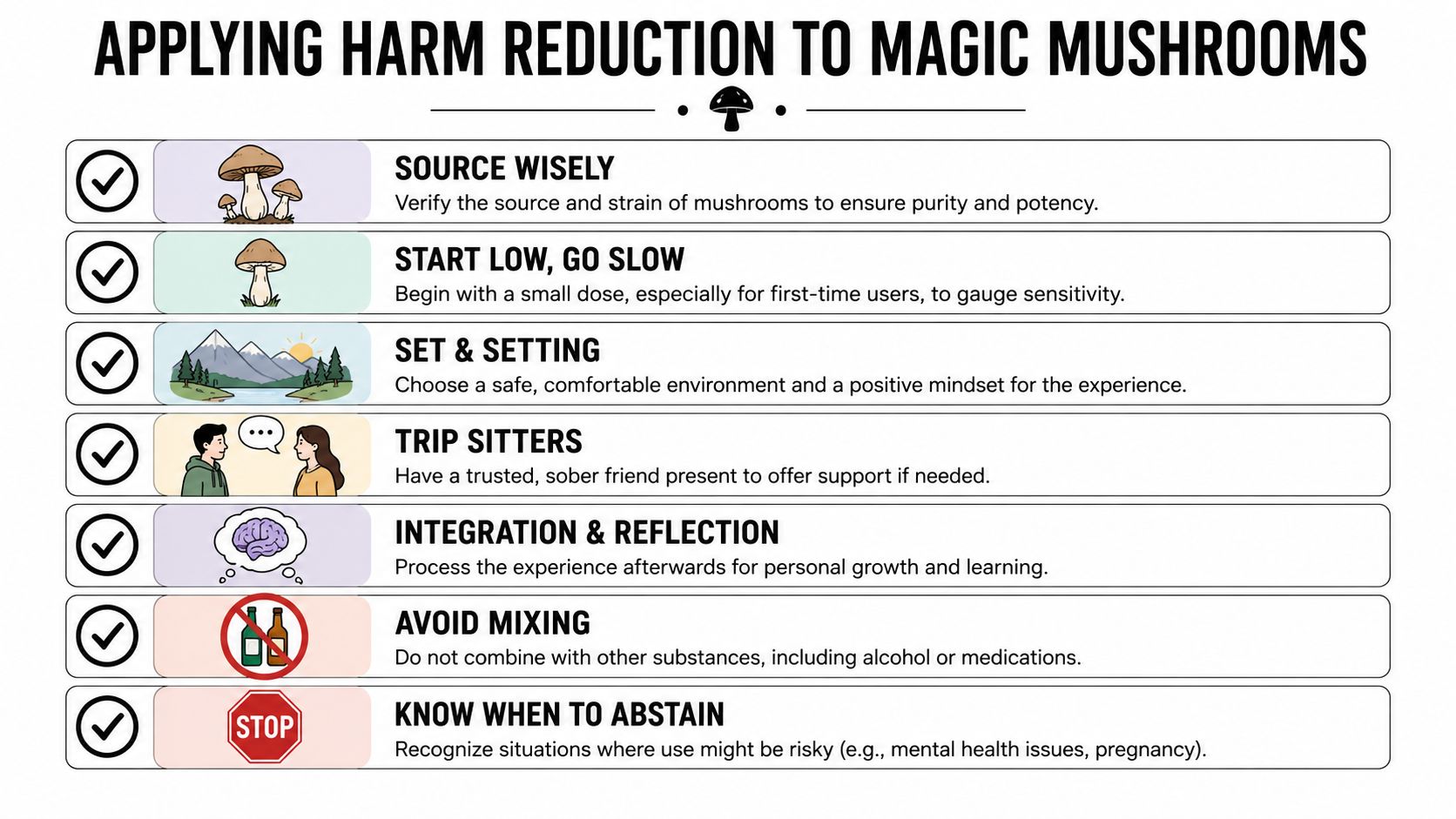
People often fixate on how much to take and ignore the setup. That's backwards. Your mental state, physical environment, and support plan shape the experience before the first effect begins.
Ask yourself:
- How's my headspace today? If you're panicked, grieving, sleep-deprived, or emotionally raw, that can change the tone of the experience.
- Where will I be? A familiar, quiet, low-pressure setting is usually easier to manage than a crowded or chaotic one.
- Who will be around? Choose people you trust. Avoid people who make you feel watched, judged, or emotionally unsafe.
Use a low-and-slow mindset
Potency can vary. Individual sensitivity can vary. Expectations are often wrong.
That's why the safer principle is simple:
- Start lower than your ego wants to.
- Wait before taking more.
- Don't chase a stronger experience because the onset feels slower than expected.
Redosing too quickly is a common way people turn a manageable experience into an overwhelming one. Harm reduction favors patience over bravado.
If you can always take more later, you don't need to prove anything at the start.
Treat mixing as a real risk
Mixing substances often gets brushed off as casual experimentation. In reality, combinations make an experience harder to predict.
For a safer psilocybin plan:
- Avoid alcohol if possible. It can muddy judgment and make it harder to respond calmly.
- Be cautious with cannabis. Some people find the combination amplifies confusion or anxiety.
- Don't ignore prescription medications. If you take SSRIs, MAOIs, or other psychiatric medications, get individualized medical advice before using psilocybin. Interaction questions are not something to guess at.
- Skip “combo nights.” If the goal is a thoughtful mushroom experience, adding extra variables usually works against that goal.
Have a trip sitter when the situation calls for one
A sober, trusted support person isn't always necessary for every adult in every situation. But it's a strong safety measure if you're inexperienced, trying a stronger amount, feeling emotionally unsteady, or using in a new setting.
A good sitter does a few basic things well:
| What a good sitter does | Why it helps |
|---|---|
| Stays calm | Your nervous system often follows the tone around you |
| Keeps the environment quiet and safe | Less stimulation can reduce panic |
| Discourages impulsive decisions | Leaving the house or contacting people mid-panic can escalate problems |
| Knows when to seek help | Severe agitation, confusion, or dangerous behavior needs a real response |
Know when not to use
One of the most important harm reduction skills is postponement. Sometimes the safest choice is not today.
Consider waiting if:
- You're in a mental health crisis
- You have unresolved concerns about psychosis or severe instability
- You're pregnant
- You don't know exactly what you have
- You can't control the environment
- You don't have time to recover afterward
Skipping a risky session is not failure. It's mature decision-making.
Plan the landing, not just the takeoff
People spend a lot of time planning the experience and almost none planning the hours after. That's a mistake.
A better plan includes:
- Hydration and simple food available
- A clear schedule with no major obligations
- A calm place to rest
- Time to reflect afterward
- Someone you can talk to if the experience brings up difficult material
Some mushroom experiences feel insightful. Others feel strange, tender, or disorienting. Integration matters. Journaling, rest, and thoughtful conversation can help you make sense of what happened instead of jumping straight back into noise.
Local Harm Reduction Resources in Detroit and Ann Arbor
Sometimes the most useful safety step is knowing where to turn before you need help. That includes community organizations, education resources, and crisis support.
If you're sorting out local access questions more generally, Metro Mush also has a location-focused guide on where to buy shrooms. For safety support, though, the following types of resources matter most.
Community harm reduction and education
In Southeast Michigan, look for local and statewide organizations focused on overdose prevention, naloxone education, safer-use supplies, and peer support. A few practical search targets include:
- Harm Reduction Michigan: A statewide organization people in Detroit and Ann Arbor should look up for harm reduction education and resource connections.
- University and campus health resources in Ann Arbor: Students and nearby residents can often find substance education, counseling, and referral options through university health systems.
- County public health departments: Local health departments may offer or direct people to naloxone access, infectious disease services, and behavioral health support.
Because programs and contact details can change, it's smart to confirm current services directly before making a trip.
Mental health and crisis support
Psilocybin safety isn't only about the substance itself. Sometimes the main concern is anxiety, panic, confusion, or distress during or after an experience.
Useful support channels can include:
- Behavioral health clinics
- Peer support networks
- Crisis lines
- Urgent care or emergency services when someone is at immediate risk
A person doesn't need to be “in trouble” to ask for help. Early support is often the safest support.
What to ask when contacting a resource
A quick call or message goes better when you know what to ask. Keep it simple.
Consider asking:
- Do you offer naloxone training or distribution?
- Do you provide safer-use education?
- Can you refer me to mental health support if I'm having a difficult experience after substance use?
- Are there local peer-based services in Detroit or Ann Arbor?
- What are your current hours and eligibility rules?
That kind of preparation fits the harm reduction mindset. You don't wait for a crisis to build your safety net.
Conclusion Empowering Safer Choices
Harm reduction is bigger than any single program or substance. At its core, it's a way of responding to real human behavior with honesty, care, and practical safety steps.
For psychedelics, that means dropping the false choice between fear and recklessness. You can be curious and cautious at the same time. You can choose lower risk without pretending risk disappears. You can decide that preparation, support, and self-awareness matter more than hype.
The most useful answer to what is harm reduction is also the simplest one. It's the practice of reducing avoidable harm while respecting human dignity and real-life decision-making. In public health, that can mean syringe programs, naloxone, and drug checking. In personal psilocybin use, it can mean a smaller starting amount, a better setting, no mixing, a trusted sitter, and the willingness to wait if the conditions aren't right.
That mindset helps people make steadier choices. It encourages people to plan before they act, notice warning signs early, and stay connected to support instead of going it alone.
Safer use isn't about perfection. It's about improving the odds, one decision at a time.
If you're looking for a trusted local starting point, Metro Mush serves adult consumers in the Detroit and Ann Arbor area with a curated psilocybin menu, approachable product formats, and easy ordering. Whether you're exploring carefully or returning with more experience, the best place to begin is with good information, clear intentions, and a safer-use mindset.