
You wake up with that familiar warning sign. Light feels sharp. Your neck is tense. You start doing mental math: Can I work today? Do I need my rescue medication now? Should I cancel dinner again?
That kind of thinking is why so many people with migraine keep searching long after they've tried the usual options. Somewhere along that search, a newer question pops up: Do mushrooms help migraines? Usually what people mean is psilocybin mushrooms, not grocery-store mushrooms or supplement blends.
The short answer is: maybe for some people, but the research is still early, and the risks are real. There are small human studies and a striking case report that suggest psilocybin may reduce migraine burden in the short term. But that's very different from saying it's a proven treatment, a safe home remedy, or something everyone with migraine should try.
The Search for Migraine Relief and a New Question
Migraine can make people feel like they're constantly negotiating with their own nervous system. One week is manageable. The next week, a routine meeting, a bright store, or a bad night of sleep can knock everything sideways.
That's why emerging treatments get attention fast. Psilocybin sits in that uneasy zone between hope and hype. Some people hear “magic mushrooms” and assume it's all internet folklore. Others hear one positive story and jump straight to “cure.” Neither view is careful enough.

Why people are paying attention
One reason this topic keeps coming up is that a small pilot study found a measurable change after psilocybin. In 10 people with migraine, psilocybin was reported to reduce migraine burden over the next 2 weeks. Migraine days per week fell by about 50%, pain intensity and functional impairment were each reduced by about half, and days using abortive medication also fell by about 50%, according to the Association of Migraine Disorders podcast discussion of the pilot study.
That's enough to justify curiosity. It isn't enough to claim certainty.
Bottom line: Early migraine research on psilocybin is interesting because researchers measured changes in attack burden, not just vague “feeling better” reports.
The most common confusion
Many readers get tripped up right here and assume all mushroom products belong in the same category. They don't.
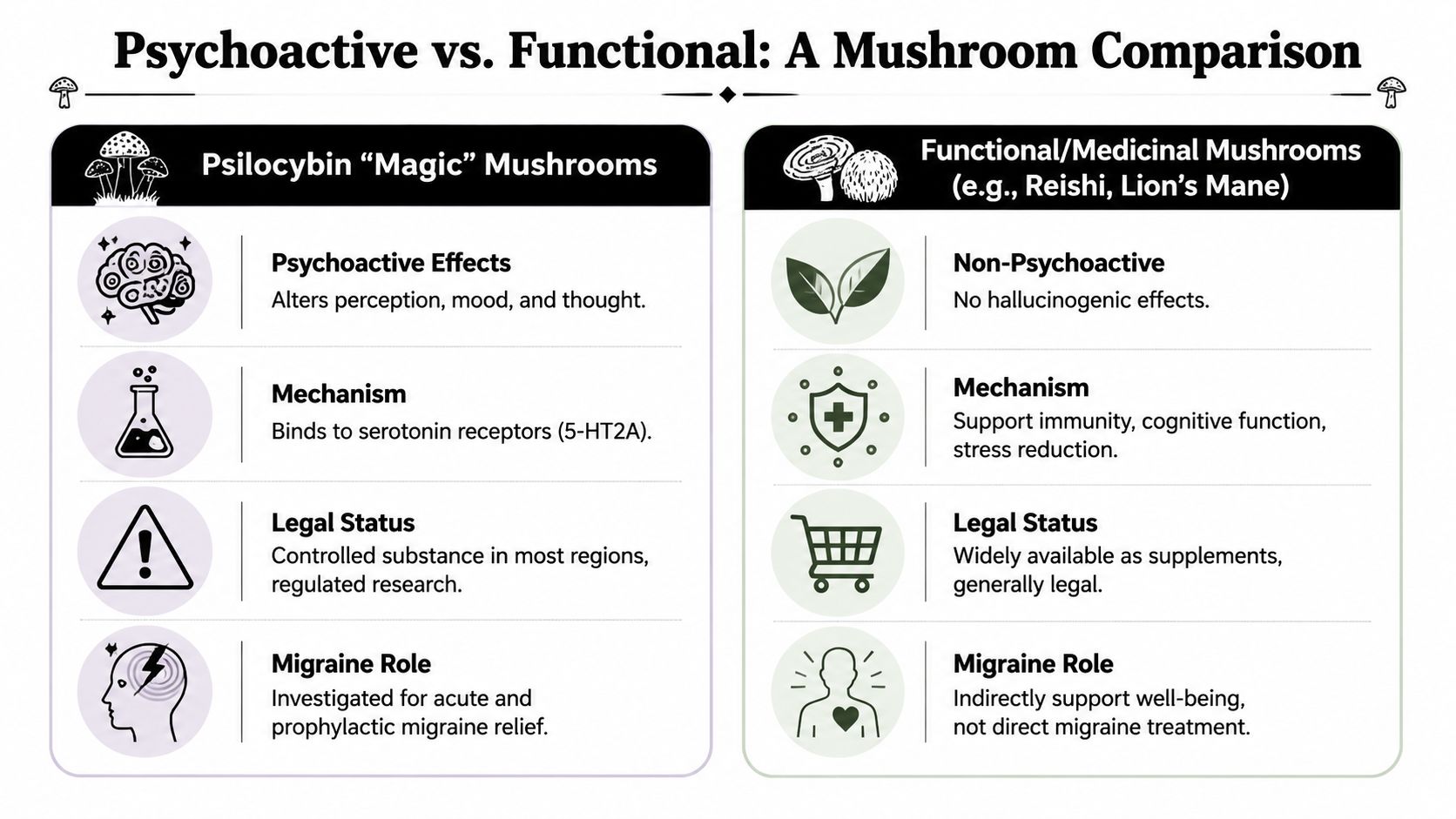
- Psilocybin mushrooms are psychoactive and can alter perception, mood, and thinking.
- Functional mushrooms like Lion's Mane or Reishi don't contain psilocybin.
- Migraine interest is focused specifically on psilocybin, not on mushrooms in general.
That distinction matters because the science, safety profile, and legal issues are completely different.
How Psilocybin Interacts with the Brain
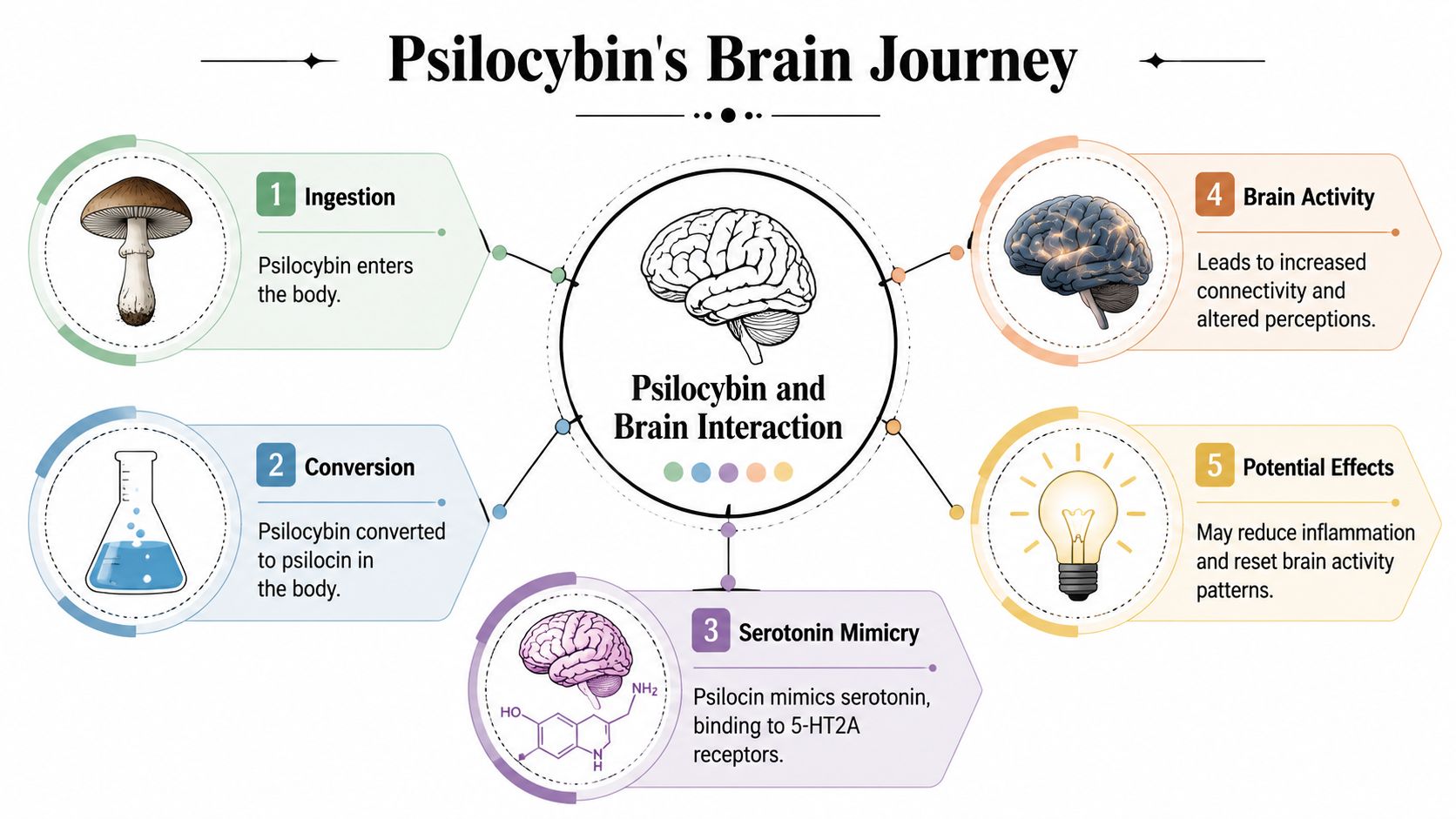
Psilocybin is often described as acting on the brain's serotonin system. If that sounds abstract, think of serotonin receptors like locks spread across a large control panel involved in pain, mood, and sensory processing. Psilocybin is converted in the body into psilocin, which can fit some of those locks, especially the 5-HT2A receptor.
That doesn't mean scientists have the full migraine mechanism mapped out. They don't. But it gives a plausible reason this compound might influence headache patterns rather than just create a psychedelic experience.
A simple way to picture it
A migraine brain can act like a house with an overly sensitive alarm system. Normal inputs, light, stress, smell, hormonal shifts, can trigger a loud response. Psilocybin may affect some of the signaling pathways involved in how that alarm system processes input.
Researchers are especially interested in whether psilocybin can briefly shift brain network activity in a way that outlasts the obvious psychedelic window. That possibility matters because migraine treatment isn't only about stopping pain in the moment. It's also about reducing the chances of the next attack.
For a consumer-friendly primer on these pathways, Metro Mush has a page on psilocybin effects on the brain.
What one case report suggests
A single case report can't prove effectiveness, but it can show what's possible. A 2023 case report described a 33-year-old man with periodic migraine with aura whose peak pain scores dropped to 0 to 2 after self-administered psilocybin, compared with 6 to 9 during comparable previous migraines, as reported in this case report in the medical literature.
That kind of acute change is one reason researchers think psilocybin may be acting on core pain pathways, not just mood or distraction.
What scientists still don't know
There are still major open questions:
- Who responds best: People with migraine aren't all the same. Aura, frequency, triggers, and coexisting conditions vary a lot.
- What dose matters most: The best migraine-focused dosing strategy remains unsettled.
- Whether psychedelic effects are necessary: It's still unclear whether the therapeutic effect requires a strong psychedelic experience.
Psilocybin may be affecting more than one migraine-related pathway at once. That's promising, but it also makes the science harder to pin down.
What the Clinical Research on Psilocybin for Migraines Says
The strongest evidence so far doesn't come from forum posts or personal testimonials. It comes from small controlled studies. That's important because migraine symptoms naturally fluctuate, and people often improve for reasons that have nothing to do with the treatment they think helped.
The signal researchers are seeing
One of the more meaningful findings comes from a placebo-controlled crossover pilot study in chronic migraine. In that study, a single oral dose of synthetic psilocybin at 0.143 mg/kg produced a significant reduction in migraine frequency per week, along with lower pain severity, functional impairment, and weekly abortive-medication use versus placebo, according to this Practical Neurology summary of the pilot study.
That's notable because it suggests a prophylactic effect. In plain language, psilocybin may not only change how a migraine feels once it starts. It may also help reduce how often migraines happen over a short period after dosing.
What that does and doesn't mean
Here's the careful interpretation:
| What the studies suggest | What they do not prove |
|---|---|
| Psilocybin may reduce migraine burden in some people | Psilocybin works for everyone with migraine |
| A single dose may have short-term preventive effects | Psilocybin is an established long-term preventive treatment |
| Researchers are seeing measurable clinical signals | Doctors have enough data to treat it like standard care |
Online content often misrepresents information. It takes “promising pilot data” and translates it into “settled answer.” That leap isn't justified.
Why small studies matter, and why they're not enough
Pilot studies are like test drives. They can show whether an idea is worth pursuing. They can't settle every question about safety, consistency, ideal patient selection, or long-term outcomes.
A small study can be meaningful if it's controlled well. But until larger and more repeated trials confirm the findings, the honest answer to “do mushrooms help migraines?” is still conditional.
If you want to understand one route people are exploring, especially at lower-intensity use patterns, Metro Mush also has a page on microdosing for migraines. Treat that kind of information as educational, not as a substitute for medical guidance.
Practical takeaway: The current research supports interest, not certainty. Psilocybin is still better described as an investigational approach than a proven migraine therapy.
Psilocybin Versus Other Medicinal Mushrooms
A lot of confusion starts with the word “mushrooms.” In everyday conversation, people lump together very different products: psychedelic mushrooms, mushroom coffees, supplement capsules, and wellness blends. For migraine questions, that shortcut causes problems.
Psilocybin mushrooms and functional mushrooms are not interchangeable.
The quick comparison
| Feature | Psilocybin mushrooms | Functional mushrooms |
|---|---|---|
| Main compound | Psilocybin | Compounds other than psilocybin |
| Psychoactive effects | Yes | No |
| Migraine relevance | Studied directly for possible migraine effects | Not studied as a direct psilocybin-style migraine treatment |
| Legal status | Restricted or controlled in many places | Generally sold as supplements |
Why this matters for consumers
If someone asks whether Lion's Mane helps migraines because they read about psilocybin research, they're mixing two different categories.
Functional mushrooms may interest people for general wellness reasons. Some use them for stress support, focus, or daily routines. But they don't produce the same pharmacology being studied in migraine research. Buying a functional mushroom gummy won't replicate a psilocybin study.
Here's a clean way to put it:
- If the product is sold as a standard supplement, it's almost certainly not the same substance used in psilocybin migraine research.
- If the product can alter perception, it belongs to a different safety and legal category.
- If a seller blurs that line, that's a reason to slow down, not speed up.
A useful shopping filter
When you read labels or menus, ask three questions:
- What active compound is in this product?
- Is it psychoactive or non-psychoactive?
- Am I looking for migraine research relevance, or just general wellness support?
Those questions can save you from a very common mistake. Many consumers aren't confused about migraine science. They're confused about product categories.
Understanding the Risks and Who Should Be Cautious
This is the part many glossy articles underplay. Psilocybin isn't just “a natural option.” Natural substances can still be powerful, unpredictable, and risky.
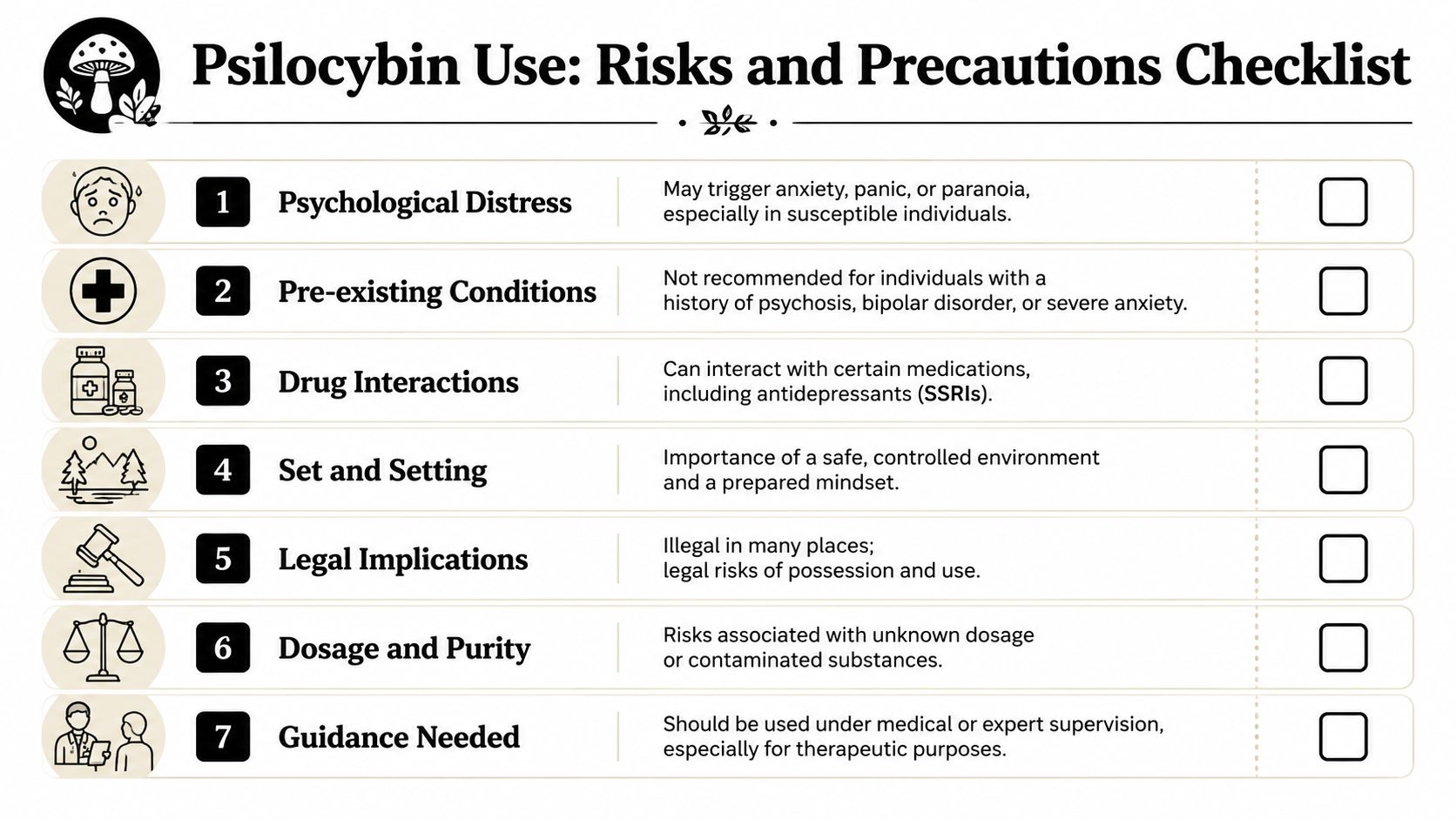
Some people may experience relief. Some may experience the opposite. Independent summaries note that psilocybin can trigger headaches in some individuals and carries risks including raised blood pressure and heart rate, impaired judgment, and possible psychosis in vulnerable people. Migraine-focused commentary also reported short-lived light-headedness, nausea, anxiety, and next-day hangover headaches, as summarized in this Medical News Today review of psilocybin and migraines.
Who should be especially careful
For some people, caution isn't optional. It's the main point.
- People with a history of psychosis or vulnerability to it should avoid psilocybin. A substance that alters perception can destabilize someone who is already at risk.
- People with significant anxiety or panic tendencies may find the experience escalates distress instead of reducing suffering.
- People with cardiovascular concerns should take seriously the possibility of increased blood pressure and heart rate.
- Anyone taking medications should assume interaction questions need professional review first.
The risks people underestimate
A migraine sufferer may focus so much on pain relief that they overlook everything else happening during a psychedelic experience. That's understandable, but it's risky.
Here are the most underestimated problems:
- Impaired judgment: If perception shifts, basic decisions can get worse.
- Unsupervised use: Being alone during a difficult experience can turn fear into a crisis.
- Product uncertainty: Dose and contents may not be what you think they are.
- Headache worsening: The same substance being studied for migraine relief can also provoke headaches in some users.
To see a general discussion of these concerns in action, here's a related video:
Some readers come looking for permission. The safer goal is better judgment. If a substance can help some people and harm others, the first job is figuring out which group you're more likely to be in.
A plain-language rule
If you're asking whether psilocybin is safe because you're desperate, that's a sign to slow down. Desperation narrows attention. Migraine pain already does that. Add a psychoactive substance, and it becomes easier to ignore red flags you'd normally catch.
Navigating the Legal Landscape and Harm Reduction
Legal status can be just as confusing as the science. In some places, people hear “decriminalized” and assume that means fully legal retail sales, medical approval, or product regulation. It doesn't.
Decriminalization usually means enforcement priorities have changed. Legalization means a formal legal market exists. Those are very different realities. If you live in or travel through the Detroit or Ann Arbor area, don't assume local culture equals simple legality.
What harm reduction actually means
Harm reduction isn't the same as encouragement. It means reducing avoidable danger if someone is already considering use.
A useful framework looks like this:
- Check your setting: A calm, familiar place is safer than a chaotic one.
- Check your company: A trusted, sober sitter lowers the chance that fear turns into panic.
- Check your mindset: If you're agitated, overwhelmed, or emotionally unstable, that matters.
- Check what else is in your system: Mixing substances increases uncertainty fast.
- Check your expectations: “I need this to stop my migraine” is a lot of pressure to put on one experience.
For people learning those basics, Metro Mush has an educational page on how to avoid bad trips.
Consumer red flags
Even before legality, there's a quality-control issue. In unregulated settings, you often can't verify exact contents, consistency, or purity. That creates a double risk: legal uncertainty and product uncertainty.
Watch for these warning signs:
- Vague labels that don't clearly state what the product contains
- Overconfident health claims that sound like guaranteed outcomes
- No discussion of risk from a seller or source of information
- Pressure to take more instead of emphasizing caution
Start with the assumption that less certainty should lead to more caution, not more experimentation.
Conclusion and Responsible Next Steps
So, do mushrooms help migraines?
The most accurate answer is psilocybin may help some people with migraine, and early research gives scientists a real reason to keep studying it. Small controlled studies and a notable case report suggest short-term benefits are possible. At the same time, psilocybin can also cause side effects, trigger headaches in some people, and create serious problems for people with certain mental health or medical risks.
That puts psilocybin in a category many readers don't love but need to hear about: promising, unproven, and not casual.
If you're thinking about this seriously, the responsible next steps are simple:
- Talk with a healthcare professional who understands migraine.
- Review your medications and health history before making assumptions.
- Look for legitimate clinical research rather than relying only on anecdotes.
- Treat harm reduction as essential, not optional.
The aim isn't chasing hype. It's making the most informed decision possible while protecting your health.
If you're an adult consumer in Southeast Michigan looking for educational information and product access in a local context, Metro Mush offers psilocybin-related resources, menu browsing, and ordering details for Detroit and Ann Arbor. Use it as one information source among others, and keep safety, legality, and medical judgment at the center of any decision.