



You're standing at the edge of a Michigan trail on a cool spring morning, basket in one hand, phone in the other, wondering if that patch of green ahead is worth the bend in the knees. The woods look generous, but Michigan rewards people who slow down, know the rules, and learn the season before they start cutting or picking.
Foraging in Michigan works best when you treat it like a local skill, not a free-for-all. The state's forests, fields, shoreline edges, and city green spaces can all produce wild food, but each setting comes with its own timing, safety concerns, and legal limits. If you learn the habitat, the season, and the land status first, the rest becomes much simpler.
Why Michigan Is a Forager's Hidden Gem
A first-time forager in a Michigan state forest usually makes the same mistake, looking down too soon. The better habit is to scan the trees, the ground cover, and the woods edge together. In this state, what grows in a spot often depends on forest type, moisture, and whether the land is public, private, or part of an urban green space.
Michigan's foraging culture is strongest around morels, but the fuller story is the state's mix of Great Lakes microclimates, public woods, river corridors, old fields, and neighborhood green space. That mix creates different harvest windows through the year, so foragers can move from spring mushrooms to summer berries to fall nuts without leaving the state. People who learn those shifts do not need to chase one “perfect” spot, they learn to read habitat.
Practical rule: if you know the land and the season, you are already ahead of most beginners.
The expectation also matters. A study of certified and uncertified morel hunters found that both groups foraged an average of 16 days per year, and the most common response was 10 days or fewer in the field (study on Michigan morel foraging). That is a useful reality check. Foraging here is usually seasonal and part-time, not a full-time occupation, and many people fit it around work, family, and weather windows.
That same seasonal rhythm is part of the appeal. One week, a hardwood slope may be dry and quiet, then a warm rain brings out mushrooms almost overnight. Later, field edges fill with berries, and autumn shifts attention to nuts, late mushrooms, and fruiting trees. Michigan gives you a lot to learn, but it also gives you time to learn it.
A morel season guide for Michigan helps new foragers see that timing more clearly, especially when spring conditions change quickly across the state. In the south, thaw and soil warmth can arrive earlier. Farther north, the woods often hold on to cool, damp conditions longer, so the same species can appear on a different schedule. That difference matters as much as the patch itself.
Access is part of the hidden-gem appeal too, but only when you know the boundaries. Michigan has plenty of public land, yet a tempting patch is not automatically open for harvest. Urban edges add another layer, since roadside plants, vacant lots, and creek corridors can carry contamination from traffic, runoff, or old industrial use, especially in parts of Southeast Michigan. A productive spot is only worth using if the land is legal to enter and the ground is clean enough to trust.
Foragers here get a useful combination of abundance and restraint. The state offers enough habitat variety to keep learning, but it also forces good habits, asking you to check ownership, read the season, and pay attention to where food is growing. That makes Michigan a place where careful people can build skill without rushing, and where the best harvests usually come from patience, not from pushing deeper into the woods.
Michigan Foraging Calendar by Season
Spring is the season most associate with wild food in Michigan, and for good reason. Morels show up in hardwood country when the weather warms and the ground stays moist, especially in state forests, burn areas, and other wooded places with the right tree mix. If you're new, start by learning one spring target well instead of trying to harvest everything at once.
April usually belongs to scouting. The woods are waking up, and you're looking for sheltered slopes, old apple trees, cottonwood, ash, and other places that hold spring moisture. By May, many hunters are focused on morels in hardwood forests and along edges where the canopy opens enough to warm the soil. If you're in southern Michigan, that window often arrives earlier than it does farther north.
Field habit: don't hunt mushrooms by calendar alone, hunt them after warm rain and steady soil moisture.
Summer changes the game. Forest edges, abandoned fields, and sunny lanes produce berries, and the search becomes more visual than technical. Blackberries, serviceberries, and similar fruiting plants are easier to spot in open light, while shaded woods cool down and shift attention away from mushrooms that prefer spring moisture. In urban areas, parks and vacant lots may also hold fruiting trees and brambles, but those sites need the safety checks covered later.
Late summer and early fall bring a second wave. Mushrooms return in some woods after rain, and fruiting trees can produce late-season abundance. Fall is also when nut gathering becomes practical, especially in places with mature hardwoods, old yards, and field margins. If you want a seasonal anchor, use the spring mushroom hunt as your first chapter and the fall nut run as your closing chapter.
Michigan's morel season gets enough attention that many beginners start with a map instead of a basket, and that's not a bad instinct. A useful regional reference for timing and search habits is the morel season guide at Metro Mush's Michigan morel resource, which fits neatly with the spring windows described above.
Autumn deserves its own caution. Harvesting nuts and late fruits is usually straightforward, but mushroom hunting in the same weeks gets trickier because decaying leaves hide stems, caps, and the details you need for identification. If you're unsure whether a patch is worth the effort, photograph it first and come back with better light.
A quick month-by-month view helps:
- April: scout hardwoods, river bottoms, and sheltered edges for early mushrooms and emerging greens.
- May: focus on morels in forests with the right tree associations and soil moisture.
- June and July: watch forest edges, old fields, and sunny openings for berries.
- August and September: look for late mushrooms after rain, plus ripening fruit and early nut drop.
- October and November: collect nuts, watch fruiting trees, and slow down your mushroom ID process as leaf litter thickens.
The rhythm is simple. Spring favors the woods, summer favors edges, and fall rewards attention to trees and ground cover. If you keep that pattern in mind, you'll stop wandering randomly and start reading Michigan's natural features like a map.
Key Species to Know and Their Poisonous Lookalikes
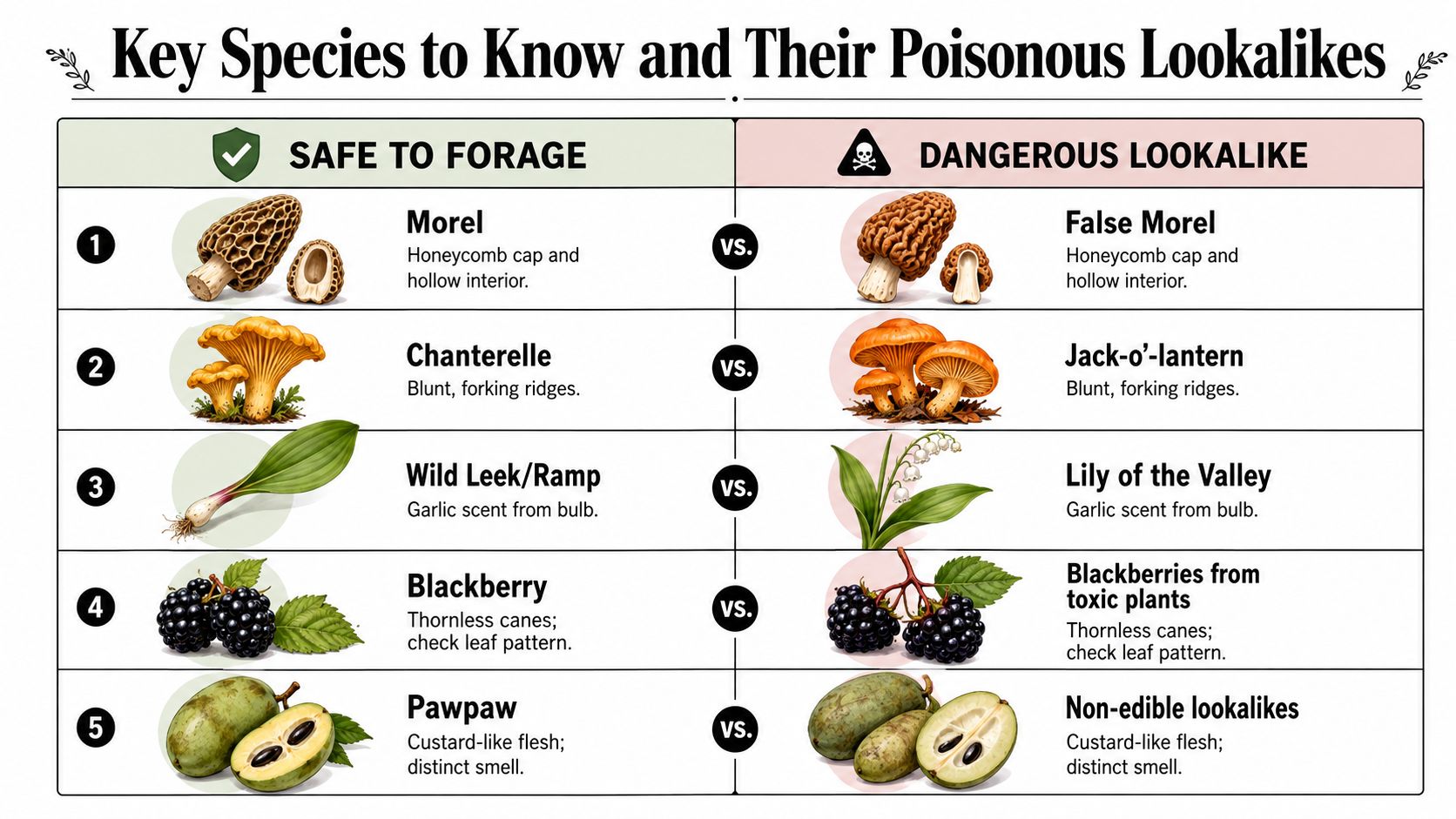
Morels are the classic Michigan prize, but they're also the place where beginners get careless. A true morel has a honeycomb cap, a pitted surface, and a hollow interior when cut lengthwise. A false morel can look close from a distance, but it doesn't share those same internal features, which is why a single glance is never enough.
The safest habit is to check multiple traits at once. Cut the mushroom, look at the inside, note the cap attachment, and pay attention to where it was growing. Morels and false morels are the comparison that gets repeated for a reason, one mistaken assumption can ruin the meal.
Chanterelles deserve the same respect. They're prized, but they're often confused with jack-o’-lantern mushrooms, which are a dangerous lookalike. Chanterelles have blunt, forked ridges instead of true gills, and they usually grow in the kind of wooded habitat where the light is filtered and the ground stays moderately moist. If you're not sure what you're seeing, compare the underside carefully before you harvest anything.
Wild leeks, or ramps, add a different kind of risk. The giveaway is the garlic scent from the bulb and the paired broad leaves that rise from the ground in spring. A common dangerous confusion is with lily of the valley, which doesn't smell like garlic and doesn't match the same leaf and bulb structure. Smell helps, but it never stands alone, because many plants can fool a quick sniff test.
Blackberries are easier, but “easy” doesn't mean automatic. A true blackberry patch usually shows the familiar cane structure and leaf pattern you learn to recognize from one season to the next. In the field, the bigger issue is not a famous deadly twin so much as picking from a plant you haven't identified, especially where multiple thorny shrubs grow together. If the cane structure, leaf arrangement, and fruiting pattern don't line up, leave it alone.
Pawpaws are worth learning because people either overestimate or underestimate them. The fruit has custard-like flesh and a distinct smell that makes it easier to recognize once you've handled it a few times. The risk isn't that every unripe fruit is deadly, it's that beginners can mistake a random green fruit for something edible and skip the smell, shape, and tree context that matter.
The simplest rule in all of this is still the best one. When in doubt, leave it out. You don't get bonus points for being brave with a mushroom that hasn't fully checked out under multiple traits.
For a deeper look at one of the most commonly confused species groups, use this Michigan chanterelle guide alongside your field notes. It's much easier to make good decisions when you compare habitat, underside structure, and lookalikes side by side.
Safety and Identification Best Practices in the Field
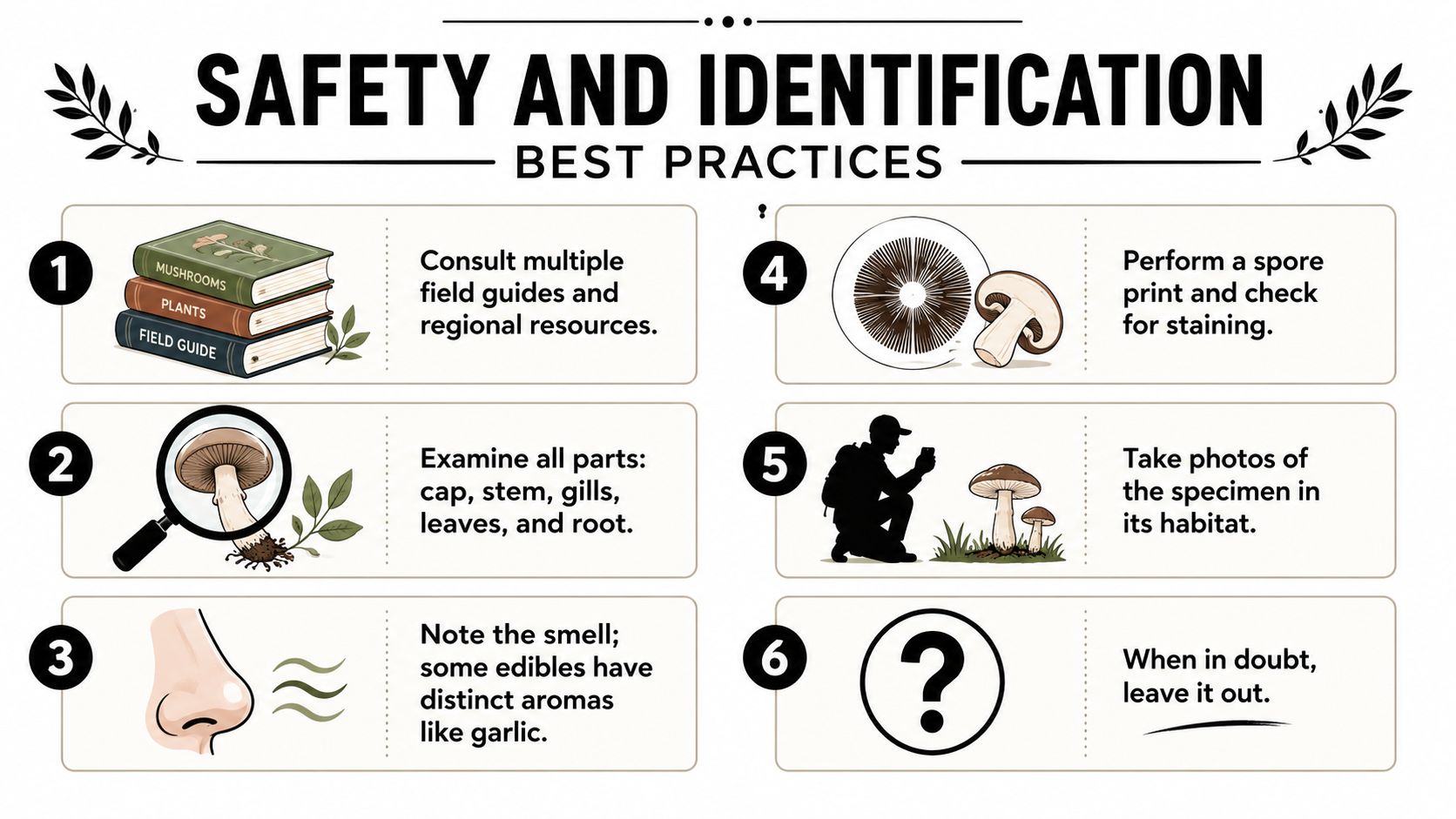
The first thing I tell new foragers is to slow the process down on purpose. Don't pick first and ask questions later. Photograph the specimen in place, note the tree or plant nearby, and check the whole body of the plant or fungus before you make any decision.
A good ID routine is mechanical, not emotional. For mushrooms, that means examining the cap, stem, gills or pores, base, and any bruising or staining. For plants, it means looking at leaf arrangement, smell, stem structure, and where the plant is rooted. Apps can help you narrow a candidate, but they can't replace a real identification process.
Practical rule: never trust one feature by itself, not color, not smell, not habitat, and not an app screen.
A small field kit makes this easier. Bring a sharp knife, a mesh bag, a regional field guide, and a phone with GPS. Mesh bags matter because they let spores fall as you walk, which helps return some of the fungus to the woods while keeping your harvest separated and cleaner.
Road edges and runoff zones need special caution. The guidance used by Michigan State and Michigan Tech-linked materials warns against harvesting near roadsides, ditches, streams, and other places exposed to runoff or herbicides, and Detroit-focused foraging materials emphasize knowing the soil and environment before you eat anything wild (Detroit urban foraging guidance). That matters most in towns and cities where the land has had years of traffic, dumping, or spray exposure.
Don't make the common beginner mistake of assuming animals can safely eat a plant, so humans can too. Deer, squirrels, birds, and insects operate on different biology. Your job is to identify the species for human use, not to borrow certainty from wildlife.
If you're still unsure, stop and ask someone who works with fungi or plants. Local mycology clubs, extension educators, and experienced foragers can catch mistakes that a phone screen won't. For mushroom-specific caution, keep a poison reference handy such as this Michigan mushroom warning guide so you can compare dangerous species before anything gets into a pan.
Legal Rules and Land Access for Michigan Foragers
A basket of wild foods can look harmless at the kitchen table and still raise legal problems in the field. Michigan's Department of Natural Resources allows harvesting mushrooms, nuts, berries, and tree fruits on public lands, but anything taken from state lands is for personal use only and cannot be sold (Michigan DNR foraging rules). Once you separate dinner from commerce, the rules make more sense.
Commercial mushroom sales follow a different path. The state treats mushroom sales from other lands as a matter of training and certification through the Michigan Department of Agriculture and Rural Development. Research on Michigan morel foraging found that the certified sample was fairly specialized, with a 15.8% response rate, and that the 2021 Michigan Certified Mushroom Forager list contained 495 certified foragers (study on Michigan morel foraging).
Public land and private land also require different habits in the field. State forests and other public tracts can produce well, and the research found that certified mushroom collectors reported foraging more often across land types than the uncertified sample except in metropolitan areas, with state forests and private land standing out as the most common places to hunt morels. Private land still requires permission, even if the habitat looks excellent from the road.
County parks and metro parks sit in a gray area that catches beginners off guard. A public sign does not automatically mean harvest is allowed, because rules can change by county, by park system, or by individual site. Read the posted regulations, call ahead if anything is unclear, and do not assume that gathering is allowed just because walking is.
Urban foraging in Southeast Michigan deserves its own caution. Detroit-area foragers can be tempted to trust anything that grows close to home, but local food does not always mean clean food. Runoff, herbicides, and older soil contamination can change the risk fast, so avoid roadsides, ditches, and other exposed places, and pay attention to soil history before you eat or share a harvest.
The legal lines are plain once you know where they sit. Michigan gives foragers access, but it also separates personal gathering, commercial sales, and landowner permission into different categories. Get those straight first, then habitat reading becomes the harder, and more useful, part of the work.
Emerging Trends in Michigan Foraging
Wild berry foraging is getting more attention in Michigan, and that shift makes sense. Berries are easier for beginners to understand than many mushrooms, they're visible from a distance, and they fit well with family outings and short walks rather than all-day hunts. Michigan Public reported in July 2025 that wild berry foraging is gaining popularity in the state (Michigan Public on wild berry foraging).
Urban and community foraging are also changing how people think about access. UM-Flint has documented GIS-based research on foraging in Detroit, which points to a more map-driven way of asking where wild foods grow, who can reach them, and how ecology shapes opportunity. That's a useful shift because it treats foraging as part of the city's natural environment, not a novelty tucked outside it.
Detroit foraging gets more complicated, not less, once you care about soil history and neighborhood conditions.
The other trend is invasive-species foraging as a conservation tool. Michigan Sea Grant highlights the idea of turning ecological harm into food, especially around Great Lakes invasive species, but the hard part is still evaluation. A plant or mushroom being invasive doesn't automatically make it safe, legal, or worth eating.
That's where a lot of beginner content falls short. People want a simple list, but the essential questions are species-specific, location-specific, and law-specific. Foraging an invasive species makes sense only when you know what it is, what it's been growing in, and whether your harvest is allowed where you found it.
The bigger insight is that Michigan foraging is moving from a single spring mushroom chase toward a broader mix of mapping, ecology, and seasonal food knowledge. More people are learning berries, urban site selection, and land ethics alongside traditional woodland species. That's a healthier direction, because it rewards careful observation instead of opportunistic grabbing.
Your Foraging Toolkit and Local Resources
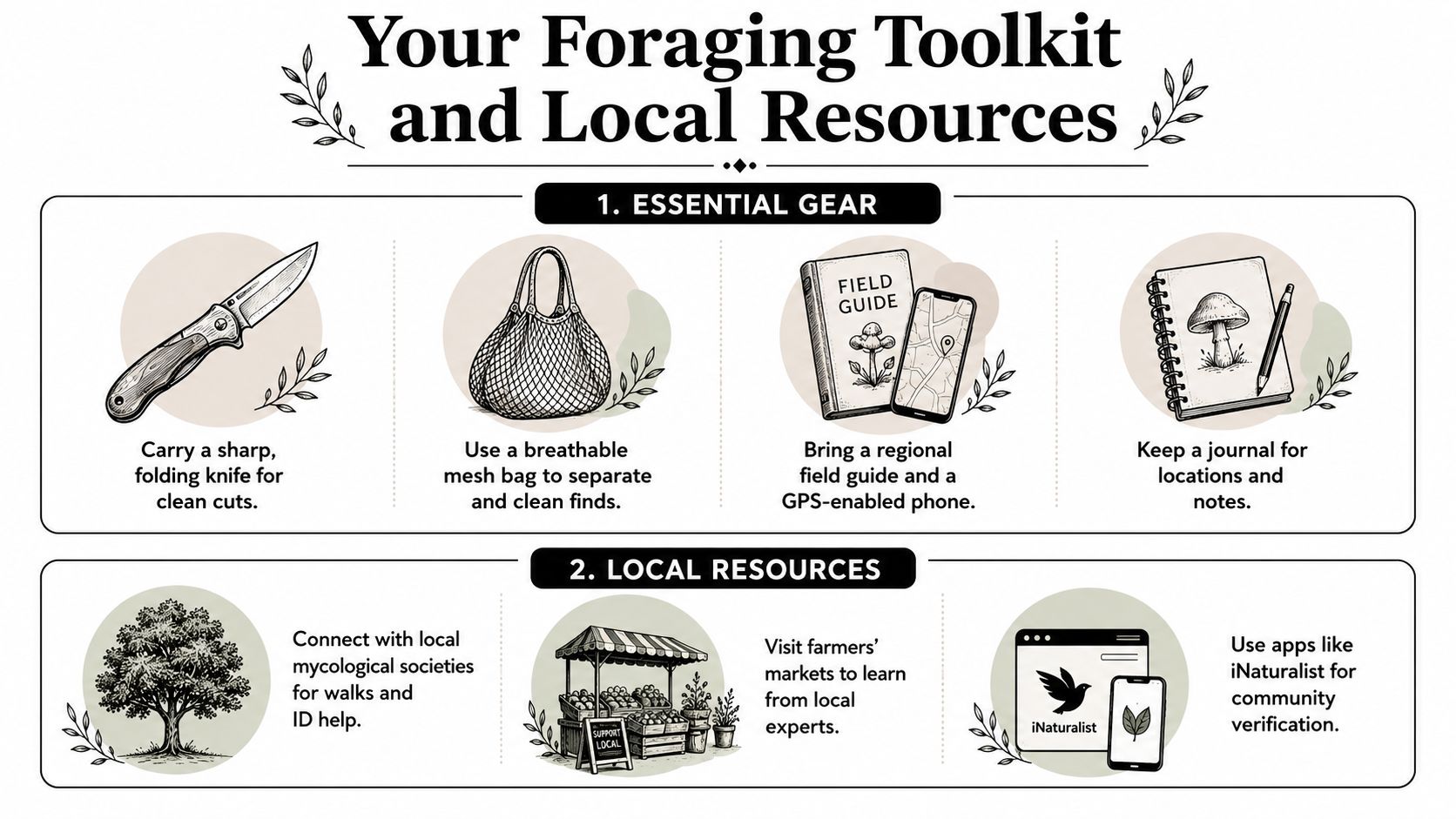
Start with a kit you can carry without fuss. A sharp folding knife handles clean cuts, a breathable mesh bag keeps finds from sweating, and a regional field guide helps you compare what you see against Michigan species, not generic internet photos. Add a GPS-enabled phone for mapping where you are, a notebook for habitat notes, and a rigid container if you plan to bring home delicate mushrooms or berries that bruise easily on the walk out.
Your local resource list should be as specific as your harvest list. Michigan mycological societies are good for guided walks and identification help, MSU Extension offices can help you think through plant questions, and the Michigan Department of Natural Resources foraging page is the place to check land rules before you head out. Online communities can help too, especially when you post clear photos of the cap, stem, underside, and habitat so other foragers can judge the details, not just the name.
The best habits come from learning the places you already use. Farmers' markets, club walks, and community ID events teach more than random scrolling because you can compare real specimens with local knowledge and ask follow-up questions on the spot. A forager who learns from the area usually makes fewer mistakes than someone chasing species names alone, especially in Michigan where habitat, season, and access can change the answer fast.
If you want a lawful, curated path instead of wild-harvest uncertainty, a regulated local option can be the safer choice for adult consumers. For anyone building a broader mushroom practice in Detroit or Ann Arbor, Metro Mush offers a separate route that keeps you out of the woods when the species, season, or land status is not right.