
You step outside after a Michigan rain, and there they are. Mushrooms in the lawn. Mushrooms pushing out of mulch around a street tree. Mushrooms clustered on a stump in a city park. If you're in Detroit, Ann Arbor, or anywhere in between, you've probably had that moment of curiosity. Maybe you wondered if they were edible. Maybe you wondered if they were psychoactive. Maybe you took a photo and thought an app could sort it out.
That’s where people get into trouble.
Mushrooms reward confidence only when that confidence is earned. In Michigan, a wild mushroom can look ordinary, even inviting, and still send someone to the hospital with liver or kidney failure. This guide is for people who want clear, practical safety advice about michigan poisonous mushrooms, especially where misidentification happens most often: around edible look-alikes, psychoactive look-alikes, and the increasingly common mushrooms popping up in urban and suburban spaces.
The Hidden Dangers in Michigan's Woods and Parks
Michigan is one of the best places in the country to notice fungi. That’s part of the problem. The state hosts approximately 2,500 species of large, fleshy wild mushrooms, while at least 50 are confirmed poisonous, and only about 60 to 100 species are generally regarded as edible, according to this Michigan mushroom safety report. Even among the edible group, correct identification still matters because mistakes can lead to severe illness or death.
That ratio should reset the way you look at a mushroom in the wild. You are not choosing between “food” and “not food.” You are sorting through a huge, messy crowd where some are harmless, some are sickening, and some are lethal.
Why ordinary places still carry real risk
People often picture danger in deep woods, but plenty of risky mushrooms show up where people live. A school lawn, a manicured apartment complex, a neighborhood park, or a patch of mulch near a sidewalk can all produce species that deserve caution. Rain, shade, buried roots, wood chips, and decaying wood create good mushroom habitat whether you're in the UP or near downtown Ann Arbor.
That matters for Metro Detroit readers because casual encounters lead to casual decisions. Someone sees a mushroom after checking when mushroom season tends to hit in Michigan, assumes timing equals safety, and starts guessing. Season helps you know what might appear. It does not tell you what’s safe.
Practical rule: A mushroom growing in a familiar place is still a wild mushroom.
This is a safety guide, not a picking guide
The safest mindset is simple. Start with the assumption that any wild mushroom is unsafe until an expert can identify it with confidence. Not “pretty sure.” Not “the app said.” Not “it looks like the one in a photo.”
That may sound strict, but mushrooms are not like berries or garden herbs. Their most important differences can hide in the base of the stem, the color of the spore print, the way the gills attach, or the kind of wood or tree nearby. If you miss one clue, you can miss the whole story.
Understanding Deadly Deception in Fungi
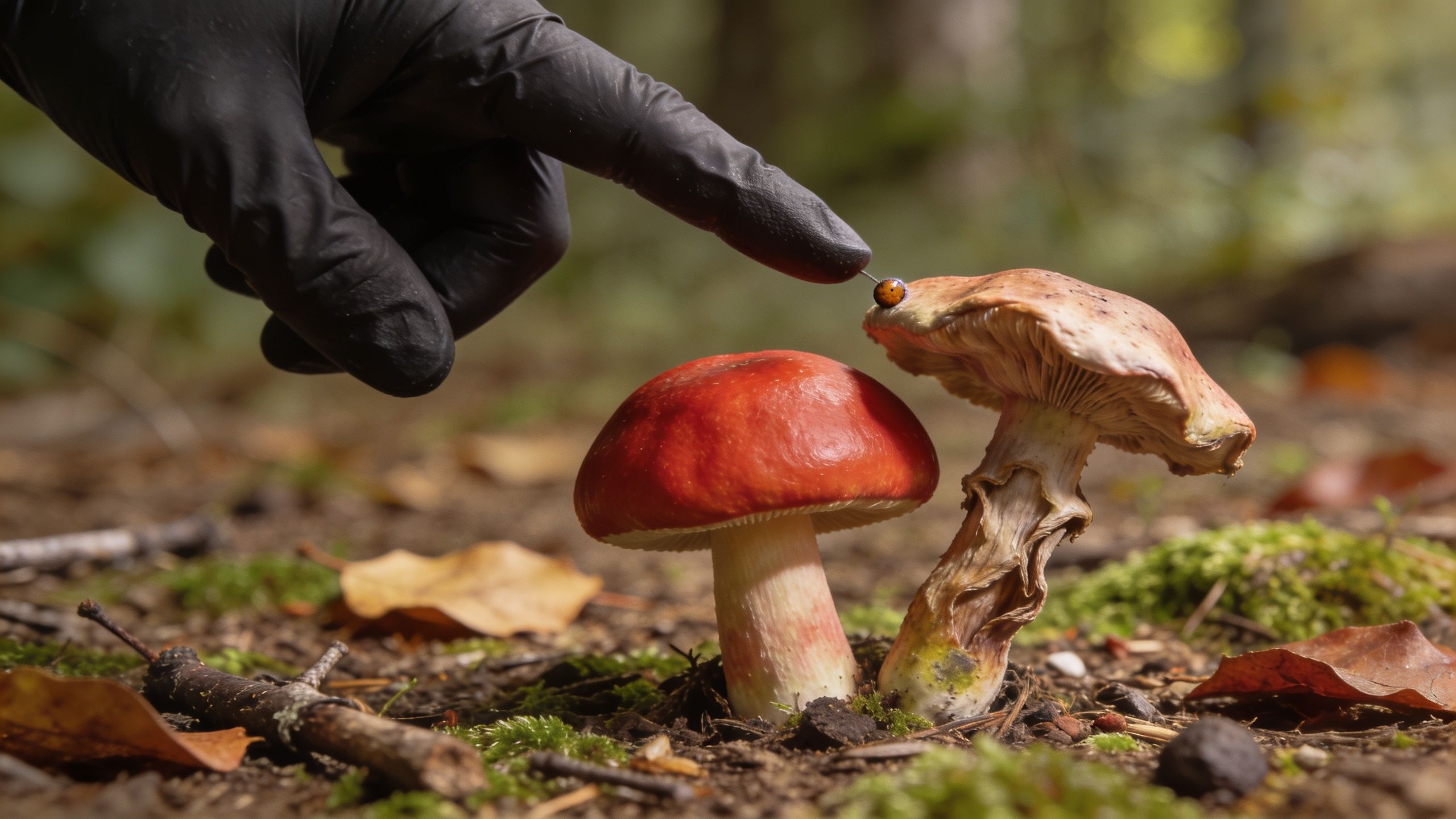
Mushroom poisoning usually starts with a visual mistake. Someone sees a cap shape they recognize, or a color that seems familiar, and they stop asking questions too soon. With fungi, surface resemblance is where danger begins.
Why look-alikes fool smart people
Think of many mushroom pairs like identical twins wearing the same coat. From across the room, they seem the same. Up close, one is kind, one is dangerous, and the details that separate them are small but decisive.
Beginners usually focus on the cap. Experts don’t stop there. They look at the gills, stem, base, ring, spore print, habitat, and growth pattern. They may also ask whether the mushroom was on hardwood, conifer debris, soil, or buried wood. A safe identification is a bundle of traits, not a vibe.
Here’s where readers often get confused:
- Color isn’t enough. White, brown, yellow, and orange all include edible and poisonous species.
- Size isn’t enough. A small mushroom can be deadly.
- Smell isn’t enough. Some dangerous mushrooms smell mild or pleasant.
- Cooking isn’t a magic fix. Some toxins stay dangerous after heat.
- One photo isn’t enough. The camera often misses the stem base, gill attachment, and texture.
The main misidentification traps
Most bad decisions fall into a few repeating patterns.
- Edible look-alike trap. Someone wants chanterelles, morels, or meadow mushrooms and talks themselves into a match.
- Psychoactive look-alike trap. Someone goes hunting for psilocybin species and ignores warning signs because the mushroom “looks close enough.”
- Urban familiarity trap. A mushroom in a backyard or city park feels safer because it’s near home.
- App certainty trap. A phone tool gives a suggestion, and the user treats it like a verdict.
A poisonous mushroom doesn’t need to look sinister. It only needs to look convincing.
What real identification requires
A careful mushroom ID is more like checking a person’s full address than recognizing their face. You need multiple matching details.
A beginner can reduce risk by learning to ask these questions before touching the idea of eating anything:
| Question | Why it matters |
|---|---|
| What is the spore print color? | Many dangerous groups separate from edible ones this way. |
| Are these true gills, ridges, pores, or teeth? | Beginners often call everything “gills,” and that causes mistakes. |
| Is there a cup or volva at the base? | This can point to deadly Amanitas. |
| What is it growing from? | Soil, wood, mulch, and buried roots each change the ID picture. |
| Is it growing alone, scattered, or clustered? | Growth habit helps narrow the field. |
That’s why casual guessing is so risky. Many michigan poisonous mushrooms don’t advertise themselves. They pass as normal until someone pays the price for a shortcut.
Michigan's Most Notorious Poisonous Mushrooms
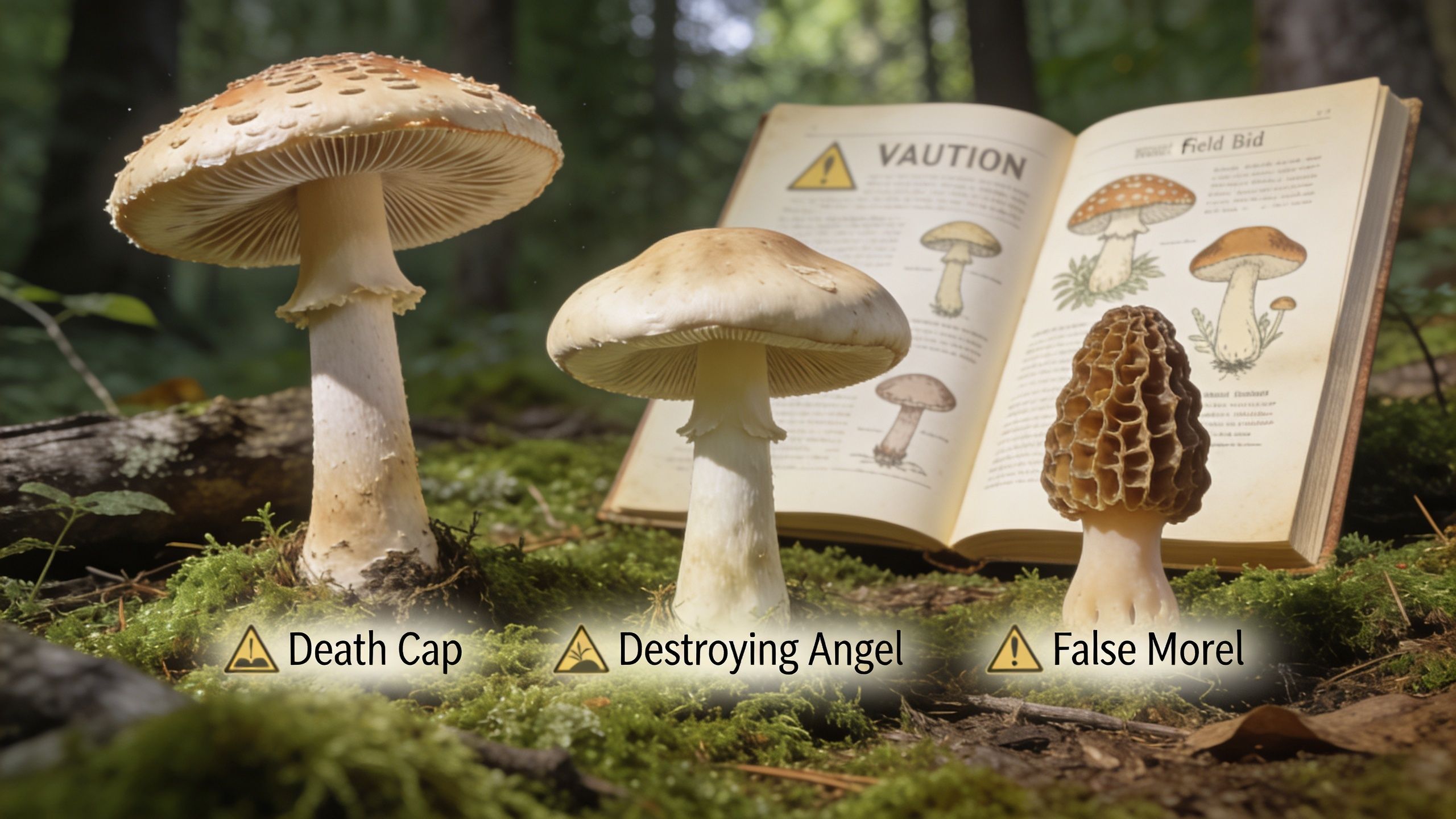
Some mushrooms deserve special attention because they combine three bad traits. They’re dangerous, they’re easy to mistake for something else, and they show up in places where people look.
The Amanita group
If I could teach one beginner rule for survival, it would be this: treat unfamiliar Amanitas as serious threats.
The worst-known example is Amanita phalloides, the death cap. According to Midwest Mycology’s poison mushroom guide, it contains amatoxins that halt cellular function and can cause liver failure, with a mortality rate of 10 to 50% even with treatment. The same source notes that half a mushroom cap can be a lethal dose for an adult, and cooking does not destroy the toxins.
That last point is critical. Many people still think heat makes a risky mushroom safer. With death cap toxins, that belief can kill.
What makes Amanitas so treacherous
Amanitas often look clean, neat, and almost textbook-perfect. White gills. A ring on the stem. Sometimes a bulb or cup-like base. To a novice, that can read as “classic mushroom.” To a mycologist, it can read as “slow down right now.”
Michigan also has other deadly Amanitas named by MSU-related materials, including A. bisporigera, A. cothurnata, A. tenuifolia, and A. velatipes in the broader verified data set. Beginners often miss the base because they pick or cut the mushroom too high, leaving the most important clue in the ground.
Never identify a white-gilled mushroom from the cap alone.
False morels
False morels, including Gyromitra esculenta, are dangerous because they collide with spring excitement. When people are eager for true morels, they become less skeptical. That’s exactly when a wrinkled, brain-like mushroom can get the benefit of the doubt it doesn’t deserve.
False morels matter because tradition confuses people. Some hear that a species is “edible if prepared right” and assume that means safe enough. It doesn’t. A mushroom with a history of poisoning is not beginner food.
Jack-o'-lantern mushrooms
Omphalotus illudens, the jack-o'-lantern, is a classic trap for chanterelle hunters. It’s bright orange and often eye-catching, which draws attention fast. The problem is that many new foragers see orange and ruffled growth and stop looking.
Jack-o'-lantern mushrooms have true gills and can cause severe vomiting and diarrhea. Chanterelles do not have true gills. They have blunt, shallow ridges. That difference sounds technical until you hold both in your hand. Then it becomes the whole game.
Cortinarius and the delayed threat
Some poisonous mushrooms are frightening precisely because nothing dramatic happens right away. Cortinarius species belong in that category. They’re not always the mushrooms people fear most, but they should be.
The broader safety lesson is simple. A mushroom doesn’t need to cause instant collapse to be medically serious. Some toxins buy time. They let a person feel fine long enough to miss the chance for early response.
Spotting the Difference Common Look-Alike Traps
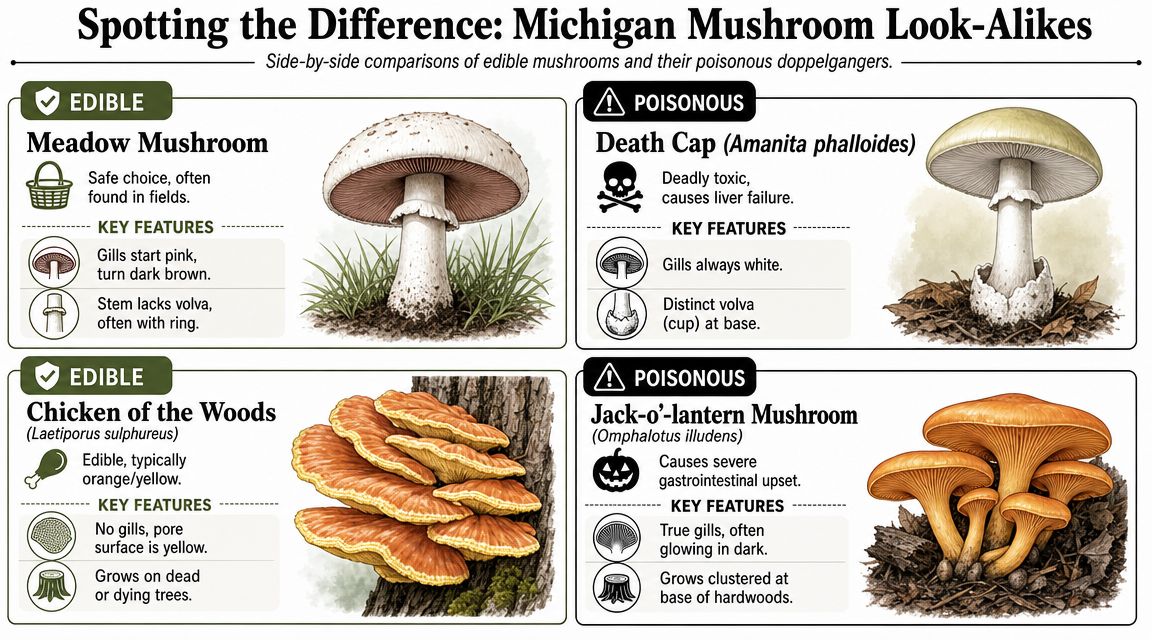
Most mushroom poisonings don’t happen because someone wanted danger. They happen because someone wanted certainty and accepted something less. In Michigan, the highest-risk errors often involve a poisonous species being mistaken for an edible mushroom, or a deadly small brown mushroom being mistaken for a psychoactive one.
Death cap and meadow mushroom
This is one of the oldest and most dangerous mix-ups. The trouble starts when someone notices a mushroom that seems “store-mushroom adjacent.” Pale cap. Familiar shape. Manageable size. That mental shortcut is exactly what dangerous Amanitas exploit.
Historically, Amanita phalloides was implicated in 16 of 44 severe illnesses and deaths in a southeastern Michigan study over a 10-year period, and a later 19-year study highlighted poisonings from Gyromitra esculenta during spring morel season, according to the Michigan toxic mushroom publication. That’s why “it looks like a grocery mushroom” should never comfort you.
Here’s the simplest distinction a beginner should remember:
| Feature | Meadow mushroom type | Death cap danger sign |
|---|---|---|
| Gills | Change as the mushroom matures | Stay white |
| Base | No cup-like volva | Cup-like volva may be present |
| Overall read | Familiar isn’t enough | White gills demand caution |
True morels and false morels
This confusion gets people every spring. A real morel is a very specific thing. A false morel is a broad warning label for mushrooms that borrow part of the morel look without being the same organism.
Use a knife and your eyes. Cut it lengthwise.
- True morel clue: Hollow through the inside.
- False morel warning: Interior may look stuffed, folded, cottony, chambered, or irregular.
- Confidence rule: If the inside doesn’t match the expectation exactly, don’t eat it.
A good comparison point is the safety mindset discussed in this look at wild mushroom confusion around lion’s mane. The species may differ, but the principle is identical. Close is not enough.
If a spring mushroom makes you argue with yourself, the mushroom has already won.
Chanterelles and jack-o'-lanterns
This pair teaches one of the most useful beginner lessons in mycology. Don’t ask only, “What color is it?” Ask, “What is the underside doing?”
Chanterelles have blunt ridges that look melted or folded into the cap. Jack-o'-lanterns have sharp, true gills. One looks carved from wax. The other looks lined with thin pages.
Other practical differences matter too:
- Growth habit: Jack-o'-lanterns often grow in clusters.
- Substrate clue: They’re commonly associated with wood or buried wood.
- Symptom consequence: Mistakes often lead to severe gastrointestinal illness.
Psychoactive species and deadly small brown mushrooms
This is the trap many people don’t talk about directly enough. Someone searching for a psilocybin mushroom can become overconfident around any small brown mushroom with the “right” silhouette. That is dangerous.
A deadly species such as Galerina marginata, often called the funeral bell, can overlap in the broad visual category people casually call “little brown mushrooms.” For beginners, that category is almost useless. It hides major differences behind a lazy label.
If someone is trying to tell apart a potentially psychoactive species from a dangerous non-psychoactive species, they need more than cap color and bruising guesses. They need careful habitat notes, spore print work, stem details, and expert review. Anything less is gambling.
Recognizing Poisoning Symptoms and Taking Emergency Action
The most dangerous mushroom poisoning mistake is waiting.

Some mushrooms cause fast vomiting and diarrhea. Others create a delay that fools people into thinking they’re fine. A person may eat a dangerous mushroom, feel normal for hours, or much longer, and then get hit when organ damage is already underway.
Why delay is so dangerous
Cortinarius species are a hard lesson in delayed toxicity. According to MSU Extension’s warning on poisonous mushrooms in Michigan, symptoms can be delayed by 10 days to 3 weeks, and a Michigan woman suffered irreversible kidney failure after consuming a Cortinarius mushroom.
That kind of timeline breaks people’s instincts. Most of us connect danger with immediate reaction. Mushroom toxins don’t always work that way. Delay can make a person dismiss the mushroom, forget details, or skip early medical advice.
What to do right away
If someone may have eaten a wild mushroom and there is any doubt about the identification, take action immediately.
- Call Poison Control now. In the United States, call 1-800-222-1222 right away.
- Don’t wait for symptoms. Waiting can waste critical time, especially with toxins that target the liver or kidneys.
- Save a sample. Keep the mushroom, leftovers, cleaning scraps, or even clear photos from multiple angles.
- Write down the time. Note when it was eaten, how much, and whether anyone else ate it.
- Go to emergency care if symptoms are severe or worsening. Repeated vomiting, confusion, weakness, dehydration, jaundice, or decreased urination all need urgent attention.
The right time to call Poison Control is when you suspect a bad mushroom, not when you’ve decided it must be one.
Symptoms that deserve immediate respect
Watch for these patterns:
- Gastrointestinal distress: Vomiting, diarrhea, stomach cramps.
- Liver-related warning signs: Fatigue, jaundice, worsening illness after an early stomach phase.
- Kidney-related warning signs: Reduced urine, flank pain, swelling, unusual thirst, or delayed illness after mushroom ingestion.
- Neurologic changes: Confusion, agitation, severe drowsiness, unusual behavior.
This short video is a useful reminder that mushroom emergencies need fast, calm action.
What not to do
Don’t try a home test. Don’t rely on internet comments. Don’t assume cooking made it safe. Don’t keep eating the mushroom because the first bite seemed fine. And don’t throw away the evidence if you can avoid it.
Doctors and poison specialists can help more when they know what was eaten. A crumpled paper towel with mushroom scraps can be more useful than a confident guess.
A Harm Reduction Guide to Foraging in Michigan
Some readers will still forage. If that’s you, the goal has to be harm reduction, not bravado. The safest forager isn’t the one with the biggest basket. It’s the one who walks away from uncertainty.
Urban and suburban Michigan make this harder than people expect. This overview of poisonous mushrooms in Michigan notes emerging risks from lesser-known poisonous mushrooms in urban settings, including Sulphur Tuft on fallen logs and Funeral Bell on conifer stumps in city parks. These aren’t only deep-woods problems. They can appear where joggers, dog walkers, students, and curious hobbyists see them every day.
The non-negotiable rules
A safe system needs rules that still work when you’re tired, rushed, or excited.
- Absolute certainty only. If your ID depends on “probably,” the mushroom doesn’t get eaten.
- Use the whole mushroom. Dig carefully and inspect the base. A missing stem base can hide the trait that mattered most.
- Make a spore print. Put the cap on paper, cover it, and wait. Spore color can narrow the field in a way cap color never will.
- Cook known edibles thoroughly. Even edible species can cause problems when eaten raw or undercooked.
- Keep species separate. One bad mushroom mixed into a bag of good ones creates a new problem.
Why apps and crowd guesses fall short
Apps are fine for keeping a journal. They are not enough for deciding what enters your body. Cameras flatten texture, miss odor, distort color, and rarely show the buried base. Online groups can help, but they can also reward fast answers over careful ones.
A safer approach is slower. Check your own observations first. Then compare multiple traits. Then seek review from a trained local expert or established mycology community. If that sounds like too much work for dinner, that’s the point.
A mushroom doesn’t become safe because several strangers agreed on a photo.
Urban foraging needs its own caution
People often underestimate city mushrooms because the setting feels controlled. It isn’t. Mulch beds, designed berms, boulevard trees, and park woodlots create odd combinations of moisture, imported wood, and stressed trees. That can produce species many field guides don’t emphasize for beginners.
If you browse broader local information about wild mushrooms in Michigan, keep one caution front and center. A mushroom found near people is still a wild organism with its own chemistry. Urban habitat does not make an ID easier. Sometimes it makes it stranger.
Your Safest Source Is a Trusted Source
The central lesson of michigan poisonous mushrooms is not that mushrooms are bad. It’s that uncertainty is bad.
Wild mushrooms can be fascinating, beautiful, ecologically important, and in some cases edible. They can also be deceptive in ways that punish overconfidence. A cap color, a phone photo, a hunch, or a friend’s casual opinion doesn’t create safety. Careful identification does. And careful enough identification is often harder than it looks.
That matters whether someone is curious about culinary species or psychoactive fungi. In both cases, the risk comes from guessing at identity. Once that guess enters your body, the debate is over and the toxicology begins.
The responsible alternative is simple. If you want a mushroom experience, get it from a source that removes the wild-ID gamble. Trust should come from sourcing, handling, and consistency, not from luck in a park or confidence in a mulch bed.
Frequently Asked Questions About Mushroom Safety
Can cooking make poisonous mushrooms safe
Sometimes people hear that “everything is edible if prepared correctly” and treat it like folklore with a safety margin. It isn’t. Some dangerous mushroom toxins remain dangerous after cooking. Heat is a cooking method, not a detox plan.
Is touching a poisonous mushroom dangerous
Touching is not the same as eating. Casual skin contact is generally not the poisoning route people fear most. Ingestion is the primary danger. Still, it’s smart to wash your hands after handling wild mushrooms and to keep children and pets from mouthing them.
Can I trust a mushroom identification app
Use apps as note-taking tools, not medical or culinary authority. They can suggest possibilities, but they cannot inspect the stem base, smell, texture, hidden bruising, substrate, or microscopic features with the reliability needed for a safety decision.
Are there universal signs that a mushroom is poisonous
No. There is no reliable “poisonous mushroom look.” Bright color doesn’t prove danger. A bug chewing on it doesn’t prove safety. Pleasant smell doesn’t prove edibility. Silver spoon myths, onion myths, peeling myths, and taste myths are all bad substitutes for identification.
If a mushroom is growing in my yard, is it safer than one in the woods
No. Yard mushrooms are still wild mushrooms. In some cases, suburban lawns, mulch beds, and cultivated areas produce mushrooms that people are less prepared to recognize because they don’t expect them there.
What’s the safest beginner rule
Don’t eat any wild mushroom unless a qualified expert has identified that exact species with confidence. Learn from photos, books, and walks if you want. But don’t turn learning into eating before your skill is real.
What if I already ate one and feel fine
Feeling fine doesn’t clear the mushroom. Some serious toxins act late. If there’s doubt about what was eaten, call Poison Control immediately and preserve a sample.
If you want mushroom products without the life-threatening uncertainty of wild foraging, Metro Mush offers a more responsible path. Adult customers in the Detroit and Ann Arbor areas can choose from curated psilocybin products like dried strains, chocolates, and drinks, with clear ordering options and local delivery support. The safest mushroom experience starts with knowing exactly what you’re getting.