


Most advice about a wild poisonous lion's mane mushroom starts in the wrong place. It treats Lion's Mane as if the main danger is a toxic twin hiding in the woods, waiting to fool you.
That isn't the actual problem.
The more useful question is this: What can go wrong when you forage a mushroom that people believe is "safe"? That question leads to better habits, better identification, and fewer bad decisions in the field.
Your Search for a Poisonous Lion's Mane Ends Here
If you're searching for a poisonous Lion's Mane, the reassuring answer is simple. There are no known poisonous look-alikes to Lion's Mane within the North American Hericium group. The fear is understandable, but the phrase itself points many beginners toward the wrong hazard.
The danger isn't a secret toxic Lion's Mane twin. The danger is broad, practical, and familiar to anyone who's spent time foraging. A person can misidentify a completely different mushroom. They can harvest a specimen that's old, soggy, or beginning to rot. They can pick from contaminated ground or treated wood. They can also discover that their own body doesn't tolerate a mushroom as well as someone else's.
Practical rule: Stop asking only, "Does Lion's Mane have a poisonous look-alike?" Start asking, "Is this the right species, in good condition, from a clean place, and am I prepared to eat it safely?"
That shift matters. It moves you from internet myth to field judgment.
Beginners often get stuck on one narrow fear because it feels easy to solve. They want one clear villain. Mushrooms don't work that way. Safety comes from correct identification, freshness, location, and restraint. You need all four.
Lion's Mane is one of the more approachable wild mushrooms to learn, which is exactly why overconfidence can sneak in. A novice who correctly recognizes one white shaggy fungus may assume they're ready for everything else nearby. They aren't. The woods reward careful people, not just enthusiastic ones.
Meet the Edible Hericium Family
Lion's Mane belongs to a small group of fungi that helps explain why the "poisonous look-alike" myth has so much staying power. People hear that mushrooms often have dangerous doubles, then apply that rule to every species. In this case, that shortcut fails.
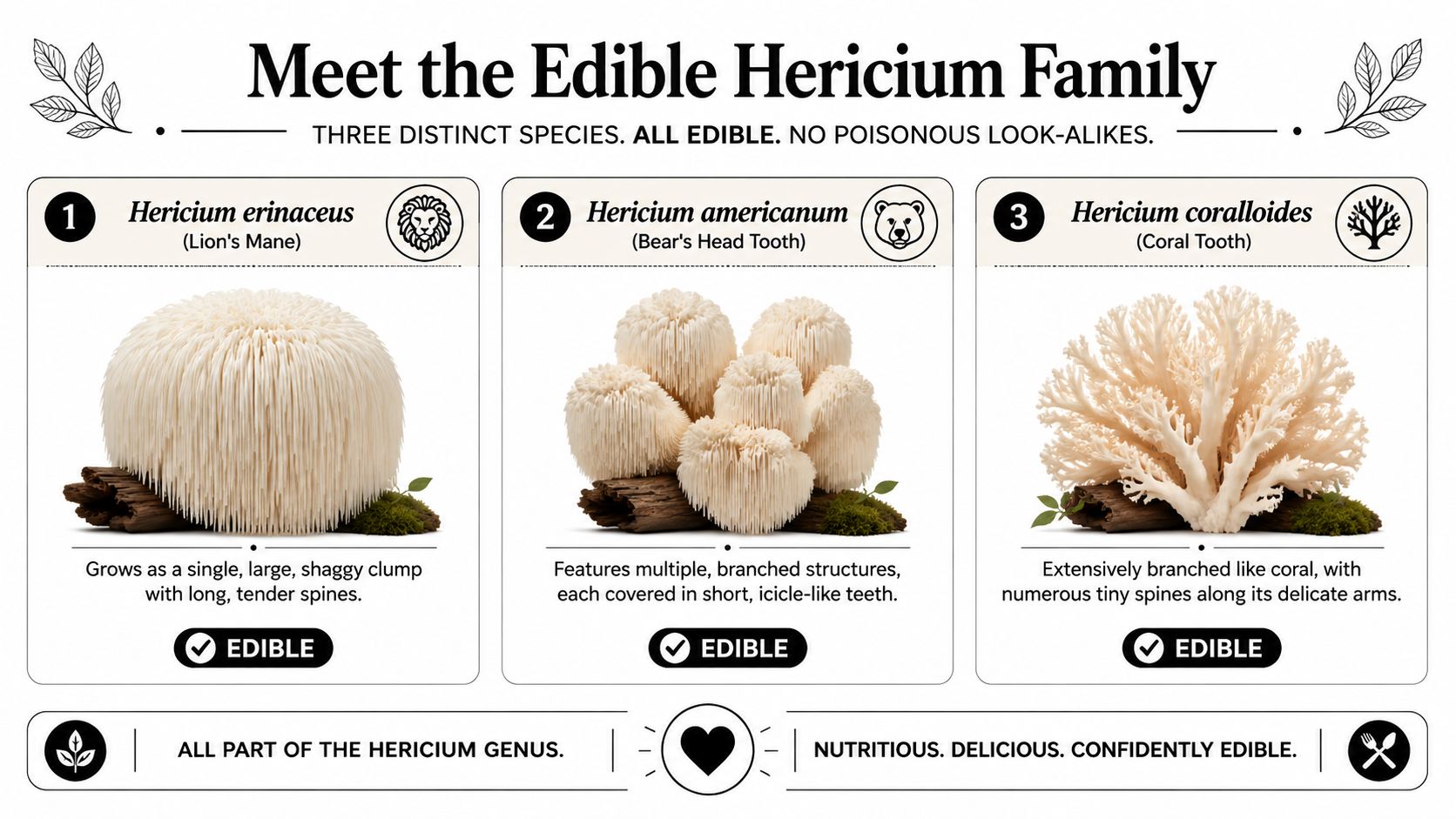
Across North American hardwood forests, the main Hericium mushrooms people encounter are edible. That includes Hericium erinaceus, Hericium americanum, and Hericium coralloides. A 2024 toxicological study on organic H. erinaceus powder also reported non-acute toxicity at 2000 mg/kg body weight in rats, with LD50 greater than 2000 mg/kg and no clinical signs of toxicity, as summarized in this Lion's Mane foraging reference.
The family resemblance
All three share a basic character. They are pale, toothy fungi that produce soft dangling spines rather than gills, pores, or caps. That's the first big clue.
What changes from species to species is the overall architecture.
- Lion's Mane (H. erinaceus) usually forms a more compact, single mass. Many people describe it as a pom-pom, waterfall, or shaggy white clump.
- Bear's Head Tooth (H. americanum) tends to branch more. You still see hanging teeth, but the fruiting body has a more divided structure.
- Coral Tooth (H. coralloides) looks the most delicate and coral-like. It branches extensively and carries many short hanging teeth along those branchlets.
A beginner often mistakes "different" for "dangerous." In Hericium, different usually just means another edible relative.
A quick comparison you can use in the woods
| Species Name | Common Name | Key Identifying Feature |
|---|---|---|
| Hericium erinaceus | Lion's Mane | Dense, shaggy clump with long downward-hanging spines |
| Hericium americanum | Bear's Head Tooth | Branched structure with clusters of hanging teeth |
| Hericium coralloides | Coral Tooth | Highly branched, coral-like form with many small teeth |
That table helps with one common confusion. A lot of new foragers assume Lion's Mane must always be a perfect round ball. It doesn't have to be. It does need to look like a toothed Hericium and not like a shelf fungus, jelly fungus, or a decayed clump of something unrelated.
The safest beginner mindset is this. If it looks like a fresh, white tooth fungus on hardwood, you're probably looking within the right family. If it has caps, gills, pores, bright slime, or a woody shelf texture, you're not.
Why this matters for confidence
Knowing the family reduces panic, but it shouldn't produce carelessness. You still need to identify what you picked. "No poisonous look-alikes" doesn't mean "anything pale on a tree is dinner."
It means that within the edible Hericium set, your risk isn't the same as with mushroom groups that contain dangerous doubles. That's a useful distinction. It gives beginners room to learn, provided they stay disciplined.
One more point confuses people. They read that Lion's Mane can start as a white lump before the long teeth become obvious. That's true. Early growth can look oddly smooth. If you're uncertain because the teeth haven't developed well, leave it and come back later if conditions allow. Time often clarifies structure better than guesswork.
How to Positively Identify Choice Lion's Mane
A good Lion's Mane isn't just correctly identified. It's also worth eating. That's a separate skill, and beginners often skip it.
You want a specimen that is fresh, clean-looking, and still holding its shape. You do not want a waterlogged sponge, a yellowing old mass, or a ragged blob that's already breaking down.
Start with the tree and the season
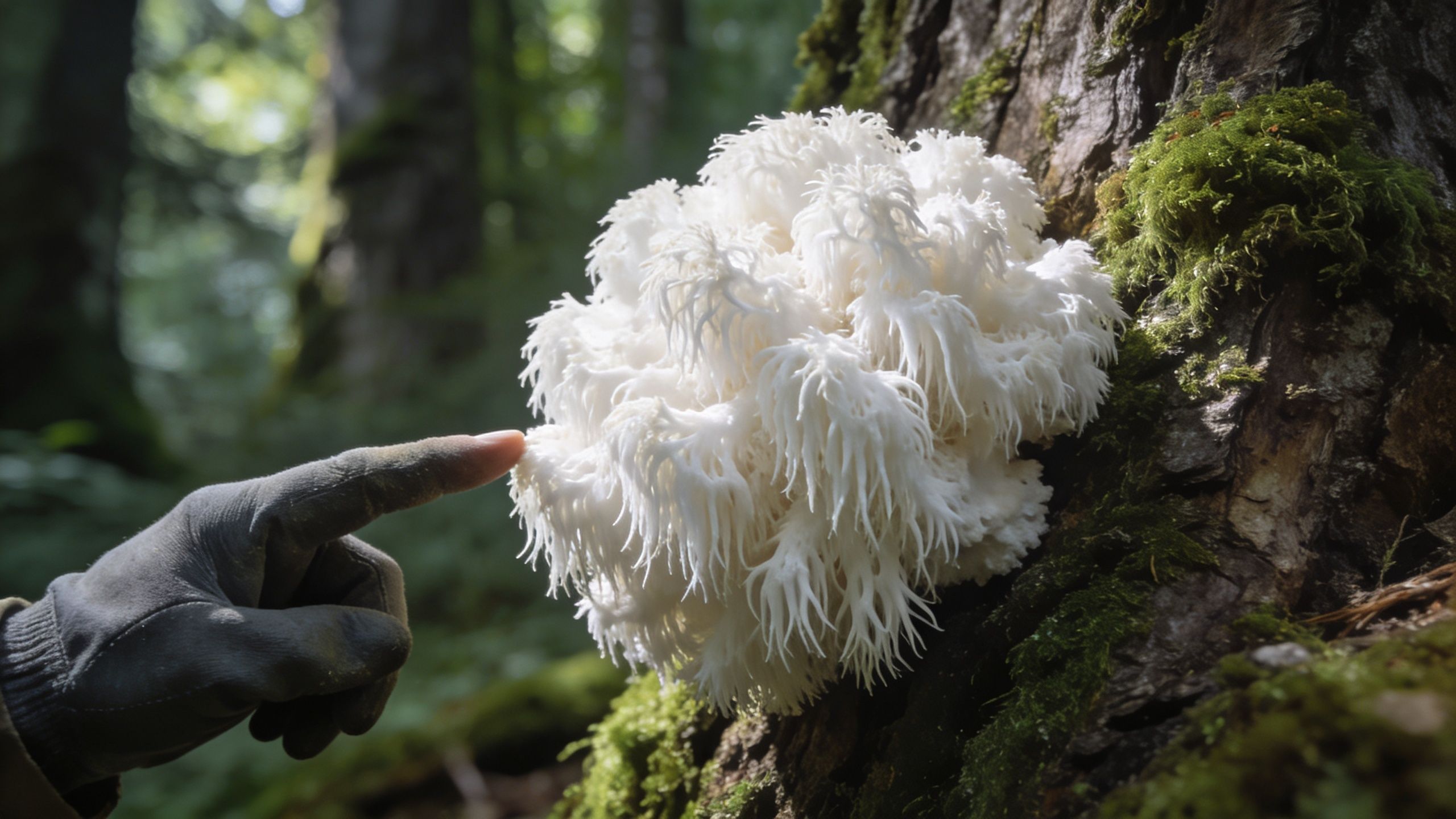
Lion's Mane grows on dead or dying hardwood, especially oak, beech, and maple. That's one of your first filters. If you think you've found Lion's Mane on a random substrate that doesn't fit, slow down.
Late summer through early winter is the expected window noted in the verified field description. That doesn't mean every white growth on hardwood during that period is Hericium. It means your find should make ecological sense before you ever touch it.
For readers who like comparing regional patterns before heading out, this guide to mushrooms of Illinois can help you think in terms of habitat and neighboring species rather than one isolated mushroom photo.
Use a field checklist, not a hunch
When I teach new foragers, I ask them to check five things in order.
Overall form
Look for a single shaggy mass or a toothy branching structure consistent with Hericium. Lion's Mane itself usually presents as a more compact clump rather than a coral fan.Spines
The hanging teeth should point downward. For Lion's Mane, the verified field notes describe spines longer than 1 cm, and mature specimens can reach up to 3 inches.Color
Fresh specimens are white to cream. Aging mushrooms turn yellowish. That color shift matters because yellowing can signal age and the onset of decline.Interior and spore print
The flesh should be pale, and the verified description notes a white spore print.Condition on the tree
A prime specimen looks hydrated but not collapsed. It should appear alive and intact, not slimy, brown, sour, or heavily degraded.
What a choice specimen feels like
Touch matters. A fresh Lion's Mane has some spring to it. It should feel moist, but not sodden.
A common beginner mistake is picking a beautiful-looking mushroom after a stretch of wet weather and assuming it will cook well. Lion's Mane absorbs water rapidly. Older specimens can hold so much moisture that they turn unpleasant in the pan unless you squeeze out excess water after harvest. If you skip that step, sautéing often produces mush.
If a Lion's Mane feels like a soaked bath sponge, treat that as a quality warning, not a cooking challenge.
What to leave behind
Some finds are legal to pick and still not worth eating. Leave these:
- Yellowing specimens that show clear age
- Mushy growth that collapses under light pressure
- Pieces with sour or rotten smell
- Dirty masses full of debris, insects, or obvious decay
- Mushrooms growing on suspect material, such as treated wood or contaminated sites
Many people misunderstand. They think "edible species" means every specimen of that species is safe. It doesn't. A spoiled edible mushroom is still a bad meal.
A simple decision test
Ask yourself three questions before harvesting:
| Question | What you want to see |
|---|---|
| Does it look like Hericium | White or cream tooth fungus with downward spines |
| Is it in prime condition | Firm, fresh, not yellowing or collapsing |
| Is the location trustworthy | On suitable hardwood, away from obvious contamination |
If you can't answer yes to all three, leave it.
That discipline is what separates collecting from foraging. Anyone can get excited by a tree mushroom. A careful forager selects only the specimen they can identify with confidence and cook with confidence.
The Real Dangers of Wild Mushroom Foraging
The phrase wild poisonous lion's mane mushroom points to the wrong lesson. It encourages a beginner to solve one imaginary problem while ignoring several real ones.
A person can be technically correct about Lion's Mane and still make themselves sick.
Mistaking safety for universal expertise
This happens constantly with beginners. They learn one iconic edible, then start scanning the forest with rising confidence. Soon they're not just looking at Lion's Mane. They're grabbing nearby fungi, comparing them loosely to phone photos, and trusting momentum.
That is where trouble starts.
If you know one mushroom well, then pick only that mushroom. Don't let success with one species bleed into unrelated groups. A shelf fungus, a capped mushroom on the forest floor, and a white toothed fungus on hardwood may all appear during the same walk. They do not belong to the same risk category.
Spoilage can make good mushrooms bad
Even a correctly identified edible can become a poor food choice when it's old, wet, or contaminated. Lion's Mane is especially prone to quality loss because it holds water so easily.
Watch for these practical hazards:
- Age-related breakdown leads to soft texture, discoloration, and poor cooking quality.
- Waterlogging can accelerate spoilage and create the kind of soggy mushroom many people wrongly blame on the species itself.
- Contaminated growing sites raise another issue. A mushroom can be the right species and still come from the wrong place.
Your body gets a vote
People often speak about edible mushrooms as if edibility were identical for everyone. It isn't. A person can have a sensitivity or allergy to a mushroom that many others tolerate.
Start small with any wild mushroom, including a carefully identified Lion's Mane. Cook it well. Eat a modest portion. Then pay attention. Caution isn't fear. It's how adults test new foods responsibly.
A mushroom can be edible in the field guide and still be a bad choice for your body that day.
The most useful safety habit
When in doubt, throw it out.
That rule isn't dramatic. It's practical. Wild foods tempt people because the find feels earned. Once you've spotted, reached, cut, and carried a mushroom, your mind starts arguing on behalf of keeping it. Good foragers interrupt that impulse. They'd rather lose one meal than gamble on a bad one.
What to Do If You Suspect Mushroom Poisoning
If you think someone ate the wrong mushroom, or ate a mushroom in bad condition and is getting sick, act quickly. Don't wait for a dramatic symptom list to appear before you respond.
Start with professional help.

The first moves
Take these steps in order:
- Call Poison Control right away at 1-800-222-1222 if you're in the United States.
- Call 911 if the person has severe symptoms, trouble breathing, confusion, seizure activity, collapses, or seems to be getting worse quickly.
- Do not induce vomiting unless a medical professional tells you to.
- Stop eating the mushroom immediately.
- Save a sample of the mushroom in a paper bag, not plastic, if any material remains.
A paper bag matters because it helps preserve the sample without trapping as much moisture as plastic. If there are leftovers from the meal, uncooked pieces from harvest, or even photos from the foraging trip, keep them. Identification can help clinicians and poison specialists make better decisions.
What symptoms can look like
Mushroom-related illness doesn't always look the same. A person may develop stomach upset, vomiting, diarrhea, dizziness, sweating, confusion, weakness, or other concerning changes.
Don't try to diagnose the exact cause yourself. The timeline and symptom pattern can matter, but interpretation belongs to poison specialists and medical staff.
If someone says, "Let's wait and see if it passes," that's usually the wrong instinct after suspected mushroom poisoning.
What to have ready when you call
Before you call, gather what you can without delaying help:
- Who ate it and roughly when
- How much was eaten, if known
- Whether it was raw or cooked
- Current symptoms
- Any photos or saved mushroom material
- Where it was picked
That last point is useful because habitat can narrow identification. Was it on hardwood? On the ground? In a yard? On landscaping mulch? Those details can help experts think more clearly.
A short visual refresher can help reinforce emergency priorities:
What not to do
Avoid the common mistakes:
- Don't trust social media identification during an emergency
- Don't keep feeding the person fluids or home remedies if they're vomiting heavily without professional guidance
- Don't assume cooked mushrooms can't be the cause
- Don't throw the evidence away
Fast, calm action helps more than internet sleuthing.
Practice Safe and Legal Foraging in Michigan
A safe forager doesn't just know mushrooms. They know where they are standing, whose land they're on, and what the local rules permit.
In the Detroit and Ann Arbor area, Lion's Mane can be found on dying hardwoods in state forests where the Michigan DNR allows wild mushroom harvesting for personal use. But commercial sale requires permits, and many local and state parks ban collecting entirely, including Waterloo Recreation Area, according to this overview of Lion's Mane look-alikes and Michigan foraging context. The same source notes a 20% decline in Midwest Hericium populations, raising a real sustainability concern.
Personal use isn't permission everywhere
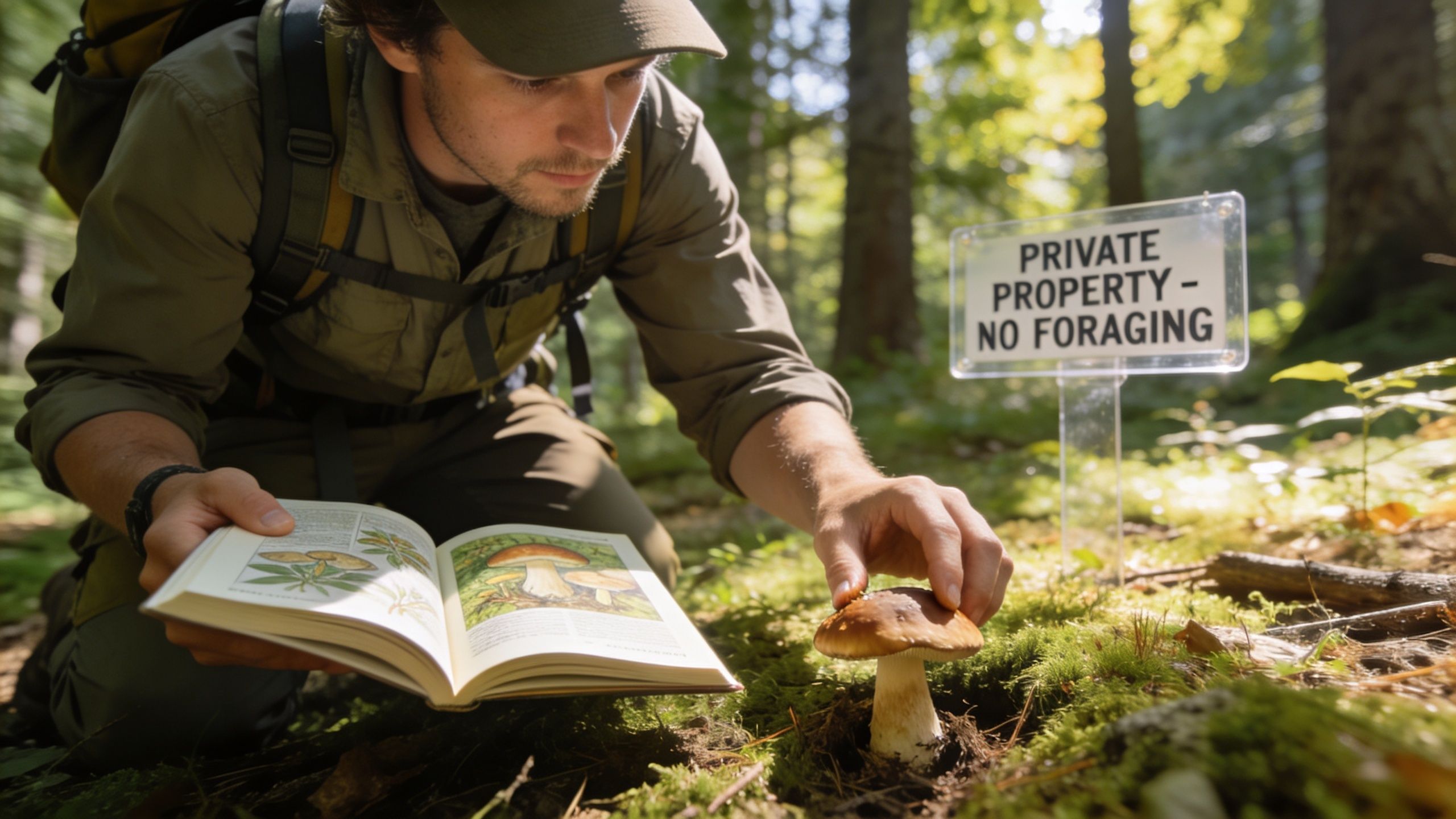
Many people get tripped up here. They hear "mushroom harvesting is allowed" and assume that means all public land is fair game. It doesn't.
Rules can differ between state forests, recreation areas, county parks, city parks, and private land. A legal forager checks the specific place, not just the state. If the site says no collecting, that's the end of the discussion.
For people exploring regional conditions, this overview of wild mushrooms in Michigan is a useful starting point for thinking locally.
Sustainability is part of safety
You can identify a Lion's Mane perfectly and still forage poorly. Ethical harvesting means leaving the woods in good shape and not treating every find as a personal prize.
A responsible approach looks like this:
- Take only sound specimens you plan to use
- Leave poor or aging mushrooms to finish their role in the habitat
- Avoid damaging the tree
- Respect access rules on public and private land
- Skip "cleanup harvesting" where you strip an area just because you found it first
The debate over cutting versus pulling still circulates among foragers, and opinions differ. What's more important in practice is minimizing damage, handling the fruiting body cleanly, and avoiding unnecessary impact on the site.
The best forager in a woodland isn't the one carrying the biggest bag. It's the one who leaves the place looking untouched.
A Michigan forager's ethic
In a region where hardwood forests support these fungi, restraint matters. If populations are under pressure, your personal code should get stricter, not looser. Harvest less. Step carefully. Follow site rules exactly. Don't turn social media enthusiasm into local depletion.
Foraging isn't just about what you can pick. It's about what you choose to leave.
Your Foraging Journey Starts with Knowledge
The myth of a wild poisonous lion's mane mushroom falls apart once you understand the Hericium family. That's the easy part.
The harder and more valuable lesson is broader. Safe foraging depends on accurate identification, specimen quality, clean habitat, legal awareness, and personal restraint. Most bad outcomes come from failure in one of those areas, not from a mythical toxic Lion's Mane twin.
A skilled forager respects uncertainty. They don't force an ID. They don't rescue a rotting mushroom with optimism. They don't harvest where collection is prohibited. And they don't confuse one successful find with mastery of the forest.
If you want to keep learning, study local species, compare fresh specimens in the field, and spend time with people who know your regional woods. If you're also curious about the market side of this mushroom, this look at the price of Lion's Mane mushrooms adds practical context from the buyer's perspective.
Knowledge makes foraging calmer. Respect makes it safer.
Frequently Asked Questions About Lion's Mane
Can you eat wild Lion's Mane raw
You can, but it's often best to cook it. Cooking improves texture, makes it easier to work excess moisture out of the mushroom, and gives you a better chance to notice if the specimen was too old or too wet to begin with. For a first try, eat a small cooked portion rather than a large raw serving.
How should you clean and store fresh Lion's Mane
Start with a gentle brush or light trimming to remove bark, insects, and forest debris. If it needs rinsing, keep it brief, because Lion's Mane already holds water easily. After harvest, especially with mature specimens, squeeze out excess moisture if needed.
Store it cool and breathable, not sealed wet in plastic. If it becomes slimy, sour, or badly discolored, discard it.
Is wild Lion's Mane better than cultivated
Not automatically. Wild mushrooms can be excellent, but they vary with age, weather, and where they grew. Cultivated Lion's Mane can offer more consistency in cleanliness, texture, and timing.
For many people, the difference isn't "better" versus "worse." It's variability versus predictability. A careful cook can enjoy both, but a beginner often finds cultivated mushrooms easier to evaluate.
If you're an adult in Southeast Michigan looking for curated mushroom products from a local provider, Metro Mush offers a straightforward way to browse options, check locations, and order from Detroit or Ann Arbor delivery zones.