


Yes, you can freeze dried mushrooms. But if they were professionally freeze-dried to preserve 90-95% of their bioactive compounds, freezing them again usually isn't the smartest long-term move because thawing introduces the main risk, moisture.
That’s the point most general storage guides miss. If you’re holding onto premium dried mushrooms for a future trip, a careful microdosing routine, or because you bought quality and don’t want to waste it, the storage question isn’t just about making them last. It’s about protecting potency, texture, and safety from preventable damage.
A lot of people ask can you freeze dried mushrooms because freezing sounds like the ultimate preservation method. Cold feels safe. In practice, room-temperature storage in the right setup is often lower risk. The mistake isn’t the freezer itself. The mistake is what happens when dried mushrooms meet air, humidity, temperature swings, and condensation.
If you start with a high-quality dried product, your job at home is simple in theory and unforgiving in practice. Keep it dry. Keep it dark. Keep it airtight. Keep the temperature stable. Everything in this guide comes back to those four rules.
Protecting Your Premium Mushroom Investment
If you’ve just picked up a premium dried strain and want to save some for later, storage matters almost as much as the product itself. People spend time comparing strains, formats, and dose styles, then toss the remainder into a plastic bag in a drawer. That’s where good material starts losing ground.
Dried psilocybin mushrooms are not shelf-stable in the casual sense. They’re shelf-stable when the environment stays controlled. That distinction matters. A properly preserved product can hold quality for a long time. A poorly stored one can soften, darken, smell off, or feel weaker long before you expected.
What you’re really trying to protect
Most buyers aren’t storing mushrooms for novelty. They’re storing them because they want a consistent future experience. That might mean saving part of a bag of Penis Envy for a planned session, keeping Enigma away from humidity between uses, or making sure a purchase still feels reliable months from now.
Storage has three jobs:
- Preserve potency: Keep sensitive alkaloids from degrading faster than they have to.
- Prevent moisture problems: Once dryness is lost, mold risk and quality loss move in quickly.
- Maintain predictable use: If texture and dryness change, dosing can feel less consistent.
Practical rule: Treat dried mushrooms more like a delicate spice than a freezer meal. The enemy isn’t time alone. It’s unstable storage.
The question behind the question
When people ask can you freeze dried mushrooms, they’re usually asking one of two things. Either they want the longest possible shelf life, or they’re trying to avoid potency loss. Freezing seems like the answer to both.
Sometimes it is. Often it isn’t.
The better question is whether freezing improves your specific situation enough to justify the added risk. If your mushrooms are already dry and professionally prepared, the safer move is to preserve that condition, not put the product through another cold-storage cycle at home.
Why Potency Fades The Enemies of Psilocybin
Psilocybin storage goes wrong for ordinary reasons. Not dramatic mistakes. Small exposures that add up. Leave a jar open too long. Store it in a humid room. Pull it in and out of the freezer. Keep it where warm air and light hit it every day. None of that looks serious in the moment, but it pushes quality in the wrong direction.
Psilocybin is a sensitive compound. According to the discussion of home and professional freeze-drying variability, lab tests on Psilocybe cubensis in 2025 indicated professional freeze-drying retained ~85% of psilocybin, while home methods were much less predictable, with anecdotal reports suggesting 20-50% potency loss. That doesn’t mean every home-stored mushroom degrades that way. It means inconsistency is the central problem.
The four things that work against you
Think of dried mushrooms the way you’d think about a rare spice. They keep best when the environment stays boring.
- Oxygen: Air exposure gives degradation more opportunity. Every time you open a container, you reset the clock a little.
- Light: Light exposure is like leaving a photograph in a sunny window. It doesn’t ruin it instantly, but it keeps fading quality.
- Heat: Warm storage speeds up the wrong chemical changes and makes everything less stable.
- Moisture: This is the one that causes the fastest trouble. Dry mushrooms that pick up humidity stop being dry.
Why cracker-dry is non-negotiable
If a mushroom bends instead of snapping, storage gets riskier. That texture tells you moisture is already part of the equation. Once that happens, airtight storage alone won’t save you. You’re sealing in a problem.
People use the phrase cracker-dry for a reason. You want a dry, brittle texture before long-term storage even starts. That doesn’t just help shelf life. It helps keep the internal environment stable so the product doesn’t drift toward softness, odor changes, or spoilage.
Moisture is the tipping point. A little too much can undo a lot of careful handling.
Potency loss is often a storage problem, not just a time problem
Users sometimes assume older mushrooms are automatically weaker because they’re older. Age matters, but conditions matter more. Two batches stored for the same length of time can perform very differently if one sat in a warm, bright kitchen and the other stayed sealed, dry, and dark.
That’s why broad advice about “just freeze it” misses the core issue. Potency doesn’t fade because mushrooms are dried. Potency fades because dried mushrooms are exposed to the wrong environment after drying.
The Hidden Risks of Freezing Dried Mushrooms
Freezing sounds protective because cold slows a lot of unwanted activity. The hidden problem is that your mushrooms don’t live only in the freezer. They have to go in, come out, and be opened by human hands in real rooms with real humidity. That transition is where people lose the plot.
The main danger is condensation. When a very cold container meets warmer air, moisture can collect where you don’t want it. If you open the package before it fully reaches room temperature, that moisture can land on the mushrooms or inside the container. With dried psilocybin mushrooms, even a small amount of unwanted moisture can start quality loss.
Cold isn't the villain. Water is.
A lot of home users blame the freezer when what damaged their stash was the thaw. Dried mushrooms can sit in a cold, sealed environment. What they can’t tolerate well is repeated contact with moisture during handling.
That means the biggest freezing mistakes are simple:
- Opening too early: The container is still cold, and room air condenses inside.
- Freezing a partially dry product: Residual moisture creates more room for trouble.
- Repeated freeze-thaw cycles: Every cycle adds another chance for condensation.
- Loose packaging: Air inside the package gives humidity space to move.
Structural damage matters too
The underlying science of freeze-drying helps explain why sloppy freezing can backfire. The process works by sublimation, which removes ice as vapor rather than letting it pass through a liquid phase. The patent record for mushroom freeze-drying describes rapid freezing to below -20°C, vacuum below 2 mm Hg with an optimum below 1 mm Hg, and drying to less than 2% residual moisture by weight, all to minimize enzymatic degradation and preserve structure.
That same source also explains why improper freezing is risky. Slow freezing or improper thawing can allow ice crystals to form from residual moisture or condensation, which can rupture delicate cellular structure and compromise the alkaloids you’re trying to protect. In other words, professional freeze-drying is precise. Casual home freezing isn’t.
Why this matters more for premium material
When you’re storing ordinary culinary mushrooms, a texture change may be an annoyance. With psilocybin mushrooms, texture changes can signal moisture uptake, and moisture uptake can mean lower reliability. That’s a bigger issue when you care about consistency.
Here’s the practical trade-off:
| Storage approach | Main advantage | Main risk |
|---|---|---|
| Freezing dried mushrooms | Can reduce heat exposure if done perfectly | Condensation during thawing |
| Fridge storage | Feels convenient | Humidity swings and repeated access |
| Cool dark shelf storage | Stable and simple | Depends on strong packaging |
Freezing isn't casual storage. It’s a precision method with a narrow margin for user error.
If you’re going to freeze dried mushrooms, the method has to be deliberate from start to finish. Otherwise you’re taking a product that was already stable and introducing a new failure point.
How to Freeze Mushrooms The Right Way
You buy a premium batch, put it in the freezer to protect it, and lose potency because moisture sneaks in during thawing. I’ve seen that mistake more than once. Freezing can work, but only if the mushrooms go in fully dry, stay sealed, and come back to room temperature before the package is opened.
Start with fully dry mushrooms
Freeze only cracker-dry material. If a stem bends instead of snapping, or a cap feels leathery, it is not ready for cold storage. Residual moisture is what turns a freezer into a risk instead of a safeguard.
If you need a reference point for proper prep, this guide to drying Psilocybe cubensis shows what dry material should look and feel like before it goes into storage.
Professionally prepared mushrooms already arrive in a stable condition. Your goal is to keep them there. Freezing does not improve weak drying. It only preserves whatever condition the product is in when you seal it.
Build the package before it hits the freezer
Air and moisture control decide whether freezing helps or hurts. A loose bag in the freezer is asking for trouble, especially if the package will sit near frost, shifting temperatures, or frequent door openings.
Use this setup:
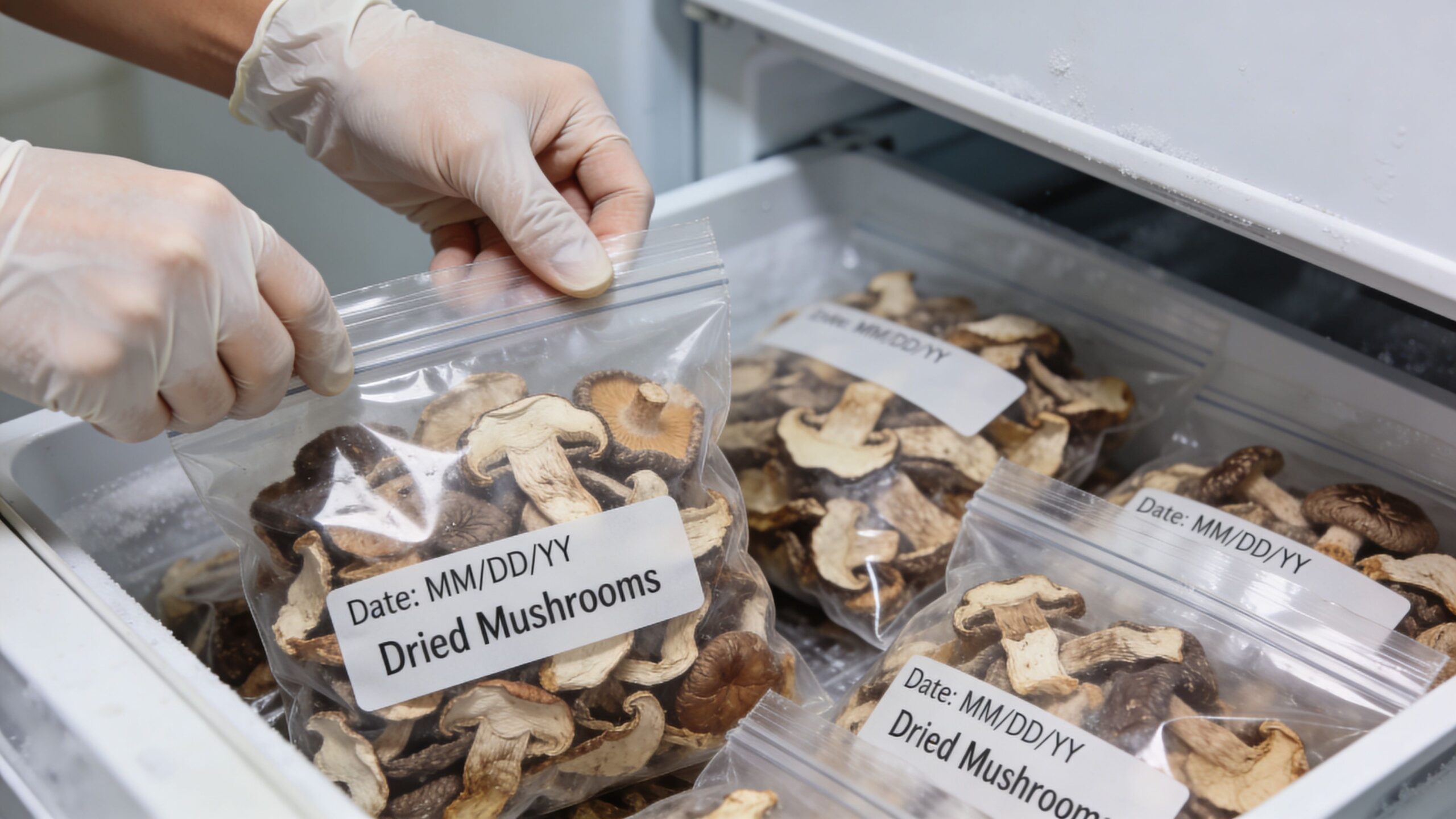
- Divide into small portions: Pack only what you expect to use at one time.
- Seal each portion tightly: A vacuum sealer is ideal. If you do not have one, press out as much air as possible and use the best moisture-resistant bag you have.
- Add a second layer: Put the sealed bag inside a rigid airtight container to protect against punctures, compression, and odor transfer.
- Label it clearly: Add the date so you do not keep reopening other packs to guess what is oldest.
- Place it in the coldest stable area: The back of the freezer is usually better than the door.
Small packs matter more than people realize. One large bag gets exposed every time you need a dose. Several small packs keep the rest untouched.
Open it only after it warms up
This is the step that protects potency.
Take one sealed portion out of the freezer and leave it closed until the entire package reaches room temperature. Do not peek inside. Do not break the seal early. Cold mushrooms pulled into warm air collect condensation fast, and that water lands directly on the material you were trying to protect.
Keep the package sealed until it is fully at room temperature. That habit does more to prevent freezer damage than any gadget.
Once opened, inspect the mushrooms before use. If they feel softer than they did before freezing, show visible moisture, or smell off, storage conditions failed somewhere in the process.
A quick visual walkthrough can help if you're deciding whether freezing is worth the hassle:
When freezing is actually worth the effort
Freezing makes sense for larger amounts you will not access often, or for situations where your room conditions are hard to keep cool and dry year-round. It also makes more sense if you already use vacuum sealing and have the discipline to thaw properly every time.
For routine personal storage, freezing often adds one more place to make a mistake. A stable shelf setup is usually easier to manage and easier to repeat correctly. That matters if your priority is protecting the consistency and value of premium mushrooms, not just storing them somewhere cold.
Safer and Simpler Storage Alternatives
A lot of storage mistakes happen after the mushrooms are already perfectly dry. The product starts strong, then home storage chips away at that quality through light, air, heat, and repeated handling. If the goal is to protect potency, a simple setup you will use correctly every time usually beats a more complicated one.
Mason jar and desiccant
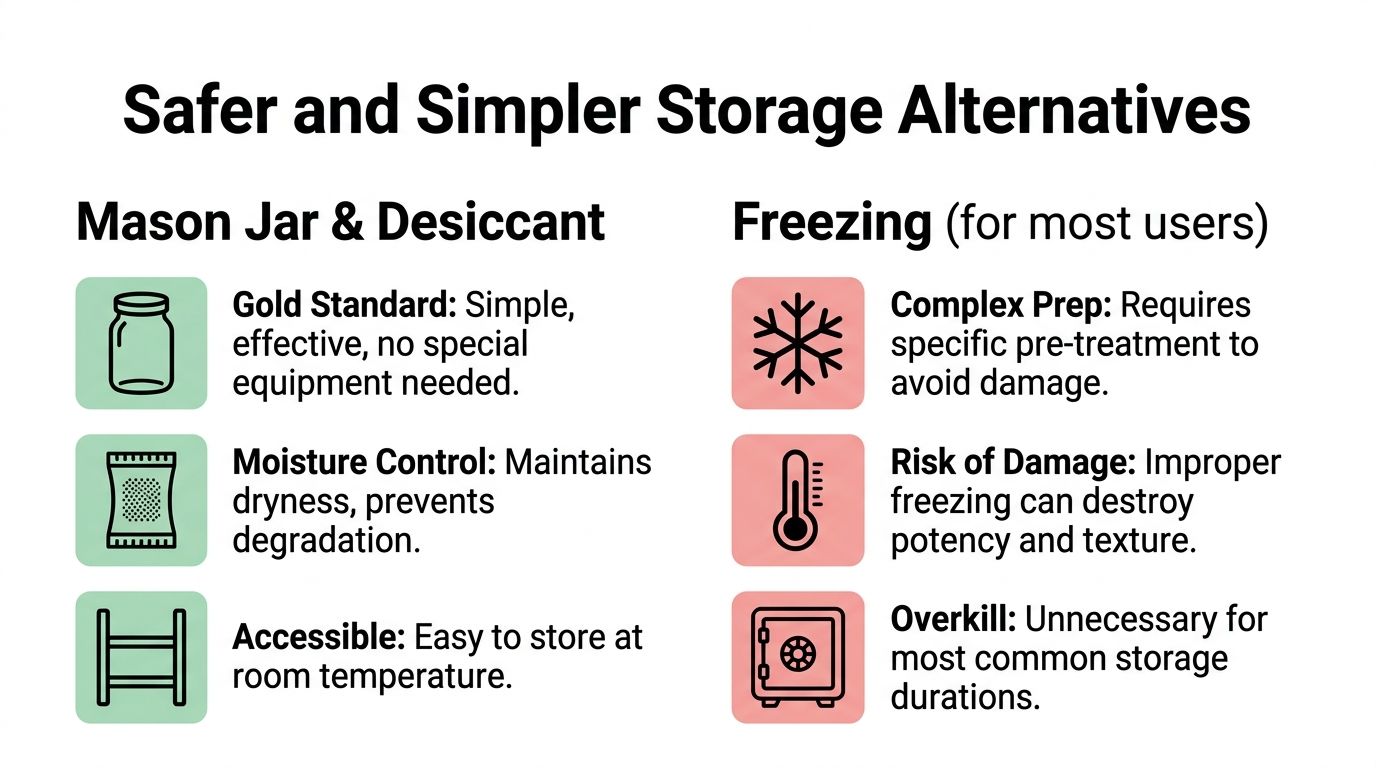
This is the option I recommend most often for personal storage. Use a clean glass jar with a tight-fitting lid, add a food-safe desiccant pack, and keep the jar in a cool, dark cabinet that stays fairly consistent year-round.
It works because it controls the two problems that ruin dried mushrooms fastest at home. Moisture gets limited, and day-to-day handling stays simple. You can open the jar, take what you need, and close it again without adding a thawing step or rebuilding a freezer barrier each time.
Why people stick with this method:
- Low moisture exposure: Desiccant helps hold dryness after the container has been opened.
- Easy routine: Fewer steps means fewer chances to make an expensive mistake.
- Better consistency: Stable room storage avoids the temperature swings and condensation risks that come with cold storage.
Vacuum sealing without freezing
Vacuum sealing makes sense for longer timelines or for dividing a larger amount into smaller portions you do not plan to open often. It reduces oxygen exposure and limits how much of your supply gets disturbed at one time.
The trade-off is practical. You need the equipment, and once a pouch is opened, that protection is gone unless you reseal it properly. For many customers, a jar handles everyday use better, while vacuum-sealed portions work well as backup storage.
Side by side trade-offs
| Method | Works well for | Main drawback |
|---|---|---|
| Mason jar with desiccant | Routine home storage | Needs a cool, dark place that stays fairly stable |
| Vacuum sealed at room temperature | Longer set-aside portions | Requires a sealer and good portion planning |
| Frozen after vacuum sealing | Rare-access storage | Packaging and handling errors carry more risk |
If you want a practical breakdown of container choices, desiccants, and where to keep them at home, this best way to store shrooms guide covers the day-to-day setup in more detail.
Potency holds up best in storage that stays dry, dark, sealed, and repeatable. Stability protects your investment better than complexity.
What to Expect for Long-Term Shelf Life
You put premium mushrooms away for a future session, come back months later, and the central question is not whether they still exist. It is whether they still have the potency you paid for. Shelf life is really a storage performance question. The starting dryness matters, but long-term results depend on how much moisture, oxygen, light, and handling the material sees after it leaves the package.
For a customer storing dried psilocybin mushrooms at home, a realistic expectation is measured in months to years, not forever. Well-dried mushrooms kept in a stable, low-humidity setup usually hold up well for ordinary personal timelines. Potency tends to fade faster when the product was not fully dry to begin with, when containers get opened often, or when storage conditions drift with the seasons.
Practical expectations by setup
Here is the pattern I see most often:
- Loose bag in a drawer: Fine only for short-term holding. Potency and texture usually decline sooner because air and humidity get in too easily.
- Jar with desiccant in a cool, dark cabinet: A dependable baseline for regular home storage. This is often the best balance of protection, access, and low handling risk.
- Vacuum sealed portions at room temperature: Better for mushrooms you want to set aside and leave alone. Portioning helps because the full supply does not get exposed each time you open one pack.
- Frozen and handled correctly: Usually reserved for longer storage plans where access is rare and packaging is done carefully. A mistake during sealing or thawing can shorten shelf life fast.
Time horizon should drive the method.
If the mushrooms will be used steadily over the next several months, freezing usually adds more chances for error than benefit. If part of the supply is being held back for a much longer period, sealed backup portions can make sense. That is especially true when the product starts out uniformly dried and consistently prepared, which removes one of the biggest unknowns in long-term storage.
Prepared formats can also reduce day-to-day handling. For customers comparing loose mushrooms with pre-portioned options, these freeze-dried mushroom edibles offer a format that gets opened and handled differently than bulk material.
A simple rule holds up over time. The less often premium mushrooms face fresh air, humidity, and temperature changes, the better their shelf life tends to be. Protecting potency is the whole point.
Your Final Storage Plan and A Legal Disclaimer
If you want the short version, store dried mushrooms the boring way. Keep them cracker-dry, airtight, out of direct light, and in a cool stable place. That setup protects potency better for most users than a complicated freezing routine.
Freezing isn’t wrong. It’s just easy to do badly. The risk isn’t the cold itself. The risk is moisture entering the picture during packaging, thawing, or repeated access. If you can avoid those failure points with a jar, desiccant, and stable room storage, that’s usually the smarter choice.
Use this checklist:
- Confirm dryness first: Never store soft or flexible mushrooms for the long haul.
- Choose airtight storage: Glass jar or vacuum-sealed portions work better than casual bags.
- Control the environment: Darkness, low humidity, and temperature stability matter.
- Avoid unnecessary handling: Every opening increases exposure.
One legal point matters too. Be aware of the laws where you live. Psilocybin remains illegal under state and federal law in many places, even where local enforcement priorities may differ. Adult consumers in Southeast Michigan should stay informed about current local rules before possessing or using any psilocybin product.
Responsible storage is part of responsible use. Protect the material, protect the experience, and don’t make a stable product less stable by overcomplicating the process.
If you want a straightforward way to browse dried mushrooms, chocolates, drinks, and storage-friendly formats from Metro Mush, you can check the current menu online and choose the option that fits how you plan to use and store your products.