
The number that reframes this whole subject doesn't come from a strain profile. Testing data from decriminalized regions found more than 20-fold variation in psilocybin potency across mushroom samples, with inconsistent levels of minor tryptamines between strains, according to an analysis of retail mushroom testing.
Twenty-fold. Two caps from the same jar can differ by a margin that swamps anything a cultivar label conveys. Albino Riptide mushrooms are sold, priced and debated as though the name carried a dose inside it.
It doesn't. A strain name is a label, not a measurement. The mushroom behind the label is real, its lineage is documented, and its potency is uncertain until someone tests the batch in front of you.
What Albino Riptide Is and Where the Name Comes From
Albino Riptide is a cultivated Psilocybe cubensis hybrid, not a separate species and not a wild variety. Strain documentation for Albino Riptide describes it as a cross between True Albino Teacher (TAT) and Tidal Wave, and that pairing is the whole basis of the name.
Tidal Wave carries its own history. It's commonly attributed to a cross of B+ and Penis Envy, so the reported background runs through four lineages: TAT, Golden Teacher-related genetics, B+, and Penis Envy. TAT supplies the pale trait that gets marketed hardest. Tidal Wave supplies the other half of the cross, and B+ and Penis Envy arrive as ancestors reached through it rather than as direct parents.
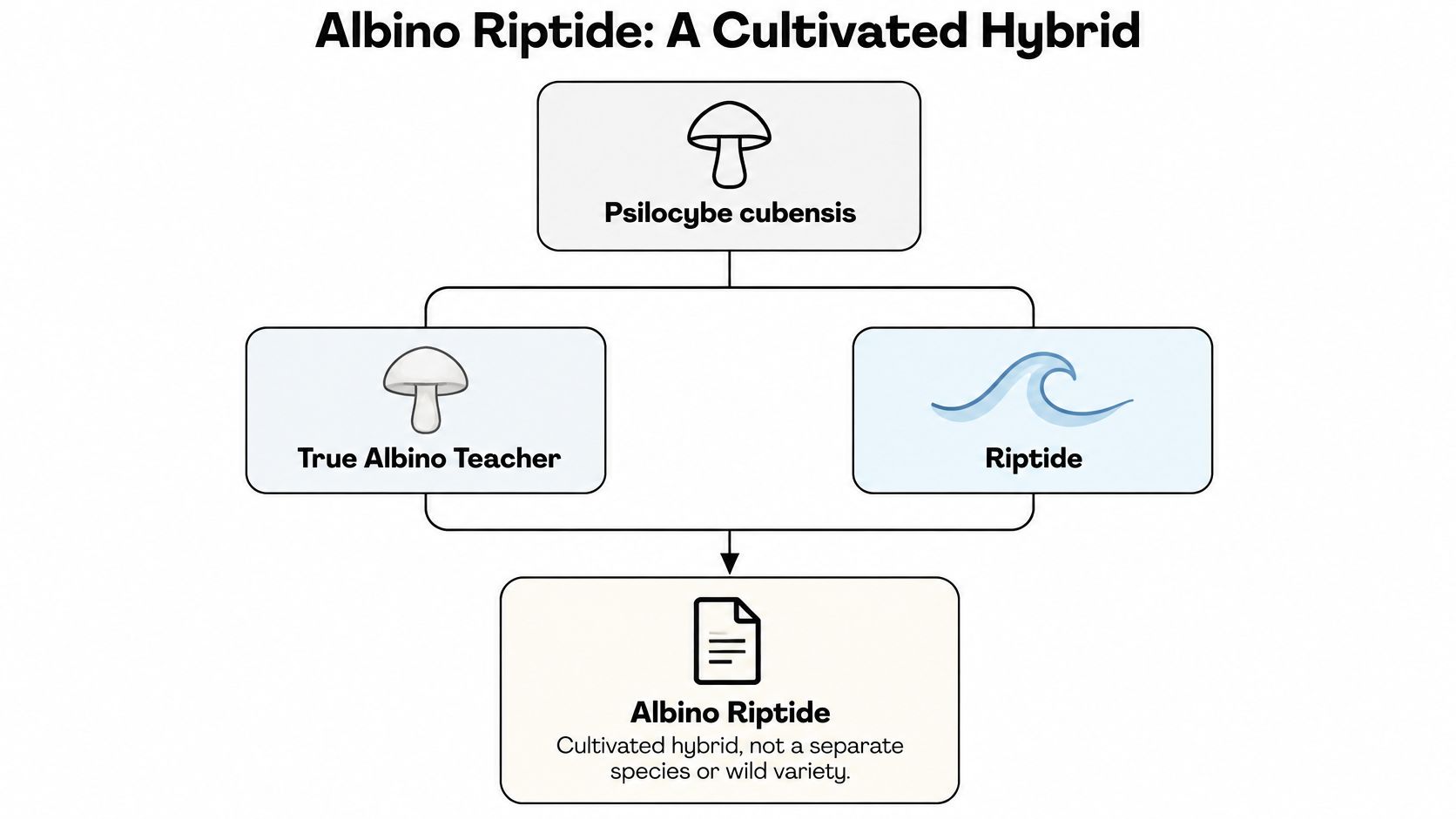
The "albino" in the name describes pigmentation, not chemistry. Cultivated specimens typically fruit pale or white, which separates them visually from ordinary brown- or gold-capped Psilocybe cubensis types. Pale caps photograph beautifully and sell easily. That's most of what the word tells you.
The lineage does have one notable data point attached. A Tidal Wave sample was credited with first place at the Psilocybin Cup in 2021, with a measured total-tryptamine concentration of 3.82%. That figure describes one tested sample of Tidal Wave, not an average for the strain and certainly not a specification for Albino Riptide.
Strain names in this market are informal. They aren't standardized taxonomic categories, so two cultivators can tell different stories about the same name without either one inventing things. If you want to see how loosely these labels map onto the species as a whole, the Psilocybe cubensis strain overview is the honest starting point.
The surname test: a family name tells you which relatives someone belongs to. It tells you nothing about their height, their blood type, or how they'll behave at a party. Cultivar names work the same way.
Reported Potency Figures and How to Read Them
Across 8 third-party samples, Albino Riptide material averaged about 17 mg of psilocybin per gram of dried mushroom, roughly 1.7% by mass, according to the Psilocybe cubensis potency reference at psychedelics.com. Here's the full set, and what each figure does and doesn't license.
| Measure | Reported value | What it means |
|---|---|---|
| Average psilocybin | 17 mg/g (about 1.7%) | Mean across 8 reported samples |
| Standard deviation | 5 mg/g | Typical spread of individual samples around the mean |
| Lowest sample | 9 mg/g (about 0.9%) | Lowest value in the dataset |
| Highest sample | 27 mg/g (about 2.7%) | Three times the lowest sample |
| Sample count | 8 | Too few to act as a universal specification |
A standard deviation of 5 mg/g means individual samples routinely sit several milligrams away from the mean, in both directions. The reported range runs from 9 mg/g to 27 mg/g, so the strongest sample carried three times the psilocybin per gram of the weakest.
Eight samples is a small dataset. It can't serve as a specification for every crop, product format or regional market, and the summary itself warns against assuming a fixed dose equivalence carries across batches. Read the number as evidence that variability is large, not as a target the next harvest will hit.
Two different analytes, two different numbers
These figures describe psilocybin specifically. Total tryptamines may also include psilocin and related compounds, so a psilocybin value and a total-tryptamine value don't compare directly, and swapping one for the other in a marketing claim is a quiet distortion.
Take the arithmetic seriously for a moment. Someone who sees 17 mg/g and assumes every gram holds 17 mg can be wrong by a factor of three at either end of the reported range. A gram from the low end carries about 9 mg. A gram from the high end carries 27 mg. Same label, same weight, threefold difference in what's there.
That's why rankings of the strongest mushroom strains work as conversation and fail as dosing tools. They compress a wide distribution into a single word.
Reading rule: treat any strain-level potency figure as a rough reference and ask for the batch result. The batch result is the only number that describes the material in your hand.
Why a Strain Name Cannot Confirm Identity or Dose
A white cap is a phenotype. It isn't an identity document. Pale fruiting bodies photograph well, which is part of why the name spread so quickly through a market that sells with pictures.
Albino Riptide is generally marketed as a leucistic phenotype within the Psilocybe cubensis lineage, and that's a description of appearance rather than a taxonomic classification. Independent genomic and chemical research shows that P. cubensis labels can be unreliable and that metabolite concentrations vary substantially across specimens, so DNA confirmation and laboratory potency testing are more informative than appearance or cultivar name alone (American Society for Microbiology study on Psilocybe labeling).
Visually similar pale or leucistic fruiting bodies can differ considerably in alkaloid content. Informal naming and misidentification obscure those differences rather than revealing them, which is exactly the opposite of what a buyer assumes the name is doing.
What settles the question is narrower than many expect. DNA confirmation addresses genetic identity: is this the organism the label claims? Validated UHPLC-MS/MS testing addresses chemistry: it can quantify psilocybin, psilocin, baeocystin, norbaeocystin and aeruginascin in the same run, which beats any anecdotal potency ranking because rankings can't quantify anything.
A short video walkthrough of the cultivated material sits below for readers who'd rather see the mushrooms than read about them.
A defensible batch record names the producer, the cultivation batch, the dry mass tested, the analytical method, and the measured concentrations of psilocybin and psilocin. That's five fields. If a seller can't supply them, the name on the package is doing all the work and none of it is verification.
A strain name is the colour of a car. It tells you something real about the car and nothing at all about the engine.
Why Two Portions of the Same Strain Can Differ
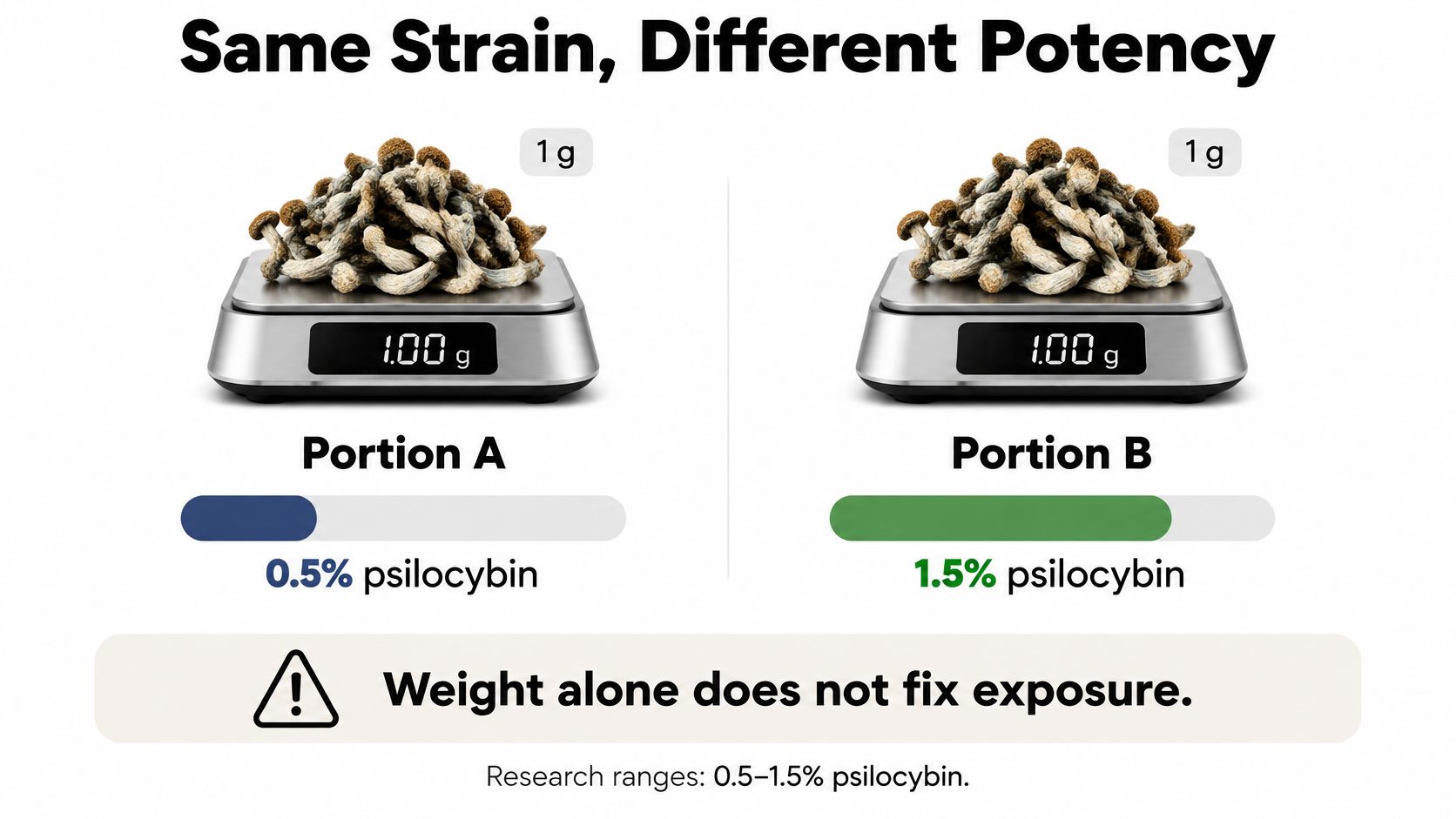
Take two 1 g portions labelled with the same cultivar name. They can contain materially different amounts of psilocybin, which means a fixed weight doesn't guarantee a fixed exposure. Published P. cubensis data show psilocybin concentrations ranging from 0.208 to 5.344 mg/g and psilocin from 0.651 to 3.509 mg/g across analyzed material (stability and potency research on Psilocybe cubensis).
A newer standardized study tightened the lens further. It found more than a 7.8-fold difference in total tryptamines between strains, and 12.81% to 23.39% variation in psilocybin between individual fruiting bodies within a single selected strain. That second figure is the one that changes how you read a menu: the spread exists inside one crop, not just between named varieties.
| Factor | Reported effect | Handling note |
|---|---|---|
| Individual fruiting bodies | Psilocybin varies 12.81% to 23.39% within one strain | Do not assume uniform content in a single crop |
| Strain differences | Total tryptamines differ more than 7.8-fold among strains | Compare batch results, not strain names |
| Light and warmth in storage | Accelerate psilocybin loss | Keep dried product dark and cool |
| Fresh material at -80 °C | Greatest tryptamine loss in the stability study | Do not treat freezing fresh material as safe storage |
| Dried biomass in darkness at room temperature | Lowest decay among tested conditions | Reference point for dry storage |
The storage finding surprises people. The greatest tryptamine loss in the validated stability work happened in fresh mushrooms stored at −80 °C, while dried biomass kept in darkness at room temperature showed the lowest decay among the tested conditions. Freezing fresh material feels like preservation. On this evidence it isn't.
Light and warmth accelerate psilocybin loss, which matters more in a retail setting than in a laboratory one. A clear bag on a sunny shelf is a slow degradation experiment. Dried product belongs sealed, dark, cool and dry, and the container should keep out oxygen and moisture as well as light.
None of this means every weak batch is a seller's error. Potency moves with genetics, substrate, temperature at fruiting, harvest timing, drying method and mushroom part, and those variables sit partly outside anyone's control. The sensible response isn't suspicion. It's a number tied to a batch.
Storage rule: airtight container, out of the light, away from heat. The cupboard above the stove is the worst place in the kitchen for dried mushroom material.
Legal Status, Safety and When to Seek Help
Two questions get merged constantly in discussions of albino riptide mushrooms, and they need pulling apart. Whether a product is legal is one question. Whether it's safe is another. A legal product can still be untested, and an illegal one can still be handled carefully.
Psilocybin remains federally illegal in the United States, and state rules differ substantially, which leaves most U.S. access outside any consistent national testing and labeling framework, per the MOST Policy Initiative science note on psilocybin decriminalization. That same public-health analysis argues real-world use is expanding while regulation, product testing and age-specific safety education lag behind, and it calls for research and education outside controlled clinical trials.
There's a concrete reason to take that gap seriously. Poison-control calls involving hallucinogenic mushrooms rose from 593 in 2012 to 1,440 in 2022, and their share of psychedelic-related calls climbed from 12% to 32%. That trend doesn't prove Albino Riptide caused any of those calls. It does argue against assuming that a natural product with a friendly name is automatically low-risk.
Three safeguards carry most of the weight. Don't mix psilocybin with alcohol or other psychoactive substances, because you lose the ability to attribute what you're feeling to what you took. Never eat an unidentified wild mushroom, since pale-capped species with no relationship to this one can be seriously toxic. Don't use alone somewhere help can't reach you, especially on a first attempt with untested material.
| Situation | Action |
|---|---|
| Unconscious or hard to wake | Call emergency services immediately |
| Trouble breathing, chest pain or a seizure | Call emergency services immediately |
| Severe confusion, agitation or risk of harm to self or others | Get urgent medical help |
| Possibly ate an unidentified wild mushroom | Seek medical help and bring the sample if possible |
| Mild unease or anxiety in a calm setting | Stay with a trusted person in a safe, quiet place and monitor |
When use turns into a pattern someone can't stop, the emergency room isn't the right door. 24/7 crisis care for addiction exists for exactly that situation, and reaching it early beats waiting for a crisis to force the decision.
Policy is drifting toward the transparency this whole subject lacks. Proposed regulatory frameworks increasingly emphasize laboratory testing, purity, potency, concentration and results the consumer can see. Until that's universal, the safeguards above and a readable batch record are what a person has.
Confirm the Batch Data Before You Use Any Albino Riptide Product
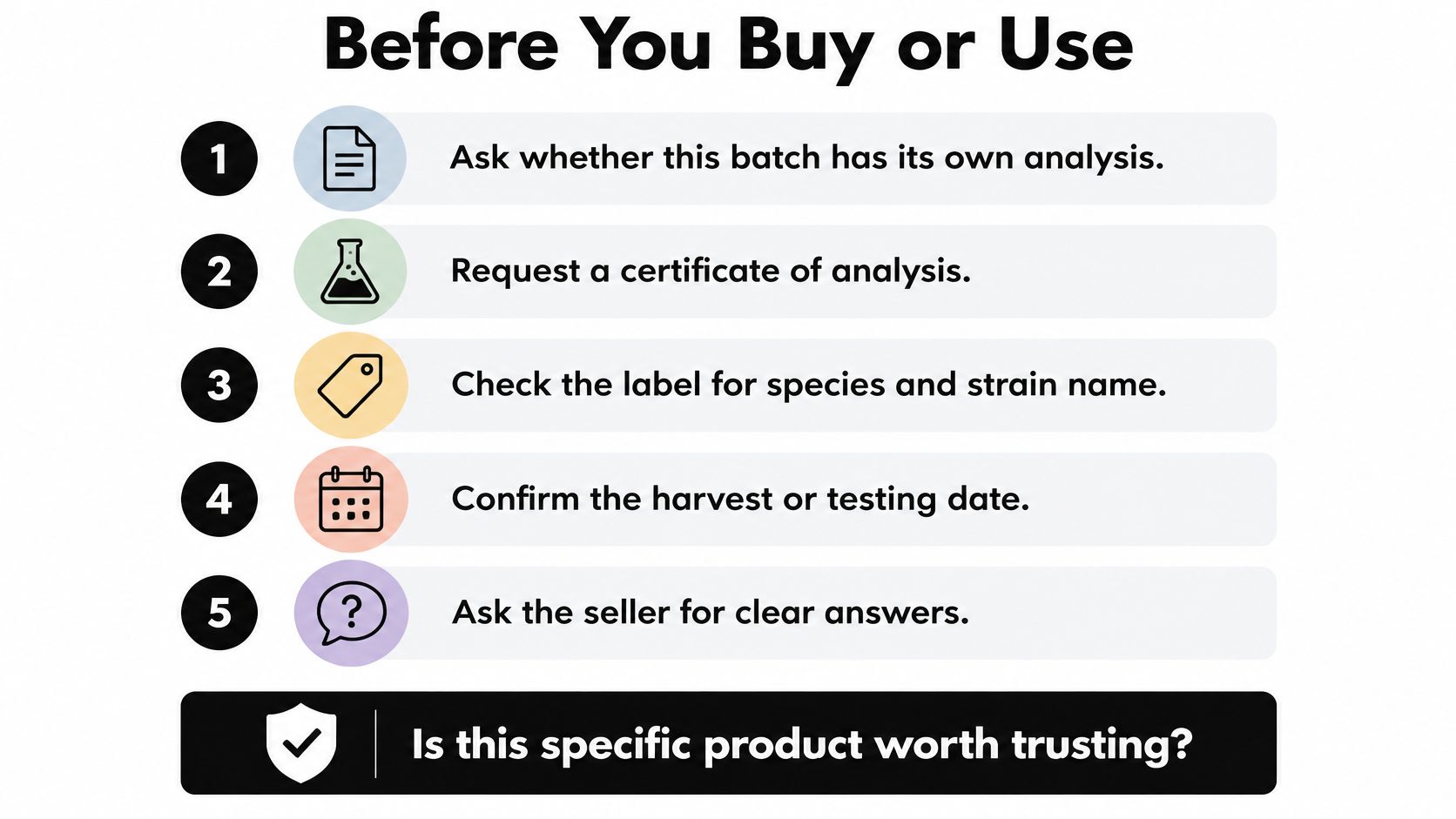
The decision facing a buyer isn't whether Albino Riptide is a good strain. It's whether one specific product, from one specific batch, is worth trusting. Run these six checks before money changes hands.
- Ask whether this batch has its own laboratory test. A strain-wide figure borrowed from somewhere else tells you about a different jar of mushrooms. The red flag is a seller who answers with a name instead of a result.
- Confirm which analyte was measured. Psilocybin, psilocin and total tryptamines are three different numbers, and most marketing copy blurs them. The red flag is a potency claim that never says what was tested.
- Check the reporting basis. A result given per gram, per serving or per package produces three very different impressions of the same product. Convert it to a per-gram figure so you can compare it with anything else you've seen.
- Find the test date. Chemistry drifts with storage, and an old result describes older material. The red flag is a certificate with no date on it.
- Look for producer, batch number and method. Those three fields let you trace a problem back to its source if something goes wrong. A record missing them can't be verified by anyone, including the seller.
- Ask about contaminant screening. Potency is only half the picture, and a batch with clean alkaloid numbers and no microbial or heavy-metal screening has answered the easier question.
Price is a weak signal in all of this, and worth saying plainly. SporeBoss listed a 10 mL Albino Riptide liquid culture at $20.00 in 2026, per the SporeBoss Albino Riptide listing, but nothing about that number speaks to potency or purity. Cheap and expensive material fails the same checks for the same reasons. If you want to know what counterfeit and mislabelled product looks like in practice, this guide to spotting fake mushroom products covers the patterns.
Our team has spent over four years growing and refining mushroom strains, and we still treat a cultivar name as a starting point rather than a potency figure. An albino appearance and a familiar name open the conversation. A current, product-specific certificate of analysis is the evidence that closes it.
Albino Riptide mushrooms reward a buyer who asks for numbers rather than descriptions, and that's the standard we try to work to at Metro Mush. Our Detroit and Ann Arbor menu carries dried strains such as Penis Envy and Enigma alongside chocolates, gummies and shroom drinks, so a first-time buyer can start at a modest, clearly portioned dose instead of guessing at a gram. Browse the full selection at Metro Mush, check current store locations, and place an order by text for Detroit Metro or Ann Arbor delivery.