
You're looking at a product page for Psilocybe azurescens dried, comparing it with mushrooms you may already know, and wondering whether the same gram measurement still applies. That's the dangerous point of comparison. A number on a scale tells you the weight of dried mushroom, not the amount of psilocybin or psilocin inside it.
Azurescens should be treated as a variable, high-potency product, not as a mythical strain with one guaranteed strength. The responsible questions are practical: Can the species be authenticated? Has the batch been tested? How was it dried and stored? Does your health history make exposure especially risky? Local law must be checked before possession, purchase, or use.
Why Azurescens Deserves a Slower, More Careful Read
An adult shopper may compare dried mushroom listings by name and weight, then assume a gram means roughly the same thing across products. With Psilocybe azurescens, that shortcut is unreliable. The scale measures dried fungal material, while the experience depends on the milligrams of psilocybin and related alkaloids within that material.
A label describing azurescens as “stronger” should therefore prompt caution, not excitement. Published testing, discussed in the potency section below, places azurescens among the more alkaloid-rich Psilocybe species, yet concentrations can differ between specimens and batches. The species name cannot reveal the contents of a particular jar.
Practical rule: Treat the product label as a starting point for questions, not as proof of a precise dose.
Use four questions before treating a dried batch as predictable:
- What is it? Look for a species claim supported by a credible source, while recognizing that dried appearance alone cannot confirm identity. A blue-stained mushroom is not, by itself, a reliable identification.
- How strong might it be? Separate dry weight from alkaloid content. A label showing “1 gram dried” identifies mass, not the amount of psilocybin in that gram.
- What changes the risk? Consider health history, medications, setting, and uncertainty. A person taking a medication that affects mood or perception has a different risk profile from someone who is not.
- How was it handled? Look for a lot identifier, such as a batch code paired with a harvest or packaging record, plus storage information. A sealed pouch with only a strain name provides little traceability.
Legal conditions add another boundary. Psilocybin access varies by location, and reduced enforcement does not necessarily mean regulated retail, laboratory standards, or protection from other legal consequences. Check the rules for your exact location before possession, purchase, or use.
This approach respects adult autonomy without romanticizing a high-potency mushroom. If a seller cannot explain sourcing, testing, lot identity, or storage, that uncertainty remains part of the product.
Background and How to Recognize the Species
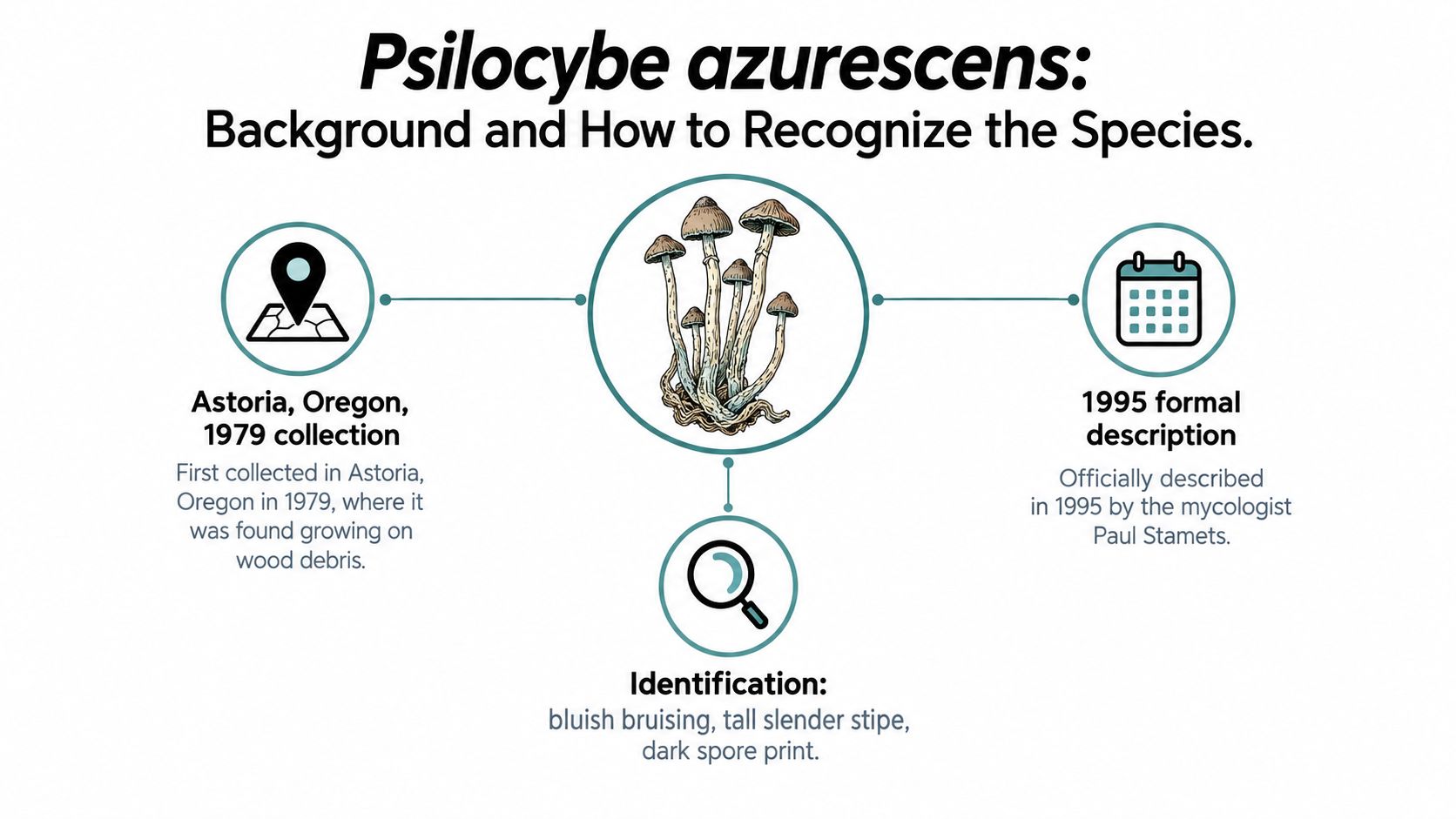
Psilocybe azurescens has a specific regional history, not a vague origin story. The first specimens were collected in 1979 on an alluvial plain within the Columbia River network near Astoria, Oregon, and the species was formally described in 1995. Its known range is concentrated in Oregon and Washington, especially coastal and riparian environments influenced by the Columbia River system. The original taxonomic account describes it as an autumnal species, with fruiting beginning in late September and often continuing until harsh frost. The taxonomic account and historical record provide the useful context.
Start with the habitat
Azurescens is lignicolous, meaning it obtains nutrients from woody material. Reports place it on deciduous wood chips and in sandy soils enriched with decomposing plant debris. That biology gives you a useful plausibility check. A story about a coastal, wood-associated autumn mushroom fits the known ecology better than a claim that every dried sample came from the same natural region.
Dried material loses much of the context that helps identification. A cap may appear caramel, tan, or pale after drying, while stems become darker and more brittle. Colour alone isn't reliable, and bruising isn't proof of species identity. A blue reaction can support a broader identification process, but it can't replace expert examination or laboratory authentication.
Ask better identification questions
For a non-mycologist, the goal isn't to certify a wild mushroom from a photograph. The goal is to notice whether the product story is coherent and whether the seller understands what they're offering.
Look for:
- A wood-loving profile: The seller should be able to explain the association with woody material.
- Pacific Northwest context: Oregon and Washington are central to the documented natural range.
- Autumn ecology: Late-season fruiting fits the species' historical description.
- Clear taxonomy: “Azurescens” should mean a species, not an invented potency tier.
- Testing information: Visual features and strain names don't establish alkaloid content.
If you're researching cultivation biology rather than buying dried material, this guide to growing Psilocybe azurescens may help explain why substrate and habitat claims matter. For a dried product, though, cultivation detail still doesn't prove what reached the package.
What Dried Azurescens Contains
A scale can show one gram of dried mushroom, but it cannot show how much active alkaloid that gram contains. Dry weight measures biomass. Psychoactive exposure depends on psilocybin and psilocin concentration, which can vary with genetics, tissue type, maturity, drying, storage, and the analytical method used.
A 2022 reference-material analysis examined 12 samples and reported an average of 1.33% ± 0.325% psilocybin and 0.20% ± 0.080% psilocin. Individual measurements reached 1.77% psilocybin and 0.29% psilocin. These results help show the spread between samples. They do not establish a guaranteed specification for a retail product.
The percentage-to-mass conversion makes the difference clearer. At 1.33% psilocybin, 1 gram of dried material would contain approximately 13.3 milligrams of psilocybin, before measurement uncertainty or degradation. At 1.77%, the same gram would contain approximately 17.7 milligrams. These are calculations from reported percentages, not a laboratory result for any particular package.
Treat the figures as ranges, not instructions
| Alkaloid | Reported range, % dry weight | Approx. mg per 1 g dried |
|---|---|---|
| Psilocybin | Approximately 0.81% to 1.77% | Approximately 8.1 to 17.7 mg |
| Psilocin | Approximately 0.08% to 0.29% | Approximately 0.8 to 2.9 mg |
The table converts reported percentages into approximate mass. It does not account for uneven distribution within one mushroom, mixing across a batch, testing uncertainty, or degradation over time. Older summaries have cited maxima near 1.8% psilocybin, but that figure is not a standard for every dried batch.
Psilocybin is generally described as a precursor that the body converts, while psilocin is the compound more directly associated with effects. Minor alkaloids such as baeocystin often appear in consumer discussions, yet their human effects and therapeutic significance remain unestablished. Avoid using a speculative minor-compound explanation to assign a confident cause to a particular sensation.
A gram on a scale measures biomass. It does not measure active-compound exposure.
Independent chemical-authentication work also found that psilocybin and psilocin quantities can vary unpredictably across Psilocybe specimens. That analytical research supports a practical conclusion: appearance, branding, and species labels cannot replace batch-specific laboratory testing. If a batch has no such testing, treat its potency as uncertain rather than inferred from its name or appearance.
Effects, Onset, and How Long They Last
A high-potency mushroom experience can involve altered visual perception, sound changes, emotional intensity, unusual associations, and a distorted sense of time. Physical effects may include nausea, changes in temperature perception, fatigue, tension, or a heavy body feeling. None of these experiences proves a particular species or alkaloid profile, and the same dried material can affect people differently.
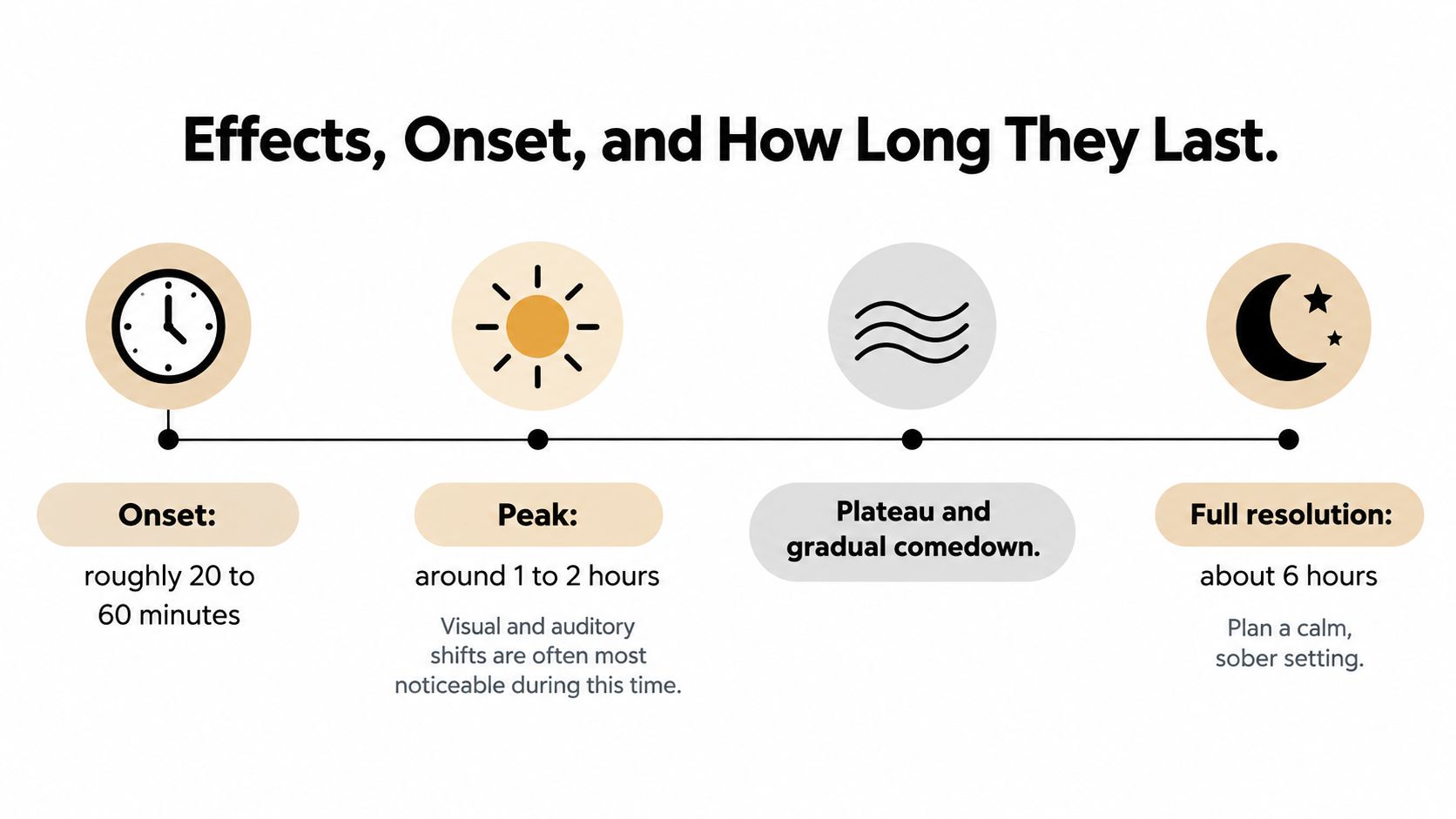
For planning purposes, ingestion can be followed by an onset within roughly 20 to 60 minutes, with the most intense period developing later and a gradual return over the rest of the day. The exact timeline depends on the material, the person, food, expectations, and setting. Don't schedule driving, work, childcare, or other responsibilities around a narrow “four-hour” assumption.
Build the day around uncertainty
A calmer setting reduces avoidable pressure. Choose a private, familiar space, keep the environment free from hazards, and have a sober, trusted adult available if the person is inexperienced or the batch is unverified. A sober supporter should know what was taken, when it was taken, and what symptoms would justify medical help.
Some people report transient weakness or paralysis-like symptoms with wood-loving mushrooms, a phenomenon sometimes called “wood-lover's paralysis.” The cause hasn't been established, and baeocystin should not be presented as the proven explanation. Treat significant weakness seriously rather than assuming it's just part of a powerful trip.
This guide to how long psilocybin effects can last can help with planning, but no general timeline overrides symptoms. If someone becomes difficult to rouse, has chest pain, has sustained confusion, can't breathe normally, or may injure themselves, contact emergency services.
The following video can provide broader educational context, but it shouldn't be used to identify a mushroom or determine a personal dose.
A Conservative Dosing Framework and Microdosing Notes
A conservative framework begins with a refusal to pretend that a species label gives you precision. The safest practical choice is not to use an untested or misidentified product. If an adult nevertheless proceeds where lawful, the central principle is start with less than you think you need, don't redose quickly, and don't treat a previous batch as a calibration for the next one.
A general consumer ladder can be described without turning it into a promise:
- Microdose band: Intended to remain below clear perceptual effects. Someone might begin here if testing sensitivity, but even this band can become perceptible when potency is unknown.
- Low perceptual band: May produce noticeable changes in mood or perception. A sober setting and an unoccupied day still matter.
- Moderate experience band: A clearly altered state that experienced users should approach deliberately, with support available.
- High band: Not appropriate for beginners. Unverified azurescens should not be treated as a challenge or a strength contest.
The often-discussed 0.1 to 0.3 gram cubensis microdose range is not a safe conversion rule for azurescens. That range appears in the supplied consumer framing, but applying it directly to a higher-potency, variable species can produce an unwanted perceptual dose. A smaller amount may be more appropriate for a cautious test, yet no single “do not exceed” number can guarantee safety without validated batch testing. If the material hasn't been homogenized and tested, the honest answer is that the exact milligram exposure is unknown.
Ask health questions before weighing anything
Don't experiment without clinician input if you're pregnant, taking serotonergic or psychiatric medication, or managing a significant psychiatric or cardiovascular condition. A personal or family history involving psychosis or bipolar disorder deserves particular caution. Medication names alone don't settle the interaction question, so bring the complete list to a qualified clinician rather than relying on an online dosing chart.
If you do obtain a lawful, tested product, look for a batch certificate that identifies the tested lot and method. A laboratory result should report measured compounds, not only a strain name or a marketing adjective. A scale can improve weight consistency, but it cannot detect uneven alkaloid distribution or prove the material's identity.
Storage, Shelf Life, and Reading a Dried Batch
Storage is part of dose uncertainty. Moisture, light, heat, oxygen, and repeated temperature changes can alter the chemical profile of dried mushroom biomass. Psilocin is generally less stable than psilocybin, so two samples that look similar may not produce identical effects even when weighed equally.
A peer-reviewed stability study found the lowest degradation in dried biomass stored in the dark at room temperature, while fresh mushrooms held at −80°C showed the greatest degradation among the tested conditions. The stability research doesn't establish a universal shelf life for every retail product, but it supports a practical storage routine.
Compare a batch with the information you actually need
| Feature | More reassuring | More concerning |
|---|---|---|
| Container | Sealed, moisture-resistant packaging | Open, loose, or visibly humid packaging |
| Light exposure | Opaque or light-protected storage | Direct or prolonged light exposure |
| Label | Lot identifier and pack or drying date | No batch identity or vague date |
| Odor | Clean, characteristic mushroom odor | Musty, sour, ammonia-like, or moldy odor |
| Texture | Dry and stable, without damp spots | Softness, condensation, or visible growth |
Don't interpret “dry” as “safe.” A contaminated or misidentified mushroom can be dry. Don't interpret a printed expiration date as proof that the product was stored correctly. A date is useful only when the seller can connect it to packaging and stability controls.
At home, keep the product sealed, dry, protected from light, and away from repeated temperature cycling. Avoid opening the container unnecessarily. This storage guide for dried mushrooms offers a practical routine, but discard material with visible mold, unexplained moisture, or a suspicious smell rather than trying to rescue it.
Harm Reduction, Contraindications, and When to Get Help
A responsible decision begins with screening, not shopping. Psilocybin exposure deserves clinician-level review for people with a history involving psychosis or bipolar disorder, serious cardiovascular disease, pregnancy, or current use of serotonergic or psychiatric medication. The relevant question isn't whether someone online says a combination is “usually fine.” It's whether a clinician who knows the person's history considers the risk acceptable.
Medication lists can be complicated. SSRIs, SNRIs, MAOIs, lithium, and other psychiatric medicines may affect response or risk in different ways, and stopping prescribed medication abruptly can create its own danger. Don't change a prescription to accommodate mushroom use without medical supervision.
Separate distress from danger
A difficult experience may involve anxiety, nausea, fear, looping thoughts, or frightening changes in perception. A calm environment, reassurance, reduced stimulation, hydration by small sips if tolerated, and a sober adult's presence can help. Don't argue with the person's perceptions or leave them alone if they're confused or physically unsteady.
Seek urgent medical help for chest pain, breathing problems, unresponsiveness, sustained severe confusion, psychotic symptoms, uncontrolled agitation, serious injury, or thoughts of self-harm. If wild mushrooms were involved, preserve the remaining material for identification and tell clinicians exactly what was taken and when.
Medical caution: Psilocin is generally less stable than psilocybin, so matching the same weight across visually similar dried samples doesn't guarantee matching exposure. The consumer potency discussion highlights why first-time and cautious consumers shouldn't treat a gram as a reliable dose indicator.
Harm reduction isn't a moral judgment. It's a basic quality-control habit, like checking a food label or confirming an allergy before eating. Screening, a safe setting, a sober support person, and a clear emergency plan should be treated as essential safeguards for an uncertain high-potency product.
Legal Status, Local Access, and Smart Buying Habits
The legal status of psilocybin products varies by country, state, city, and sometimes the specific activity involved. Possession, cultivation, delivery, and commercial sale may be treated differently. A local policy that reduces enforcement priority does not automatically create regulated retail, laboratory testing, or a legal guarantee that a product is accurately labeled.
That distinction matters in Southeast Michigan. Some cities, including Ann Arbor and Detroit, have moved toward decriminalization or deprioritized enforcement, but those policies shouldn't be confused with a licensed retail framework. Before buying, carrying, or using dried azurescens, check current local and state rules and understand what the seller is legally authorized to do.
Read the seller before reading the strain name
A thoughtful adult shopper should look for practical signals:
- Transparent product information: The menu should identify the product, weight, and available testing information without relying only on words such as “premium” or “strong.”
- Batch accountability: Ask whether the product has a lot identifier, pack date, and validated laboratory results.
- Storage answers: Staff should be able to explain how dried material is protected from moisture, light, oxygen, and temperature swings.
- Age and ordering controls: Responsible operators should use clear age verification and explain minimum-order or delivery policies.
- No pressure tactics: A seller shouldn't push a high-potency product as a beginner challenge or imply that more intense always means better.
- Useful support: Staff should answer questions about uncertainty, contraindications, and emergency planning without making medical promises.
An online menu, text ordering, local delivery coverage, and community promotions may make access convenient, but convenience isn't evidence of product quality. The quality question remains: Can the seller connect the package to a clearly identified batch and explain how it was handled?
For a cautious adult, the next step is small and concrete. Verify the law where you are, ask for batch-specific testing, review your health and medication history with a clinician when relevant, and reject any package with unexplained moisture, contamination, or vague sourcing. If those answers aren't available, don't substitute confidence for evidence.
Metro Mush offers adult customers in the Detroit and Ann Arbor metro areas online menu access, text ordering, local delivery, and a curated selection of mushroom products, including dried options and edibles. Visit Metro Mush to review current availability and ask product questions before making a decision.