

You've just opened a chocolate bar or drink, checked the label, and realized you're not entirely sure what the serving means. Maybe the product uses a strain name you recognize, but you don't know whether that name predicts strength. Maybe you're wondering whether to take more because nothing has happened yet. These moments create avoidable risk.
Learning how to avoid common mistakes with magic mushrooms is less about memorizing a perfect experience and more about managing information, timing, health, setting, and storage. Psilocybin products can vary by form and batch, while personal medications, mental health history, food intake, and surroundings can change what happens. A calm, methodical process gives you better control than confidence based on past experiences or informal comparisons.
Why Most Bad Trips Are Actually Logistics Failures
A customer walks into a dispensary or opens an online menu and sees dried mushrooms, chocolate bars, and drinks. The product names sound familiar, but the labels use different serving descriptions. One package emphasizes a strain, another lists pieces, and a third gives information about a drink rather than a mushroom weight. The customer remembers that a previous experience felt manageable, so they choose a larger amount, take it after a stressful day, and keep waiting for the effects to arrive.
That chain of decisions can create the frightening experience people later describe as a “bad trip.” The problem may not have started with the substance alone. It may have started with unclear product information, an unrecorded serving size, poor timing, an unsuitable setting, or a failure to account for other substances and health conditions.
Treat the experience as a planned operation
A useful mindset is to treat consumption as a safety-and-information problem. Before taking anything, identify the exact product, serving size, total active content if available, ingestion time, and other substances in your system. Write those details down. Memory becomes less reliable when someone feels anxious or impaired.
The broader medication-safety picture shows why this approach matters. The CDC's medication safety guidance reports approximately 1.3 million emergency-department visits and 350,000 hospitalizations in the United States each year from adverse drug events, and says that more than 40% of related ambulatory costs may be preventable. Those figures concern medications broadly, not psilocybin specifically, but they illustrate how often preventable harm begins with mistakes involving labels, doses, combinations, or contraindications.
Practical rule: Confidence should come from verified information and preparation, not from a strain name or a previous experience.
A safer process means reading the complete label, using only clearly stated serving information, avoiding impulsive redosing, choosing a familiar environment, and arranging sober support. Metro Mush's guidance on avoiding bad trips follows the same practical principle: reduce uncertainty before exposure rather than trying to solve confusion after effects begin.
Navigating Metro Mush Orders and Deals Safely
The safety process begins before delivery. An incomplete order, a misunderstood minimum, or an unclear product selection can create pressure later, especially if someone feels they need to use everything they purchased. Treat the transaction as part of preparation, not as a separate step.
Build the order carefully
Metro Mush serves the Detroit and Ann Arbor metro areas and accepts orders by text through dedicated local numbers. Use the menu on the Metro Mush website to identify the product format, read the available serving information, and confirm which delivery area applies before sending the order. Keep the confirmation message so you can check the products and quantities when they arrive.
Metro Mush maintains a $75 minimum order. Confirming that requirement before ordering prevents last-minute substitutions or unnecessary additions. It also gives you a chance to choose products based on what you can identify and manage, rather than buying an unfamiliar item just to complete a transaction.
Separate value from potency
A promotion can lower the cost of an order, but it doesn't make products interchangeable. On Mix & Match Saturdays, customers can combine any three chocolate bars or drinks for $100, saving up to $40. If you use that offer, choose products whose labels and serving information you understand. Don't interpret a larger bundle as a reason to consume more in one session.
Check the following when your order arrives:
- Product identity: Match each item with the order confirmation and keep products in their original packaging.
- Serving information: Record the stated serving size and total active content when provided.
- Condition: Don't use packaging that appears damaged, unsealed, or incorrectly labeled. Ask the seller for clarification before consuming.
- Storage plan: Put the products somewhere secure immediately, rather than leaving them in a delivery bag or on a shared counter.
- Personal suitability: If you take medication or have a relevant medical history, pause and ask a qualified healthcare professional about possible risks.
Promotions and convenient ordering can simplify access, but they can't replace product verification. The safest purchase is the one you can identify, store, and use according to clear information.
Understanding Onset Windows to Prevent Overdosing
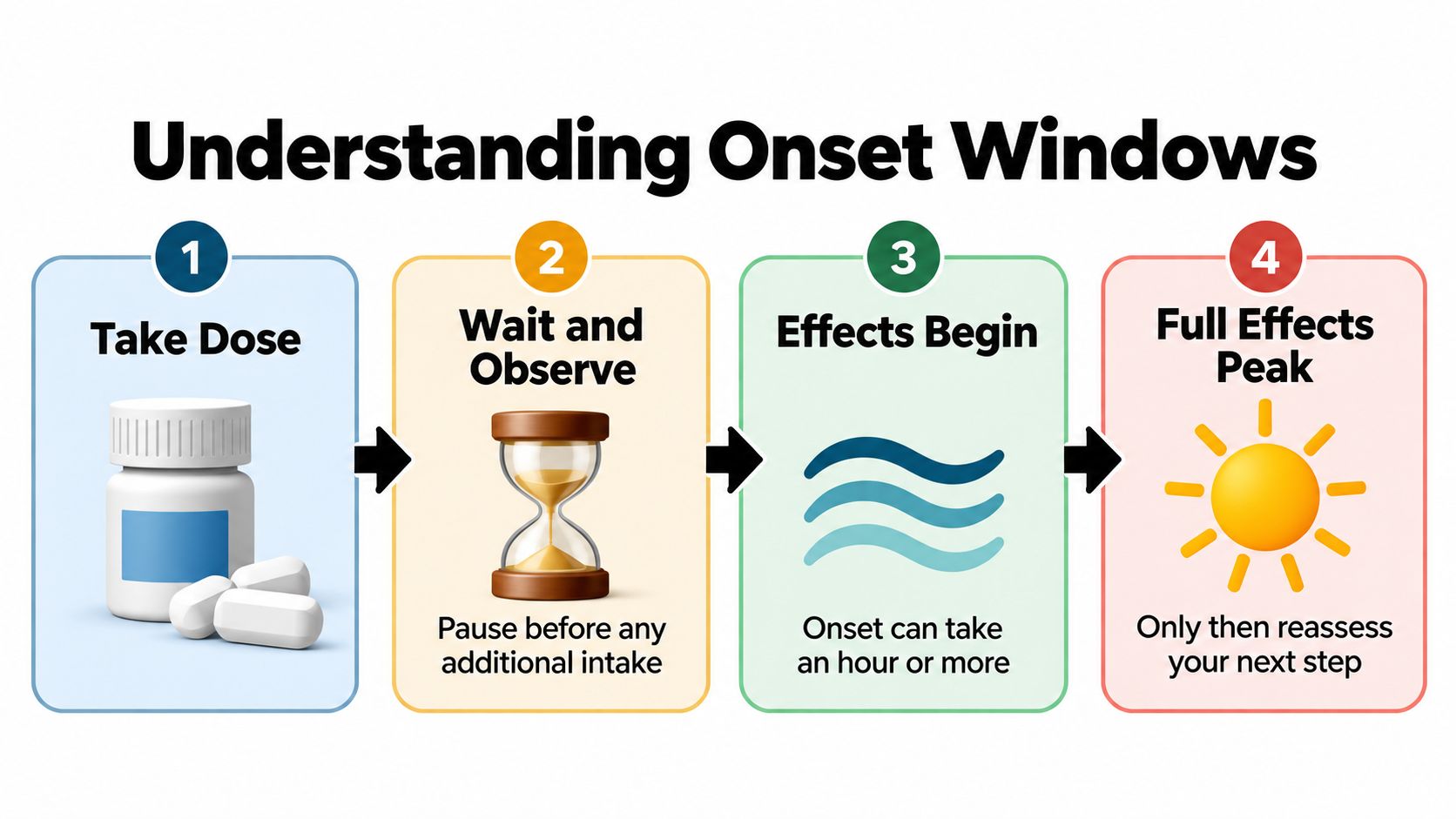
The most common timing error is simple: someone takes an initial serving, feels nothing, and assumes the product is weak. They take more, then the first serving and the second one begin working close together. The result can feel much stronger and last much longer than intended.
A systematic review of clinical trials involving 528 patients found that psilocybin effects typically begin within 20 to 90 minutes, while adverse effects such as headache and nausea usually resolve within 24 to 48 hours. You can review the findings in the systematic review of psilocybin clinical trials.
Why the product format changes the wait
Dried mushrooms, chocolate, and drinks don't deliver information in exactly the same way. Food intake, formulation, digestion, and individual absorption can all affect how quickly effects appear. A heavy meal may make the onset feel slower, while a drink may feel different from a solid edible because the product moves through the digestive process differently.
That variation doesn't justify taking more. It makes recording the details more important.
- Write down the product and serving. Include the product name, the stated serving, and the amount you consumed.
- Record the ingestion time. Use your phone rather than relying on memory.
- Wait through the expected onset window. Don't treat early silence as evidence that the serving failed.
- Avoid other substances while waiting. Alcohol, cannabis, stimulants, and other psychoactive drugs can make the experience less predictable.
- Reassess only when sober judgment is possible. If effects are developing, adding more can turn manageable sensations into overwhelming ones.
The safest response to delayed onset is patience, not escalation.
Stay in a familiar place, avoid driving and hazardous tasks, and keep a sober trusted person available. Nausea, anxiety, headache, dizziness, increased heart rate, and blood-pressure changes can occur even in controlled research settings. Severe confusion, chest pain, dangerous agitation, seizures, loss of consciousness, or symptoms suggesting psychosis require urgent medical help.
Legal Context and Setting the Stage for Safety
Legal uncertainty can affect the experience before consumption begins. Ann Arbor and Detroit have taken local decriminalization steps, but local policy doesn't erase state or federal restrictions. Laws and enforcement priorities can change, so adults should check current official guidance and understand that a local policy isn't the same as universal legal authorization.
That distinction matters psychologically. Worry about possession, delivery, public exposure, or driving can raise stress before the experience starts. A person who feels rushed, watched, or unsure about the law may find it harder to respond calmly to ordinary changes in perception and emotion.
Set and setting are practical controls
“Set and setting” can sound like informal psychedelic vocabulary, but the underlying idea is operational. Set includes your mental state, expectations, physical condition, and current stress. Setting includes the room, people present, access to help, privacy, and hazards. Each factor changes how easily you can interpret sensations and make decisions.
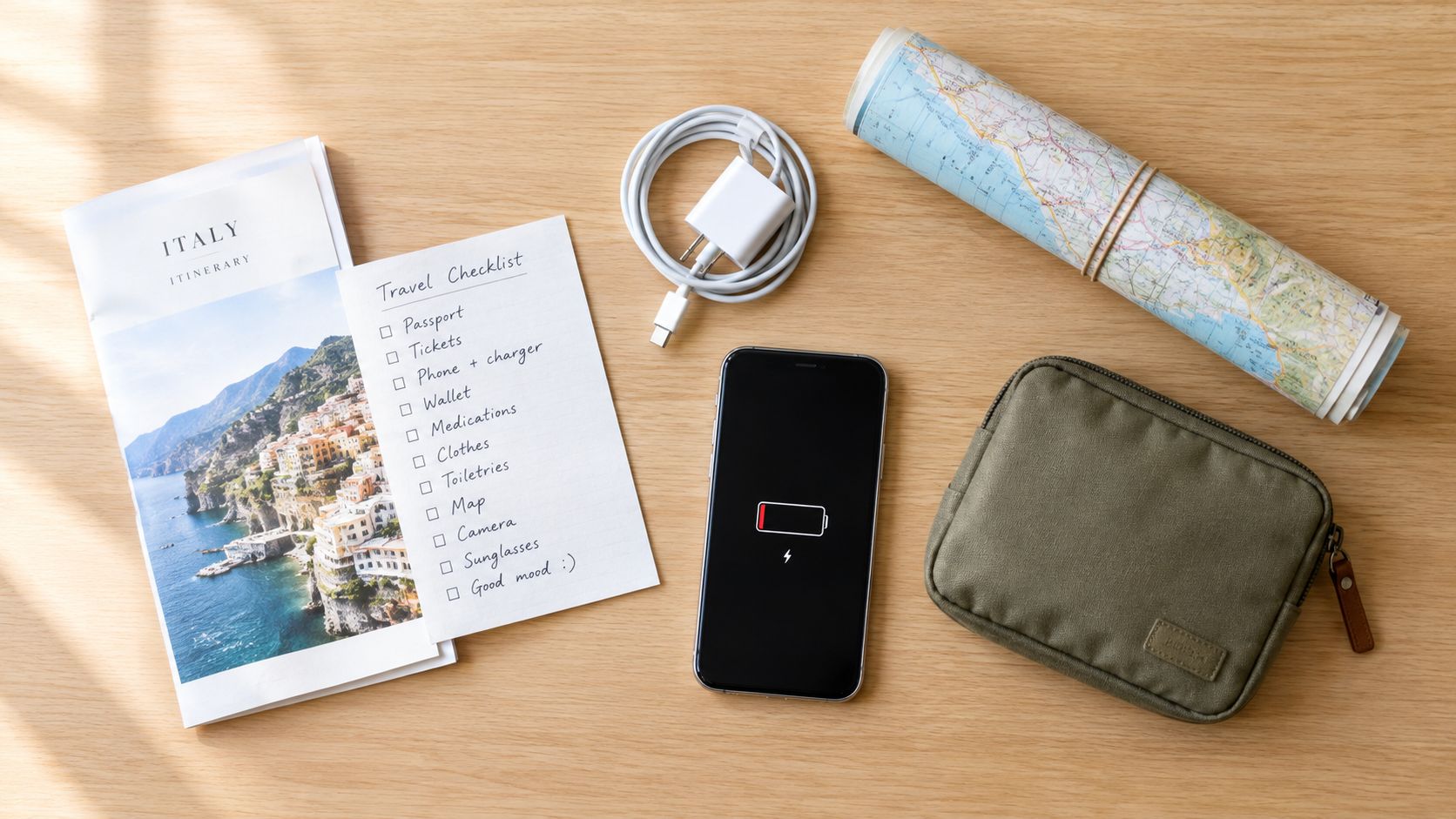
Choose a familiar private space where you don't need to leave, drive, cook, climb, swim, or manage demanding responsibilities. Remove avoidable hazards, silence unnecessary notifications, and tell the sober support person what you've taken and when. Keep a charged phone available, but don't use constant online searching to amplify anxiety.
Clinical research offers a useful benchmark. In psychedelic investigations, the FDA guidance for psychedelic clinical studies describes safeguards including continuous observation by two monitors and the ability to reach a medical emergency site within 15 minutes. A home setting won't reproduce that structure, but the lesson is clear: don't use alone, and don't assume that personal familiarity replaces support.
Legal awareness and environmental planning work together. Confirm the rules, choose a controlled location, arrange sober assistance, and make a simple emergency plan. Preparation doesn't guarantee a pleasant experience, but it removes several external problems that can turn uncertainty into panic.
The Myth of Strain Potency and Batch Variability
A strain name can help identify a product, but it isn't a laboratory measurement. Names such as Penis Envy or Enigma may create an impression of precision, especially for someone who has used the same name before. That impression can be misleading because the active content can vary between batches.
Analytical research found projected total active-compound content in a typical 3-gram dose of Psilocybe cubensis ranging from 19.8 mg to 46.2 mg, demonstrating substantial variability. The published analytical research on psilocybin and psilocin content supports a practical conclusion: don't use a strain label as a substitute for testing or clear serving information.
Why strain names fail as potency indicators
| Assumption | Reality | Risk |
|---|---|---|
| The same strain always has the same strength. | Active-compound content can vary between batches. | A familiar name can create false confidence. |
| A previous amount will feel identical next time. | Product composition, preparation, food intake, and personal condition can differ. | Repeating an old serving may produce a different experience. |
| Dried mushrooms, chocolate bars, and drinks can be compared by weight alone. | Different formats require different label interpretation. | An apparently equivalent amount may not be equivalent in effect. |
| A larger product or stronger-sounding name provides better information. | Marketing language doesn't replace laboratory-verified content. | Consumers may select based on reputation rather than evidence. |
Prioritize laboratory-verified total psilocybin content when available. Then identify the smallest clearly labeled serving and resist translating that amount directly across formats. A gram weight for dried mushrooms doesn't automatically tell you how much active compound is in a chocolate piece or drink.
This uncertainty matters for experienced users as much as beginners. Familiarity can reduce caution at exactly the moment caution is needed. Keep a record of the product and batch details, avoid comparing products by name alone, and never redose early because a familiar label feels predictable.
Proper Storage and Interaction Precautions
A product can create risk when nobody is actively using it. Chocolate bars and drinks may look ordinary to children, visitors, or someone who doesn't know what they contain. Leaving them in a refrigerator door, backpack, bedside drawer, or open delivery bag makes accidental access easier.
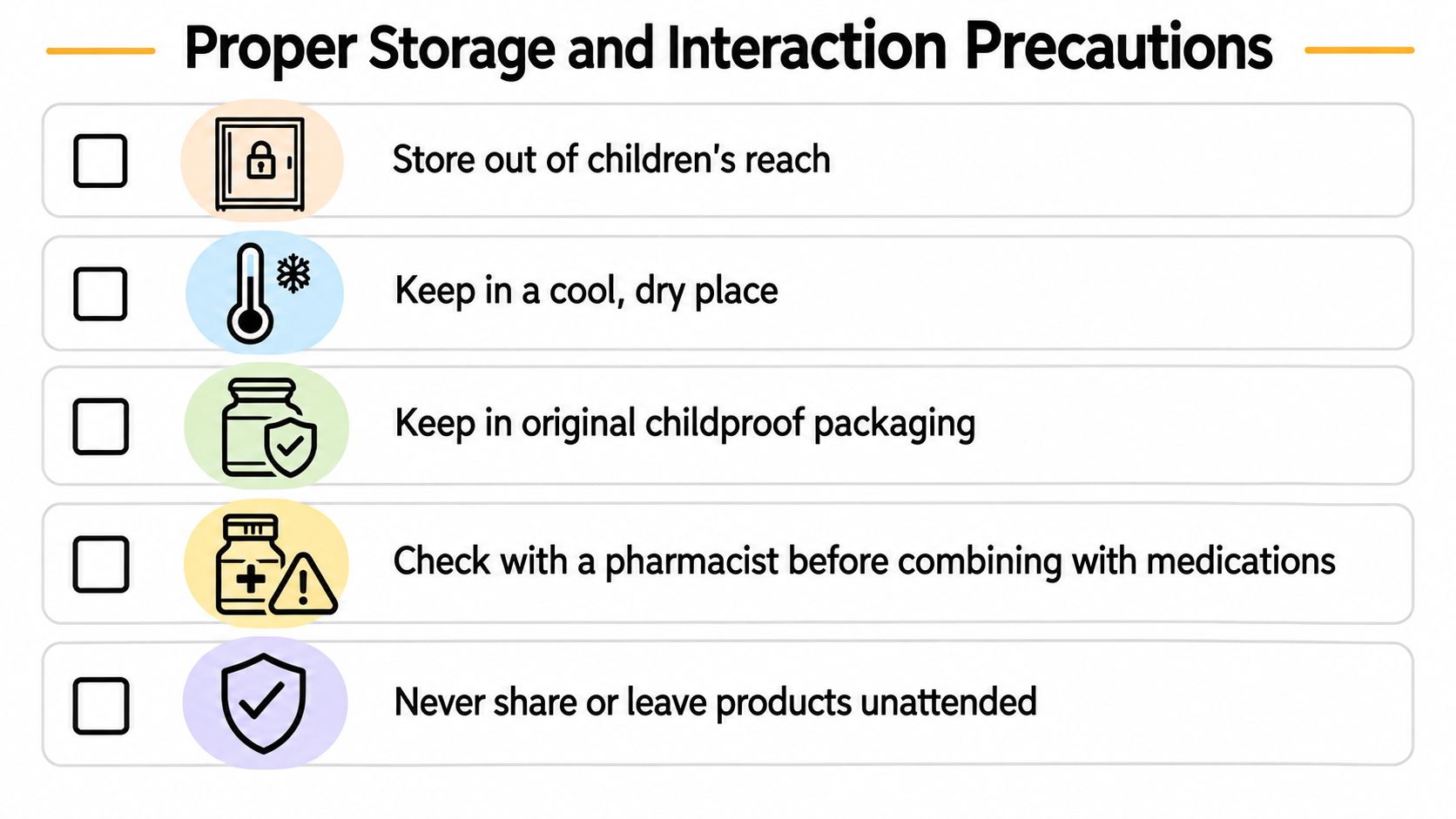
Store products in their original packaging, in a cool, dry place, and somewhere children and other unauthorized people can't reach. Don't share products, leave them unattended, or transfer them into containers that could be mistaken for ordinary food. Metro Mush's storage guidance for mushrooms can help you think through the practical details of protecting product quality and household safety.
Treat combinations as a separate risk
Psilocybin can interact with the situation around it even when the product itself is accurately labeled. Alcohol, cannabis, stimulants, and other psychoactive substances can change judgment, anxiety, heart rate, or the ability to recognize a developing problem. Prescription and over-the-counter medications also deserve attention, particularly psychiatric and cardiovascular medicines.
Before consuming, make a complete list of medications, supplements, and substances you've already taken. Ask a qualified healthcare professional or pharmacist about possible interactions instead of relying on an online anecdote. The CDC reports that 82% of U.S. adults take at least one medication and 29% take five or more, which helps explain why incomplete disclosure can create preventable uncertainty. These figures concern medication use broadly and aren't a psilocybin-specific risk estimate.
Follow a simple household protocol:
- Secure the product: Use a locked or inaccessible storage location.
- Preserve the label: Keep the original packaging so serving and ingredient information remains available.
- Avoid casual combinations: Don't add alcohol, cannabis, stimulants, or other psychoactive substances to make the experience stronger or easier.
- Disclose fully: Tell a healthcare professional what you take, including supplements and recreational substances.
- Plan for supervision: Don't use alone or leave an impaired person without a sober, trusted contact.
The FDA's research guidance includes continuous observation and rapid access to emergency care, a reminder that supervision is a meaningful safety layer rather than a ceremonial precaution. Seek urgent medical help for chest pain, seizures, severe confusion, dangerous agitation, loss of consciousness, or possible psychosis.
Building a Personal Protocol for Peace of Mind
A reliable protocol doesn't need to be complicated. It needs to answer the questions that become difficult under pressure: What did I take? How much did I take? When did I take it? Who knows where I am? What happens if I feel unwell?
Think in three pillars: preparation, verification, and environment. Preparation means checking your health, medications, schedule, legal context, and support. Verification means confirming the product, serving information, packaging, and available testing data. Environment means choosing a familiar place, removing hazards, arranging sober support, and keeping emergency communication available.
Use a pre-consumption pause
Before opening the package, work through this short checklist:
- Health: Have you considered personal or family history of psychosis or bipolar mania and sought qualified medical guidance where relevant?
- Interactions: Have you disclosed medications, supplements, alcohol, cannabis, and other substances to a healthcare professional when needed?
- Product: Can you identify the format, serving size, total active content, and batch information?
- Timing: Can you remain in a safe setting through the full expected experience without driving or handling hazards?
- Support: Is a sober trusted person available and aware of what you took?
- Storage: Will the remaining product go directly into secure storage?
- Emergency plan: Does someone know when to seek help for chest pain, seizures, severe confusion, dangerous agitation, loss of consciousness, or possible psychosis?
Harm reduction isn't a promise that every risk disappears. It means identifying risks early and using practical steps to reduce preventable harm. The Metro Mush harm-reduction resource reflects that broader approach, which values honest information, preparation, and nonjudgmental decision-making.
Caution is not inexperience. A person who checks the label, waits through the onset window, avoids combinations, plans the setting, and secures the remaining product is demonstrating competence. The aim isn't to force a particular outcome. It's to make fewer avoidable decisions while judgment may be changing.
Metro Mush offers adult customers in the Detroit and Ann Arbor areas online menu access, text ordering, and products including dried mushrooms, chocolate bars, and shroom drinks. Visit Metro Mush to review current products, confirm ordering details, and approach your purchase with the preparation and verification steps described above.