


You might be trying to decide whether a weekend away, a structured retreat, or a higher level of care makes the most sense right now. Maybe therapy has helped, but not enough. Maybe you're tired, overloaded, and looking for something that feels more immersive than a weekly appointment, but you don't want to guess wrong about what kind of help you need.
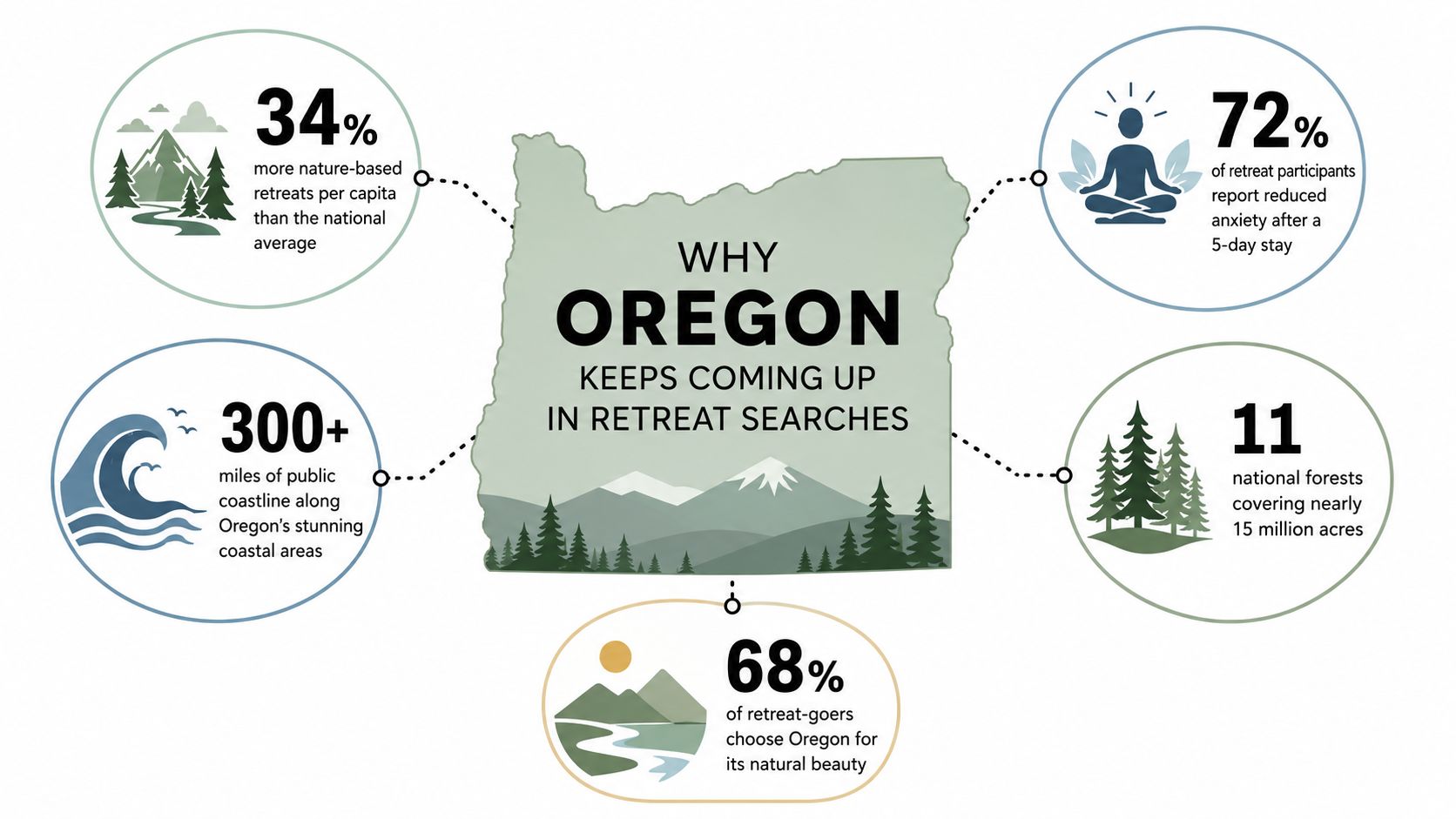
That's where a mental health retreat in Oregon can sound appealing, and also confusing. Oregon comes up so often because it sits at the intersection of a documented treatment gap, a regulated psilocybin services market, and a public behavioral-health system that still has clear limits. Oregon adult mental illness prevalence has been estimated at 27.5%, or about 992,000 people, with serious mental illness at about 7% of adults, and one state-focused analysis says Oregon ranks 51st overall for mental-health prevalence and access, while CareOregon reports 48 out of 51 for outcomes and 30 out of 51 for access to care (Common Sense Institute Oregon report).
The goal here is simple, help you decide whether a retreat fits your situation, or whether you'd be better served by outpatient, intensive, residential, or crisis care. Oregon's system is layered, not flat, and that matters when you're weighing time off work, travel, caregiving, cost, and what happens after the retreat ends. For readers who want to understand Oregon's psychedelic therapy field more broadly, this overview pairs well with Metro Mush's Oregon psychedelic therapy page.
Why Oregon Keeps Coming Up in Retreat Searches
A lot of people start this search in a very ordinary place. They're not looking for a dramatic intervention, they're looking for relief, better sleep, less rumination, maybe a reset after months of stress. Oregon keeps surfacing because it looks like a place where nature, regulated alternative services, and mental-health need all overlap.
Oregon's pull is practical, not just scenic
The state's mental-health gap helps explain the attention. Oregon has high reported need, a substantial share of adults who don't receive treatment, and a public system that still leans heavily on outpatient care even when needs are more complex. In Medicaid reporting, 116,352 people received mental-health services in 2023, including 84,486 adults, and 97.7% of those adults were served only in outpatient settings (Common Sense Institute Oregon report). That's a useful clue, because it shows why some people start looking beyond standard weekly therapy.
Oregon also stands out because it has a regulated psilocybin system. In 2025, that system served 5,935 clients across 5,375 administration sessions, with 747 group administrations and 32.6% of participants living outside Oregon (Frontiers study). That doesn't mean a retreat is right for everyone. It does mean Oregon has become a real destination for people comparing conventional care with structured, supervised alternatives.
Practical rule: if you're searching for a retreat because weekly care feels too thin, first ask whether you need more structure, not just a different setting.
What this article helps you decide
The decision is not “retreat or nothing.” It's more specific than that. You're trying to sort out whether you need:
- A retreat-style reset, if you're stable and want structure, reflection, and support.
- Outpatient or community care, if you need ongoing but not intensive help.
- Intensive or residential services, if symptoms are harder to manage.
- Urgent or crisis evaluation, if safety is part of the question.
That distinction matters in Oregon because the system has limited reserve capacity. A June 2024 state study estimated 461 inpatient psychiatric beds statewide, equal to 10.88 beds per 100,000 population, and 301 withdrawal-management beds, or 7.11 beds per 100,000 (Oregon residential facility study). A retreat can be helpful, but it can't substitute for care that matches the level of need.
What a Mental Health Retreat Actually Is
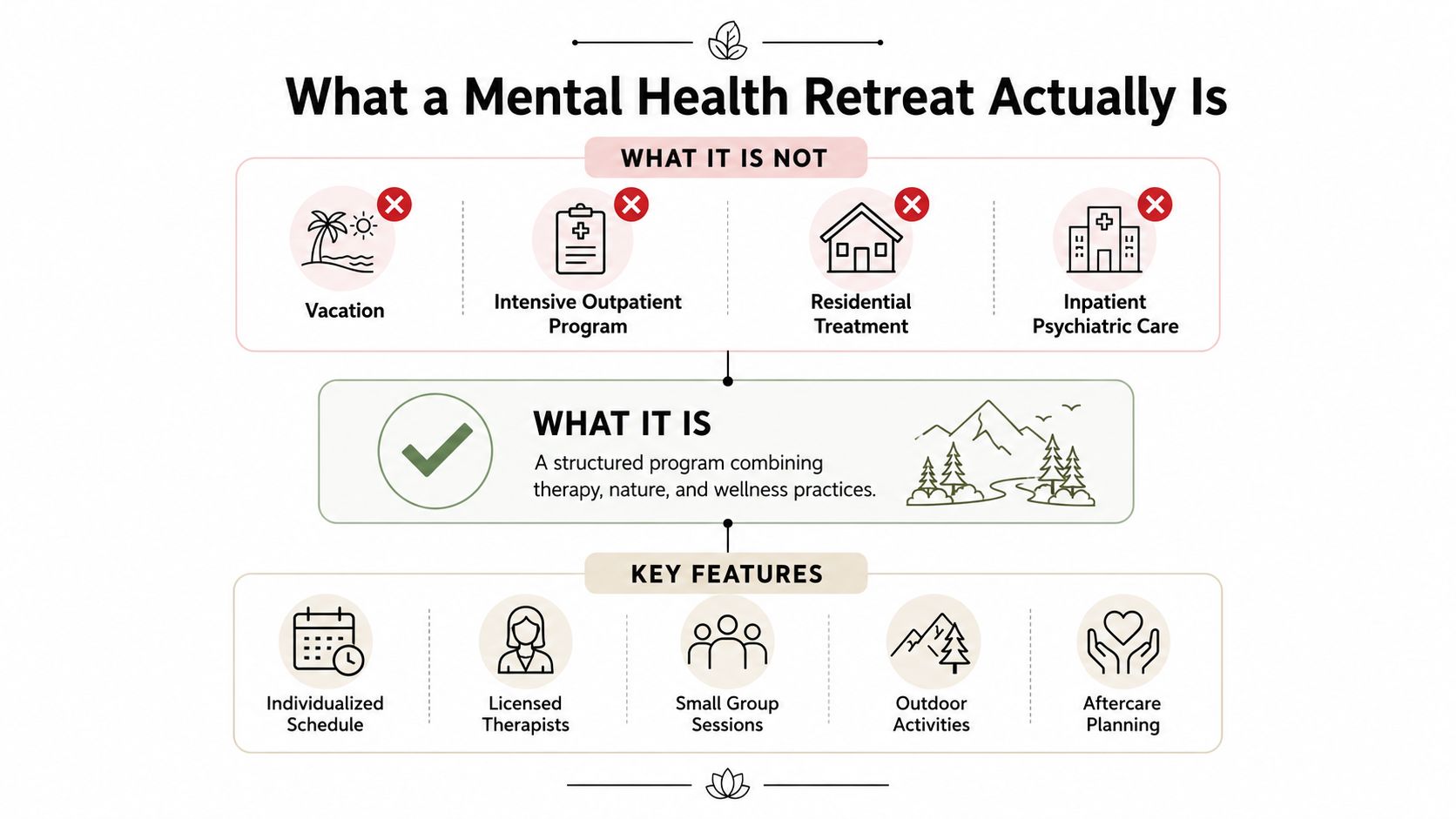
A mental health retreat is a structured, time-limited experience designed to support reflection, stress reduction, or therapeutic work outside everyday routines. It is not a vacation with wellness branding, and it is not the same thing as residential treatment or inpatient psychiatric care. The key question is whether the program offers screening, structure, and follow-up, not just a quiet place to stay.
Retreats sit inside a broader care continuum
Oregon's public behavioral-health language is useful here because it separates community mental health programs, intensive treatment, residential treatment, and inpatient care (Oregon Health Authority CMH programs). Retreats usually live outside that formal continuum, which is exactly why buyers need to do more homework. A retreat may include therapy sessions, mindfulness, nature time, or facilitator-led group work, but it usually isn't designed to manage acute instability.
The biggest signal of seriousness is whether licensed clinical staff are involved. A program with a licensed clinician, defined screening, and a clear handoff plan after the stay looks very different from a loosely organized wellness weekend. If a provider can't explain who screens participants, who handles emergencies, and what happens after discharge, that's a weak sign.
A retreat should make your next step clearer, not blur the line between support and care.
How to tell a retreat from higher-acuity care
You can usually separate the two by asking three questions. First, is this meant for a person who can stay safe and function outside a hospital or residential setting? Second, does the program offer short-term support rather than round-the-clock psychiatric supervision? Third, does it include an aftercare plan that connects you back to therapy, community support, or a primary clinician?
That's the boundary that gets missed in most listicles. A retreat can be restorative, even powerful, but it's still a limited intervention. If you need medication management, crisis containment, or a supervised step-up in care, the retreat label doesn't change that.
The internal link What is psychedelic therapy is useful if you want to understand how structured psychedelic services differ from generic wellness language.
The Main Types of Retreats You Will Find in Oregon
Oregon searches usually surface four broad categories, and the differences matter. Some are built for relaxation. Some are built for symptom-focused work. Some are legally structured around psilocybin services. A few blend more than one model, which can be helpful when the screening is strong and risky when the boundaries are fuzzy.
Wellness and mindfulness retreats
These are the most familiar. A typical day might include yoga, journaling, hikes, meditation, meals, and one or two guided check-ins. They tend to serve people who are stressed, burned out, or looking for a reset without needing higher-acuity behavioral-health services.
Marketing for these retreats often leans on scenery, silence, and self-care. That's fine, but read carefully for what's missing. If the listing doesn't mention screening, medication review, or follow-up, you should assume the retreat is designed for general wellness, not complex mental-health needs.
Trauma-informed retreats
These programs are more deliberate. They usually promise facilitators who understand trauma responses, pacing, emotional safety, and nervous-system regulation. A weekend might include small group work, breathwork, individual reflection, and structured grounding practices.
Trauma-informed doesn't automatically mean clinically staffed, though. That phrase can signal quality, but it can also be used loosely. Ask whether the program has licensed therapists on site, how they handle overwhelm, and whether participants can step out of group activities without being pressured to keep up.
Oregon-licensed psilocybin service centers
Oregon's regulated psilocybin system is its own category, not a generic retreat. These services involve preparation, administration, and integration under the state's rules, and they're built around a supervised process rather than a simple getaway. In 2025, the system served 5,935 clients across 5,375 administration sessions, which shows that this is already an operating service market, not a speculative one (Frontiers study).
A typical experience usually includes a preparation session, the administration day itself, and follow-up integration. That structure matters because psilocybin services are not just about the session, they're about screening and integration around it. If you're comparing services, look for how they discuss contraindications, support during the experience, and post-session follow-up.
For a broader context on blended psychedelic offerings, see ayahuasca retreat Oregon.
Nature-based and wilderness retreats
These are especially common in Oregon because the state's identity and geography make them easy to market. A weekend might center on hiking, campfire reflection, unplugged time, or guided outdoor practices. They tend to fit people who want distance from daily triggers and feel restored by quieter, more physical settings.
Nature alone is not treatment. It can lower stress, create space for reflection, and make hard conversations feel more manageable, but it does not replace clinical assessment when symptoms are severe. The best nature-based retreats are honest about that boundary.
When a Retreat Is Not the Right Level of Care
A retreat is not a solution for every kind of distress, and Oregon's own capacity data makes that clearer. The state still has limited inpatient and withdrawal-management beds, and that scarcity means the surrounding system does not have endless flexibility if someone decompensates or needs a rapid step-up. Oregon's June 2024 study estimated 461 inpatient psychiatric beds and 301 withdrawal-management beds statewide, with an average inpatient psychiatric length of stay of 12.66 days in 2022 (Oregon residential facility study).
A retreat can't solve an acute problem
If someone is in crisis, actively unsafe, or needing immediate containment, a retreat is the wrong frame. The same is true if the main issue is not stress but instability, suicidality, mania, psychosis, or withdrawal risk. In those situations, a retreat can waste time and money, and it can create false reassurance.
The treatment gap adds urgency. Oregon's adult mental-health need is high, and nearly 55% of the 439,000 adults reporting mental-health needs did not receive treatment, according to CareOregon's reporting on the state's access problem (Common Sense Institute Oregon report). That makes careful triage more important, not less.
Use a simple self-check before you book
Ask yourself this one question: Do I need rest and structure, or do I need a clinical step-up in care?
If you need the first, a retreat may fit. If you need the second, start with your therapist, primary clinician, local behavioral-health access point, or crisis services. Oregon's own system materials describe community programs as the entry point and intensive treatment as a short-term stabilization option, which is a very different function from a retreat (Oregon Health Authority CMH programs).
Practical rule: if you're trying to decide between a retreat and safety planning, choose safety planning first.
How to Vet Providers and Ask the Right Questions
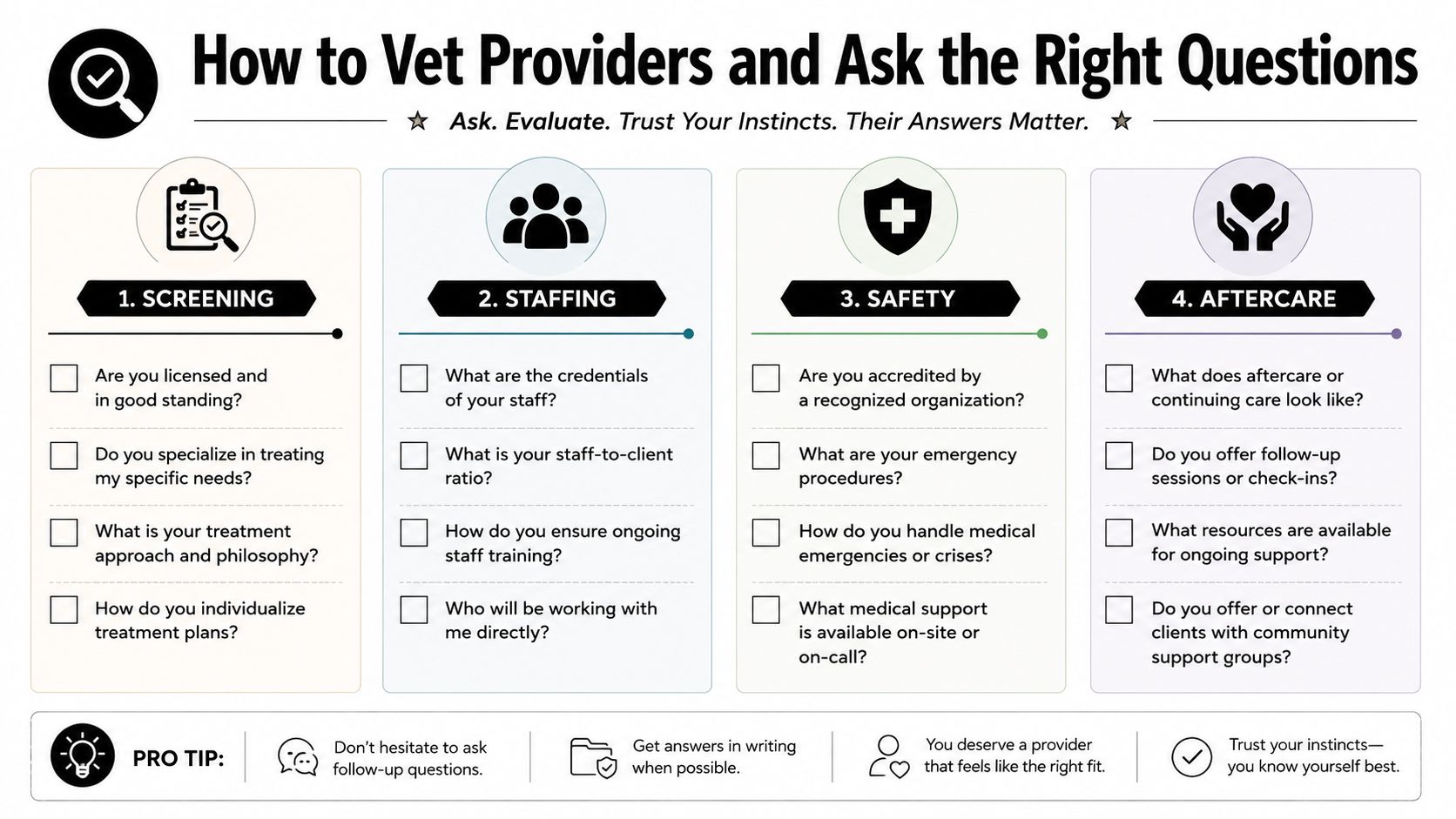
A good retreat isn't defined by scenery. It's defined by how seriously the provider handles screening, staffing, safety, and aftercare. That's especially true in Oregon, where the market includes both general wellness offerings and regulated service models.
Screening
Ask, who do you exclude and why? A serious provider should be able to explain whether they screen for medications, diagnoses, recent crises, substance use concerns, or medical issues. If they dodge that conversation, they're not showing you a safety process, they're selling optimism.
Also ask whether the retreat is designed for stress reduction, trauma work, or a more structured psychedelic service. Those are different offerings. A provider who can't describe the difference is asking you to do the sorting for them.
Staffing
Ask, who is in the room? You want credentials, not vague titles. If a retreat includes clinical work, find out whether a licensed therapist, nurse, physician, or other qualified professional is involved and what their role is.
Then ask about the staff-to-client ratio and what happens if someone becomes overwhelmed. A small group can still be unsafe if no one knows how to respond when a participant dissociates, panics, or needs medical attention.
Safety
Ask, what is the emergency plan? The answer should be concrete. You want to know whether the site has local emergency procedures, how staff respond to medical symptoms, and whether there is a process for escalation or transfer if someone needs higher care.
If a provider uses words like “transformational” or “deep healing” but won't talk about emergencies, that's a red flag. Safety isn't a secondary detail. It's the framework that makes the rest of the experience possible.
Aftercare
Ask, what happens after I leave? A good retreat should offer integration sessions, written resources, or a referral path back to ongoing care. Without that, the retreat can feel intense in the moment and thin afterward.
Practical rule: if a provider can't explain aftercare in plain language, the program probably isn't built for real continuity.
Red flags are easy to spot once you know what to listen for. Guaranteed outcomes, pressure to stop asking questions, refusal to discuss medications or diagnoses, and the absence of any licensed clinician should all slow you down. A retreat can be warm, beautiful, and well run, but it still needs a structure that protects participants.
Costs, Session Numbers, and What an Itinerary Looks Like
Planning gets easier when you translate the category into a schedule. Oregon's regulated psilocybin market gives one of the clearest snapshots of actual service volume. In 2025, the system served 5,935 clients across 5,375 administration sessions, including 747 group administrations, and 32.6% of participants lived outside Oregon (Frontiers study). That pattern suggests a real cross-state service market, not just a local wellness niche.
What the itinerary usually looks like
For a structured psilocybin service, the flow is typically prep, administration, and integration. For a non-psychedelic retreat, the rhythm is usually arrival, orientation, sessions or activities, reflection time, and departure. The more serious the offering, the more likely it is to include a plan before and after the stay, not just during it.
Costs are often harder to compare because many retreat directories don't publish standardized pricing. One Oregon retreat example publicly estimates a package at $300–$600 for a pre-session, one-day retreat, and post-session, which shows how fragmented pricing can be across the category (Jennifer Sowers LPC retreat listing). That's a useful reference point, not a universal price.
Oregon Retreat Program Comparison Snapshot
| Program Type | Typical Length | Core Structure | Who It Fits Best |
|---|---|---|---|
| Wellness or mindfulness retreat | Weekend to several days | Rest, journaling, movement, group reflection | People who want reset and structure |
| Trauma-informed retreat | Often weekend-based | Grounding, paced group work, emotional safety | People wanting gentle therapeutic support |
| Oregon psilocybin service | Preparation, administration, integration | Screened, supervised, regulated sessions | Adults seeking a legal psychedelic service model |
| Nature-based retreat | Weekend to several days | Outdoor time, quiet, reflection, simple routines | People who recover well in natural settings |
The right question is not whether a retreat is expensive in the abstract. It's whether the cost buys you the right level of structure, screening, and follow-up for your situation.
Packing, Travel, and What to Do After the Retreat Ends
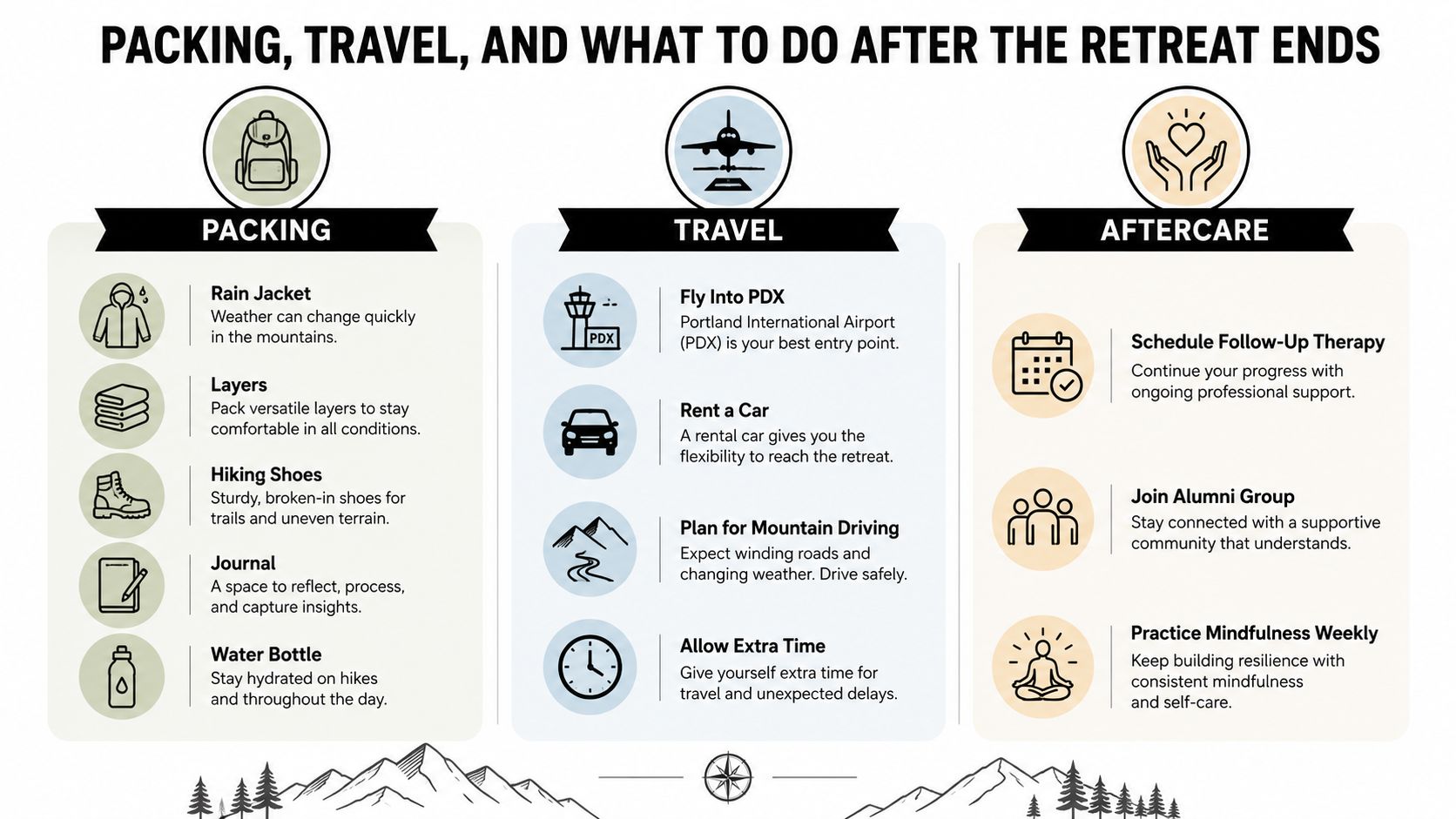
The practical side matters more than people think. Oregon weather shifts quickly, especially outside the cities, so packing should lean toward layers, a rain jacket, sturdy shoes, and anything that helps you stay comfortable during downtime. If the retreat is rural, assume driving may take longer than your map suggests, and build in extra time for roads, weather, and parking.
Before you leave
Pack for comfort and for the actual setting, not just the brochure. Bring a journal, water bottle, medications if they're approved by the program, and anything that helps you wind down at night. If you're flying, PDX is the main airport many travelers use, but some retreat locations will still require a rental car and a long drive.
After you get home
The retreat doesn't end when you check out. What you do afterward often determines whether the experience fades or becomes useful. Schedule follow-up therapy if you can, write down what stood out while the experience is still fresh, and reconnect with the supports that keep you steady.
If a retreat offers an alumni group or integration call, use it. If it doesn't, create your own follow-up rhythm with a therapist, peer support, or a trusted person who understands what you're working on. Oregon's limited service capacity makes continuity especially important, because the state system already has little spare room for people who need a late correction or another fast step-up.
Practical rule: if you can't make time for aftercare, you may not be ready for a retreat yet.
The true test is whether this fits your life, not just your budget. If you're juggling work, caregiving, or travel constraints, a retreat may be harder to use well than a local outpatient option. If you do choose one, make it part of a bigger plan, not a standalone escape.
If you're comparing Oregon retreat options and want products, education, and a clearer way to think about psilocybin support, visit Metro Mush. The right choice starts with matching the experience to your real needs, and Metro Mush can help you keep that decision grounded in context, not hype.