
What are functional mushrooms, exactly, and why do some labels promise calm, focus, immunity, or energy while others sound like they're talking about ordinary food? The confusion is real because the same word gets used for several different things, and not all of them mean the same thing in practice.
A clean working definition helps: functional mushrooms are edible fungi marketed for bioactive compounds that may support health beyond basic nutrition. That's different from mushrooms you cook for flavor, and it's also different from psilocybin mushrooms, which belong in a separate legal and pharmacological category.
Defining Functional Mushrooms in Plain Language
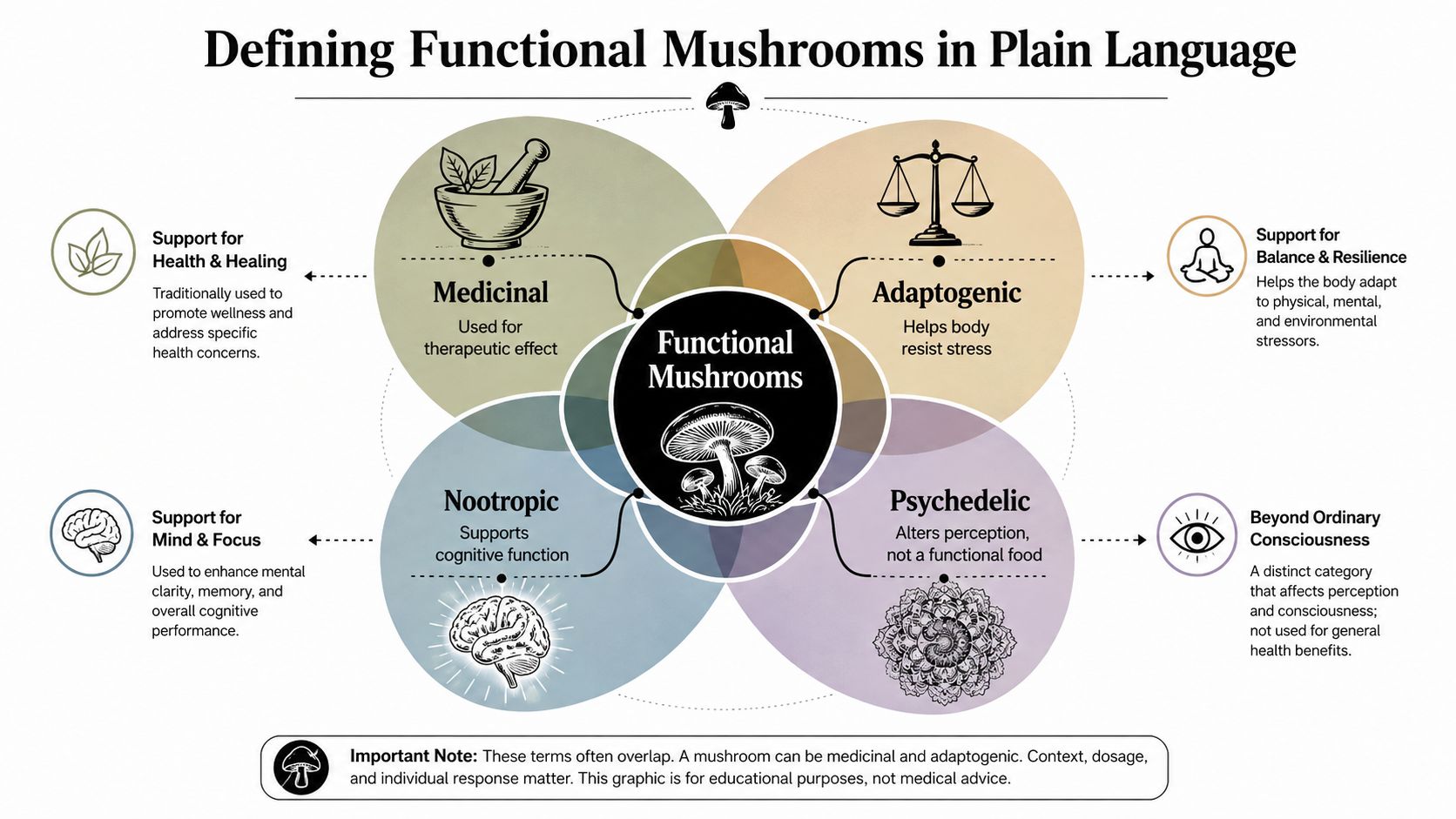
The simplest way to think about what are functional mushrooms is this, they're mushrooms used for a job, not just a meal. The term sits under a messy cluster of labels, including medicinal, adaptogenic, and nootropic, but none of those words fully replace the others. A functional mushroom can be described with one of those labels depending on how it's marketed, which is why shoppers often feel like they're looking at the same product through four different lenses.
A working definition you can actually use
A mushroom is usually called functional when people consume it for a specific wellness purpose tied to its compounds, not for calories or culinary texture. That's why species like lion's mane, reishi, chaga, cordyceps, turkey tail, and maitake keep coming up in product lines and supplement aisles.
Ordinary culinary mushrooms, like button or portobello, are mainly food. Functional mushrooms are food ingredients too, but they're chosen because someone wants more than taste from them. The mushroom benefits overview at Metro Mush uses that same basic distinction, flavor versus function, but the label can still get blurry when brands mix wellness language with food language.
Practical rule: if a product is sold because of a mushroom's named compounds or targeted wellness use, it's being treated as a functional mushroom product.
The term psychedelic is where the boundary matters most. Psilocybin mushrooms are not functional foods, and they're not interchangeable with the mushrooms in coffee, capsules, or gummies. If a brand implies otherwise, the marketing is doing more work than the science.
Why the overlap causes so much confusion
People often use medicinal to mean “good for health,” adaptogenic to mean “helps with stress,” and nootropic to mean “supports thinking.” Those are useful shorthand ideas, but they don't guarantee proof, dose, or effect. The label tells you the category a brand wants to evoke, not whether the product is well designed.
That's why it helps to keep one sentence in mind, functional mushrooms are edible fungi marketed for bioactive compounds that may support health beyond basic nutrition. Once that definition is clear, the rest of the category stops feeling like hype soup and starts looking like a set of ingredients with different uses, strengths, and evidence levels.
How Functional Mushrooms Actually Work in the Body
The body does not respond to a mushroom label. It responds to specific molecules. In functional mushrooms, the compounds most often discussed are beta-glucans, triterpenes, and, in some species, hericenones and erinacines. Those compounds do different jobs, which is why one mushroom gets linked with immune support, another with calm, and another with cognition.
The fruiting bodies are also mostly water, about 80 to 90 percent, and they typically provide only 50 to 70 kcal per 100 g according to one market summary. That helps explain why they are usually used as ingredients rather than as dense food staples. The same market summary placed the global functional mushroom industry at $3.6 billion in 2023, with North America at 38% of the market that year, which shows how large this category already is functional mushroom market data.
The main compound groups
Beta-glucans are long-chain sugars found in mushrooms. They are often discussed in relation to immune signaling because they interact with immune cells rather than acting like a vitamin or stimulant. Triterpenes are bitter compounds found in species such as reishi, and they are usually discussed in relation to inflammation and other regulatory pathways. Hericenones and erinacines show up most often in lion's mane conversations, because that species is marketed for nerve and cognitive support.
Short version: the species matters, but the compound profile matters just as much.
The adaptation idea is straightforward. Adaptogenic mushrooms are usually framed as helping the body respond to stress more smoothly. That is a useful concept, but it is still a concept, not a promise that every product will produce a measurable result.
Why the mushroom part and extraction method matter
The U.S. Office of Dietary Supplements says functional mushrooms are sold as fruiting-body or mycelium-based supplements, but it is still unclear whether those products deliver the same compounds or biological effects as whole mushrooms, and it says there is not enough scientific evidence to support their use for any purpose other than as food ODS mushroom supplement guidance. That matters because a capsule made from a fruiting body extract is not the same thing as a cheap powder built around mycelium on grain.
Extraction also changes what ends up in the jar. Hot-water extracts tend to concentrate water-soluble compounds such as beta-glucans, while other formulations may shift the balance of what is present. A label that says “mushroom” still leaves the important questions open, which species is it, which part was used, and which extraction method was used?
If you want a practical example of how that plays out in a specific use case, a close look at mushrooms for focus shows why species choice and formulation matter together.
Clinical Evidence and the Benefits People Actually Claim
People usually buy functional mushrooms for a few recurring reasons, focus, immunity, energy, stress resilience, and metabolic support. The evidence behind those claims is uneven. One product may be tied to a specific study, while another relies on broad category language that sounds persuasive but does not match what was tested.
Human evidence also depends on the exact mushroom, the part used, and the form. Capsules, powders, extracts, and drink mixes do not all deliver the same mix of compounds, so the label has to be read more carefully than the marketing copy. A mushroom supplement can sound well supported and still be a poor match for the claim being made.
Claim, species, and evidence need to match
A practical way to read a mushroom label is to ask three questions. Is there human evidence for this species? Is there human evidence for this form, meaning extract, powder, capsule, or drink mix? And is the claim about the same outcome that was studied?
| Common Functional Mushroom Claim | Most Studied Species | Human Evidence Strength | Notes |
|---|---|---|---|
| Cognitive support | Lion's mane | Limited, promising | Often marketed for focus or memory, but the product form matters. |
| Immune support | Turkey tail, reishi | Mixed, condition-specific | Claims are often broader than the evidence. |
| Energy or stamina | Cordyceps | Preliminary | Usually framed around performance or vitality rather than a direct stimulant effect. |
| Stress or sleep support | Reishi | Preliminary | Often used in evening formulas, but human evidence remains narrower than marketing suggests. |
| Blood sugar or metabolic support | Maitake | Preliminary | Better treated as an emerging use case than a settled one. |
Useful filter: if a brand gives you a big claim but cannot name the species and extract, the claim is doing more work than the ingredient.
The U.S. Office of Dietary Supplements says mushroom dietary supplements are sold as food and supplement ingredients, and that evidence is limited for uses beyond food in many cases. That does not make every claim worthless. It does mean the claim has to be matched to the mushroom, the formulation, and the actual human evidence instead of the category name alone.
That is why the same product category can sound contradictory from one source to the next. Some mushrooms contain bioactive compounds that have been studied in people. Other products borrow the language of research without matching the dose, species, or extract to what was tested. The middle ground is the most useful one here. Some claims have a real research base, others are still preliminary, and a lot of the marketing sits in between.
For readers who want a narrower look at cognitive products, the best mushrooms for focus guide at Metro Mush shows why species choice and formulation need to be considered together. Use it as a starting point, not as proof that every focus product will work the same way.
Profiles of the Six Most Popular Functional Mushroom Species
Species matter because each mushroom brings a different mix of compounds, traditional uses, and product formats. Treating them as interchangeable is how shoppers end up with a jar that sounds promising but doesn't match the goal. A better approach is to think of each one as a distinct character with a different job.
Lion's mane, the cognition mushroom
Lion's mane is the mushroom most often linked with focus, memory, and nerve support. It's usually sold as a cultivated fruiting-body extract or powder, and it's one of the main mushrooms people choose when they want a nootropic-style product. The reason it gets so much attention is simple, it fits the “brain support” story better than most other species, even if the evidence is still developing.
Reishi, the calming mushroom
Reishi is the mushroom people usually reach for when they want evening support, calm, or a sleep-friendly routine. It's often associated with triterpenes, which helps explain why it's commonly framed as a stress and recovery ingredient rather than a daytime performance product. Reishi is one of the clearest examples of a mushroom whose reputation comes from both tradition and modern supplement marketing.
Chaga, the wild-harvested antioxidant favorite
Chaga is commonly marketed for antioxidant activity and a rugged, forest-grown image. It's often wild-harvested, although cultivated versions exist, and that sourcing question matters because “natural” doesn't automatically mean more consistent or better controlled. Chaga is best understood as a specialty ingredient, not a universal wellness mushroom.
Cordyceps, the energy and stamina option
Cordyceps is usually positioned around energy, endurance, and performance. It's a favorite in pre-workout blends and morning formulas because brands want it to feel like a cleaner alternative to stimulant-heavy products. That doesn't make it a stimulant in the same way caffeine is, but it does make it one of the most recognizable energy mushrooms in the category.
Turkey tail and maitake, the immune and metabolism pair
Turkey tail is often discussed for immune modulation and has one of the deeper clinical footprints in the mushroom world. Maitake is commonly linked with metabolic support and blood sugar conversations. Both are usually marketed more as system-support ingredients than as quick-acting wellness boosters, which is part of why they tend to appear in more serious supplement lines than in novelty products.
A simple way to keep them straight is this.
- Lion's mane: think cognition.
- Reishi: think calm.
- Chaga: think antioxidant positioning.
- Cordyceps: think stamina.
- Turkey tail: think immune support.
- Maitake: think metabolic support.
Forms, Dosing, and How to Actually Take Them
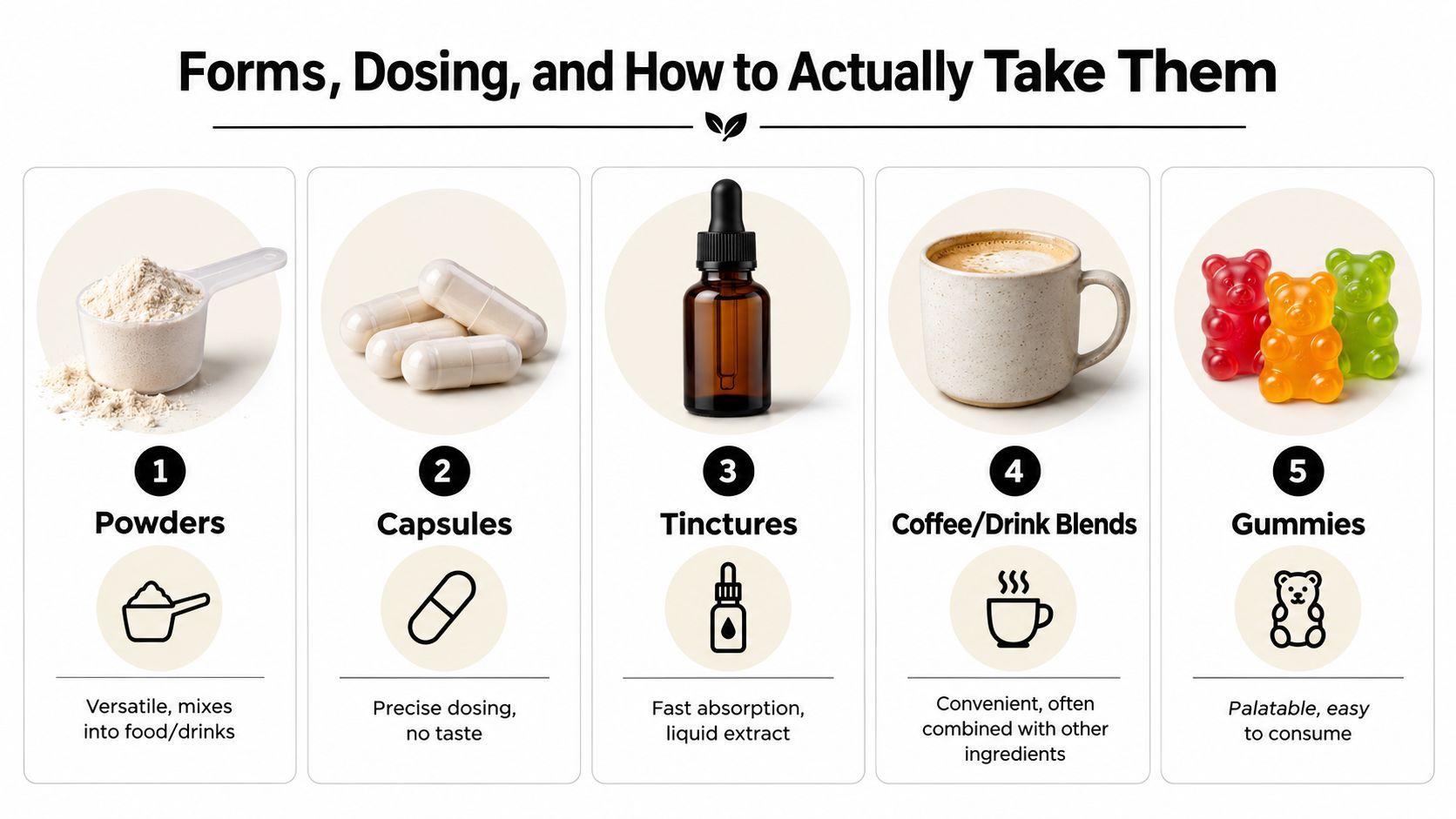
Walk down a wellness aisle and you'll see mushrooms in powders, capsules, tinctures, coffee blends, gummies, and broths. The form matters because the delivery system changes the experience, the taste, and sometimes the amount of actual mushroom material you get. A product can be convenient and still be light on meaningful actives.
What the form tells you
Powders are flexible because you can mix them into food or drinks. Capsules are easier when you want no taste and a fixed dose. Tinctures are liquid extracts, so they're popular with people who like an easy dropper format. Coffee or drink blends are convenient, though they often combine mushrooms with other ingredients. Gummies are the most approachable for taste, but they can also be the easiest place for low-dose formulations to hide.
Buy for the label, not the vibe. A product that looks wellness-forward can still be underdosed or poorly specified.
The biggest quality divide usually isn't the packaging. It's whether the product is a real extract from the fruiting body, a mycelium-on-grain powder, or a blend that doesn't make the source obvious. That difference matters because the mushroom part and the extraction process affect what compounds are likely to be present.
A practical example helps. A lion's mane capsule built from a clear fruiting-body extract is a different product from a sweetened gummy that uses a vague mushroom blend and leaves the species undisclosed. The first invites analysis, the second invites suspicion.
For people who prefer liquid formats, the mushroom tinctures benefits guide at Metro Mush is one way to compare form factors. The main rule stays the same, read the label with the same care you'd use for any supplement you plan to take.
Functional Mushrooms Versus Psilocybin Mushrooms
Functional mushrooms and psilocybin mushrooms are not the same thing, and the difference matters legally, pharmacologically, and practically. Functional mushrooms are non-psychoactive and sold as food or dietary supplements. Psilocybin mushrooms contain a compound that converts to psilocin and alters perception, which puts them in a completely different category.
That distinction gets blurred online because the word mushroom gets used as if it were one umbrella for every fungus product. It isn't. Mushroom coffee and mushroom gummies sold as functional products don't get you high. If they did, they wouldn't be sitting in the supplement aisle or in everyday beverage formats.
Legal and practical differences
Psilocybin is a Schedule I compound under federal law, which is why its legal treatment is separate from functional mushroom supplements. Michigan also has its own local history here, including Ann Arbor's decriminalization in September 2020 and Detroit's Proposal E in November 2021. Those local policy changes affected psychedelic enforcement conversations, not the dietary-supplement status of functional mushrooms.
That's where some brands get clever. They use mushroom imagery, mystical language, or vague wellness claims to make consumers feel like they're getting something stronger than a supplement. The product may still be a functional mushroom product, but the branding can make it feel intentionally adjacent to psychedelics.
The clean way to shop is to ask one question: does this product contain psilocybin, or is it a non-psychoactive functional mushroom supplement? Once you ask that, the rest usually becomes less confusing. If the answer is functional, then the relevant questions are about species, extraction, and evidence, not altered states.
Safety, Side Effects, and Who Should Be Cautious
Functional mushrooms are generally tolerated by many adults, but “natural” doesn't mean risk-free. The most common issues are digestive upset, allergic reactions, and, for certain species, possible blood-thinning effects. Those are the kinds of concerns that matter in real life, because they're the ones that can affect daily use, medication safety, or surgery planning.
The groups that should slow down
People on anticoagulants should pay special attention to reishi and chaga, because those species can amplify the effect of drugs like warfarin. People taking immunosuppressants should also be cautious with immunomodulating mushrooms such as turkey tail, because mushroom ingredients that interact with immune signaling could theoretically work against prescribed therapy.
Pregnant or nursing people should talk to a clinician before using functional mushrooms. So should people with autoimmune conditions, organ transplant recipients, and anyone scheduled for surgery. The same advice applies to people who have a history of allergy to molds or fungi, since cross-reactivity is possible.
Safety first: if a mushroom product sits next to a prescription med, treat it like a supplement, not a snack.
A lot of confusion comes from assuming that because a mushroom is sold in a coffee or gummy, it must be gentle enough for everyone. That's not a safe assumption. A product can be popular, widely sold, and still be inappropriate for certain people.
Buying Quality Products and Frequently Asked Questions
A good mushroom supplement label should answer the important questions quickly. If it doesn't, that's usually the warning sign.
A quick buying checklist
- Look for Third-Party Testing: Seek USP, NSF, or independent lab CoAs so you're not guessing about identity or contamination.
- Check Beta-Glucan Content: A label that names the active fraction is more informative than one that only says “mushroom blend.”
- Verify Extraction Method: Hot-water or dual extraction is easier to evaluate than a vague powder claim.
- Confirm Mushroom Identity: The species should be listed clearly, not hidden behind “mycelium” language alone.
- Research the Brand: Transparent sourcing and manufacturing matter more than pretty packaging.
Red flags to watch for
Proprietary blends can hide individual doses. Vague mushroom blend labels can hide species. Claims that sound clinical but don't name a species, extract type, or testing method deserve skepticism. If the front of the package sounds more specific than the back, trust the back.
Fast FAQ
Can you take functional mushrooms every day? Many adults do, but the right choice depends on the species, the dose, and your medications or health conditions.
Do they interact with coffee? They can be combined in drink products, but coffee brings caffeine, while mushrooms bring their own compounds. The combination doesn't automatically make a product better.
Can kids or pets use them? Don't assume so. Ask a clinician or veterinarian, because adult supplement logic doesn't transfer cleanly.
Are they real or just placebo? Some uses have a plausible biological basis and emerging human research, but the category also includes a lot of marketing that outruns the evidence.
If you want a place to compare mushroom products against a clearer standard, Metro Mush offers mushroom-based products through its Detroit and Ann Arbor service. For anyone trying to separate honest product design from marketing fog, visit Metro Mush and look closely at how the category is presented before you buy.