
Your phone lights up. A message comes in, then another. You switch tabs to answer one quick thing and suddenly you've forgotten what you were working on in the first place. By the afternoon, your brain feels busy but not productive.
That's why so many people start looking at mushrooms for focus. They want something gentler than pushing caffeine harder, but more useful than vague “brain health” promises. The confusing part is that people often mean two very different things when they talk about mushrooms for concentration.
One path uses functional mushrooms like Lion's Mane. These are non-psychoactive and usually taken as part of a daily routine. The other path is psilocybin microdosing, which people often pursue for mental flexibility, creative problem-solving, and getting unstuck in rigid thought patterns.
Both paths get discussed under the same umbrella. They are not the same tool.
Searching for Focus in a World of Distraction
Focus problems don't always look dramatic. Sometimes it's simple stuff. You reread the same paragraph three times. You sit down to pay bills and end up checking weather, email, and sports scores. You feel mentally tired even when you haven't done much deep work.
That daily friction is exactly why interest in the best mushrooms for focus keeps growing. People aren't only asking, “What wakes me up?” They're asking, “What helps me stay steady, think clearly, and finish something?”

Two very different paths
The first path is practical and familiar. You use a legal functional mushroom supplement, often every day, and judge it the same way you'd judge any wellness routine. Are you more consistent? Less mentally foggy? Better able to stay with a task?
The second path is more complicated. Psilocybin isn't mainly about raw task performance. People are usually drawn to it because they feel stuck, repetitive, or overly rigid in how they think.
The most common mistake is assuming all “focus mushrooms” do the same job. They don't.
What most beginners actually need
If your goal is daily clarity, steady concentration, and a routine that fits normal work life, functional mushrooms usually make more sense as a starting point.
If your goal is cognitive flexibility, perspective shifts, or breaking out of stale mental loops, psilocybin becomes part of the conversation. But it brings different legal, psychological, and practical considerations.
A useful way to think about it is simple:
- Functional mushrooms support the brain you use every day.
- Psilocybin may affect how flexibly that brain organizes thoughts and attention.
- Your real question isn't “Which mushroom is strongest?” It's “What kind of focus problem am I trying to solve?”
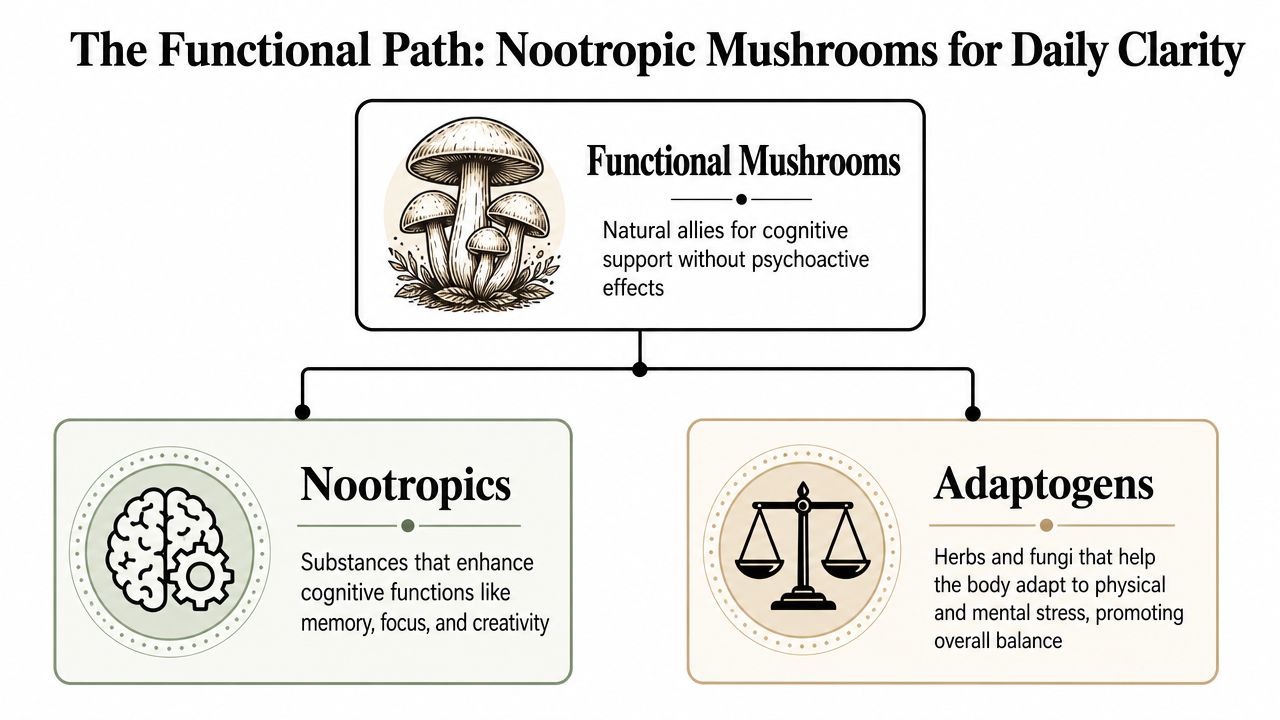
The Functional Path Nootropic Mushrooms for Daily Clarity
You wake up tired, open your laptop, and try to settle into work. The problem is not a lack of ideas. It is that your attention keeps slipping. For that kind of day-to-day focus problem, functional mushrooms are usually the more practical path.
They are non-psychoactive, so the goal is not a perceptual shift. The goal is steadier mental clarity over time. People usually take them the same way they take other supplements, in capsules, powders, coffees, or extracts.
Two labels can make this category sound more complicated than it is. Nootropic is a broad term for something used to support thinking, memory, or attention. Adaptogenic usually refers to helping the body handle stress more evenly. Some mushroom products are marketed as both, which can be confusing at first. A simple way to sort it out is this: nootropic points toward mental performance, adaptogenic points toward stress response, and some mushrooms may touch both.
Why Lion's Mane gets most of the attention
If functional mushrooms are the daily-clarity path, Lion's Mane is a common starting point. That is not just because it is popular. It is because, compared with other functional mushrooms discussed for focus, it has the clearest direct connection to cognition in human research.
Part of the interest comes from its relationship to nerve growth factor, or NGF. In plain terms, NGF helps support the health and maintenance of neurons. That does not mean Lion's Mane works like a stimulant. It is closer to support work than a quick jolt, more like improving the condition of the road than pressing harder on the gas pedal.
A useful overview from the Cleveland Clinic on Lion's Mane mushroom benefits and limits explains why the mushroom keeps coming up in discussions of brain health, while also stressing an important point for beginners: promising early evidence is not the same as guaranteed results for every person.
What the human trials suggest
The strongest case for Lion's Mane is that researchers have tested it in people, not only in lab models. The results are still early and the studies are small, but they are more concrete than the marketing language you see on many labels.
According to Medichecks' summary of Lion's Mane human trial findings, several human studies have reported improvements in measures related to cognitive performance after regular supplementation, especially when taken consistently over weeks rather than a few days. That time frame matters. Functional mushrooms are usually a routine, not a one-time trick.
The same summary also notes a pilot trial in healthy young adults where Lion's Mane was associated with faster Stroop task performance after a single dose. The Stroop test measures attention and cognitive control, so it gives a more useful signal than vague claims about “brain power.” It still does not mean you will suddenly breeze through every task. It means Lion's Mane has at least some research relevance to the kind of focus people care about in real life.
Practical rule: If you want the most research-backed functional mushroom for focus, start with Lion's Mane before combining several products.
Where the other mushrooms fit
The comparison with the psilocybin path helps. Functional mushrooms are usually better for steady daily support, but they do not all solve the same problem.
- Cordyceps may be a better fit if your focus drops with physical fatigue or low drive.
- Reishi makes more sense for people whose concentration is being drained by stress or poor sleep.
- Chaga is usually discussed more for general antioxidant support than for direct attention benefits.
- Lion's Mane remains the clearest match if your main goal is sharper day-to-day mental clarity.
So the functional path has strengths and limits. The strengths are legality, accessibility, and an easy fit with normal routines. The limits are just as important. Effects are usually subtle, product quality varies, and results often depend on consistent use rather than a noticeable same-day boost.
If you are comparing powders, capsules, and extracts, cost can shape what is realistic to use long enough to judge. This local guide to the price of Lion's Mane mushrooms can help you compare common product forms before you buy.
The Psilocybin Path Microdosing for Cognitive Flexibility
You sit down to work, open the same project, and hit the same wall again. The issue is not always low energy or mental fog. Sometimes your attention keeps circling the same thoughts, the same frustrations, or the same stuck way of seeing the problem. That is the lane where people usually become curious about psilocybin microdosing.
Psilocybin belongs to a different path from functional mushrooms like Lion's Mane. The goal is usually not steadier daily clarity. The goal is often greater cognitive flexibility, which means an easier time shifting perspective, breaking repetitive thought patterns, or approaching a task with a little more openness.
That distinction matters.
What microdosing is actually trying to do
Microdosing usually means taking a very small, sub-perceptual amount of psilocybin. In plain English, people are not aiming for a full psychedelic experience. They are trying to create a subtle mental shift that feels usable inside ordinary life.
A simple way to frame the difference is this. Functional mushrooms are often used like routine support for the brain, more like maintaining good traction on a daily drive. Microdosing is closer to changing the route when you keep ending up on the same mental road. That can sound appealing if your problem is creative stagnation, rigid thinking, or repetitive inner loops. It is less appealing if your main goal is to power through email, spreadsheets, or long study blocks with consistent concentration.
Why researchers connect psilocybin with flexibility
Researchers have paid attention to psilocybin because it appears to affect how different brain networks communicate. Imperial College London's report on psilocybin and brain connectivity describes increased communication across brain networks after psilocybin administration, along with findings that support neuroplasticity-related effects.
For a beginner, “neuroplasticity” can sound abstract. It helps to translate it. Neuroplasticity refers to the brain's ability to adapt, form new connections, and loosen old patterns. That matters for focus in an indirect way. A person who is mentally locked up, overly repetitive, or creatively boxed in may need flexibility before they need sharper concentration.
So the promise here is specific. Psilocybin may help some people think differently. That is not the same as helping them concentrate better on command.
Where confusion starts
Many new readers hear “brain connectivity” or “plasticity” and assume better productivity must follow. That leap is too big.
A flexible mind and a focused mind overlap sometimes, but they are not identical. A writer trying to get unstuck from the same paragraph may benefit from a shift in perspective. An office worker trying to stay on task for three straight hours may need stable attention, not a broader mental frame. This is one of the clearest differences between the functional path and the psilocybin path, and most articles blur it.
Subjective experience adds to the confusion. Someone may feel more open, more reflective, or more creative and describe that as “better focus.” But that phrase can mean several different things.
What microdosing does not clearly improve
Controlled research matters because expectation can shape perception. A systematic review in Frontiers in Psychiatry on microdosing psychedelics found that reported benefits are mixed, study quality varies, and objective improvements in attention and cognition are still not clearly established.
That is the practical takeaway for a focus guide. Microdosing may feel meaningful, especially for people dealing with rigidity, creative blocks, or repetitive thinking. It does not have clear support as a reliable tool for better task-based attention in the way many beginners hope.
If you want to understand how people approach scheduling, dose spacing, and self-monitoring, this guide to microdosing with magic mushrooms is a useful starting point. Read it as a caution-first framework, not as proof that microdosing will improve your performance.
Functional vs Psilocybin Choosing Your Approach
You are at a coffee shop in Ann Arbor with a laptop open, three tabs too many, and a task you keep postponing. The first question is not which mushroom is stronger. It is what kind of focus problem you are trying to solve.
Some people need steadier attention so they can read, write, study, or work through a checklist without drifting. Others can pay attention, but their thinking feels jammed, repetitive, or creatively boxed in. Those are different problems, and functional mushrooms and psilocybin sit on different sides of that divide.
Functional vs. Psilocybin Mushrooms for Focus
| Attribute | Functional Mushrooms (e.g., Lion's Mane) | Psilocybin (Microdosing) |
|---|---|---|
| Legal status | Broadly used as non-psychoactive wellness products | Legal status varies and requires much more caution |
| Main focus benefit | Daily clarity and cognitive support | Cognitive flexibility and perspective shifts |
| Best fit for | Work routines, study blocks, consistent mental upkeep | Intentional reflection, creative blocks, rigid thought patterns |
| Research strength for direct concentration | Better support, especially around Lion's Mane, though still not a magic fix | Objective focus gains remain unclear |
| User experience | Usually subtle and routine-based | More variable and shaped by context and expectation |
| Risk profile | Mostly about product quality and sourcing | Includes legal, psychological, and situational risk |
A practical way to choose is to sort your goal into one of two lanes.
The functional lane is for people who want something they can use as part of ordinary life. It works like adding better tires to a daily commuter car. You are not changing the destination or the driving style. You are trying to make the ride steadier. If your goal is fewer foggy mornings, more consistent study sessions, or better mental upkeep over time, functional mushrooms usually fit that job better.
The psilocybin lane is different. It is less about holding one line of attention and more about loosening a mental pattern that feels stuck. That can matter for someone who keeps circling the same ideas, feels creatively blocked, or wants more flexibility in how they see a problem. It is a different tool, with a different set of tradeoffs.
A simple decision framework
Functional mushrooms are usually the better first step if these points sound familiar:
- You want a legal daily routine that does not alter perception.
- You are trying to improve consistency during work, school, or home tasks.
- You are new to mushrooms and want the lower-complexity option.
- You want support that can sit alongside basics like sleep, exercise, and fewer distractions, rather than replace them.
Psilocybin may be the closer fit if this description matches better:
- Your main problem is mental rigidity, not ordinary distractibility.
- You are looking for perspective or insight, not just longer task endurance.
- You understand that microdosing is not a standard nootropic approach.
- You are prepared to think carefully about legality, setting, personal history, and medication fit. If that last point applies, review common psilocybin drug interactions and medication concerns before treating it as an option.
One mistake beginners make is forcing both paths into the same story. They hear "mushrooms for focus" and assume all mushrooms should help in the same way. They do not. Functional mushrooms are closer to routine support. Psilocybin is closer to an intentional experiment that may matter more for flexibility than for straightforward concentration.
Can both ever belong in the same broader routine
For some adults, yes, but only if the roles stay clear.
Lion's Mane can sit in a daily rhythm in the same way coffee, exercise, or a sleep schedule supports mental performance over time. Psilocybin, if someone chooses to explore it where legal, belongs in a more deliberate category. Treating it like a casual productivity shortcut usually leads to muddled expectations.
If your goal is simple, repeatable focus for ordinary life, start with the path that asks less of you and creates fewer variables. For many beginners, that means functional mushrooms first.
Understanding Risks and Responsible Use
You finish a long workday, notice your attention is slipping, and start looking for a mushroom product that might help. This is the point where people often blur two very different choices. One is a daily supplement question. The other is a legal, psychological, and medical decision.
That distinction matters because the risks are not interchangeable.
Functional mushroom safety basics
For functional mushrooms such as Lion's Mane, risk usually centers on product quality, tolerance, and expectations. The practical question is less "Will this alter my mind today?" and more "Do I know what I am taking, and does this fit my routine?"
A good label should tell you whether the product uses fruiting body, mycelium, or a blend. It should also make testing and sourcing easy to verify. If a seller is vague about what is in the bottle, treat that as a warning sign.
Start simple. Try one product at a time, pay attention to how you feel over a couple of weeks, and avoid stacking several new supplements at once. Otherwise, it becomes hard to tell what is helping, what is doing nothing, and what may be upsetting your stomach or sleep.
Functional mushrooms also have a ceiling. They may support clearer thinking for some people, but they do not replace the basics. Sleep still does the heavy lifting. So do stress control, food, movement, and a work setup that does not pull your attention in ten directions at once.
Psilocybin needs a different level of caution
Psilocybin belongs in a separate category. It can affect perception, judgment, and emotional state, even at low doses, and people often confuse feeling different with performing better.
Research discussed earlier in this article found a mismatch between what some microdosers expected and what objective testing showed. That gap is a safety issue in plain terms. If you believe you are sharper than you really are, you may make poor decisions at work, while driving, or during demanding tasks.
Legal status matters too, especially for readers in Michigan. Local decriminalization in places such as Ann Arbor or Detroit does not make psilocybin the same as an ordinary retail supplement. That can confuse beginners, so it helps to use a simple rule. If the product changes consciousness and carries legal uncertainty, it deserves more caution, not less.
A safer checklist before considering psilocybin
Before treating microdosing as a focus strategy, slow the process down and check a few basics:
- Get clear on your goal: If you want steady task focus for work or studying, psilocybin may not match that goal as cleanly as functional mushrooms.
- Review mental health history: Extra caution is warranted for anyone with a personal or family history of psychosis, mania, or severe mood instability.
- Check medication fit: Antidepressants, stimulants, and other medications can change the picture. Review common psilocybin drug interaction concerns and medication fit questions before making assumptions.
- Respect setting and timing: Even a low dose can land differently when you are stressed, sleep-deprived, overstimulated, or trying to push through a normal workday.
- Avoid casual mixing: Combining psilocybin with alcohol, cannabis, or multiple new supplements adds variables fast.
One practical way to remember the difference is this. Functional mushrooms are closer to tuning an engine over time. Psilocybin is closer to changing how the driver experiences the road. Both relate to focus in some way, but they create very different kinds of risk.
That is why responsible use starts with choosing the right path for the problem you have.
Finding Quality Mushrooms in Southeast Michigan
If you live in Southeast Michigan, your best move is to shop with a filter. Don't start with flashy branding. Start with product clarity, testing information, and whether the seller explains what they're offering.
What to look for in functional mushroom products
For Lion's Mane and other functional mushrooms, local shoppers should compare a few practical details before buying in-store or online:
- Transparent labeling: You should be able to tell what mushroom is included and in what form.
- Routine-friendly format: Capsules, powders, and drink mixes all work differently depending on your habits.
- Clear sourcing standards: Sellers who care about quality usually say so plainly.
A good local store or wellness shop should be able to answer simple questions without getting evasive. If nobody can explain the product, that's useful information.
Psilocybin shopping takes more local awareness
In Southeast Michigan, conversations around psilocybin often involve the decriminalized environment in places like Detroit and Ann Arbor. That still isn't the same as broad retail normalcy, and adults need to understand that distinction before treating any product like an ordinary supplement.
If someone is exploring psilocybin products for a cautious, low-dose approach, form matters. Many beginners prefer measured edibles because they feel easier to portion than raw dried mushrooms. Products like OuterSpore Milk Chocolate Bars and Mush Love Chocolate Bars often appeal to new users for that reason, while drinks such as Rocket Fuel shroom drinks may feel more familiar to people who don't want to start with whole mushrooms.
A short local video can also help you get oriented before buying:
Local buying is easier when the menu is understandable
The best local resource isn't the one with the most hype. It's the one that helps adults distinguish between dried strains, low-dose edibles, and convenience products without acting like every option fits every person.
That matters more in a category where newcomers often don't know whether they want experimentation, routine, or something in between.
Frequently Asked Questions About Mushrooms and Focus
Can you use functional mushrooms and microdosing together
Some adults do, and people often call that stacking. But it's better to think carefully before combining approaches. If you're new, start with one path so you can tell what it's doing for you.
How long does Lion's Mane take to notice
People often expect an instant jolt, then get disappointed. Lion's Mane usually makes more sense as a consistent routine than as a one-time boost. If your goal is daily clarity, patience matters more than hype.
Does microdosing improve work performance
Not necessarily. Subjective feelings of focus can differ from measured outcomes, which is why people should be careful about driving, deadlines, or demanding tasks if they're assuming they'll function better.
Is decriminalized the same as legal
No. Those terms are not interchangeable. Decriminalization can change local enforcement priorities, but it doesn't automatically mean full legalization or a risk-free retail environment.
Which is the best mushroom for focus if I'm a beginner
For most beginners, Lion's Mane is the simplest starting point because it's non-psychoactive, routine-friendly, and the most directly supported option for cognitive use.
What if my problem is brain fog plus stress
That's where people sometimes branch beyond Lion's Mane and look at broader functional mushroom blends. Just remember that “best” depends on whether your problem is attention itself, energy, stress load, or mental rigidity.
If you're in Detroit or Ann Arbor and want a local option for exploring psilocybin products as an adult, Metro Mush offers a curated menu that includes dried mushrooms, approachable edibles like OuterSpore Milk Chocolate Bars and Mush Love Chocolate Bars, and convenient drink options. It's a practical starting place if you want clear product choices, local delivery, and a more understandable way to compare formats before you buy.