
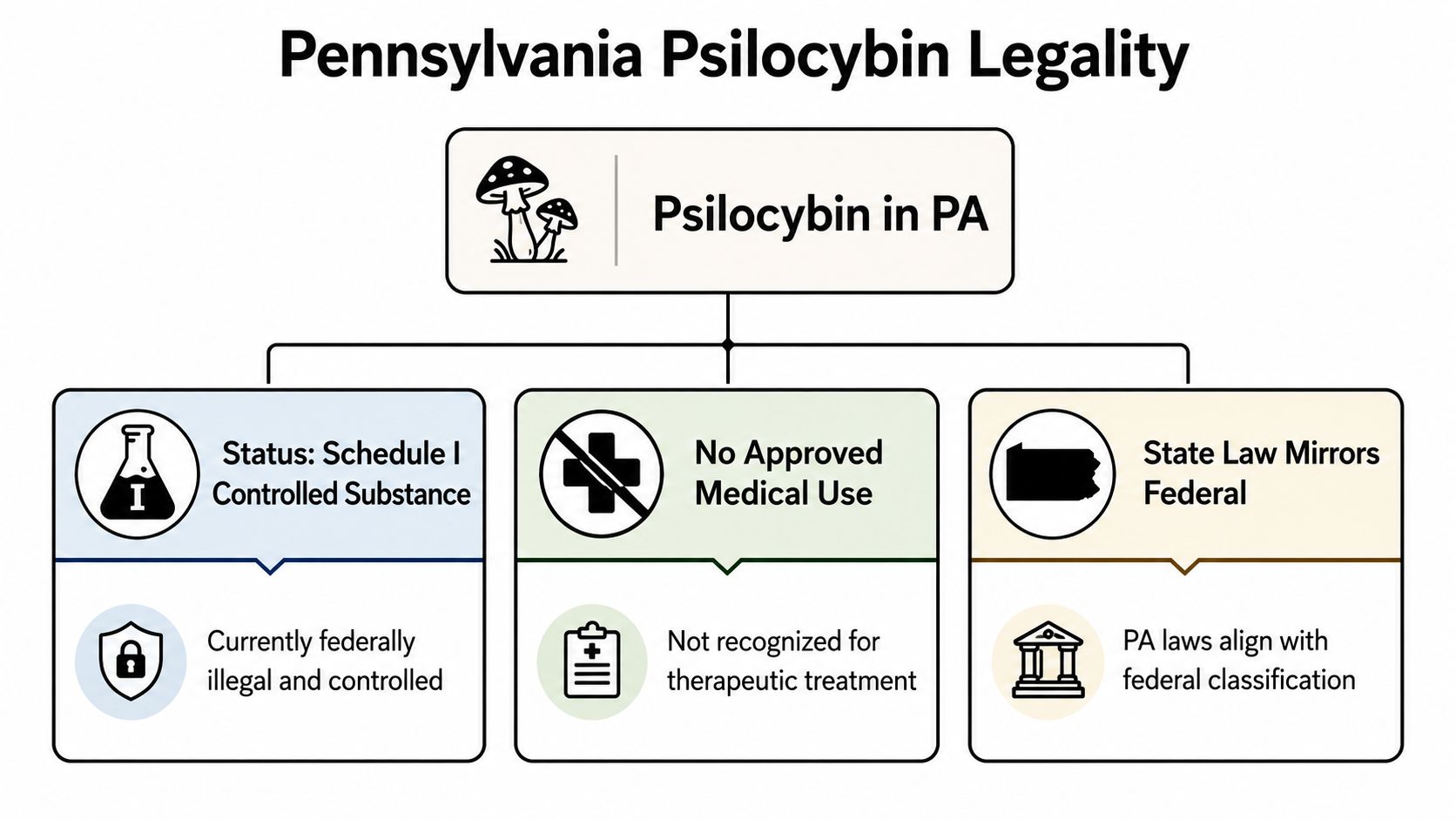
Psilocybin remains illegal for recreational use in Pennsylvania under state and federal law, and federal law classifies it as a Schedule I controlled substance. In Pennsylvania, policy interest has still moved forward, including the introduction of H.B. 1959 in 2021 to permit research into psilocybin-assisted psychotherapy, which is why searches for magic mushrooms in PA often bring up headlines that sound more permissive than the law is.
Late-night research, opening tab after tab, often reveals a confusing mix of answers. One page says psychedelic therapy is advancing. Another says possession can still create legal risk. Both ideas can be true at the same time.
The hard part is that "magic mushrooms PA" isn't one legal question. It usually means several questions bundled together. Is possession illegal? What about growing? Are spores treated the same way? Can a doctor prescribe psilocybin? Are there research programs? Can you travel from another state with it?
Those questions don't all have the same answer. The safest way to understand this topic is to separate them, one by one, and keep two ideas in view at once. First, psilocybin is not legally available for personal recreational use in Pennsylvania. Second, Pennsylvania is part of a broader medical and legislative conversation, but that conversation has not created retail legality.
Your Guide to Magic Mushrooms in Pennsylvania
A Pennsylvania resident can read one headline about psychedelic therapy, another about criminal penalties, and come away with the wrong takeaway from both. The underlying issue is simpler and more confusing at the same time. "Magic mushrooms PA" usually points to several different legal questions, and each one needs its own answer.
That is the starting point for this guide. Psilocybin policy is being discussed in medical, legislative, and research settings, but those discussions have not created a general legal market for personal use in Pennsylvania. At the same time, not every related topic is identical under the law. Possession, spores, research access, and interstate travel are separate categories, and mixing them together is what causes so much confusion.
A helpful way to read this subject is to sort it like labeled folders instead of one big pile.
The questions people usually mean
Readers who search for "magic mushrooms pa" are often trying to answer one of these:
- Possession: Can you legally have psilocybin mushrooms in Pennsylvania?
- Cultivation: Does growing them at home create a different legal issue?
- Spores: Are spores treated the same way as mushrooms that contain psilocybin?
- Research or therapy: Is there any lawful medical, clinical, or study-based path to access?
- Travel: If another state has a different policy, does that change the risk once you cross into Pennsylvania?
Those are related questions, but they are not interchangeable. A news story about a research bill does not mean retail access exists. Interest from clinicians does not mean a doctor can prescribe psilocybin at a neighborhood office. A product sold lawfully somewhere else does not become lawful to carry everywhere.
Why the answers get blurred together
Part of the confusion comes from timing. Public discussion often moves faster than the law. Another part comes from language. People use "magic mushrooms" as shorthand, even though the legal treatment can turn on details such as whether a person is talking about active mushrooms, inactive spores, a supervised study, or travel across state lines.
That distinction matters because legal risk is tied to the specific conduct. Safety questions are different again. A substance can be the subject of serious medical research and still be unlawful for unsupervised personal use.
A practical rule: separate legality, safety, and medical research before drawing any conclusion.
This guide is built to do exactly that. It explains where Pennsylvania law is restrictive, where the gray areas people ask about tend to appear, what active reform efforts mean, and what lawful, lower-risk options are available right now for residents who want to stay on solid legal ground.
The Legal Maze of Psilocybin in Pennsylvania
The biggest mistake people make is assuming "illegal" answers every legal question by itself. It doesn't. You need to know what activity you're talking about.
In Pennsylvania, the legal picture is fragmented. Psilocybin bills discussed in the House have been aimed at research and clinical use, not retail access, and some sources describe the legislation as inactive or still under consideration, which is very different from decriminalization or legalization, as described in the Pennsylvania House discussion of psilocybin legislation.
What is clearly illegal
For everyday practical purposes, possession, sale, and cultivation of psilocybin mushrooms are not lawful personal-use options in Pennsylvania. If a mushroom contains psilocybin, the law does not treat it like a wellness supplement or retail botanical product.
That seems simple, but then people run into news stories about psychedelic reform and assume the state has already changed course. It hasn't. Legislative interest is real. Legal access is not.
Why bills create confusion
Pennsylvania introduced the Public Health Benefits of Psilocybin Act (H.B. 1959) in 2021, but the bill was aimed at permitting research into psilocybin-assisted psychotherapy, not opening a consumer market. That's an important distinction because readers often hear "psilocybin bill" and mentally translate it into "psilocybin is becoming legal." Those are not the same thing.
Here's the practical difference:
| Legal topic | What it means in plain English |
|---|---|
| Research bill | Lawmakers are considering structured study or clinical frameworks |
| Decriminalization | Enforcement priorities or penalties may shift, depending on jurisdiction |
| Legalization | A lawful system exists for access under defined rules |
| Retail access | Consumers can obtain products through an authorized market |
Pennsylvania is not a retail-legal state for psilocybin. That's the anchor point.
The most confusing subtopic is spores
Spores create a lot of online confusion because people hear that one mushroom-related item may be treated differently from psilocybin-containing material and assume everything around cultivation must also be allowed. That leap is where risk begins.
The safer mindset is this:
- Spores and active mushrooms aren't the same legal question
- Cultivation and possession aren't the same legal question
- Research access and personal access aren't the same legal question
If you're not sure where a specific item or activity falls, don't rely on forum chatter or broad social media claims. In a legally sensitive area, vague confidence is usually a bad sign.
A headline about "Pennsylvania considering psilocybin" should never be read as permission to possess, grow, or buy it.
How Federal Law Governs Mushrooms in PA
Even if Pennsylvania moved faster at the state level, federal law would still matter. That's because psilocybin remains a Schedule I controlled substance under federal law, a classification the U.S. Department of Justice describes as applying to drugs with high abuse potential and no legitimate medical purpose in the Justice Department drug classification reference.
That federal status affects how people should think about risk. State reform conversations can influence local enforcement and future policy. They do not erase the underlying federal rule.
What federal scheduling means in real life
Federal law doesn't become irrelevant just because a state legislature is discussing research or treatment frameworks. It remains the default legal backdrop. That matters especially for interstate conduct, mail, transportation, and any assumption that another jurisdiction's softer approach creates a shield.
A lot of confusion comes from comparing psilocybin to cannabis policy changes in some states. The legal and regulatory history is different. If someone says, "Other places are loosening up, so Pennsylvania probably won't care," that's not a legal defense.
Public health context matters too
Pennsylvania's state review found a maximum of 122 unintentional fatal overdoses involving MDMA, ketamine, LSD, or psilocybin between 2017 and 2021, representing less than 5% of all overdose fatalities reported by the state during that period, and the same review counted thirteen ketamine clinics statewide, illustrating how limited therapeutic infrastructure remains relative to public and medical interest, as summarized in the earlier verified state review and federal-law context.
Those figures don't make psilocybin legal. They do, however, help explain why this issue sits in a strange place politically. Public interest and therapeutic discussion are growing, while legal access and formal infrastructure remain narrow.
What readers should take from this
If you're in Pennsylvania, the safest assumption is straightforward:
- Federal illegality still applies
- State-level discussion doesn't equal protection
- "Medical interest" is not the same as lawful personal use
That may feel unsatisfying, but it's clearer than the internet's usual half-answer. When the law is layered, the strictest active layer is the one to respect.
Navigating Safety and Harm Reduction Principles
Legal risk isn't the only concern around magic mushrooms in PA. Safety is a separate issue, and in an unregulated setting it's often the more immediate one.
The core problem is uncertainty. If a product isn't coming through a controlled, tested system, you often don't know what it contains, how potent it is, or whether handling changed it after production.
Why potency isn't stable
Psilocybin chemistry is sensitive. Analytical work has shown that heating can cause measurable conversion of psilocybin to psilocin and then further degradation, which means potency can shift during drying or when mushrooms are infused into products like chocolate or tea, according to this technical overview of psilocybin and psilocin quantification.
That sounds technical, but the takeaway is simple: heat and storage can change the active profile. So if someone assumes a homemade tea, baked edible, or warm-stored chocolate will behave exactly like the original mushroom material, that assumption may be wrong.
Safety lens: when chemistry shifts during processing, "same ingredient" doesn't guarantee the same experience.
The basics of harm reduction
Harm reduction doesn't mean approval. It means lowering avoidable risk.
A careful framework usually includes:
- Mindset first: If someone is already panicked, emotionally overwhelmed, or sleep-deprived, that can shape the entire experience in a bad direction.
- Environment matters: Crowded, chaotic, or unfamiliar settings can amplify distress.
- A sober support person helps: A calm, trusted adult can notice confusion early and respond better than another impaired person.
- Don't mix uncertainty with more uncertainty: Combining unknown potency with alcohol or other substances adds layers of unpredictability.
- Medical history counts: People with certain psychiatric or cardiovascular concerns should be especially cautious and seek qualified medical advice, not internet reassurance.
If you're trying to understand emotional and environmental risk factors in plain language, Metro Mush also has a practical article on how to avoid bad trips.
Here's a short explainer that many readers find useful before they go deeper into harm reduction concepts:
What reassurance should actually sound like
Good reassurance isn't "you'll be fine." Good reassurance is more grounded:
- stay with the person
- reduce stimulation
- keep communication simple
- seek medical help if symptoms look severe, prolonged, or physically dangerous
That kind of support is boring compared with online psychedelic mythology, but it's the sort of practical thinking that prevents small problems from becoming large ones.
Exploring Lawful Pathways to Psilocybin
A common Pennsylvania scenario goes like this. Someone has read about psilocybin and depression, trauma, or end-of-life anxiety, and they want to know what is permitted here. The answer is narrower than many headlines suggest, but it is not a dead end.
The first distinction to keep clear is access versus information. You can lawfully learn about psilocybin, follow legislation, speak with licensed professionals, and look for approved research opportunities. That is different from possessing psilocybin or trying to create your own workaround. In a legally sensitive area, those categories matter.
Pennsylvania has seen legislative interest in research-focused approaches, including proposals that would study psilocybin in controlled settings. That does not mean there is a general public access system in place right now. It means the state is part of a larger policy conversation about whether supervised research and future medical models should exist, and under what rules.
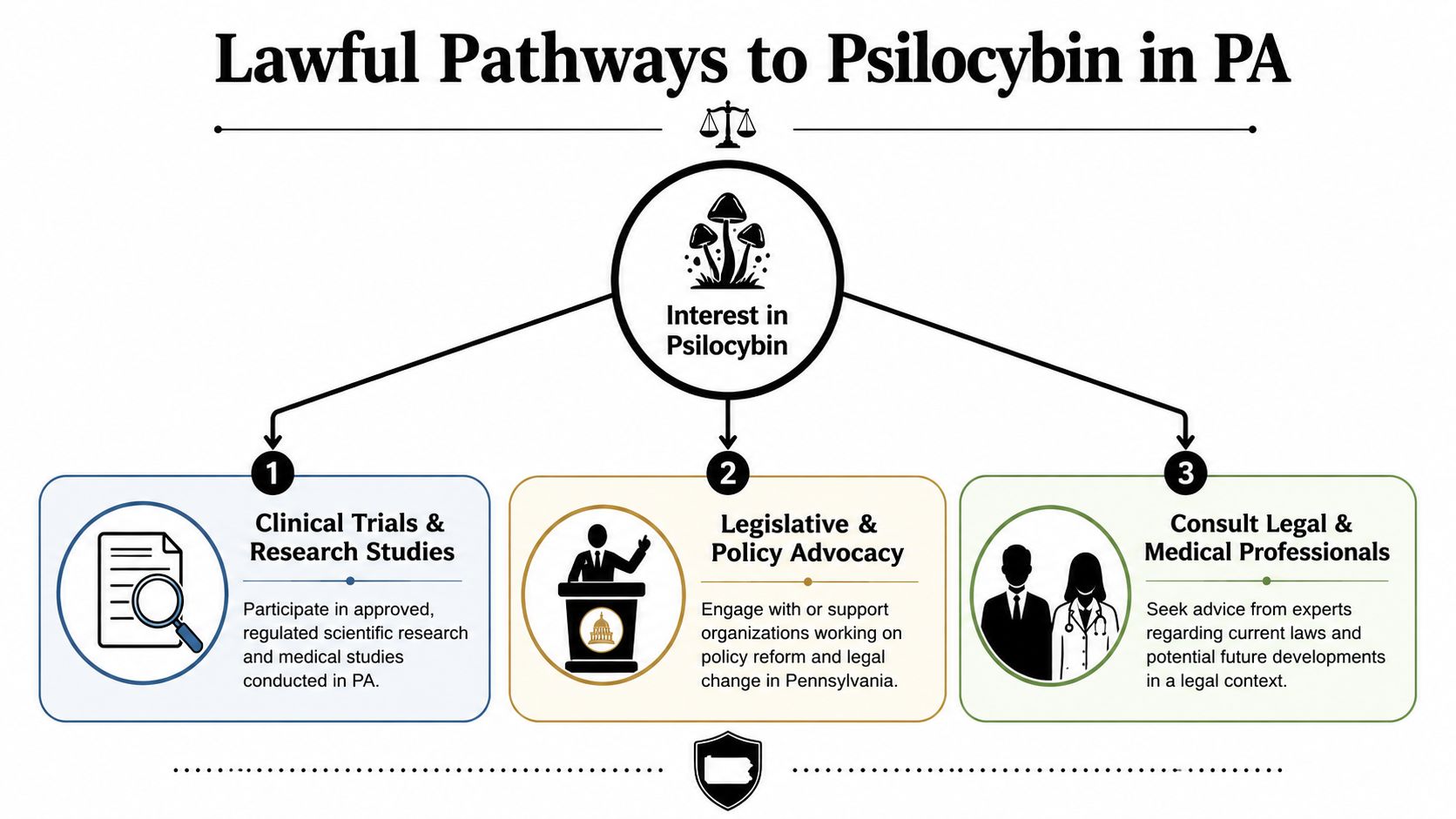
The lawful options that make sense
Research participation
The clearest lawful route is a legitimate study. Search established registries such as ClinicalTrials.gov for psilocybin-related trials connected to mental health conditions or palliative care. A real study has screening, consent forms, eligibility rules, and clinical oversight. That structure works like guardrails on a steep road. It does not remove all risk, but it reduces guesswork and keeps the process inside a formal system.
Policy engagement
Some readers are less interested in personal access and more interested in reform. That path is lawful too. You can track Pennsylvania bills, read committee activity, contact your state representatives, and support education around research standards, patient protections, and public health questions. If laws change, they usually change this way. Slowly, in public, and in writing.
Professional consultation
Licensed therapists, physicians, and attorneys cannot make illegal access legal. They can help you sort out what is available, what is still experimental, and where people often get confused. That is especially useful if you are trying to separate three very different ideas: underground use, supervised research, and future regulated treatment models.
For a plain-language overview of the clinical model people are usually referring to, Metro Mush has a helpful explainer on what psychedelic therapy is.
What lawful access does not mean
Lawful pathways in Pennsylvania do not currently amount to a storefront, a broad medical program, or a list of approved local providers offering psilocybin on demand. Readers often expect something like a cannabis dispensary framework. Psilocybin is not there.
That gap causes confusion because the word "legal" gets used loosely online. In this context, lawful usually means one of three things: approved research, legal discussion and education, or participation in the political process. Keeping those buckets separate will help you avoid expensive mistakes and false hope.
The slower route is frustrating. It is also the route that keeps legal risk lower and decision-making clearer.
Understanding Cross-State Travel Risks
One of the most dangerous misunderstandings around magic mushrooms in PA is the idea that another state's approach somehow travels with you. It doesn't.
If psilocybin is illegal where you are entering, crossing into Pennsylvania with it can create serious risk. That's true even if the place you came from has a more permissive policy culture, lower enforcement priority, or a local decriminalization measure.
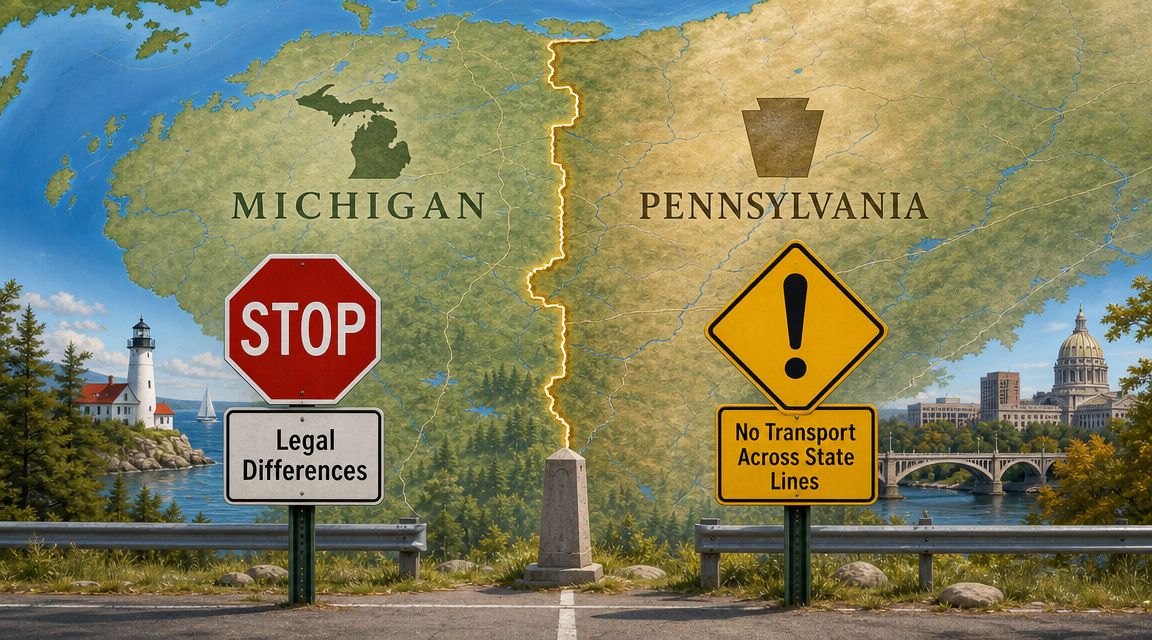
Why border crossing changes the stakes
Interstate transport introduces a federal layer on top of state law. That means the trip itself can become part of the problem, not just the possession.
People near neighboring states often reason by analogy. They think, "If a product is treated more casually there, bringing a small amount home won't matter much." That's exactly the kind of shortcut that can produce life-changing legal trouble.
The safest rule for travelers
Don't transport psilocybin across state lines into Pennsylvania. Don't assume packaging, discretion, or personal-use intent changes the legal analysis enough to make it safe.
If you're comparing regional laws, it's better to read about them than act on a half-understood version of them. For example, people who are sorting out nearby state differences often start with guides like this one on magic mushrooms in New Jersey, but research is not a travel defense. It only helps you avoid confusion.
If another state changed its local approach, that still doesn't give you permission to carry psilocybin into Pennsylvania.
Frequently Asked Questions About Magic Mushrooms in PA
By this point, most readers don't need more theory. They need straight answers.
One reason the topic is so tricky is that potency, legality, and product form all get mixed together. On the science side, a recent study reported average psilocybin content of 9.913 mg/g in Psilocybe fruiting bodies versus 0.041 mg/g in mycelia, a roughly 240-fold difference, which shows why untested material can be so unpredictable according to this compositional study on psilocybin content in different fungal tissues.
FAQ on psilocybin in Pennsylvania
| Question | Answer |
|---|---|
| Are magic mushrooms legal in Pennsylvania? | No. Recreational possession and use are not legal in Pennsylvania. |
| Does a proposed bill mean psilocybin is now allowed? | No. A proposed bill signals policy interest, not current retail legality or personal-use permission. |
| Is research access the same as legalization? | No. Research frameworks are controlled and limited. They don't create a general consumer market. |
| Why is dosing so inconsistent with raw mushrooms? | Potency can vary sharply by material type and processing conditions. Untested mushrooms are not reliable for consistent dosing. |
| Do other states' laws protect me in Pennsylvania? | No. Once you're in Pennsylvania, Pennsylvania law and federal law still matter. |
| Are spores, cultivation, and possession all the same legal issue? | No. They are related, but legally distinct questions. If you need certainty on a specific fact pattern, get legal advice rather than relying on broad internet summaries. |
The questions people still hesitate to ask
Some readers are really asking whether there is a "small amount" exception in practice. Others want to know if therapeutic intent changes the answer. It doesn't create a personal-use exemption.
Others ask why psilocybin isn't treated like cannabis in places where public attitudes have shifted. The short answer is that different substances move through different legal, political, and medical pathways. Similar public conversation doesn't produce identical legal outcomes.
A final plain-language takeaway
If you remember only three things, make them these:
- Personal recreational use is not legally protected in Pennsylvania
- Research headlines are not the same as legalization
- Untested mushroom products can be chemically and legally unpredictable
If you want to keep learning without relying on rumors, Metro Mush publishes plain-language educational content on psilocybin topics, harm reduction, and state-by-state legal differences. That's a practical starting point if you're trying to separate curiosity, policy changes, and real-world legal risk.