
In a 2025 Portland study, 100% of the 12 magic mushroom edibles tested contained neither psilocybin nor muscimol, and related products were associated with 180 emergency cases across 34 U.S. states during 2024. Those products contained undisclosed active ingredients instead, so the main danger isn't only mold on a mushroom. It may be a product that never contained the mushroom compound you expected.
You may be holding a chocolate bar or gummy that looks polished, sealed, and professionally branded. The package might show colorful mushrooms, promise a relaxing experience, or use language that sounds scientific. None of that confirms the species, dose, purity, or identity of the active ingredients.
For adult consumers, magic mushroom contamination includes biological contamination such as bacteria and mold, but it also includes mislabeling, chemical residues, and undisclosed psychoactive substances. A safe decision starts with understanding all of those risks, not just looking for fuzzy growth.
The Hidden Risks in Your Magic Mushroom Products
A customer walks into a smoke shop, sees a package labeled “magic mushroom gummies,” and reasonably assumes the product contains a mushroom-derived compound. That assumption failed in every sample examined in a 2025 Oregon State University study. Researchers purchased 12 gummies and chocolate products marketed as magic mushroom products from smoke shops and convenience stores in Portland, Oregon. Laboratory testing detected no psilocybin and no muscimol in any of them. Instead, researchers found undisclosed ingredients that included caffeine, hemp-derived botanical extracts, kava, and synthetic psychedelic chemicals they called “syndelics” (Oregon State University's study summary).
That means the label may describe a marketing category, not verified mushroom content. A chocolate can look like a mushroom product while containing no psilocybin, no Amanita muscaria compound, or any identifiable mushroom-derived active ingredient. It can still contain substances that affect the heart, nervous system, mood, or digestion.
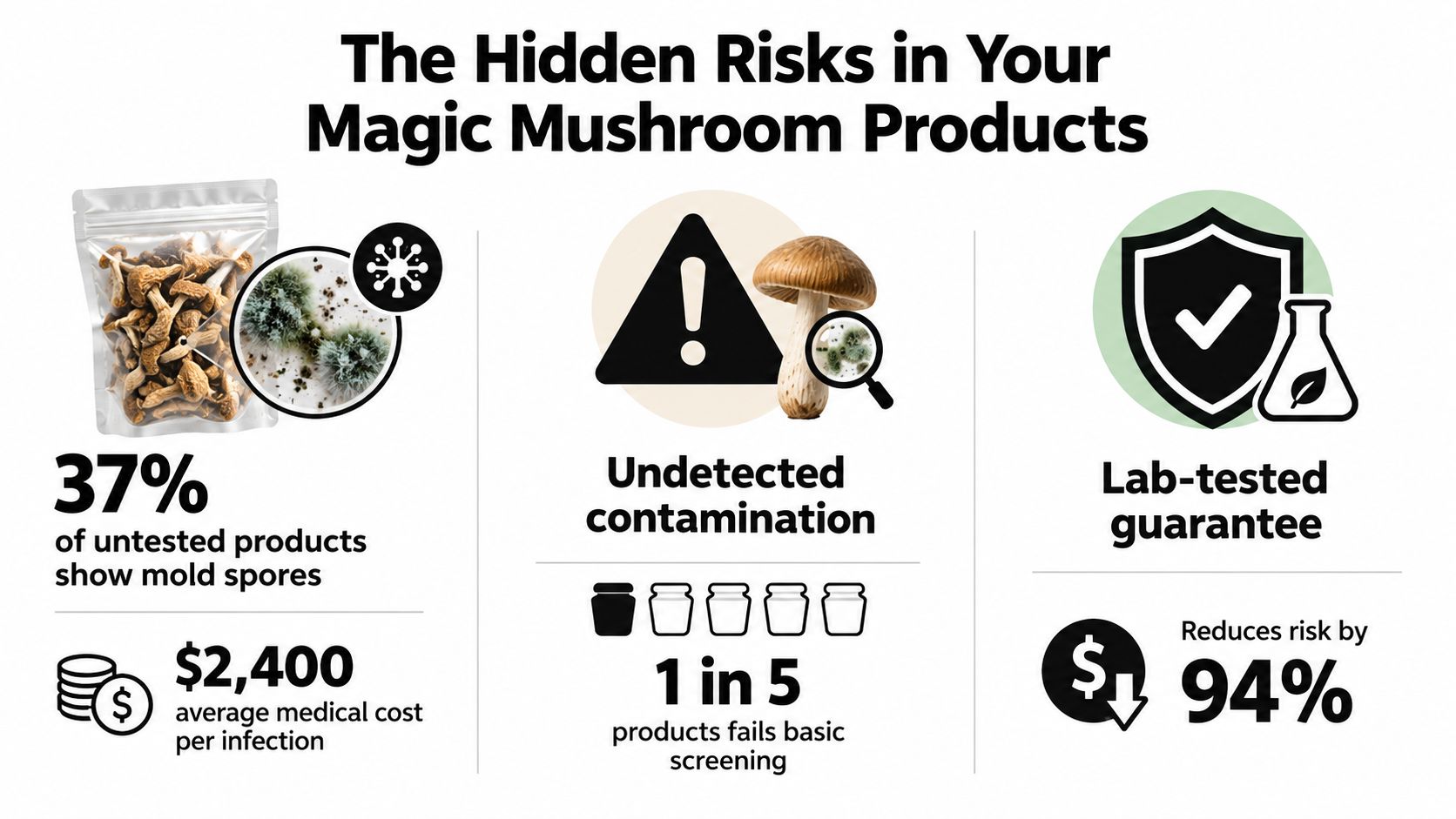
The public-health consequences are also documented. During 2024, related products were associated with 180 emergency cases across 34 U.S. states, including 73 hospitalizations and three deaths, according to the same Oregon State University report. The study sample was geographically limited and small, so it shouldn't be treated as a measurement of every product on every market. It does, however, show why attractive packaging and a familiar product format can't substitute for testing.
Contamination means more than mold
Consumers often ask whether a mushroom is “clean” by checking for mold. That matters, but it addresses only one part of the problem. A product can be free of visible mold and still contain a synthetic psychedelic, a stimulant, a cannabinoid, a solvent residue, or a compound that wasn't disclosed on the label.
The practical question isn't just, "Does this look like a mushroom?" It is, "Can the seller demonstrate what this product contains and what it doesn't contain?" Without that evidence, you can't reliably infer identity or dose from color, flavor, branding, or a mushroom illustration.
Practical rule: Treat an untested mushroom label as a claim to verify, not proof of contents.
The safest response isn't panic or judgment. It's caution. Don't assume that a familiar gummy format carries the same risks as a tested dried mushroom product, and don't assume that a negative reaction means the product was harmless. Unknown ingredients can produce effects that are delayed, unexpected, or difficult for clinicians to identify.
Understanding Common Contaminants in Psilocybin Products
Contamination falls into several groups, and each group requires a different testing approach. Biological hazards include pathogenic bacteria such as Escherichia coli and Salmonella, along with yeasts and molds. Chemical hazards include mycotoxins, pesticides, heavy metals, and residual solvents (overview of contamination hazards in psilocybin mushrooms).
The distinction matters because consumers can see only a small portion of what a product contains. A fuzzy patch may be visible. Heavy metals, pesticide residues, and many microbial hazards aren't visible at all.
Biological contamination
Mushrooms and mushroom ingredients can encounter contamination during spawning, casing, harvesting, drying, or storage. Poor sanitation can introduce bacteria. Excess moisture can encourage mold. Inadequate drying or damaged packaging can allow moisture-driven deterioration after harvest.
Mold also creates a second concern beyond its visible growth. Some molds, including Aspergillus and Penicillium, can produce mycotoxins. Many mycotoxins remain chemically stable through food processing, so turning contaminated material into a chocolate or gummy doesn't necessarily remove the hazard.
Chemical and physical contamination
Chemical contamination can enter through the growing environment, agricultural inputs, processing equipment, or formulation. Pesticides and heavy metals may come from raw materials or environmental exposure. Residual solvents can remain after extraction or manufacturing if the process isn't controlled and verified.
Physical contamination includes unwanted material introduced during harvesting, processing, packaging, or handling. A sealed package may protect the product after filling, but it doesn't prove that the production environment was clean before sealing.
The overlooked category
The most serious confusion involves undisclosed psychoactive compounds. A product may contain caffeine, kava, hemp-derived extracts, cannabinoids, or synthetic psychedelic chemicals while using mushroom imagery to shape the buyer's expectations. That creates a dosing problem and a medical problem because the consumer may tell a clinician they used mushrooms when the product contained something else.
A 2025 analysis of products purchased from Portland smoke and vape shops found several undisclosed compounds, including psilocin, a synthetic tryptamine, and delta-9 THC in a product marketed as a nootropic. Products claiming to contain Amanita muscaria didn't contain its expected active compounds, according to the study's published record (published analytical study of commercial mushroom products).
A consumer test that checks only for psilocybin can therefore produce false reassurance. A negative psilocybin result doesn't prove that a product is safe. It may mean the product contains a different active ingredient.
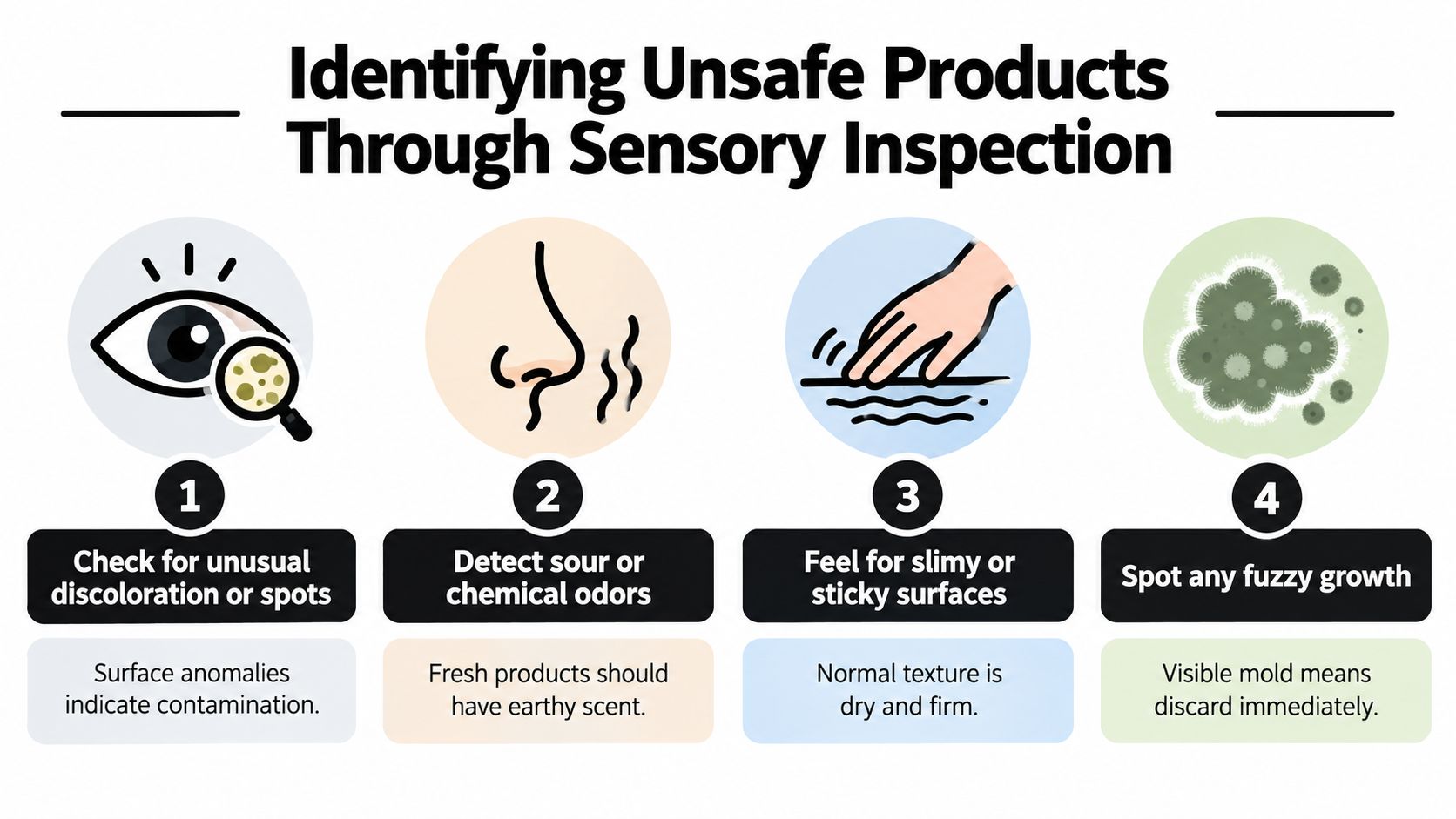
Identifying Unsafe Products Through Sensory Inspection
Sensory inspection is useful for rejecting obviously compromised material, but it can't verify a product's identity or chemical profile. Use it as a first filter, not as a substitute for laboratory analysis.
Start with the package. Look for broken seals, moisture inside the container, damaged wrapping, or evidence that the product was stored in heat or humidity. A compromised package deserves extra caution because water and handling can create conditions for microbial growth.
Check the material without tasting it
Look for unusual discoloration, wet spots, fuzzy growth, slimy surfaces, or a texture that doesn't match the product type. Dried mushrooms should not appear wet or sticky. A chocolate or gummy may have normal surface variation from ingredients, but unexplained spotting, leakage, or moisture still warrants quarantine.
Smell the product carefully without putting it in your mouth. Strong sour, rotten, fermented, or chemical odors are warning signs. Don't taste a small piece “to see what happens,” because taste can't identify a compound and even a small amount of an unknown substance can produce effects.
If you see visible mold, don't trim around it or blend the rest into another batch. The safe action is to isolate the product and avoid consuming it. Contaminants can extend beyond the area you can see.
For storage guidance, review this practical resource on the best way to store shrooms, especially if you're handling dried material at home. Storage can reduce moisture-related problems, but good storage won't correct an inaccurate label or remove an undisclosed chemical.
A clean appearance tells you only that you didn't see a problem. It doesn't tell you that no problem is present.
Why Unregulated Products Pose a Greater Threat
The central difference between a regulated or accountable seller and an unregulated source is traceability. A responsible supplier should be able to identify where a batch came from, how it was processed, what tests were performed, and which results apply to the finished product. An unregulated seller may offer nothing beyond a package claim.
An international example shows why that gap matters. A Chilean Institute of Public Health analysis of seized hallucinogenic mushrooms collected from 2020 through 2022 found psilocybin combined with other substances. The most frequently observed combination was psilocybin plus THC, recorded 42 times, while psilocybin plus cocaine was recorded 22 times. Investigators also identified caffeine and ketamine among the principal adulterants, and a substantial number of seized mushrooms showed no detectable psilocybin (Chilean Institute of Public Health analysis).
Those findings don't establish a contamination rate for products in the United States. They do demonstrate two different risks: a genuine mushroom product can be mixed with another psychoactive drug, or material sold as a magic mushroom can contain no psilocybin at all.
What accountability should look like
| Question | Unregulated product | Accountable seller |
|---|---|---|
| Identity | Often based on packaging or seller description | Supported by documented sourcing and analysis |
| Active ingredients | May be undisclosed | Listed with relevant potency information |
| Contaminants | Unknown unless tested independently | Addressed through batch testing |
| Traceability | Limited or absent | Connected to a specific production or processing lot |
| Response to a problem | Difficult to investigate | Seller can isolate affected inventory and review records |
A licensed or otherwise accountable operation isn't automatically perfect, and local rules differ. The important standard is whether the seller can answer practical questions without becoming defensive: Who produced this batch? What exactly was tested? Was the finished edible tested, or only the raw mushroom material? Can the seller show a report that matches the lot in your hand?
Ask for the batch story: If a seller can't connect the product to testing and production records, you can't evaluate the claim with confidence.
In Detroit and Ann Arbor, consumers should apply the same standard they would use for any ingestible product. Convenience and low price don't compensate for unknown ingredients. A vendor that prioritizes documentation, proper handling, and clear communication gives you information that a smoke-shop package alone can't provide.
The Critical Role of Laboratory Testing and Verification
Laboratory testing answers questions that sight, smell, and packaging cannot. A useful program should examine identity, active compounds, adulterants, microbial contamination, and chemical contaminants. The exact panel depends on the product, but testing only for psilocybin is too narrow for a market where products may contain synthetic tryptamines, cannabinoids, stimulants, or toxic botanicals.
Oregon's psilocybin-product rules illustrate how detailed microbial controls can become. They specify aseptic sampling, total-coliform testing, follow-up E. coli analysis when fecal coliforms are detected, and batch failure when E. coli exceeds 100 colony-forming units per gram. The rules also allow testing for aflatoxins and other harmful mycotoxins (Oregon laboratory testing procedure).
A separate analytical study of homogenized Psilocybe cubensis biomass reported microbial loads below 10,000 CFU/g for total coliforms and 100,000 CFU/g for yeast and mold, with mycotoxins below 20 micrograms per kilogram in the tested specimens. Those are benchmarks from specific research or regulatory contexts, not universal limits for every mushroom chocolate, drink, gummy, or finished edible.
The finished product is what matters
Testing raw mushroom material doesn't automatically validate a chocolate bar or drink. Ingredients, water activity, heating, cooling, filling, and post-process handling can change the contamination profile. A credible program should test representative samples from the finished lot, preserve chain-of-custody records, and retest after meaningful formulation or packaging changes.
The chemistry panel should also match the market's actual risks. A credible screen may need to look for:
- Mushroom identity: Whether the expected species or material is present.
- Target compounds: Psilocybin, psilocin, or muscimol when those compounds are claimed.
- Synthetic adulterants: Emerging tryptamines and other psychoactive chemicals.
- Unexpected drugs: Cannabinoids, stimulants, and compounds such as ketamine when relevant.
- Environmental hazards: Heavy metals, pesticides, residual solvents, and mycotoxins.
- Microbial hazards: Total microbial loads, indicator organisms, yeasts, and molds.
A report should identify the tested lot and the methods used. It shouldn't be a generic certificate copied onto every product. Consumers who want more practical guidance can also review how to spot fake mushroom products, while remembering that consumer inspection can't replace accredited laboratory analysis.
What to Do If You Suspect Product Contamination
Stop using the product first. Don't take another dose to confirm that the reaction came from the product, and don't combine it with alcohol, cannabis, prescription medicines, or supplements while you're trying to understand what happened.
Preserve evidence. Keep the package, label, batch information, remaining product, and photographs. The Ontario Poison Centre also advises retaining remaining mushroom material or emesis when possible for assessment, while obtaining a detailed exposure history (Ontario Poison Centre mushroom guidance).
Write down the information a clinician or poison specialist will need:
- Product details: Brand, product type, package claims, lot information, and where you obtained it.
- Exposure details: Approximate amount, time taken, and whether the material was swallowed or combined with another product.
- Co-use: Alcohol, cannabis, medicines, supplements, or other substances used around the same time.
- Symptoms: What started first, how symptoms changed, and whether they appeared immediately or after a delay.
Contact local poison-control services or emergency services if you develop severe confusion, persistent vomiting, chest pain, seizures, breathing problems, or jaundice. Don't drive yourself if you're impaired or confused.
Delayed symptoms deserve attention even if the first part of the experience seemed manageable. The Ontario Poison Centre notes that delayed symptoms after mushroom ingestion warrant liver-enzyme testing because poisonous and non-poisonous mushrooms can grow near one another. Tell clinicians exactly what the package claimed and what you consumed, but make clear that the label may be unreliable.
Preserve the package, not just your memory. A label, leftover material, photograph, and timeline can help professionals assess an unknown exposure.
Don't throw away the remaining product before speaking with poison-control staff if they may need it. Avoid handling or opening visibly moldy material unnecessarily, and keep it away from children, pets, and anyone else who might consume it.
Making Safer Choices at Your Local Dispensary
A safer purchase begins with questions, not assumptions. Ask whether the seller can connect the product to a specific batch, whether the finished edible was tested, and whether testing covers both expected compounds and unexpected contaminants. If the answer is vague, treat that uncertainty as meaningful.
Look for practical signs of responsible handling:
- Clear product identity: The seller explains what the product is intended to contain and doesn't rely only on mushroom artwork.
- Lot-level records: Testing applies to the batch being sold, not an unrelated sample.
- Finished-product testing: The chocolate, drink, or gummy is assessed after formulation and packaging.
- Storage discipline: Products are protected from excess moisture, heat, and damaged packaging.
- Direct communication: Staff can explain what testing does and doesn't establish.
- A response plan: The business can identify and isolate a product if a concern emerges.
Metro Mush is a Detroit and Ann Arbor area option that offers dried mushroom products and edibles, including chocolate bars and drinks, while publishing information about contamination screening and product testing. Consumers should still ask which tests apply to the specific product and lot they're considering.
The most useful mindset is simple: don't confuse natural appearance with verified safety. A dried mushroom can carry biological contamination. A chocolate can contain an undisclosed active compound. A product with no visible mold can still be mislabeled, and a negative psilocybin result can still leave other hazards undiscovered.
For first-time or cautious consumers, choose information over impulse. Keep the package, follow storage instructions, avoid mixing substances, and start by verifying what the seller can document. Responsible purchasing doesn't eliminate every risk, but it makes unknowns easier to identify before they become a health problem.
Metro Mush offers dried mushroom products, chocolates, and drinks for adult customers in the Detroit and Ann Arbor areas, with online browsing and local ordering options. Visit Metro Mush to review available products, ask about testing and batch information, and choose with clearer information than an unverified smoke-shop label provides.