


Orally consumed mushrooms usually start working within 20–40 minutes, peak around 60–90 minutes, and remain active for about 4–6 hours, although residual effects can last longer. The full timeline depends on dose, food, potency, product form, and your own body.
You may be checking the clock after dinner, wondering whether you'll be ready to socialize later, sleep normally, or feel fully clear the next morning. The safest answer isn't a single end time. Think of the experience as a gradual wave, with an onset, a strongest period, a comedown, and a recovery window that can continue after the visuals and emotional intensity have eased.
How Long Shrooms Usually Last at a Glance
An early-evening dose can extend well beyond the moment when the strongest visuals fade. Noticeable changes may begin within 20–40 minutes, peak effects commonly appear around 60–90 minutes, and the main psychedelic experience often lasts about 4–6 hours. A broader public-health range places onset at 20–90 minutes and allows noticeable effects to continue for as long as 12 hours (clinical-practice review of psilocybin timing). Plan beyond the six-hour estimate, especially if you need to travel, socialize, work, or sleep on schedule.
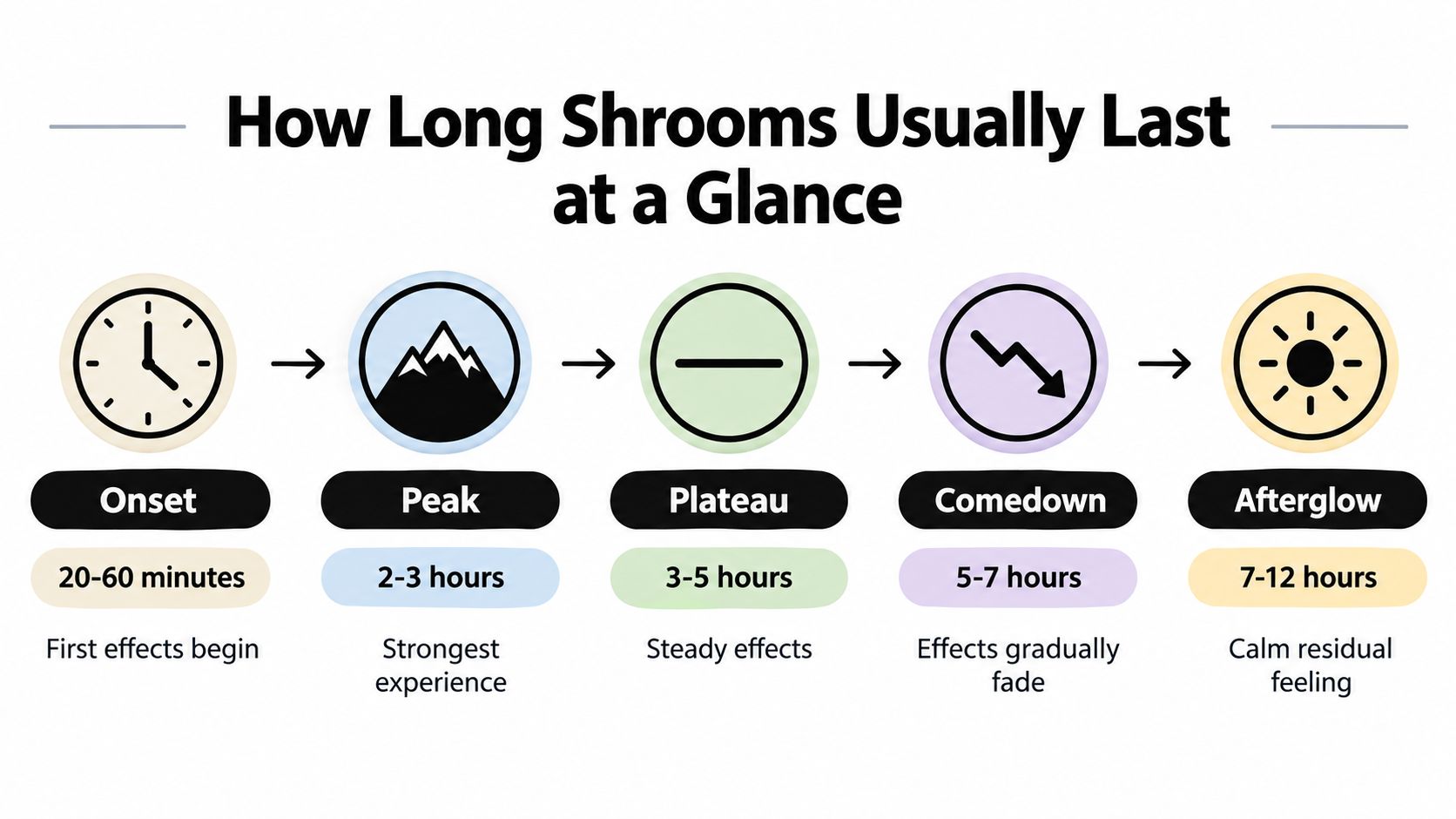
The end of the active window is gradual. Fatigue, stimulation, mood changes, difficulty sleeping, or impaired judgment can remain after perception feels close to normal. You may feel mostly sober while still feeling socially uncomfortable, mentally scattered, or unready to drive.
A practical clock-based anchor
- First hour: Effects may start, although digestion can delay them.
- Around the strongest period: Perception, thoughts, emotions, and time awareness may feel most altered.
- Several hours in: Intensity usually softens gradually instead of stopping at a precise moment.
- After the main effects: Tiredness, mood changes, or difficulty sleeping may continue.
Food, mushroom potency, metabolism, dose, and product form can shift this timeline. Fresh or dried mushrooms may feel different from chocolates or drinks, and individual responses vary. A fixed six-hour finish can therefore leave too little time before transportation, work, guests, or other responsibilities.
Practical rule: Reserve the full evening, plus recovery time, rather than scheduling around the strongest visual effects.
For basic preparation and timing, the guide to using magic mushrooms can sit alongside this timeline. The useful planning question includes sleep, social comfort, clear thinking, and readiness to drive, not only the point when the trip feels strongest.
Onset Peak Comedown and Afterglow Explained
The experience moves through distinct phases, and the transitions can be gradual enough that people misread where they are. A session is easier to plan when you track the full timeline, from the first noticeable changes to next-day readiness.

Onset
Early changes may involve body sensations, attention, mood, or visual sharpness. Stomach discomfort or nervous anticipation can appear before the psychedelic effects become clear. Colour, sound, and emotional sensitivity may then become more noticeable.
A quiet start does not show that the dose has failed. Food, formulation, digestion, and individual absorption can delay noticeable effects. Time may also feel unusual, so a short wait can seem much longer.
Peak
The strongest effects often arrive around 60–90 minutes after oral consumption, although timing varies between people. Perception may feel fluid, thoughts may take unexpected directions, and familiar surroundings can seem unusually intense or meaningful. This pattern is consistent with the psilocybin dose-response timeline.
Decision-making is often least reliable during this phase. Someone may feel ready to take more, leave the setting, or contact people who are not prepared for the situation. Once the experience intensifies, those choices can become harder to manage.
Comedown
The comedown usually involves a gradual reduction in visual changes and emotional intensity. Tiredness, reflection, sensitivity, or mental fog may remain. Some people feel calm and comfortable, while others feel drained and want quiet.
The end of the peak does not equal complete sobriety. Judgment and coordination may still be affected, so driving, cycling in traffic, swimming, operating equipment, or handling conflict creates avoidable risk.
Afterglow and recovery
Some people notice a pleasant afterglow. Others mainly experience exhaustion, headache, lingering anxiety, nausea, or difficulty sleeping. The next-day experience can depend on session intensity, rest, hydration, food, emotional state, and whether other substances were involved.
Remember: Feeling less altered does not guarantee readiness for every normal responsibility.
A calm room, familiar people, low demands, and time to rest can make the transition easier. If the experience becomes uncomfortable, reduce stimulation and stay with a trusted sober person rather than trying to force it to end. Feeling socially comfortable, thinking clearly, sleeping well, and being ready to drive are separate milestones, and they may not arrive together.
How Dose Size Changes Your Trip Length
Dose affects more than intensity. A smaller amount may bring subtle changes and a shorter-feeling session, while a stronger amount can create a more immersive experience, a heavier comedown, and greater disruption to sleep. Potency and personal sensitivity still shape the result, so the same measured amount may not feel identical from one session to another.
Use three separate markers when planning: amount, intensity, and recovery demand. A lower-intensity experience can leave someone emotionally or mentally altered after the clearest effects fade. A stronger experience may require a longer quiet period before conversation, social plans, or ordinary responsibilities feel manageable.
| Dose or Product | Usual Onset | Active Window | Aftereffects Note |
|---|---|---|---|
| Lower amount of dried mushrooms | Often within the usual oral onset range, though food and digestion can delay it | May feel shorter or less intense, but timing is not guaranteed | Mild fatigue or changed mood can remain |
| Moderate amount of dried mushrooms | Often develops progressively rather than all at once | Commonly follows the broader 4–6-hour active pattern, with individual variation (clinical timing review) | Allow time for judgment and comfort to return gradually |
| Higher amount of dried mushrooms | May continue building after early effects appear | Can feel longer and more demanding, even as concentration declines | Sleep, energy, and emotional steadiness may take longer to normalize |
| Chocolate, drink, or other formulated product | Timing depends on the product, serving, food, and speed of consumption | Harder to estimate if the serving is uneven or delayed | A familiar label does not guarantee a familiar timeline |
This table is a planning guide, not a dosing chart. Mushroom potency can vary between varieties, batches, and preparations. A small measured amount of a potent variety may feel more intense than a larger amount of a less potent product. Homemade or divided edibles may also distribute active material unevenly.
Match the plan to the experience
A cautious first-time consumer should avoid scheduling important plans around the shortest expected timeline. Experienced users also need room for variation, particularly when potency, product form, setting, or personal circumstances have changed.
For variety-specific discussion, see Golden Teacher mushroom dosage. Treat product guidance as context rather than a promise about your own response.
Plan for the active effects, the comedown, rest, and a buffer if the experience runs later than expected. No amount guarantees a specific number of hours.
Dried Mushrooms Chocolates and Drinks Compared
Product form affects how quickly the experience becomes noticeable and how simple it is to gauge the dose. Dried mushrooms are usually easier to recognize as a physical substance, while chocolates and beverages can make that portion seem more ordinary.
With dried mushrooms, stomach contents can change the early timeline. A full stomach may delay the first noticeable effects, while an empty stomach may make onset feel quicker. Neither situation guarantees a shorter or longer overall experience, because absorption and subjective response still vary.
Chocolate adds its own context. Sugar, fat, the size of each piece, and whether the bar is divided evenly can influence how the serving is consumed and perceived. A person may eat one piece, feel little, then add another before the first serving has fully developed. That can turn uncertainty about onset into an unexpectedly intense session.
Drinks can encourage faster consumption, which may make the beginning feel more obvious. They can also be easier to sip gradually, creating uncertainty about when the effective serving was consumed. Labels may describe the total product rather than what one person will experience from each sip.
Read the product before the clock
Before using any formulated product, check:
- Serving information: Know whether the label describes the entire bar, container, or individual portion.
- Ingredients and formulation: A product containing other psychoactive ingredients can make impairment and duration less predictable.
- Portion consistency: Don't assume every homemade or hand-divided piece contains the same amount.
- Consumption time: Note when you started and when you finished, especially with a drink consumed gradually.
Products such as magic mushroom chocolate bars can be convenient to portion, but convenience doesn't eliminate uncertainty about onset or strength. Start with a conservative approach, avoid stacking servings during the early waiting period, and keep the rest of the evening clear.
The safest comparison is not “which format lasts the shortest?” It's “which format lets me understand what I consumed and give it enough time to develop?” If the answer isn't clear, assume the timeline may be less predictable.
Why Your Timeline Can Feel Different From Others
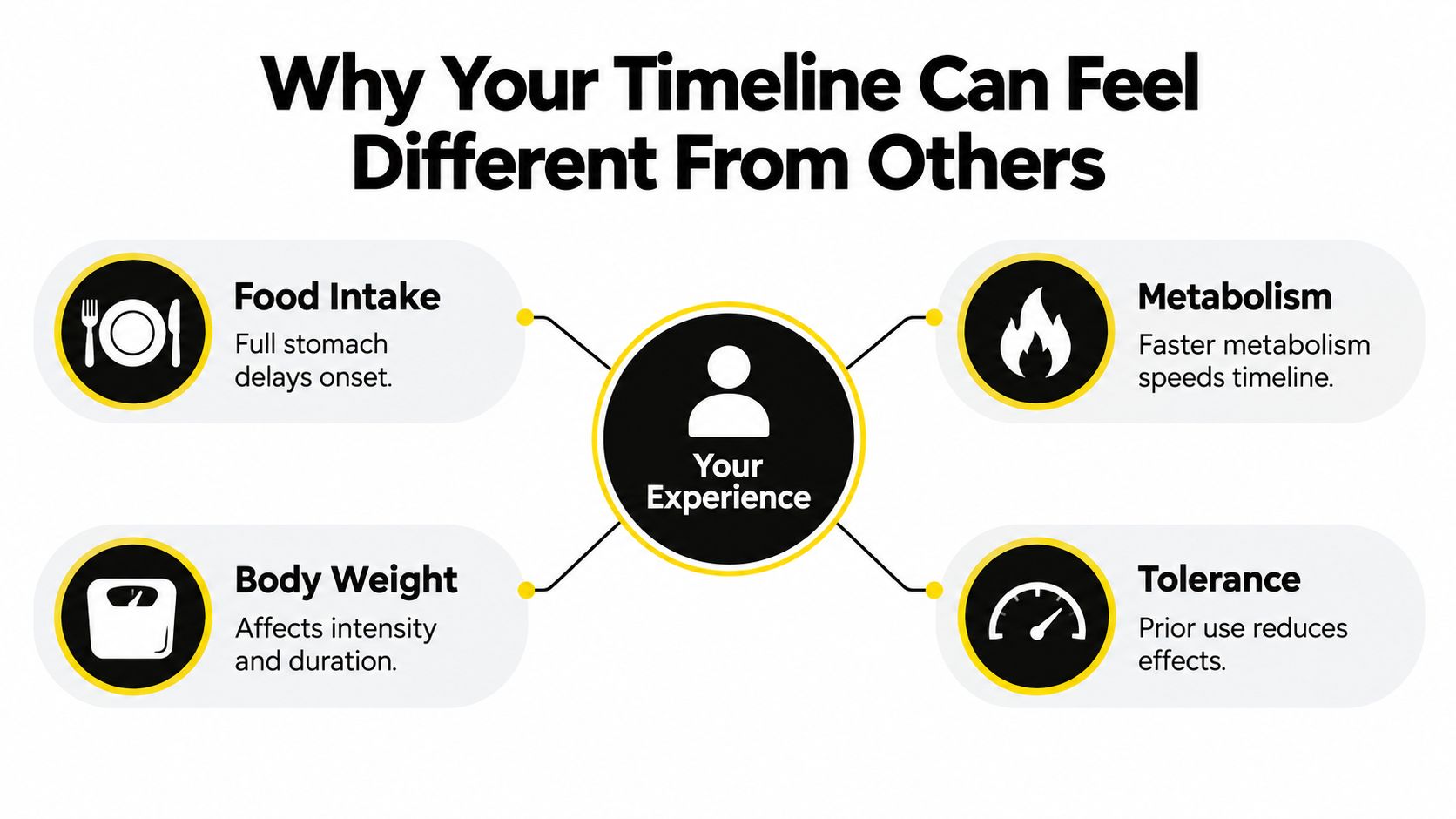
Two people can consume similar-looking amounts and still experience different timelines. The difference may come from digestion, metabolism, potency, prior use, medication, expectations, or the setting. These variables don't combine into a reliable personal formula, so they're better used as reasons for caution than as tools for calculating an exact finish time.
Food changes the starting point
Food can delay absorption and make the onset feel less obvious. That delay often creates the temptation to take more, even though the original serving may still be developing. The important distinction is that a slower beginning doesn't necessarily mean the experience will be weak or brief.
Metabolism changes exposure
After oral use, psilocybin is converted into psilocin, the principal psychoactive compound. Research reports that psilocin reaches maximum plasma concentrations at roughly 1.8–4 hours, while reported elimination half-lives range from about 1.5–4.8 hours (clinical pharmacokinetic review). Those measurements describe drug concentration, not a guaranteed period of noticeable intoxication.
The body processes psilocin through an early distribution phase followed by slower elimination. Receptor effects and psychological aftereffects can continue while concentrations decline, which helps explain why the experience fades gradually rather than stopping at a precise time.
Potency and tolerance complicate comparisons
Mushrooms can differ in potency, and a named variety doesn't remove batch-to-batch variation. Prior psychedelic use may also alter the subjective response, but tolerance isn't a dependable way to predict how long a particular session will feel.
Body size alone shouldn't be treated as a simple duration calculator. Liver enzyme activity, concurrent medications, individual sensitivity, and overall health can affect exposure. Alcohol and other psychoactive drugs add another layer of unpredictability and can make impairment harder to judge.
Planning insight: Other people's timelines are examples, not a schedule for your own body.
Write down what you consumed, when you consumed it, whether you had eaten, and what other substances were present. That record can help you notice patterns over time, but it still can't turn a variable experience into an exact appointment.
What Body Processing Means for Redosing and Patience
Psilocybin does not remain at one level before disappearing. After ingestion, the body quickly converts it into psilocin, which rises and falls in the bloodstream while the brain and body continue responding. That movement helps explain why a session can still build after the first signs appear, then fade gradually rather than ending at a precise moment.
A clinical study found that unconjugated psilocin reached maximum plasma concentration after a mean of approximately 2 hours. Its elimination half-life was about 1.8 hours, with a reported range of 1.1–2.2 hours (human psilocin pharmacokinetic data). These figures describe concentration in the blood, not a guaranteed period of noticeable intoxication.
Why early redosing can surprise you
Suppose little has happened during the first part of the evening. Food, digestion, or the product's form may have slowed the onset, while the first serving is still moving toward its strongest effects. Adding more during that rising phase can stack the doses together.
The result may be a stronger or longer session than intended, even if the first serving would have become effective on its own. Early uncertainty is therefore a poor guide to whether more is needed.
Half-life also requires careful interpretation. It describes how quickly concentration declines, while subjective effects and aftereffects may follow a different timetable. Earlier research cited in a dosing review reported a psilocin half-life of about 50 minutes. Newer measurements using a 25-milligram psilocybin dose found approximately 108 minutes, with a range of 66–132 minutes. Differences may reflect dose, formulation, measurement methods, and individual physiology.
A calmer timing routine
- Record the start time. Note when you began consuming a drink or edible, rather than only when you finished it.
- Wait through the early uncertainty. The first part of the experience does not show the full direction of the session.
- Keep the setting steady. Lower noise and bright stimulation, and avoid unnecessary travel while effects are developing.
- Avoid mixing substances. Alcohol and other psychoactive drugs can make duration and impairment harder to judge.
- Let the session resolve. Build the comedown and recovery period into your evening plan from the start.
Patience cannot make the timeline exact. It can reduce the avoidable risk of adding more while the first dose is still taking effect.
Planning a Safe Evening and Handling a Long Night
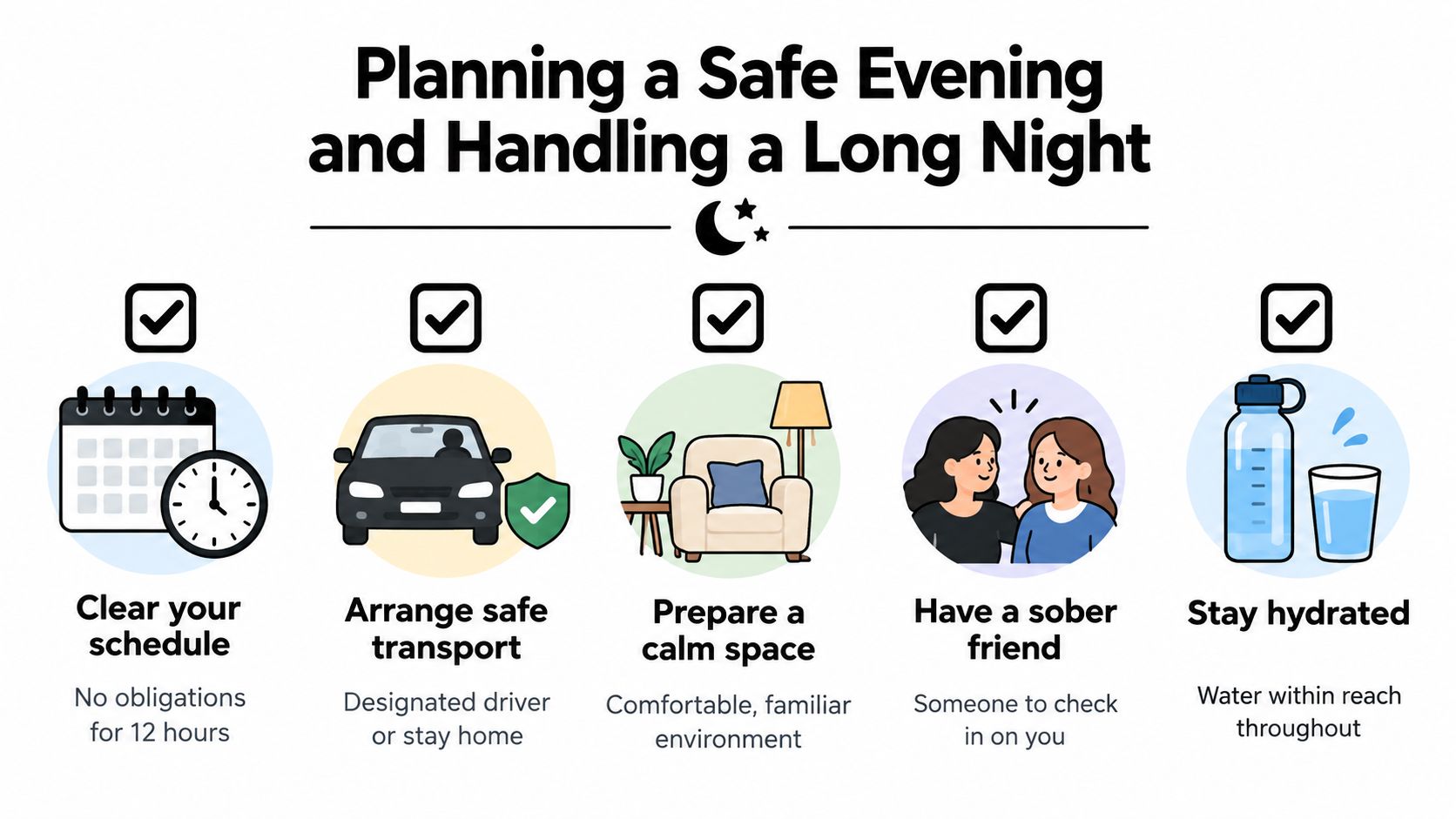
A safe evening starts before the first effects appear. Plan around roughly 4–6 hours of main effects, while remembering that noticeable changes can continue beyond that window (psilocybin duration review). Leave transportation, work, important responsibilities, and difficult conversations off the schedule. Do not drive or operate machinery until you are fully rested, clear-headed, and confident that your judgment and coordination have returned.
Build a low-pressure setting
Keep water, comfortable clothing, and a familiar room available. A sober person should know what was taken and when, especially if this is your first experience or the dose is uncertain. Reduce noise and bright stimulation if anxiety rises. Avoid alcohol and other drugs, since mixing can make impairment and timing harder to judge.
The practical timeline includes more than the strongest perceptual effects. Anxiety, confusion, nausea, tiredness, or difficulty sleeping may continue during the comedown and recovery period. Mild symptoms that are improving can be observed in a calm setting, but worsening or dangerous symptoms need prompt attention.
Know when the situation needs urgent help
Seek urgent medical assistance for chest pain, seizures, severe agitation, dangerous behavior, loss of consciousness, or suspected poisoning. Stay with anyone who may harm themselves or others, and tell emergency responders what was consumed and when, if that information is available.
A survey of 9,233 past-year magic-mushroom users found that 19 people, or 0.2%, reported seeking emergency medical treatment, corresponding to an estimated risk of 0.06% per use event. All but one returned to normal within 24 hours, and everyone recovered within seven days (survey of emergency medical treatment after mushroom use). These figures describe that survey and should not be used to dismiss severe symptoms.
If you are still impaired, distressed, or unable to judge your condition, prioritize supervision and medical advice over waiting alone. The goal is to reach a clear-headed, rested state before driving, making important decisions, or returning to normal responsibilities.
Metro Mush offers adult consumers in the Detroit and Ann Arbor areas dried mushrooms, chocolates, and drinks, with online browsing, local ordering, and product information. Visit Metro Mush to review available formats and consider questions about serving details, onset, and recovery time before ordering.