

You're standing at the kitchen counter with a baggie, a chocolate bar, or a jar of dried pieces, trying to answer the question nobody answers cleanly: how much should I take? The bad habit is to treat mushroom weight like the dose itself. The smarter move is to treat measured psilocybin content as the number you should use and mushroom mass as a rough, often misleading proxy.
That shift matters because two mushrooms that look similar can hit very differently. Potency varies across strain, batch, flush, and even individual fruiting bodies, so a name on a label or a tidy gram count can create false confidence. If you want a dose that makes sense, you need to think in terms of active-compound exposure, not folklore.
Before You Weigh a Single Gram
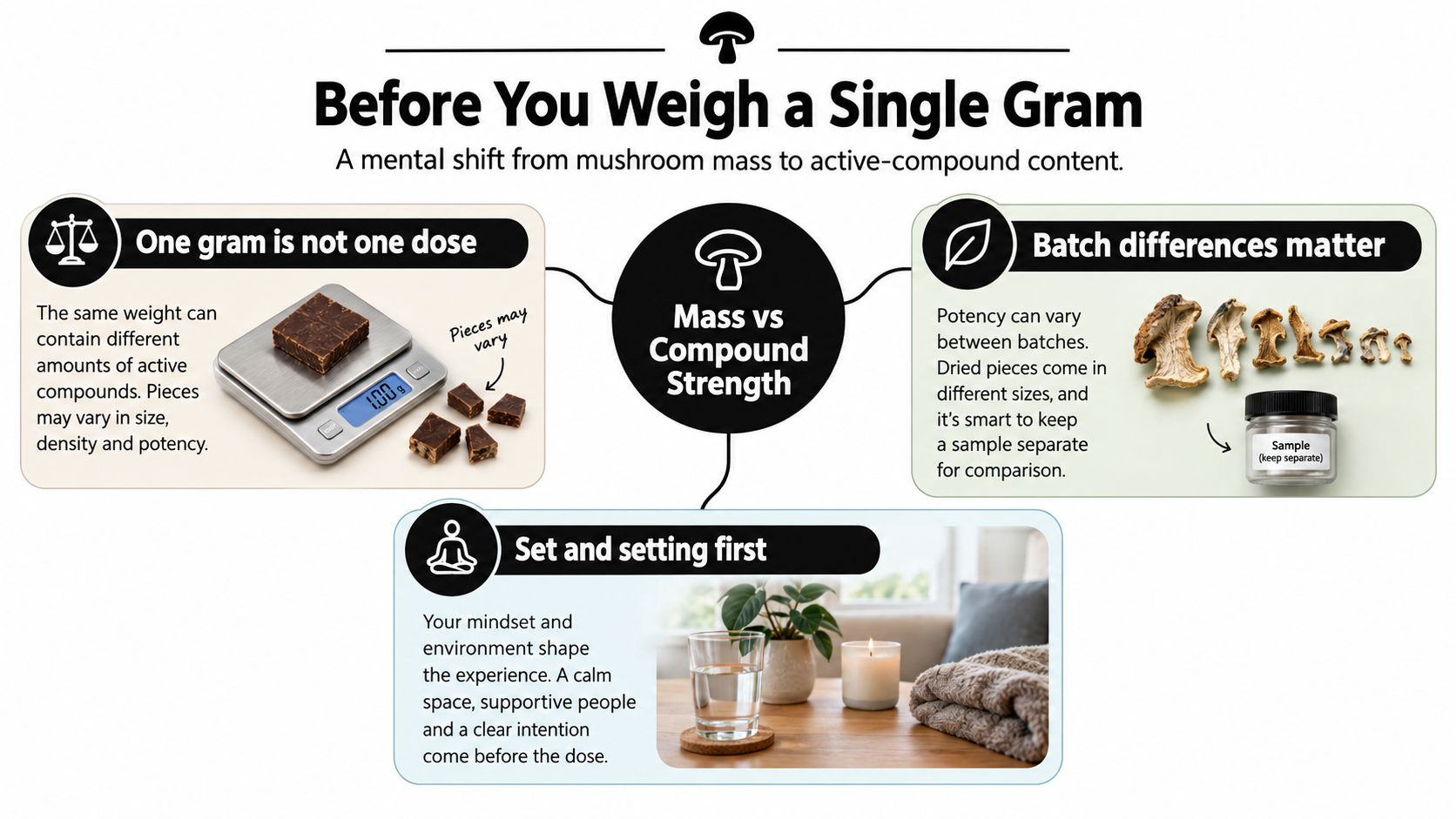
You've got dried pieces on the counter and a scale in your hand. Good. Now ignore the urge to treat that gram number like the dose. Mushroom mass is only the weight of plant material. It does not tell you the psilocybin content, and a strain name on a label does not make it predictable.
What you should verify first
Start with the product's laboratory result. If there is no independent potency test, treat the dose as uncertain. If it's a chocolate, capsule, or drink, find out whether the active ingredient was measured in the finished product or just estimated from the mushrooms that went into it.
That matters because variation is not a small technical detail. A controlled analysis of 14 cultivated Psilocybe cubensis strains found total tryptamine concentrations ranging from 2.62 to 20.65 milligrams per gram of dried mushroom, a difference of more than 7.8-fold, with within-strain coefficients of variation between 12.81% and 23.39% source. Same species, same rough appearance, very different chemical exposure.
Practical rule: if you can't point to a potency result, you're guessing.
That is why casual advice like "just take 1 gram" falls apart fast. Weight can only be a rough proxy, and sometimes a bad one. Even standardization research shows a nominal 3 g dried dose can land in a much wider tryptamine range across batches source. If your product is unverified, the dose is ambiguous before you ever swallow it.
Ask three blunt questions before you weigh anything. Is the product tested? Is the active-compound amount listed? Is this batch kept separate from other batches? If any answer is vague, get more conservative. That is the grown-up move.
Dose Ranges by Experience Level and Body Weight
A heavier person can still have a strong reaction to a modest amount of mushrooms, while a smaller person may tolerate more. Body weight provides context, but measured psilocybin content determines exposure more directly. Clinical data connect dose with both intense effects and difficult reactions, so gram charts cannot replace measured milligrams source.
Use the active compound as your anchor
A Johns Hopkins study found that 20 or 30 milligrams per 70 kilograms of body weight produced a mystical-type experience in 72% of volunteers. The same trial reported extreme anxiety or fear in 39% of participants at one or both doses. A separate clinical review reported three-week response rates of 37% for 25 mg, 19% for 10 mg, and 18% for 1 mg. These findings come from screened, supervised participants. They are not a retail dosing blueprint.
For consumers, plan around active-compound exposure rather than gram counts. Start with the smallest planned amount, and stop if the product is untested or its dose source is unclear. With dried material, an identical weight can represent very different exposure.
| Experience Level | Estimated Psilocybin | Typical Dried Range | Expected Effects |
|---|---|---|---|
| Very light | low, often near the threshold of perception | small fraction of a gram | subtle shifts, sometimes hard to distinguish from expectation |
| Light to moderate | low to moderate measured exposure | about 1 g to 2.5 g in many consumer charts, but potency varies widely | noticeable sensory and thought changes, manageable for many adults |
| Strong | moderate to higher measured exposure | about 3 g and up in many consumer charts | intense effects, more emotional volatility, less control |
| Clinical-style exposure | measured milligram dose, not a dried-mushroom guess | not safely convertible from an untested dried amount | used only in screened, supervised settings |
Use this table to frame a conversation, not to promise an outcome. Dried grams do not map cleanly to dose, especially when potency has not been independently measured. Larger body size does not guarantee lower sensitivity. Previous psychedelic experience can shape expectations and tolerance, yet it cannot make an unknown batch predictable.
Bottom line: body weight is one input, measured potency is the input that matters.
Measuring, Preparation, and Set and Setting
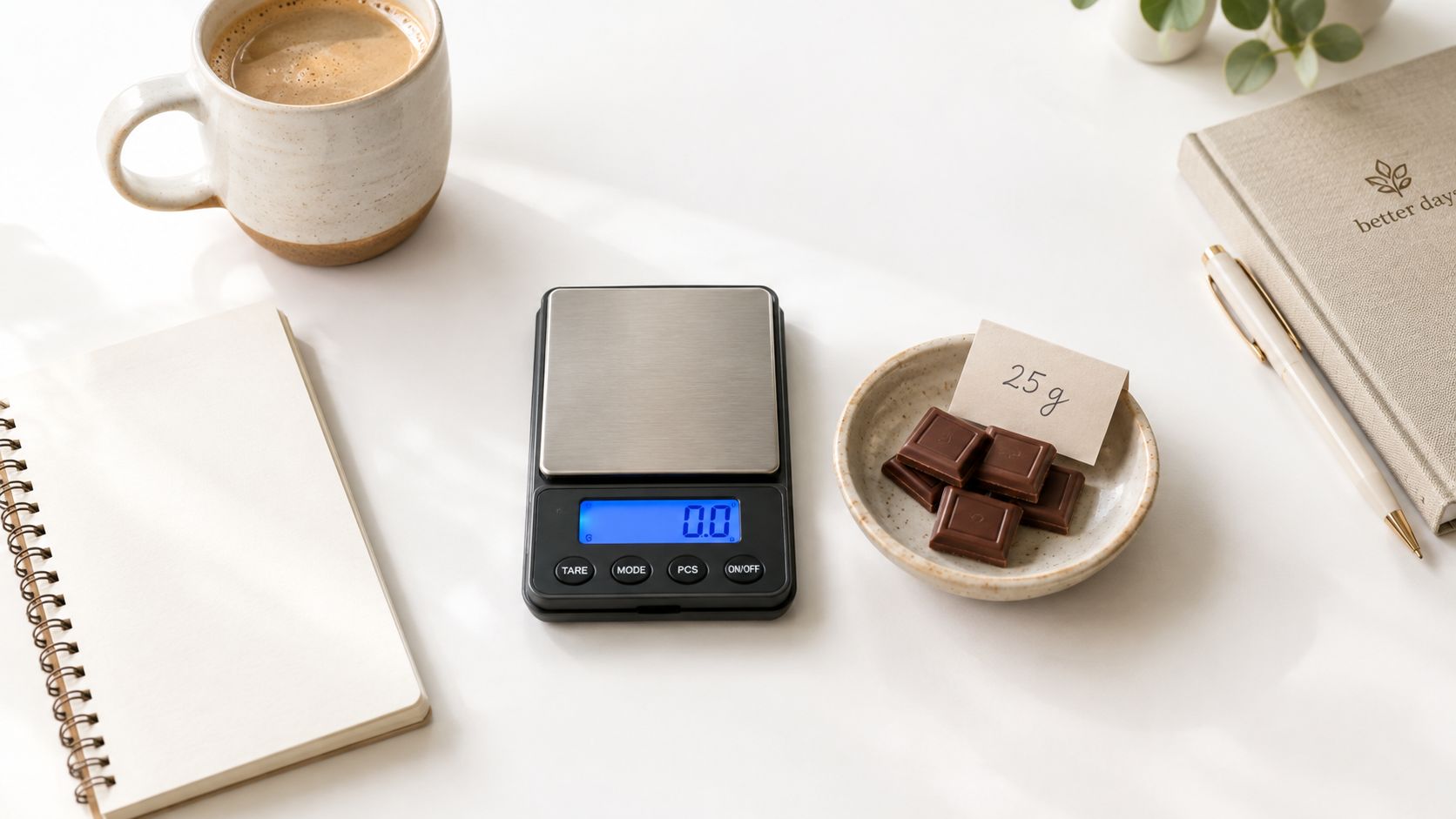
A scale can make an unknown product look precise, so use it for consistency, not false confidence. For dried material, choose a digital scale that reads to at least 0.01 g, place it on a flat surface, and zero it before weighing. Avoid eyeballing pieces or combining material from different bags. Weight remains an unreliable proxy for psilocybin exposure when potency has not been measured.
Product format changes the risk
Chocolate bars and drinks create extra uncertainty. A square or sip only represents a consistent amount if the product was evenly mixed and tested. Without that information, the center of a bar may be stronger than its edge, and a drink may settle unevenly.
Prepare the room before taking anything. Keep water nearby, clear your schedule, and remove tasks, arguments, and notifications. For a drink or edible, wait through a slow onset rather than adding more. Delayed gastrointestinal absorption can turn impatience into an unexpectedly intense session.
For a practical tea format, follow Metro Mush's shroom tea recipe as a preparation reference, not a dosing guarantee. Tea may feel faster than dried material, but faster onset does not make an untested product predictable.
A sober companion should remain clear-headed, keep the environment calm, and discourage impulsive redosing. Clinical protocols use screening, controlled surroundings, and repeated monitoring because those conditions reduce avoidable risk source.
Keep the room quiet, comfortable, and safe. A boring setting gives an unpredictable product fewer ways to become a bigger problem.
Reading Your Body and Adjusting Mid-Session
The first mistake is usually impatience. A first-timer feels almost nothing, checks the clock, and starts bargaining with the dose. Don't do that. If the product is edible or drink-based, delayed onset is normal, and the right move is to wait, not stack more on top.
Three real-world judgment calls
If you're the first-timer and it's been a short while, hold your nerve. The same batch that feels quiet early can still arrive all at once later, especially with mixed-format products. If you're unsure, stop the session plan, stay put, and let the material do its work.
If you're experienced and anxiety is climbing on the come-up, reduce stimulation immediately. Sit down, lower the light, sip water, and stop talking yourself into a bigger problem than you have. Anxiety on the way up is not the same as a medical crisis, but it does mean you should not add anything else to the mix.
If you're combining psilocybin with a low-dose edible from another product category, be stricter than usual. Mixed substances complicate judgment, body load, and anxiety. The safest move is usually to avoid cross-combinations entirely, but if someone has already done it, the next move is waiting, grounding, and keeping the environment quiet.
Clinical trial teams monitor vitals before dosing and repeatedly afterward, because the early phase can change fast. Consumer sessions should borrow that mindset even if they cannot copy the full protocol.
What to do instead of redosing
- If it feels slow, wait longer: delayed onset is common with food-based products.
- If anxiety rises, lower stimulation: dim lights, music off, phone away.
- If you feel fine but unsure, do nothing: adding more because you're impatient is how people lose the session.
- If you're already overwhelmed, end the experiment: no more substance, no more decision-making.
The rule is blunt because the situation is blunt. Once the dose is in, restraint is your best tool.
Safety, Contraindications, and Red Flags
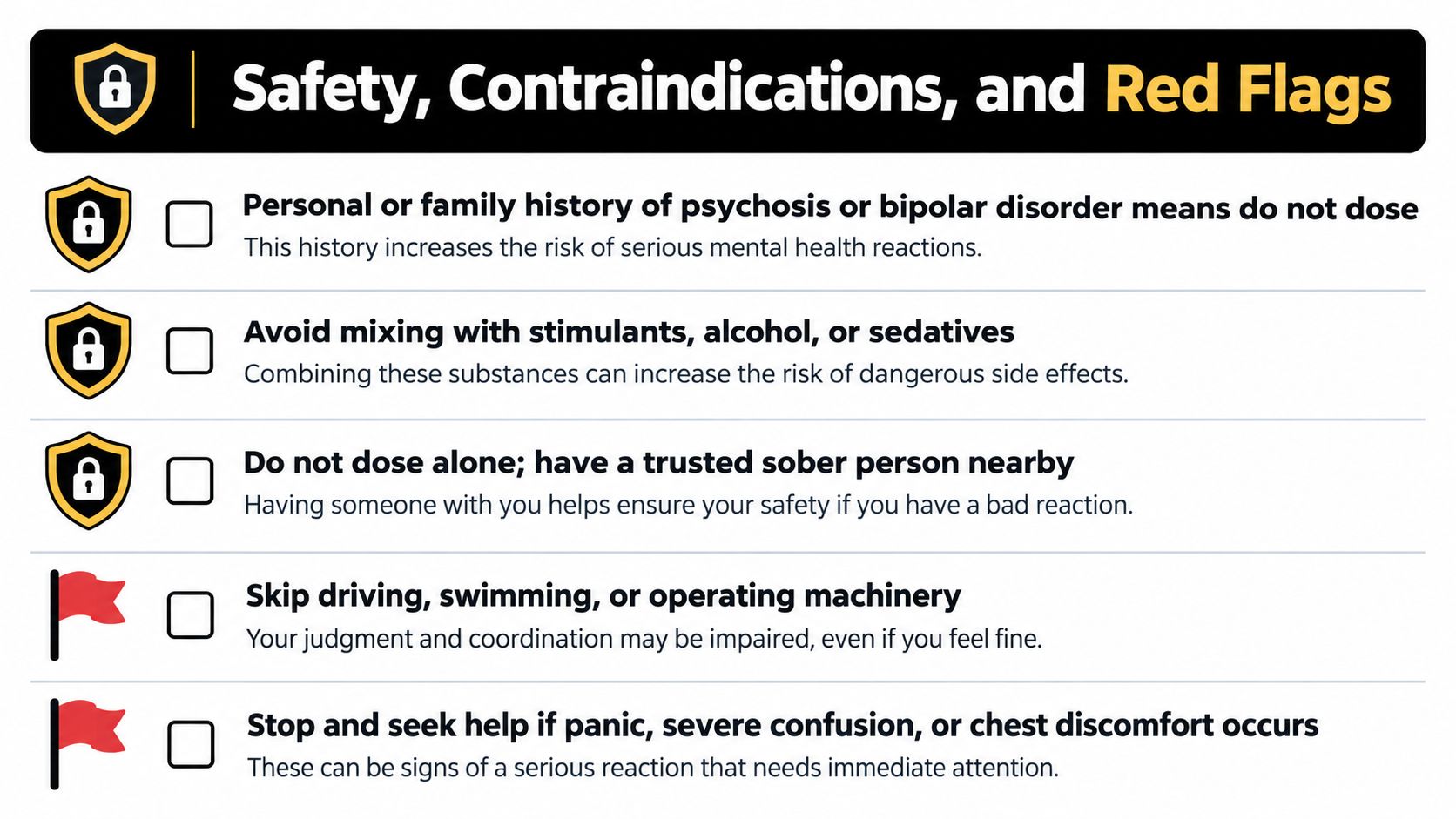
Some people should not dose at all. If you have a personal or family history of psychosis or bipolar disorder, don't play games with psilocybin. If you take medications that affect serotonin, blood pressure, or mental state, get qualified medical advice first. If you have significant cardiovascular disease, treat psilocybin like a risk conversation, not a casual wellness choice.
Don't mix and don't go solo
Alcohol, stimulants, sedatives, and unknown combinations make the whole thing messier. They can blur judgment, intensify panic, or hide warning signs. A sober companion isn't optional if you want a serious harm-reduction setup. It's the difference between a bad moment and a preventable emergency.
Numbers from real-world surveys back up that caution. Survey data involving 9,233 past-year magic-mushroom users found that 0.2% reported seeking emergency medical treatment, with anxiety or panic and paranoia among the most common symptoms, and higher dose and more frequent use showed a risk trend source. That doesn't mean the substance is “safe” in a casual sense. It means emergencies are uncommon, but they do happen, and they're more likely when people push dose, repeat use, or ignore their own risk profile.
If a session turns ugly, don't try to outsmart it. Focus on safety, not interpretation. The sober person should keep the individual away from water, roads, heights, and anything hot or sharp. They should also avoid arguing, shaming, or trying to force the experience to end.
Call for help if you see this
- Chest pain or sustained cardiovascular symptoms: treat it as urgent.
- Seizure or loss of consciousness: call immediately.
- Severe confusion that doesn't settle: get medical help.
- Persistent vomiting or dangerous agitation: don't wait it out.
- Paranoia that becomes unsafe behavior: stop the session and intervene.
If someone needs help, tell clinicians exactly what was taken. That's not drama, it's useful information. And if you're looking for a plain-language overview of interactions, Metro Mush's psilocybin drug interactions guide is a practical place to start.
Why Strain Names and Labels Mislead and What to Ask Instead
A strain name is not a dose. “Penis Envy,” “Enigma,” “beginner,” “microdose,” and “high-dose” are marketing words or loose shorthand, not a guarantee of strength. One batch can hit much harder than the label suggests, and a chocolate or drink can vary from piece to piece if it was not mixed evenly.
Ask about the number that matters
Ask whether anyone measured psilocybin and psilocin in the final product. A standardization review reported a mean of 1.02% psilocybin with a standard deviation of 0.17 percentage points, and a nominal 3 g dried dose ranged from 19.8 to 46.2 mg of total tryptamines across batches. That spread is why the bag name does not tell you much.
If you buy from a dispensary, ask for the certificate of analysis and read the actual analyte values. If the result is vague, missing, or only says “mushroom extract,” pass on it. If you are shopping with Metro Mush, ask the Detroit or Ann Arbor line these questions before ordering, where applicable:
- What's the measured psilocybin content of this batch?
- Is the product independently tested, or is the dose estimated?
- Is the chocolate or drink mixed evenly, or just portioned by weight?
- Are different lots kept separate?
- What should I do if the onset feels slow?
That is the conversation that prevents bad assumptions. Labels identify the product. They do not prove its strength.
Aftercare, Integration, and a Quick-Reference Summary
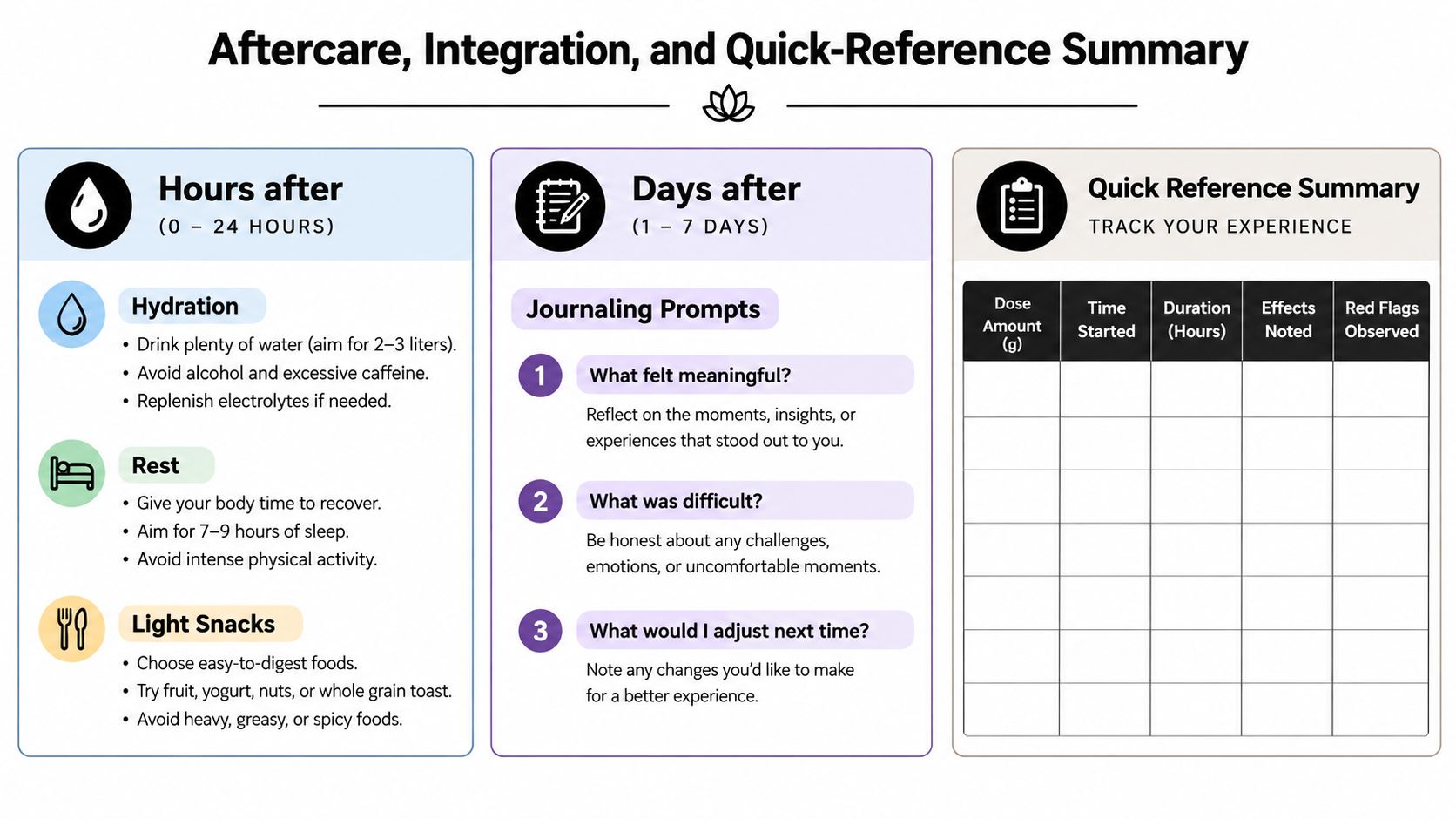
What you do after the session matters. Drink water, eat lightly if your stomach wants it, and rest. Don't immediately judge the experience by how intense it felt in the moment. The smarter move is to write down what happened while it's still fresh.
What to record
Use a notebook or your phone and capture the basics. Note the product, the amount, the time you took it, when it started, when it peaked, and whether anything felt physically or psychologically off. If you want a structured place to think through the experience afterward, Metro Mush's psilocybin integration guide is a useful companion concept, because integration turns a session into usable memory instead of just a story.
A few prompts are enough:
- What felt meaningful?
- What felt difficult?
- What would I change next time?
Quick reference
- Weight is not a dose: potency varies too much to rely on grams alone.
- Clinical-style doses are not consumer formulas: milligram data from supervised studies do not convert cleanly to dried mushrooms.
- Edibles and drinks need caution: onset can be delayed, and redosing too early is a classic mistake.
- Don't mix with alcohol or stimulants: keep the session clean.
- Don't dose alone if you can avoid it: have a sober person present.
- Seek help for chest pain, seizure, dangerous confusion, or severe agitation: those are not things to “ride out.”
Your responsibility is simple. Measure carefully, respect uncertainty, and make conservative choices when the product is untested. If you remember one thing, remember this, clinical milligram doses are not directly transferable to retail dried-mushroom dosing.
If you want help choosing a product format, comparing tested options, or asking the right potency questions before you buy, Metro Mush can help you shop with more clarity. Browse the menu, check what's available, and use Metro Mush as a starting point for a more careful, more informed approach to dosing.