
If you've read a few "types of magic mushrooms" lists this week, you've probably noticed the same names appearing in the same order, with Penis Envy near the top and Golden Teacher somewhere in the middle. So which one is strongest?
The chart can't answer that, and the name on the bag can't either. A strain label describes a cultivated line, not a measured amount of anything. What follows sorts types the way a cautious adult needs them sorted: by species, by verified potency, and by the format the product comes in. Then it tells you which label details to check before you decide on an amount.
Psilocybin Mushroom Types at a Glance
| Type | Appearance | Potency Tendency | Duration |
|---|---|---|---|
| Psilocybe cubensis (Golden Teacher, Penis Envy, Enigma) | Golden to brown caps, blue bruising, grows on dung-based substrate | Moderate to high; varies widely between strains | 4-6 hours |
| Psilocybe cyanescens (wavy caps) | Wavy honey-brown caps, strong blue bruising | High and relatively consistent | 4-6 hours |
| Psilocybe azurescens | Large caps, blue bruising, grows on wood chips | Reported as high; limited lab data | 4-6 hours |
| Psilocybe semilanceata (liberty caps) | Small caps with a pointed tip, thin stem, grows in grass | Moderate; varies with cap size | 4-6 hours |
| Psilocybe stuntzii | Tall slender stem, pale cap | Lower | 4-6 hours |
| Psilocybe zapotecorum | Clustered brown caps on rotting wood in highland forest | High | 4-6 hours |
Read the table as a field guide, not an identification key. Appearance can help you understand how a species is described, but it cannot confirm what a mushroom is. The Seed Cellar mycology primer provides background on psilocybin therapy.
The potency column gives a broad tendency, not a measurement of an individual mushroom. Cultivated lines within one species can vary, so a strain name or species label cannot tell you the strength of a particular batch.
Duration is also an estimate. Effects from dried mushrooms are commonly described as beginning within 20 to 60 minutes, peaking around one to two hours, and fading over four to six hours. Timing varies with the batch, whether you have eaten, and individual differences.
Use the table to distinguish broad species patterns, then treat any potency label as a prompt to check the specific product rather than as a dose recommendation.
Why Species and Strain Names Are Not Dose Guides
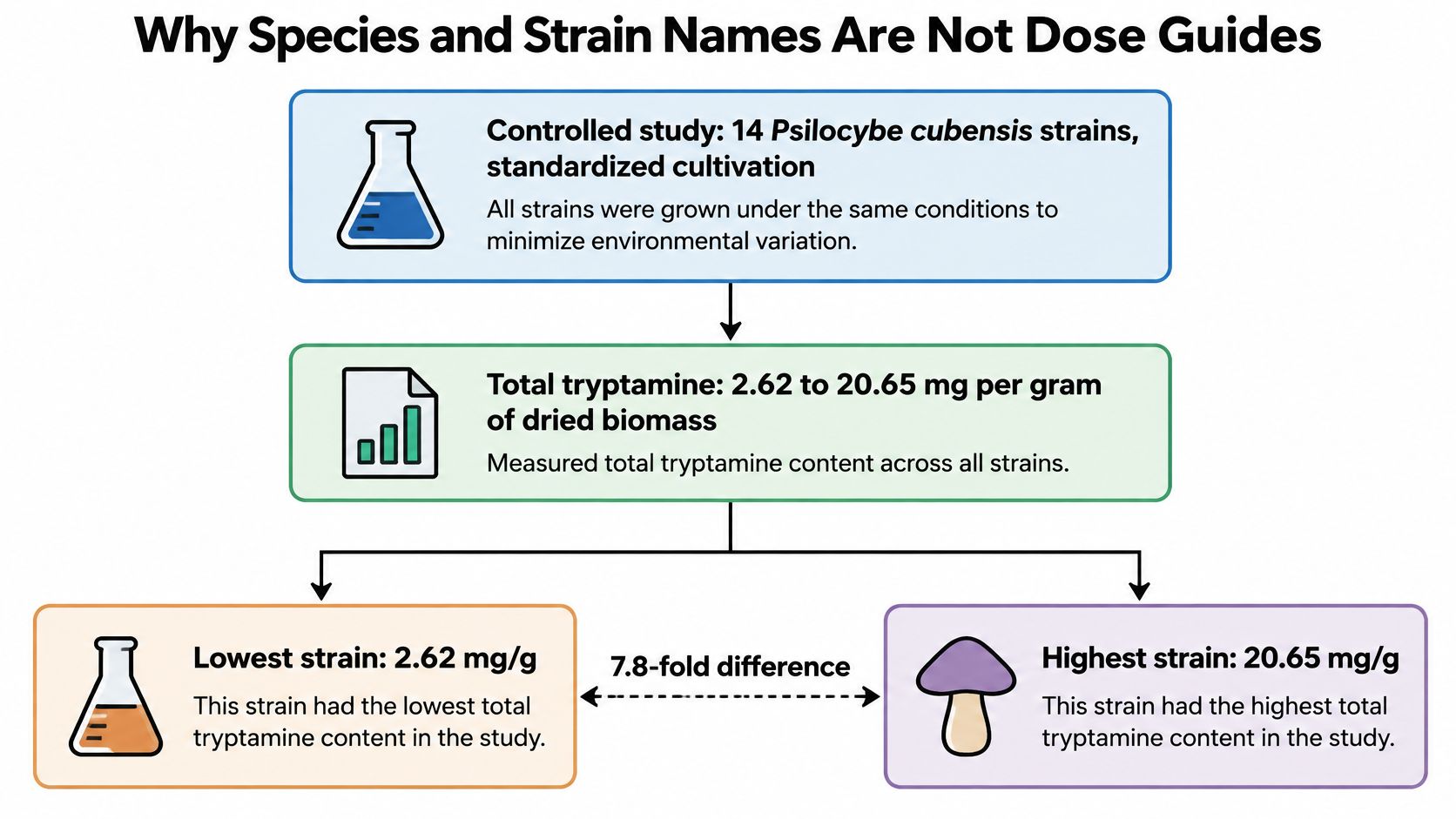
Fourteen Psilocybe cubensis strains, cultivated, extracted and analysed under standardized procedures, produced total tryptamine concentrations from 2.62 to 20.65 mg per gram of dried biomass. That is a 7.8-fold difference between the lowest and highest results in the controlled cultivation study of 14 cubensis strains. The species and growing method stayed the same; the lineage changed.
Psilocybin was the dominant alkaloid in every sample, but levels of related compounds also varied, including psilocin, baeocystin, norbaeocystin, aeruginascin and norpsilocin. A label's psilocybin percentage therefore describes only part of the chemical profile. A cultivar name gives no measurement of that profile.
How wide the category really is
Psilocybin occurs in multiple genera, including Psilocybe, Panaeolus, Pluteus and Gymnopilus, according to a review of psilocybin-producing fungi. Within Psilocybe, narrow classifications recognize more than 150 species, while broader estimates for the less strictly defined grouping range from 277 to 326.
Many of these species have not been chemically confirmed, genetically studied or regularly consumed. The review reports that only about 10 species have been used regularly by Indigenous groups in Mexico, roughly 4 to 6 in Europe and Asia, and about 6 to 8 in North America. A long species list does not mean every name has equally well-established chemistry.
The four layers behind a product name
Read a product name from broadest category to most specific:
- Genus: Psilocybe, Panaeolus, Pluteus or Gymnopilus. A genus groups related species; it does not identify a particular product.
- Species: Psilocybe cubensis, Psilocybe cyanescens or Psilocybe semilanceata. Chemical profiles can differ between species.
- Cultivar or strain: Golden Teacher, Penis Envy or Enigma. These names commonly refer to cultivated lines within Psilocybe cubensis. Commercial strain names do not necessarily correspond to formally recognized species.
- Product: Dried mushrooms, chocolate, a drink or capsules. The format describes how the material is presented, not its species or measured chemistry.
A shop's use of “type” could refer to any of these layers. Two different names may describe products with similar chemistry, while products carrying the same name may still vary.
Two bags with the same strain name can differ, just as two different strain names do not tell you which bag has more active compounds.
Why weight alone doesn't rescue you
Weight measures how much material you have, not how much active compound it contains. Maturity can shift the chemistry, so equal weights may contain different amounts of active compounds. Appearance is not a reliable substitute for identification: research on DNA authentication found specimen identifications unreliable even at the genus level, so a blue bruise, a cap shape or a vendor's description can't confirm identity on its own.
Doses and Onset by Experience Level
| Experience Level | Dried Dose | Chocolate or Drink | What to Expect |
|---|---|---|---|
| Microdosing | 0.1 to 0.3 g | Labelled mg per serving | Subtle mood or focus effects, no clear trip |
| First-time user | 0.5 to 1.0 g | One low-dose serving with labelled mg | Mild visual and mood changes |
| Experienced user | 1.5 to 2.5 g | Labelled dose matched to known tolerance | Full psychedelic effects |
| High-dose experience | 3.5 g and above | Avoid stacking servings | Intense experience; sober sitter advised |
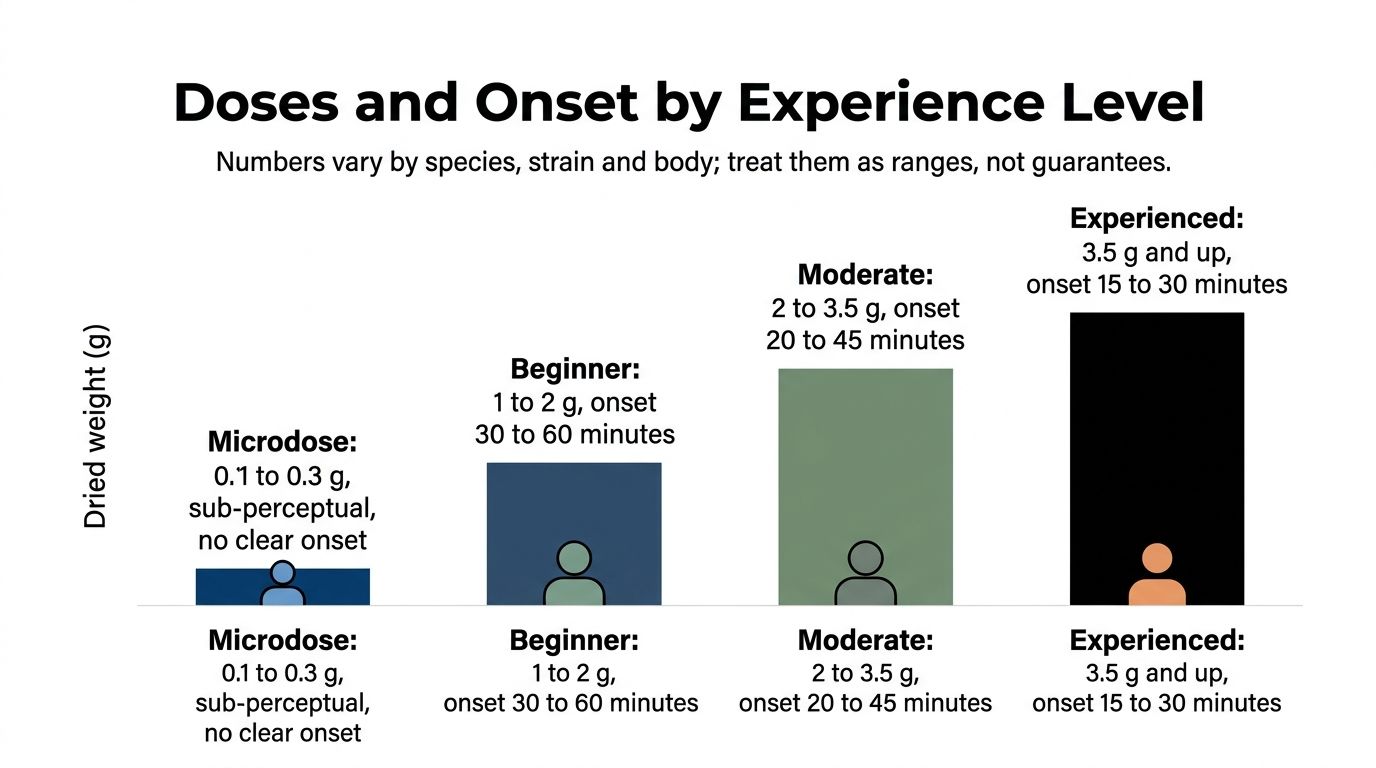
Those ranges are starting points, not prescriptions. Species differences break them open. Psilocybe cyanescens samples carried roughly 3.0 to 15.6 micrograms of psilocybin per milligram of dry material, with fairly high and consistent alkaloid levels compared with many other specimens in the same DNA-authentication and chemical-analysis study. The same work found concentrations generally falling as mushrooms matured, which means a young specimen and an old one of the same weight aren't the same dose.
That's why published beginner ranges diverge. Some charts put a first experience at 1 to 2 grams, others at half that. Start at the bottom of whichever window you're considering, then wait.
The timing sequence
Onset lands somewhere around 20 to 60 minutes for dried mushrooms, with drinks and chocolates often slower because food and digestion sit in the way. The peak arrives around one to two hours. Fade-out runs to roughly four to six hours. If you feel nothing at the 45-minute mark, the correct move is to wait, not to top up.
Rules that hold regardless of type
- Start low. Take the lowest row matching your experience and adjust upward on a later occasion, not during one.
- Wait two hours minimum before any additional dose. Stacking is how mild evenings turn into overwhelming ones.
- Use the labelled milligram figure on chocolate and drinks when one exists. It beats guessing from the bar's total weight.
- Book a sober person for any high-dose experience. Someone who can regulate a room is worth more than any strain chart.
- Avoid mixing with alcohol or other substances on a first attempt with an unfamiliar batch.
If you want a fuller walkthrough of timing and redosing, this guide to dosing magic mushrooms covers the practical side in more depth. Pick the row that matches your experience level, and when you're unsure, choose one row lower than you think you need.
Dried, Chocolate and Drink Formats Compared
| Format | Dose Control | Main Risk |
|---|---|---|
| Dried mushrooms | Low unless weighed on a scale accurate to 0.1 g | Dose varies between caps and batches |
| Chocolate bars | Moderate if the label gives mg per serving | Uneven distribution of mushroom powder |
| Drinks | Moderate to high when mg is tested and stated | Dose uneven if the drink has settled |
| Capsules | High when each capsule states tested content | Dose depends on the stated mg being accurate |
Dried mushrooms give you the most natural experience and the least dose control. Unless you own a scale that reads to 0.1 gram and use it, you're estimating. People who already know their weight-to-effect pattern tend to prefer them for exactly that reason.
Chocolate bars portion easily and taste familiar, but onset can stretch to 30 to 90 minutes, especially after a heavy meal, because fat and food slow absorption. Eat a big dinner first and a 45-minute wait becomes a two-hour wait, which is how people end up taking a second piece too early.
Drinks deliver the smoothest experience when the label states milligrams per serving, because a tested liquid disperses evenly. Shake or stir the bottle first. A drink that has settled at the back of a fridge can put most of its active content in the last third.
Practical rule: the format matters less than the label. A bar with no milligram figure gives you no more control than a bag of dried caps.
Capsules offer the tightest control of the four, provided each capsule states its tested content. They also make it easy to take a consistent amount on a day when you don't want to think about measurement.
For a closer look at pre-made options, this roundup of mushroom drinks shows how much label detail varies between products. The format that gives you the clearest labelled dose is the right starting point for a first experience.
How to Check a Product Before You Use It

A label can use “type” to mean a species, a cultivar, or a product format. Those terms answer different questions: species describes biological classification, cultivar is a cultivated variety, and format tells you how the product is made. A Washington State Liquor and Cannabis Board research brief on psilocybin explains that most psilocybin mushrooms belong to the Psilocybe genus, while other genera also contain psilocybin.
Check the label in this order:
- Look for a species name or a stated cultivar. A trade name by itself may be a marketing label, not a precise identification.
- Find the batch number and test report. The batch code should connect the product to the result, rather than relying on a strain's reputation.
- Check what the report measures. Look for milligrams of psilocybin and psilocin per serving. Words such as “strong,” “premium” and “exotic” do not give a measured amount.
- For dried mushrooms, weigh the amount. Use a scale accurate to 0.1 gram and compare the weight with the relevant dose guidance. A large cap does not necessarily contain more active compounds than a small one.
- Record the product, batch, amount and time. A brief note makes it easier to keep track of what you took and how the experience unfolded.
- Check for potential interactions. Alcohol, other drugs and prescription medicines can affect the experience. Ask a health professional about medication concerns before use.
- Do not identify wild fungi from a photo or guess. Some harmful species resemble psilocybin-containing mushrooms, so appearance alone is not a safe identification method.
A product label is easier to assess when it names the species or cultivar, shows the batch code and test date, and states the measured amount per serving. Be cautious when packaging relies on potency adjectives or gives only a total weight without clarifying how many servings it contains. For more packaging warning signs, see this guide to spotting fake products.
Check the rules where you live, since legal status varies by location and sales channel. If you have a personal or family history of psychosis or bipolar disorder, or take prescription medication, consult a clinician before use.
Choose Your Starting Type and Format

The recommendation splits cleanly by experience.
If this is your first time, or you're cautious by temperament, start with a labelled low-dose format: one chocolate bar or one drink with a stated milligram figure per serving. You're buying information as much as effect. A dried gram guessed from a bag gives you neither.
If you already know your tolerance, compare labelled potency across products and choose the dose row that matches your established range. A strain name can still guide taste and expectation. It can't guide your amount.
The Moon Bar, for example, is built around 3.5 grams of McKennaii magic mushrooms across the whole bar. That total tells you what went into the batch, not what one square delivers, so ask for the per-serving breakdown before you break off a piece. A product that states its total is a better starting point than one that doesn't state anything.
Four years of cultivation work sits behind the strains we carry, and that experience shapes a simple piece of advice: pick the type and format that gives the clearest labelled dose for your experience level, and drop to the lowest row of the dose table whenever you're unsure.
Keep the note you started. Product, batch, dose, time. Your second choice should rest on the first result rather than on a chart someone else wrote.
One next step you can take today: open the product page for whatever you're considering and look for a milligram figure per serving. If it isn't there, that's your answer about how much control you'll have.
At Metro Mush we stock both dried strains like Penis Envy and Enigma and edibles built for measured dosing, including Moon Bars, Mush Love chocolate bars and Rocket Fuel shroom drinks, with delivery across the Detroit and Ann Arbor metro areas. If you've read this far, you already know what to ask for: species named, milligrams per serving printed, batch traceable. Browse the Metro Mush menu and start with the product that gives you the clearest labelled dose for your experience level.