The most common advice on mushrooms vs LSD is to pick the shorter, milder option or the one that “hits harder.” That advice treats intensity as the decision and treats the two as different kinds of experience. They aren't, once the dose is matched.
Both are classic psychedelics. The overlap in what people feel is large. The split that matters for planning a day is narrower. One question is how predictable the dose is before you take it. The other is how many hours the session will occupy, including the time you need to come down and sleep.
That split is practical, not a vibe ranking. Mushroom products run from dried material and capsules to chocolate and drinks, and the active amount is not uniform from piece to piece. LSD is a lab-made compound, and its effects still depend on whether a very small stated dose is accurate. Neither is risk-free. Federal law still treats both as controlled substances, even in cities that have changed policing priorities.
Mushrooms vs LSD at a Glance
The useful difference is simple. These two overlap heavily in what they do, and they differ mainly in how predictable the dose is and how long the experience lasts.
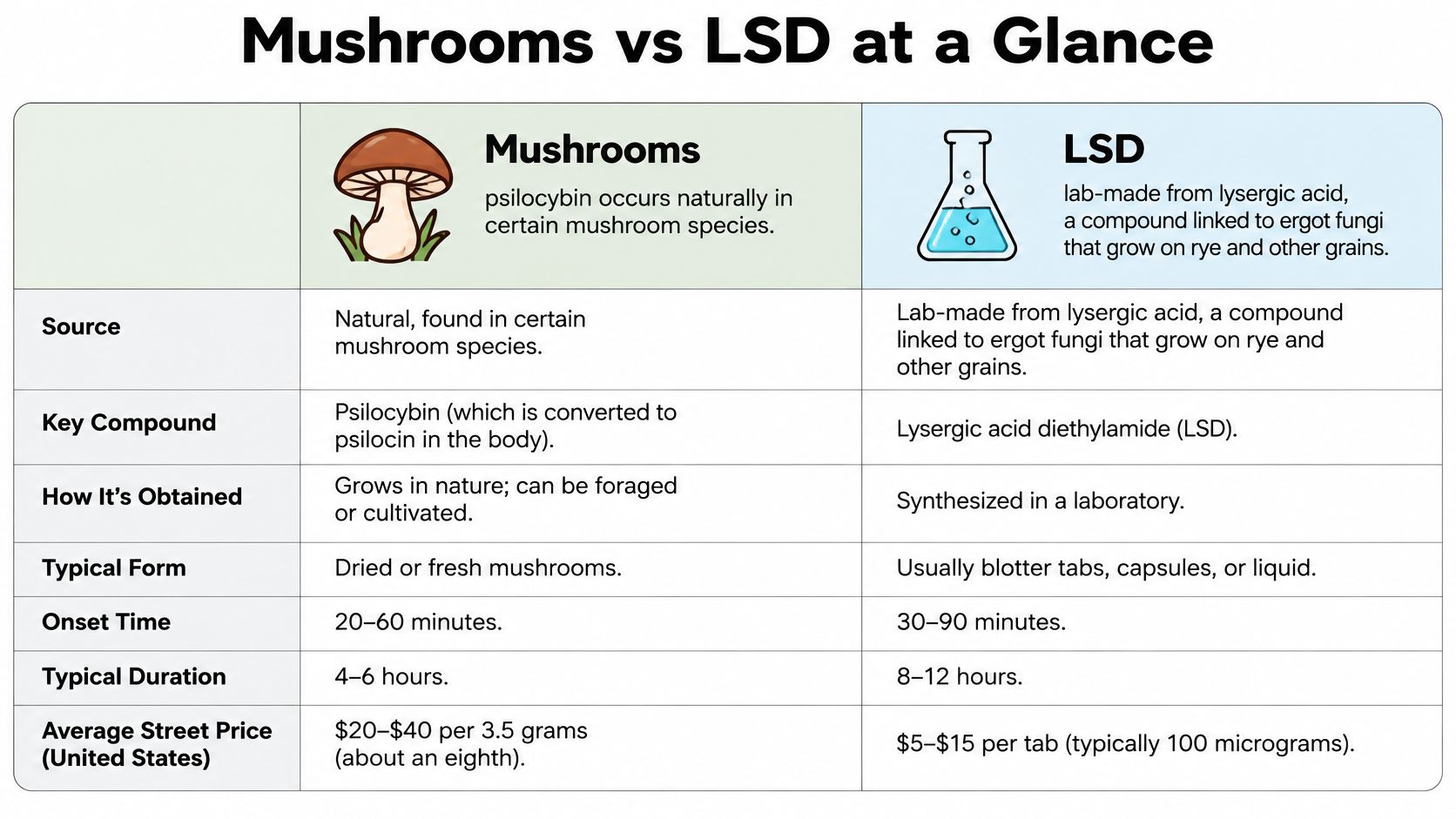
| Factor | Psilocybin mushrooms | LSD |
|---|---|---|
| Origin | Naturally occurring in certain mushroom species | Synthetic, made from lysergic acid linked to ergot fungi |
| Active compound | Psilocybin, converted to psilocin in the body | LSD itself |
| Main receptor target | Serotonin 5-HT2A | Serotonin 5-HT2A |
| Common product forms | Dried mushrooms, capsules, chocolate, drinks | Blotter, liquid, tablets |
| Main source of variability | Species, growing, drying and weighing | Formulation and dose accuracy |
Psilocybin is the naturally occurring psychedelic compound in certain mushroom species. LSD is synthetic, derived from lysergic acid associated with ergot fungi that grow on rye and other grains, as described in National Institute on Drug Abuse materials on psychedelic and dissociative drugs. LSD was first synthesized in 1938 by Swiss chemist Albert Hofmann, and its psychedelic properties were recognized in 1943 after accidental exposure. Psilocybin research entered a modern scientific phase after the 1957 publication of reports on mushrooms used in Indigenous Mexican ceremonies, followed by laboratory synthesis of psilocybin and psilocin in the late 1950s.
Psilocybin doesn't act as itself for long. The body converts it to psilocin. LSD acts directly. Both work primarily through the serotonin 5-HT2A receptor, which is why altered perception, changes in time awareness, and intense shifts in mood and cognition show up with either one.
Why the product form changes the risk
Mushrooms are sold as dried fruit, capsules, chocolate, and drinks. LSD is sold as blotter, liquid, and tablets. The error that bites people is different in each case. With mushrooms, species, growing conditions, drying, and how the material is divided all move the amount of psilocybin in a serving. With LSD, the compound is made in a lab, so the swing comes from formulation and whether the printed dose matches what is on the paper, in the dropper, or in the tablet.
After psychedelic research was broadly restricted in the 1970s, the two timelines split. Psilocybin studies later regained momentum in regulated clinical trials. LSD research stayed more limited. Adult use is already large. In 2025, approximately 11 million U.S. adults used psilocybin during the previous year, and LSD was among the five most-used psychedelic substances, according to a 2026 peer-reviewed analysis of U.S. adult survey data. Legal status still varies widely by jurisdiction, and neither compound is risk-free.
Typical Subjective Effects Compared
When doses are adjusted so the two land at a similar intensity, the character of the session lines up. Chasing whichever one “feels stronger” is a weak way to choose. At a matched level, you're mostly choosing duration and dose control, not a different mental event.
The shared core is fairly stable across both compounds.
- Perception: Visuals, sound, and body sensation can sharpen, warp, or blend.
- Time: Minutes can feel stretched or compressed, which throws off any plan that assumes a normal clock.
- Mood and thought: Emotion can swing hard, and ordinary ideas can feel newly important or newly frightening.
- Inward focus: Many people get more introspective or more emotionally open than they expected.
Set and setting still steer the hour. Expectations, the mood you walked in with, and how familiar you are with psychedelics all change the same milligram amount. A calm, known room with no errands on the calendar is a different session from a crowded place you can't leave.
When the same effects turn difficult
Anxiety, confusion, paranoia, and a sense of being overwhelmed can show up with either substance. The useful response is physical and simple. Sit or lie down, lower the lights, name what you can see and hear, and stay with a sober person you already trust. Arguing someone out of a frightening loop rarely helps.
A longer look at how psilocybin acts in the brain is worth reading before you treat a mushroom product as a milder cousin of LSD. The felt experience can be the same kind of event. What changes is how long that event keeps the day.
Dose Equivalence and Why Mushroom Potency Varies
A controlled, double-blind comparison put the match at about 100 micrograms of LSD to 20 milligrams of psilocybin, and 150 micrograms of LSD to 30 milligrams of psilocybin, an approximate 1:200 mass ratio, in a National Institute on Drug Abuse review of hallucinogens. Both showed dose-proportional pharmacokinetics and first-order elimination. The same comparison found that psilocybin raised blood pressure more, while LSD raised heart rate more. Those readings come from measured pharmaceutical doses.
| Comparison | Psilocybin | LSD |
|---|---|---|
| Equivalent pair one | 20 mg | 100 micrograms |
| Equivalent pair two | 30 mg | 150 micrograms |
| Informal microdose range | 0.1–0.3 g dried mushrooms, not a clinical dose | No agreed clinical microdose |
That ratio is easy to misuse. A full LSD dose is a speck. The matching psilocybin dose is still measured in milligrams of pure compound, not in a casual handful of dried mushrooms. People sometimes treat “a gram of mushrooms” as if it were a fixed unit of psilocybin. It isn't.
Why a label in grams isn't a dose
Dried mushrooms change with species, cultivation, storage, and how evenly a batch is split. An edible can list the weight of a whole bar or bottle and still hide an uneven amount in each square or sip. Extraction and serving accuracy add another swing. The pharmaceutical pairs above should not be used to guess the strength of unstandardized mushroom material or retail edibles.
Many consumers talk about 0.1 to 0.3 grams of dried mushrooms as a microdose. That is an informal range people repeat, not a clinical dose, and it still inherits whatever concentration that particular batch happens to have.
Even a known milligram amount won't feel identical every time. Body weight, recent tolerance, food in the stomach, other medications, and the room you're in all move the experience. Before you buy, read whether the label states milligrams of psilocybin per serving. If it only states grams of mushroom material, build that uncertainty into the plan instead of assuming the 1:200 match still holds.
A weighed pharmaceutical dose and a chocolate square are not the same measurement, even when the package looks precise.
Onset, Peak and Duration for Planning Your Day
LSD reaches peak plasma concentration sooner and then stays active much longer. Faster onset is not a shorter day.
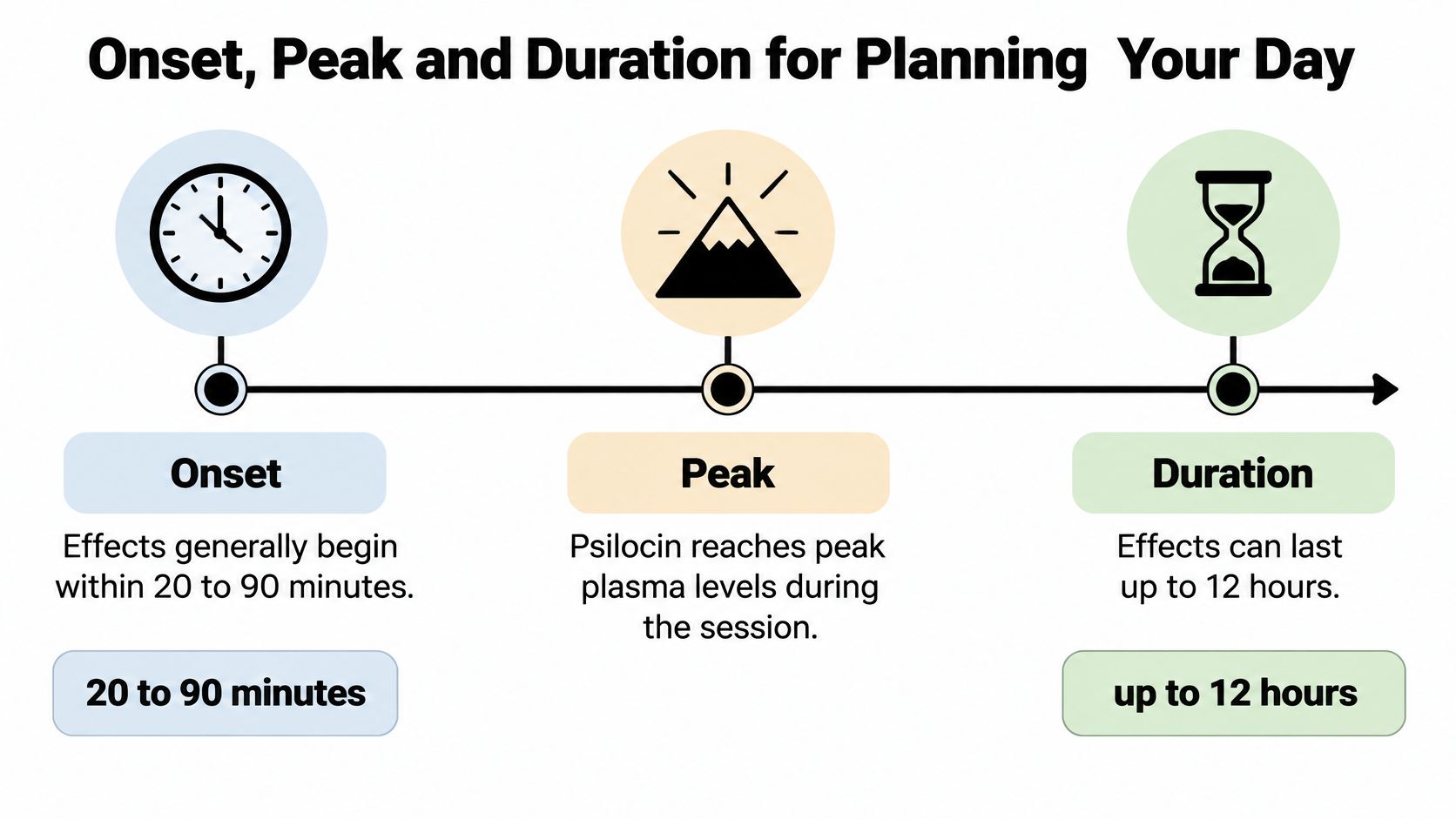
Pharmacokinetic reviews report that LSD peaks at about 1.38 hours on average, versus about 2.2 hours for psilocin, while mean half-lives run about 3.7 hours for LSD and 2.6 hours for psilocin, in a National Institute on Drug Abuse hallucinogen research report. Average acute effects run roughly 10 hours for LSD and 5 hours for psilocybin. The same materials describe classic hallucinogen effects as commonly beginning within 20 to 90 minutes and potentially lasting up to 12 hours, with shifts driven by dose, mood, expectations, personality, and environment.
| Timing marker | Psilocybin (psilocin) | LSD |
|---|---|---|
| Onset window | 20–90 minutes | 20–90 minutes |
| Time to peak plasma | About 2.2 hours | About 1.38 hours |
| Mean elimination half-life | About 2.6 hours | About 3.7 hours |
| Average acute-effect duration | About 5 hours | About 10 hours |
| Reported maximum duration | Up to 12 hours | Up to 12 hours |
Food, metabolism, tolerance, and setting move every one of those markers. A shorter mushroom window doesn't make the dose safer or more predictable. It only changes how much of the calendar you have to protect. For a closer look at mushroom timing on its own, see how long psilocybin lasts.
The phases in that window are easier to see on a single timeline than in a paragraph.
A day you can actually keep
A mushroom session often fits a morning start, a peak before early afternoon, and a quiet rest before evening plans. An LSD session needs a block of about 10 to 12 hours, including recovery and a check-in later that night. Don't book a drive, a shift, or childcare inside either window.
Block these pieces before you dose.
- Arrival: Be in the place you'll stay, with food, water, and a phone charger already there.
- Dosing: Take the planned amount once. Redosing because onset feels slow is how sessions run long.
- Peak: Keep the next few hours free of decisions and visitors.
- Comedown: Stay put until ordinary tasks feel ordinary again.
- Sleep: Don't assume you'll be ready for bed at your usual hour, especially after LSD.
Side Effects and What the Data Cannot Prove
Recent U.S. survey data show side effects reported by 72.6% of recent psilocybin users and 82.1% of recent LSD users, according to a Denver Health summary of psychedelic use. Headache, nausea or vomiting, and fatigue were among the most common physical problems.
A lower average side-effect rate is not a personal safety guarantee.
Those figures are observational. They don't establish that LSD is more dangerous. Dose, setting, adulteration, who answered the survey, how often they used, and what they counted as a side effect can all move the percentages. A person taking an unknown street dose in a chaotic room is not comparable to someone taking a labeled, smaller amount at home.
What self-reported benefit does not prove
The same survey found that 49.9% of psilocybin users and 43.1% of LSD users reported improved mental health. Perceived improvement doesn't prove treatment efficacy. Feeling better after a weekend isn't the same result as a controlled trial with screening, a known dose, and follow-up.
Separate three things before you treat a percentage as advice. Pharmacology is not the same as product variability. A self-report is not clinical evidence. And an average across thousands of people doesn't describe your heart, your medications, or your family history.
Talk with a doctor before any use if you have high blood pressure or a heart condition, a personal or family history of psychosis, or if you're pregnant. Antidepressants and other psychiatric medications can change the session in ways you can't predict from a label. Mixing with alcohol, cannabis, or other drugs stacks impairment and makes it harder for someone else to tell what is going wrong.
The hours after the peak are part of the risk, not an afterthought. A practical walk-through of winding down, including non-alcohol options some people use, is in the Colorado Cultures guide to trip comedowns. If someone can't be calmed, stops making sense, or might hurt themselves, that is an emergency, not a waiting period.
Legal Status for Adults in Detroit and Ann Arbor
The legal answer depends on which government you're asking, and on which substance. A city vote doesn't erase federal law, and a mushroom measure doesn't cover a synthetic compound.
| Level | Psilocybin | LSD |
|---|---|---|
| Federal (US) | Schedule I controlled substance | Schedule I controlled substance |
| Michigan | Possession, use and sale illegal under state law | Controlled under state law |
| Ann Arbor | Lowest policing priority (decriminalization, not legalization); sale not authorized | Outside the measure, which covers plants and fungi; state and federal law apply |
| Detroit | Personal possession and therapeutic use decriminalized under Proposal E; commercial sale illegal | Outside Proposal E, which covers entheogenic plants and fungi; state and federal law apply |
Federally, both sit in Schedule I. Michigan law still makes possession, use, and commercial sale of psilocybin illegal. Local policy sits on top of that statute. It doesn't replace it.
What the city votes actually changed
Ann Arbor moved enforcement against psilocybin and other entheogenic plants to the bottom of its policing priorities. That is decriminalization, not legalization, and it doesn't authorize sale. Detroit followed with Proposal E, a ballot measure that decriminalized personal possession and therapeutic use of entheogenic plants and fungi. Commercial sale remains illegal there too.
LSD falls outside both measures because they speak to plants and fungi, and LSD is synthetic. The same compound that sits at the lowest rung of one city's enforcement ladder is an ordinary controlled substance everywhere else in the state. Carrying either substance into Illinois, Ohio, or Indiana means a new set of state rules the moment you cross the line. Local non-enforcement doesn't travel with you, and city policy can be revised.
Decriminalization changes police priority. It doesn't create a lawful market, and it doesn't bind the state or the federal government.
Read the current ordinance text rather than a social post about it. If your situation isn't clearly personal possession inside one of those cities, speak with a local attorney before you assume you're covered. For how Michigan rules sit next to product shopping, start with psilocybin and Michigan law and then check the ordinance yourself.
Choose Your Starting Point and Plan Your Session
If this is your first time, or you're cautious, don't start with LSD. Its active window takes the whole day, and a mislabeled microgram dose is hard to see. A mushroom product with a stated milligram amount per serving, plus a sober person you trust, is the more bounded starting point. If you already know your tolerance and you can clear the full day, LSD's per-dose predictability can be workable when the product is what it claims to be. Strength is the wrong tie-breaker either way.
- Confirm the law where you are. City policy, Michigan statute, and federal scheduling don't say the same thing, and a seller's story isn't a legal opinion.
- Screen health issues with a doctor. Blood pressure, heart conditions, psychosis history, pregnancy, and psychiatric medications belong in that conversation before any dose.
- Plan from the serving label, not from body weight. Milligrams of psilocybin per piece beat “grams of mushroom” or a guess based on how much you weigh.
- Block the day, then add recovery. Give a mushroom session the morning through early evening. Give LSD the entire day and the night that follows. Don't schedule a ride home inside that block.
- Stay in a calm, familiar room with a sober sitter. The sitter's job is presence, not coaching you through insights.
- Don't mix. Alcohol, cannabis, and other drugs make distress harder to read and harder to manage.
- Set the exit before you start. Food, water, a quiet room, and a person to call should already be decided. If distress builds, move to that quiet space and use simple grounding. If there's danger, contact emergency services.
Formats that do and don't state a dose
An edible is consistent only when the label states milligrams per serving. Dried mushrooms swing with the batch. Blotter, liquid, and tablets swing with how carefully that batch was laid. Our Mush Love Shroom Chocolate Bar and Rocket Fuel Shroom Drink are each listed at $40. We take time to understand what you're trying to do and help match a product to that goal, including whether a lower-dose edible fits better than dried material.
Choose based on your experience, the hours you can realistically protect, and the law where you stand. Don't choose based on which compound has a reputation for hitting harder.
Metro Mush is a Detroit and Ann Arbor dispensary and delivery service with dried mushroom strains and labeled edibles, including chocolate bars and drinks, for adults comparing dose and session length. If you want a product matched to a shorter, more clearly portioned session rather than an all-day one, browse the menu and talk with the team about servings. Visit Metro Mush to see current options and place an order.