
Psychedelic therapy for anxiety is still early enough that the strongest synthesis found only 5 studies with 122 participants for anxiety reduction, and the evidence certainty was low even though average scores on trait and state anxiety improved on the STAI scales (Cochrane review). That single fact changes the conversation. It means the field is producing real signals, but not yet the kind of broad, durable proof that can support sweeping claims for everyone with anxiety.
That gap matters because many don't encounter this topic through a journal article. They encounter it through headlines about magic mushrooms, through friends who've had intense personal experiences, or through dispensaries and community access where the legal and therapeutic lines can blur. A careful reading of the science helps separate what's promising from what's still speculation.
Researchers got interested in these substances for a reason. Classical psychedelics have a long history in ceremonial and spiritual use, and modern clinical work revived them because some patients reported meaningful shifts in fear, meaning, and emotional processing under structured support. The modern question isn't whether these experiences can feel powerful. It's who benefits, under what conditions, and for how long.
Why the Evidence Still Feels Early
The cleanest number in the field is also the most humbling one. The best synthesis for anxiety still rests on 5 studies with 122 participants, and it rates the certainty of the evidence as low even while showing average improvement on STAI-Trait MD −8.41 and STAI-State MD −9.04 (Cochrane review). That mix of real signal and limited certainty is why clinicians stay interested and cautious at the same time.
Why headlines feel bigger than the evidence
Public discussion often compresses a complicated evidence base into a simple promise. People hear “psychedelics for anxiety” and assume the findings apply broadly to generalized anxiety disorder, panic, or social anxiety. The published evidence does not support that leap yet. Much of the literature is concentrated in structured settings and in people facing cancer-related distress or other serious illness, not in the everyday outpatient anxiety that shows up in primary care.
That distinction matters because anxiety is not one condition. Fear tied to a life-threatening diagnosis, persistent worry about work, and social avoidance overlap, but they do not behave the same way. A treatment that helps someone reinterpret mortality-related distress may not translate cleanly to generalized anxiety disorder, where the problem is often chronic anticipation and rumination.
Practical rule: if a claim sounds broader than the underlying study population, slow down and ask who was actually studied.
Why the history matters but does not solve the evidence gap
Psychedelics are not new to human culture. Their ceremonial use across Indigenous traditions shows that people have long understood these compounds as meaning-shifting, not just mood-altering. Modern research, though, has to answer a different question. It has to identify dose, screening, setting, follow-up, safety, and durability in a way that can be tested and repeated.
That is why the excitement in research circles does not automatically translate into a ready-made option for a person sitting at home with anxiety. The field is still building the bridge between striking individual experiences and generalizable clinical care.
The plain-language takeaway is simple. Psychedelic therapy for anxiety is promising, but still experimental, and the biggest gap is not whether people can feel better in the short term. It is whether those effects hold across diagnoses, settings, and time.
How Psychedelic-Assisted Therapy Works
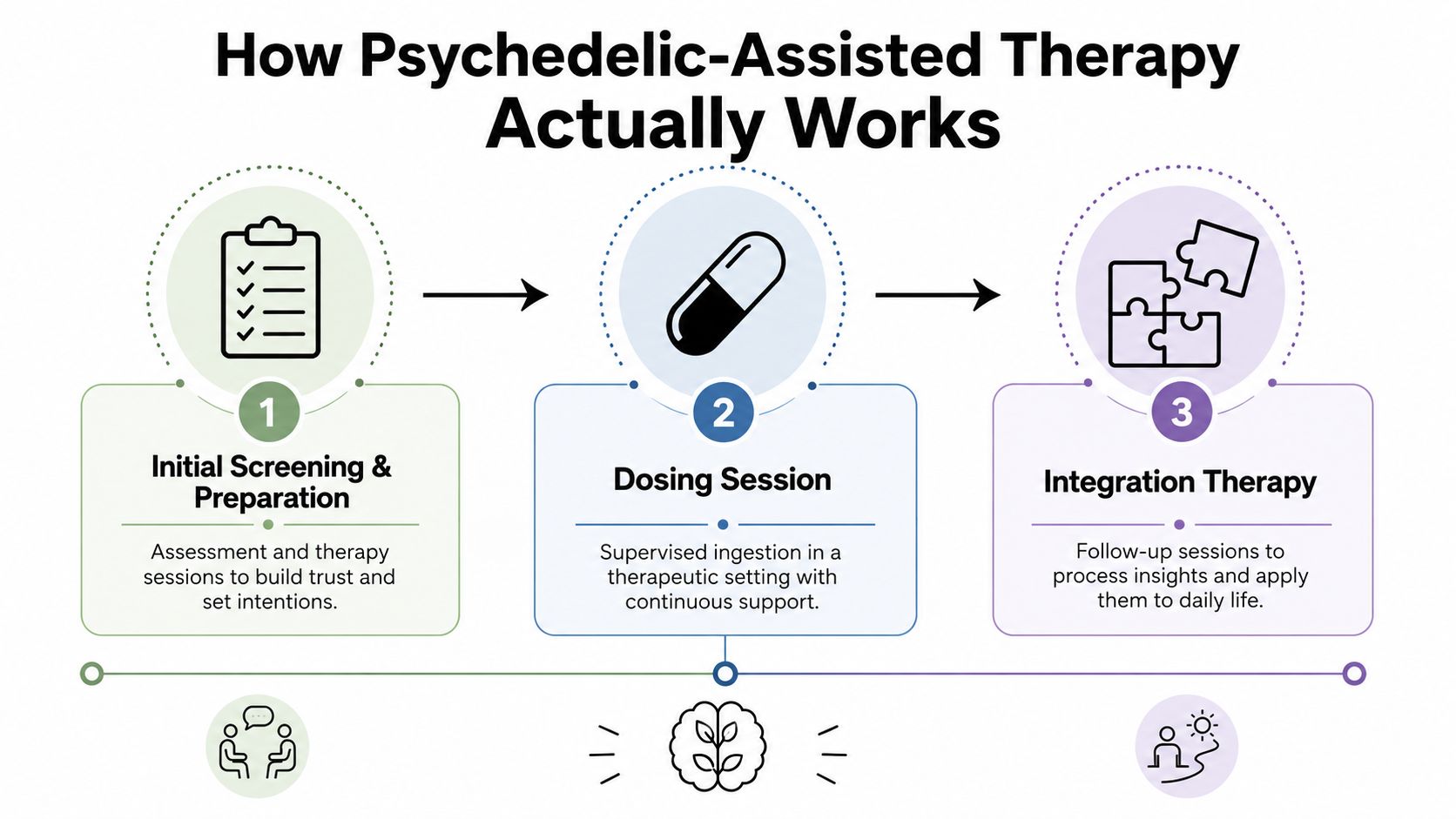
A person does not take a psychedelic and wait for insight to appear. In clinical care, the substance is paired with therapy before and after the dosing session, so the experience has a structure around it. That structure matters because the medicine and the psychological setting are meant to shape each other.
The process usually has three parts. Preparation helps the person understand what may happen, clarify intentions, and build trust with the therapist or guide. Dosing is the supervised session itself, when the person takes the substance in a monitored setting. Integration comes afterward, when the person and therapist review what surfaced and connect it to daily life.
A more useful way to picture it is through function rather than mystery. The psychedelic can open up attention and emotion, while the therapy gives those experiences a place to be sorted, interpreted, and carried forward. Without preparation, the session can feel disorienting. Without integration, even a meaningful session can stay vivid but not change behavior.
The term “psychedelic-assisted therapy” also separates clinical treatment from recreational use. Recreational settings may involve similar substances, but they usually lack screening, a therapeutic goal, and planned follow-up. Clinical protocols are built around safety, emotional processing, and tracking whether the person improves.
For readers who want a plain overview of the framework, this explainer on psychedelic therapy is a helpful companion. It lays out the basic terms before you try to judge the evidence.
The therapist's role during dosing is often quieter than people expect. In many protocols, the guide stays present, monitors comfort, helps the person stay oriented, and steps in if fear starts to rise. That is different from standard talk therapy, where the therapist usually does most of the talking.
The treatment is only partly about the compound. The other part is the environment, the support, and what happens after the session ends.
A related distinction matters too. Psilocybin and LSD are classical psychedelics. MDMA is usually discussed separately because it is often grouped as an empathogen or entactogen, with a different subjective profile and therapeutic logic. Keeping those categories straight makes the research much easier to follow.
A three-step process flow infographic illustrating the structured protocol. Steps: 1) Initial Screening & Preparation, 2) Dosing Session, 3) Integration Therapy.
What Clinical Trials Show for Anxiety
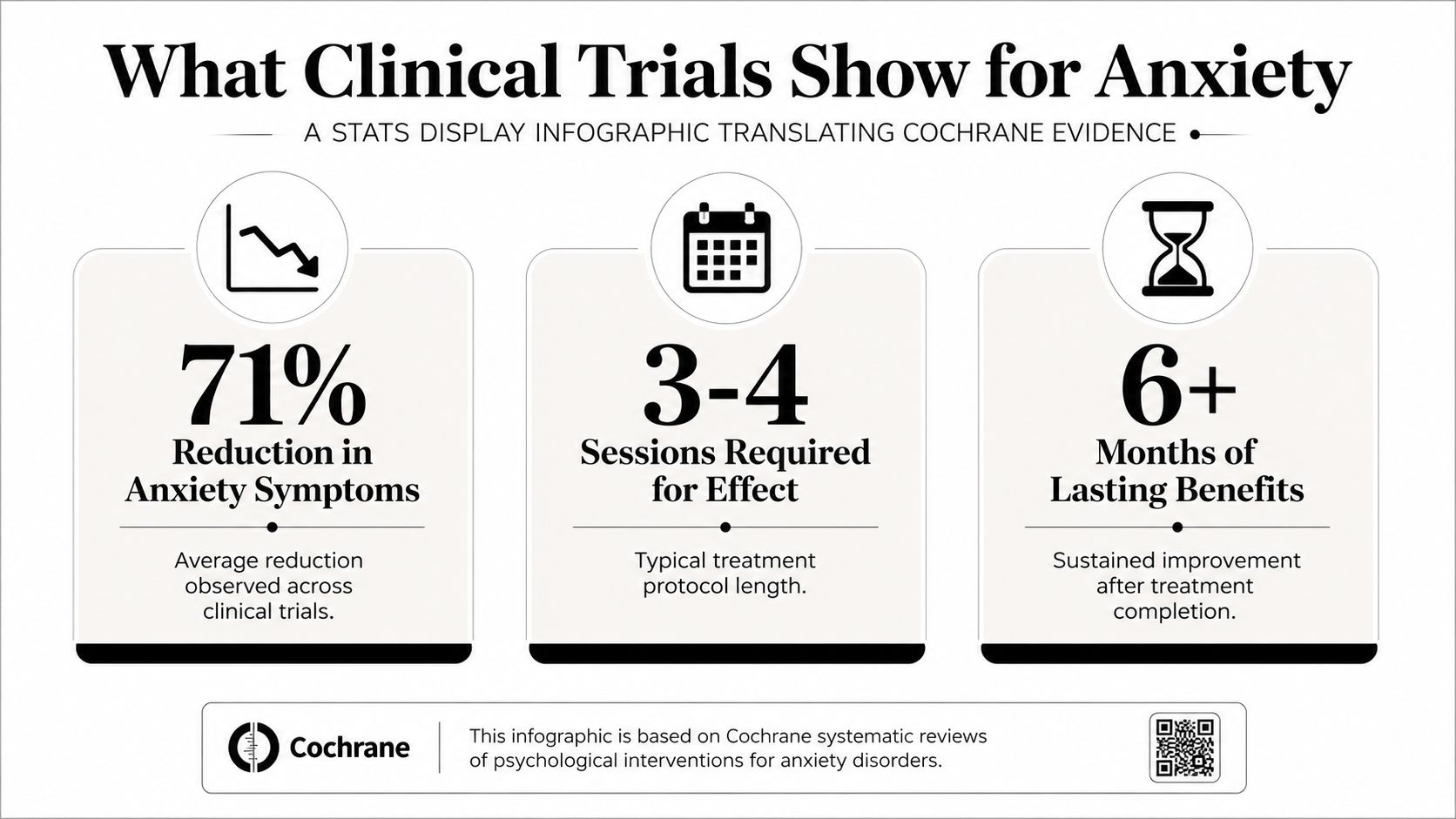
The clinical evidence points in a clear direction, but it is still early. A Cochrane review found that anxiety scores improved on average, while also judging the certainty of the evidence low and basing its conclusions on only 5 studies with 122 participants (Cochrane review). That is enough to treat the signal seriously, yet not enough to call the treatment settled.
Where the strongest data comes from
Most of the best-known trials have focused on cancer-related distress and existential anxiety. That choice makes sense. People facing serious illness often carry fear, grief, and uncertainty that are easy to identify and measure, which gives researchers a clearer target than the broader, more variable world of everyday anxiety disorders.
The result is encouraging, but narrow. A person with generalized anxiety disorder wants to know whether the same approach can ease persistent worry, tension, and sleep disruption. The current studies do not give researchers enough confidence to say that.
What durability means in practice
A short-term drop in anxiety after a guided session is a real finding, but it is only part of the story. The deeper question is whether the benefit remains after the session ends and daily life resumes. The available studies suggest improvement, yet the long-term picture is still limited because the evidence base is small and concentrated.
A useful way to read this literature is to think in terms of probability, not guarantee. Some people may gain meaningful relief, especially in well-supported settings. Others may notice little change, or feel better for a while and then drift back toward their earlier baseline.
Who the trials leave out
Clinical trials usually exclude people with more complex psychiatric histories and medically complicated situations. That means the average participant in a study is not the same as the person who may encounter psilocybin through a dispensary, a retreat, or community access. It also means people with severe anxiety plus unstable mood symptoms, psychosis risk, or complicated medication regimens may not appear in the evidence at all.
That exclusion is part of how safety is established. It also limits how far the findings can be generalized.
The practical takeaway is straightforward. The research supports carefully supervised, tightly selected use, not a universal solution. If you do not resemble the trial populations, it is wise to be cautious about assuming the same outcome.
Beyond Psilocybin The Expanding Research Pipeline
The research conversation is moving beyond the familiar “magic mushrooms for anxiety” frame. A 2026 review notes that the FDA has granted breakthrough designation in trials for LSD for generalized anxiety disorder, and it also describes multiple phase 2 studies for GAD using 5-MeO-DMT, psilocybin, MDMA, and DMT (Nature review). That broader pipeline matters because the field is no longer centered on one molecule.
Why regulators care about the indication
A compound can look promising in one condition and still need separate proof in another. Regulators don't approve a substance as a general mood cure. They evaluate it for a specific indication, a specific protocol, and a specific risk profile. That's why LSD for generalized anxiety disorder is scientifically interesting, but it doesn't automatically tell us what psilocybin will do in social anxiety, or what MDMA will do in trauma-linked anxiety.
The same logic applies to different formulations and routes of administration. A medicine's effects depend on more than its name. Dose, preparation, support, and the population being treated all shape the result.
Why “the field” is the better lens
A lot of consumer-facing content still treats psychedelic therapy as if it were one story about one drug. The actual research is wider. Psilocybin remains important, but so do LSD, MDMA, 5-MeO-DMT, and DMT programs that are testing different hypotheses about anxiety reduction and emotional processing.
This broader view also changes the commercial conversation. People often ask which psychedelic is “best” for anxiety, but the better question is which protocol, in which setting, for which diagnosis, under what supervision. That's a more demanding question, but it's the one the data can eventually answer.
The molecule matters, but the indication matters just as much.
The field is still early, but it isn't static. It's widening, and that makes simple one-size-fits-all messaging even less accurate than it used to be.
Clinical Therapy vs Self-Directed Use
Clinical therapy and self-directed use can overlap in spirit, but they're not the same experience at all. In formal treatment, a clinician screens for psychiatric and medical risk, explains the protocol, supervises the session, and supports integration afterward. In self-directed use, the person often chooses the product, the setting, and the support level without the same medical oversight.
| Feature | Clinical Therapy | Self-Directed Use |
|---|---|---|
| Screening | Formal mental health and medical review | Usually informal or self-assessed |
| Dosing | Protocol-based, supervised | User-selected, often variable |
| Support | Trained therapist or guide present | May be alone or with peers |
| Emergency response | Planned and available | Depends on the setting and the people present |
| Integration | Built into follow-up care | Optional, self-managed journaling or discussion |
The overlap can be misleading. Both paths may involve intention setting, quiet rooms, music, and reflection afterward. Those similarities can make self-directed use feel like “therapy without the therapist,” but the missing pieces are exactly where risk rises.
Where the differences matter most
The biggest gap is screening. A person with a history of psychosis, a complicated cardiac condition, or a risky medication combination needs more than a strong intention and a comfortable room. They need a clinician or facilitator who can identify whether the person should avoid the substance entirely or should be referred elsewhere.
Another major difference is rescue capacity. In a clinical setting, someone has already thought through what happens if panic escalates or if a medical issue appears. In a community or retail context, that planning often falls on the user and whoever is present.
For readers exploring psilocybin outside formal therapy, the honest answer is that the set and setting still matter, but they are not a substitute for screening. The rituals can be similar, while the safeguards are not.
If the environment looks therapeutic but nobody has checked contraindications, it's not equivalent to clinical care.
That distinction is the core of the decision. People can make informed choices about either path, but they shouldn't confuse the two.
Safety Risks and Harm-Reduction Practices
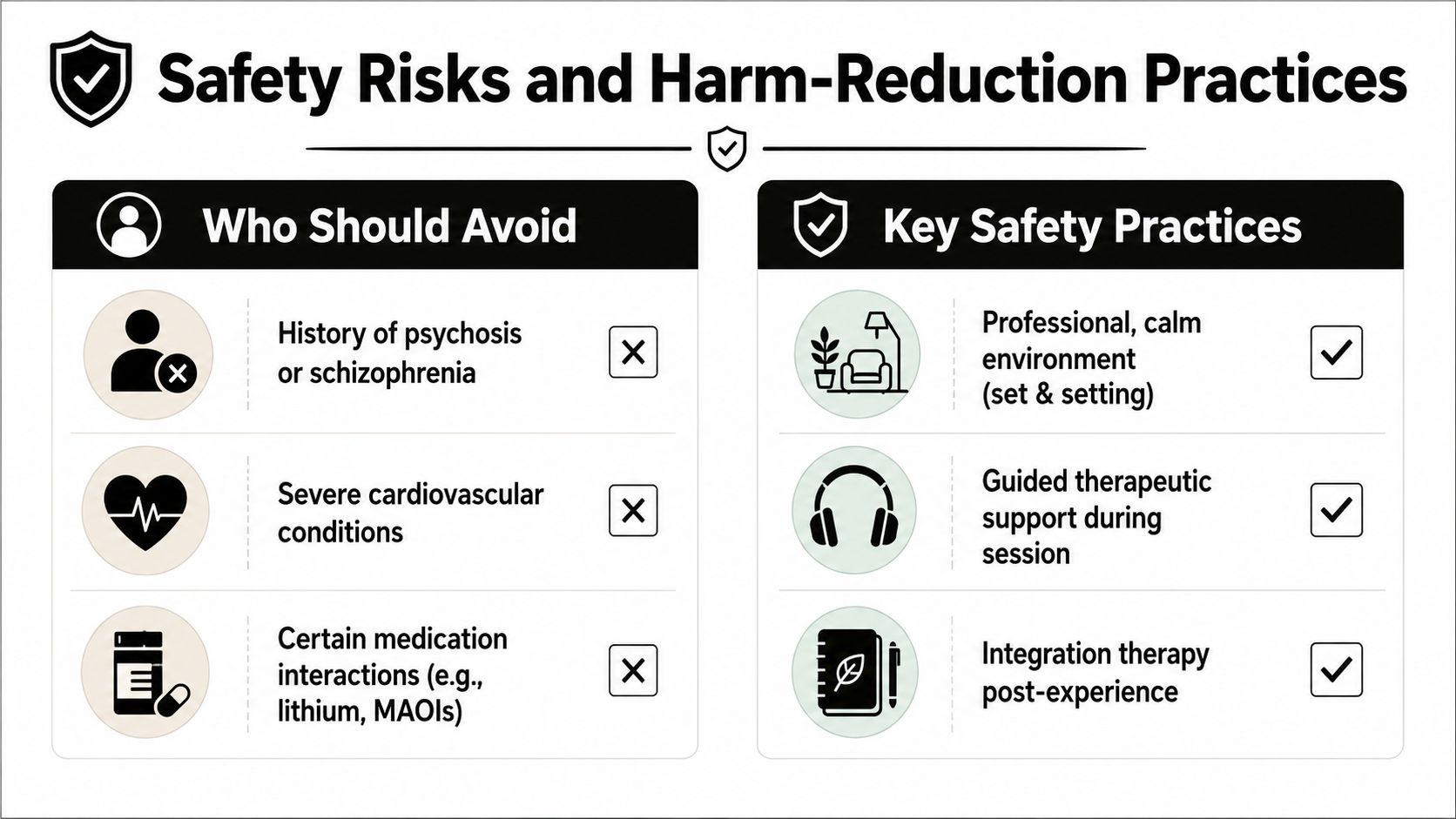
The safest way to think about psychedelics is to treat them as powerful mental state changers, not wellness supplements. The main safety questions are who should avoid them, what medications can complicate the picture, and what kind of environment lowers the chance of a bad outcome. For a plain-language overview of risk reduction, this harm-reduction guide is a useful companion.
Who should avoid them
People with a personal or family history of psychosis or schizophrenia should be especially cautious, because altered perception and destabilizing experiences can be harder to manage in that context. People with severe cardiovascular conditions also need a careful medical review, since intense experiences can place extra strain on the body. Certain medication combinations matter too, including lithium and MAOIs, which can create additional risk or complicate the experience.
None of that means every other person is automatically safe. It means these are some of the clearest red flags.
What reduces harm in practice
A calm setting matters because the nervous system responds to cues. A busy, noisy, or socially unpredictable environment can turn a challenging experience into a more frightening one. A sober sitter or trained guide adds a layer of protection, especially if anxiety rises quickly.
A few practical habits help:
- Choose a controlled environment: quiet room, minimal interruptions, and no pressure to perform.
- Use sober support: someone who can stay grounded if emotions intensify.
- Prepare emergency contacts: write them down before the session starts.
- Keep basics nearby: water, a charged phone, and a plan for getting help if needed.
What integration does after the session
The experience itself is only part of the story. Integration gives the person a place to sort out what felt meaningful, what felt confusing, and what should change in daily life. Without that step, even a positive session can stay abstract.
The safest mindset is practical, not mystical. Check the medical risks first, then think about environment, support, and follow-up. That order keeps the conversation grounded.
Legal Status and Access Pathways in 2026
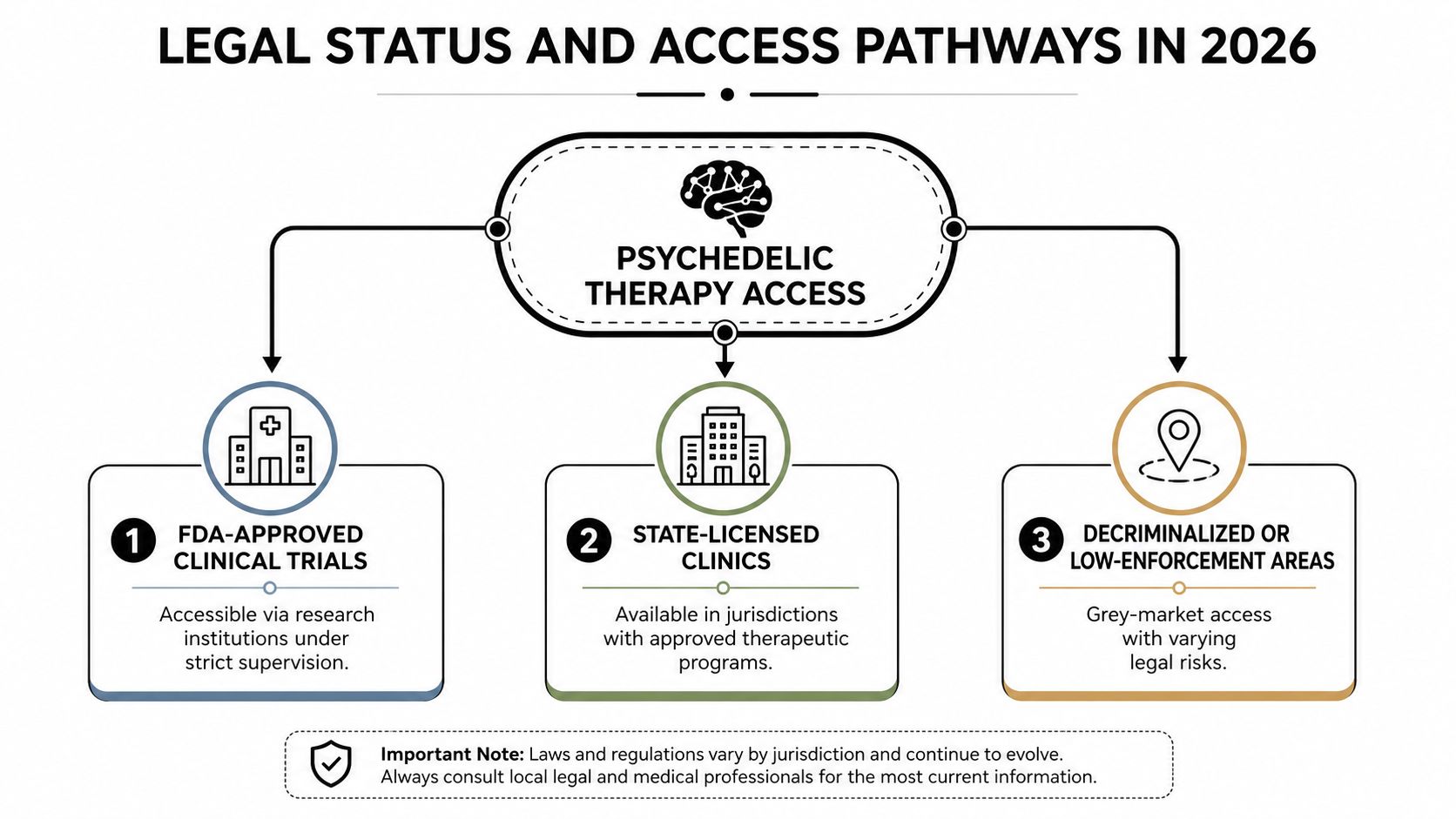
Access is fragmented, and the path you choose depends on where you live and what kind of experience you want. One pathway is FDA-approved clinical trials, usually hosted by university or research medical centers. Another is state-regulated programs in places like Oregon and Colorado, where supervised facilitators can operate outside traditional clinical research. A third is the decriminalized or low-enforcement environment in cities such as Detroit and Ann Arbor, where personal possession has been deprioritized but commercial sales remain unlicensed.
Why these pathways are not interchangeable
Clinical trials are the most evidence-generating option because they are designed to answer scientific questions. State-licensed programs are built more for supervised access than for publishing new efficacy data. Decriminalized areas reduce some legal pressure, but they don't create a medical framework, and they don't guarantee product testing, screening, or aftercare.
That distinction is especially important for consumers who see every access point as “therapy.” The same substance can move through very different systems depending on the state, the provider, and the legal status of the setting.
What this means for Michigan readers
Detroit and Ann Arbor sit in a more complicated consumer reality than a research brochure suggests. People may encounter psilocybin through community access or local retail-style channels, but that isn't the same thing as an approved therapeutic program. The evidence base discussed earlier still applies, and so do the safety cautions.
For readers who are comparing jurisdictions, Oregon's regulated psychedelic therapy model shows how supervised access can be separated from full clinical trial infrastructure. That's useful context, even if the local rules differ from state to state.
The honest bottom line is that access is easier to find than evidence-based therapy. A legal or semi-legal pathway doesn't automatically make the experience therapeutic, and a therapeutic intention doesn't make the pathway medically supervised.
Practical Next Steps and Questions to Ask
Start with your own risk profile. If your anxiety is severe, if you've had psychotic symptoms, if you take interacting medications, or if you're not sure how you'd handle an intense altered state, formal medical screening is the smarter first move. If your interest is more exploratory, the key question is whether you're choosing a setting that can support the experience, not just sell it.
Ask any clinician or facilitator these questions:
- Training: What specific training do you have in psychedelic-assisted therapy or psychedelic harm reduction?
- Screening: How do you rule out people who shouldn't participate?
- Emergency planning: What happens if panic, confusion, or a medical problem comes up?
- Integration: How do you help people process the experience afterward?
- Medication review: Do you check for risky combinations before a session?
Watch for warning signs too. A provider who dismisses screening, treats every product as interchangeable, or promises certainty about outcomes is not giving you a serious answer. Good support sounds measured, not magical.
For Detroit and Ann Arbor readers, the most practical next step is to compare the route you want with the route that fits your risk level. Review the menu online, call the appropriate metro line for current availability, and join the Discord if you want ongoing updates about products and community changes.
Metro Mush offers a local way to explore psilocybin products while keeping the conversation grounded in real-world access, not hype. If you're comparing cautious self-directed use with the clinical research on psychedelic therapy for anxiety, visit Metro Mush to review current options and decide what fits your comfort level and legal situation.