


A lot of Great Lakes mushroom seasons begin with the same moment. You're out on a trail after a long Michigan winter, the ground is finally soft, the woods smell alive again, and you notice everything at once. Red maple buds, damp leaves, a fallen elm starting to break down, maybe a mayapple pushing through the litter. Then the question hits: is it time to look for mushrooms yet?
That question matters more here than people think. In Michigan and across the Great Lakes, mushroom hunting season doesn't follow a clean date on the calendar. It moves with spring rain, soil warmth, lake-cooled air, shaded ravines, hardwood ridges, and the slow northward crawl of the season from southern counties into cooler ground.
If you're new to foraging, that can feel confusing. It's also what makes the hobby so rewarding. Once you learn how to read the woods, you stop guessing and start noticing patterns. If you want a broader primer on local species, this guide to wild mushrooms in Michigan is a useful companion while you learn the seasonal rhythm.
Your First Steps into the World of Foraging
My favorite way to introduce someone to mushroom hunting season is simple. Don't start with a basket full of expectations. Start with a walk.
In southern Michigan, that first walk often happens on a cool spring morning when the forest still feels half-awake. The leaf litter is wet, the creeks are moving, and the canopy hasn't fully closed. You're not marching through the woods trying to cover miles. You're slowing down enough to notice texture, slope, tree species, moisture, and the places where decay and new growth meet.
That's when foraging starts to make sense.
What beginners usually get wrong
Most new hunters ask for a date. They want to know when mushroom hunting season begins, as if the answer were as fixed as opening day for fishing or deer season. In the Great Lakes, that mindset causes frustration. One patch of woods can be ready while another, only a short drive away, still needs another week of warmth and rain.
Another common mistake is focusing only on the mushroom. Experienced foragers spend just as much time reading habitat. They notice dead or dying trees, old orchard edges, low damp ground, and disturbed areas that hold moisture longer than the open woods.
Practical rule: Go into the woods ready to observe first and harvest second. The best early trips teach you timing, even if you bring home nothing.
What makes the Great Lakes region special
Michigan foragers deal with variability. Lake influence can cool one area and speed up another. Northern woods lag behind southern counties. Sandy soils warm differently than heavier ground. That's why local knowledge matters so much here.
The upside is that the region offers a long learning season. Spring morels get most of the attention, but the Great Lakes calendar keeps giving if you know what to watch for. That's the craft. You build it one walk, one weather shift, and one carefully identified mushroom at a time.
Understanding the True Rhythm of Mushroom Season
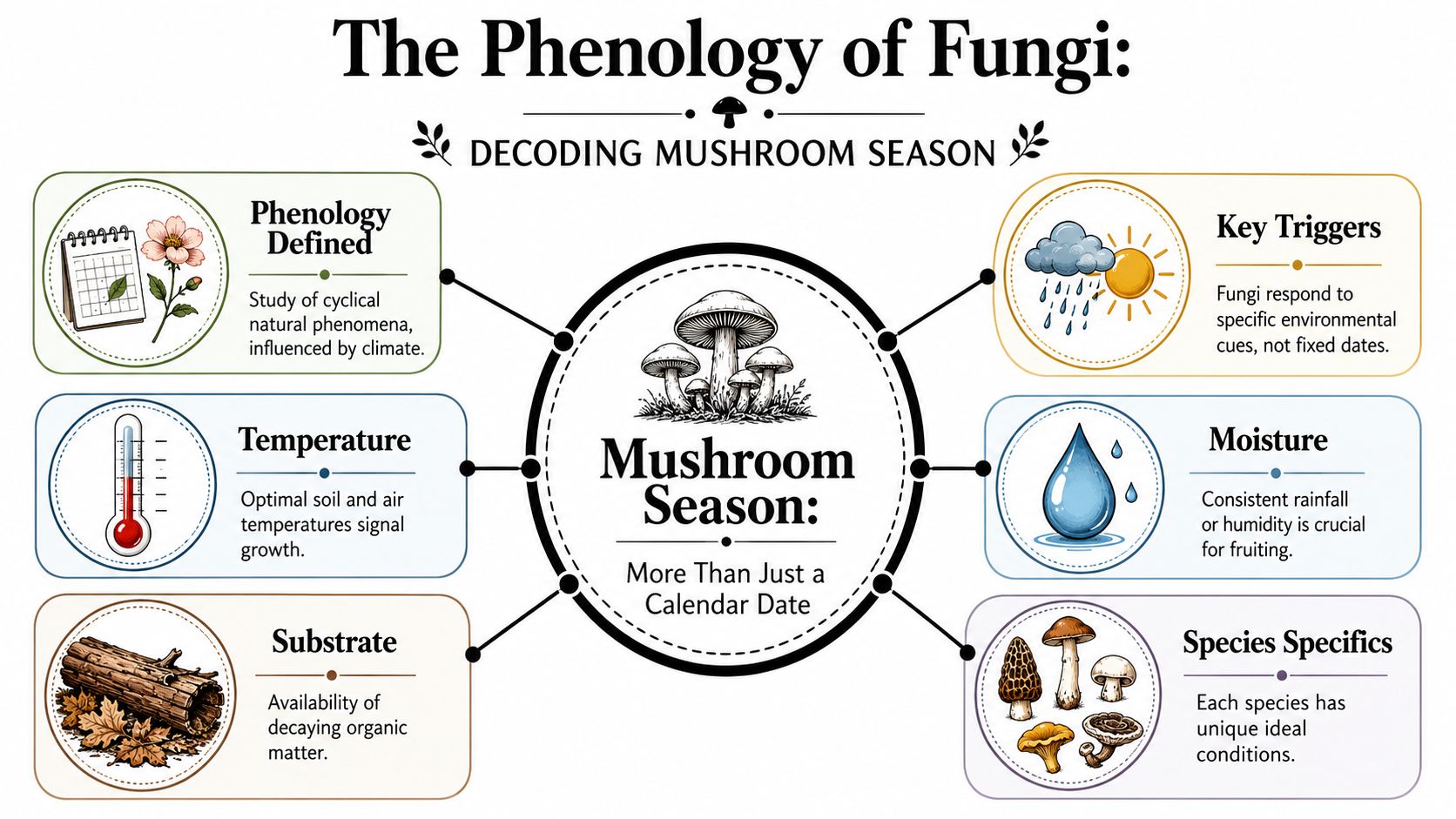
The key to mushroom hunting season is phenology, which is just a practical way of saying that living things respond to conditions, not dates. Trees leaf out when the weather and light line up. Wildflowers bloom when the soil and air tell them it's time. Mushrooms work the same way.
For morels, the best-known spring target in Michigan, the broad North American pattern is clear. The peak window is often April and May, they usually emerge when soil reaches about 50°F, and they fade as temperatures approach 60°F, according to MeatEater's guide to morel mushroom hunting.
Think like a baker, not a date-checker
If you bake bread, you know yeast won't rise just because the calendar says it should. It needs the right mix of warmth and moisture. Mushroom fruiting works in a similar way. The underground fungal network is there before you ever see a cap. The visible mushroom appears only when conditions line up.
Three drivers matter most:
- Soil warmth helps trigger spring fruiting. Cold ground can hold a season back even when the air feels pleasant.
- Moisture gives fungi what they need to develop fruit bodies. A dry warm spell often disappoints hunters who went out too early or too late.
- Air temperatures shape how long the window stays open. A sudden heat jump can shorten a promising patch.
Why Michigan never moves all at once
In the Great Lakes, local conditions scramble the calendar. South-facing slopes warm faster. Low wet woods stay cooler longer. Areas near the lakes can lag behind inland spots. Northern Michigan often follows southern Michigan after a delay because spring heat accumulates more slowly.
That's why experienced hunters don't ask only, “What month is it?” They ask better questions:
- Has the ground warmed enough?
- Did the area get steady rain?
- Is this habitat the kind that holds spring moisture?
- Are nearby plants and trees at the stage that usually matches fruiting?
Mushroom hunting season is a moving window. If you treat it like a fixed holiday, you'll miss it in some places and arrive too soon in others.
The lesson most people need first
The woods don't run on your schedule. That's not bad news. It's what makes foraging feel less like shopping and more like paying attention. Once you accept that, your decisions get sharper. You stop asking for a single statewide start date and start tracking a living process.
Reading the Signs from Weather and Nature
A forecast can tell you whether the weekend looks pleasant. A forager wants to know something narrower. Did the area get rain, has the soil warmed into the right range, and are the day and night temperatures supporting growth?
For morels, field guidance puts peak fruiting around 45–55°F soil temperatures, with daytime highs near 60°F and nighttime lows around 40°F after spring rain, as explained in Hunter-Ed's article on how to hunt for morel mushrooms. That's a useful working rule for Michigan and the broader Great Lakes.
What to watch after rain
Not every rain helps in the same way. A cold soaking rain followed by chilly nights may stall things. A warm rain followed by mild nights often creates the kind of window hunters wait for.
When I'm helping a beginner read conditions, I suggest this checklist:
- Feel the pattern, not one day: A single warm afternoon doesn't create a season by itself.
- Watch nighttime lows: Mild nights keep the ground from backsliding.
- Notice drying wind: Warm but breezy conditions can pull moisture out of the top layer fast.
- Revisit known habitat: The same place can switch from empty to productive within a short span when the weather lines up.
Use simple tools
You don't need a truck full of equipment. A cheap soil thermometer does more for timing than a lot of guesswork. Check shaded ground in likely habitat, not just open sunny edges that warm faster than the woods where you plan to hunt.
A notebook helps too. Write down the date, recent rain, trees present, and what you saw. After a season or two, your own notes become local knowledge.
Let plants give you clues
Many foragers also watch spring plants as rough indicators. You might notice mayapples, trilliums, and other woodland growth showing up alongside the seasonal shift you care about. Those signals aren't proof by themselves, but they can tell you the forest is entering the right phase.
The best mushroom hunters don't just look down. They read the whole woods.
That habit matters in Michigan because conditions can change from county to county, and even from one slope to the next. The more cues you gather from weather, soil, and plant life, the less random your timing feels.
A Foragers Calendar for Michigan and the Great Lakes
Michigan doesn't have one mushroom hunting season. It has a sequence. If you think in terms of waves rather than one big moment, the year opens up.
Morels usually get top billing because they're so seasonal. State guidance elsewhere shows how short that window can be. Iowa officials recommend beginning in early April and continuing through mid-May, which works out to roughly a 6- to 8-week hunting period, while Missouri describes the season as lasting just several weeks in spring, according to Iowa DNR's article on spotting morel mushrooms. Michigan follows the same broad truth. The season is exciting partly because it's brief and condition-dependent.
If you want a local deep dive on spring timing, this page on morel season in Michigan adds extra regional context.
Great Lakes Mushroom Season at a Glance
| Mushroom | Peak Season | Common Habitat |
|---|---|---|
| Morels | Spring | Near dead or dying elms, old apple orchards, creek and river bottoms, burn areas |
| Pheasant's Back | Spring into early warm season | On hardwood logs and stumps |
| Chanterelles | Summer | Mixed woods, often near hardwoods |
| Chicken of the Woods | Summer into early fall | On living or dead hardwoods |
| Hen of the Woods | Fall | At the base of oaks |
| Lion's Mane | Fall | On hardwood trunks and dead standing wood |
| Oyster mushrooms | Cool periods, often spring or fall | On dead or dying hardwood |
Early spring in Michigan
Morels are the headline species for good reason. They're one of the clearest examples of a true seasonal sprint. In Great Lakes woods, hunters often focus on dead elms, old orchards, creek bottoms, and other spots that hold moisture and organic activity.
Pheasant's Back, also called Dryad's Saddle, often shows up around the same broad part of the year when hardwood logs are waking up with spring moisture. It's easier to spot than many ground mushrooms because it grows shelf-like on wood. Beginners often find it encouraging because it teaches the habit of scanning logs and trunks, not just leaf litter.
Summer hunting in the region
By summer, the pace changes. Instead of sprinting for a narrow spring flush, you start watching for species that favor warmer settled weather.
Chanterelles are a classic Great Lakes target in this period. They reward patient forest walking and careful identification. They're often associated with hardwood-rich woods, and their appearance can feel less sudden than the burst of spring morel excitement.
Chicken of the Woods draws plenty of attention because of its color and bold shelf growth. It tends to appear on hardwoods, and it teaches a valuable lesson: many worthwhile mushrooms aren't tucked into the ground at all. They're right on the tree, visible once you train your eyes to scan trunks and fallen wood.
Fall favorites
Fall in Michigan is strong for wood-growing and base-of-tree species.
- Hen of the Woods: Often found at the base of oaks. It's a species many local foragers wait for every year.
- Lion's Mane: Look for it on hardwoods, especially dead standing wood and damaged trunks.
- Oyster mushrooms: These favor wood as well and often show best during cooler stretches.
A good forager's calendar isn't just a list of months. It pairs each season with the habitat you should be checking.
That shift in mindset helps a lot. Instead of saying, “It's July, what should I find?” ask, “It's midsummer after rain. Which local woods and which substrates make sense right now?”
Forage Safely with Smart Identification Practices
The most important rule in mushroom hunting season is blunt. Never eat a wild mushroom unless you are completely certain of the identification. Not pretty sure. Not close enough. Certain.
That's especially important in a region where changing weather can slide timing forward or backward. Recent coverage in 2026 notes that morel timing can stretch from March–July depending on elevation, rainfall, and soil warming, which matters because shifting seasons can confuse hunters who rely too heavily on old date expectations, as discussed in Salish Mushrooms' guide to finding morels in Washington. The location is different, but the lesson applies well to the Great Lakes. Conditions shift. Assumptions get people in trouble.
Morel and false morel confusion
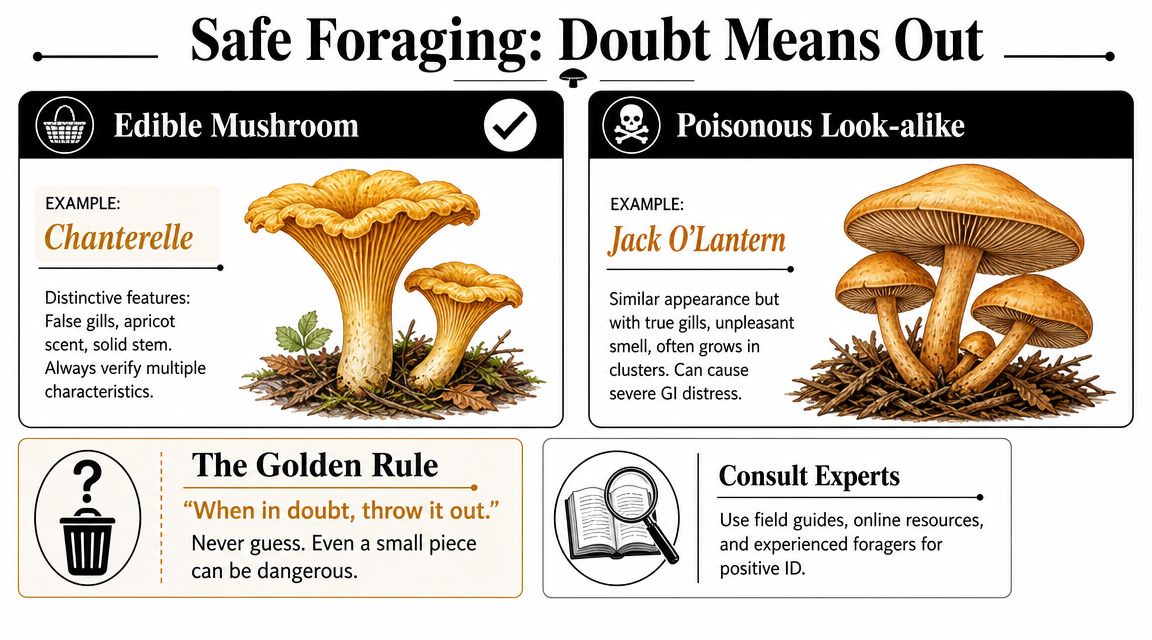
Michigan beginners often hear, “Just look for morels.” That advice leaves out the hard part. You also need to understand what can be confused with them.
A true morel has a distinct overall structure that experienced hunters learn to recognize from multiple features, not one. False morels are a separate problem. The safe approach is never to identify based on a quick glance, color alone, or one online photo.
If you're learning this comparison, slow down and use multiple references. A local guide to poisonous mushrooms in Michigan can help you study dangerous categories before you ever put anything in a pan.
Build a real identification process
A safe forager usually does several things before eating any wild mushroom:
Checks multiple traits
Look at cap structure, stem, attachment, habitat, growth pattern, and internal features.Uses more than one guide
One field guide is helpful. Two or three are better. Different photos and descriptions catch different details.Takes a spore print when relevant
Spore prints aren't needed for every species, but they're a valuable technique to learn.Gets local confirmation
A mycological society, experienced mentor, or trusted local identification group can save you from a bad decision.
“When in doubt, throw it out.”
That saying survives because it's right.
Why certainty matters more than enthusiasm
Beginners often feel pressure after finally finding something promising. That excitement can override caution. The smarter move is to treat uncertain finds as study material. Photograph them. Note the tree nearby. Cut one open. Compare later.
You don't lose by walking away from a mushroom you can't fully name. You win by staying healthy enough to keep learning the woods.
Essential Gear and Following the Rules of the Hunt
A solid mushroom kit is small. The right habits matter more than carrying a lot of stuff.
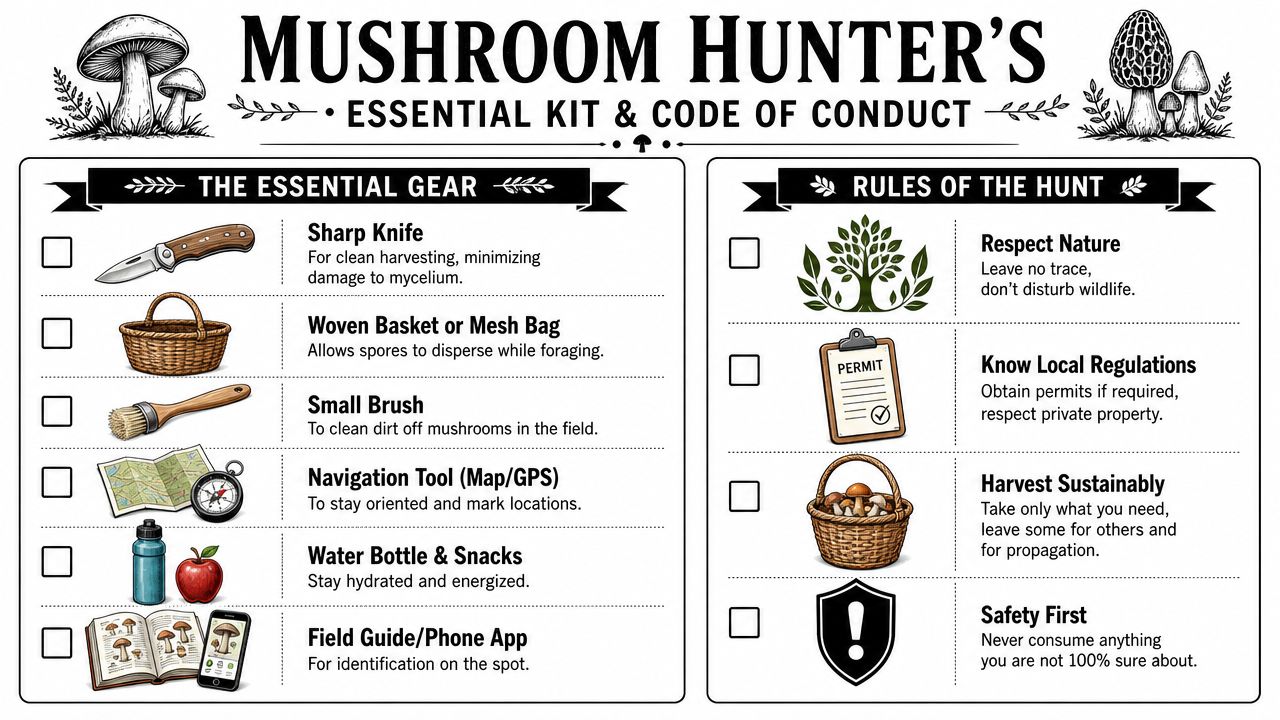
The short gear list that actually helps
Bring tools that make you safer, cleaner, and more observant:
- A sharp knife helps you harvest cleanly and inspect mushrooms in the field.
- A woven basket or mesh bag keeps finds from turning into a sweaty mess and is a traditional choice many foragers like.
- A small brush lets you remove dirt on the spot.
- A map or GPS tool matters more than people admit, especially in unfamiliar state or national forest land.
- Water and snacks keep you from rushing because you got tired or dehydrated.
- A field guide or trusted ID app gives you a reference in the woods, though it should support judgment, not replace it.
A short field video can help you see how experienced hunters move and think outdoors:
Access rules matter
Foraging ethics start with permission. Practical guidance often stresses checking access rules for public lands, avoiding private land without consent, and telling someone where you're going and when you expect to return, as noted in this discussion of mushroom hunting safety, legality, and access.
For Michigan hunters, that means doing the unglamorous work before the trip:
- Check the land status: State forest, recreation area, wildlife property, county park, and federal land can all have different rules.
- Get permission on private ground: A promising old orchard or fencerow is not yours to enter because it looks abandoned.
- Tell someone your plan: Share where you're parking and when you expect to return.
Harvest like you plan to come back
Good foragers don't strip a patch. They leave small specimens to grow, avoid trampling surrounding habitat, and take only what they'll use.
Field ethic: Leave the woods looking like you were never there, except for your boot prints and better knowledge.
That attitude pays off in two ways. It protects the resource, and it sharpens your eye. People who move carefully find more.
Embarking on Your First Mushroom Foray
Your first trip during mushroom hunting season doesn't need to end with a full basket. It should end with better instincts.
Start with one or two species that are widely discussed, easy to study carefully, and relevant to the season you're in. In Michigan, that often means spring morel scouting or fall observation of wood-growing mushrooms. Keep the goal modest. Learn the trees. Notice the moisture. Watch how one patch differs from another.
If conditions seem right, move slowly. Stop often. Scan ahead, then scan low, then look back from a different angle. Many mushrooms appear only when your eyes settle down enough to catch shape and texture instead of just color.
Keep safety at the center of everything. Don't rely on memory from one social media post. Don't eat anything you can't identify with confidence. Don't cross onto land without permission. Those aren't side notes. They're the foundation of the craft.
The deeper reward is easy to miss at first. Foraging teaches you your local environment in a different way. You stop seeing “the woods” as one flat category and start seeing warm slopes, damp bottoms, old hardwood edges, fallen trunks, and places that hold life differently through the season. That's when the Great Lakes stop feeling generic and start feeling familiar.
If you're exploring the broader world of mushrooms and want to browse curated products from a local Southeast Michigan business, Metro Mush offers an approachable online hub for adult customers in the Detroit and Ann Arbor area.