


A lot of people in Michigan hit the same point every spring. You’ve had enough of winter, the woods finally smell alive again, and you want a reason to get outside that feels a little more rewarding than another neighborhood walk.
That’s where morels get their hooks in.
If you already care about mushrooms, whether that means gourmet cooking, natural wellness, or curated products from shops around Detroit and Ann Arbor, wild foraging scratches a different itch. It’s slower. It asks more of you. And when you finally spot that first cap blending into last year’s leaves, the payoff feels earned in a way store-bought food never does.
Morel season michigan isn’t one single day on the calendar. It’s a moving window, a set of conditions, and a skill you build over time. The good news is Michigan is one of the best places in the Midwest to learn it.
The Thrill of the Hunt for Michigan's Elusive Morel
The first good morel hunt usually starts with doubt.
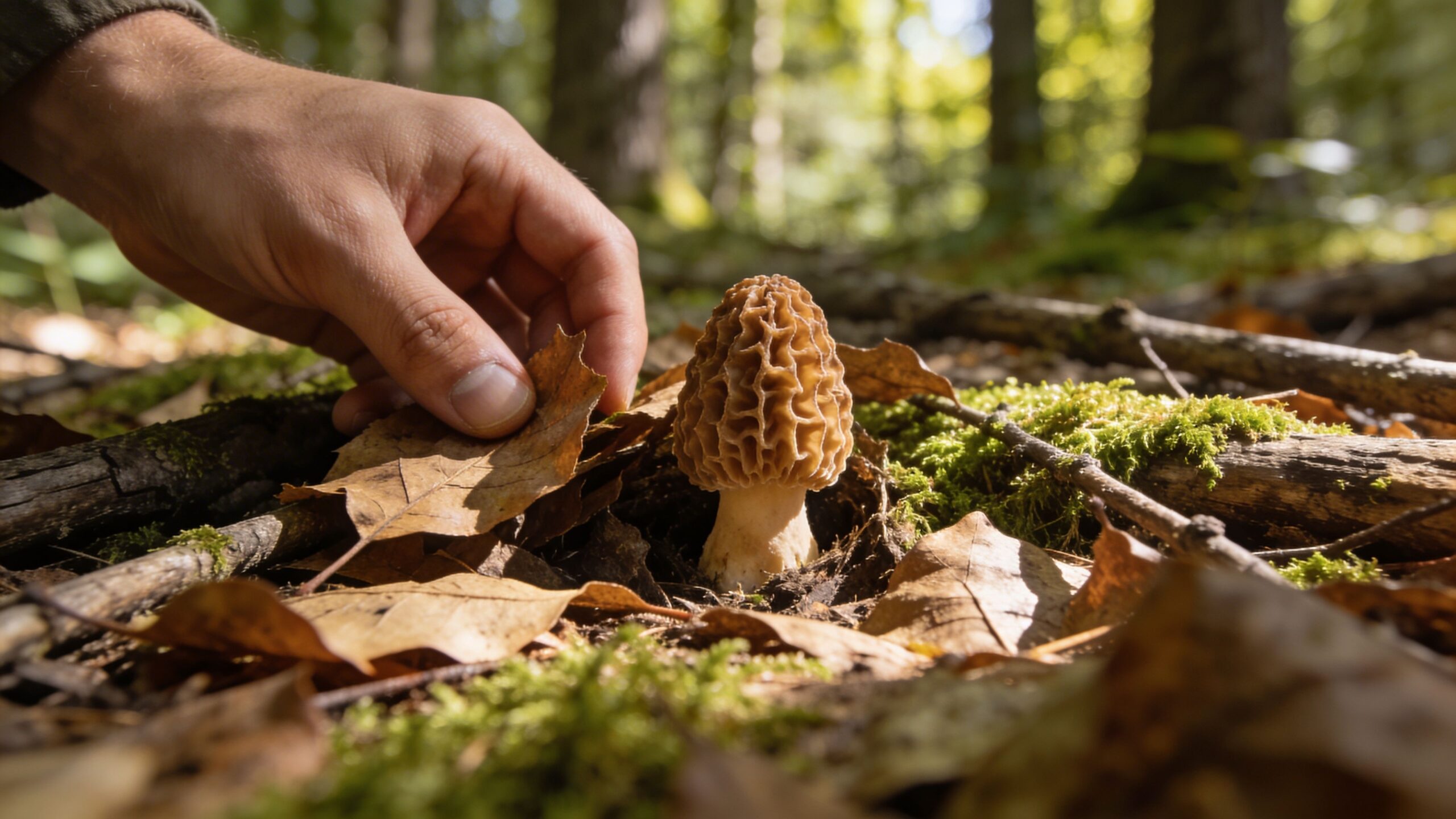
You walk for a while seeing nothing but sticks, wet leaves, and old grass. Then your eyes adjust. The forest floor stops looking random. Small shapes start standing out. A wrinkled cap near a dead elm. Another one a few feet away. Then four more you would’ve stepped past ten minutes earlier.
That shift is why morel hunting gets addictive.
Why morels matter so much
Morels have a rich, nutty, savory flavor that makes them one of the most prized wild mushrooms in the kitchen. But taste is only part of it.
Their season is brief. Their habitat can be picky. And they rarely announce themselves. You find them by slowing down, learning trees, reading moisture, and covering ground with purpose.
That challenge is the appeal.
Practical rule: Morel hunting rewards patience first, speed second. New foragers usually miss mushrooms because they’re scanning too broadly, not because the patch isn’t there.
Michigan adds another layer to the experience. Morels grow in all 83 counties of the state, and the season peaks in May, with a longer northward progression that stretches opportunity across much of spring (North Spore’s Michigan morel overview).
The main morels you’ll hear about
In casual Michigan foraging talk, people usually split them into a few practical groups:
- Black morels tend to be the early ones many hunters look for first.
- Half-free morels show up in spring too, and they can confuse beginners because their cap attachment differs from the classic mental image.
- Yellow or white morels are the ones many people associate with the larger late-season finds.
You don’t need to memorize Latin names on day one. You do need to learn what a true morel looks like and how to confirm it safely.
A good hunt also changes how you move through the woods. Instead of just “being outside,” you start noticing tree health, slope warmth, damp pockets, and old orchard edges. That’s part of the natural wellness appeal people often underestimate. The reward isn’t only what ends up in the pan. It’s the attention the hunt demands.
Decoding Morel Season in Michigan
The biggest beginner mistake is asking, “When does morel season start in Michigan?” as if the whole state flips on at once.
It doesn’t.
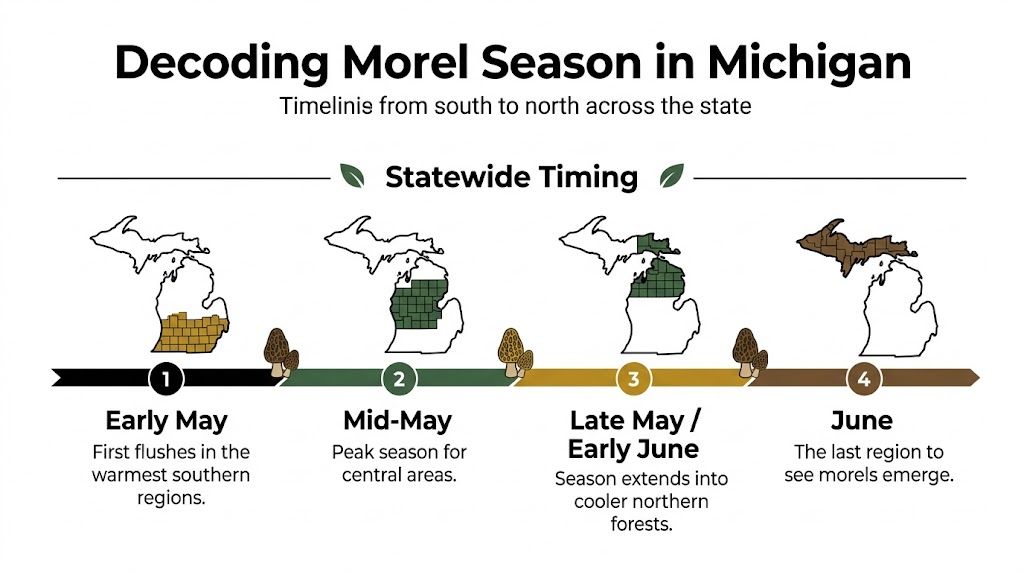
Michigan’s season moves like a wave from south to north. Peak season is May, but the broader window runs from mid-April in southern Michigan to mid-June in the Upper Peninsula, and the best trigger pattern is daytime temperatures around 60°F, nights above 40°F, and soil temperatures of 50 to 55°F after rain (North Spore’s seasonal timing guide).
Read the season like a progression
If you live in Metro Detroit or Ann Arbor, you’re usually watching the southern part of the state wake up first. Hunters farther north often hit their stride later.
That means one statewide date isn’t useful. A rolling calendar is.
- Southern Michigan often gets the early flush.
- Central areas usually follow as conditions stabilize.
- Northern Lower Michigan often comes on later.
- The Upper Peninsula can hold the tail end of the season into June.
If you want a broader seasonal context for different mushrooms, this guide to when mushroom season happens in Michigan is a helpful companion.
What works better than watching the calendar
A date alone won’t help much if the weather hasn’t lined up.
What works is combining a few field signals:
- Warm days in the low spring range, not summer heat.
- Nights that stop dipping too cold, because chilly overnight conditions can stall a flush.
- Recent moisture, especially a good rain followed by mild conditions.
- Soil warmth, because morels respond to what’s happening at ground level, not just in the air.
Go after a warm rain, not just a warm week. Dry warmth can make the woods feel promising while the ground still isn’t ready.
The trade-off most new hunters miss
Early season hunting has excitement. It also has lower odds if you jump too soon.
Late season hunting can be productive, but you’ll often deal with taller vegetation, more competition, and mushrooms that are easier to miss once the forest floor gets busy. The sweet spot is usually the moment conditions settle into a pattern instead of swinging wildly.
For 2026, early sightings reported on April 9 in places like Middleville and Hartford suggested a slightly early start moving northward, but that should be treated as a season indicator, not a guarantee for every county (North Spore’s 2026 observation note).
Identifying True Morels and Avoiding Dangerous Lookalikes
If you remember only one thing from this guide, make it this.
Never eat a wild mushroom because it “looks close enough.”
With morels, beginners get into trouble when they rely on a wrinkled cap alone. That’s not enough. You need a simple identification process that rules out lookalikes before anything reaches your kitchen. If you want a broader grounding in local species, this overview of wild mushrooms in Michigan is useful, but for morels the field check needs to be strict.
The two checks that matter most
A true morel should pass both of these tests when sliced lengthwise from the tip of the cap through the stem:
- Completely hollow interior
- Cap attached to the stem, rather than hanging loosely like a skirt
If you cut it open and see cottony fibers, webbing, chambered tissue, or a solid interior, stop. That’s not the mushroom to experiment with.
Why lookalikes fool people
False morels can still look “morel-ish” from above, especially when they’re dirty, crumpled, or partly emerged. That’s why top-down identification is weak.
The danger usually comes from one of two shortcuts:
- trusting the outside shape without cutting the mushroom open
- collecting in poor light and deciding later that it’s probably fine
Neither is worth it.
If you’re ever torn between “maybe edible” and “maybe not,” leave it in the woods.
True Morel vs. False Morel Identification
| Characteristic | True Morel (Morchella) | False Morel (Gyromitra/Verpa) |
|---|---|---|
| Cap surface | Pitted and ridged in a more organized honeycomb pattern | Often lobed, folded, wrinkled, or brain-like |
| Interior when cut lengthwise | Hollow from cap through stem | Often solid, chambered, cottony, or webbed inside |
| Cap attachment | Cap is attached to the stem | Cap may hang free or attach differently |
| Beginner confidence level | Safer only when both key checks are confirmed | High risk of confusion, not for guessing |
| Best action if unsure | Re-check, compare, and confirm | Do not eat |
A safe beginner routine
Start with habits, not confidence.
- Cut every single mushroom you plan to keep.
- Check it in daylight, not in the car at dusk.
- Keep unknowns separate from confirmed edible mushrooms.
- Don’t rely on one photo online as final proof.
- Cook only mushrooms you’ve positively identified.
Half-free morels can complicate things because they don’t match the classic full-attachment silhouette beginners expect. That’s one reason many experienced hunters tell new people to be conservative. If the mushroom creates uncertainty, skip it and keep walking.
The woods will always offer another chance. Your body doesn’t always get one.
Finding Your Secret Morel Spot
Good morel hunters don’t just “look in the woods.” They hunt habitat.
That’s the shift that starts producing mushrooms. Instead of wandering randomly, you begin narrowing the search to trees, terrain, and disturbance patterns that make morel growth more likely.
Start with the right trees
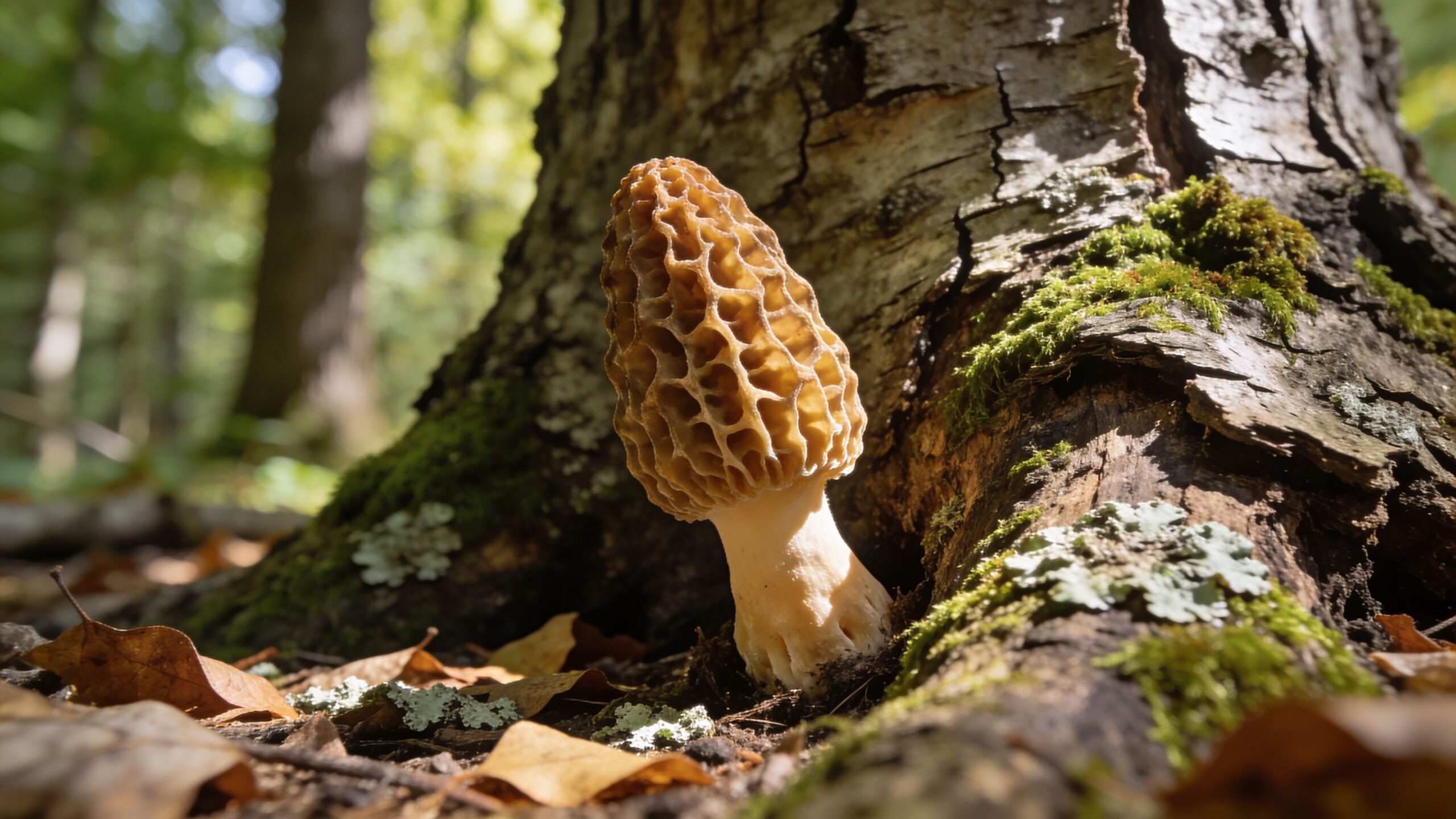
In Michigan, productive morel habitat often includes poplar, apple, and ash trees, and hunters also pay close attention to dying elms and old orchard ground. White morels are often associated with ash and old apple trees later in the season, while black morels tend to show first in other productive spring habitat, according to Michigan-focused reporting and field guidance already noted earlier in this article.
The practical lesson: Don’t spread your attention evenly.
Spend your time in places that have the right mix of:
- Tree associations that morels commonly favor
- Filtered spring light
- Moist but not swampy ground
- Leaf litter you can visually scan
- Enough openness to let you move and stop easily
Burn areas can change the game
Michigan’s DNR supports hunters with maps that overlay burn areas, and morels often emerge after wildfire or prescribed burns over 10 acres (North Spore’s Michigan morel notes).
That matters because burn sites give you a more targeted way to search than blind wandering. They don’t guarantee mushrooms, but they improve your odds if the timing and moisture cooperate.
A lot of people overlook this because they focus only on classic hardwood spots. That works, but it’s not the whole picture.
How I’d search a new area
If I’m walking unfamiliar ground, I don’t move at one speed the whole time.
I cover ground until I hit likely habitat. Then I slow down hard. If I spot one morel, I stop scanning the horizon and start working in tight circles because singles often have neighbors.
One morel means “search this patch,” not “drop it in the bag and keep marching.”
That habit saves time and finds more mushrooms than constant roaming.
Think like a forager, not a collector
A secret spot usually isn’t one magic GPS pin. It’s a repeatable habitat pattern you learn to recognize in different counties.
Michigan’s broad geography helps here. Morels grow in all 83 counties, which means your “spot” can be a kind of place rather than one place. Once you understand the pattern, the woods start offering options.
Demand is real, too. In Michigan, nearly half of certified morel foragers sell their harvest to local restaurants and pubs for an average of $36 per pound, which is one reason areas near strong hunting culture, including Mesick, draw so much attention (economic study summary in the NIH article).
That local demand also means good public-access areas can get picked over fast.
Here’s a useful visual before you head out into the field:
What doesn’t work
Some habits waste a lot of time:
- Hunting only by rumor instead of habitat clues
- Walking too fast through prime ground
- Ignoring old orchards and burn maps
- Returning to the exact same unproductive spot just because it feels familiar
Reliable hunters keep notes. They remember what trees were nearby, what the slope looked like, how wet the soil felt, and whether the patch produced black or white morels. That’s how secret spots are built.
Essential Gear and Foraging Etiquette
The gear list for morel hunting is short. The judgment list is longer.
You don’t need expensive equipment. You do need tools that help you harvest cleanly, stay oriented, and avoid turning a peaceful spring walk into a dumb problem.
What to bring
- Mesh bag or basket so your mushrooms can breathe while you walk.
- Knife for a clean cut at the stem.
- Compass, map, or GPS if you’re covering unfamiliar ground.
- Good boots because spring woods often stay wet longer than anticipated.
- Layers and tick awareness because Michigan’s shoulder season can swing fast.
- Water and a small snack so you don’t rush the back half of your hunt.
A simple bag setup beats overpacking. More gear rarely finds more mushrooms.
What good etiquette looks like
The woods remember how people behave.
A respectful hunter does a few basic things:
- Ask permission on private land. Don’t assume unused land is open land.
- Follow public land rules. In Michigan, morels harvested on public land are for personal use only, not for sale, according to state and industry guidance noted in the verified data.
- Harvest gently. Cut or pinch carefully instead of tearing up the surrounding ground.
- Leave some behind. Cleaning out every mushroom you find is short-sighted.
- Don’t trash a patch. Stay light on the land and don’t rake leaves or stomp habitat apart.
Commercial picking is a different lane
Selling wild morels in Michigan isn’t just a matter of finding enough of them. The state requires a certification curriculum developed by the Midwest American Mycological Society for people harvesting and selling wild mushrooms commercially, including morels (Michigan wild foraged mushroom information from MDARD).
That’s a line worth respecting.
If your interest in mushrooms also includes cultivated or curated products, those belong in a different category from wild harvest. For example, Metro Mush carries prepared psilocybin products for adults in Southeast Michigan. That’s separate from the legal, identification, and land-use responsibilities that come with picking wild morels yourself.
From Forest to Table Preservation and Cooking
Fresh morels are delicate. Handle them like something you worked hard to find, because you did.
Most mistakes happen after the hunt. People soak them too long, trap them in bad storage, or bury their flavor under heavy cooking.
Cleaning without ruining them
Start dry.
Brush off loose dirt and forest debris first. Then cut each mushroom lengthwise. That second step matters for both cleaning and one final visual confirmation. If you find grit or tiny insects inside, shake or brush them out gently.
If the mushrooms are especially dirty, a quick rinse is fine. What doesn’t work is long soaking. That turns a great mushroom soft and waterlogged.
Clean for texture, not for perfection. A little forest character is better than a sponge.
Best ways to preserve them
Two methods make practical sense:
- Drying works well if you want long storage and concentrated flavor.
- Freezing works if you prefer a quicker process and plan to cook them later.
If you already use dehydration for other mushrooms, the same basic discipline applies. This guide on drying mushrooms properly is about a different mushroom category, but the storage mindset is still useful: low moisture, good airflow, and careful handling.
Keep the cooking simple
Morels don’t need much.
A classic sauté with butter, garlic, and a little cream lets their nutty, earthy character stay in front. They’re also excellent with eggs, on toast, folded into pasta, or spooned over roasted meat.
Always cook morels before eating them. And if it’s your first time, keep the portion modest. Even with properly identified wild mushrooms, easing in is just common sense.
Your Michigan Morel Questions Answered
A few questions come up every season, especially once someone goes from curious walker to active hunter.
Can I legally sell the morels I find
Not automatically.
Michigan requires certification for people harvesting and selling wild mushrooms commercially, including morels, through a curriculum developed by the Midwest American Mycological Society, and public land harvests are for personal use only under the guidance cited earlier from MDARD and the Michigan-focused economic research.
This highlights the trade-off. A hobby hunt is simple. Commercial sale adds rules, food safety responsibility, and sourcing limits.
Is climate variability changing morel season michigan
Yes, in practical terms.
The old spring rhythm still matters, but more hunters now pay close attention to warm rains, overnight temperatures, and soil warmth because erratic springs can compress or shift the productive window. Michigan State University guidance summarized in the verified data also points to morels emerging after warm rains as soil approaches the key temperature range, and to the value of tracking your own spots year after year instead of relying only on a generalized statewide forecast.
The lesson is to watch conditions, not just tradition.
What’s the best way to clean really gritty morels
Split them lengthwise first.
That lets you inspect the hollow center, remove debris, and shake out insects. Brush whenever you can. If grit is packed in, give them a brief rinse and dry them promptly on towels before cooking.
Long soaking usually creates a worse problem than the dirt you started with.
Are some years just bad years
Absolutely.
You can do everything right and still hit poor timing, dry ground, or a patch that already finished. That doesn’t mean your habitat read was wrong. It may just mean the window was short.
The hunters who improve fastest are the ones who keep notes and return with better timing, not the ones who assume one empty walk means a place is worthless forever.
What’s the deeper reward if I’m already into mushroom culture
Foraging gives you contact with the source material of that interest.
Curated mushroom products fit one kind of experience. A spring morel hunt gives you another. It gets you outside, makes you pay attention, and turns a Michigan forest into something interactive instead of scenic background. Even if you come home with a modest haul, the hunt itself is part of the return.
If you’re part of Michigan’s broader mushroom community and want both sides of that experience, wild spring foraging on one hand and curated adult mushroom products on the other, Metro Mush is a practical place to browse what’s available in the Detroit and Ann Arbor area while you wait for the woods to warm up.