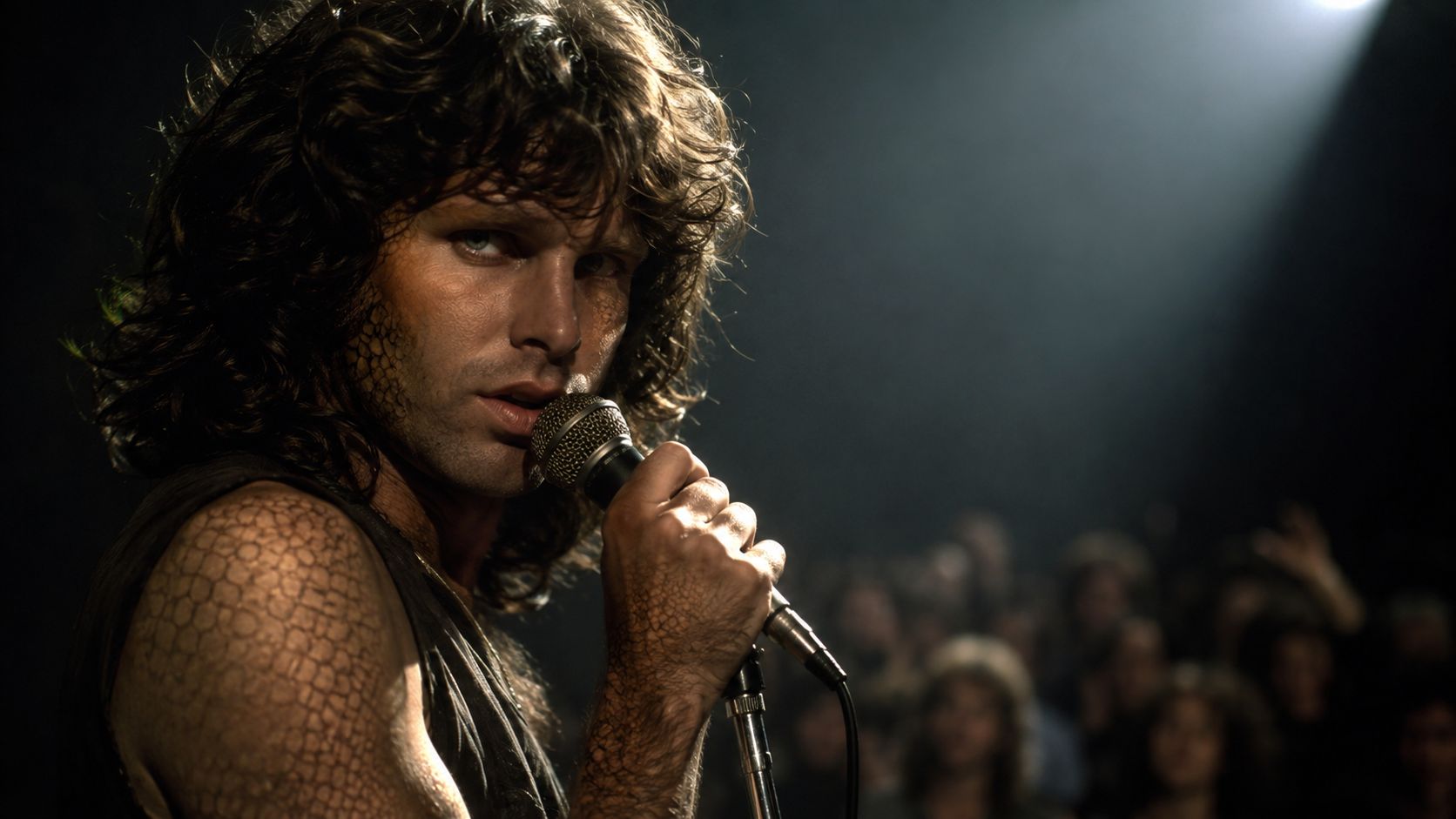
The room is dark, the band is locked in, and Jim Morrison steps to the microphone like he's about to announce a prophecy instead of a song. Then comes the line that has outlived the concert, the decade, and in some ways the man himself: “I am the Lizard King, I can do anything.”
An Introduction to the Lizard King
A lot of famous rock phrases survive because they sound cool. This one survived because it sounds like it means more than it says.
If you hear “I am the Lizard King” for the first time, the obvious question is simple. What on earth was Morrison talking about? A nickname? A joke? A bit of stage theater? The short answer is yes, but only partly. The phrase works because it sits at the intersection of poetry, performance, ego, myth, and altered consciousness.
The Doors emerged in a moment when American youth culture was already pushing against old boundaries. People were experimenting with sound, sexuality, spirituality, politics, and states of mind. Morrison fit that world perfectly, but not as a tidy spokesperson. He came across as magnetic, unruly, literary, and often deliberately hard to pin down.
That's why the Lizard King idea matters. It wasn't just branding before branding. It was a persona that let Morrison become more than a frontman onstage. He could act like a poet-priest one minute, a drunken provocateur the next, then slip into something stranger, more symbolic, almost ritualistic.
The phrase keeps pulling people back because it feels less like a slogan and more like a doorway.
Readers often get stuck on the literal animal image. They assume “lizard” must be random or purely psychedelic decoration. But Morrison's reptile imagery feels purposeful. It evokes something ancient, instinctive, low to the ground, not polished by polite society. In the world The Doors created, that wasn't an insult. It was power.
So when people search for the meaning of I am the Lizard King, they're really asking a larger question. What kind of self was Morrison trying to summon, and why does that character still feel alive?
The Origin of a Rock and Roll Myth
The historical starting point is more concrete than many people realize.
The phrase came from a poem, not a casual interview line
Jim Morrison's nickname “the Lizard King” became widely associated with him in the late 1960s and was cemented by the 1968 poem “The Celebration of the Lizard,” which he first presented as a long-form spoken-word and poetic performance before the Doors' music audience. Morrison was born in 1943 and died in 1971, which ties the phrase tightly to a specific era of American rock culture, as summarized in the historical overview of the Lizard King persona.
That timeline matters because it clears up a common misunderstanding. Morrison didn't start with a mass-market persona and then backfill it with symbolism later. The Lizard King identity emerged from his own poetic world first, and then spread outward through live performance, fan memory, and rock mythology.
Why the poem mattered so much
“The Celebration of the Lizard” wasn't just a clever title. It was one of Morrison's grand attempts to fuse poetry, theater, music, and myth into a single experience. He wasn't merely singing lyrics over chords. He was trying to stage a symbolic journey.
That helps explain why the line hits with such force. It isn't presented as a dry self-description. It arrives like a transformation scene. Morrison isn't telling the audience who he is in ordinary biographical terms. He's declaring entry into another identity, one that operates by different rules.
Readers often ask whether the line should be taken literally, ironically, or theatrically. The best answer is that Morrison's art often depended on all three at once.
A simple way to place the phrase in context
If you're trying to understand the origin without getting lost in fan lore, keep these points in view:
- It began in Morrison's poetry. The line belongs to a larger imaginative framework, not an isolated catchphrase.
- It was delivered live. That matters because spoken performance gave it dramatic force.
- Fans turned it into shorthand. Over time, one line became the key to an entire public image.
- The image outgrew the poem. Many people know the phrase who have never read or heard the larger work.
Historical takeaway: The Lizard King wasn't invented by hindsight alone. Morrison introduced it as part of a poetic and performative identity during his own lifetime.
This is also where the myth machine of rock culture takes over. Once audiences hear a line like that from a singer like Morrison, they don't just remember it. They build around it. They repeat it. They turn it into a title, then a legend, then a lens for everything else the artist did.
That's how one poetic declaration became one of the most durable pieces of 1960s lore.
Deconstructing What the Lizard King Symbolized
The phrase gets flatter than it deserves when people treat it as nothing more than swagger. Morrison's line has swagger, sure. But its staying power comes from symbolism.
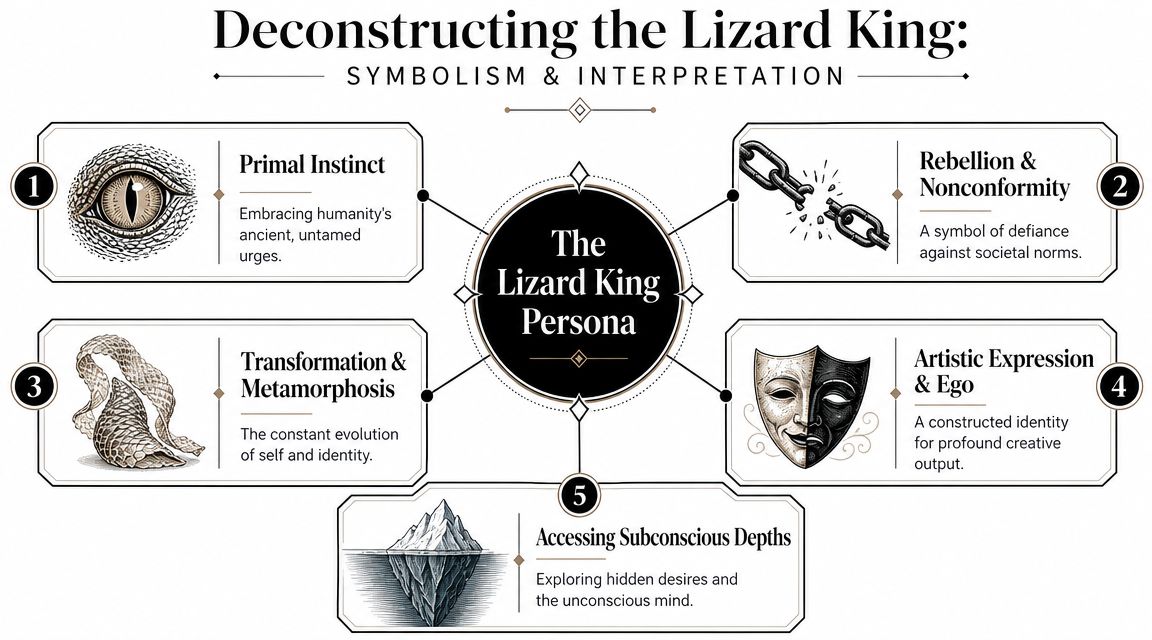
A key underserved angle in existing coverage is the meaning behind the phrase itself. Much of the discussion stops at repeating the quote, instead of asking why Morrison used reptile imagery, how it worked inside The Doors' performance mythology, or how later readers recast it as an “edgewalker” or disruption metaphor, as noted in this discussion of the quote's interpretive gap.
The lizard as a primal image
Lizards carry a very old symbolic charge. They suggest survival, instinct, heat, stillness, sudden movement. They belong to a world beneath polished civilization. That makes them useful if you want to express a self that's raw, ancient, and not fully socialized.
Morrison's public image already leaned in that direction. He often appeared less interested in neat self-explanation than in crossing into zones most performers only hinted at. The Lizard King persona gave him a compact way to represent that crossing.
Here's a simple way to read the symbol:
| Symbolic thread | What it suggests |
|---|---|
| Primal creature | A self guided by instinct rather than decorum |
| Cold-blooded survivor | Toughness, watchfulness, adaptation |
| Earth-bound animal | Contact with the body, appetite, and the physical world |
| Shedding skin | Reinvention, metamorphosis, altered identity |
The stage persona as ritual mask
Rock performance often invites exaggeration. Morrison went further. He seemed to understand the stage as a place where identity could become ceremonial. The singer steps forward, but so does an alter ego.
That's one reason “king” matters as much as “lizard.” The phrase doesn't say he's merely reptilian. It gives command, hierarchy, drama. It exalts an instinctive creature into a ruling figure, almost a mythic sovereign of the subconscious.
Morrison's genius was to make performance feel like revelation, even when it may also have been provocation.
Readers sometimes get confused. Was he sincere, or was he acting? In a lot of late 1960s performance culture, that split doesn't hold. The act was part of the sincerity. A persona could be artificial and still reveal something real.
The edgewalker idea
The later “edgewalker” reading is useful because it captures the sense of someone living at thresholds. Not comfortably inside ordinary social rules, but not fully outside them either. The edgewalker crosses lines between reason and instinct, restraint and release, civilization and wildness.
That fits Morrison's mythology because he often appeared to court thresholds of all kinds:
- Art and chaos
- Poetry and rock spectacle
- Control and surrender
- Everyday consciousness and altered states
A persona like the Lizard King let him inhabit those thresholds dramatically. He could become a figure of transgression without needing to explain that transgression in plain prose.
Rebellion, but not the simple kind
The Lizard King also symbolizes rebellion, though not just the standard youth-culture version. It's deeper than “ignore your parents” or “break the rules.” Morrison's persona hints at revolt against the disciplined, managed, overly rational self.
That's why the phrase still resonates with people interested in counterculture, psychology, and consciousness. It suggests that something essential in the human being has been buried under routines, institutions, and polite masks.
Interpretive caution: If you read the line only as rock-star bragging, you miss the symbolic machinery that made it memorable in the first place.
So what did the Lizard King symbolize? A primal self. A ritual self. A rebellious self. A self in transformation. Above all, a self willing to walk into the dark interior spaces that mainstream culture prefers to keep lit and orderly.
The Connection to the Psychedelic Experience
The Lizard King persona makes immediate sense once you place it beside the broader psychedelic imagination of the late 1960s.
Psychedelic culture has always been fascinated by transformation. The ordinary self loosens. Boundaries shift. Symbols become charged. Animals, masks, environments, and archetypal figures can feel less like decorative images and more like active presences in the mind. Morrison's reptile-king identity fits that symbolic terrain very well.
Why reptile imagery feels at home in altered states
People often describe altered states through images of metamorphosis, bodily intensity, and encounters with something ancient or buried. Even without reducing everything to one explanation, it's easy to see why a lizard image would resonate. Reptiles suggest old layers of mind, instinctive reactions, and forms of awareness that feel pre-verbal.
That doesn't mean Morrison was giving a clinical map of psychedelic states. He was making art. But art often gets at these experiences more accurately than literal explanation does.
A helpful way to think about it is this:
- Shedding skin mirrors the feeling of leaving behind a familiar version of the self.
- Cold, watchful animal imagery echoes contact with deep instinct.
- Kingship introduces mastery, expansion, and grandiosity, all of which can appear in visionary states.
- Mythic speech matches the way altered consciousness can make language feel ceremonial or charged.
The shamanic flavor of the persona
Morrison's stage image also overlaps with a loose, countercultural idea of the shaman. Not in the strict anthropological sense, and not as a claim that he held an actual ritual role within a traditional culture. But as a modern symbolic figure, the comparison helps.
The shaman goes to the edge, crosses into another mode of perception, and returns with songs, warnings, visions, or trouble. Morrison's performances often carried that sense of dangerous passage. He wasn't offering calm self-help. He was dramatizing psychic descent and return.
Psychedelic culture didn't just celebrate escape. At its most serious, it asked what happens when a person encounters more of the mind than ordinary life can comfortably hold.
That's one reason the phrase still attracts readers interested in consciousness. It sounds like ego expansion, but it also hints at ego dissolution. The person speaking is somehow larger than the ordinary self, yet also less fixed. Human and animal. poet and mask. performer and vessel.
For readers who want a more grounded look at how altered states can affect perception and cognition, Metro Mush has a plain-language guide on psilocybin effects on the brain. It's useful if you want to connect the symbolic side of psychedelic culture with a more practical discussion of experience.
Why the phrase still lands today
The modern audience may not stand in a 1960s concert hall, but the appeal hasn't vanished. People still look for language that can describe moments when the self feels unstable, newly open, or strangely expanded. Most everyday vocabulary is bad at this. Morrison's phrase isn't.
It's theatrical, yes. It's excessive, yes. But altered states often feel excessive compared with normal speech. “I am the Lizard King” survives because it gives dramatic form to an inner event that many people recognize even if they'd never use those exact words.
The Lizard King's Legacy in Pop Culture
Some phrases stay attached to one artist and fade with the era. This one kept traveling.
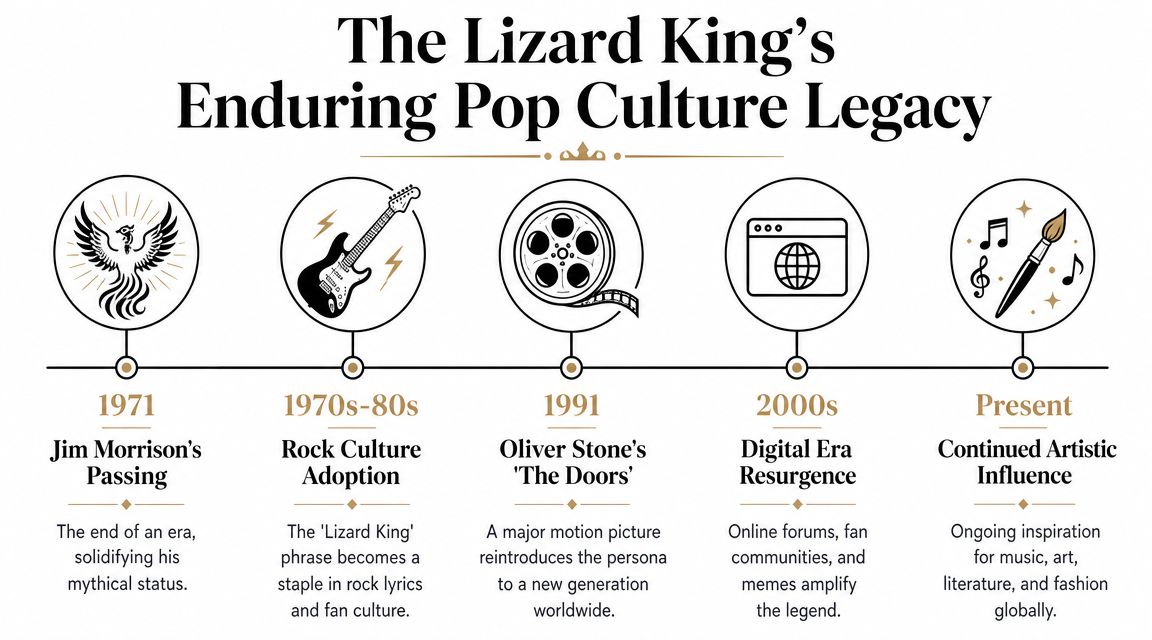
After Morrison's death, the Lizard King image hardened into legend. That's often what happens when a performer dies young. The person disappears, but the persona becomes portable. Fans, filmmakers, writers, musicians, and marketers can all pick it up and use it for their own purposes.
How the phrase changed over time
At first, the Lizard King mainly functioned as rock myth. It was shorthand for Morrison's intensity, erotic charge, poetic weirdness, and self-destructive aura. Later, it became a broader cultural reference point. People who knew little else about The Doors often still knew the line.
That broadening has produced several different versions of the phrase in circulation:
| Version of the Lizard King | How people use it now |
|---|---|
| Rock icon | A symbol of Morrison's stage mythology |
| Counterculture emblem | A shorthand for rebellion and altered consciousness |
| Camp reference | A slightly exaggerated symbol of classic rock excess |
| Modern metaphor | A figure for disruption, edge-walking, or identity play |
A more recent underserved angle is the phrase's post-2024 afterlife. Recent coverage shows “The Lizard King” being reused in unrelated contexts, including a 2025 leadership article that treats it as a model for strategic disruption and a music release using the title for a club track. The broader point, discussed in this 2025 reflection on the Edgewalker and the Lizard King, is that the phrase now functions as a multi-meaning cultural keyword rather than a single rock reference.
The science detour that nobody expects
One of the strangest and most delightful pieces of Morrison's afterlife appears in paleontology. Barbaturex morrisoni was an Eocene lizard from Myanmar that measured about 6 feet (1.8 meters) from nose to tail and weighed roughly 68 pounds (30 kilograms), and it was named in honor of Morrison's Lizard King persona, as reported in Live Science's coverage of Barbaturex morrisoni.
That fact matters for more than novelty. It shows how thoroughly the image escaped its original setting. A poetic-rock persona became memorable enough to leave a trace in scientific naming. That's a rare kind of cultural migration.
A myth has really taken hold when it can move from stage lights to fossil records without losing its charge.
Legacy in present-day niche culture
The phrase also keeps resurfacing in more specialized communities. Some are musical, some literary, some psychedelic, some internet-native. In those spaces, the Lizard King can mean Morrison specifically, but it can also suggest a mood: visionary, primal, eccentric, transgressive.
That helps explain why the phrase now appears around products, playlists, essays, memes, and strain names. If you're curious about one of those modern offshoots, Metro Mush maintains a Lizard King mushrooms guide and archive focused on that contemporary usage.
What's interesting is that none of these newer uses fully cancels the older one. The phrase keeps layering meanings rather than replacing them. A person might encounter it through rock history, then through internet culture, then through psychedelia, then through a leadership article using it as a metaphor for strategic risk.
That's not dilution. It's what successful myths do. They mutate.
Exploring the Mythos Further
The lasting power of “I am the Lizard King” comes from its unusual mix of specificity and openness. It points to a real artist, a real performance context, and a real moment in late 1960s culture. At the same time, it invites interpretation. That's why it keeps attracting people interested in poetry, performance, symbolism, consciousness, and counterculture.
If you want to go deeper, the smartest approach is to explore Morrison in multiple modes, not just as a singer frozen inside a famous quote. Listen to The Doors with an ear for theatricality and spoken-word texture. Read Morrison's poetry to see how image and persona interact on the page. Then place all of it back into the wider currents of the era, where mysticism, rebellion, and altered states constantly overlapped.
A good next reading and listening path
- Start with The Doors recordings that foreground Morrison's dramatic vocal presence and taste for incantatory language.
- Read Morrison's poetry so the Lizard King persona appears in a literary, not just musical, setting.
- Look for biographies and critical studies that treat him as a writer and performer, not only as a scandal magnet.
- Compare rock mythology with consciousness studies if you're interested in how symbolic identities emerge around altered states.
- Keep one foot in the present by reading material on contemporary psychedelic culture, including practical explainers like this guide to what psychedelic therapy is.
The best way to understand Morrison is to resist the easiest caricature. The wilder the legend gets, the more useful it is to return to the work itself.
In the end, the line survives because it still feels active. It doesn't sit there like a museum label. It still asks something of the listener. Are you hearing a boast, a mask, a myth, a psychedelic metaphor, or a ritual declaration? Probably all of them.
If you're exploring the overlap between counterculture history and modern mushroom culture, Metro Mush publishes practical guides and strain-specific content for adult readers who want a clearer vocabulary for these conversations.