You're probably here because the terms sound simple, but the decision doesn't. One person says microdosing helps them stay creative and steady through the workweek. Another says macrodosing gave them a deep, life-shifting experience. Then you start looking at products, hearing different dose language, and wondering whether these are just two sizes of the same thing.
They aren't.
For most adults trying to understand microdosing vs macrodosing, the core question isn't “Which one is better?” It's “What am I trying to do?” If your goal is subtle support that fits into ordinary life, that points one direction. If your goal is a fully immersive psychedelic experience with introspection and strong perceptual change, that points another.
That's the frame that helps most. Think of microdosing and macrodosing as different tools for different jobs. The safest and most useful choice usually starts with intention, not curiosity alone.
Understanding Two Distinct Psychedelic Paths
A lot of confusion comes from treating dose like a volume knob. Turn it down and you get microdosing. Turn it up and you get macrodosing. In practice, the split is bigger than that.
Microdosing is commonly defined as taking about one-tenth to one-twentieth of a macrodose, a pattern that emerged from James Fadiman's 2011 work, according to a peer-reviewed review in Therapeutic Advances in Psychopharmacology discussed in this review of psychedelic microdosing. That same review notes that observational studies have reported improvements in creativity, mood, and cognition, while also noting side effects such as insomnia, headaches, anxiety, and increased neuroticism in some users.
That matters because microdosing is meant to avoid a full trip. A person using this approach is usually not looking for strong hallucinations, major time distortion, or a day built around the experience.
Macrodosing aims at the opposite end of the spectrum. It's an intentional psychedelic event. People generally choose it because they want depth, not subtlety. That can mean emotional intensity, visual changes, spiritual or personal reflection, and a setting that gives the experience room to unfold.
The clearest way to think about it is this. Microdosing tries to fit around daily life. Macrodosing usually asks daily life to pause.
For Michigan readers, that distinction helps with practical decisions. If you need to drive, work, care for kids, or manage a normal schedule, a full psychedelic dose isn't compatible with that. If you're considering a stronger experience, planning and environment become part of the dose decision, not an afterthought.
What Are Microdosing and Macrodosing
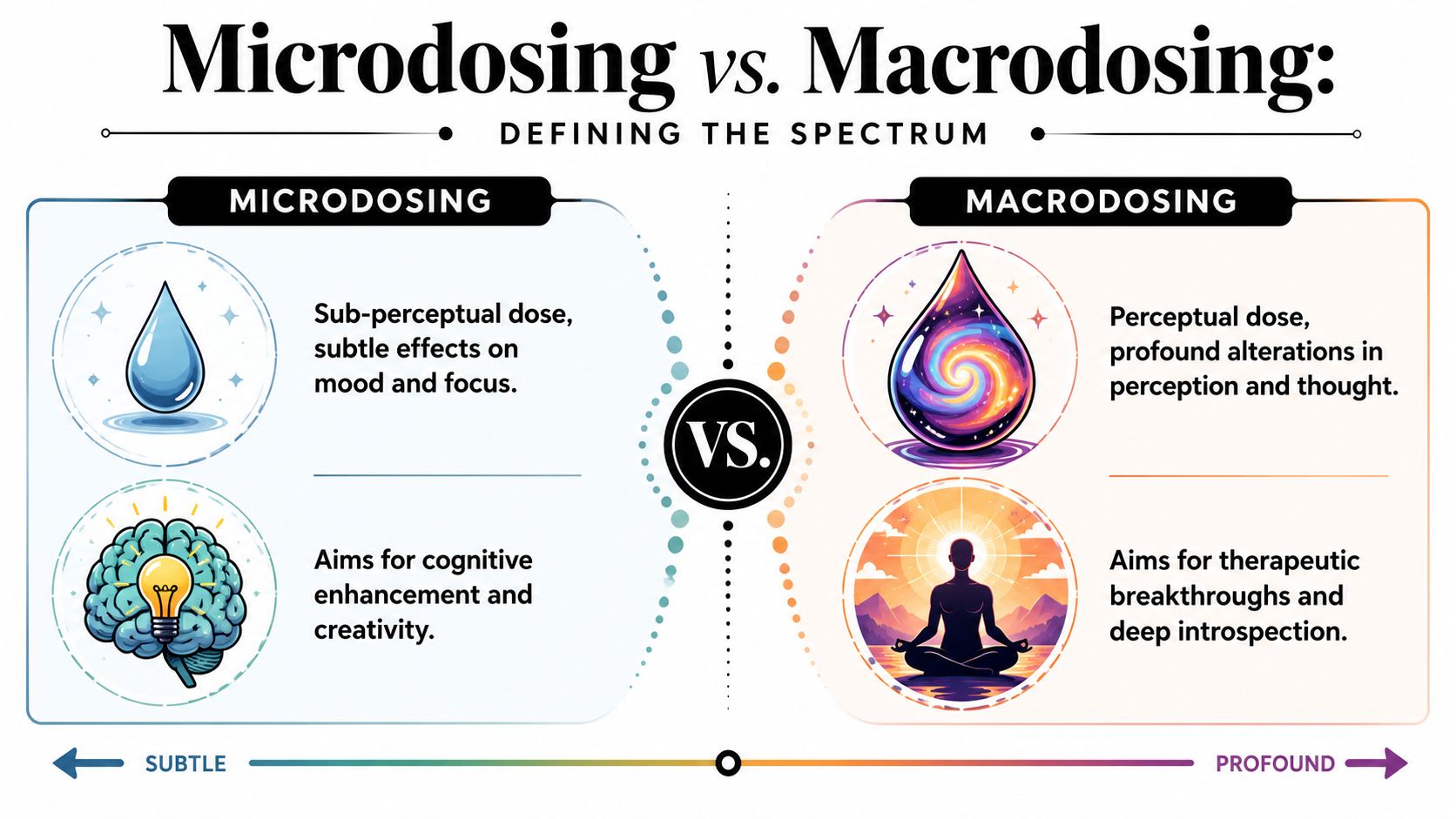
A good way to separate these two approaches is to stop treating them like stronger versus weaker versions of the same thing. They are different dosing strategies with different uses. One is built for subtlety. The other is built for a full psychedelic experience.
| Characteristic | Microdosing | Macrodosing |
|---|---|---|
| Basic idea | Very small, subperceptual or barely perceptible amount | Full psychedelic dose intended to be clearly felt |
| Typical goal | Subtle support for mood, focus, or creativity | Deep introspection, emotional processing, or a full trip |
| Daily functioning | Often intended to preserve it | Usually disrupts it for the duration |
| Sensory effects | Minimal or absent | Strong changes in perception, emotion, and time |
| Planning needed | Dose awareness and schedule | Stronger attention to setting, time, and support |
Microdosing in practical terms
A microdose is a very small amount taken with the intention of staying below the threshold of a classic trip. Clinical education from the Johns Hopkins Center for Psychedelic and Consciousness Research describes psychedelic dosing as a spectrum, which helps explain why a microdose is defined more by its effect than by a single universal number.
That point causes a lot of confusion. “Subperceptual” does not always mean a person feels nothing at all. It usually means the experience stays mild enough that there are no strong visual effects, no major time distortion, and no obvious loss of normal functioning.
A microdose works like using a dimmer switch instead of flipping on stadium lights. The change, if felt, is modest. For some Michigan consumers, that makes microdosing the better fit when the goal is cautious experimentation, routine-friendly use, or interest in subtle shifts rather than immersion.
Common examples of when someone leans toward microdosing:
- Workday curiosity: They want to explore subtle changes without setting aside a whole day.
- Routine-minded use: They prefer a repeatable, lower-intensity approach.
- Cautious first steps: They're not ready for a strong psychedelic experience.
Macrodosing in practical terms
A macrodose is a clearly noticeable amount taken with the expectation of marked psychedelic effects. That often includes stronger emotional shifts, changes in perception, and a much greater need to protect the setting and the schedule. If you want a fuller explanation of why those effects can feel so different, this overview of how psilocybin affects the brain gives useful background.
Macrodosing is closer to blocking off the whole day for one tool to do one job. People usually choose this route for inward work, emotional release, spiritual reflection, or a complete psychedelic session. That choice calls for more preparation, more caution, and no competing responsibilities.
A short visual overview helps if you're still sorting out the spectrum.
Purpose shapes the dose choice
The amount matters, but the purpose matters more.
- Microdosing usually fits goals that call for subtlety, consistency, and lower disruption.
- Macrodosing usually fits goals that call for depth, intensity, and dedicated time.
- Neither is better in every situation. They are different tools for different outcomes.
That mindset helps people make smarter choices. Someone looking for a measured, pre-dosed option for light experimentation should not shop the same way as someone planning a strong, hours-long experience. For Michigan readers, especially those buying locally through Metro Mush, that means starting with intention first, then choosing a product format and dose range that matches it.
A Detailed Comparison of Effects and Duration
A side-by-side comparison makes the difference clearer than any simple pro and con list.
How the experience usually feels
Microdosing is often described in functional terms. People may look for slight changes in mood, mental flexibility, or creative flow without obvious disruption. If the dose feels strongly psychedelic, many users would say it's no longer doing the job of a microdose.
Macrodosing is more immersive. The person usually expects clear changes in perception, stronger emotions, altered time sense, and a more inward experience. Ordinary tasks can become difficult or inappropriate during that window.
Practical rule: If your plan includes normal errands, work meetings, or driving, you're thinking in microdose territory. If your plan requires a protected environment and a clear schedule, you're thinking in macrodose territory.
Onset and time commitment
The exact timeline can vary based on body, product type, food intake, and setting. What matters most for decision-making is the difference in how much of your day the experience claims.
| Characteristic | Microdosing | Macrodosing |
|---|---|---|
| Intensity | Subtle to minimally noticeable | Strong and unmistakable |
| Main use pattern | Integrated into routine by some users | Planned, dedicated session |
| Psychological tone | Light shift, if any | Intense introspection or perceptual change |
| Functional impact | Intended to preserve normal function | Often requires stepping away from obligations |
A common mistake is assuming a lower dose always means zero impact. That's not guaranteed. Even small amounts can feel different from person to person. The safer mindset is to treat any psilocybin product with respect, especially if it's your first time with that format.
Psychological effects are not just “more” or “less”
Microdosing and macrodosing don't only differ by intensity. They differ by type of experience.
Microdosing is often discussed in relation to day-to-day goals such as mood support, focus, or creativity. Macrodosing is more often associated with emotional release, perspective shifts, and fully altered consciousness. If you want a deeper look at the mechanisms behind these experiences, Metro Mush has a useful overview of psilocybin effects on the brain.
A microdose is usually chosen to keep you anchored. A macrodose is often chosen because it may loosen the anchor.
One area where higher doses showed an advantage
In a peer-reviewed self-report study of 107 respondents, macrodosing produced a statistically significantly greater perceived reduction in pain intensity than microdosing, with mean pain relief scores of 8.23 for macrodoses versus 7.12 for microdoses, according to this study on psychedelic dosing and pain outcomes. The same study also found longer duration of perceived pain relief with macrodosing.
That doesn't mean higher is always better for every goal. It does show something important. Different dose ranges may serve different purposes, and for some outcomes, the stronger experience appears to have a measurable advantage.
Reported Benefits and Potential Risks
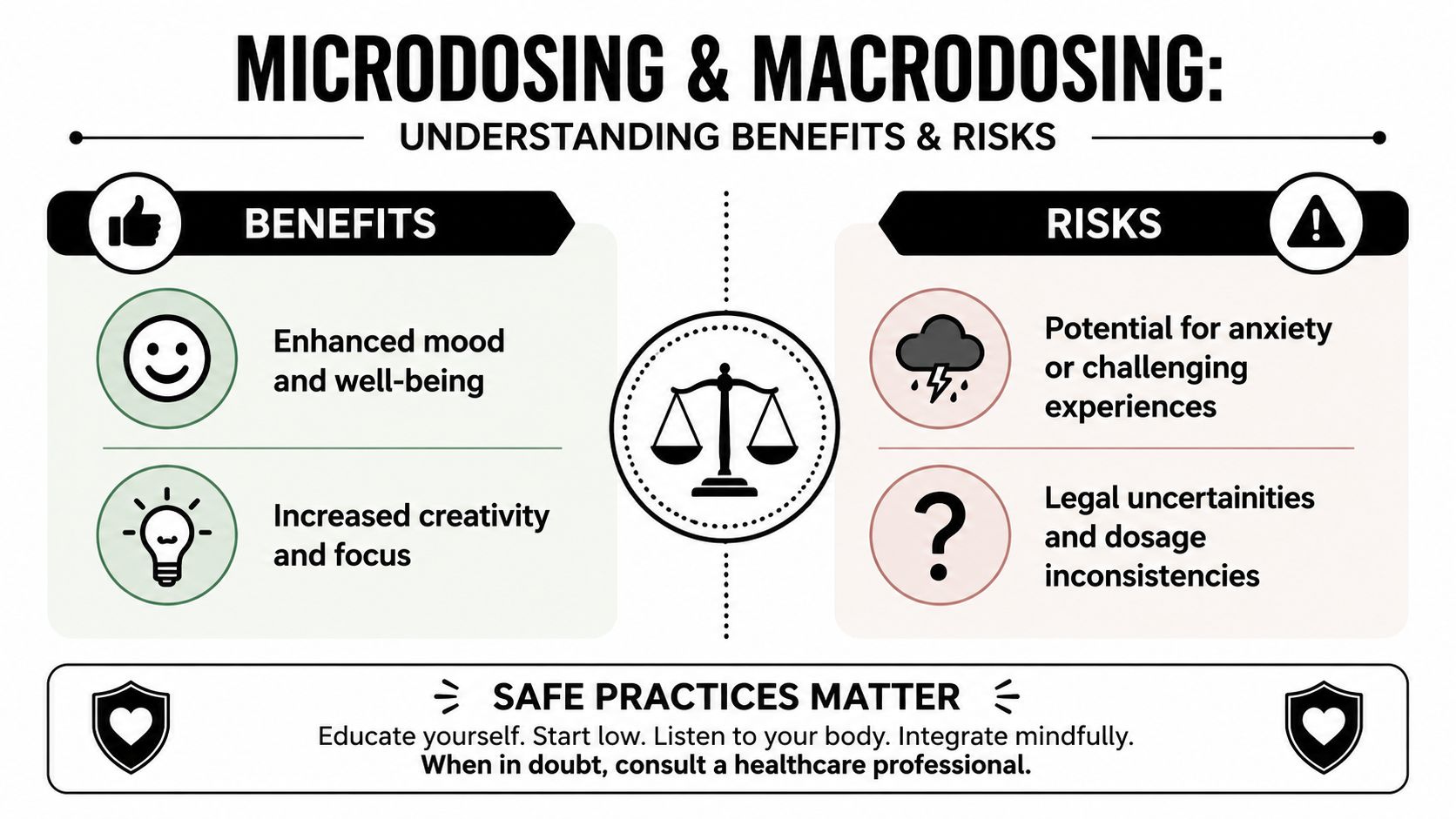
A responsible conversation about microdosing vs macrodosing has to hold two truths at once. Many people report meaningful benefits. The evidence is also uneven, and the risks change with dose, person, and setting.
What people often seek from each approach
Microdosing is commonly associated with reports of better mood, creativity, and cognitive support in observational research and user accounts. That helps explain why it appeals to adults who want something that feels manageable and low-profile.
Macrodosing draws interest for a different reason. People often pursue it when they want a significant psychological experience, not a subtle nudge. The attraction is depth, not convenience.
Where readers often get misled
The biggest confusion around microdosing is the gap between popular claims and controlled evidence.
A review focused on psychedelic microdosing noted that, in properly blinded, placebo-controlled trials, perceived benefits for productivity, mood, and creativity have often been inconsistent or null, as discussed in this review of microdosing, macrodosing, and mushroom powders. That doesn't mean nobody feels benefits. It means the research doesn't support treating microdosing as a reliably proven performance tool.
That's useful for consumers because it lowers the hype. If you try microdosing, it's better to think in terms of personal response and careful observation, not guaranteed enhancement.
Risks change with the path
Microdosing is often described as gentler, but “gentler” doesn't mean risk-free. Users and reviews have noted issues like insomnia, headaches, anxiety, and emotional discomfort in some cases. Since the goal is subtlety, these side effects can be especially frustrating because they may outweigh whatever benefit the user hoped to feel.
Macrodosing carries a different risk profile. The biggest issues are usually intensity and unpredictability. A strong psychedelic experience can become challenging if the person is unprepared, anxious, in the wrong setting, or dealing with underlying mental health concerns.
Consider these practical differences:
- With microdosing: The risk is often mismatched expectation. Someone expects smooth focus and instead feels restless or off-balance.
- With macrodosing: The risk is often situational. A strong experience in an unsafe or chaotic environment can spiral fast.
- With either: Unclear dosing creates avoidable problems.
The safest mindset isn't “Which path has no downside?” It's “Which path matches my goal, tolerance, and ability to prepare?”
Choosing Your Path Which Approach Fits Your Goal
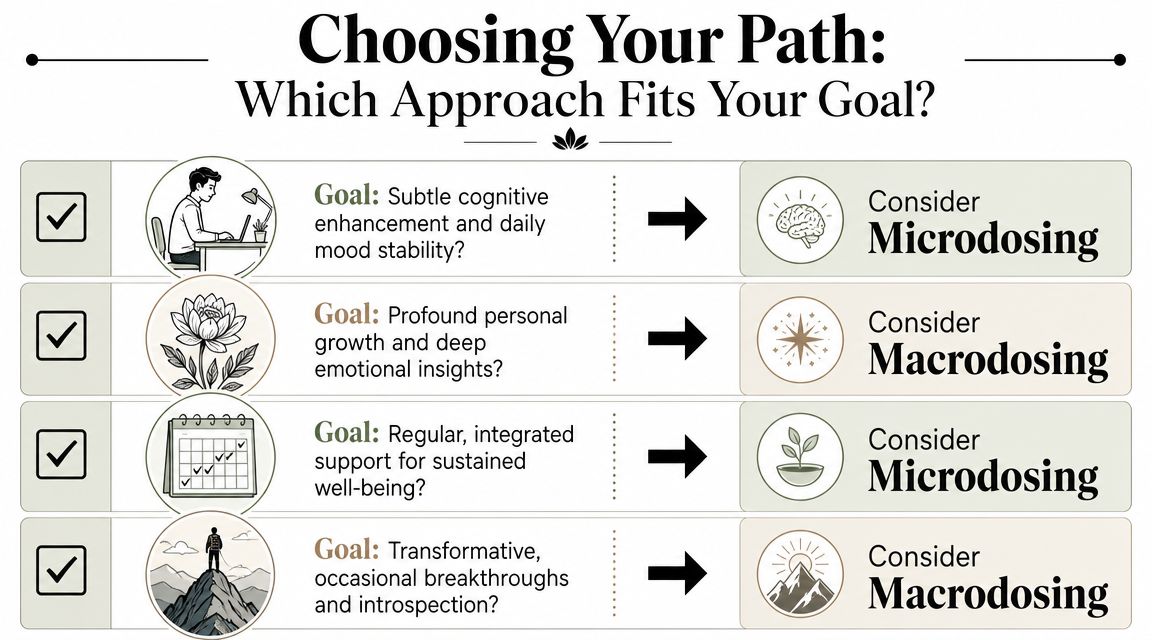
The best way to choose between microdosing and macrodosing is to stop asking which one wins. Ask what you want the experience to do.
If your goal is subtle support
Microdosing usually fits people who want a low-intensity experiment that may sit alongside normal life. That could mean curiosity about mood, creativity, or personal routine without committing to a full trip.
This path may fit you better if:
- You value predictability: You want to start cautiously and notice how your body responds.
- You're not seeking altered perception: Strong visuals or major emotional intensity aren't part of your goal.
- You want easier integration: You prefer something that can be observed in ordinary settings, with care.
If your goal is depth and interruption
Macrodosing makes more sense when the whole point is to step out of ordinary consciousness for a while. This is the better fit for people seeking a dedicated, fully felt experience with room for introspection, insight, and emotional movement.
You may be leaning toward macrodosing if:
- You want a decisive experience. You're not looking for subtlety.
- You can set aside real time. Your schedule allows you to protect the experience and recover afterward.
- You're willing to prepare the setting. You understand that environment matters as much as dose.
Questions worth asking yourself first
At this stage, many people save themselves from a bad fit. Before choosing a path, ask:
- What's my actual intention? Mood support, curiosity, creativity, emotional processing, or something else?
- How much disruption can I realistically handle? A full experience asks for more than people often expect.
- Am I chasing hype or making a grounded choice? That question matters most with microdosing.
- Do I have the right setting for a stronger dose? If the answer is no, that answer should guide the decision.
Choose the dose that matches the job. Don't choose the job that flatters the dose.
For many first-timers, the most sensible answer isn't “go bigger” or “stay tiny forever.” It's to be honest about what they're ready for. A person seeking subtle experimentation doesn't need to force a ceremonial mindset. A person seeking deep introspection shouldn't expect a tiny dose to do the work of a full experience.
Safe Dosing Practices and Finding Products in Michigan
Good decisions start with control. That means clear labeling, intentional timing, and a realistic plan for the day.
How to reduce avoidable mistakes
For microdosing, consistency matters more than bravado. People often get into trouble by eyeballing amounts, stacking with other substances, or treating “small” as the same thing as “harmless.” The more precise the dose format, the easier it is to repeat or adjust carefully.
For macrodosing, the classic safety principle is set and setting. Your mental state, physical environment, and available support can shape the entire experience. If the setting is chaotic, public, or demanding, that's not a neutral detail. It's a risk factor.

A basic preparation checklist helps:
- Pick a low-pressure day: Don't test a new dose format before work, travel, or family obligations.
- Use one variable at a time: If you're trying a new product, don't also mix in other substances and expect clean feedback.
- Write down the amount and timing: Memory gets fuzzy fast, especially when people are experimenting casually.
- Keep water and a calm space nearby: Simple comforts matter more than people think.
Why pre-dosed products matter
One of the biggest practical advantages of modern mushroom products is dose clarity. A clearly portioned chocolate bar or drink can remove a lot of guesswork that comes with breaking apart dried material by feel.
That doesn't make any product automatically safe. It does make informed use more achievable. Someone exploring low-dose use may prefer a format that's easy to divide into repeatable portions. Someone considering a stronger experience may still want that same precision while scaling carefully.
For Michigan adults trying to understand local access and context, this guide to magic mushrooms in Michigan offers a helpful overview. If you're comparing product types, edibles and drinks often appeal to beginners because they're approachable and easier to portion, while dried mushrooms may appeal more to experienced users who already know how different amounts affect them.
Product format should match your intention
The “tool for the job” idea becomes practical in this context.
- If you want repeatable, lower-intensity experimentation, choose a format that makes portioning straightforward.
- If you're planning a dedicated session, choose a day and setting first, then choose the product.
- If you're unsure how strong something will feel for you, treat uncertainty as a reason to be more cautious, not less.
Your Dosing Questions Answered
Is psilocybin legal in Ann Arbor or Detroit?
Local policy can be confusing. In some Michigan cities, enforcement around entheogenic plants and fungi has shifted, but that isn't the same as broad statewide legalization. “Decriminalized” generally doesn't mean “fully legal retail everywhere.” It means local enforcement priorities may differ. If you live in or travel through Southeast Michigan, stay current on local rules and don't assume one city's approach applies everywhere else.
Can you mix psilocybin with alcohol or cannabis?
The cautious answer is that mixing substances adds unpredictability. Even if someone has done it before, combining psilocybin with alcohol or cannabis can change the feel of the experience in ways that are harder to manage, especially for newer users. If your real goal is to learn how a dose affects you, mixing gets in the way of that.
What's the best first product for a beginner?
Beginners usually do best with a product that feels easy to portion and easy to understand. Many people prefer edibles or drinks for that reason. They can be more approachable than raw dried mushrooms, especially for someone focused on consistency rather than tradition. If you want a practical starting point, Metro Mush has a useful guide on how to microdose with magic mushrooms.
Should you start with microdosing first?
Not always, but it's often the lower-pressure choice for someone who wants to learn slowly. If your true goal is a full, introspective experience, a microdose won't replicate that. But if you're uncertain how your body responds, lower-intensity experimentation can teach you more than jumping into a strong dose without preparation.
If you're in Southeast Michigan and want clearly presented options for adults exploring mushroom products, Metro Mush offers a local menu that includes dried mushrooms, chocolate bars, and shroom drinks designed for easier dose planning. Browse products, compare formats, and choose the option that best matches your goal, whether that's careful low-dose experimentation or a more intentional, fully planned experience.