
Possessing magic mushrooms in Texas is a felony offense, not a low-level ticket, and even less than 1 gram can bring about 6 months of state-jail-felony exposure, while more than 400 grams can reach life imprisonment and a fine of up to $250,000. Unlike decriminalized areas, Texas still treats psilocybin as illegal under strict state and federal rules, and this guide explains the specific legal risks involved so you can make safer, better-informed decisions.
A lot of people land on this topic after hearing very mixed messages. Maybe they saw news about psychedelic reform in another state, heard a friend talk about mushroom chocolates, or assumed that “natural” means lower legal risk. In Texas, that assumption can go badly wrong.
The confusion usually starts because the national conversation has changed faster than state law. In some places, psilocybin is discussed in terms of wellness, therapy, or decriminalization. In Texas, enforcement is much more straightforward, and policy is much more nuanced.
An Introduction to Magic Mushrooms in Texas
A common Texas scenario starts with mixed signals. Someone hears about psychedelic therapy research, sees mushroom gummies discussed online, or assumes a product sold as a chocolate bar must fall into a softer legal category. In Texas, those ideas can create a dangerous misunderstanding.
The starting point is simple. Magic mushrooms are illegal in Texas, and the state does not treat psilocybin like a minor policy gray area. That matters because people often approach this topic with assumptions borrowed from other states, where decriminalization debates or regulated programs have changed the public conversation.
Texas is harder to understand because two separate tracks are running at the same time. One track is criminal enforcement. The other is state-supported interest in limited psychedelic research. Those tracks sound related, but they do very different things. Research does not create general public access. It also does not make possession, cultivation, or retail-style products lawful.
That split is the part many readers miss.
A useful way to read Texas policy is to sort it into three buckets. Current law controls what can get a person arrested. Product form affects how risk can increase, especially with edibles. Research activity shows where policy interest exists, but not what is legal for everyday use.
Here is the practical framework:
- Possession is treated as a criminal matter, not a casual infraction.
- Edibles and infused products can carry added risk because the form of the product can affect how a case is viewed.
- Texas can fund or discuss psychedelic research while still keeping ordinary psilocybin use illegal.
That last point often causes the most confusion. A good comparison is alcohol-free cough syrup versus whiskey. Two products may involve overlapping ideas, but the legal rules, purpose, and access points are completely different. Texas applies a similar separation here. Research policy and criminal law can exist side by side without changing what a regular person may legally possess.
Understanding that separation early helps make the rest of the topic clearer. It also helps explain why mushroom chocolates, travel, and news about psilocybin studies can all point in very different legal directions inside the same state.
The Unmistakable Legal Status of Psilocybin
A common Texas misunderstanding starts like this: someone sees news about psychedelic research, hears that mushrooms are changing laws in other states, and assumes the basic legal rule in Texas must be getting softer. For ordinary possession or use, that assumption can go badly wrong.
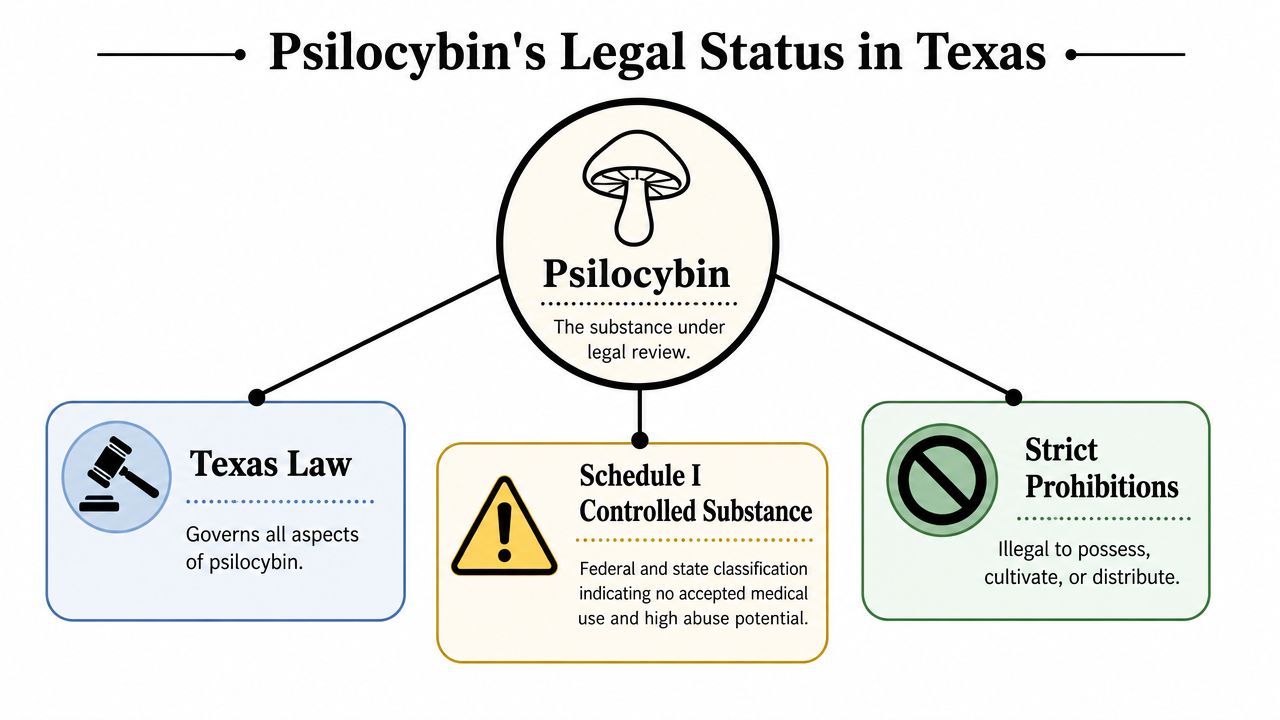
Psilocybin remains illegal in Texas and under federal law. At the federal level, it sits in Schedule I. Texas also treats psilocybin as part of its controlled-substance system, which is why cases involving possession, sale, or cultivation can carry felony exposure.
What Schedule I means in plain language
Schedule I is the federal government's top restriction category for controlled substances. In plain terms, it places psilocybin in a legal bucket associated with the highest level of prohibition.
That label matters because it shapes how the state treats everyday conduct. Texas does not provide a general personal-use carveout for psilocybin. There is no broad recreational access system, no ordinary retail channel, and no general home-grow exception a resident can safely rely on.
A simple comparison helps here. Schedule I works more like a locked cabinet than a regulated storefront. News about research may suggest movement, but the public-facing door stays closed unless the law itself changes.
Why the public message feels confusing
Confusion often comes from mixing together three very different ideas: criminal law, medical or scientific research, and reforms in other states. Those topics can sound related while producing very different legal outcomes.
A person reading national headlines might see decriminalization in one place, supervised use in another, and a Texas research initiative somewhere else. None of that changes the baseline rule for day-to-day conduct inside Texas. State law still treats psilocybin as prohibited.
Here is the practical reading:
| Question | Texas |
|---|---|
| Personal possession treated as lawful | No |
| Statewide recreational use decriminalized | No |
| General retail sales allowed | No |
| Broad public therapeutic access available under ordinary state law | No |
That table may look blunt, but it prevents a costly mistake. Texas can show interest in studying psychedelics while still keeping public possession and use illegal. Both facts can exist at the same time.
What conduct creates risk
People sometimes focus only on carrying mushrooms in a bag or container. The legal exposure can be broader than that. Possession is one issue, but sale and cultivation also create risk under the same general prohibition.
That point trips up readers who assume growing at home is somehow separate or less serious. A safer way to understand Texas law is to treat psilocybin itself as the center of the rule, not the setting, packaging, or personal intent behind it.
Practical rule: If a product contains psilocybin, Texas law can treat it as a controlled substance rather than a casual wellness product.
Case details still matter, and courts look at specific facts. The core starting point, though, is strict prohibition. That is the baseline a Texas resident should keep in mind before thinking about possession, cultivation, sharing, or buying any mushroom-based product.
Understanding the Severe Penalties for Possession
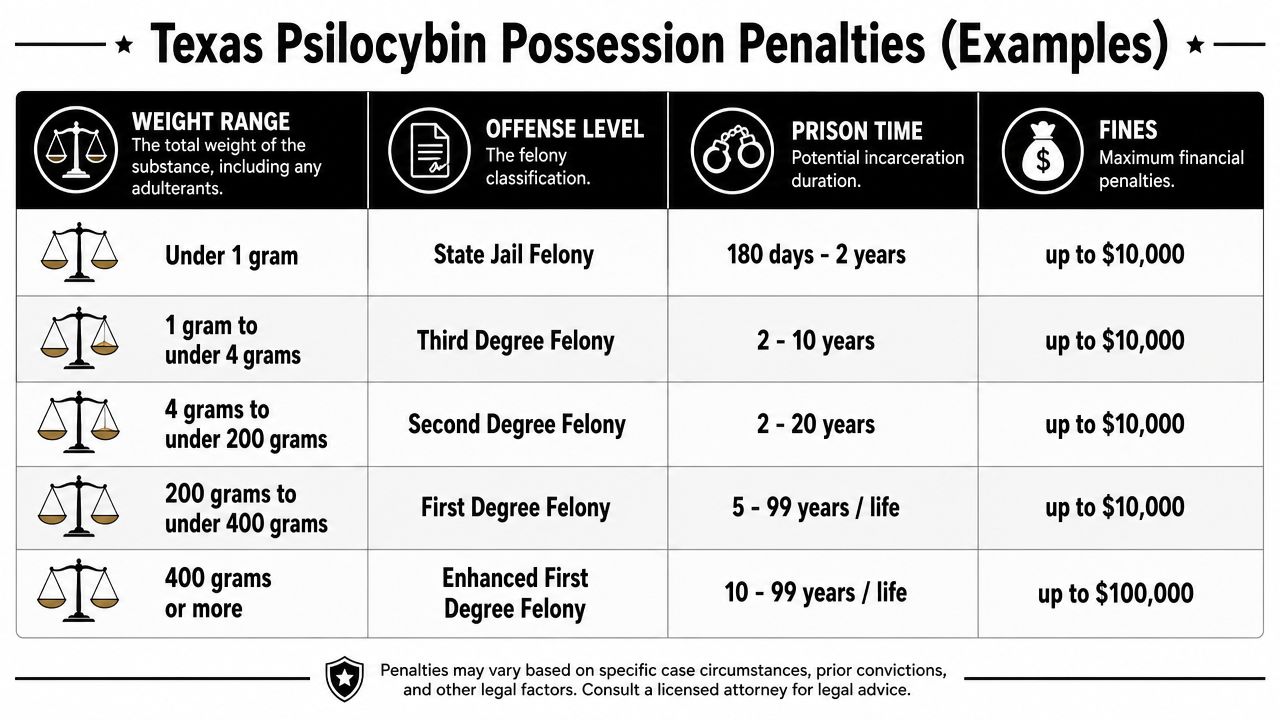
Once you move from classification to punishment, the stakes become more concrete. A 2025 Texas penalty update states that possession of less than 1 gram of psilocybin mushrooms can carry about 6 months of state-jail-felony exposure, while possession of more than 400 grams can reach life imprisonment and a fine of up to $250,000, according to this 2025 overview of mushrooms in Texas.
The key point is escalation
Many people assume drug penalties work like traffic fines. Small amount, small consequence. Larger amount, bigger consequence. Texas doesn't work that way in any casual sense here. Even the low end starts in felony territory.
That matters because the word felony changes the whole frame. People often think in terms of “getting caught with a little.” The law may think in terms of controlled-substance possession with felony exposure.
A simple way to read the cited range is this:
| Amount mentioned in the cited update | Penalty exposure mentioned |
|---|---|
| Less than 1 gram | About 6 months, state-jail-felony exposure |
| More than 400 grams | Life imprisonment and up to $250,000 fine |
The source doesn't just show a penalty range. It shows how aggressively Texas law can scale punishment based on amount.
Why this matters for ordinary people
A lot of readers aren't large-scale traffickers. They're trying to understand risk around a personal amount, a gift from a friend, or a product bought elsewhere. That's exactly why this penalty structure deserves close attention.
Even at the low end, the issue isn't “Will I lose the item?” It's “Am I stepping into felony territory?”
Three practical implications follow from that:
- Small amount doesn't mean small risk: The low end can still be a felony.
- Amount changes exposure fast: The statutory consequences climb sharply with weight.
- Context doesn't erase classification: Whether someone sees the product as therapeutic, experimental, or occasional doesn't change how Texas law may categorize it.
A safer mental model
Think of Texas psilocybin law less like alcohol regulation and more like a hard-stop controlled-substance regime. That model helps correct a common mistake, which is assuming there must be a tolerated gray area for modest personal use.
When people hear “mushrooms,” they often think culture first. Texas law starts with criminal classification first.
This isn't legal advice, and individual cases always depend on facts, evidence, and procedure. But for general decision-making, the lesson is clear. If you're trying to avoid major legal exposure, don't treat psilocybin possession in Texas as minor.
The Hidden Risk of Mushroom Edibles and Travel
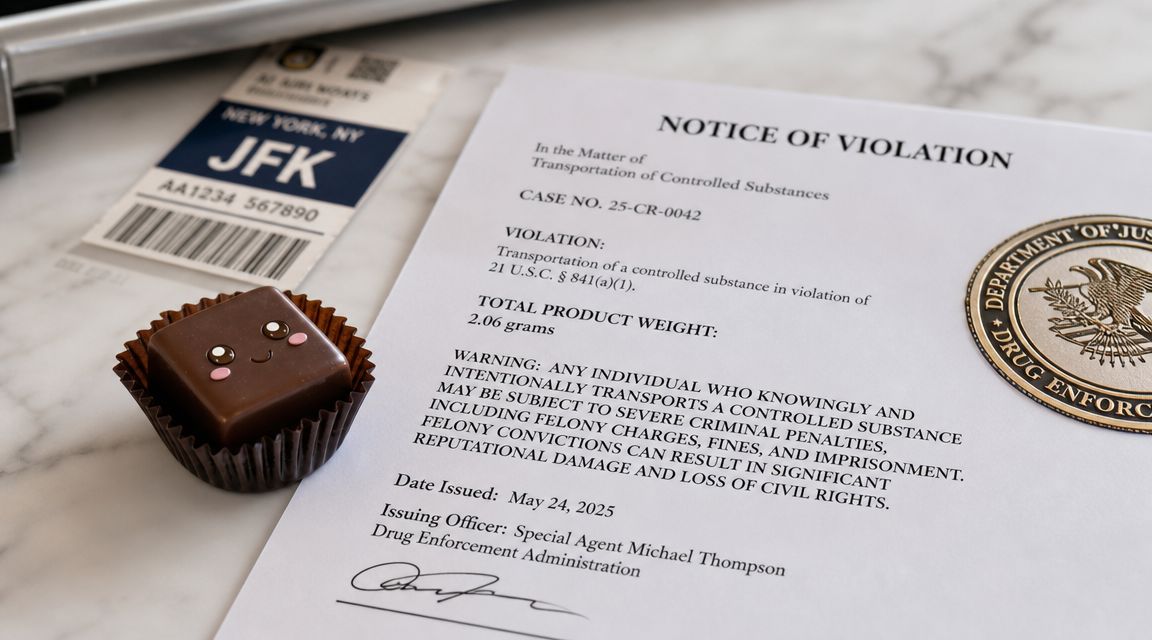
The most misunderstood trap in this area involves edibles, especially chocolate bars and similar products. In Texas, charges involving mushroom edibles can become more serious because they may be based on the total product weight, not just the estimated psilocybin content, according to this Texas discussion of mushroom chocolate charges.
Why chocolate bars create extra exposure
A common misconception often misleads people. They assume the law focuses on the active mushroom content alone. But the cited Texas legal discussion warns that the carrier medium can matter. So if psilocybin is in a chocolate bar, the weight of the chocolate itself may affect how the charge is evaluated.
A simple analogy helps. It's like being judged by the weight of the whole pie, not just the fruit filling.
That creates a dose-to-charge mismatch. A person may think, “This only contains a small active amount.” But the product's full weight can still push the legal picture into a more serious category.
Travel makes this worse, not safer
Another common misunderstanding is travel from a more permissive area into Texas. Someone buys mushroom edibles in a place where access feels normalized, packs them like any other specialty product, and assumes the main issue is discretion. That's the wrong frame.
Crossing into Texas doesn't preserve the logic of the place where you bought the item. Once you're in Texas, you're dealing with Texas enforcement risk.
Here are the practical takeaways:
- Don't assume packaging helps: A branded chocolate bar can still be treated as a controlled-substance product.
- Don't assume low-dose labeling protects you: Label language doesn't control how Texas may view the item.
- Don't assume “edible” means lighter treatment: The total-weight issue can make edibles legally riskier than many people expect.
For people trying to understand why these products attract attention, this guide to magic mushroom chocolate bars shows the kinds of edible formats that commonly shape consumer assumptions. The key legal point in Texas, though, is that product format can increase exposure rather than soften it.
If you're carrying a mushroom chocolate bar in Texas, the legal question may not be “How strong is it?” It may be “How much does the whole product weigh?”
That one detail changes the risk calculation dramatically.
The Paradox of Texas Psychedelic Policy and Research
Texas has a genuine contradiction in its psychedelic policy. The state is keeping psilocybin illegal for recreational use while also expanding state-backed psychedelic research through HB 1802 and newer legislation such as SB 2308 and HB 4014, according to this Texas Matters report on psychedelics and the Texas trip.
That sounds inconsistent at first, but it's better understood as a split between public access and formal research. Texas isn't opening the door to everyday legal use. It is, however, supporting clinical trials and recommendations for eventual access in a more controlled setting.
What this means for the future
Many people asking about magic mushrooms in Texas aren't really asking about parties or counterculture. They're asking whether the state is moving toward some kind of medical model.
The answer is more nuanced than a simple yes or no.
- Recreational access remains off-limits: The cited reporting says Texas is still keeping psilocybin illegal for recreational use.
- Research is moving ahead: The same reporting says the state is funding clinical trials and recommendations for eventual access.
- The likely path, if one develops, is controlled: The shape of policy discussion points more toward supervised or medical channels than broad personal-use legalization.
Why this distinction matters for decision-making
People often make a leap that sounds reasonable but isn't safe. They hear that Texas is funding psychedelic research and conclude the substance must be partly legal already. Research support doesn't create general permission for possession.
That distinction also matters for people reading educational material about effects, therapy, or neuroscience. Information about possible brain effects isn't the same as lawful access. If you're trying to understand that medical side of the conversation, this overview of psilocybin effects on the brain shows the kind of topic people often confuse with legal availability.
The real takeaway
Texas is not frozen in place. But it also hasn't crossed into broad legal access. The current picture is a narrow institutional opening inside a still-prohibitive system.
That may eventually shape legislation, medical programs, or tightly supervised treatment pathways. It does not mean a personal-use exception exists now.
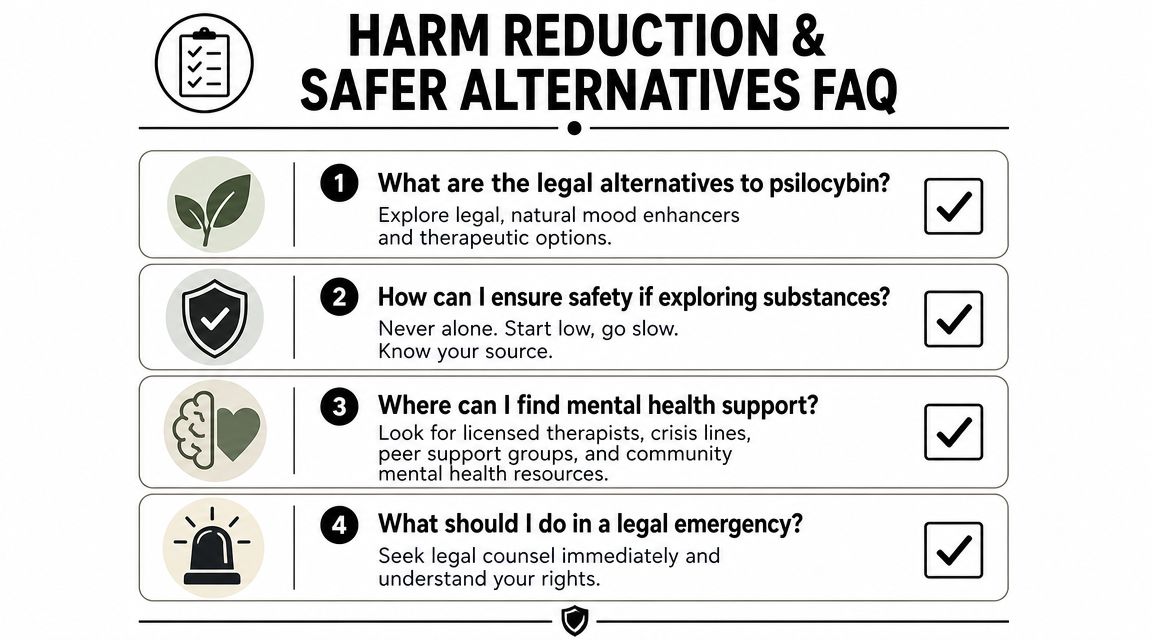
FAQ on Harm Reduction and Safer Alternatives
People asking about mushrooms often aren't only looking for legal status. They're also trying to reduce risk, sort hype from evidence, and avoid preventable mistakes. That's where a harm-reduction mindset helps, even in a state with strict laws.
Recent reporting says microdosing is gaining popularity, but it also says the science is still early, that benefits may be driven by expectancy or placebo effects, and that placebo-controlled trials have not shown durable gains in creativity or cognition, according to this report on microdosing claims and the current evidence.
Is microdosing a proven shortcut to better mood or performance
Not based on the reporting cited above. A lot of consumer conversation treats microdosing as if it's settled science. It isn't.
That doesn't mean nobody reports benefits. It means the strongest current summaries are more cautious than social media tends to be.
Early interest in microdosing shouldn't be confused with strong proof of lasting improvements.
Does a small dose make it legal or legally safer in Texas
No. Small dose and low legal risk are not the same thing. Texas law doesn't turn personal possession into a harmless category just because someone describes the amount as minimal or frames it as self-experimentation.
That confusion is common because “micro” sounds medically modest. Legally, that label doesn't carry special protection.
What if someone is more concerned about safety than legality
Then the right first step is to slow down and separate three questions:
What does the evidence support?
If the goal is mood support, stress management, or mental health care, look for approaches with clearer evidence and professional oversight.What is the product risk?
The reporting above notes that unregulated products can contain harmful substances, and accidentally taking too much can produce distressing effects.What is the setting risk?
Substances that alter perception can create problems quickly when someone is alone, anxious, mixing substances, or in an unsafe environment.
For readers trying to think through acute experience risks, this guide on how to avoid bad trips covers common harm-reduction ideas in plain language.
What are safer alternatives if the goal is mental wellness
The safest alternatives are the ones that stay inside legal, regulated channels. That can include speaking with a licensed mental health professional, asking about established treatments, or looking into legitimate clinical research pathways where available.
A few grounded rules help:
- Choose regulated care first: Licensed therapy, psychiatry, and supervised treatment create more protection than self-experimentation.
- Be skeptical of internet certainty: Strong claims about microdosing often outrun the evidence.
- Treat unregulated products cautiously: Unknown contents and dosing inconsistency can turn curiosity into a medical or legal problem.
What if there's a legal emergency
If someone is facing a real legal situation, they should speak with a qualified Texas attorney as soon as possible. This article is educational, not legal advice, and case-specific guidance depends on facts that general content can't evaluate.
The most useful takeaway is simple. In Texas, psilocybin is not an area for casual assumptions. When people slow down, verify the law, and avoid importing rules from other states, they usually avoid the worst mistakes.
If you're in Southeast Michigan and want straightforward education about psilocybin products, formats, and consumer questions, Metro Mush is one place to browse informational content alongside its menu. If you're traveling or comparing jurisdictions, keep the key distinction in mind: what may be available in Detroit or Ann Arbor doesn't change Texas law, and bringing products into Texas can create serious felony risk.