
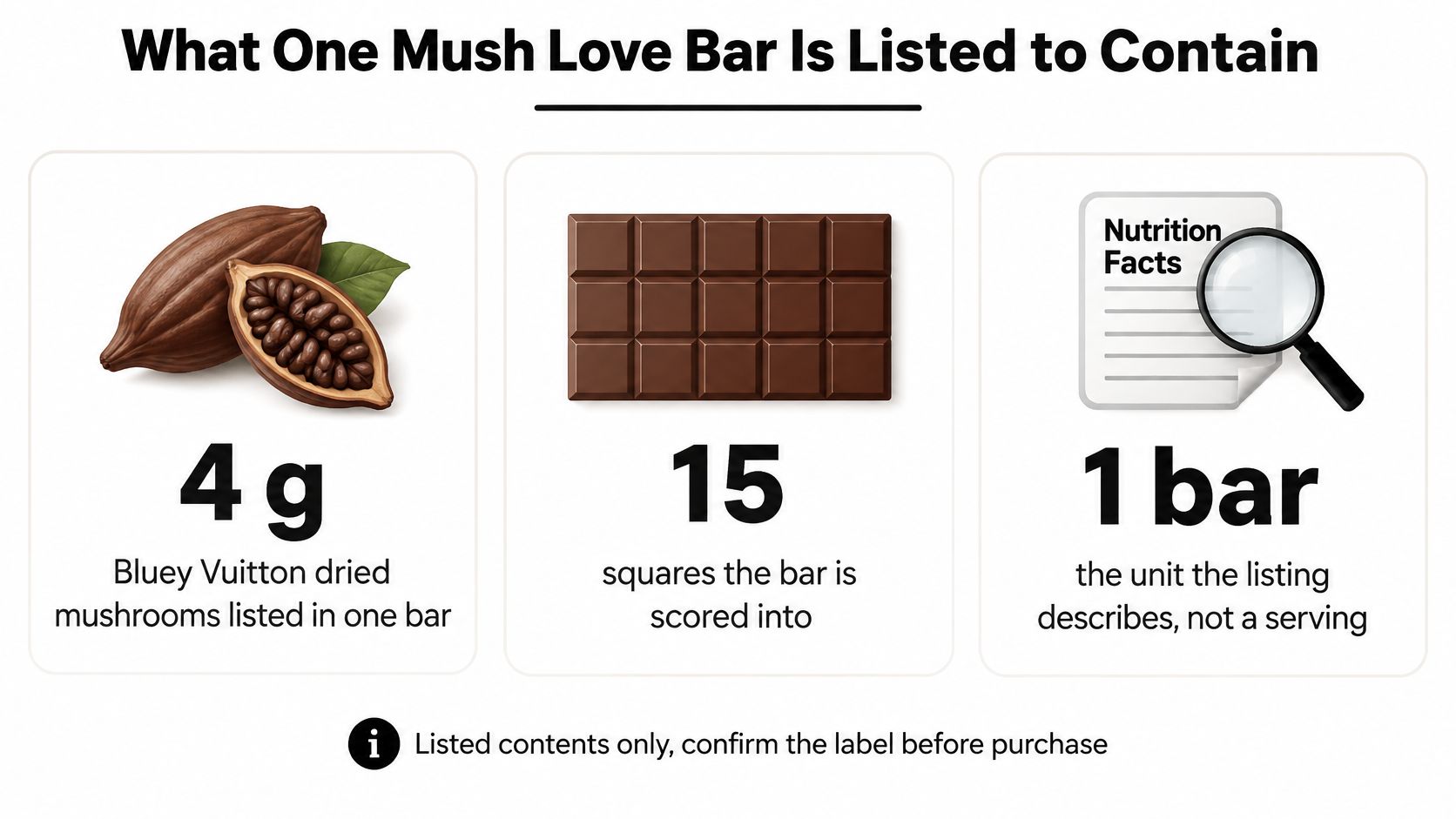
The Mush Love chocolate bar is listed as containing 4 grams of Bluey Vuitton dried mushrooms split into 15 pieces, which works out to about 267 mg of dried mushroom material per piece. That figure describes the weight of dried mushroom material, not a lab-confirmed psilocybin dose.
The advice you'll hear most often about a love chocolate bar is to eat one square and wait. That advice skips the step that matters. It assumes you already know which bar is in your hand, and the name on the wrapper doesn't tell you. Two bars sharing the word Love can hold different mushrooms, different total weights, and different piece counts, and one of them may contain no psychoactive mushroom at all.
A piece is a portion, not a measurement. The score lines tell you where the manufacturer cut the bar. They don't tell you how the mushroom powder settled, whether the batch was tested, or what species went into the mix. Read the package in your hand as you go, and treat the branding as the least reliable clue on it.
Why Love Chocolate Bar Does Not Name One Product
“Love chocolate bar” can point to unrelated products: a mushroom edible, a functional wellness bar made with ingredients such as reishi and maca, or conventional chocolate sold under a romantic name. The word Love works like a sign on a shop door. It does not identify what is inside.
The bar this guide means is Mush Love, the mushroom chocolate adult shoppers look up when they want chocolate instead of dried caps, so check the package for the named species, the total weight, and the piece count before you buy. Those details help distinguish one product from another; a name alone cannot.
Love also appears on ordinary chocolate. Love Cocoa, a British brand founded by James Cadbury, sells premium bars and reports supporting the planting of more than 1.6 million trees through a one-tree-per-bar program. That branding does not make its chocolate a mushroom edible.
The difference between wellness chocolate and a mushroom edible matters. Ingredients like reishi and maca do not establish that a bar contains psilocybin. Read the actual package details rather than inferring contents from the word Love or from a product's general wellness language.
As you compare products, treat the package as the product's identification card. Check the named species, total mushroom weight, and number of pieces before drawing conclusions from the branding. Listings can change, so confirm that the details match the package in hand.
How to Tell Mush Love From Similarly Named Bars
The word “Love” is not a product identifier. A chocolate bar with that word in its name might be a mushroom edible or a wellness chocolate, so compare the package's stated contents and serving details before drawing conclusions.
| Bar | Category | What the label describes | How it is split | What the name alone cannot establish |
|---|---|---|---|---|
| Mush Love chocolate bar | Mushroom edible | Bluey Vuitton dried mushrooms | Scored pieces | Psilocybin amount, even distribution, or batch match |
| Comparable Love Bar | Mushroom chocolate | Fungi and chocolate | Squares | Exact amounts or an even mix |
| Functional Love Chocolate | Wellness chocolate | Cacao and functional ingredients | Pieces and serving guidance | Any psilocybin content |
Row one, the bar with a named mushroom
Mush Love is the Metro Mush product in this comparison. Its name and listing identify it as a mushroom chocolate, but the word “Love” by itself does not confirm which product you have. Check the package for the product name, the named mushroom, the amount stated for the whole bar, and how the pieces are portioned. Those details help identify the product; they do not verify the contents of a particular batch.
Row two, the bar that shows its chocolate details
A similarly named mushroom bar may describe its chocolate and fungal ingredients without giving enough information to establish how much of each ingredient is in each square. Bar weight, cacao percentage, and piece count can help a reader understand the chocolate's composition and division when those details are stated on the package. They do not show that mushroom material is spread evenly from square to square.
The distinction is like reading a recipe and inspecting the finished tray: ingredient totals and cut lines explain the plan, not the contents of every piece.
Row three, the bar with no established psilocybin content
Functional chocolate may list cacao and ingredients such as reishi, maca, or other wellness ingredients. A mushroom ingredient on that label does not, by itself, mean the bar contains psilocybin. Read the ingredient panel and serving directions as written, and don't treat a wellness bar as a mushroom edible based on its name or the word “mushroom.”
The name test: if a bar's name is the only thing linking it to the product you meant to buy, you haven't identified it yet.
Use three checks to compare lookalikes. Does the package name a mushroom species in words, rather than relying on a graphic? Does it distinguish the contents of the whole bar from the contents of one piece? Does it provide batch evidence, rather than only a milligram claim or flavor description? These answers help identify what the package claims. They do not, on their own, confirm the amount or distribution of active compounds in an individual piece.
What One Mush Love Bar Is Listed to Contain
The product definition is short. The Mush Love chocolate bar is listed as 4 grams of Bluey Vuitton dried mushrooms in a single bar, scored into 15 pieces, which comes to about 267 mg of dried mushroom material per piece, as stated in the product listing.
Think about a tray of brownies cut before they cool. The lines let you lift one piece without dragging out a scale or a knife. They don't tell you whether the cocoa was stirred evenly. Score lines on a chocolate bar work the same way: they're a conveniences for portioning, not an analysis of what landed in each section.
The distinction buyers miss
Dried-mushroom mass is the weight of mushroom material. It is not a purified or guaranteed amount of psilocybin. Alkaloid concentration shifts with genetics, growing conditions, processing, and storage, so two pieces that both weigh about 267 mg need not produce the same experience, and a piece from a bar stored warm for a month isn't the same object as one from a fresh bar.
That's why the 4-gram figure should be read as total mushroom material, not a dose promise. Before you treat 267 mg as a personal plan, look for any batch-specific laboratory result printed on the box or available with it. If the seller can't point to one, you're working from a claim rather than a measurement.
Practical rule: the number on the front tells you what went into the bar by weight. Only a batch result tells you what a piece contains.
This section answers one question: what the listing claims. How a high-cacao matrix behaves, and how to read the rest of the panel, are separate jobs.
How Chocolate Can Change One Square
Hold the mushroom weight constant and change the chocolate, and the square in your hand changes anyway. The comparable Love Bar makes that visible: 60 grams total, 58% cacao, 15 squares, 4.5 grams of fungi, which lands near 4 grams of chocolate and 300 mg of dried fungal material per square, according to the product specification.
Why the matrix matters
A 58% cacao bar carries substantial cocoa solids and fat. Cocoa-butter-rich chocolate is also what distributes a powder through the bar in the first place. Stir a handful of chocolate chips into batter and stop early, and one corner of the pan comes out dense while another is plain. Powdered mushroom behaves the same way when mixing is rushed. Uniform mixing is the whole game, because clumping is what makes one square stronger than the next.
Handling steps, in order
- Keep it cool and dry. A bar that has softened and firmed repeatedly has been redistributed, not improved.
- Don't melt it and let it set again in a puddle. Re-solidifying unevenly moves the powder with the fat.
- Treat each scored square as an approximate portion. That holds unless an independent certificate of analysis confirms the mix is homogeneous and reports the active compounds.
A square is a serving clue. It is not a lab result, and it never was. If you're planning to keep a bar for weeks rather than days, the storage details matter as much as the label does, and this guide to how to store chocolate bars covers temperature and wrapping without overcomplicating it.
Cool, dry, whole. Those three words do more for consistency than any ritual around cutting the bar.
Label Lines That Verify a Love Chocolate Bar
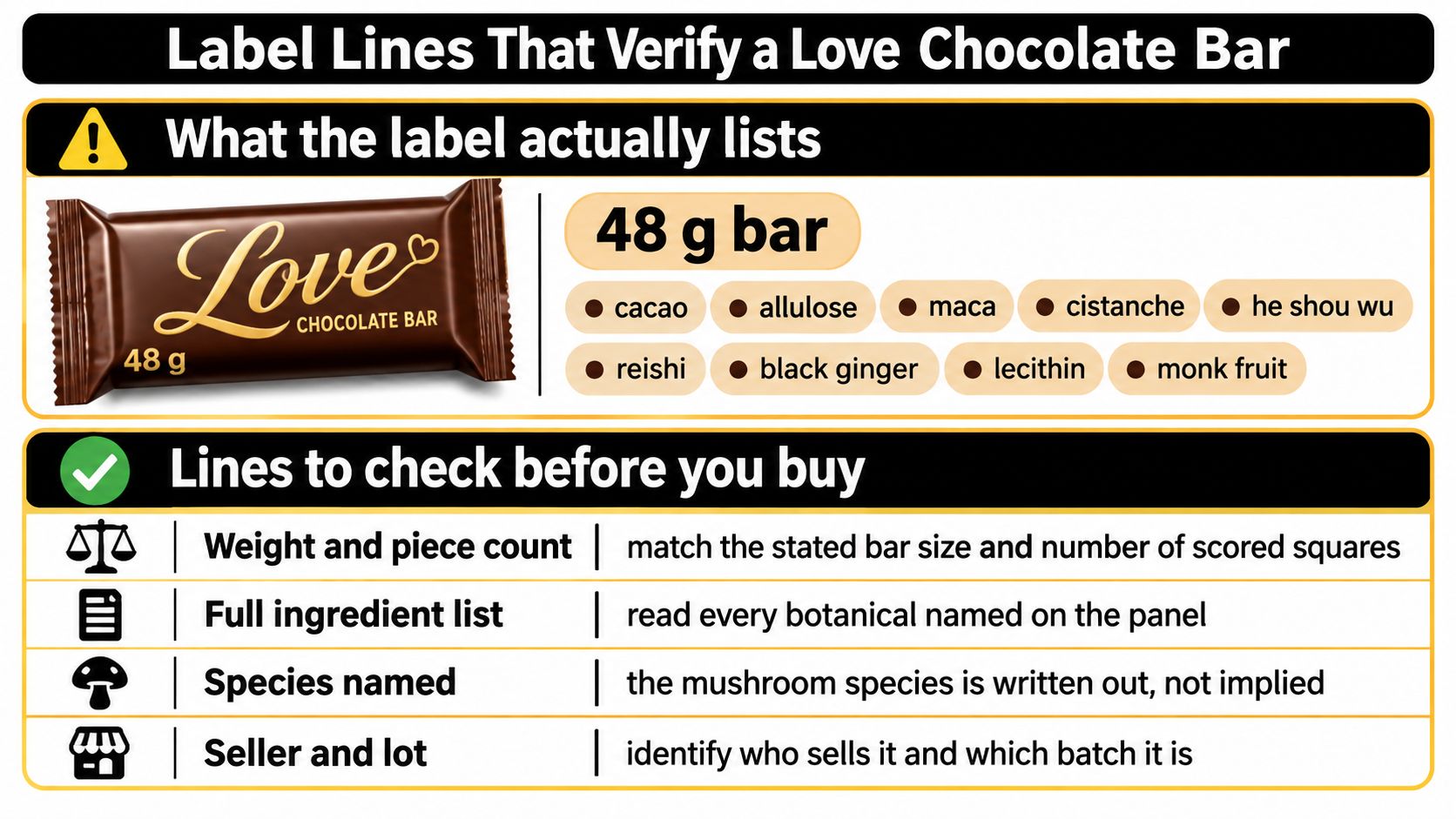
The word Love does not identify one bar. Start with the package, not the name: check which mushrooms it lists, how pieces map to a serving, and whether any batch-specific evidence is provided. A 48-gram bar sold as Love Chocolate, for example, lists cacao, allulose, maca, cistanche, he shou wu, reishi, black ginger, lecithin, monk fruit, and salt. Its panel names culinary mushrooms and botanicals, without listing psilocybin.
That ingredient list describes what the product contains, not an active dose or independent test result. Reishi and other functional ingredients do not make a bar a psilocybin edible. If you searched for a mushroom edible, the package needs to identify the relevant species directly. The same care applies when the front uses a broad name such as “Love.”
Five lines to read before you buy
- Every ingredient, not just the flavor name. Read through the full panel. Maca, cistanche, and he shou wu are botanicals, while reishi is a functional mushroom. None identifies psilocybin.
- The named mushroom species. Check whether the package names a culinary or functional mushroom, or a psychoactive species. A panel listing only culinary mushrooms and botanicals does not establish that the product is a mushroom edible in the sense you intended.
- The whole bar and serving description. Check how many pieces the bar contains and how many the label calls a serving. Piece size and serving count help you understand the package, but do not prove potency.
- Batch-specific evidence. A printed milligram claim is not the same as a certificate of analysis tied to a lot and reporting the relevant compounds. Without that evidence, treat stated mushroom strength as a package claim, not a confirmed result.
- Storage instructions. Read them before buying so you know how the seller expects the bar to be kept between delivery and use.
A polished wrapper can still leave important questions unanswered. Labels may not establish the species, composition, or strength of the contents, and stated mushroom strength can differ from what a package claims. Flavor and branding are not substitutes for clear ingredient details and batch evidence.
For a practical way to examine ingredients, serving information, and other label details, see Maximum Health Products on supplement labels. You can also use this guide to spot fake or mislabeled mushroom products.
A package name is not proof of what is inside.
If the label does not identify the mushroom, explain the piece and serving count, or provide batch evidence, you still do not know what product you are considering.
When a Love Bar Is the Wrong Choice
The word Love does not identify one kind of mushroom bar. A familiar name can sit on very different ingredients, so check the species, piece count, and batch evidence on the package before deciding whether the product is right for you. Chocolate affects taste and texture, not the identity or predictability of what it contains.
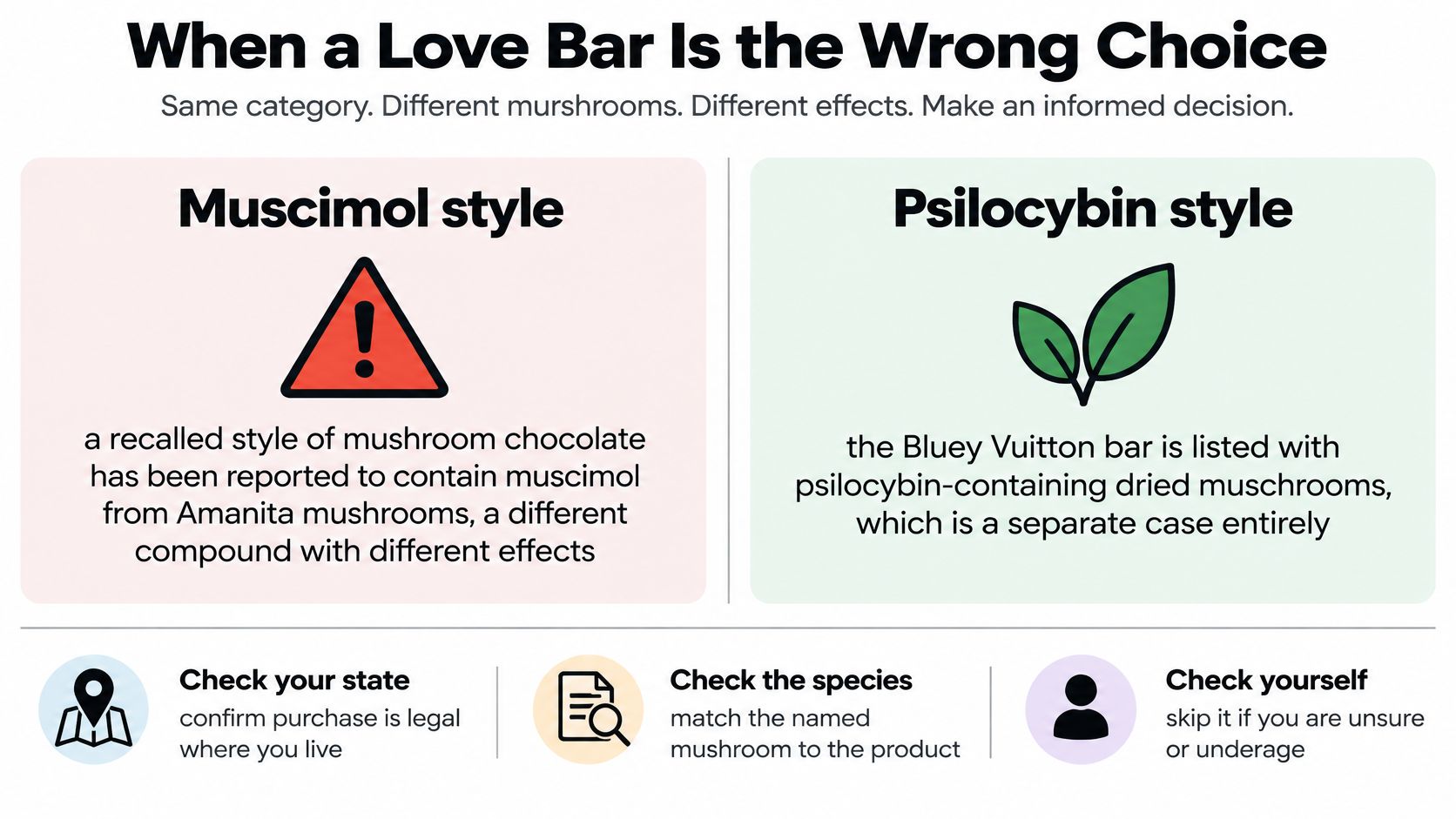
Some mushroom chocolates have been reported to contain muscimol, a compound derived from Amanita. Muscimol and ibotenic acid are different compounds from psilocybin, with a different risk profile and regulatory status. A bar containing Amanita-derived compounds should not be treated as interchangeable with a psilocybin bar.
Three categories, not one
Keep three categories distinct. Muscimol-style products use Amanita-derived compounds. Psilocybin products, including a listed Bluey Vuitton bar, are a separate category. Functional mushrooms, such as reishi, are not the same as psychoactive mushroom products. A vague label saying “mushroom chocolate” does not tell you which category a bar belongs to. The species name is the first useful clue.
The listed mushroom weight alone also cannot verify what a bar contains or what effect it may have. Ingredients can vary between batches, and people can respond differently to the same product. A product being offered for sale does not establish premarket approval or clinical validation.
Questions to settle before use
| Question | Why it matters | Next step |
|---|---|---|
| Is the mushroom species named? | Amanita-derived muscimol is not psilocybin | Do not assume a vague mushroom chocolate is Mush Love |
| Is it only a functional mushroom? | Reishi and similar mushrooms do not identify a psilocybin serving | Read the ingredient list again |
| Is there batch testing? | Labeled strength may not match the product | Look for a certificate of analysis |
| Any alcohol, other drugs, or relevant prescriptions? | Combinations may make effects less predictable | Use extra caution or skip the product |
| Breathing trouble, abnormal heart rate, or seizures? | These are emergency symptoms | Contact emergency services |
Medication interactions matter, and the same product may affect people differently. If you have a psychiatric or cardiovascular condition, or take prescription medicine, discuss the risks with a clinician before use.
Stop rule: if the species is unclear, the bar is unidentified. Do not test it with a bite.
If the experience becomes unexpectedly intense, do not take another piece to see what happens. Stop, seek help if an emergency symptom appears, and treat missing product information as a reason not to proceed.
Verify the Listing and Local Law
The word “Love” does not identify one specific bar. Before ordering, compare the live listing with the package: confirm the product name, mushroom species, stated contents, piece count, and any batch-specific test result. A dried mushroom weight describes the material listed, not a guaranteed effect.
The order that saves you a mistake
- Open the live listing. Check the current product page, rather than relying on a saved screenshot, reseller repost, or similarly named bar from another brand.
- Compare the listing with the package. Check that the name, species, contents, piece count, and batch evidence agree. If key details are missing or conflict, do not treat the product as identified.
- Check local legal status. Psilocybin is federally controlled as a Schedule I substance in the United States. State and local rules vary, so review the rules that apply where you live.
- Separate a menu from legal guidance. A retailer's listing does not establish whether a sale or delivery is lawful at your address.
For Southeast Michigan readers, this overview of magic mushrooms in Michigan provides local context. A product description is not a substitute for checking the rules that apply to you.
Wait to order until the listing and package agree. If the identity or label details remain unclear, stop rather than guess.
If you take prescription medicines or manage a psychiatric or cardiovascular condition, speak with a clinician before use. Breathing difficulty, an abnormal heart rate, or seizures call for emergency services.
Price can help you check that you are looking at the intended listing, but it cannot verify what is inside. Metro Mush lists the Magic Mushrooms Chocolate Bar – Mush Love at $40.00. Its product description states 4 grams of Bluey Vuitton across 15 pieces. Match those details to the package in front of you; if the listing and package disagree, do not assume they refer to the same bar.
Metro Mush serves Detroit and Ann Arbor with a curated menu that includes Mush Love chocolate bars. The listing describes 4 grams of Bluey Vuitton across 15 pieces. Visit Metro Mush to browse the current selection, check store locations, and place an order by text.