

Albino Penis Envy is a pale-fruiting, informal cultivar of Psilocybe cubensis, not a separately classified species, and the pale color doesn't carry a potency guarantee. In the one published comparison available here, dried albino Penis Envy measured 12.33 mg of total tryptamines per gram, about 30% below regular Penis Envy at 17.59 mg/g.
The advice you'll meet most often says the opposite. Scan enough vendor pages and forum threads and you'll find APE described as the heavy hitter of the cubensis family, a strain to treat with extra caution, a name that implies "stronger than the rest." That claim has a thin evidentiary floor. The comparison behind it involved one culture, one harvest and one laboratory, and in that experiment the albino line finished behind its non-albino parent, not ahead of it.
So the useful question isn't "Is APE the strongest?" It's "What does this name certify, and what does it leave me guessing about?" An albino label describes appearance and a claimed cultivation lineage. It says nothing verified about the psilocybin or psilocin in the bag in front of you. Treat the name as the start of a conversation with a lab report, not the end of one.
What Albino Penis Envy Is and Where the Name Comes From
Say someone searches for albino PE mushrooms and lands on a listing of pale, dense mushrooms with a name that reads like a species. It isn't one. Pull the name apart in four layers and the confusion clears.
- Genus. Psilocybe, the group of mushrooms known for producing psilocybin and psilocin.
- Species. Psilocybe cubensis, first documented in Cuba in 1906 and now reported across multiple continents, according to a 2025 peer-reviewed review of P. cubensis strains.
- Cultivar. Penis Envy, a named enthusiast line maintained inside that species through selective cultivation.
- Albino line. A pale, pigment-reduced selection associated with that cultivar, sold as Albino Penis Envy and shortened to APE.
That same review is blunt about the middle layers. Dozens of named strains circulate informally while rigorous academic classification of those variants remains incomplete. It identifies albino or leucistic forms by their pale fruiting bodies, then stops short of giving those forms a single genetic or chemical definition. Two products sold as APE can therefore be related lineages rather than identical genetics, and no amount of visual inspection settles which is which.
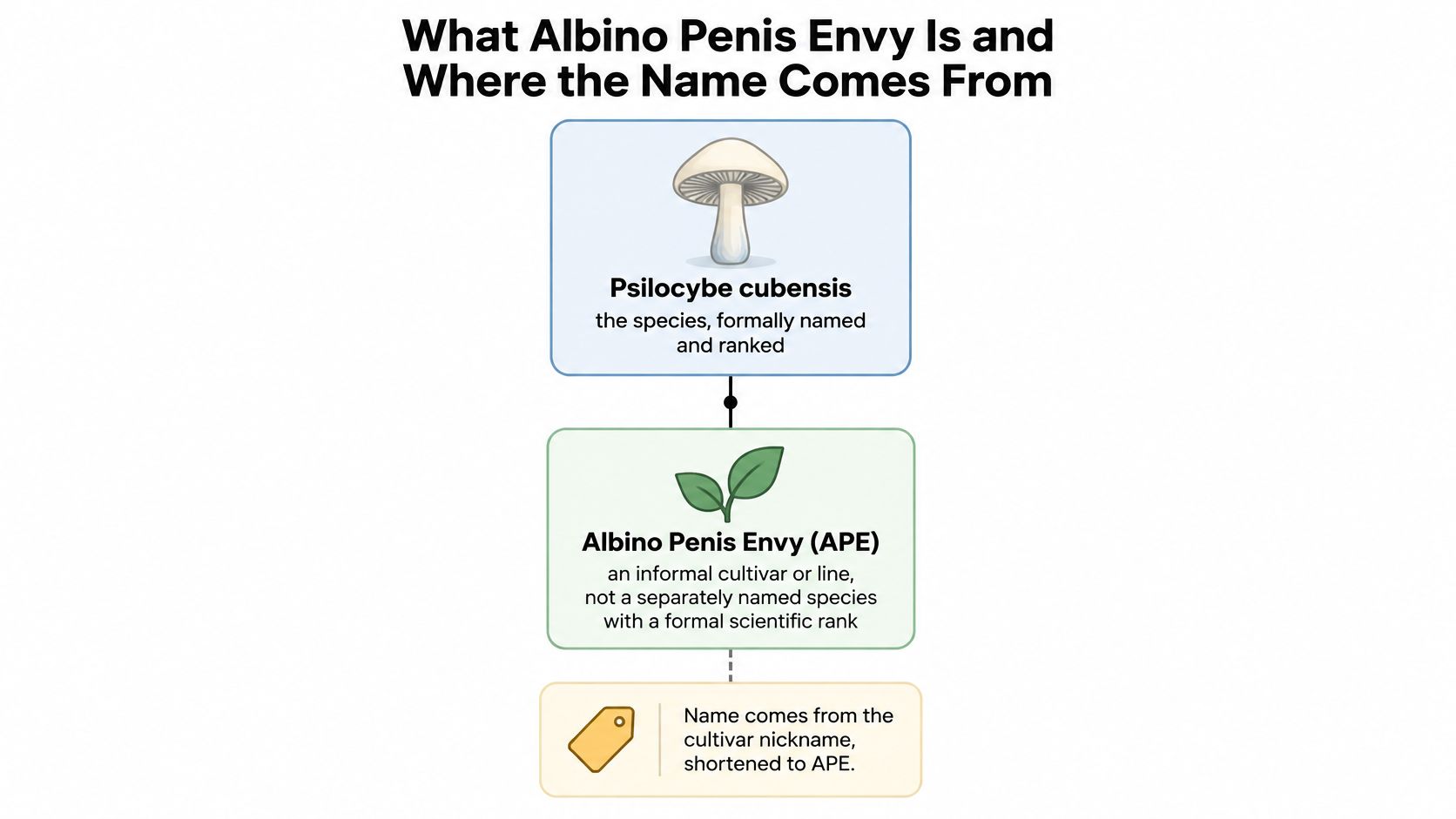
The commercial name carries two things a buyer can use and one thing they can't. It carries appearance, since the pale fruiting body is the visible trait the label points to. It carries a claimed lineage, which is only meaningful if the grower documents provenance. It doesn't carry chemistry.
Put the timeline side by side and the gap gets wider. APE belongs to a few decades of grower selection and enthusiast naming. The species underneath it has been formally described for more than a century and holds a far older ceremonial record. A modern cultivar name is a marketing and horticultural convenience, not a taxonomic verdict, and it can't confirm ancestry or predict a dose.
Albino and Regular Penis Envy Compared Side by Side
Measured tryptamines in one 14-strain comparison
| Measure (per gram of dried mushroom) | Albino Penis Envy | Regular Penis Envy | Difference |
|---|---|---|---|
| Psilocybin | 11.38 mg | 15.49 mg | Albino about 27% lower |
| Psilocin | 0.67 mg | 1.77 mg | Albino about 62% lower, a 1.10 mg gap |
| Total measured tryptamines | 12.33 mg | 17.59 mg | Albino about 30% lower |
Those figures come from a controlled comparison of 14 named P. cubensis lines run under standardized conditions, published as a strain potency comparison. Read each row for what it measures. Psilocybin is the compound the body converts into the active form. Psilocin is the compound that binds directly, and it's the one most sensitive to drying and storage. Total measured tryptamines is the lab's own aggregate figure rather than a simple sum of the two rows above, so the column won't add up perfectly if you reach for a calculator.
The headline result runs against the reputation. Albino Penis Envy came in at 12.33 mg/g total, regular Penis Envy at 17.59 mg/g. That's roughly 30% lower for the albino line, or put the other way, regular Penis Envy measured about 43% higher in that experiment.
Why the psilocin gap matters more than the total
The psilocybin difference looks moderate. The psilocin difference doesn't. At 0.67 mg versus 1.77 mg, the albino line carried under two-fifths of the regular line's measured psilocin, the largest proportional gap in the table.
That's a plausible reason two products with similar-looking totals can produce different experiences. Two lines that differ most sharply in the fast-acting metabolite aren't interchangeable by weight, and no label that says only "APE" gives you that information.
Reading rule: Compare potency figures only when they share units (mg per dried gram) and come from the same analytical method. A percentage and a milligram-per-gram figure describe the same thing only after you convert them.
Now the limits, stated as plainly as the numbers. This was one culture, one harvest and one laboratory. It ranks two lines under one set of conditions. It doesn't establish a permanent potency order for every mushroom sold under either name, and it doesn't tell you what's in the jar at your local shop. For the broader species picture, the guide to Psilocybe cubensis strains covers how much variation exists across named lines.
Why Potency Labels Are an Unreliable Guide
The clearest public spread for mushrooms submitted as APE comes from the 2022 Psilocybin Cup. A 2024 account of the associated laboratory testing reported an average psilocybin concentration of roughly 0.93% across submitted APE samples, with the strongest cited sample at 1.73% psilocybin and 0.61% psilocin, as documented in DoubleBlind's history of APE testing.
Convert the average and it lands near 9.3 mg of psilocybin per dried gram. The top sample lands near 17.3 mg. That's the point: a set of mushrooms all carrying the same name spanned a gap of that size.
These were competition submissions, not a controlled population average for every mushroom sold as APE. That distinction cuts both ways. The numbers don't condemn the cultivar, and they certainly don't certify it. What they show is that samples diverge widely enough that a name on a package predicts very little about the contents.
What moves the number before it reaches a lab
Genetics set a range. Everything after genetics moves a mushroom within that range: substrate, environment, harvest timing, maturity at picking, drying method, storage conditions, the specific tissue sampled, and the analytical method the lab used. Change one of those and the measured alkaloid content changes.
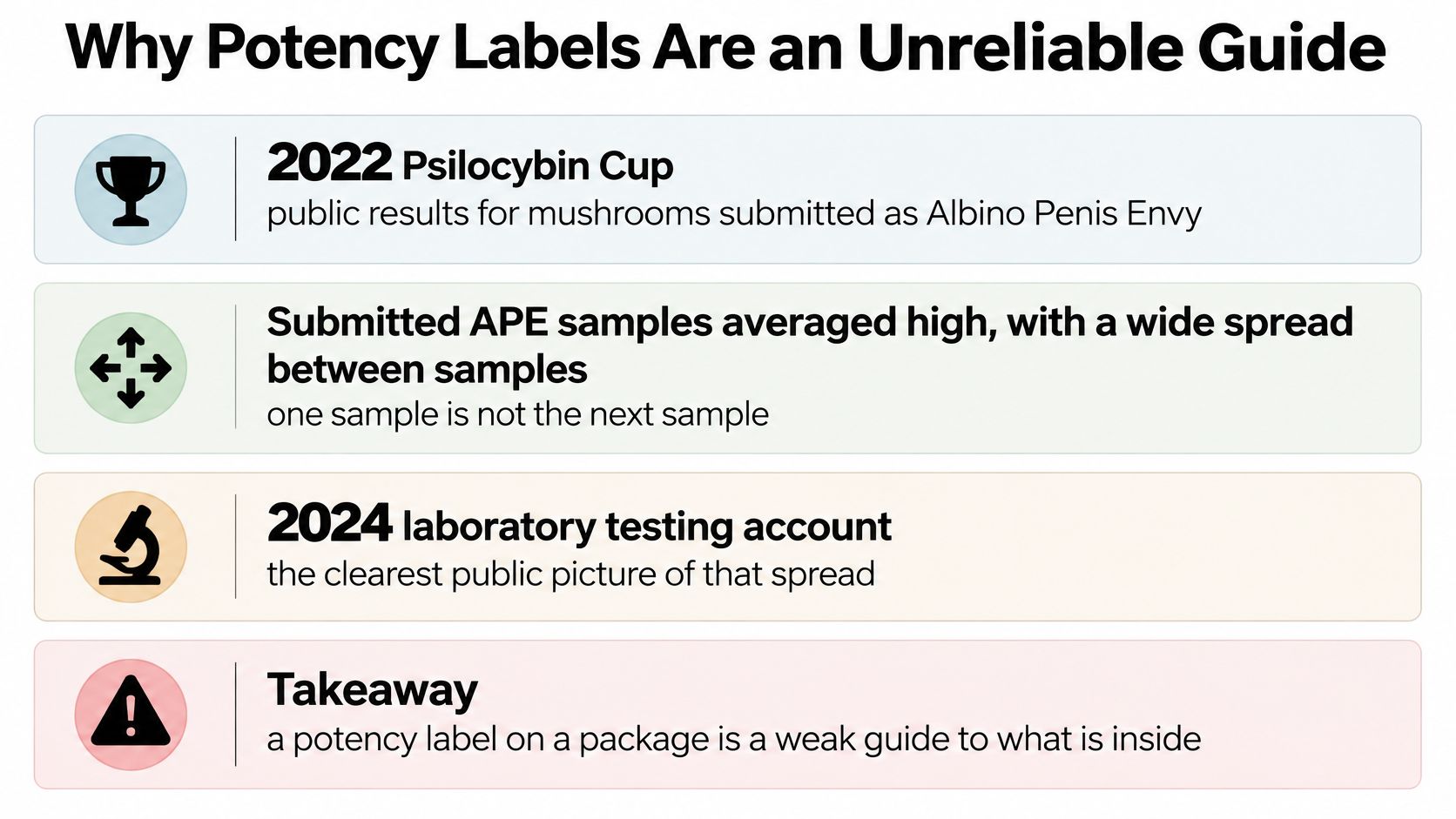
A cultivar name works like a recipe title. It tells you what style someone was aiming for. Only a lab count tells you what's in the portion you're about to take.
This is why the "strongest strain" framing misleads even when a strain tests high. Rankings built on a handful of samples collapse as soon as a different grower, a different harvest or a different lab enters the picture. If you want the reasoning behind that claim in more depth, the breakdown of the strongest mushroom strain shows how quickly popularity and measured potency part ways.
The defensible conclusion is narrow. Some tested APE samples have shown relatively high psilocybin levels, and some have not. No accepted percentage applies to all Albino Penis Envy mushrooms, so a headline number is a sample result, not a specification. Don't convert a name, a pale cap or a reputation into a dose.
How Batch Variation Shapes Dried and Infused Products
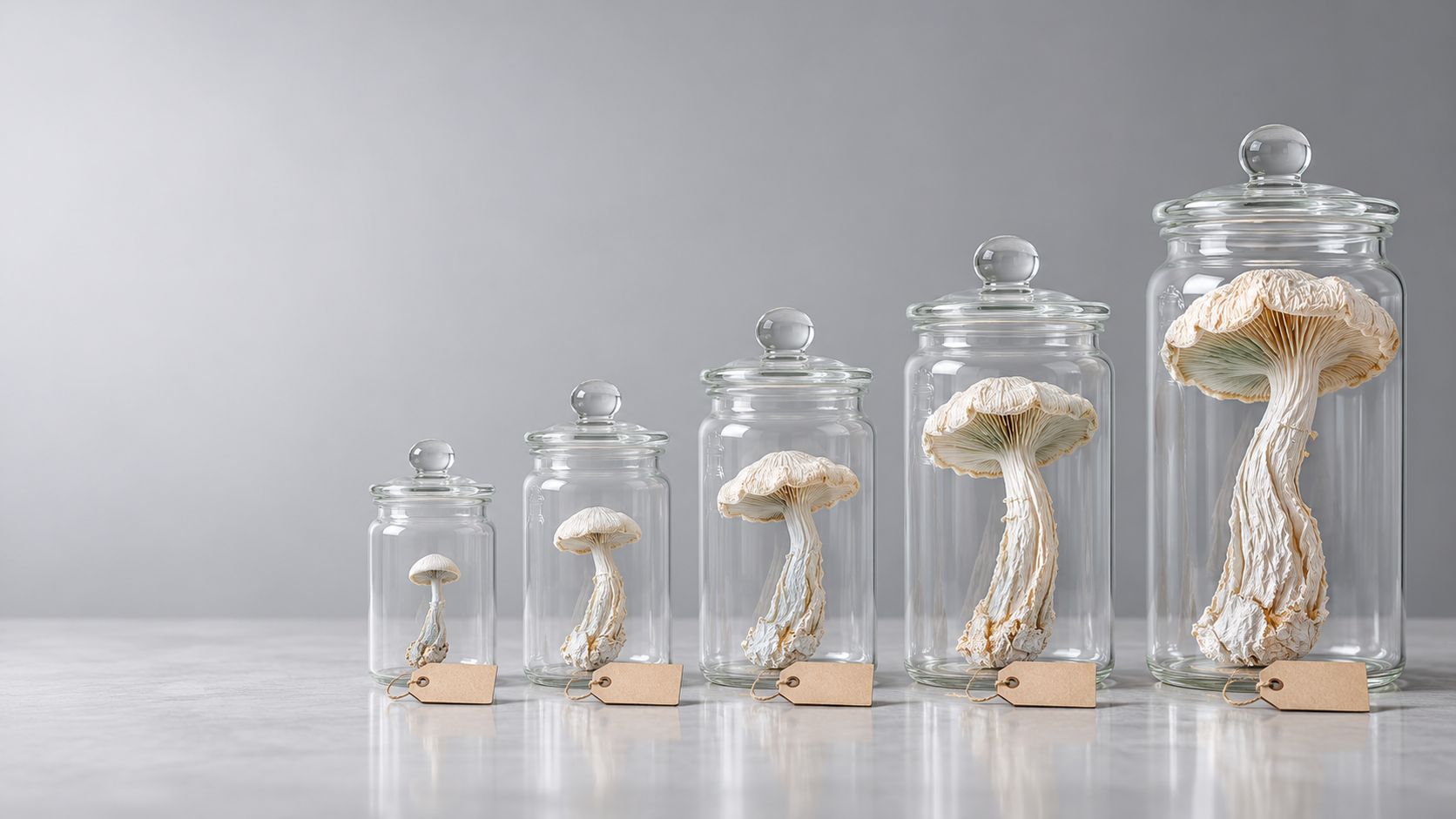
Two people split a batch of whole dried mushrooms and each take the same nominal weight. They can absorb different amounts of psilocybin, because potency isn't distributed evenly through a fruiting body or across a harvest.
The scale of that unevenness is measurable. Within-strain variation in controlled material reached roughly 13% to 23% among individual fruiting bodies, while broader comparisons found more than a sevenfold spread in psilocybin concentration across named P. cubensis lines, according to Norshroom's strain reference. Sevenfold isn't a rounding difference between brands. It's the difference between a mild portion and a very large one.
What grinding fixes and what it can't
Grinding a verified batch and mixing it thoroughly evens out the differences between individual mushrooms. Someone taking a gram from a well-mixed jar gets a more representative portion than someone biting the cap off one fruit. That's a real improvement in consistency.
It can't fix a mislabeled batch. It can't reverse degradation from heat, light or moisture during storage. Homogenizing bad material gives you uniform bad material.
Infused products need a different test
Chocolate bars, gummies and drinks introduce new variables. Extraction efficiency, heat during processing, moisture, pH and shelf life all shift how much active compound ends up in the finished unit. A lab result on raw mushrooms doesn't transfer automatically to a chocolate bar made from them.
The specification that matters for an edible is a validated assay of the finished product. A label worth trusting states four things:
- Batch or lot identity, so the result can be matched to the product in your hand.
- Concentration basis, whether the figure is per gram, per piece or per package.
- Test method and lab name, because methods aren't interchangeable.
- Serving amount, expressed in the same unit the test used.
Practical rule: A chocolate bar and a dried gram carrying the same cultivar name are not the same measurement. Never compare them gram for gram.
Effects, Safety Limits and Who Should Avoid It
Psilocybin can produce panic, confusion and nausea. It can raise heart rate and blood pressure, impair judgment, and in less common cases trigger prolonged psychiatric symptoms, as mushrooms.how's APE strain overview sets out alongside its discussion of the gaps in most strain content.
Some people should skip it. The compound is generally considered unsuitable for anyone with a psychotic disorder or severe bipolar disorder. Safety during pregnancy and breastfeeding remains unknown, which is different from known-safe, and the difference should govern the decision. "Natural" describes an origin, not a risk profile.
Most strain pages spend their words on subjective effects and dose anecdotes. Far fewer address medication interactions, mental-health history or what to do if a session goes wrong. That's the content gap worth closing before a purchase, not after.
The legal picture is fragmented
Federal prohibition continues in the United States, while some states and localities have adopted different approaches, and newer programs are still developing their operating standards and data systems. The practical instruction is simple: check the law where you are, not where the vendor ships from.
Reducing avoidable risk
A few habits remove the most common failure modes, and none of them depend on knowing a strain's potency label.
- Don't drive or operate machinery, on the day of use. Arrange transport before you start.
- Don't redose while onset is uncertain. Impatience is the most frequent cause of an unintendedly large experience.
- Have a sober companion if you're trying a batch for the first time, since batch-to-batch variance is real.
- Don't treat a clinical trial result as a retail guarantee. Evidence from supervised trials may not transfer to community settings with less standardized screening and counseling support.
If you want to understand what these compounds do to memory and recall while they're active, this discussion of the neuroscience of psychedelics and recall is a useful primer. Knowing the mechanism makes the "don't drive, don't operate machinery" guidance easier to take seriously.
Check the Batch Before You Buy Albino Penis Envy
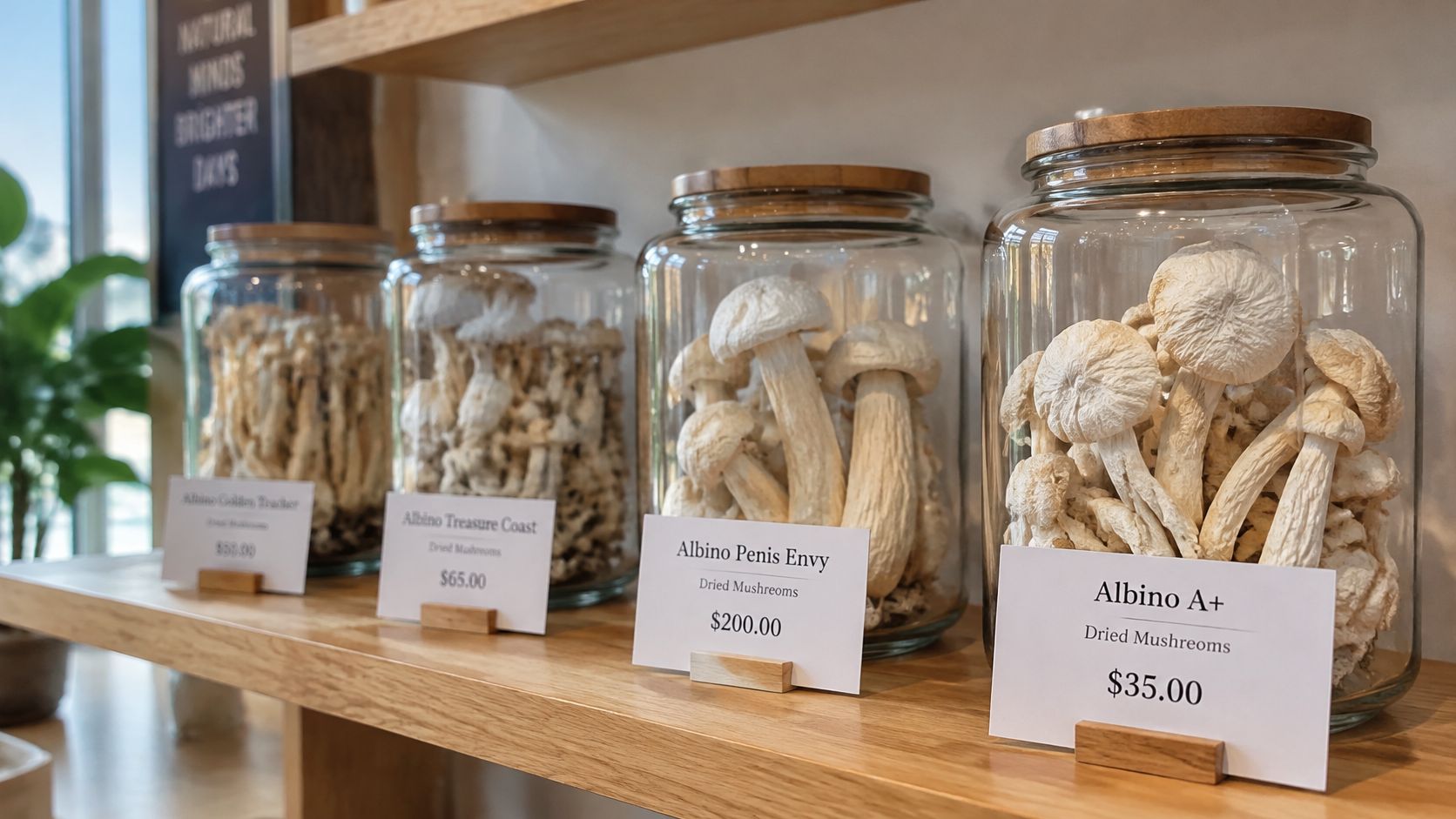
An albino label does not establish a potency ranking. In the available comparison, albino Penis Envy had lower total tryptamines than regular Penis Envy. That finding is a reason to treat cultivar names as descriptions, not measurements.
A price is no substitute for batch data. Penis Envy magic mushrooms are listed from $35.00 to $200.00, depending on the variant, but price alone does not show what a particular batch contains.
The five-point buyer check
- Confirm the batch or lot identity. A result without a batch reference cannot be matched to the product.
- Look for the lab name and analytical method. Results can vary with the method used.
- Check the reporting basis. A figure without a clear unit, such as per dry gram, is difficult to interpret.
- Compare like with like. Dried mushrooms and infused bars are different product types.
- Treat cultivar names as labels, not test results. Appearance and reputation do not establish a batch's composition.
Metro Mush's team has dedicated over 4 years to growing and perfecting its mushroom strains, and the service covers the Detroit and Ann Arbor areas. For more on the shop's range, browse its high-quality mushroom products.
The useful question is whether the information available describes the specific product and batch you are considering. If a listing offers only a cultivar name and price, those details cannot establish its potency.
Metro Mush also offers Mush Love chocolate bars. Browse the menu at Metro Mush and order by text.