
More than 200 species of fungi produce psilocybin, according to the National Institute on Drug Abuse's overview of psilocybin mushrooms. That biological diversity makes a familiar retail name a weak starting point for judging chemical content. For adults comparing gold cap mushrooms dried, the useful questions concern species identity, batch testing, and storage history, not which bag looks strongest.
A scale measures mushroom material, not psilocybin. Understanding that distinction lets you evaluate a product description without mistaking a common name, a premium label, or a precise gram weight for a predictable experience.
What Dried Gold Cap Mushrooms Are
Gold cap is a common name for Psilocybe cubensis, a psilocybin-producing mushroom, rather than a scientifically standardized strain designation. The Psilocybe cubensis species account describes Franklin Sumner Earle's original classification as Stropharia cubensis in 1906 and Rolf Singer's transfer to Psilocybe in 1948. The scientific name identifies a species; a retail nickname doesn't establish a chemically uniform product.
That distinction matters when a seller describes gold cap as though it were a potency grade. A species can include different cultivation lineages and chemically different harvests. Even accurate species identification leaves unanswered questions about the material inside a particular package.
Common names and what they tell a buyer
| Term | What it refers to | What it does not tell you |
|---|---|---|
| Gold cap | Common name for Psilocybe cubensis | Potency, cultivar, or lab-tested content |
| Golden halo | Another common name for Psilocybe cubensis | Batch identity or dose |
| Cube | Informal name for Psilocybe cubensis | Whether drying or storage was controlled |
| Magic mushroom | Umbrella term for psilocybin-producing species | Which species or strain is in the bag |
These names aren't interchangeable with evidence. A label can accurately describe the intended species while providing no measurement of its active compounds. Likewise, a named cultivation lineage can add descriptive detail without proving that successive lots have equivalent composition.
Naming rule: Treat the common name as a description to verify, not a chemical specification.
A useful product description separates the species, the cultivation name, and the batch identifier. Those fields answer different questions: what organism is claimed, how the grower describes its lineage, and which particular material the documentation covers. Combining them into a single marketing name makes comparison harder, not more precise.
Dried Forms and Physical Traits to Recognize
Dried gold cap products can appear as intact caps, separated stems, mixed pieces, or powder. Caps may retain a golden-to-brown surface and recognizable gills; stems are generally paler and more fibrous. Powder removes most recognizable anatomical features, so its uniform appearance offers little help with identity.
The cap-to-stem distinction deserves attention without becoming another strength-ranking shortcut. A 2024 EntheaCare article comparing mushroom caps and stems reports that caps may contain approximately 30% more psilocybin than stems. That's a secondary-source figure, not a measurement of the pieces in a particular bag.
Dried forms compared
| Form | Typical look | What it means for dosing | Storage sensitivity |
|---|---|---|---|
| Whole dried caps | Firm, golden to brown, intact | Anatomical differences don't establish the content of an individual cap | Lower exposed surface than powder |
| Dried stems | Paler, thinner, more fibrous | The cited comparison suggests lower content than caps, not a reliable conversion rule | Still require protection from moisture, light, and oxygen |
| Ground powder | Fine, relatively uniform colour | A consistent appearance doesn't establish chemical consistency | Rapid degradation occurred in tested dried powder |
| Mixed caps and stems | Both forms in one bag | Composition reflects the pieces included, not just total weight | Packaging must protect all the material from moisture and exposure |
Appearance is useful for description, not authentication. A photograph can show whether a product is whole or ground, but it can't establish measured alkaloid content. Nor should these physical descriptions be used to identify wild mushrooms for consumption.
A visually consistent product and a chemically characterized product are different things.
For powder, ask whether the laboratory tested a representative sample of the finished batch. For whole pieces, ask how the sample was selected. A result from a conveniently chosen fragment provides less useful information about a mixed package than a documented, representative sampling process.
Why Dried Weight Does Not Equal a Dose
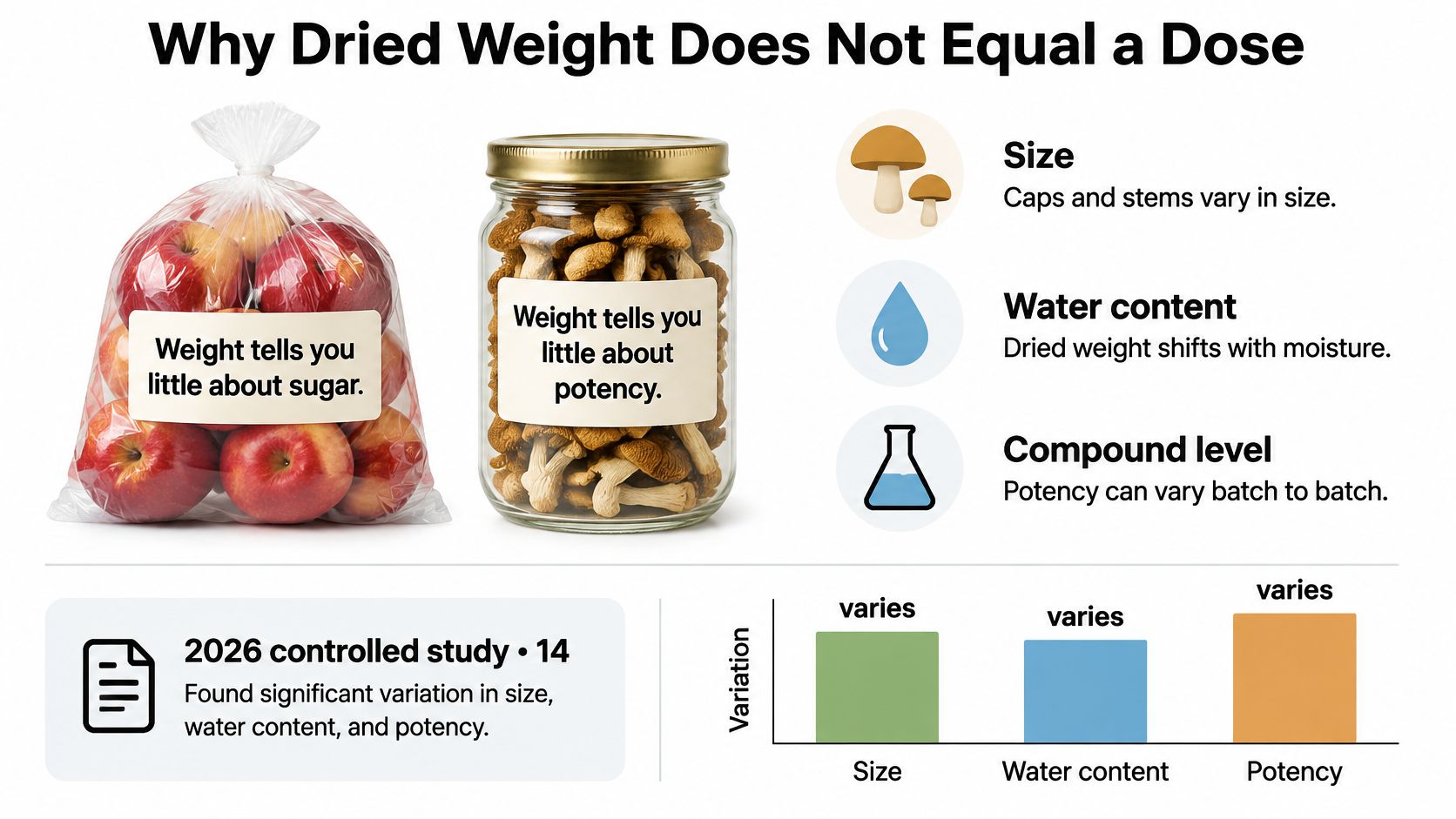
A gram is a reliable unit of mass. It isn't a reliable unit of psychoactive content unless you also know the concentration of the relevant compounds.
A 2026 controlled study of 14 Psilocybe cubensis strains, summarized by miraculix in its analysis of strain potency variability, found psilocybin concentrations from 2.03 to 19.60 milligrams per gram, more than a ninefold spread despite standardized cultivation, drying, and laboratory conditions. The calculations below use those reported bounds, not measurements of any Metro Mush product.
The visual comparison captures why weight alone can't answer the potency question.
Milligram ranges by dried weight
The following values are arithmetic projections from the cited study concentrations. They aren't recommended portions, safe-dose limits, or a complete range for all mushrooms.
| Dried weight | Low end (2.03 mg per gram) | High end (19.60 mg per gram) |
|---|---|---|
| 1 gram | 2.03 mg | 19.60 mg |
| 3.5 grams | 7.105 mg | 68.60 mg |
| 7 grams | 14.21 mg | 137.20 mg |
The extra decimal places reflect multiplication, not laboratory certainty. Real samples introduce uncertainty through sampling, analytical methods, and differences among pieces.
Read the analyte, not just the headline
A report should specify whether it measures psilocybin, psilocin, or a stated combination. Don't substitute a combined figure into a calculation described as psilocybin alone. Percentages also need a clear basis, particularly whether the result refers to dry material.
The analytical authentication review hosted by the Oregon Health Authority describes DNA identification alongside chromatographic measurement of mushroom compounds and emphasizes the importance of representative material. Identity testing and chemical testing answer different questions; neither should be presented as a substitute for the other.
Our guide to dosing terminology and mushroom measurements offers additional context for reading product information. The central buying decision remains whether the seller can connect an intelligible laboratory result to the actual lot offered, rather than assigning strength from a strain name.
Storage and Freshness Checks That Protect Potency
Freezing everything isn't automatically the best preservation strategy. A stability study hosted by the Oregon Health Authority found the lowest decay in dried biomass stored in darkness at room temperature, while dried fungal powder degraded rapidly across tested storage conditions. Those findings describe the tested materials and conditions, not an unlimited shelf-life guarantee.
A storage setup should prioritize a dry, sealed package and protection from environmental exposure.
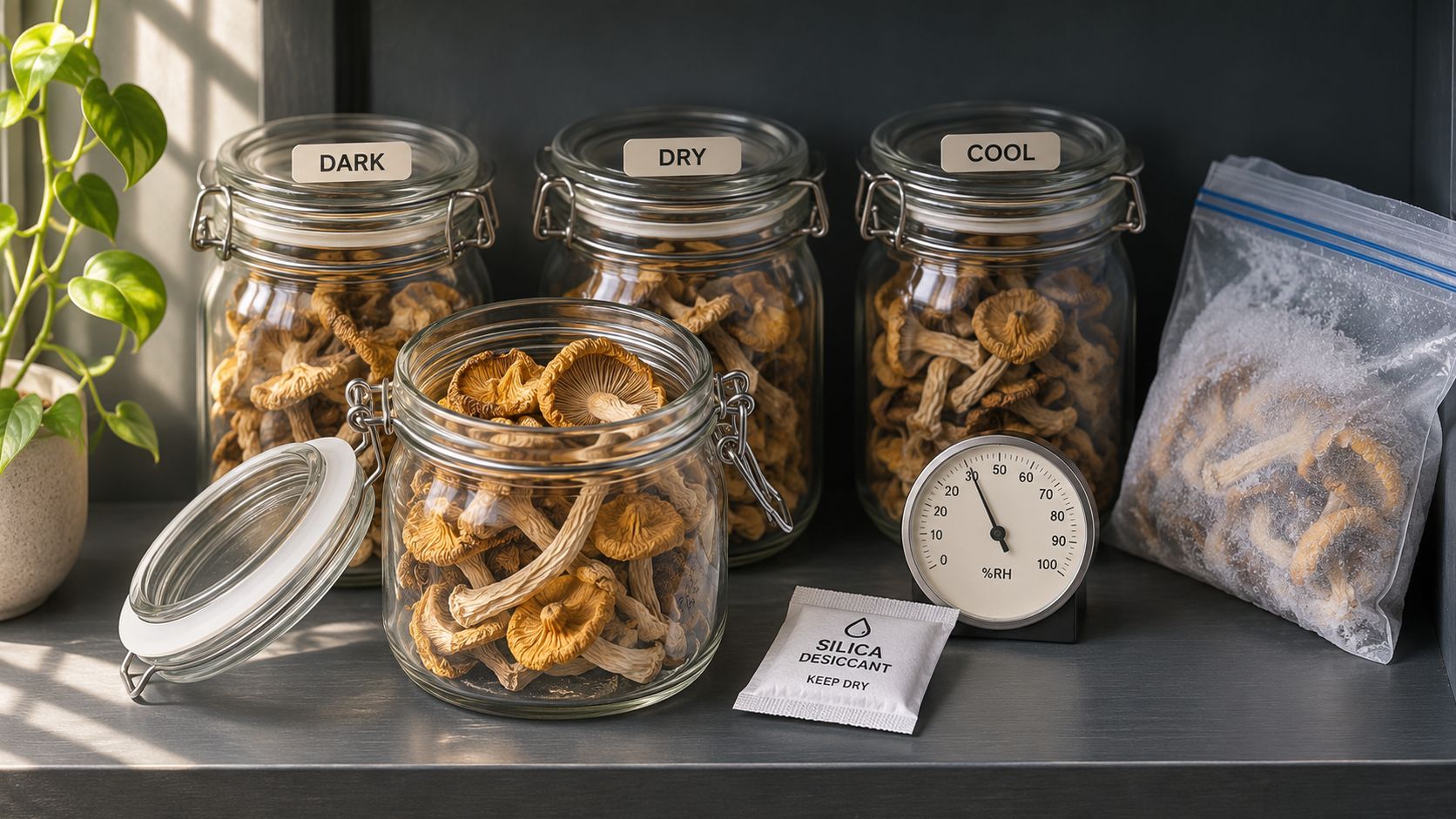
Grinding increases exposed surface area and contact with oxygen, which can contribute to chemical loss. The researchers suggested an inert-gas environment as a preservation improvement, but a household container shouldn't be assumed to reproduce laboratory-controlled conditions.
A practical storage routine
- Check dryness before sealing. Don't package material with visible moisture or condensation.
- Use a tightly sealed container. Keep the closure clean and minimize unnecessary opening.
- Choose a dark location away from heat. Avoid windowsills, hot vehicles, and damp cupboards.
- Avoid unnecessary grinding. Don't turn intact material into powder for storage convenience.
- Keep the lot information. Retain the original label and record when the package was opened.
- Match the report to the material. Check whether the certificate describes whole dried mushrooms, powder, or another preparation.
Our psilocybin shelf-life guide provides further storage context. A printed date is more useful when the seller can explain the packaging and stability evidence behind it.
For additional storage context, the following video is available.
Food-safety inspection and potency assessment are separate tasks. Don't consume material showing visible mould, unexpected moisture, or an unusual foul odour, and don't try to salvage suspect pieces by drying them again. Conversely, a normal appearance doesn't prove either chemical strength or freedom from contamination.
Legal Status and Seller Questions to Settle First
In the United States, psilocybin remains federally controlled, while state and local approaches differ. Reduced local enforcement priority isn't the same as permission to operate a retail market, deliver products, or transport them across state lines. Check the rules governing the specific activity and location, not just whether a city is described as decriminalized.
Adults in Detroit and Ann Arbor should also distinguish local policy from rules that apply during travel. Our Michigan mushroom information page provides local context, but a seller's availability isn't proof that a transaction is lawful. For questions involving distribution allegations, drug defense guidance from Fiscella Law offers legal context; it isn't a substitute for advice about your own circumstances.
The checklist below separates legal considerations from product verification.
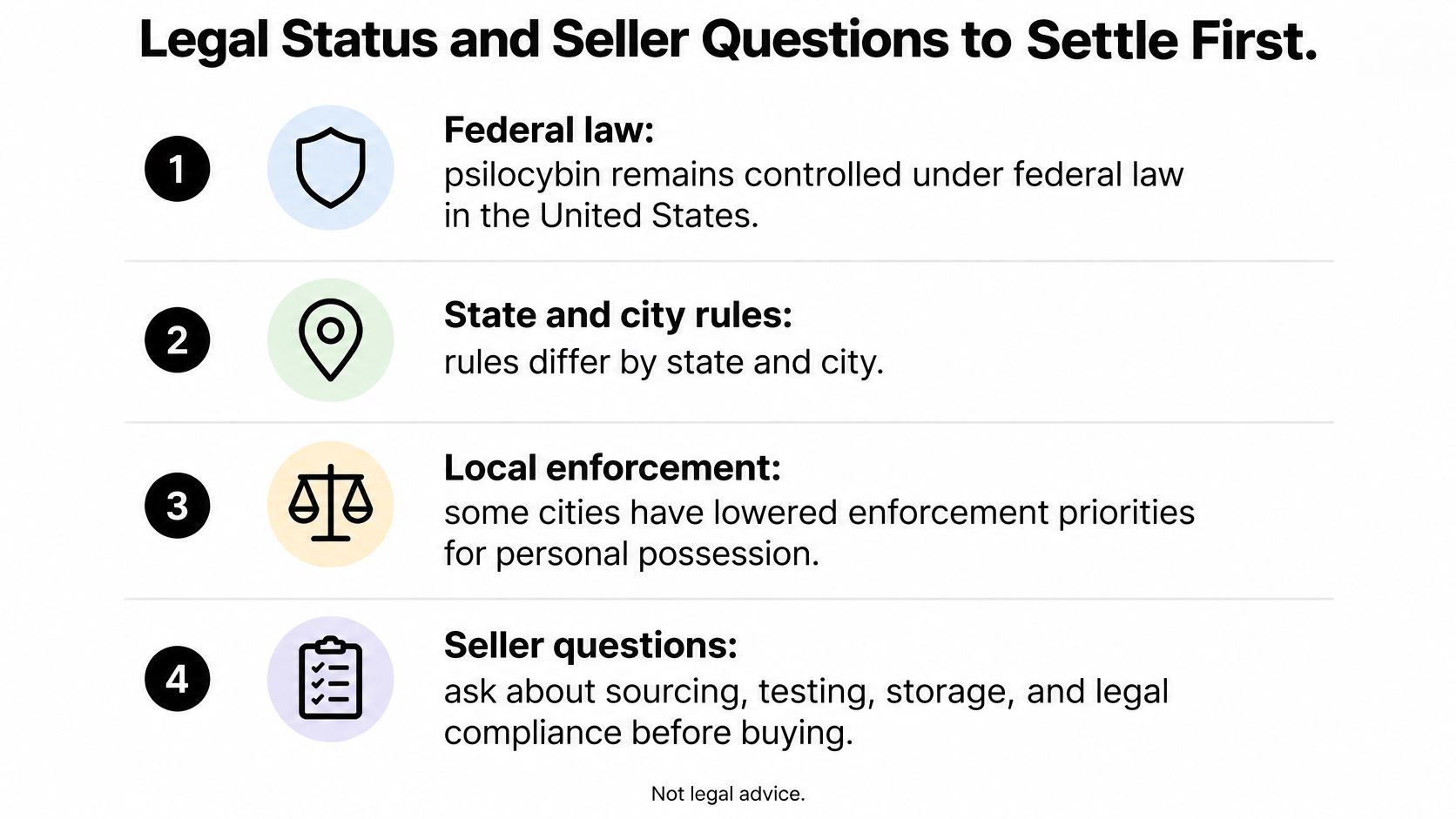
Questions worth putting in writing
- Species identification. What scientific species name applies, and what supports that identification?
- Batch documentation. Does the report identify the same lot as the package?
- Analytical detail. Which compounds were measured, in what units, and by which laboratory?
- Processing history. How was the material dried, packaged, and stored?
- Traceability. Is there a lot date and a clear distinction between harvest, packaging, and testing dates?
- Product form. Was the tested material whole, powdered, or processed further?
- Quality failures. What happens if contamination, packaging damage, or a documentation mismatch is discovered?
A 2026 PlugReports reference on psilocybin mushrooms lists typical dried-mushroom street prices at approximately $8–$15 per gram. That isn't a cultivar-specific valuation or evidence of legal sourcing, so price shouldn't stand in for verification.
A premium label without supporting documentation deserves scrutiny just as much as an unusually cheap offer. If a seller can't connect the package, lot, and report, you don't have enough information to assess its claimed chemical content.
Safety Points Adult Consumers Should Weigh
Psilocybin can produce strong perceptual and emotional effects. Chemical measurements can't establish whether a particular person will tolerate those effects, and a seller shouldn't be your medical screening resource.
Speak with a qualified clinician before considering use if you have a personal or family history of psychosis or bipolar disorder, a heart condition, or you're pregnant or breastfeeding. Discuss current medications explicitly, including antidepressants, lithium, and nonprescription substances. Don't stop prescribed treatment to make room for mushroom use.
Decisions to make before any exposure
- Avoid driving and machinery. Arrange transportation and stay away from activities where altered perception could injure you or someone else.
- Don't combine substances casually. Avoid mixing with alcohol, cannabis, or other drugs, and seek professional advice about medication interactions.
- Arrange sober support. A trusted, sober adult should know what's been taken and be able to seek help.
- Secure the package. Keep mushrooms and infused products out of reach of children and pets, clearly labelled and separate from ordinary food.
Adults who also use cannabis shouldn't assume familiarity with cannabis predicts a manageable mushroom experience. For that separate mental-health discussion, cannabis risks explained for Florida patients from Refresh Psychiatry & Therapy provides context, not evidence that combining substances is safe.
Emergency priority: Respond to symptoms, not to reassurance from a product label.
Seek medical help promptly for chest pain, fainting, severe agitation, persistent confusion, or thoughts of harming yourself or others. If someone is in immediate danger, contact emergency services and tell responders what may have been consumed.
Laboratory documentation can reduce uncertainty about composition. It doesn't establish medical suitability, eliminate adverse reactions, or turn an unregulated product into a clinically supervised treatment.
Starting Small With a Worked Example
Starting small doesn't solve missing information. If a batch has no applicable laboratory report, weighing a small fragment accurately still leaves its chemical concentration unknown. The more defensible decision is to resolve the missing documentation rather than invent a reassuring milligram estimate.
A hypothetical calculation, not a recommended portion
Suppose a report states 11.0 milligrams of psilocybin per gram of dried material. This is an invented value solely for demonstrating arithmetic, not a measurement of a named product. For a hypothetical 0.5-gram sample, the calculation is:
11.0 mg/g × 0.5 g = 5.5 mg of psilocybin
That result estimates chemical content under the example's assumptions. It doesn't predict the person's experience, establish safety, or account for other compounds.
| Calculation check | What must be true |
|---|---|
| Concentration | The reported figure measures the intended compound |
| Material | The report applies to the dried product being evaluated |
| Weight | The sample's mass is measured accurately |
| Traceability | The package and report share a verifiable batch identity |
Don't treat this calculation as permission to take more when effects seem weaker or slower than expected. Arithmetic is a documentation tool, not a redosing schedule.
Apply the same standard to our offering
Our team at Metro Mush has dedicated over 4 years to growing and perfecting its mushroom strains. That experience isn't a substitute for batch-specific evidence, and readers should evaluate our descriptions by the same standard they apply elsewhere.
The decision is concrete: verify identity, traceability, analytical units, and storage history before relying on a potency claim. If those inputs aren't available, acknowledge the uncertainty instead of assigning a strength ranking.
We offer dried mushroom products and edibles for adult consumers in the Detroit and Ann Arbor areas. Visit Metro Mush to review the current selection, then bring the batch-verification questions above before making a purchase decision.