

For dried mushrooms and chocolate bars, use a product-specific, tested shelf-life date rather than a generic planning window: no universal psilocybin expiration date exists. A purchase date alone can't tell you whether an older product remains potent or safe.
You find a sealed pouch in a drawer, or an unfinished chocolate bar behind the coffee. The packaging looks intact, but you can't remember whether it spent time in a hot car. That missing storage history matters more than the receipt.
Psilocybin shelf life involves separate questions: how much active compound remains, whether the food or mushroom material has spoiled, and whether the label's dose still represents what's inside. The table below separates those questions without assigning unsupported expiration windows.
Shelf Life by Product Format at a Glance
Start with the manufacturer's storage directions and a batch-specific test report. If neither exists, treat potency as unverified, not as predictable for a certain number of months. Calling an estimate a planning window doesn't make it a measured shelf life.
Planning Windows by Psilocybin Product Format
| Format | Sealed planning window | After opening | Main risk |
|---|---|---|---|
| Dried whole mushrooms | Use a validated batch-specific date; no universal window established | Reseal promptly; opening introduces additional uncertainty | Heat, humidity, light |
| Ground or powdered mushroom | Use stability testing for the powder, not a whole-mushroom estimate | Keep dry in a tightly sealed container; use a suitable desiccant | Moisture and oxygen exposure |
| Chocolate bars | Follow the finished product's label; a food best-by date alone doesn't establish potency | Follow the manufacturer's opened-storage instructions | Heat, moisture, formulation changes |
| Shroom drinks | Label date supported by finished-product testing | Follow the label's refrigeration and use-after-opening directions | Microbial growth and chemical instability |
| Tinctures, alcohol-based | Require formulation-specific testing; no validated public window established here | Follow the label; keep the closure tight | Evaporation, light, composition changes |
| Capsules | Use the manufacturer's validated date for the capsule contents | Retain the original bottle and any supplied desiccant | Moisture and oxygen |
The distinction between sealed and opened matters, but opening doesn't start a universal countdown. A carefully resealed dry product and a repeatedly opened beverage don't face the same conditions. Neither should inherit the other's storage advice.
A Merck analytical technical article describes how processing and storage conditions affect measured compounds in mushroom material. Its findings don't establish consumer expiration windows for chocolates, tinctures, capsules, or drinks.
Read the Label as a Starting Point
Look for what the printed date really describes. A date may address food quality, measured potency, unopened storage, or some combination of these. Ask the manufacturer rather than assuming those meanings are interchangeable.
For example, an OuterSpore Milk Chocolate Bar needs information about the finished chocolate, not just the mushrooms used to make it. A Rocket Fuel shroom drink needs instructions appropriate to a liquid, including what to do after opening.
Practical rule: A sealed wrapper is evidence that a package hasn't been opened. It isn't evidence that the contents stayed cool, dry, or chemically stable.
Before trusting a date, check the batch identification, the storage requirements, and whether the product experienced any obvious temperature or moisture incident.
Why Psilocybin Potency Fades in Storage
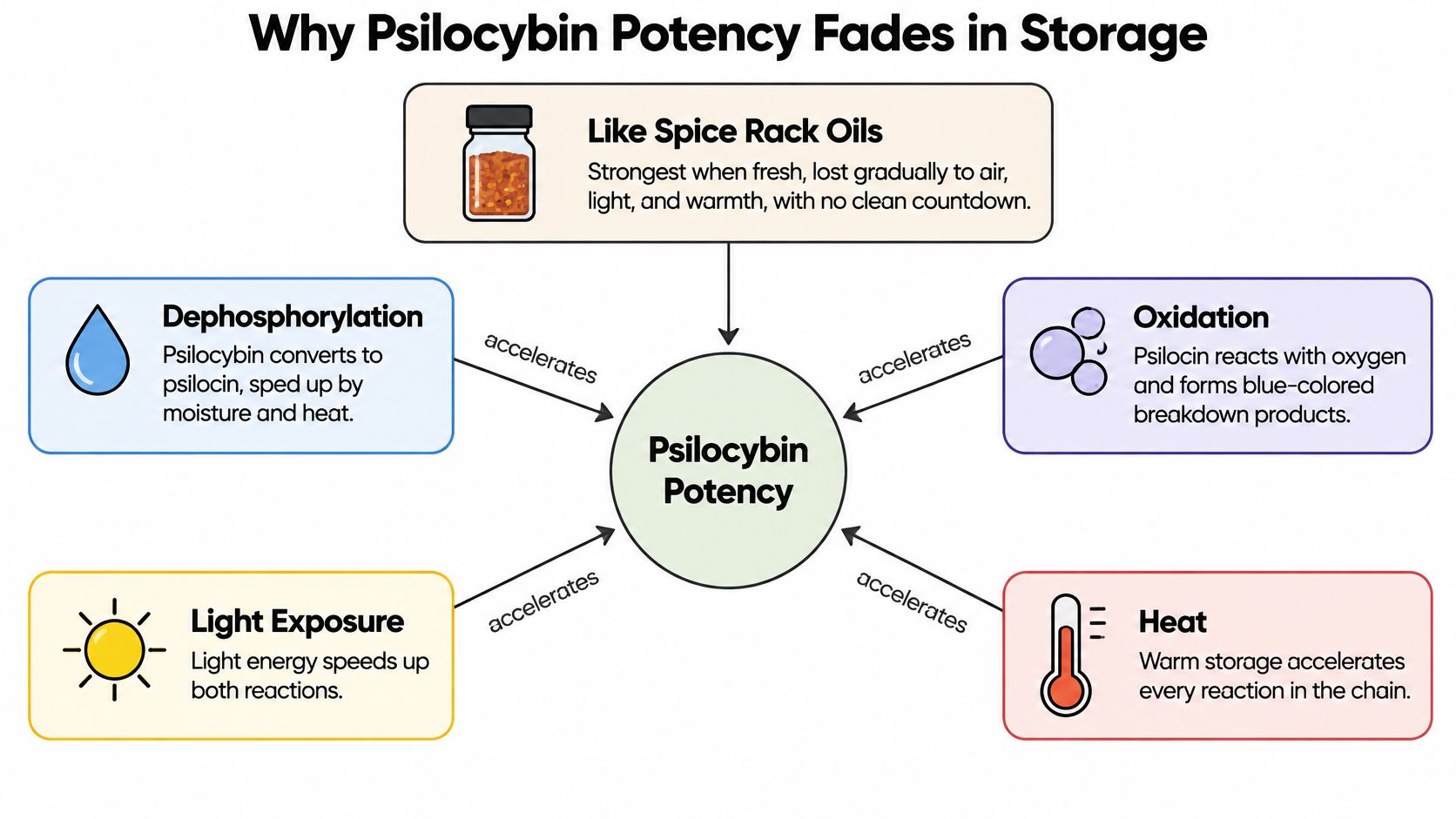
A spice rack offers a useful analogy: storage can change a product gradually without producing a clean, visible countdown. But psilocybin doesn't evaporate like an aromatic oil. Its chemistry can change, and those changes aren't always obvious from appearance.
Psilocybin and psilocin are related compounds, not interchangeable measurements. During storage, conversion and degradation can occur together. Measuring a decline in psilocybin alone may therefore miss changes in psilocin and the broader chemical profile.
The concept map below highlights the environmental factors involved.
Why the Freezer Isn't Automatically Better
A 2020 study in Drug Testing and Analysis examined psilocybin and four related tryptamines in cultivated Psilocybe cubensis, finding the greatest tryptamine degradation in fresh mushrooms stored at −80 °C and the lowest decay among tested conditions in dried biomass kept dark at room temperature.
That finding challenges a familiar household assumption: if cold preserves food, colder must preserve potency better. The experiment instead shows why the state of the material matters. Fresh tissue and dried biomass aren't equivalent starting points.
It doesn't establish that every frozen mushroom product deteriorates faster than every room-temperature product. Nor does it validate an expiration date for a chocolate bar, bottled drink, or extract. Those products have different compositions and need their own stability evidence.
The useful lesson is narrower and more practical: don't choose freezing solely because it sounds protective. Follow storage instructions supported by testing of the actual product.
Freshness describes a product's condition and handling history, not merely how recently someone bought it.
A recently purchased pouch could already have experienced poor storage. An older, properly handled batch might have better-preserved compounds, but only testing can establish what remains.
Heat, Light, Humidity and Oxygen Damage Explained
Heat and moisture deserve particular attention, especially in processed mushroom material. In a four-week assessment described in a Sigma-Aldrich analytical technical article, cryo-milled mushrooms exposed to 40 °C and 75% relative humidity showed an almost complete reduction in measured psilocybin, while refrigerated and room-temperature samples were comparatively more stable; heated conditions also produced conversion to psilocin and further degradation.
Those were specific experimental conditions, not a universal temperature boundary. You can't use the result to calculate what a short car ride did to a particular bar. You can use it to recognize prolonged heat and humidity as serious storage failures.
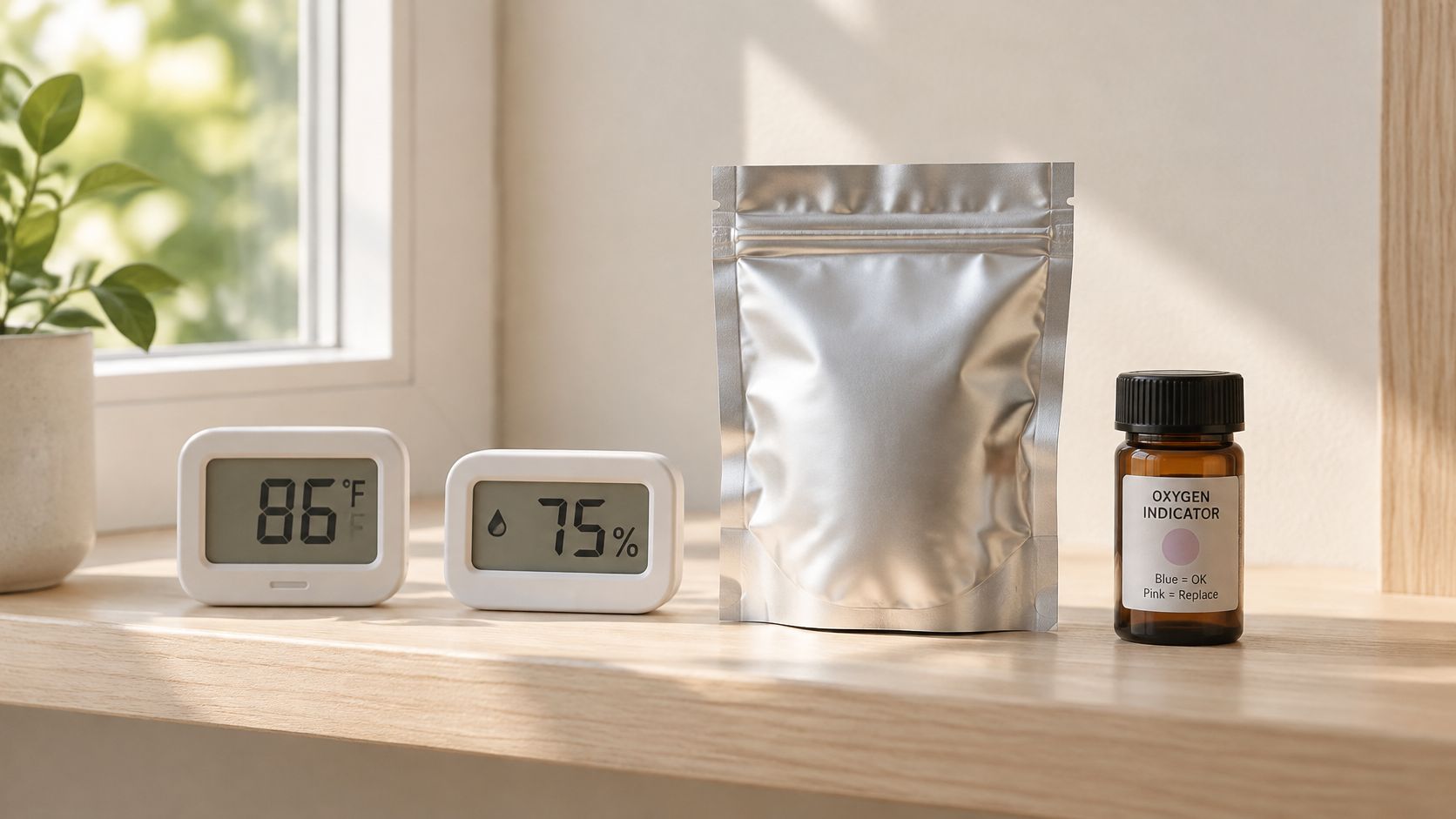
The pictured tools illustrate environmental monitoring and protective packaging, not a guarantee of preserved potency.
What Each Exposure Changes
Heat can accelerate chemical changes. A stable cupboard away from heating appliances is more sensible than a shelf beside an oven.
Humidity allows dry contents to pick up water. Clumping or a newly damp texture signals that the storage environment has changed, even before visible mold appears.
Light is another avoidable exposure. Use an opaque outer package or a dark cupboard rather than displaying a product in a clear jar beside a window.
Oxygen remains inside partially filled containers and enters when you open them. A well-fitting container and prompt resealing limit unnecessary exposure, although neither stops all chemical change.
Finished Foods Need Their Own Evidence
Chocolate and drinks introduce ingredients and processing steps absent from dried mushrooms. Water activity, acidity, emulsifiers, oxygen, and heat treatment can affect stability. A result measured in mushroom powder can't establish the shelf life of a finished beverage.
Avoid storage locations that repeatedly expose products to unstable conditions:
- Hot vehicles: Don't leave products in a glove compartment or parked car.
- Bathrooms: Steam and repeated humidity changes make them poor storage spaces.
- Sunny shelves: Direct light can also warm the package.
- Cooking areas: Keep products away from ovens, kettles, and dishwasher exhaust.
- Unattended bags: A backpack left outdoors can become an uncontrolled storage environment.
Packaging Choices That Slow Potency Loss
Good packaging has practical goals: limit oxygen, block light, exclude moisture, and avoid unnecessary headspace. No container compensates for poor drying, an unsuitable formulation, or a damaged seal.
Choose packaging for the contents rather than treating every product alike. A desiccant can help protect dry capsules, but it doesn't belong loose inside a drink or tincture.
Packaging Options Compared for Psilocybin Storage
| Packaging option | Protects against | Limits | Verdict |
|---|---|---|---|
| Original sealed retail packaging | Handling exposure; light and moisture if designed for them | Barrier performance and closures differ | Retain when intact and appropriate to the label |
| Vacuum-sealed foil pouch | Light, moisture, and much of the package air | Punctures and seal failures; compression can crush material | Suitable for dried material when properly specified |
| Amber glass jar with tight lid | Light exposure and air exchange | Humidity enters during opening; amber glass doesn't block all light | Useful for appropriate liquids or dry capsules; desiccant only for dry contents |
| Mylar bag with oxygen absorber | Light and oxygen when the material and seal are suitable | Absorber capacity is limited; not appropriate for every formulation | Useful for dry portions with manufacturer-specified components |
| Clear zip bag or plastic tub | Basic handling protection | Often limited light protection and uncertain barrier performance | Don't rely on it alone for extended storage |
| Freezer bag | Basic containment | Not necessarily a high oxygen barrier; condensation remains a concern | Not a reason to freeze; use only with validated product instructions |
Make the Closure Work
Inspect the actual sealing surface. Powder caught in a zipper, a cracked jar rim, or a poorly seated cap can prevent a reliable closure. A soft pouch alone doesn't prove a leak, and a rigid package alone doesn't prove protection.
Use food-compatible desiccants specified for the container and contents. Follow the packet manufacturer's capacity and replacement instructions rather than guessing from packet size or squeezing it to judge saturation. Keep packets intact and clearly separated from anything someone might mistake for food.
Oxygen absorbers also have a finite capacity. Follow their handling instructions and replace them when required after exposure; don't assume an old packet remains effective indefinitely.
For bulk dry products, smaller sealed portions can reduce repeated opening of the main supply. Keep every portion labeled so you don't lose the batch identification during repacking.
Chocolate requires attention to the wrapper and food-storage instructions as well as the active ingredient. This guide to storing chocolate bars provides format-specific context, but the manufacturer's directions should govern a particular bar.
How to Store Each Format Step by Step
Create a storage record when a product arrives, not when you discover it months later. A marker, an intact container, and a photograph of the original label can prevent much of the uncertainty surrounding an old batch.
The visual below provides a storage overview. Don't treat its temperature wording as a validated universal limit, or blue discoloration alone as a discard rule; handling-related blue bruising requires different interpretation from suspicious growth.
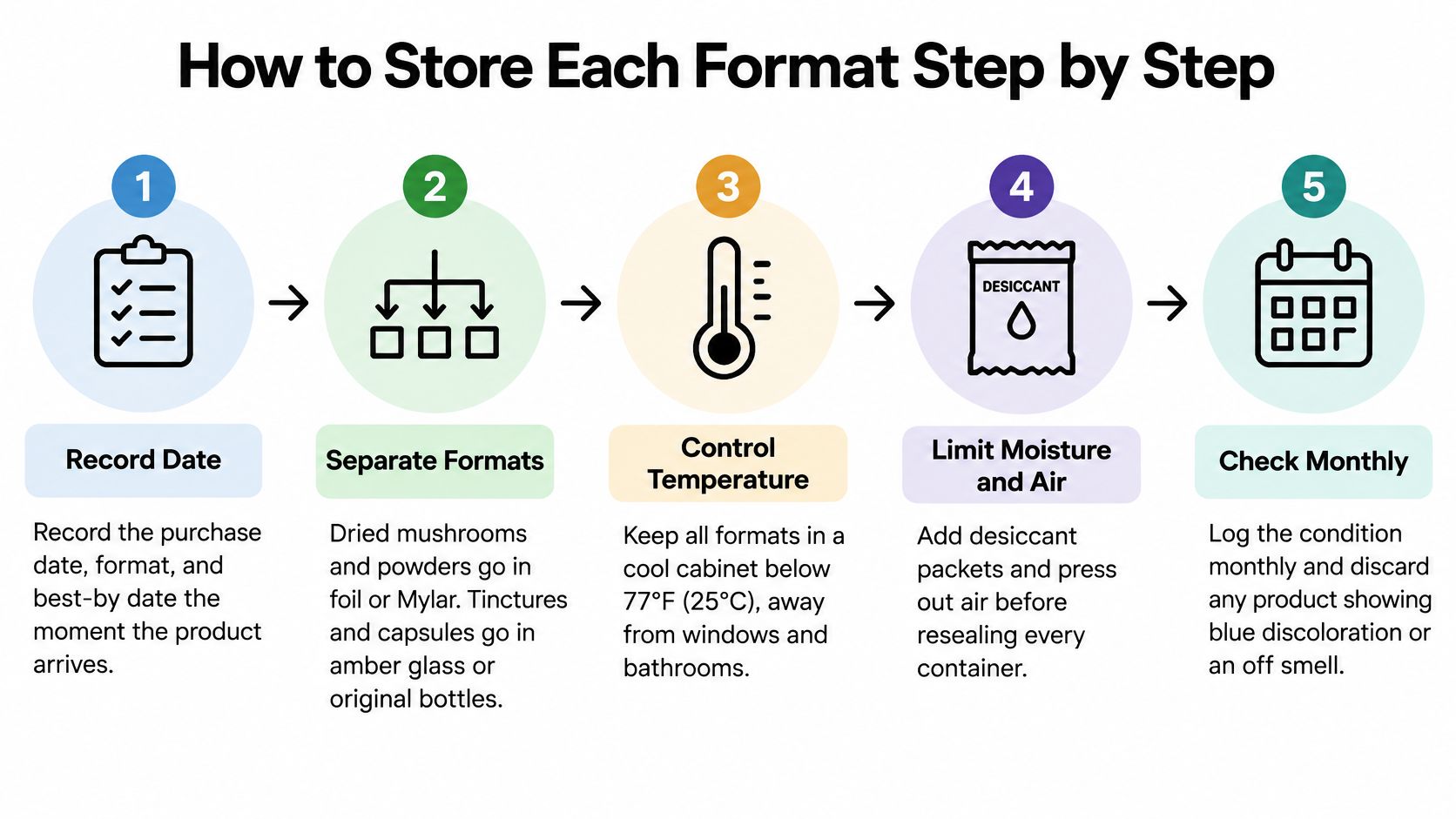
- Record the identifying details. Photograph the batch number, manufacture date, best-by date, and storage directions. Keep the purchase date separately, since it isn't the production date.
- Keep formats separate. Store dry material as dry material, and follow liquid-specific instructions for beverages and tinctures.
- Preserve the original label. If repacking is necessary, transfer the identification and warnings to the new container.
- Choose compatible moisture control. Keep supplied desiccants with dry products when instructed. Never add them directly to liquids.
- Select a stable location. Use a dark, dry cupboard away from appliances, children, pets, and ordinary snacks.
- Avoid unnecessary cold cycling. Don't refrigerate or freeze dried products by default. If a labeled product requires cold storage, keep it sealed during warming before opening when appropriate to its instructions.
- Close promptly after use. Don't leave the main container open while preparing portions.
- Log changes and incidents. Note opening, damaged packaging, unexpected dampness, or exposure to heat.
- Arrange reassessment through the supplier or laboratory. Don't use a calendar reminder as proof that potency remains within specification.
If drying history is unclear, this guide to drying Psilocybe cubensis offers context. Drying instructions don't establish that an already questionable batch is safe, and redrying doesn't reverse contamination.
A video resource is included below; product-specific instructions should take precedence over general demonstrations.
Telling Spoilage From Potency Loss
Spoilage is a safety concern. Potency loss is a chemical-quality concern. They can occur together, but a product may also look normal while its active-compound content has changed.
Don't taste an uncertain product to diagnose it. A sensory check can identify reasons to discard something, but passing that check doesn't establish safety or potency.
Diagnosing Spoilage Versus Potency Loss
| Sign | Likely cause | Action |
|---|---|---|
| Mold, fuzz, or unexplained growing spots | Possible contamination | Discard; don't scrape off the affected area |
| Off, sour, or rotten smell | Possible spoilage | Discard |
| New slime, unexpected cloudiness, or unexplained sediment | Microbial growth, precipitation, or formulation breakdown | Don't consume; consult the manufacturer or discard |
| Clumping or newly damp dry material | Moisture exposure | Set aside; discard if storage safety can't be established |
| Blue bruising after handling | Can reflect psilocin oxidation | Not proof of spoilage or measured potency; inspect other changes |
| Normal appearance with an apparently weaker effect | Possible potency change, among other explanations | Don't compensate by increasing intake; obtain testing |
| Melted or bloomed chocolate | Temperature exposure or fat/sugar changes | Check packaging and storage history; appearance alone can't establish potency |
Why Age Doesn't Give a Dosing Correction
A New Mexico Department of Health rulemaking document describes limited evidence for homogenized powdered mushrooms, including degradation beginning around one month under some conditions and a more pronounced decline between two and 15 months; because of uncertainty, the agency favored six-month retesting rather than a universal expiration date.
That isn't a promise that a powder stays stable until a particular month. It also doesn't establish a household retesting schedule for every edible.
Psilocybin and psilocin needn't decline together. For low-dose products, uncertain ingredient distribution adds another reason not to translate age into a precise dose adjustment.
An apparently weaker previous experience doesn't prove that the next portion will be weak.
For help recognizing suspicious growth, consult this mushroom contamination guide. If you can't distinguish bruising from contamination, don't consume the product. A smaller amount doesn't make spoiled material safe.
Testing Benchmarks That Make a Date Meaningful
A credible shelf-life date needs a connection to the batch, the product format, and the tested storage conditions. A laboratory result from an ingredient supplier doesn't automatically establish the contents or stability of a finished chocolate.
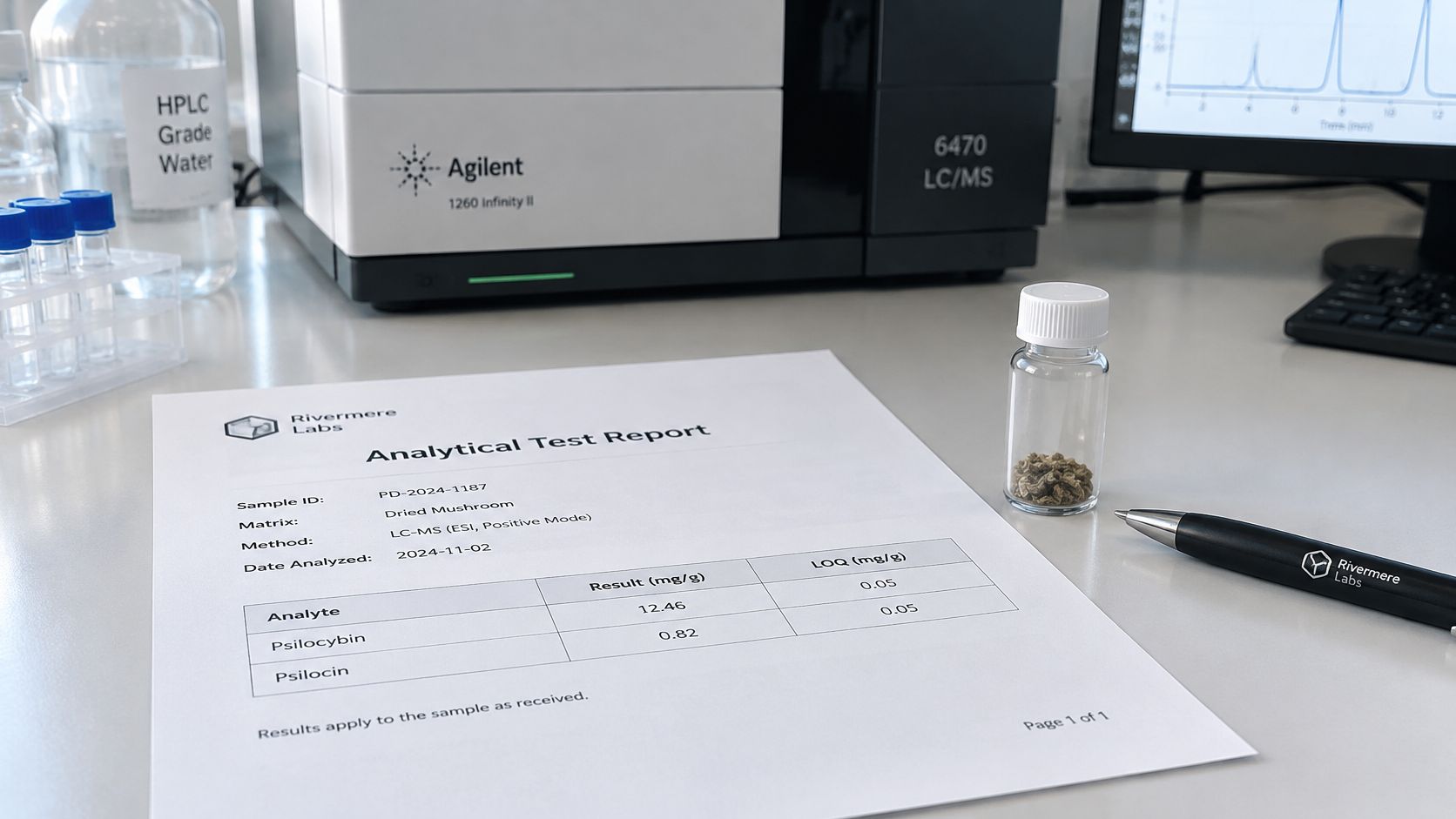
Look for quantitative results for both psilocybin and psilocin, a named analytical method, clear units, sample identification, and a test date. Methods such as HPLC or LC-MS should appear in a report with enough detail for the laboratory to explain what it measured.
The image illustrates analytical testing. A photograph of laboratory equipment isn't a substitute for an accessible, batch-matched report.
Recognizable Doesn't Mean Chemically Preserved
A 2023 Applied and Environmental Microbiology study analyzed 25 fungarium specimens representing Psilocybe cubensis, Psilocybe cyanescens, and Psilocybe semilanceata, finding taxon- and time-dependent differences in decay; most specimens stored for more than 40 years had no detectable psilocybin or psilocin.
The lesson isn't that household products last for decades. Museum specimens are not consumer shelf-life trials. The useful distinction is between physical persistence and measurable active compounds: recognizable tissue can remain after the compounds of interest have declined substantially.
A single potency test also has limits. It describes the submitted sample at the time of analysis, while a shelf-life claim requires evidence of change over storage. Potency testing and microbial testing answer different questions, so ask which was performed.
Questions to Ask Before Trusting a Date
- Batch match: Does the report identify the lot on your package?
- Finished format: Was the actual bar, drink, capsule, or tincture tested?
- Compound coverage: Are both psilocybin and psilocin quantified?
- Timing: How do manufacture, sampling, and testing dates relate?
- Storage conditions: What temperature, packaging, and opened state does the claim cover?
- Stability evidence: Were samples followed over time under intended conditions?
- Safety scope: Does separate testing address contamination where appropriate?
A seller who can provide these details gives you something more useful than reassurance based on appearance or a recent delivery.
Deciding Whether to Use, Test or Replace an Old Batch
Choose based on what you can verify, not on a generic age cutoff. A product with an intact package, documented storage, and a supported label date presents a different situation from an unmarked pouch found in a car.
Within a supported date and stored as directed: Check the batch match and packaging condition. Those checks support confidence in the label, but they don't guarantee an individual response or make consumption risk-free.
Past the supported date, with good records: Ask the manufacturer whether stability evidence or retesting supports continued use. Don't assign the product a percentage of its original strength or increase intake to compensate for presumed degradation.
Unknown origin or storage history: Treat both composition and potency as unverified. Replacing the batch is more conservative than trying to estimate its strength from appearance, smell, or a remembered experience.
Evidence of spoilage: Discard it. Neither laboratory potency results nor a reduced amount makes mold, rot, or an unexplained change in a liquid acceptable.
Keep the Next Batch Easier to Evaluate
Buy quantities you can store properly, retain the original identification, and avoid mixing leftovers from different lots. Ask about manufacture dates and opened-storage instructions before purchase, especially for edibles and beverages.
The date is a useful starting point only when you know what it means. Storage history, finished-product testing, and contamination checks answer different parts of the quality question. When those answers are missing, don't substitute confidence for evidence.
Metro Mush offers dried mushrooms, chocolates, and shroom drinks for adult consumers in the Detroit and Ann Arbor areas. Visit the current menu and ask staff for the batch or manufacture date, available testing, and format-specific storage instructions before choosing a product.