
Some days, stress doesn't feel dramatic. It feels ordinary. You wake up tired, your mind is already racing, and by midafternoon you're searching for something natural that might help you calm down, think clearly, or finally sleep.
That's where a lot of people run into the same problem. They search for the best mushroom for stress, and the internet throws everything into one bucket. Reishi. Lion's Mane. Psilocybin. Chocolates. Capsules. Teas. Microdosing. Full journeys. It all gets presented as if it's one category.
It isn't.
There are two very different mushroom paths for stress. One is functional mushrooms for steady, day-to-day support. The other is psilocybin mushrooms for deeper therapeutic work and major perspective shifts. If you mix those up, it's easy to expect the wrong result from the wrong tool.
Searching for Relief in a Stressed-Out World
Stress has a way of shrinking your options. When your nervous system feels overloaded, even simple choices start to feel fuzzy. You want relief, but you also want something safe, realistic, and grounded in what these mushrooms do.

Many adults first land on mushrooms after trying the usual basics. They've cut back on caffeine, tried breathing exercises, maybe looked into other natural remedies for stress relief, and now they're wondering whether mushrooms belong in that toolkit.
Why the search gets confusing
The word mushroom covers products that behave in completely different ways.
One group includes non-psychoactive functional mushrooms like Reishi and Lion's Mane. These are usually taken as part of a routine. People use them for support, not for intoxication.
The other group includes psilocybin mushrooms, often called magic mushrooms. Those work on a very different level and are associated with altered perception, deep introspection, and carefully managed therapeutic use.
The best mushroom for stress depends less on the mushroom itself and more on what kind of help you're actually looking for.
If you want something gentle that fits into a morning or evening routine, you're probably looking at functional mushrooms.
If you're looking for a profound shift in mood, meaning, or entrenched stress patterns, you're in psilocybin territory. That doesn't make one better than the other. It means they serve different jobs.
The better question to ask
Instead of asking, “What's the best mushroom for stress?” ask:
- Do I want daily support? Something subtle, cumulative, and non-psychoactive.
- Do I want a therapeutic reset? Something deeper, more intense, and not meant for casual everyday use.
- Am I trying to sleep better, think more clearly, or work through emotional weight? Different goals point to different tools.
That shift in thinking clears up most of the confusion right away.
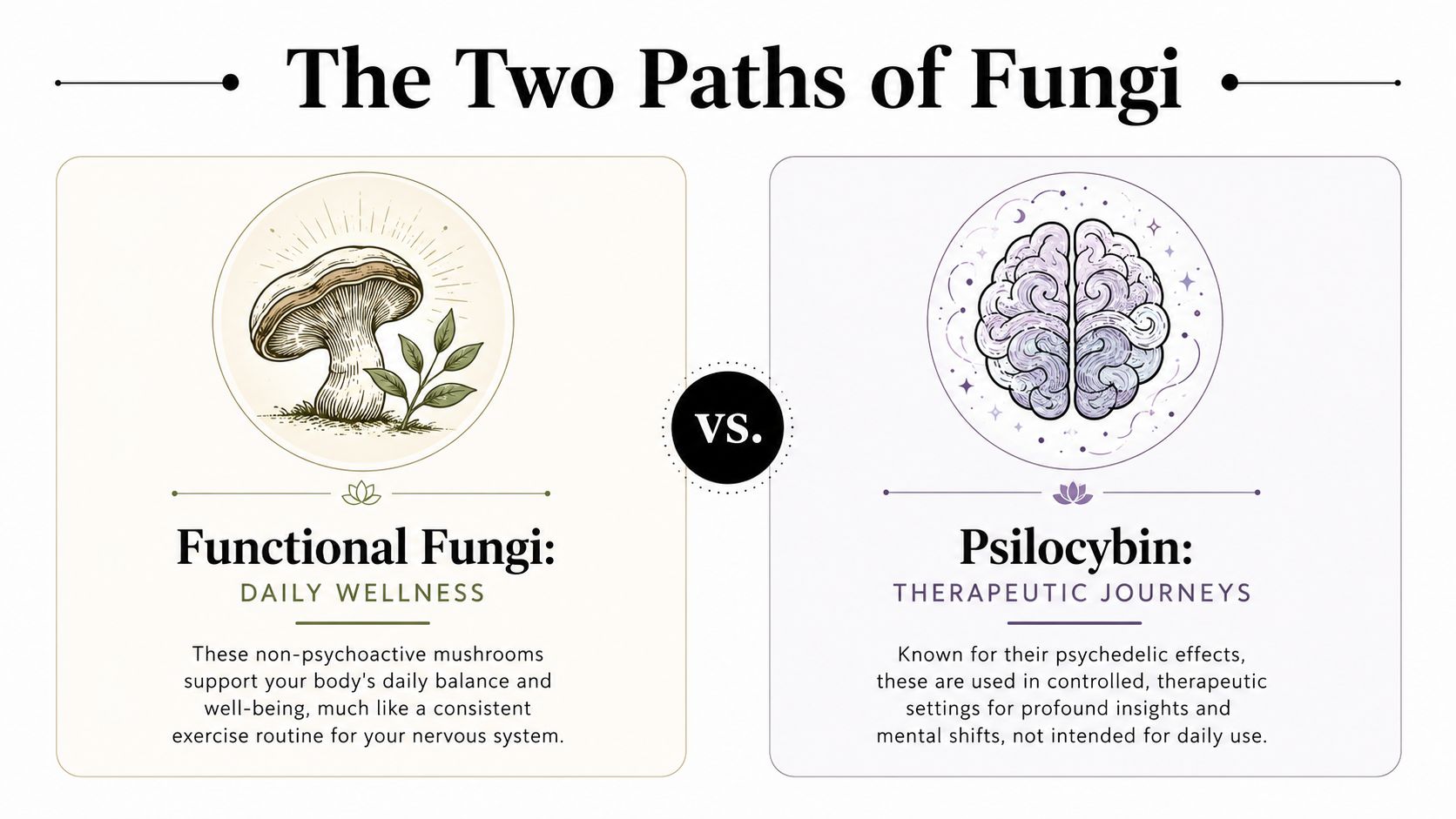
The Two Paths of Fungi Functional vs Psilocybin
The easiest way to understand this topic is to stop treating all mushroom products as interchangeable. They're not.
Functional mushrooms are like a steady training plan for your nervous system. Psilocybin is more like an intensive therapeutic experience. Both can matter for stress, but they operate in different worlds.
The mechanism is the main difference
A major source of confusion is failing to separate adaptogenic support from psychedelic action. As noted in this Frontiers review on functional versus serotonergic mushroom mechanisms, functional mushrooms like Reishi work through indirect pathways tied to stress regulation, while psilocybin has acute, session-based potential through direct serotonin 5-HT2A receptor agonism.
That sounds technical, so here's the plain-language version.
Functional mushrooms don't try to create a dramatic altered state. They support systems involved in balance, recovery, and resilience. Psilocybin directly changes brain signaling in ways that can open up perception and interrupt rigid thought patterns.
A side-by-side view
| Path | What it's for | How it tends to be used | What to expect |
|---|---|---|---|
| Functional mushrooms | Daily stress support, sleep support, cognitive support | Routine use in drops, capsules, powders, or tea | Subtle, gradual effects |
| Psilocybin mushrooms | Deep therapeutic work, perspective shifts, guided introspection | Occasional use, ideally with careful planning and support | Acute psychoactive experience |
That's why one person can say mushrooms helped them sleep more consistently, while another says mushrooms changed their outlook after one profound session. They may both be telling the truth, but they're talking about different substances.
Why this matters for safe choices
Confusion creates two common mistakes:
- Mistake one: expecting Reishi or Lion's Mane to feel immediate and dramatic.
- Mistake two: treating psilocybin like a casual wellness supplement.
Neither approach matches the reality of how these mushrooms work.
Simple analogy: Functional mushrooms are closer to a daily wellness practice. Psilocybin is closer to a carefully chosen therapeutic event.
Once you understand that split, the phrase best mushroom for stress gets less mysterious. The true answer becomes: the best one is the one matched to your goal, timeline, and tolerance for intensity.
Functional Mushrooms Your Daily Support System
A lot of stress does not arrive as a dramatic breakdown. It shows up at 10:30 p.m. when your body feels tired but your mind keeps scanning. It shows up at work when you reread the same sentence three times. In that kind of stress, functional mushrooms are often the better-fit tool because they are meant for daily support, not a profound psychoactive experience.
They are often grouped under the word adaptogenic. In plain language, that means they may help your stress-response systems stay steadier under repeated pressure. A helpful comparison is physical therapy versus surgery. One is built around small, repeated support. The other is a separate category entirely. Functional mushrooms belong in the first lane.
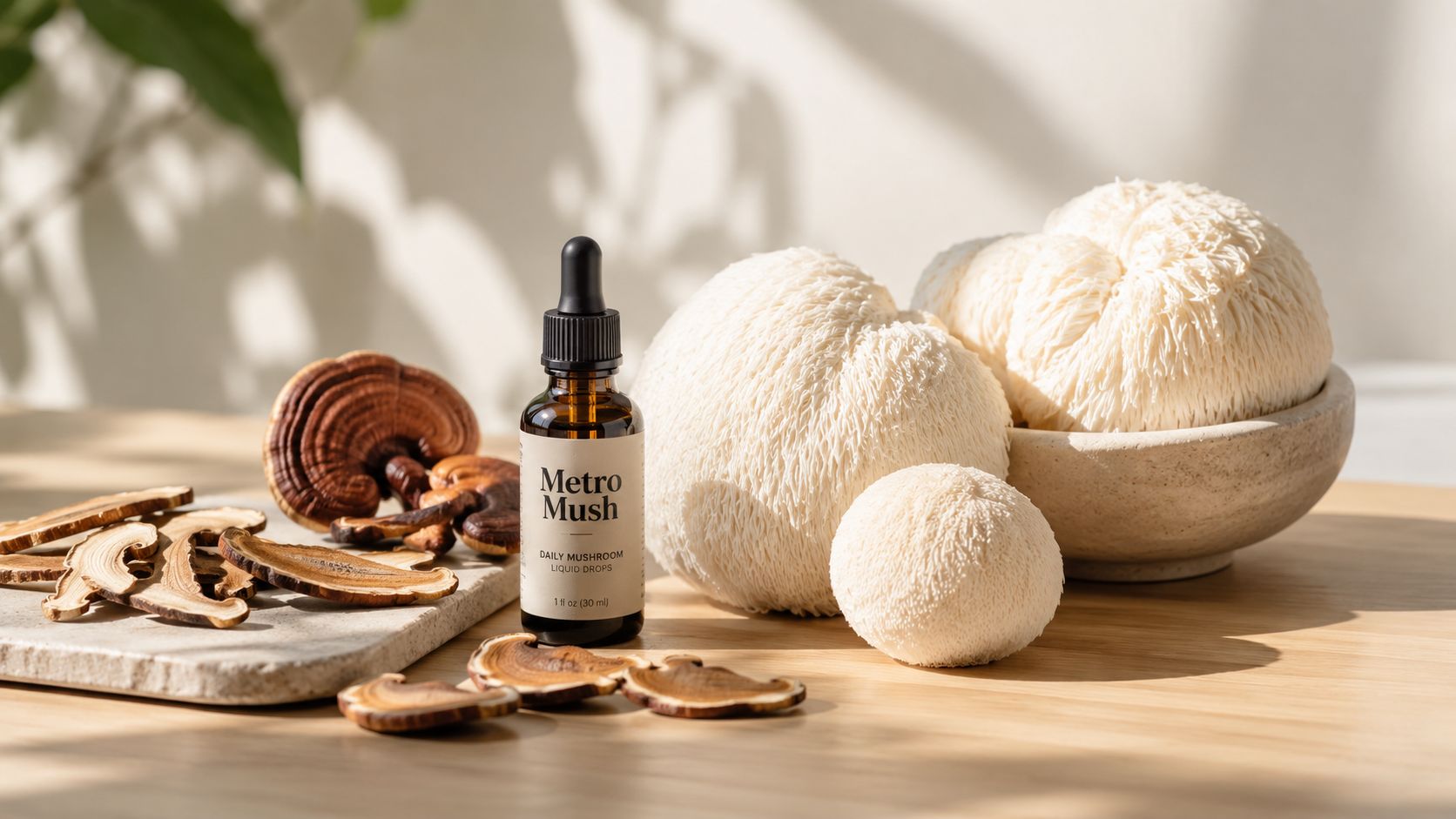
Reishi for calm and sleep support
Reishi is usually the first name that comes up when stress feels physical. Tight shoulders. Restlessness. Trouble shifting out of alert mode at night.
Preclinical evidence summarized in this evidence review on mushrooms for stress and anxiety describes Reishi's effects on the HPA axis, one of the body's central stress-response systems. The review also discusses animal research with anxiety-related benefits and human supplementation findings tied to better sleep quality and less fatigue.
That does not make Reishi a replacement for medical treatment. It does make it a reasonable option for someone whose stress is closely tied to poor recovery and difficulty winding down.
If sleep is your weak point, it also helps to place Reishi inside a broader evening routine. Metro Mush covers that more directly in this guide to adaptogenic mushrooms for sleep.
Lion's Mane for stress with mental fog
Lion's Mane fits a different pattern. It is often the more sensible choice when stress leaves you unfocused, mentally dull, or emotionally worn thin.
A pilot human trial on Hericium erinaceus and stress-related outcomes found that participants taking H. erinaceus for 28 days had lower stress ratings than the placebo group. The same study also reported faster performance on a cognitive task after a single dose, while the stress effect appeared with repeated use rather than immediate use.
That distinction matters. People sometimes expect Lion's Mane to feel calming on day one, like flipping a switch. The research points to a different pattern. It is better understood as support that builds with routine use.
Practical rule: Match functional mushrooms to the kind of stress you actually have, then use them consistently long enough to judge them fairly.
Why consistency matters
Daily support tools are easy to dismiss because their effects are usually subtle at first. A multivitamin does not feel like coffee. Good sleep habits do not feel like a sedative. Functional mushrooms follow a similar logic.
Lion's Mane has also been studied for compounds related to neurotrophic activity. A review of Lion's Mane mycelium and erinacines describes research on erinacine-rich mycelium, nerve growth factor synthesis, and preclinical findings related to anxiety and sleep.
To see the category in a more practical format, this short explainer helps connect the daily-use idea to real product types:
Who functional mushrooms fit best
Functional mushrooms usually make the most sense for people who want:
- Steady support: Something that can fit into ordinary life without an intoxicating effect.
- Sleep and recovery help: Reishi is often the first place to look when stress shows up most strongly at night.
- Cognitive resilience: Lion's Mane is a better fit when pressure shows up as brain fog, distraction, or irritability.
For many people, this is the safer first lane to explore. The effects are usually gradual, but that is the point. Functional mushrooms are built for daily scaffolding, not a single dramatic event.
Psilocybin Mushrooms The Profound Reset
Psilocybin belongs in a different conversation.
If functional mushrooms are for daily scaffolding, psilocybin is for moments when someone is seeking a deep shift in perception, mood, or emotional processing. It's not a background supplement. It's a psychoactive compound that can produce a strong, immersive experience.
How psilocybin works in the brain
Psilocybin acts on serotonin 5-HT2A receptors. According to Johns Hopkins Medicine's psychedelic research overview, it induces neuroplasticity and reduces threat-related amygdala activity, which correlates with decreased anxiety. Clinical trials also show it can significantly reduce anxiety and depression in patients, with effects lasting up to a year, but outcomes are dose-dependent and require careful management to be therapeutic.
The key word there is therapeutic.
Psilocybin isn't just “stronger stress relief.” It's a different category of intervention. People often describe it as creating mental flexibility when they've been stuck in loops of fear, hopelessness, or emotional rigidity.
Why set and setting matter so much
Stress can make people chase relief fast. Psilocybin is the wrong place to be careless.
Your mindset going in, your physical environment, and the support around you all shape the experience. A calm setting and clear intention can make the difference between a useful journey and a destabilizing one.
Psilocybin can be powerful for stress-related suffering, but power and predictability are not the same thing.
That's why responsible use centers on preparation, not just product selection.
Microdose versus full journey
These two ideas get blurred all the time, so it helps to separate them clearly.
- Microdose: A very small amount intended to be sub-perceptual or lightly perceptual. People usually choose this route when they want subtle support without a full psychedelic state.
- Macrodose or full dose: A more immersive experience intended for introspection, emotional release, or therapeutic depth.
The verified material also notes that outcomes are dose-dependent, and that lower-risk therapeutic use depends on careful management. That's especially important for anyone using psilocybin in response to anxiety.
When this path makes sense
Psilocybin may be the better fit when someone isn't just asking for a calmer day. They're asking bigger questions.
They may feel trapped in repetitive stress patterns, weighed down by persistent fear, or disconnected from meaning. In those situations, the appeal of psilocybin often comes from its ability to create a felt interruption in the usual mental script.
That doesn't make it casual. It makes it consequential.
For readers who want a broader overview of that therapeutic side, this guide to psilocybin health benefits offers more context. The safest takeaway is simple: use psilocybin with respect, preparation, and a realistic sense of what it can and can't do.
Choosing Your Product at Metro Mush
You're standing in front of two shelves with the same goal in mind: less stress. One shelf holds daily wellness products. The other holds psilocybin products that can lead to a much stronger, more intentional experience. The smart choice starts with one question. Are you looking for support you can fold into an ordinary week, or are you considering a deeper session that asks for planning and care?
At Metro Mush, that distinction matters more than product hype. Stress can show up as brain fog, irritability, poor sleep, or the feeling that your mind never fully powers down. Different products suit different versions of that problem.
If you want gentle daily support
Lion's Mane fits the functional lane best for readers who want non-psychoactive support. As noted earlier, the human research discussed in this article points to benefits building with consistent use rather than after a single serving.
That makes it a routine product, not a quick jolt.
A good fit often sounds like this:
- “I want clearer thinking during a busy week.”
- “I want support without altered perception.”
- “I can stick with a daily habit and give it time to work.”
If your stress shows up as mental clutter, scattered attention, or that worn-down feeling after too many demanding days, a functional product usually makes more sense than jumping straight to psilocybin.
If you're curious but cautious about psilocybin
Familiar formats can lower the intimidation factor. Chocolates and drinks, such as OuterSpore Milk Chocolate Bars, Mush Love Chocolate Bars, Rocket Fuel shroom drinks, and Moon Bars, often feel easier to approach because portioning is simpler and the format feels less clinical than dried mushrooms.
That convenience should not be confused with lightness. A chocolate bar can still lead to a meaningful psychedelic experience.
For a careful first purchase, keep the frame simple:
- Start with a low amount. Leave room to learn how your body responds.
- Wait patiently. Taking more too soon is one of the easiest mistakes to make.
- Choose a calm setting. Your environment shapes the experience as much as the dose.
- Drop the performance mindset. Stress relief rarely improves when the session turns into a test you feel pressured to pass.
For cautious users, predictability matters more than intensity.
If you're experienced and seeking depth
Some adults already know they are looking for a full psychedelic session, not a beginner format. In that case, dried strains with stronger reputations, including Penis Envy and Enigma, may be the category they examine first.
Those names attract attention, but the better question is readiness. Stronger products ask for judgment, self-awareness, and respect for setting. They are a poor match for impulse buying or for someone hoping potency alone will solve a complicated stress pattern.
Here's a simple way to sort the options:
| Goal | Better fit | Why |
|---|---|---|
| Daily non-psychoactive support | Lion's Mane products | Suited to steady routine use |
| Low-pressure first psilocybin experience | Chocolates or drinks | Easier to portion and approach carefully |
| Full psychedelic depth | Dried strains like Penis Envy or Enigma | Better suited to experienced users |
A practical buying mindset
Buying well means matching the tool to the job. Functional mushrooms work more like steady maintenance. Psilocybin products belong to a different category entirely, one that can be subtle at low amounts or intensely immersive at higher ones.
If you feel depleted, highly sensitive, or unsure what kind of support you want, simpler usually beats stronger. Start where your readiness is real, not where the marketing is loud.
Your Safe and Informed Next Steps
Most confusion around the best mushroom for stress disappears once you split the category in two.
If you want daily support, look toward functional mushrooms. Reishi makes sense when stress and sleep are tangled together. Lion's Mane makes sense when stress comes with brain fog, strain, or a need for steadier mental performance.
If you want deeper therapeutic work, psilocybin belongs in that conversation. But it asks more from you. More preparation. More honesty about your mindset. More respect for dose and setting.
Use the right tool for the right job
That's the core takeaway.
- Choose functional mushrooms when you want support that fits into ordinary life.
- Choose psilocybin carefully when you're considering a meaningful, non-routine experience.
- Don't judge one by the rules of the other. A capsule and a psychedelic journey shouldn't be expected to do the same thing.
Informed adult consumers usually make better choices than trend-driven shoppers. They stop chasing hype and start matching products to goals.
Keep safety in the center
A few final guardrails matter:
- Be honest about your sensitivity: If anxiety is already high, caution matters even more.
- Respect time horizons: Functional products may need consistency. Psilocybin needs planning.
- Avoid mixing expectations: Don't expect a subtle adaptogen to create a breakthrough session, and don't treat a psychedelic like a nightly supplement.
The right mushroom can help. The wrong expectation can make even a good choice feel disappointing.
For adults in Southeast Michigan, having local access helps when you want to choose deliberately instead of guessing. Metro-area shoppers can also take advantage of practical offers that reward slower, smarter buying. Mix & Match Saturdays let customers combine any three chocolate bars or drinks for $100, with savings of up to $40. Fire, police, and veterans receive 10% off, and Discord members can receive 20% off while staying updated on new drops and promotions.
If you're ready to act, keep it simple. Detroit Metro customers can text 734-691-6122. Ann Arbor Metro customers can text 734-280-2868. There's a $75 minimum order, which helps frame purchases as intentional rather than impulsive.
If you're ready to choose the right mushroom path for your stress goals, explore Metro Mush for local access to dried psilocybin strains, approachable edibles, current specials, and easy text-to-order service in the Detroit and Ann Arbor metro areas.