
You're probably searching for an ayahuasca retreat in California because something in you is asking for change. Maybe therapy helped but didn't go far enough. Maybe you've heard stories about breakthroughs, spiritual clarity, or relief from patterns that won't let go. That pull is real.
The confusion is real too. California has a strong psychedelic culture, lots of whispered recommendations, and plenty of websites that make ceremonies sound accessible, safe, and almost mainstream. They're not. If you're looking for an ayahuasca retreat California option, you need a clear view of what's available, what isn't, and where the biggest risks sit.
I'm not interested in fear-based messaging, and I'm not interested in hype. Ayahuasca can be meaningful. It can also be medically risky, psychologically destabilizing, and legally messy when people enter unregulated spaces without proper screening. The safest path starts with honesty.
Navigating Your Search for an Ayahuasca Retreat
This search is rarely a casual undertaking. It typically commences after a breakup, burnout, grief, addiction recovery work, spiritual disconnection, or years of feeling stuck in the same loop. By the time someone types “ayahuasca retreat California” into a search bar, they usually want more than novelty. They want movement.
That's why this topic needs a practical lens. In California, the desire for healing runs straight into an underground market. Some circles are careful and sincere. Others are disorganized, under-screened, or driven more by mystique than competence. From the outside, they can look almost identical.
Practical rule: If a retreat page sells transformation faster than it explains screening, safety, and aftercare, slow down.
A lot of seekers assume California's broader psychedelic conversation means ayahuasca retreats are basically tolerated. That assumption gets people into trouble. The state's culture may feel permissive, but culture and law are not the same thing. And community warmth isn't the same thing as medical preparedness.
What people usually hope to find
Searchers are often looking for some mix of the following:
- A legal retreat center: A place that operates openly, with clear standards and no ambiguity.
- A trustworthy facilitator: Someone experienced, grounded, and able to handle difficult material without theatrics.
- A structured process: Preparation, ceremony support, and integration afterward.
- A safer alternative to going abroad: Less travel, less cost, less logistical stress.
In California, that combination is much harder to find than many people expect.
The better question to ask
Instead of asking, “Where can I book an ayahuasca retreat in California?” ask, “What level of legal, medical, and ethical risk am I taking on if I do this here?” That question leads to better decisions. It also helps you separate the deep call for healing from the urgency that can cloud judgment.
The Legal Landscape of Ayahuasca in California
You find a retreat page that looks polished, the testimonials sound sincere, and the organizer says ceremonies are held in a “safe container” outside the city. The question that matters is simpler than the branding. Is this legal in California?
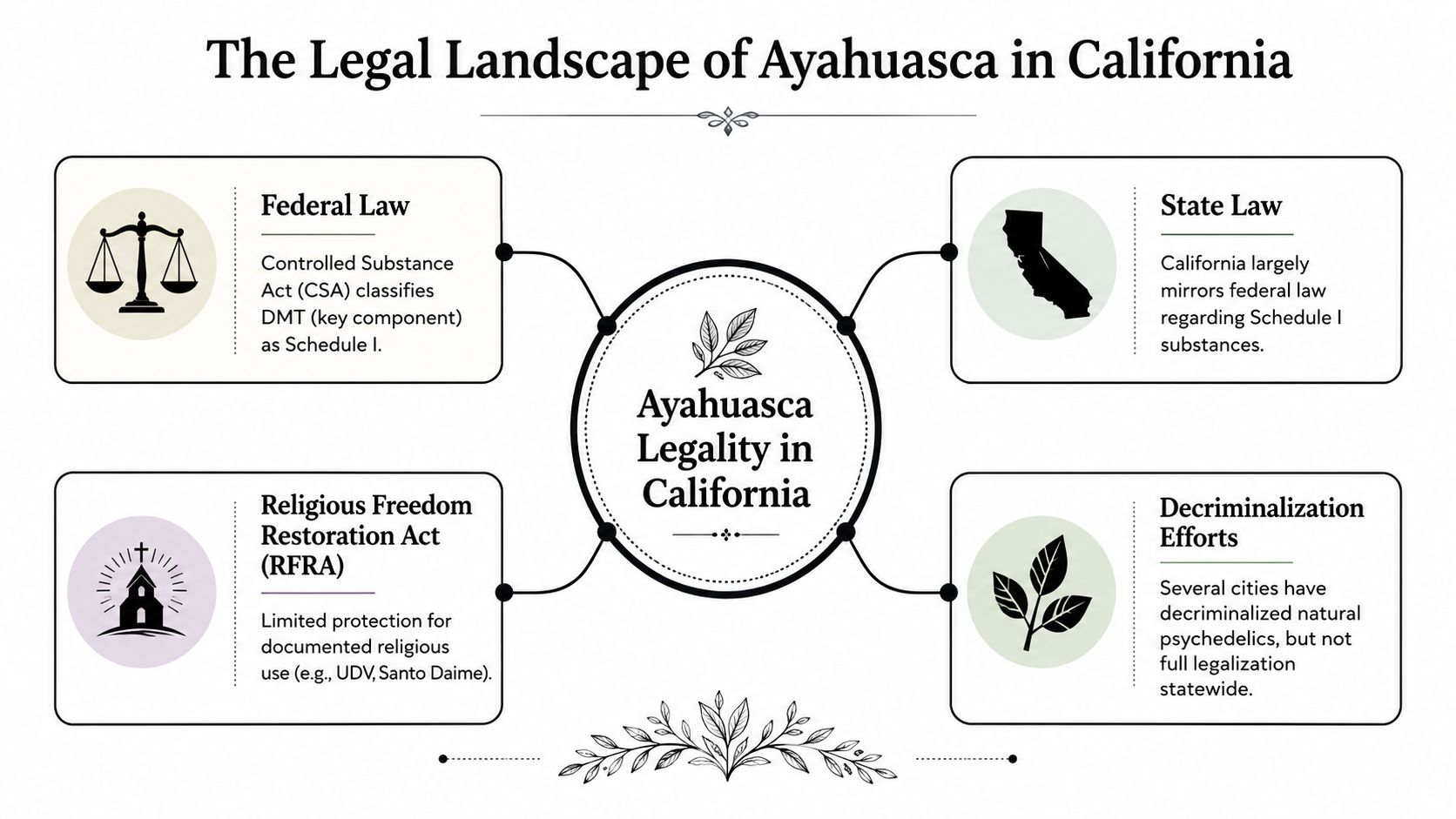
For public retreats, the answer is no. There are no openly operating, clearly state-sanctioned ayahuasca retreat centers in California, and ayahuasca's legal status remains tied to the status of DMT under federal and state law, as outlined in Arkana's overview of ayahuasca retreats in California.
That has practical consequences. A facilitator can describe the work as spiritual, therapeutic, ancestral, or community-based. Those labels do not create legal protection for a paid public ceremony.
Decriminalization does not authorize retreats
California's psychedelic culture creates confusion here. Several cities have deprioritized enforcement around entheogenic plants, but local decriminalization does not authorize organizers to run ayahuasca retreats, accept payment for ceremonies, or advertise public access with legal cover.
This is the gap many seekers miss. Lower enforcement priority is not a license. It is not a permit. It is not the same thing as regulated care.
If you've followed broader psychedelic policy, compare ayahuasca with the separate and still-misunderstood rules around psilocybin in this guide to California mushroom laws and decriminalization limits. The comparison helps clarify how often people confuse cultural tolerance with actual legal authorization.
What seekers are actually walking into
In California, ayahuasca ceremonies generally happen in underground settings or within small religious communities with their own membership structures, as noted in the same source. That does not automatically mean a group is reckless. It does mean the burden shifts to you to understand the risk clearly.
There is usually no state licensing. No standard inspection process. No public regulator checking screening protocols, sanitation, emergency planning, or facilitator competence.
That trade-off matters. Some underground groups may offer sincere care and strong preparation. Others may operate far beyond their skill level while speaking with total confidence.
| Legal question | Practical reality in California |
|---|---|
| Can a center openly market public ayahuasca retreats as legally authorized? | No |
| Does city-level decriminalization protect paid ceremony organizers? | No |
| Does a spiritual framing make a public retreat lawful? | No |
| Do some religious groups use different structures than public retreat businesses? | Yes |
A careful seeker should hear “California ayahuasca retreat” and translate it into a more accurate phrase: “an unregulated ceremony space with legal ambiguity and uneven safety standards.”
If a facilitator presents the offering as plainly legal, treat that as a warning sign. In my experience, good operators speak carefully about what they can and cannot claim. They do not ask you to ignore the legal reality.
Critical Health and Safety Contraindications
A common California scenario goes like this. Someone finds a ceremony that feels credible, fills out a short form, mentions an antidepressant, and gets told to stop it for a few days and come anyway. That is not careful screening. It is how preventable medical and psychiatric emergencies happen.
Ayahuasca combines DMT with MAOIs. That mix can interact dangerously with prescription medications, some supplements, underlying heart issues, and certain psychiatric histories. The risk many seekers underestimate is not the ceremony itself. It is the interaction between the brew and what is already happening in the body.
The Heroic Hearts ayahuasca dietary and medical guidelines advise that SSRIs should be stopped well in advance because of serotonin syndrome risk, and they list major contraindications including cardiovascular disease, bipolar disorder, schizophrenia, pregnancy, severe liver or kidney disease, psychosis risk, and important medication conflicts.
Who should pause and get medical clearance first
Some red flags are straightforward.
- Current or recent SSRI use
- Bipolar disorder, schizophrenia, or a personal history of psychosis
- A family history of psychotic-spectrum illness
- Heart disease, prior stroke, or uncontrolled blood pressure
- Pregnancy or possible pregnancy
- Severe liver or kidney disease
- Use of antipsychotics, stimulants, sedatives, blood pressure medication, or other serotonergic drugs
This is also why SSRI and psychedelic interaction risks need more than casual internet advice. Medication changes should be handled with the prescribing clinician, not with a facilitator giving off-the-cuff instructions over text.
Why this goes wrong in underground settings
In legal medical systems, screening usually involves chart review, clear exclusions, and a defined emergency plan. In underground California ceremonies, screening may amount to an intake form, a waiver, and trust that participants disclosed everything accurately.
That is a weak system for a high-intensity brew.
I have seen seekers minimize symptoms because they do not want to lose their place, waste a deposit, or disappoint a group they already feel attached to. Facilitators can miss obvious concerns for the same reasons any unregulated operator misses them. Time pressure, overconfidence, poor training, or financial incentive.
Questions to answer honestly before you go further
Use these as a self-check.
- Am I taking an SSRI, SNRI, stimulant, antipsychotic, sedative, or blood pressure medication, or did I stop one recently?
- Have I ever had mania, psychosis, or a diagnosis on the bipolar or schizophrenia spectrum?
- Does my family history include psychosis or bipolar disorder?
- Do I have heart disease, fainting episodes, stroke history, or blood pressure problems?
- Am I pregnant, trying to conceive, or uncertain?
- Am I downplaying medical information because I want the experience badly?
If any answer raises concern, stop there and get qualified medical advice. Desire for the experience is real. It still does not change the contraindication.
One more practical point. A careful facilitator may still decline you even if your intention is sincere. That is not gatekeeping. It is a sign they understand the limits of what they can safely hold.
How to Vet an Underground Retreat and Facilitator
Some people will still pursue underground options. If that's you, approach it like risk reduction, not spiritual shopping. In California, pricing alone should not persuade you that something is professional. According to APL Journeys' overview of ayahuasca in California, underground retreats in California typically charge between $1,500 and $3,500 for weekend programs, with prices significantly higher than in countries where it's legal, and participants also face critical safety risks including potentially fatal serotonin syndrome from MAOI and SSRI interactions.
High price can mean legal risk overhead. It can also mean branding. It does not automatically mean quality.
Questions that matter before you commit
Ask direct questions. A solid facilitator won't get defensive.
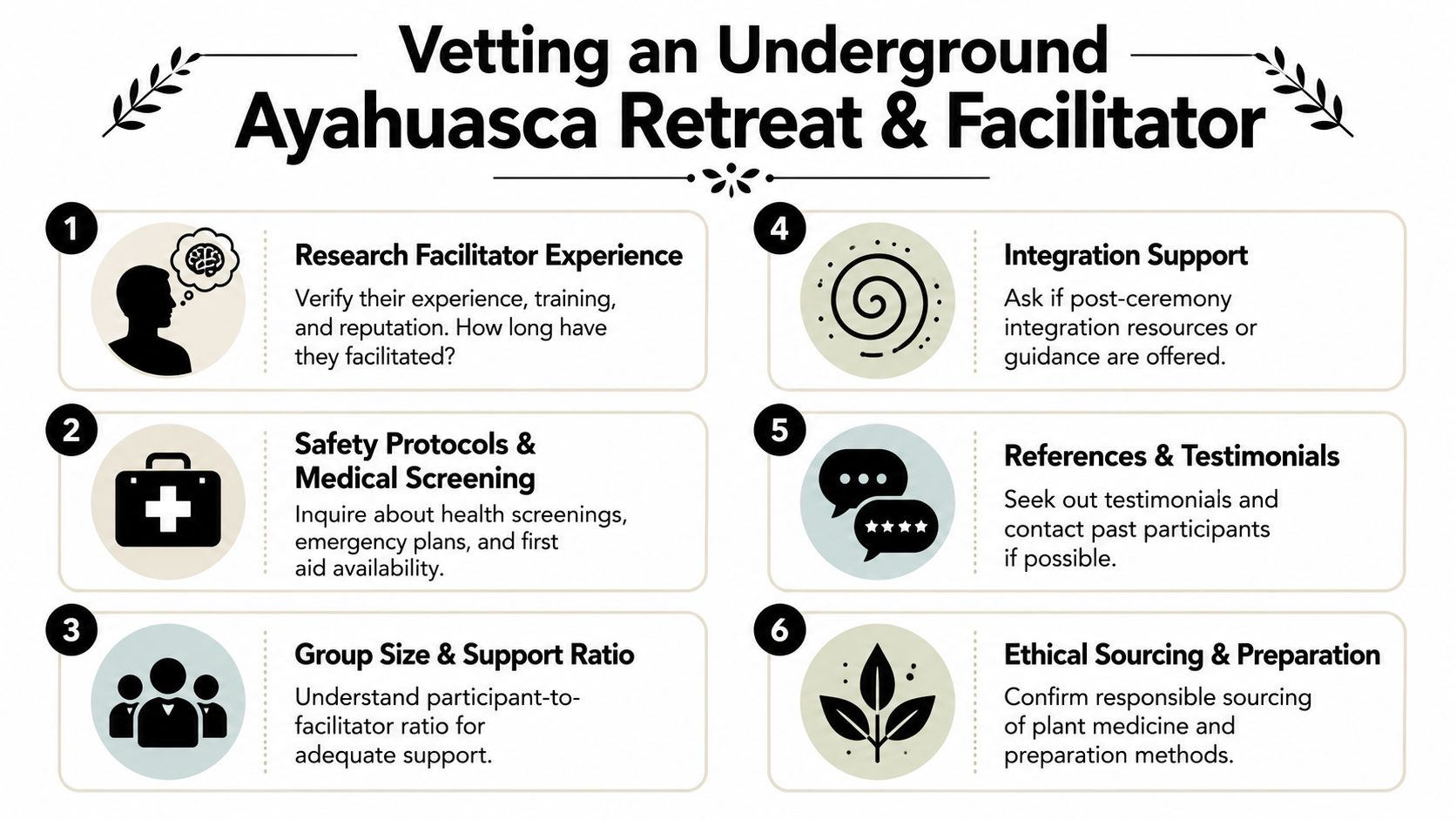
- What is your screening process? You want more than an intake form. Ask how they screen for medication conflicts, psychiatric history, and cardiovascular risk.
- Who is present during the ceremony? Find out who's in the room, not just whose name appears on the website.
- What happens in a medical emergency? Ask about first aid, transportation, and who makes decisions if a participant becomes disoriented or unstable.
- How many participants do you serve at once? Group size affects safety, visibility, and the ability to respond when someone needs support.
- What support exists after the ceremony? A retreat without integration support often leaves people to sort through difficult material alone.
What competent facilitators usually do
A stronger underground operator tends to show certain behaviors consistently:
| Green flag | Why it matters |
|---|---|
| Thorough intake and follow-up questions | They're screening for real contraindications |
| Clear boundaries around touch and support | Vulnerable participants need explicit consent norms |
| Calm answers about emergencies | They've thought beyond the ideal ceremony |
| Modest claims about outcomes | They understand the work isn't predictable |
| Preparation and integration guidance | They see the ceremony as part of a larger process |
The best facilitators sound less like gurus and more like steady adults who take responsibility seriously.
Red flags that should stop the conversation
Some warning signs are immediate deal-breakers. Others become obvious only after a call or message exchange.
- Pressure to book fast: Scarcity tactics work well in unregulated markets. That doesn't make them ethical.
- Promises of guaranteed healing: No serious guide can guarantee what ayahuasca will do for you.
- Casual attitude about medications: This is one of the clearest signs of danger.
- Blurred sexual or relational boundaries: Any flirtation, suggestive language, or “special connection” framing is unacceptable.
- Mystery around sourcing or preparation: You don't need every detail, but total vagueness is a problem.
- No aftercare plan: Ceremonies can open grief, trauma, confusion, and destabilization. Sending people home with a hug and a group chat isn't enough.
Ask for specifics, not atmosphere
A polished aesthetic can hide a weak container. Warm language, candles, beautiful music, and spiritual branding don't answer the hard questions. Ask what they do when someone panics, dissociates, vomits repeatedly, tries to leave, or reveals a medication conflict late.
If the answers stay abstract, keep looking.
What to Expect Before During and After a Ceremony
A lot of anxiety comes from not knowing what the process feels like. The arc is usually less glamorous than people imagine and more demanding than they expect. It helps to think of it in three phases: preparation, ceremony, and the immediate landing afterward.
Before the ceremony
Preparation isn't busywork. It shapes the entire experience.
Individuals often spend the days leading up to ceremony simplifying. That often means cleaner food, less stimulation, less social noise, and more reflection. Traditional dieta guidance can also include avoiding alcohol, cannabis, pork, red meat, and salt, not as a purity contest but as a way to reduce physiological stress and bring more discipline to the process.
Intention matters too, but it's often misunderstood. A good intention is simple and honest. “Show me what I need to face.” “Help me understand this grief.” “Teach me where I'm still hiding.” A bad intention is a demand for a specific outcome.
Enter with a question, not a script. Ayahuasca rarely follows your preferred storyline.
You'll also want practical preparation. Clear your calendar afterward. Arrange transportation. Don't assume you'll be emotionally coherent the next morning. If you have unresolved doubts about the facilitator, that uncertainty usually gets louder once the medicine starts working.
During the ceremony
A typical ceremony begins gently and then becomes inward fast. There may be instruction, prayer, songs, silence, and a period of waiting after the cup is taken. Some people feel effects gradually. Others feel a hard shift.
Experiences vary widely. You might encounter visual imagery, autobiographical memory, body discomfort, fear, grief, awe, insight, or stretches where nothing seems to happen. Purging can be part of the experience. So can crying, shaking, sweating, confusion, and periods of deep stillness.
The most difficult moments often come when someone tries to stay in control. Ayahuasca tends to confront that impulse directly. That doesn't mean surrendering all discernment. It means loosening the internal grip enough to let material move without turning every sensation into a fight.
After the ceremony
The hours after ceremony are tender. People can feel raw, relieved, disoriented, openhearted, exhausted, or all of that in sequence. Insight may come immediately, or it may arrive later in fragments.
A grounded landing usually looks simple:
- Rest first: Don't rush into phone calls, social media, or long analysis.
- Hydrate and eat gently: Let your body settle.
- Write down key moments: Not a polished journal entry. Just the parts you don't want to forget.
- Stay quiet if possible: Too much conversation too early can flatten something important.
Some people leave feeling clear. Others leave with more questions than answers. Both are normal. The ceremony isn't a final product. It's often the opening move in a longer process.
The Crucial Role of Psychedelic Integration
The ceremony is only one piece of the work. Integration is where the experience becomes usable.

Without integration, even a profound night can fade into memory, story, or spiritual identity. With integration, an insight becomes a conversation you finally have, a boundary you finally hold, a habit you finally stop feeding. That's the difference.
What integration actually looks like
It doesn't need to be exotic. It needs to be consistent.
- Journaling: Capture recurring themes, not just dramatic visuals.
- Meditation or breathwork: Build tolerance for stillness and emotional material.
- Nature time: Give the nervous system room to settle and organize.
- Trusted community: Talk with people who won't either romanticize or dismiss what happened.
- Therapy or coaching: Work with someone who understands psychedelic material without over-interpreting it.
A strong integration question is, “What did this experience ask me to change by next week?”
That question keeps the process grounded in behavior. If the answer is nothing concrete, the lesson may still be too vague.
Support helps when the glow fades
The first few days after ceremony can feel unusually open. Then ordinary life returns. Work emails, family patterns, loneliness, old coping strategies. It is then that many people lose the thread.
A short educational resource can help reinforce that integration mindset:
If your ceremony brought up trauma, shame, panic, or destabilizing spiritual material, professional support matters even more. Find a psychedelic-informed therapist or integration coach who can help translate symbols, emotions, and body memories into actual life changes. You don't need someone to tell you what every image meant. You need someone who can help you stay honest, regulated, and responsive.
Safer Legal Alternatives to California Ayahuasca
A common California scenario goes like this. Someone wants the depth and ceremonial frame associated with ayahuasca, starts asking around, and quickly finds private invites, encrypted chats, and facilitators who say the right things. At that point, the question is no longer just spiritual. It becomes practical. What option gives you the kind of work you want without taking on avoidable legal, medical, or facilitator risk?
For many people, the safest answer is to separate the goal from the specific brew. If your goal is trauma work, mood relief, spiritual inquiry, or a structured reset, several legal paths may serve that need better than an underground ayahuasca circle in California.
One option is travel to countries where ayahuasca practice is established and permitted. That route still requires real vetting. Some centers are careful, medically organized, and clear about preparation and aftercare. Others are tourist-facing businesses with weak screening and too many participants. Travel adds cost and complexity, but it can offer a setting that is more coherent than an unregulated local ceremony.
Another option is legal psychedelic-adjacent care in the United States. Ketamine-assisted therapy is the clearest example. It is not ayahuasca, and it does not carry the same cosmology or ritual form, but it does offer medical screening, informed consent, and follow-up support that many seekers find essential.
Some people are also better served by retreat models built around psilocybin in places where rules differ. If that route is part of your search, review these magic mushroom retreats with the same caution you would apply to any facilitator: screening, emergency planning, dosage clarity, and integration support all matter more than branding.
Legal and Practical Options at a Glance
| Option | Legal status | Screening and support | Trade-offs |
|---|---|---|---|
| International ayahuasca retreat | Permitted in some countries | Varies by center, sometimes strong, sometimes minimal | Travel costs, cultural fit, operator quality, medical distance from home |
| Underground California ayahuasca ceremony | Not clearly lawful as a public retreat model | Unregulated and inconsistent | Higher legal ambiguity, uneven safety standards, limited accountability |
| Ketamine-assisted therapy in the US | Lawful in clinical settings | Usually includes medical intake and follow-up | Different experience, more clinical, less ceremony-focused |
| Non-ayahuasca psychedelic retreats in jurisdictions with different rules | Depends on local law | Varies widely | Requires careful review of law, staff training, and emergency readiness |
Choose based on the function you need the experience to serve.
If your top priority is staying inside a lawful framework with proper screening, ketamine or another legal care model usually makes more sense. If your priority is the traditional ayahuasca container itself, going to a country where that practice is openly held is often the more honest path. If your priority is broad psychedelic exploration, keep your standards high and your questions specific. Legal status, facilitator skill, medical screening, and post-retreat support all matter more than the promise of a powerful night.