


A military discount is a price reduction a business offers to people with a qualifying connection to military service, usually after they show proof, and the most common rate is 10%. That sounds simple, but it isn't one standard benefit that follows you from store to store.
Each business writes its own policy. One shop may include veterans and spouses, while another limits its offer to active-duty shoppers only. The difference matters when you're at checkout expecting money off and staff tell you your card, status, or purchase doesn't qualify.
Understanding what is military discount eligibility, then, means learning how to read an individual offer before you rely on it. Check who counts, which proof works, and what limits apply. Those three checks prevent most surprises.
What a Military Discount Actually Is
About 7% of American adults are veterans. The Bureau of Labor Statistics veteran release reported 17.3 million veterans in 2025, representing approximately 7% of the civilian noninstitutional population age 18 and over. Add spouses and dependents, and the potential audience grows much larger. That scale explains why recognition programs are so common.
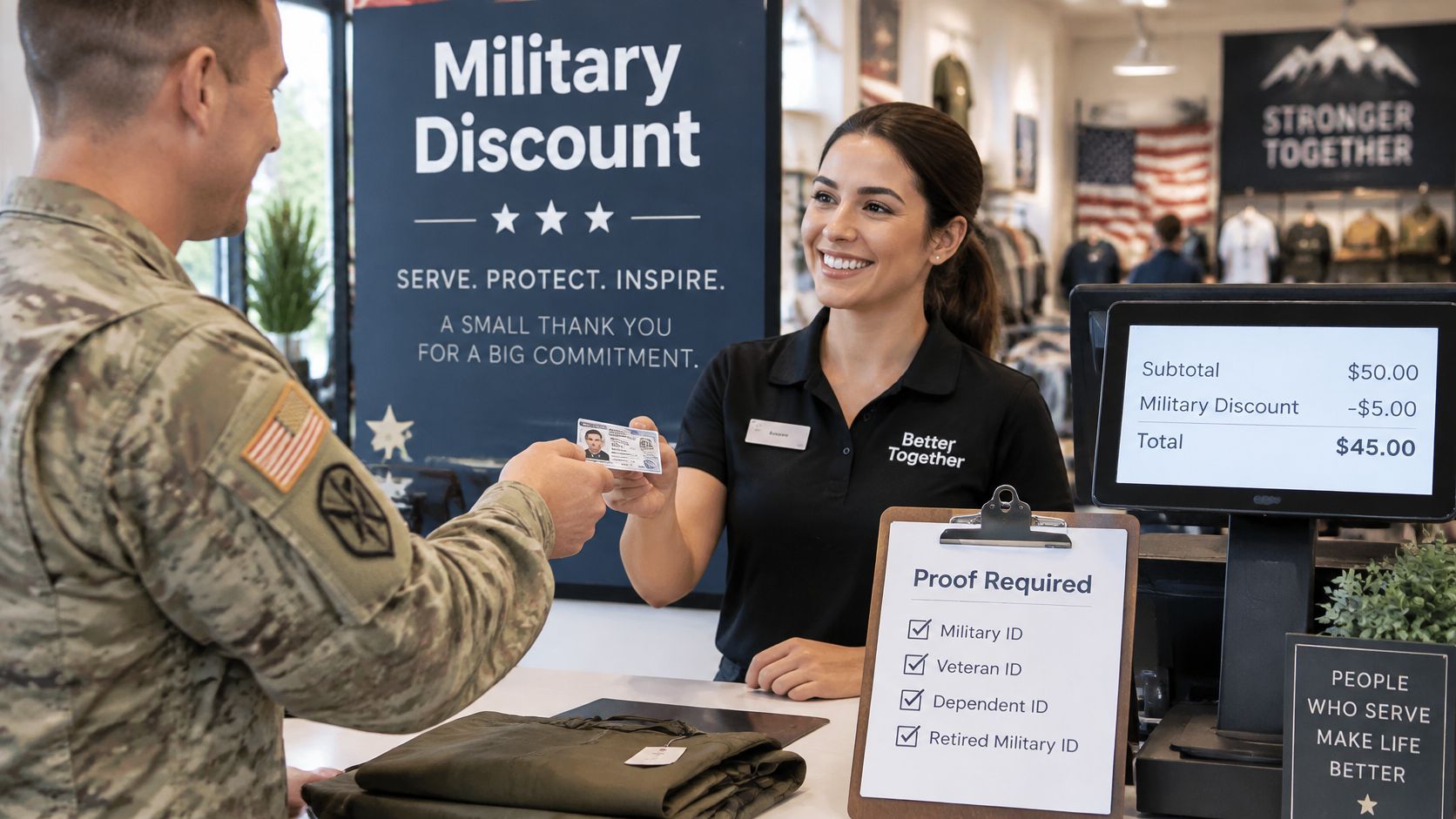
A military discount is a price reduction a business offers to people with a qualifying connection to military service, granted only after proof. It works like a student or senior rate. The business, not the government, sets the percentage, eligible products, dates, and proof it wants.
No law requires a store to offer one. No rule sets the amount.
The groups usually named are active-duty personnel, veterans, retirees, reservists, National Guard members, spouses, and dependents. A business does not have to include all of them. Some accept current military identification, others accept veteran documentation, and others use a third-party verification service.
With an audience that broad, businesses usually design these as broad recognition programs rather than narrow promotions for a tiny group. For you as a shopper, the practical definition is narrower. It is a conditional reduction that applies after you prove qualifying service under that store's terms.
Confusion often starts at checkout. Shoppers expect a standard benefit. Staff apply store policy.
Before counting on one, confirm three things:
- Percentage: How much comes off, and is it off the full price or only regular-priced items?
- Who qualifies: Does the policy name your exact status, not just "military"?
- Proof required: Which card, document, or verification service will staff or the checkout accept?
Who Qualifies for a Standard Military Discount
There's no single eligibility list, but market patterns are clear. This table shows how often programs named each group.
Share of military discount programs listing each group
| Group | Programs listing it | Typical condition |
|---|---|---|
| Active-duty personnel | 99% (186 of 187) | Current service member status |
| Veterans | 92% (172 of 187) | Veteran status, often with separation proof |
| Reservists and National Guard | Not published in the review | Reserve or Guard status named in merchant terms |
| Retirees | Not published in the review | Retired status confirmed by the business |
| Spouses | 9% (16 of 187) | Explicit spouse listing required |
| Dependents | 13% (24 of 187) | Explicit dependent listing required |
Read those rows in plain language. Almost every program includes active-duty personnel, and almost as many include veterans. Spouses and dependents appear far less often, so family members shouldn't assume coverage from the phrase "military discount" alone.
How to read the numbers
The figures come from a 2026 review of 242 retailers, which found that 187 operated a military or veteran discount program. That makes the table a useful picture of the market pattern, not a promise about any one store.
"Not published in the review" means that review didn't report a rate for reservists, National Guard members, or retirees. It doesn't mean those groups never qualify. It means you can't infer a standard rate, so the merchant's written terms are your only reliable guide.
The pattern to remember is simple:
- Active duty and veterans form the core of nearly every program.
- Spouses and dependents need explicit policy language naming them.
- Reservists, Guard members, and retirees should confirm status with the specific business before shopping.
Practical rule: If your exact status isn't named in the policy, treat yourself as not eligible until the business confirms otherwise.
That one habit prevents the most common disappointment. A sign saying "military discount available" tells you an offer exists. It doesn't tell you whether you're inside it.
Edge Cases Where Eligibility Gets Confusing
Prior service alone doesn't guarantee a discount. That's the surprise for many shoppers, because the term sounds like a formal entitlement. It isn't. Each merchant chooses which slice of the military community its offer covers.
Lowe's shows how detailed a policy can get. Its Lowe's military program page includes veterans, several uniformed services, National Guard members, and verified spouses, while Lowe's explicitly excludes dishonorably discharged veterans. By contrast, United's cited leisure discount is limited to active-duty members of specified U.S. branches, so a veteran who qualifies at one business may not qualify at the other.
Edge cases to check one by one
- Separated veterans: Confirm the program accepts veterans at all, then bring proof that shows your service and separation status.
- Dishonorably discharged veterans: Expect exclusion where a policy states it, even if you served. Don't rely on the word "veteran" alone.
- Surviving spouses: Ask whether the policy names surviving spouses directly, and expect to show dependent identification or sponsor documentation if asked.
- Dependents: Look for dependents listed by name. Being related to a service member isn't enough when the terms only name the member.
- Reservists: Ask whether reserve status counts outside active orders, and carry a current reserve ID or orders if the business requests them.
- Retirees: Confirm retired status counts separately from veteran status, since some policies treat those categories differently.
Watch the wording closely. "Military community" is broad language that can include families and veterans. "Active duty" is narrow and usually means currently serving members only. Swapping one phrase for the other changes who's eligible completely.
Readers outside the United States need extra care. The examples here are primarily U.S.-centric, and military categories, documentation, and benefit systems differ by country. If you're in the UK, Canada, or Australia, check local merchant terms and local proof documents instead of assuming U.S. categories transfer.
The term sounds standardized, but the underlying policy is fragmented and set by each merchant.
How Businesses Verify Military Status
Verification is where an advertised offer becomes real or falls through. Most businesses follow the same basic flow, whether you're at a counter or checking out online.
This infographic lays out the four steps businesses usually follow.
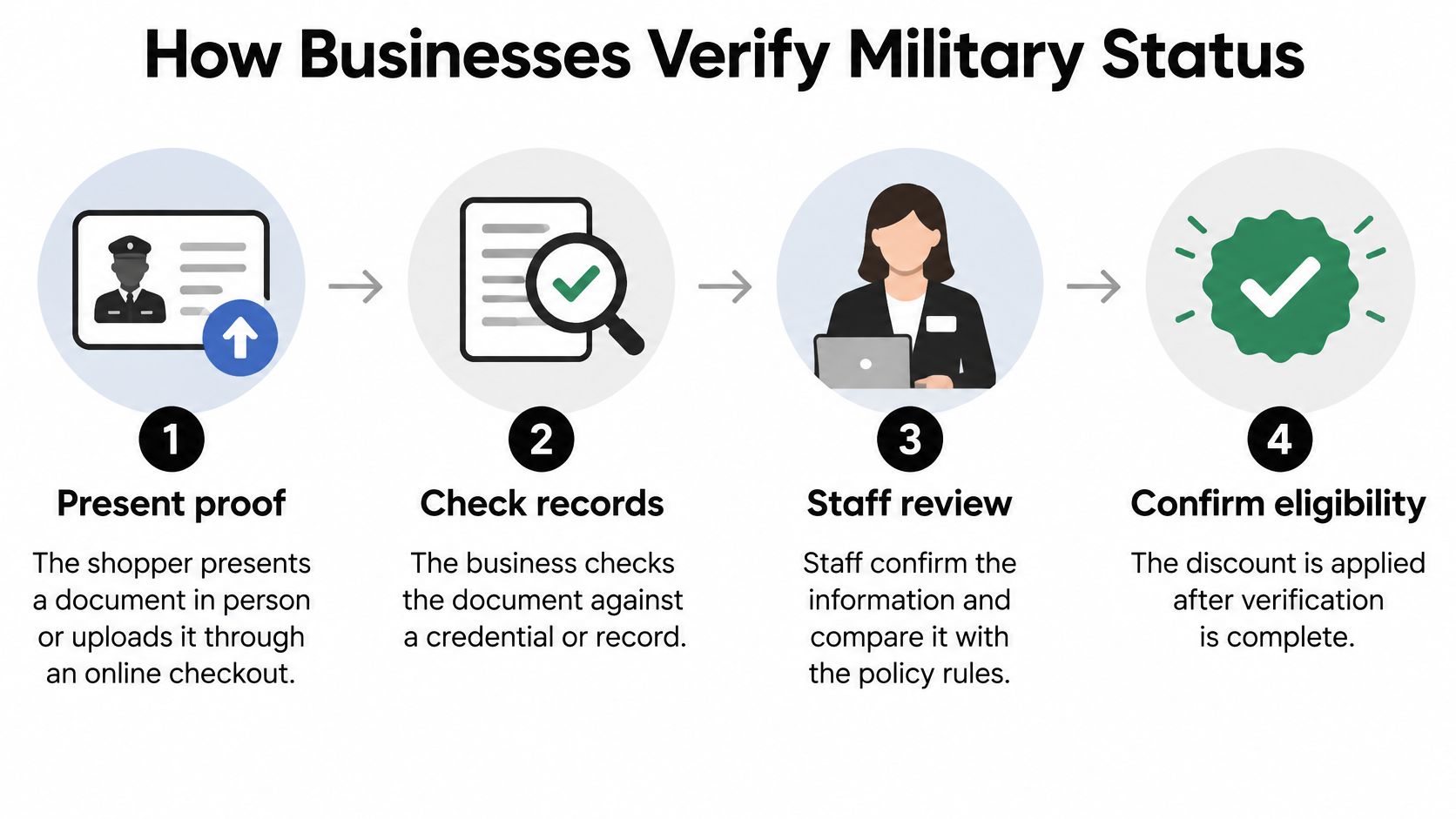
- Present proof. You show a document in person or upload it through an online checkout.
- Check records. The business checks the document against a credential or record.
- Match name and status. Staff match the name and status on the document to you, in store or through a third-party check.
- Apply the discount. The reduction applies only after that match succeeds.
If any step fails, the discount usually stops there. An expired card, a name mismatch, or the wrong document type can all end the process.
Matching the document to your situation
Common military verification methods
| Method | What it proves | Where it is typically accepted |
|---|---|---|
| Current military ID (Common Access Card or uniformed services ID) | Active duty, reserve or Guard status | Most retailers and base-linked programs |
| VA-issued veteran ID card | Veteran status | Retailers that accept veteran cards |
| VA disability rating letter | Veteran status and service-connected disability | Some retailers that verify veteran status |
| Third-party services such as ID.me or SheerID | Verified status checked against records | Online checkouts and many chains |
| In-store ID check | Physical match of card to shopper | Local stores running walk-in programs |
A DD Form 214 deserves special attention because it isn't in the table's usual checkout flow. It's the separation record that shows discharge type, and discharge type can decide eligibility. Some businesses ask for it when a veteran card alone doesn't answer their policy question.
This video walks through how verification works in practice.
Keep it practical. Share only the documents the offer needs, keep digital copies ready for online verification, and check expiration dates before you shop. If a business uses ID.me or SheerID, completing verification before a big purchase saves you from troubleshooting at checkout.
Typical Discount Amounts and Common Limits
A $50 basket with 10% off drops by $5. That small example helps set the right expectation. A military discount works like a thank-you coupon. It trims a little from the total instead of cutting the price in half.
Across the wider market, 10% is the single most common rate, followed by 15%. Many other programs use different amounts or a flat-dollar offer. Treat the percentages here as a market pattern from one review, not a rule every business follows.
This chart compares the two most common rates.
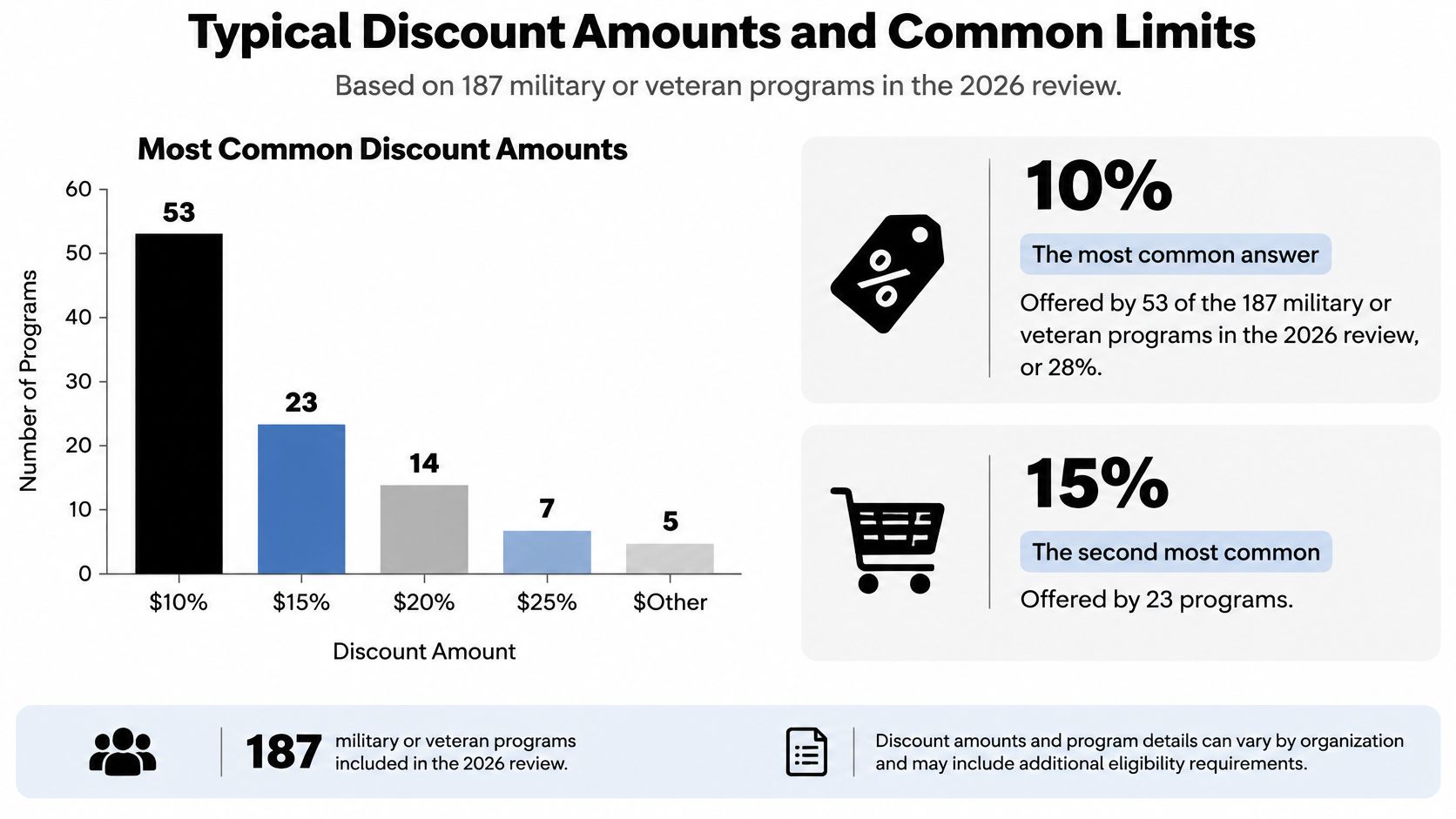
The percentage is only half the question. Limits decide what you save.
Think through four limits before you count on the math. Channel limits can restrict the offer to in-store or online only. Product limits can exclude sale items, gift cards, or selected brands. Timing limits can confine it to certain days or short windows. Stacking limits can block combining it with coupons or other promotions.
A store promotion like current Mix and Match Mama bundle pricing shows how product and timing rules narrow an offer, even when the headline looks simple.
Ask three questions every time. What rate applies. Which items are excluded. Whether it combines with a current promotion.
How to Claim the Metro Mush 10% Discount
At Metro Mush, we give fire, police, and veterans 10% off as an ongoing thank-you, not a time-limited promotion. Notice the groups. Fire and police aren't military categories, so our offer is broader than a standard military discount and tests occupation and service group, not military status alone.
This infographic shows the four steps to claim it.
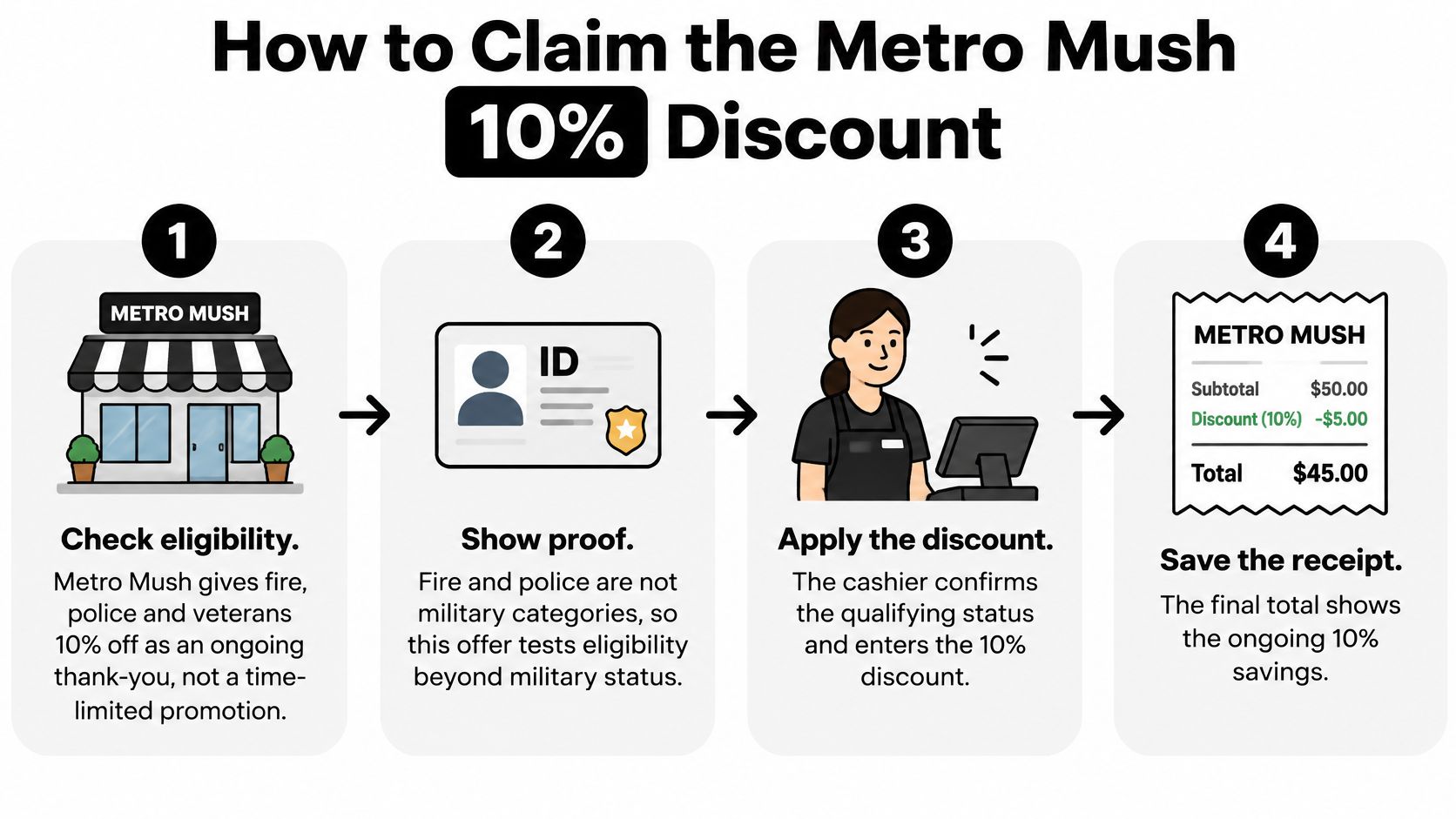
- Confirm your group. You must belong to fire, police, or veterans. This step matters because staff can only apply the discount to a named group.
- Bring valid government photo ID. Shoppers must be 21 years old with valid ID to shop at our partner stores, so bring ID that proves both identity and age.
- Bring proof of service. We haven't published a fixed list of accepted documents here, so confirm what proof we'll accept before you visit. Guessing at the counter wastes your trip.
- Confirm before you pay. Ask staff to enter the 10% and check your total before payment. Fixing a missing discount is easier before the transaction closes.
You can review current offers on our Metro Mush deals page before you come in. The most common mistake is assuming the 10% applies automatically without asking. It doesn't apply until staff check your group and enter it, so mention it at the start of your order, not after you've paid.
Confirm Eligibility and Proof Before You Order
A military discount works like a store coupon. The merchant sets the groups, the proof, and the limits. Your job is to confirm all three before you build a $75 delivery cart around savings that may not apply.
Start with the two questions that cause the most confusion. First, ask whether the 10% thank-you for fire, police, and veterans applies to delivery orders or only to in-store purchases. Second, ask about stacking. Joining the Discord community gives 20% off, so ask directly if you can combine that with the 10% on the same order. Many stores allow one offer per order.
Plan around delivery rules at the same time. Metro Mush delivers Monday through Saturday from 11 am to 8 pm, with a $75 minimum for delivery orders. If the discount drops your subtotal, ask how staff calculate the minimum before you finalize anything.
Call Detroit Metro at 734-691-6122 or Ann Arbor Metro at 734-280-2868 to confirm your group and the exact proof to bring. You can also review contact options and current details on our Metro Mush support and contact information page before you order.
A discount counts only once staff confirm it.
If you do not qualify for this offer, compare standard pricing with the total in front of you. Confirm first, then order. You will know your status counts, your proof works, and your final price matches the plan.