


You crawl into bed tired enough to fall asleep fast. Then your brain starts inventorying everything you didn't finish. The email you forgot to send. The bill you meant to pay. The weird comment from earlier that shouldn't matter but somehow does. Your body feels heavy, but your mind keeps pacing.
That's the kind of sleep problem a lot of adults in Metro Detroit know well. You're not exactly awake, but you're not settling either. You may have already tried melatonin, herbal tea, white noise, or a stricter bedtime. Sometimes those help. Sometimes they don't touch the underlying issue, which is that your stress system never fully got the message that the day is over.
That's where adaptogenic mushrooms for sleep enter the conversation. These aren't psychedelic mushrooms, and they aren't meant to knock you out like a sedative. They're part of the broader category of functional mushrooms used in wellness, with growing interest around how they may help the body handle stress more smoothly. For people whose sleep is disrupted by tension, overstimulation, or that “wired but tired” feeling, that distinction matters.
The useful way to think about them is simple. A sleeping pill tries to push sleep. An adaptogenic mushroom is usually aimed at improving the conditions that allow sleep to happen.
That approach also fits real life better for many people. If your evenings are packed, your nervous system runs hot, and your sleep falls apart most during stressful stretches, a nightly support tool that works with your body may make more sense than a hard sedative effect.
Tired of Being Tired? A New Look at Natural Sleep Support
Many sleep conversations get stuck on one question: “What will make me fall asleep faster tonight?” That's understandable, but it's often too narrow. For a lot of adults, the bigger problem isn't a total lack of sleepiness. It's stress-driven sleep disruption.
You may feel exhausted all day, then strangely alert once your head hits the pillow. Or you fall asleep without much trouble, then wake up in the middle of the night feeling mentally switched on. In both cases, the body may still be acting like it needs to stay on guard.
That's why adaptogenic mushrooms for sleep are getting attention. They offer a different lens. Instead of working like a blunt sleep aid, they're more often discussed as tools that may help the body regulate stress and settle into a healthier rhythm over time.
What makes them different
Adaptogenic mushrooms are generally discussed in the wellness world as non-psychedelic functional mushrooms. The goal isn't altered perception. The goal is support. Some are used for focus, some for stamina, and some, especially reishi, are commonly associated with rest and calm.
This point clears up one of the biggest areas of confusion. People hear “mushrooms” and assume every mushroom product belongs in the same category. It doesn't. A mushroom used in a sleep supplement is not being used for the same reason as a psilocybin product.
Adaptogenic mushrooms for sleep make the most sense when stress feels like the engine behind your insomnia.
Who tends to be most curious about them
They often appeal to adults who:
- Feel tired but overstimulated: You're drained physically, but your mind won't power down.
- Notice stress wrecks their sleep: Tough workweeks, family pressure, or nonstop screen time seem to spill directly into bedtime.
- Want something gentler: You're interested in natural support, but you still want a practical, safety-minded approach.
- Care about routine: You're open to building a wind-down habit instead of relying on a one-night fix.
That last point matters. These products usually fit better into a nightly ritual than a last-minute rescue plan. If you want a stronger foundation for sleep, not just a temporary override, that's where they're most interesting.
What Are Adaptogens and How Do They Affect Stress
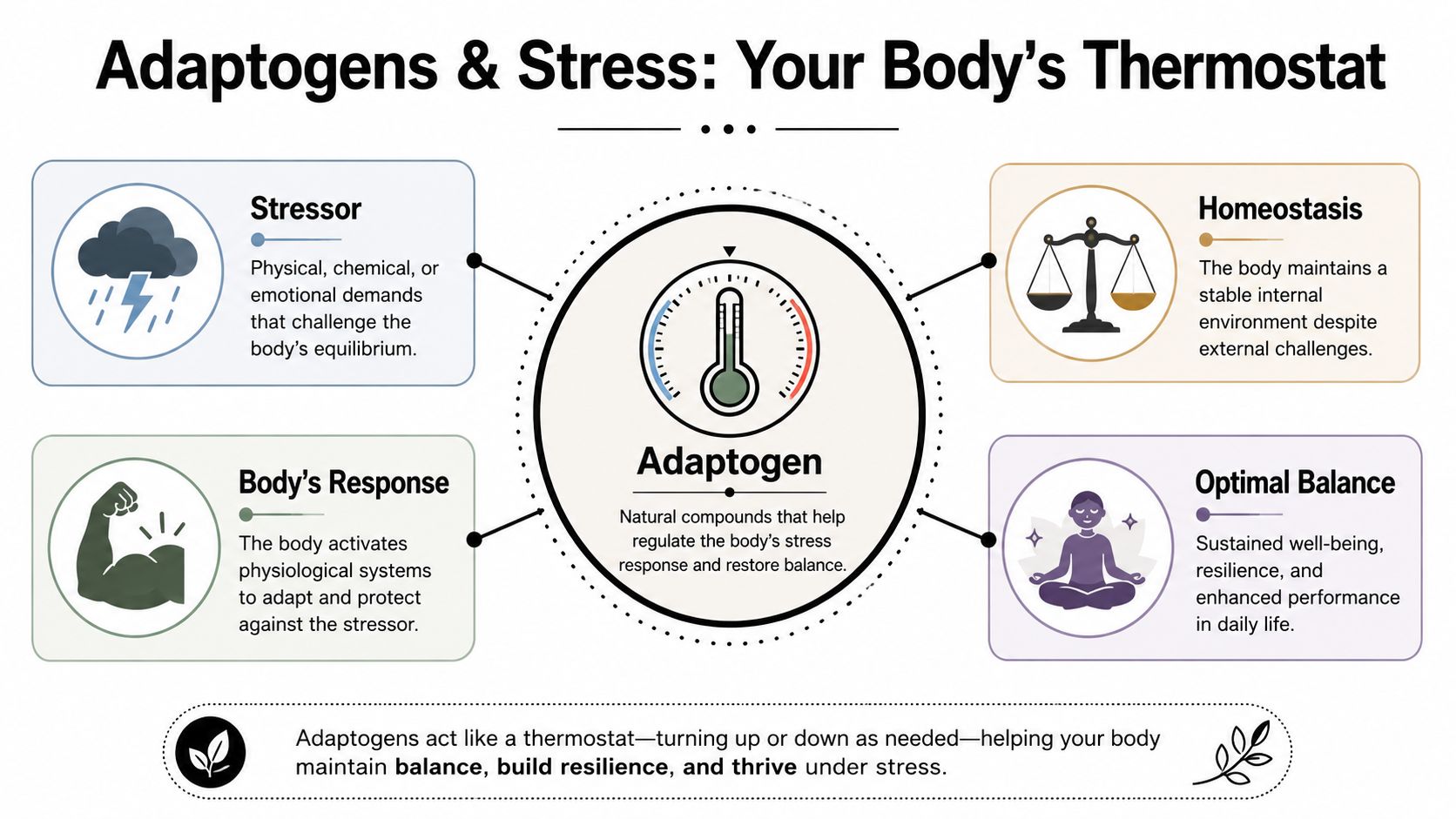
The word adaptogen sounds technical, but the basic idea is pretty approachable. Think of an adaptogen like a thermostat for your stress response. A thermostat doesn't force your house to become freezing or hot. It notices when things drift too far and helps bring them back toward a comfortable range.
Your body has its own stress-regulation network, often called the HPA axis. That stands for the hypothalamic-pituitary-adrenal axis. You don't need to memorize the term. What matters is the job. This system helps manage how your body reacts to pressure, challenge, and recovery.
Why stress messes with sleep
When stress sticks around, your internal “alarm system” can stay too active. That can show up as a busy mind, shallow sleep, or difficulty settling at the start of the night. In plain language, your body may still be preparing for action when you're asking it to rest.
Adaptogens are different from sedatives because they don't just switch the lights off. They're discussed as substances that may help the body respond to stress in a more balanced way.
Human evidence is still developing, but one clinical study found that a mushroom blend improved sleep quality over time and also reduced anxiety, depression, and fatigue, which supports the idea that the effect may be tied to HPA-axis downregulation rather than direct sedation according to this clinical review of adaptogenic mushroom sleep evidence.
Why this matters for nightly use
This explains why some people try a mushroom product once, feel only a subtle shift, and assume it “didn't work.” If the main value comes from helping your body manage stress more smoothly, then the effect may feel more like a gradual lowering of internal noise than a dramatic knockout sensation.
That's also why these mushrooms often fit well alongside other calming habits. Dim lights, a consistent bedtime, less alcohol, and less late-night doomscrolling all support the same goal. If you're also looking at broader ways to calm your system, this guide to natural remedies for stress relief fits well with a mushroom-based approach.
Practical rule: If your sleep issue is mostly “my brain won't stop,” adaptogens tend to make more sense than if you want an immediate, heavy sedative effect.
The Best Adaptogenic Mushrooms for Restful Sleep
If you only remember one name from this topic, make it reishi. It's the mushroom most consistently tied to sleep support and nighttime use. Other adaptogenic mushrooms may still play a role, but they tend to be more indirect.
Reishi as the main sleep mushroom
Reishi is the most cited adaptogen for sleep. A typical dose range is 400 mg to 1.5 g daily, taken 30 to 60 minutes before bed, and one modern summary reports research suggesting it can reduce sleep latency by an average of 7 minutes while interacting with the body's central stress-response system, according to this reishi sleep summary with dosing guidance.
That doesn't mean reishi acts like a pharmaceutical sleep medication. A better way to think about it is that reishi is the mushroom most often positioned for falling asleep a bit more easily and staying settled more consistently.
The supporting cast
Lion's mane and cordyceps show up often in mushroom blends. Their role in sleep is usually less direct.
Lion's mane is often chosen by people who feel mentally overloaded. It's not typically the mushroom people reach for as a primary sleep aid, but it can make sense when poor rest is tied to an overactive, distracted mind.
Cordyceps sits in a different lane. It's more often discussed around energy and performance. That may sound strange in a sleep article, but daytime energy patterns affect nighttime sleep. If your days are flat, irregular, or driven by caffeine swings, a better daytime rhythm can help your nights indirectly.
Sleep-Supportive Mushroom Quick Guide
| Mushroom | Primary Benefit for Sleep | Best For |
|---|---|---|
| Reishi | Most directly associated with calming support, sleep latency, and nighttime use | People who feel stressed, wired, or unable to wind down |
| Lion's Mane | Indirect support through mental calm and cognitive balance | People with a “busy brain” at bedtime |
| Cordyceps | Indirect support through daytime energy rhythm | People whose sleep suffers when their daily energy is erratic |
How to choose without overthinking it
Start with the symptom, not the trend.
- Can't wind down: Reishi usually makes the most sense.
- Mind won't stop spinning: A blend with reishi plus lion's mane may feel more relevant.
- Bad sleep follows chaotic daytime energy: Cordyceps may belong earlier in the day, not right before bed.
If you only want one mushroom specifically for sleep, reishi is usually the cleanest starting point.
A lot of products combine several species, and that can be useful. Still, it helps to know which ingredient is doing the heavy lifting for the result you want.
The Science of How Mushrooms Improve Sleep Quality
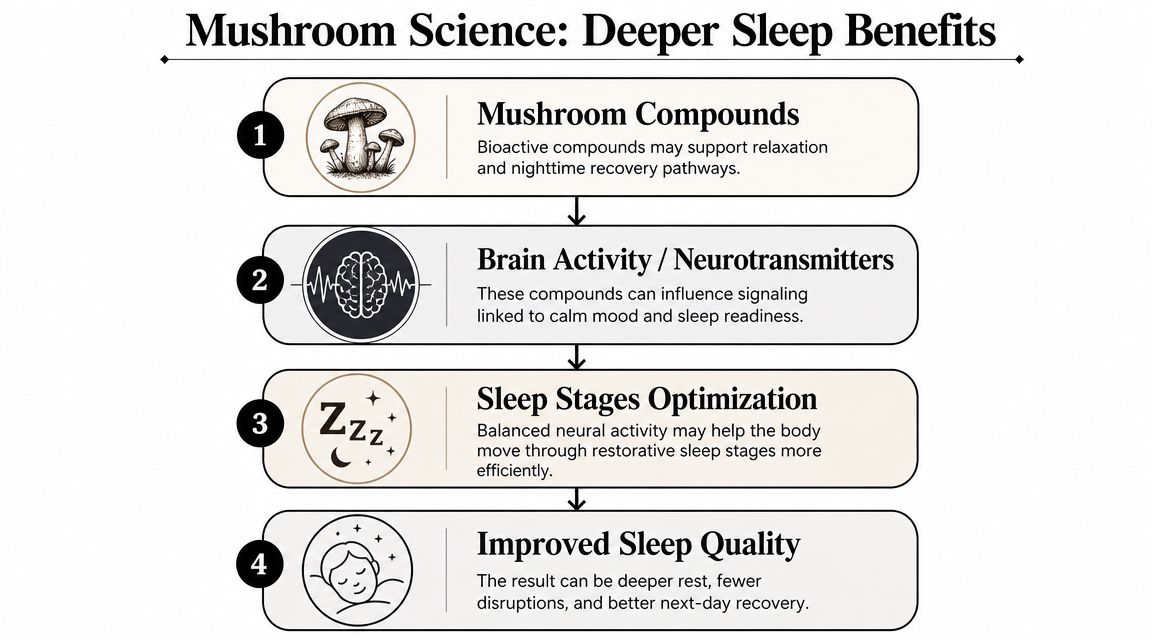
You lie down at 11, but your body still acts like it is 3 p.m. Your thoughts keep sorting tomorrow's problems, your shoulders stay tight, and sleep feels delayed instead of natural. That is the problem adaptogenic mushrooms are usually trying to address. They are being studied less as knockout aids and more as tools that may help the body shift out of a stress-heavy state that interferes with sleep quality.
What human studies are showing
Human sleep research on medicinal mushrooms is still early, and that matters. A cautious reader in Metro Detroit should know the evidence is promising, but it is not broad enough to treat mushrooms like prescription sleep medicine.
What researchers do measure is useful. Instead of asking only, “Did people sleep better?”, they often use standard tools such as the Pittsburgh Sleep Quality Index, or PSQI. That score works like a report card for sleep. It looks at areas such as how long it takes to fall asleep, sleep disturbances, and how rested a person feels the next day.
Some small human studies and early clinical reports on mushroom blends have suggested improvements in sleep quality alongside changes in stress-related markers. The pattern is consistent with the bigger adaptogen idea: if the stress system becomes less reactive, sleep may come more easily. The exact effect size, though, likely depends on the product, the dose, and the person using it.
What may be happening under the hood
The most discussed pathways are stress regulation, inflammation, and nervous-system signaling.
A review in the journal Nutrients describes adaptogens as agents that may increase resistance to stress and help normalize body functions under strain, partly through effects on the hypothalamic-pituitary-adrenal axis and related mediators of the stress response, as explained in this review of adaptogens and stress-protective activity. If that language feels technical, the practical version is simpler. The HPA axis is part of the body's stress command system. When it stays stuck in “alert mode,” sleep often gets lighter, later, or more fragmented.
Reishi gets the most attention here. Preclinical research suggests some of its compounds, especially triterpenes and polysaccharides, may influence pathways tied to calm, inflammation, and sleep regulation. Animal and lab findings do not prove the same effect in humans, but they give researchers a map of where to look next.
Another possible pathway involves the gut-brain connection. The gut works like a busy messaging hub, sending signals that can affect mood, stress response, and sleep. Early research on mushrooms suggests they may shape that environment in ways that support more stable signaling. For stressed adults building a practical nighttime routine, that means the benefit may be indirect but still meaningful. Better stress signaling can set the stage for better sleep.
What this means for real-life use
The practical takeaway is modest, not magical.
Adaptogenic mushrooms may help improve sleep quality over time, especially for adults whose poor sleep is tied to stress, tension, or feeling mentally “on” at night. They are less likely to act like a fast sedative and more likely to work like background support for a more settled system.
That is why product quality matters so much for Detroit and Ann Arbor shoppers. The mushroom species, extraction method, and dose can all change what you are taking. If you want a clearer explanation of the difference between sleep support and sedation, Metro Mush breaks it down in this article on whether mushrooms help you sleep.
Creating Your Nightly Mushroom Ritual
You finish dinner, answer one last email, and crawl into bed with a mind that still feels like it is under bright office lights. That is the moment a mushroom supplement tends to disappoint people. Used randomly, it can feel like just another wellness product on the nightstand. Used as part of a steady evening pattern, it has a better chance of supporting the kind of downshift your body recognizes.
That pattern matters because the nervous system learns by repetition. A consistent bedtime routine works like a familiar path through your neighborhood. The more often you take it, the less effort it takes to follow. Adaptogenic mushrooms fit best as one cue inside that larger route to sleep.
Pick a form you'll actually use
The best format is usually the one you will take regularly for several weeks.
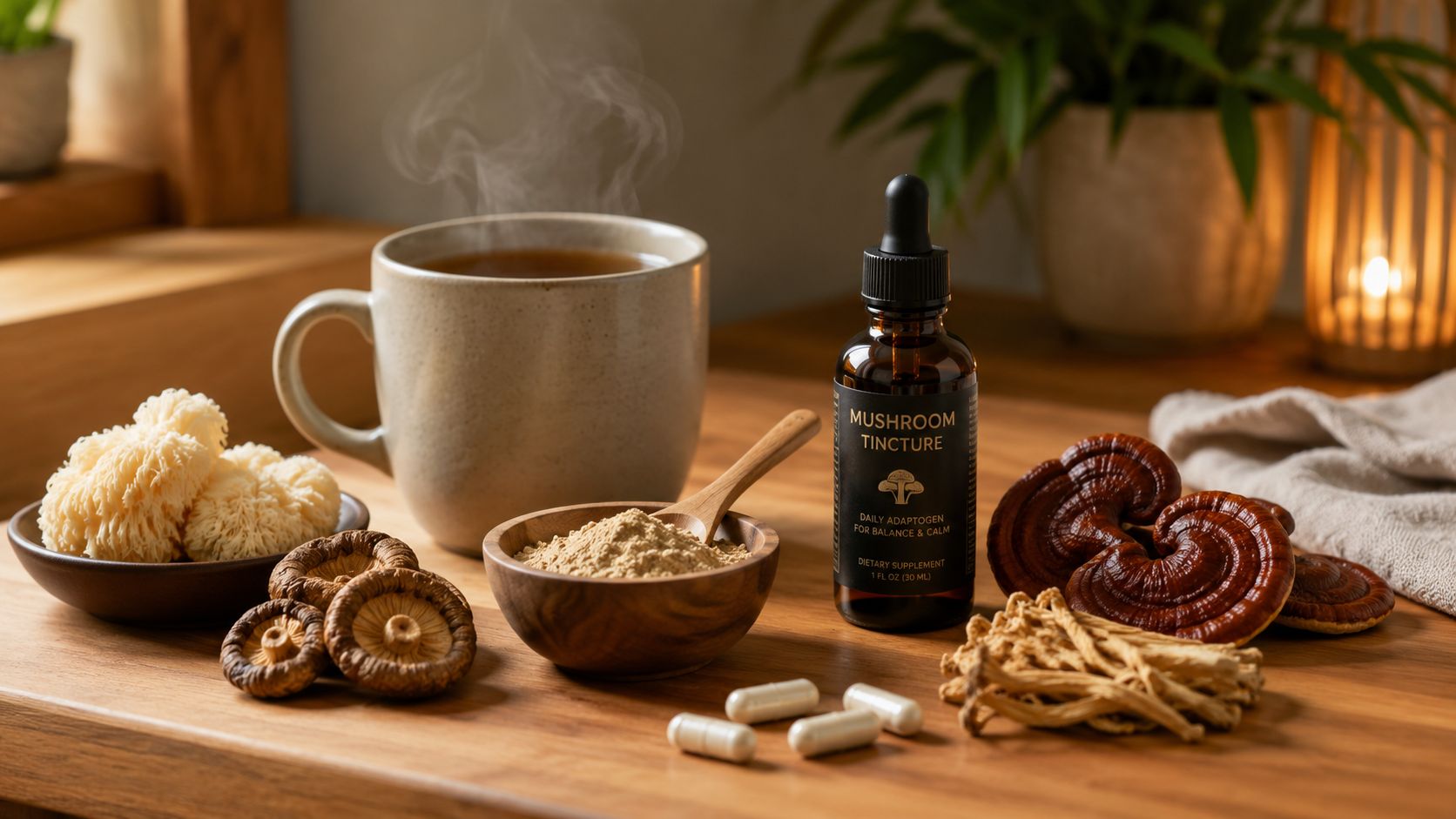
Capsules are the simplest option. They give you a fixed amount, travel well, and remove the earthy taste that turns some people off.
Tinctures feel more hands-on. Adding a dropperful to warm, caffeine-free tea can create a clear mental signal that the day is ending.
Powders can work well too, especially if you already make an evening drink. They just require a little more label reading.
Pay attention to quality, not just the mushroom name
Shoppers often find this confusing. Two products can both say "reishi" on the front and still be very different in practice.
Extraction method matters because mushrooms have tough cell walls, and different compounds are pulled out in different ways. For a sleep-focused routine, many people look for extracts rather than plain mushroom powder, since extracts are designed to concentrate the compounds manufacturers want to preserve. As noted earlier, reishi products are often judged in part by how well they retain compounds linked to calm support, which is one reason label details matter so much.
For Metro Detroit and Ann Arbor shoppers, this is a practical issue, not a chemistry quiz. Check for the mushroom species, whether the product uses fruiting body or mycelium, how it was extracted, and whether the company provides third-party testing for identity and contaminants. A tidy label and trendy branding do not tell you any of that.
A simple evening routine
Keep it boring. Boring routines are easy to repeat.
Try this for two to three weeks:
- Choose one set time: Take your mushroom product at roughly the same point each evening, such as after dinner or 30 to 60 minutes before bed.
- Pair it with one calming habit: Tea, light stretching, quiet music, or a few pages of a book all work.
- Lower the room's intensity: Dim lights, silence work notifications, and avoid stimulating screens if possible.
- Notice patterns, not one-night miracles: Pay attention to how quickly you settle, whether your thoughts feel less revved up, and how you feel the next morning.
A good ritual should feel gentle, familiar, and easy to do on a stressful Tuesday.
If you are comparing local options, look beyond flavor and packaging. Retailers and brands, including Metro Mush, may offer capsules, tinctures, and blends, but the better choice is the one with clear sourcing, clear testing, and a format that fits your real evening life.
Important Safety and Potential Drug Interactions
A lot of wellness content treats mushrooms as if “natural” means “no downside.” That's too loose. Adaptogenic mushrooms may be low-risk for many healthy adults, but low-risk isn't the same as no-risk.
The biggest blind spot is interaction risk. If you're already taking medication or combining several sleep aids, this part matters more than clever branding or trendy packaging.
Who should be more cautious
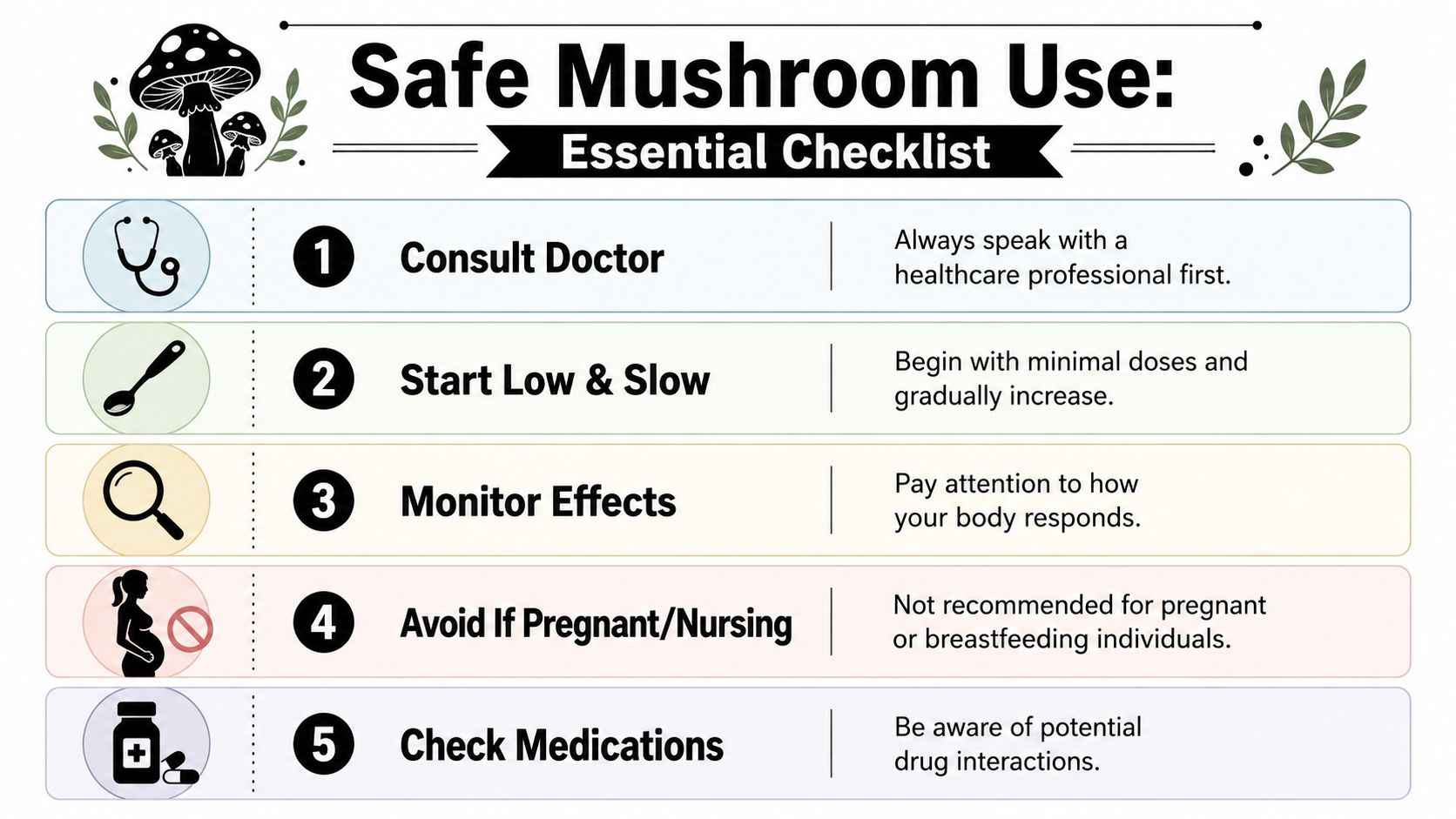
Medical coverage warns that adaptogenic mushrooms can amplify the effects of sedatives, lower blood sugar or blood pressure, and may be problematic for people taking blood thinners or living with autoimmune conditions, based on this medical overview of adaptogenic mushroom pros, cons, and interactions.
That means extra caution makes sense if you:
- Use sleep medication or sedatives: Combining calming agents can stack effects in ways you didn't intend.
- Take blood pressure or diabetes medication: If a supplement also nudges those systems, the combination may not be harmless.
- Use blood thinners: This is not a category for guesswork.
- Have an autoimmune condition: “Immune-supportive” ingredients aren't always appropriate in every medical context.
- Are pregnant or breastfeeding: This is a situation where skipping self-experimentation is the smart move.
A safer way to test them
If your clinician says it's appropriate, the cautious approach is straightforward:
- Start low: Don't begin with a full complex stack.
- Change one variable at a time: If you're testing a mushroom supplement, don't also change alcohol, cannabis, melatonin, and antihistamine use all at once.
- Watch your response: Pay attention to next-day grogginess, dizziness, digestive changes, or unusual sedation.
Talk to your doctor or pharmacist if you take prescription medication. The label on a supplement bottle can't account for your whole medical picture.
That advice may sound conservative, but it's the right kind of conservative. Better sleep is only useful if you get there safely.
A Smart Shoppers Guide for Detroit and Ann Arbor
The shelf can get confusing fast. Labels say “organic,” “full spectrum,” or “mushroom complex,” but those phrases don't automatically tell you whether a product makes sense for sleep.
What to check on the label
Look for a few practical signals:
- Fruiting body listed clearly: That tells you the actual mushroom portion is part of the formula.
- Dual extract wording: This is especially relevant when you want reishi for sleep support.
- Standardization details: If a brand mentions triterpenes or beta-glucans, that at least shows they're thinking about active compounds.
- Third-party testing: This gives you a better shot at a cleaner, more predictable product.
Where local shoppers can look
Detroit and Ann Arbor shoppers can compare options at local health food stores, wellness boutiques, supplement retailers, and community markets such as Eastern Market or the Ann Arbor Farmers Market. Online shopping also widens the field, but it helps to know what you're looking for before you click.
If you're browsing mushroom-related options locally and online, Metro Mush also keeps a practical page on where to buy shrooms in the Detroit and Ann Arbor area, which can help orient you to the local mushroom shopping market more broadly.
The simplest buying rule is this: choose clarity over hype. A plain, well-labeled reishi extract with thoughtful testing beats a flashy sleep blend that tells you almost nothing.
If you're exploring mushroom wellness options in Southeast Michigan, Metro Mush offers local mushroom-focused shopping and educational content for adult consumers in the Detroit and Ann Arbor area.