
If you live in Detroit or Ann Arbor, you've probably heard two very different mushroom conversations at once. One happens in the grocery aisle, where mushrooms show up as an easy dinner add-on. The other happens in wellness circles, group chats, and local policy discussions, where people talk about psilocybin, microdosing, and decriminalization.
That mix can get confusing fast. Some claims are grounded in nutrition research. Some are based on personal experience. Some are promising but still early. And locally, the legal reality is more nuanced than many people realize.
This guide is for adults who want a clear, balanced view of mushroom benefits without hype. It starts with the everyday benefits of culinary mushrooms, then moves into the therapeutic and experiential potential people associate with psilocybin, and finally looks at what Detroit and Ann Arbor residents should understand before buying or using any mushroom product.
Your Guide to the World of Mushrooms
Mushrooms don't all belong in one bucket.
At the most basic level, there are culinary mushrooms like button, shiitake, oyster, and lion's mane sold as food. People use them for flavor, texture, and nutrition. Then there are psilocybin mushrooms, which contain compounds that can produce altered perception, emotional shifts, and in some settings, introspective experiences.
That distinction matters because the benefits, risks, and legal issues aren't the same.
Two categories people often blur together
Many readers get stuck at the phrase "mushroom benefits" because it sounds singular, as if all mushrooms do the same thing. They don't.
- Food mushrooms fit into everyday eating. You can sauté them with eggs, add them to soup, or roast them with vegetables.
- Functional mushroom products often focus on concentrated compounds or specific wellness goals.
- Psilocybin mushrooms are in a different category entirely because they affect consciousness and require a more careful, adult-only decision-making process.
Local reality: In Southeast Michigan, mushroom conversations aren't abstract. Detroit and Ann Arbor residents hear about health, policy, sourcing, and safety all at once.
Why local context matters
National articles often flatten the topic. They might praise mushroom nutrition without mentioning psilocybin at all, or they might jump straight to psychedelics without helping readers understand basic nutrition, local enforcement priorities, or buying risks.
For people here, the practical questions are more grounded:
- What are the real health benefits of common mushrooms?
- What does psilocybin actually do?
- What does decriminalized mean in Ann Arbor or Detroit?
- How should a cautious adult think about dose, setting, and product quality?
Those are reasonable questions. They deserve straightforward answers, especially when the topic touches food, mental health, and local law all at once.
The Everyday Powerhouse Nutritional and Health Benefits
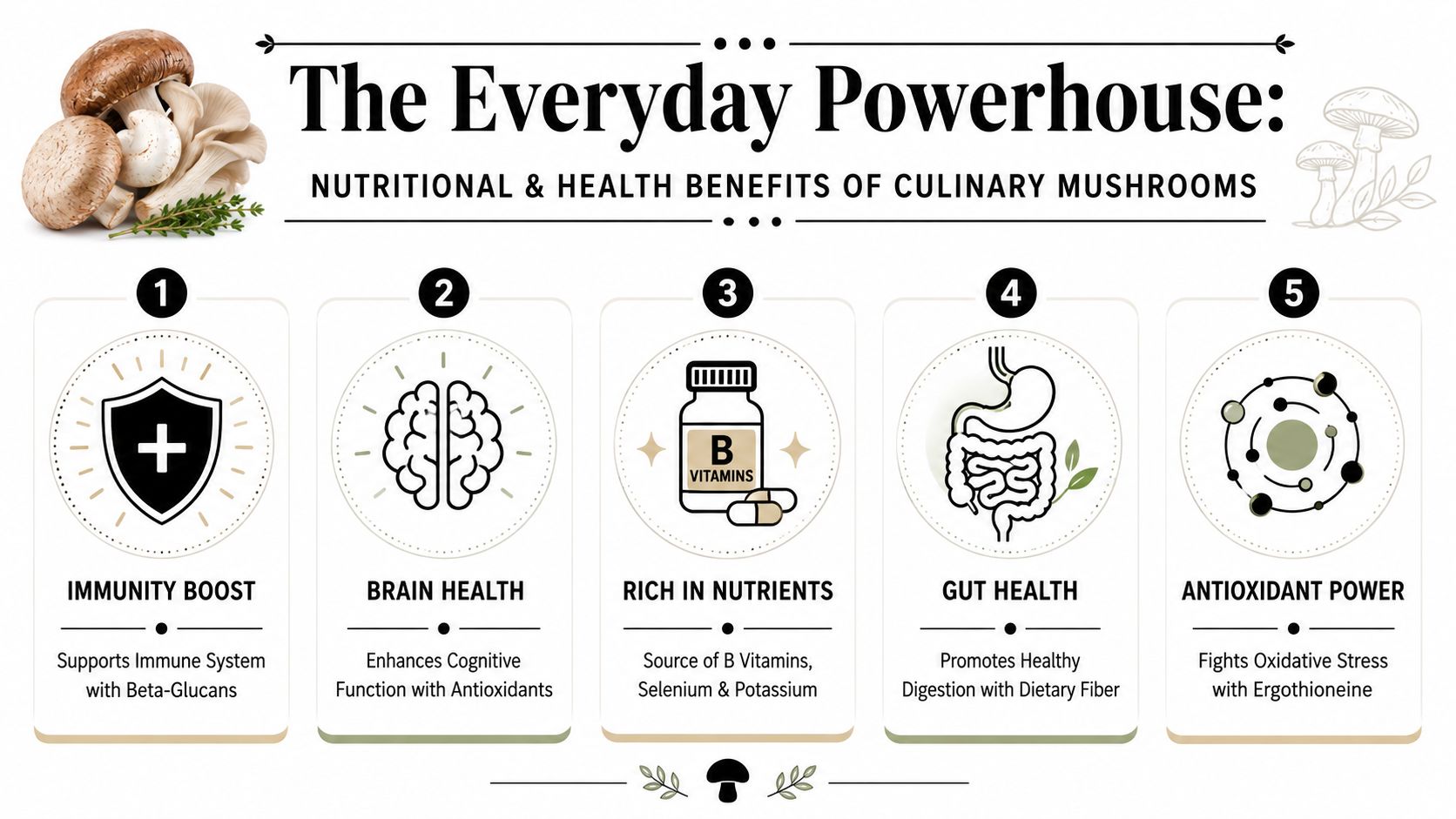
A lot of Detroit and Ann Arbor readers arrive here expecting the word "mushrooms" to mean one thing. In daily life, the most immediate benefits usually come from the ordinary kinds sold at grocery stores, farmers markets, and produce counters. Cremini, shiitake, oyster, portobello, and similar culinary mushrooms give you a practical mix of flavor, texture, and nutrition without adding much fat or many calories.
They also pull more weight nutritionally than their size suggests. Common edible mushrooms provide nutrients such as B vitamins, potassium, selenium, and fiber. Research interest goes further because mushrooms also contain compounds like beta-glucans, polyphenols, sterols, terpenoids, and other polysaccharides that scientists examine for their potential roles in antioxidant activity, inflammation, immunity, gut health, and cardiometabolic function, as described in this review of mushroom bioactive compounds and health effects and in Cedars-Sinai's overview of mushroom nutrition and cancer-related findings.
Why mushrooms do more than add flavor
One helpful way to understand mushrooms is to compare them to a small tool that does several jobs well. They can make a meal taste richer, help it feel more filling, and add useful nutrients at the same time. That matters for people trying to improve everyday eating without rebuilding their whole diet.
The health conversation can get fuzzy here, so a distinction helps. Mushrooms are not a magic shield against disease, and one serving does not cancel out the rest of a person's habits. What the research does support is a steady, food-first view. Regular intake of nutrient-dense foods, including mushrooms, can contribute to a healthier overall pattern.
Some of the attention comes from findings people can use in real life. One observational study discussed by Cedars-Sinai found that people who ate mushrooms regularly had lower cancer risk than people who ate none, and the same source notes that even modest weekly intake may matter. Observational research shows association, not proof of cause, but it gives a grounded takeaway. Consistency usually matters more than perfection.
Mushrooms fit best into real life when they become part of the weekly grocery routine.
Easy ways to bring them into daily meals
For many Southeast Michigan households, the best plan is simple enough to repeat through a busy week.
- Add them to meals you already make: sliced mushrooms work in eggs, chili, tacos, pasta sauce, stir-fries, and grain bowls.
- Use them to build savory depth: mushrooms bring an earthy, almost broth-like quality that can make meatless meals feel more satisfying.
- Try more than one variety: different mushrooms bring different textures and flavors. If you want a food-focused example, this guide to chanterelle mushroom benefits and uses shows how variety changes both the cooking experience and the wellness conversation.
- Shop with a practical eye: at Detroit and Ann Arbor markets, look for firm mushrooms with a fresh smell and no slimy surface, then cook them thoroughly and use them within a few days.
That local angle matters. In Southeast Michigan, mushroom talk often gets pulled toward psilocybin, policy, and gray-area sourcing. Culinary mushrooms are the quieter part of the story, but for many residents they are still the most accessible starting point, and often the most useful one day to day.
Exploring Psilocybin Therapeutic and Experiential Benefits
Psilocybin mushrooms belong to a different conversation. People don't use them for dinner texture or potassium. They use them because psilocybin can produce changes in mood, thought patterns, sensory experience, and self-perception.

A simple way to think about it is this. If your everyday mental habits are like a set of roads you travel over and over, psilocybin may temporarily make those routes feel less fixed. Some people report that this creates emotional openness, fresh perspective, or a sense of distance from repetitive thought loops. Others experience it as awe, insight, or a stronger feeling of connection.
Therapeutic potential and personal experience aren't the same thing
People often get mixed up on this point. There are two separate claims in circulation:
- Therapeutic potential, which refers to research and structured mental health interest.
- Experiential benefits, which refers to what adults sometimes report from their own use.
Those overlap, but they aren't interchangeable. A person might feel reflective or emotionally lighter after a guided or intentional experience, yet that doesn't automatically mean the effect is medical treatment.
What does seem clear is that fungi more broadly have drawn interest for brain-related outcomes. Harvard's Nutrition Source notes that a 2019 cross-sectional study of 663 Chinese adults aged 60 and older found that those eating more than 2 servings of mushrooms per week had a lower risk of mild cognitive impairment than those eating less than 1 serving per week, according to Harvard's mushroom feature.
That finding concerns non-psychoactive mushroom intake, not psilocybin therapy. Still, it helps explain why mushrooms in general have become part of broader brain-health discussions.
What people often hope to gain
Adults interested in psilocybin usually aren't chasing one single outcome. Their reasons vary.
- Emotional insight: Some want to revisit personal patterns with less defensiveness.
- Perspective shifts: Others describe seeing a problem from a wider angle.
- Connectedness: Many users talk about feeling more linked to other people, nature, or their own values.
- Creative looseness: Some report less rigid thinking and more mental flexibility.
For readers who want a simple neuroscience-oriented primer, this overview of psilocybin effects on the brain is a useful companion to the broader benefit discussion.
A short visual walkthrough can also help make the topic less abstract:
Why expectations need to stay grounded
Psilocybin isn't a shortcut to wisdom. It also isn't a guaranteed positive experience.
A good rule is to treat it as a powerful catalyst, not a cure-all. Some people come away with meaningful personal insights. Some feel overwhelmed. Some need time afterward to process what came up. The benefit often depends less on hype and more on intention, preparation, emotional readiness, and what happens after the experience.
Finding Your Dose Microdosing vs Full Journeys
When adults talk about psilocybin, they're often describing very different kinds of use. That's why dose matters so much.
A helpful analogy is music. Microdosing is like having music playing softly in the background while you go about your day. A full dose journey is like attending a concert where the music becomes the entire environment. Same medium, very different experience.
Microdosing and full-dose use serve different intentions
People often assume microdosing is just a weaker version of tripping. That's not quite right. The intention is different.
Microdosing usually aims for subtle effects. People may be looking for gentler shifts in mood, openness, or routine awareness while staying fully engaged with daily life. Full-dose use tends to be more immersive and more disruptive to normal functioning for several hours, which is exactly why many people reserve it for planned time, a safe setting, and reflection.
For a more detailed product-and-practice comparison, this guide to microdosing vs macrodosing maps the distinction in a consumer-friendly way.
Microdosing vs Full Dose Journeys
| Aspect | Microdosing | Full Dose (Macrodose) |
|---|---|---|
| Main intention | Subtle support, routine self-observation, gentle experimentation | Deep introspection, emotional processing, major perspective shifts |
| What it feels like | Often mild enough that the day still feels normal | Noticeably altered perception, mood, and thought patterns |
| Best setting | Low-demand day, familiar environment, no pressure to perform | Protected space, trusted company or sitter, clear schedule |
| Planning needed | Moderate. You still need to think about timing and responsibilities | High. You need to plan your environment, emotional readiness, and aftercare |
| Common mistake | Taking more because the subtlety feels underwhelming | Treating it casually and underestimating intensity |
| Who it may suit | Curious beginners, cautious adults, people testing sensitivity | Experienced users or adults approaching it with strong preparation |
Practical rule: If you're unsure which path fits, choose the one that asks less of your nervous system first.
Questions worth asking yourself before choosing
A smart starting point isn't "How much should I take?" It's "What am I trying to do?"
Ask yourself:
- Do I want subtle or immersive effects?
- Do I need to drive, work, parent, or handle tasks that require steady attention?
- Am I looking for experimentation or a deliberate inner process?
- Will I have time afterward to rest and reflect?
Those questions usually clarify the path faster than any dose chart. The right choice depends on your goals, comfort level, and willingness to prepare.
Navigating with Care Understanding Risks and Safety
The most responsible way to talk about mushroom benefits is to talk about limits and risks with equal honesty.
With culinary mushrooms, the biggest issue is usually practical. Do you tolerate them well, and are you buying from a source you trust? With psilocybin mushrooms, the safety conversation shifts toward psychological intensity, decision-making, and context.
Set and setting shape the experience
People use the phrase set and setting for a reason. "Set" means your mindset. "Setting" means your environment. Together, they heavily influence whether an experience feels manageable, meaningful, disorienting, or frightening.
If someone goes into a psilocybin experience stressed, sleep-deprived, hiding it from others, or surrounded by chaos, the odds of a difficult time rise. If the person is calm, intentional, and in a safe place with support, the experience is usually easier to manage.
A few harm-reduction basics matter:
- Know your mental state: If you're already emotionally destabilized, postponing is often the safer choice.
- Choose your environment carefully: Privacy, comfort, and low demands matter.
- Don't mix responsibilities: Driving, work obligations, and public settings are poor matches for altered states.
- Have support available: A trusted sober person can make a major difference during a strong experience.
Some of the worst psychedelic decisions happen before the experience starts, not during it.
Why balanced expectations protect people
Penn State has reported that mushroom consumers had lower odds of depression after adjustment for multiple confounders, but that finding was observational and doesn't establish causation. The same discussion notes that evidence for neuroprotective and immunomodulatory effects remains emerging rather than definitive, according to Penn State's summary of mushroom consumption and depression research.
That point matters beyond depression headlines. People can get hurt when they treat early or population-level findings like settled proof.
Who should slow down or seek medical guidance
Not everyone is a good candidate for psilocybin use. Caution is especially important for people with:
- A history of severe mental health instability
- Current medication questions that need professional review
- High anxiety about losing control
- No safe setting or support plan
For many adults, the safest move isn't saying yes or no forever. It's slowing down long enough to make a decision with clear eyes.
Your Local Guide to Mushrooms in Southeast Michigan
In Detroit and Ann Arbor, local policy changed the conversation, but it didn't erase legal complexity.
Residents often hear that psilocybin mushrooms are "decriminalized" and interpret that as fully legal. That's not the same thing. Decriminalization generally means personal use and cultivation have been pushed down the priority list for local law enforcement. It does not create a simple, fully regulated retail system in the way many people assume.
What decriminalized usually means on the ground
For local adults, the practical takeaway is caution, not panic.
Decriminalization can create a more tolerant environment around entheogenic plants and fungi, but consumers still need to think carefully about sourcing, product consistency, and how public-facing behavior may draw unwanted attention. A gray-area market puts more responsibility on the buyer, not less.
That means asking basic questions before you purchase anything:
- Who made this product?
- Is the form easy to understand, such as dried mushrooms versus a mixed edible?
- Can the seller explain what they're offering in plain language?
- Do you understand what "adult use" means in practice?
What to look for in a trustworthy source
Without a standard retail framework, transparency becomes the closest thing to quality control.
A source is generally more trustworthy when it does the following:
- Explains the product clearly: You should know whether you're looking at dried mushrooms, chocolate, drinks, or tincture-style products.
- Communicates ordering steps plainly: Confusing or evasive sales practices are a warning sign.
- Treats education as part of the transaction: Sellers should expect questions about timing, intended use, and beginner caution.
- Avoids wild claims: The more dramatic the promise, the more skeptical you should become.
Buy from people who can answer ordinary questions calmly. If everything sounds secretive, rushed, or exaggerated, step back.
Local common sense still applies
For Detroit and Ann Arbor residents, the smartest approach is low-drama and informed. Keep your expectations realistic. Keep your use private and adult-only. And remember that legal nuance doesn't remove the need for personal responsibility.
The local area gives adults more room to explore than in many places, but it also asks them to be more careful consumers.
Putting It into Practice Your First Steps with Metro Mush
A Detroit or Ann Arbor resident might be standing in a farmers market aisle one week, choosing shiitakes for dinner, then browsing psilocybin products the next and realizing these are two very different decisions. One is about adding a reliable food to your routine. The other calls for more planning, more patience, and a clearer sense of purpose.
Start by matching the product to the job. If you want everyday mushroom benefits such as flavor, fiber, and meal variety, begin with culinary mushrooms you can cook regularly. If you want to explore psilocybin, begin with a format that is easy to portion, on a day with no obligations, in a setting that feels calm and familiar.
Matching product type to your goal
Confusion usually starts when people ask for the "best" mushroom product without defining what they want it to do. A better question is simpler: what format fits your goal, your experience level, and your comfort with intensity?
- For cautious beginners: Lower-dose edibles often feel easier to understand because the format is familiar and portions are more consistent than loose dried mushrooms.
- For adults with prior experience: Dried mushrooms may make more sense if you already know how setting, timing, and dose affect your response.
- For convenience: Chocolates and drinks can feel less intimidating than measuring raw material yourself.
Metro Mush serves Detroit and Ann Arbor with a menu that includes dried strains such as Penis Envy and Enigma, along with edibles and drink options. That range matters because beginners and experienced adults rarely need the same starting point.
A simple first-step checklist
Before you order, slow the process down and answer a few plain questions.
- What am I looking for? A mild sense of curiosity is different from a reflective solo experience or a stronger journey.
- How easy is this product to portion? Clear portions reduce guesswork.
- What does my day look like? A calm, obligation-free window matters more than people expect.
- Who knows I am doing this? For first-time psilocybin use, a trusted sober person can add a layer of safety.
- Am I willing to wait before taking more? Impatience causes many avoidable problems.
Cooking mushrooms regularly is a habit. Psilocybin use is a deliberate event. Keeping those categories separate helps you make better choices.
If you're an adult in Southeast Michigan and want a straightforward way to compare formats and understand how local ordering works, Metro Mush is one local option to review before making an informed decision.