
You may be in that exact spot right now. You've heard that “magic mushrooms are legal in Colorado,” you've seen healing centers mentioned online, and now you're trying to figure out what that means in practice for a real person who wants help, not hype.
That confusion makes sense. “Legal” can mean personal possession, a supervised therapy session, or a loosely described wellness experience that may or may not fit Colorado's rules. Those are not the same thing. If you're curious but cautious, the important question isn't just whether psilocybin is legal. It's whether psilocybin therapy colorado is accessible, structured, and appropriate for you.
Navigating a New Era of Mental Wellness in Colorado
Interest in psilocybin didn't appear out of nowhere. Public curiosity has grown fast, and that wider shift helps explain why Colorado created a regulated path instead of leaving people to sort things out alone. Between 2019 and 2023, reported lifetime psilocybin use among U.S. adults rose from 25 million to 31.3 million, a 25% increase, according to Denver Health's report on rising magic mushroom use.
That national rise matters because Colorado's system didn't emerge in a vacuum. It reflects a larger change in how people think about psychedelics, mental health, and harm reduction. More people are asking whether a guided psilocybin experience could support depression, trauma processing, or a sense that conventional care hasn't fully reached the root of the problem.
If you're new to the topic, it helps to start with a simple definition of what psychedelic therapy means in practice. The short version is that the medicine is only one part of the process. The setting, the screening, and the follow-up support matter just as much.
Practical rule: If a service talks only about the substance and not about preparation or integration, it's probably leaving out the part that makes therapy different from simple use.
Colorado's new development is promising, but it's still early. Some people will find a thoughtful, licensed option that fits their needs. Others will discover that geography, wait times, screening, or cost are barriers. That gap between public excitement and practical access is where most of the confusion lives.
Understanding Colorado's Psilocybin Legal Framework
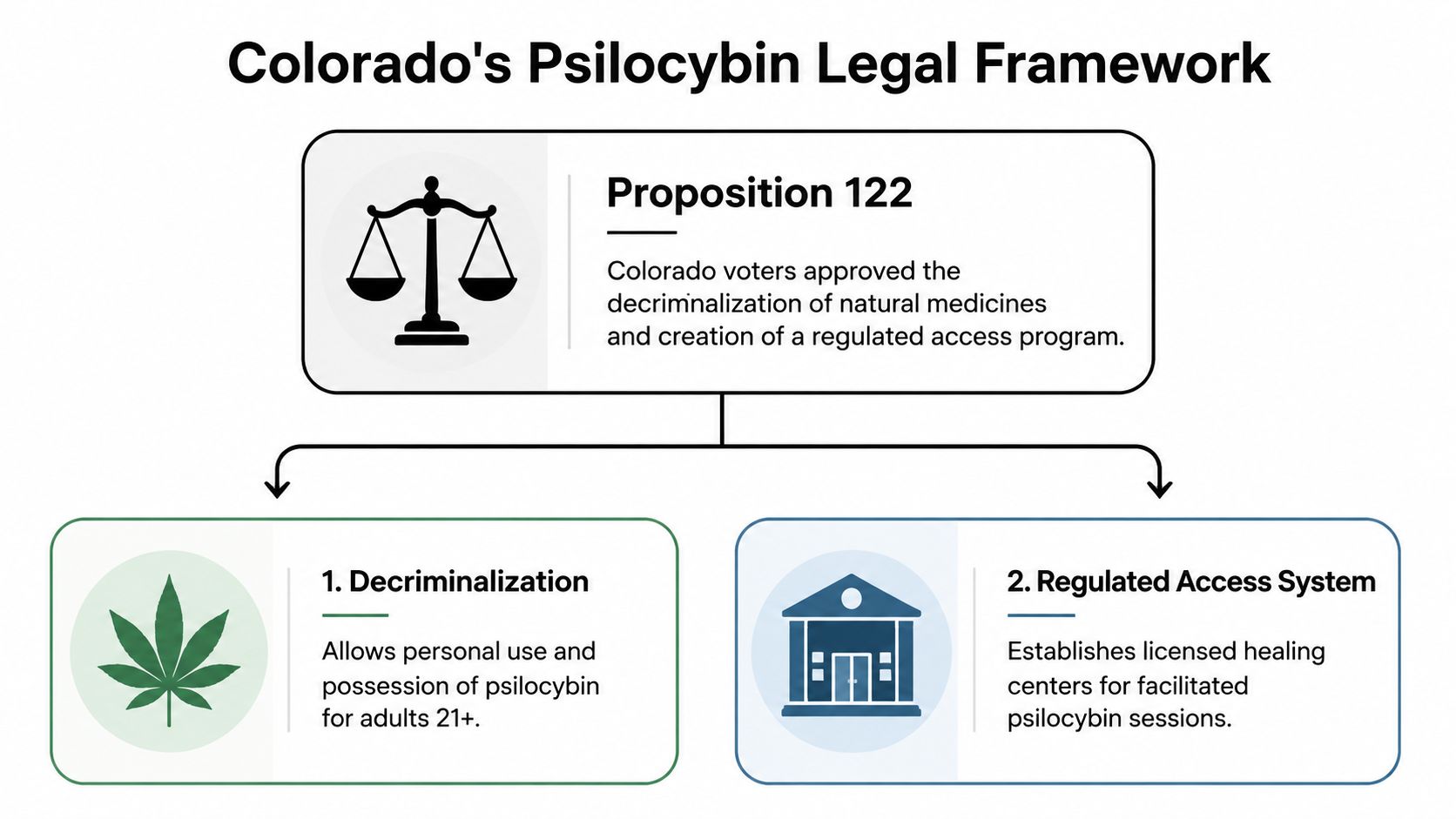
A lot of people hear one phrase and stop there: “psilocybin is legal in Colorado.” That's not quite right. A better way to think about it is that Colorado created two separate lanes.
One lane involves personal decriminalization for adults. The other is a regulated therapeutic system with licensed facilities and trained facilitators. Mixing those up leads to most of the online confusion.
Personal use and regulated therapy are different
Colorado's framework came from Proposition 122, with SB 23-290 shaping how regulated access works. Under that program, adults can receive psilocybin in state-licensed healing centers, and the model is tied to clinical research showing psilocybin-assisted therapy can produce rapid and sustained reductions in depression scores, as described by Colorado Psychotherapists' overview of the state program and research context.
Here's the easiest analogy. Personal decriminalization is closer to home-brewing. Regulated therapy is closer to visiting a licensed brewery with rules, staff, inspections, and controlled service. Both exist in the same state. They are not interchangeable.
What the therapeutic lane actually means
If you're considering psilocybin therapy colorado services, the regulated lane is the one that matters. That model is built around licensed healing centers rather than retail sales. You are not walking into a shop, buying mushrooms, and leaving with a product.
Instead, the therapeutic model involves:
- Licensed settings: Healing centers and, in some cases, micro-healing centers operate under state rules.
- Facilitated sessions: A trained facilitator oversees the session rather than leaving you on your own.
- Screening and support: The process is designed around safety, consent, preparation, and follow-up.
- Limited exceptions: Certain home-based administration circumstances may apply in narrow cases such as hospice or palliative care, but that is not the standard path.
Colorado also isn't the first state to build a system like this, which can help if you want context on how state-regulated psychedelic care has developed. This comparison with Oregon psychedelic therapy is useful because it shows how different states can legalize access without creating a conventional retail market.
The cleanest way to avoid legal confusion is to ask one question first: “Is this a licensed healing-center service, or is this something else?”
What Colorado law does not mean
It does not mean every advertised mushroom experience is part of the state system. It does not mean every facilitator using therapeutic language is licensed. And it does not mean access is broad or immediate just because the law exists.
That distinction matters because the legal headline is simple. The actual-world system is not.
Exploring Different Psilocybin Therapy Programs
Once people understand that Colorado uses a licensed service model, the next question is usually more practical: what kinds of programs are available?
The answer is less uniform than many expect. Under the regulated model, you may come across a full-service healing center, a smaller micro-healing center, or support that focuses on integration rather than a dosing session. Each serves a different need.
The main service types people encounter
A licensed healing center is the closest thing to a complete psilocybin therapy experience. This is usually where someone goes for screening, preparation, the administered session, and follow-up integration support in one coordinated path. If you want a structured environment and a provider who handles the full arc of care, this is often the clearest fit.
A micro-healing center follows the same broad regulatory idea but may operate on a smaller scale. For a potential client, that can mean a more intimate setting or a provider with a narrower operational footprint. It may feel less like a larger wellness operation and more like a tightly focused practice.
Then there's integration support. This is important because not everyone needs or wants a dosing session right away. Some people are trying to make sense of a past psychedelic experience. Others want help deciding whether they're a good candidate for Colorado's licensed model at all. Integration work can also continue after a legal session to help turn insights into real behavioral change.
Comparison of Colorado Psilocybin Service Models
| Service Model | Primary Setting | Best For | Includes Dosing? |
|---|---|---|---|
| Licensed healing center | State-licensed facility | People seeking a full, supervised therapeutic process | Yes |
| Micro-healing center | Smaller licensed facility | People who prefer a smaller-scale setting | Yes |
| Integration-focused support | Therapy or coaching setting tied to follow-up care | People processing a previous experience or preparing for one | Not necessarily |
How to think about fit
If your main goal is clinical structure, a healing center is usually the strongest match. You're looking for screening, consent, supervised administration, and follow-up in one place.
If your main goal is a smaller environment, a micro-healing center may appeal more. The core idea is still regulated care, but the experience may feel less institutional.
If your main goal is processing and meaning-making, integration support may be the first step. That's especially true if you're uncertain about dosing, have mental health complexity, or want to test the provider relationship before committing to a full session.
A good program match depends less on how “intense” you want the experience to be and more on how much structure, screening, and follow-up you need.
Questions to ask before choosing a model
Before you pick a provider, ask yourself:
- What am I seeking? Relief from depression, support after grief, trauma-informed care, or exploratory personal work can point toward different providers.
- Do I want all services under one roof? Some people value continuity. Others already have a therapist and only need the regulated session component.
- How much support do I want after the dosing day? This is one of the easiest things to underestimate.
- Am I comfortable with a newer market? Colorado's system is still developing, so options may look different from one city to another.
Some centers will market a serene room, a ceremonial atmosphere, or a highly personalized vibe. Those details matter, but they come after the basics. First confirm that the service is licensed, supervised, and explicit about preparation and integration. Then decide whether the setting feels right for you.
How to Find and Vet a Licensed Provider
The hardest part for many people isn't deciding whether they're interested. It's figuring out which provider is legitimate, qualified, and realistically available.
That challenge is bigger than it sounds because Colorado's market is still young. As of early 2026, the state had approved 34 licensed healing centers, with more applications pending, according to Colorado Public Radio's reporting on the state's healing centers. That tells you something important right away. Access exists, but it's still limited and uneven.
Start with license verification
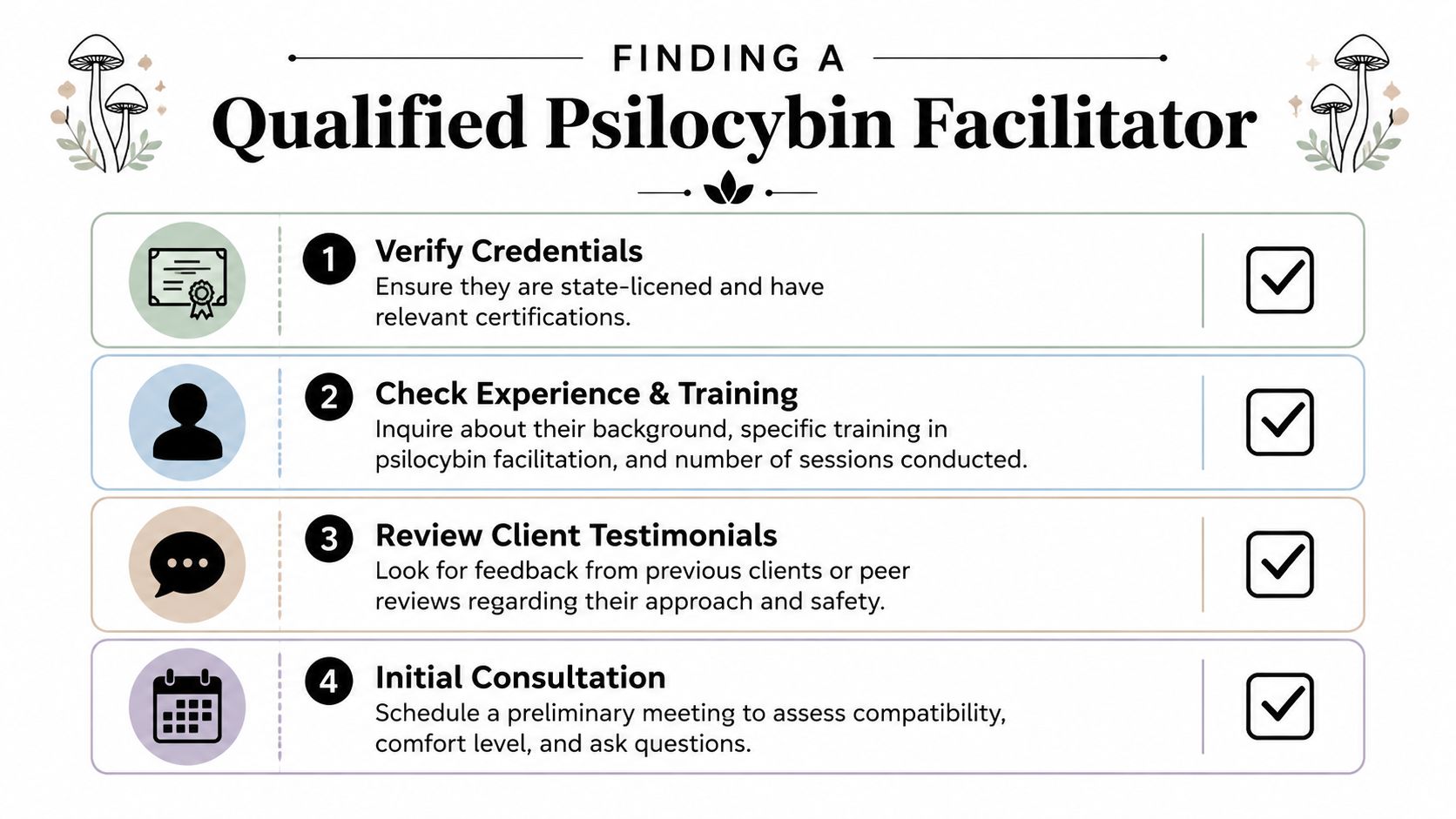
A polished website is not proof of legal status. A soothing tone, spiritual language, or wellness branding also isn't proof. Start by checking whether the healing center and facilitator are part of Colorado's regulated system.
That first screen matters because some people use language that sounds official without clearly showing state authorization. If a provider is vague when you ask about licensure, that's a problem.
Ask direct questions in the consultation
A short consultation can tell you a lot. You don't need to sound like an investigator. You do need to ask clear questions.
Use questions like these:
- Are you licensed through Colorado's natural medicine program? A legitimate provider should answer clearly.
- How do you handle screening? You want to hear about medical history, mental health review, medications, and safety planning.
- What does preparation look like? If prep sounds rushed or optional, that's a warning sign.
- How do you approach integration afterward? Good providers treat integration as part of the service, not an afterthought.
- What happens if I become overwhelmed during the session? Their answer should be calm, specific, and practiced.
- Who is not a good candidate for your program? This question often reveals whether a provider takes risk seriously.
If a provider seems annoyed by basic safety questions, keep looking.
Know what access limits look like
Even a good licensed provider may not be easy to book. Some people will face travel issues because there may not be an operating center near them. Others may find that the nearest option has limited openings or a waiting period.
This changes how you should shop for care. Don't just ask, “Is it legal near me?” Ask:
- Is there a currently operating center within realistic travel distance?
- How long is the wait for intake and session scheduling?
- What support is available if I live far away?
- How many visits will require in-person attendance?
Red flags that deserve caution
Not every concern is dramatic. Sometimes the red flags are subtle.
- No clear mention of licensing: If you have to hunt for it, be cautious.
- Overpromising outcomes: Responsible providers don't present psilocybin as a guaranteed fix.
- Little detail on screening: Safety should never sound improvised.
- No plan for aftercare: Integration is part of the work.
- Pressure to book fast: Good care usually feels measured, not sales-driven.
People often spend more time comparing room aesthetics than comparing safety practices. Reverse that order. The space matters, but the provider's judgment matters more.
What to Expect in a Psilocybin Therapy Session
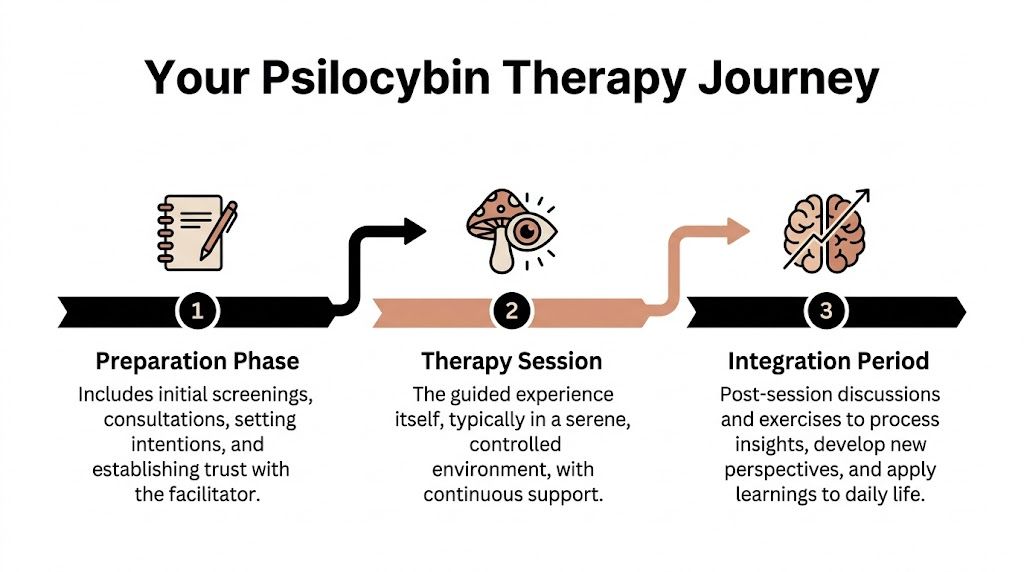
The most reassuring thing to know is that a legal Colorado psilocybin session is not designed as a single dramatic event. It's a process. Colorado's regulated model uses a three-phase workflow of preparation, administration, and integration, with psilocybin administered in a licensed healing center by a trained facilitator, as explained in this overview of what to expect in Colorado psilocybin therapy.
Preparation before anything is administered
Preparation is where the work starts. This phase usually includes conversations about your history, your current mental state, what you're hoping to address, and what kinds of support you might need before and after the experience.
Some people arrive expecting to talk mostly about dosage. In practice, a good preparation phase often spends more time on trust, emotional readiness, and logistics. Who will take you home? What happens if difficult material surfaces? What personal patterns tend to show up for you under stress?
Preparation also helps set expectations. Psilocybin therapy isn't about forcing a pleasant experience. It's about creating a safer container for whatever comes up.
The administration day
On the session day, the setting is controlled and supervised. Clinical trial protocols offer a useful example of the general session architecture. One major depressive disorder protocol listed on ClinicalTrials.gov includes two facilitator preparation meetings, a 7 to 10 hour supervised dosing session in a comfortable room, and about 4 hours of integration, with participants encouraged to use eyeshades and a curated playlist during the session, as shown in this ClinicalTrials.gov psilocybin protocol.
That doesn't mean every Colorado center will look identical. It does show the basic shape of professionally designed psilocybin care. The session is long. Monitoring is active. The room is meant to support inward focus, not distraction.
Some of the most therapeutic parts of a session don't look dramatic from the outside. A person may be lying quietly with eyeshades on, listening to music, while the real work is happening internally.
The facilitator's role isn't to entertain or direct your thoughts. It's to maintain safety, offer support, and help you stay oriented if the experience becomes intense. Many people find that reassuring once they realize they won't be left alone to manage a difficult moment.
Integration after the experience
Integration is where insights meet real life. You might talk through images, emotions, memories, or shifts in perspective that surfaced during the session. Then comes the harder question: what do you do with that?
For one person, integration might mean changing a relationship pattern. For another, it might involve restarting therapy with a new level of honesty. Someone else may need help organizing a confusing or emotionally heavy experience into something understandable.
A useful way to think about integration is this:
- The session can open a door
- Integration decides whether you walk through it
- Daily life shows whether anything changed
People often focus on the dosing day because it sounds unusual. The longer-term value often depends on what happens after it.
Understanding the Cost and Insurance Considerations
For many people, the biggest barrier isn't interest. It's money.
Colorado providers note that effective care may involve multiple psilocybin sessions and ongoing talk therapy, which means the total cost can be much higher than a one-time experience and is typically not covered by insurance, according to Reflective Healing's discussion of psilocybin-assisted therapy in Colorado.

Why the price can feel surprisingly high
People sometimes compare psilocybin therapy to a standard therapy appointment. That comparison breaks down quickly. A regulated psilocybin service includes screening, preparation meetings, a long supervised administration session, facility overhead, and follow-up integration.
In plain language, you're not paying for a product. You're paying for professional time, a licensed setting, risk management, and continuity of care.
That doesn't make the price easy. It does make it easier to understand.
What to budget for in the real world
A cautious way to think about cost is to view the process as a course of care, not a single date on the calendar. Ask providers whether their quote includes:
- Preparation sessions
- The supervised administration day
- Integration follow-up
- Any required extra therapy support
- A second session if the first is not considered the end of the process
If a provider gives you only the price of the dosing day, you may not be looking at the full financial picture.
Here's a useful reality check. Some people are good candidates in principle but still decide not to proceed because the out-of-pocket cost, travel demands, and time commitment don't fit their lives right now. That's not failure. It's informed decision-making.
A broader discussion of the cost-access challenge is worth watching here:
Insurance and who gets left out
At this stage, many people should assume they'll be paying themselves unless a provider clearly says otherwise. That reality can narrow access fast.
Cost also shapes who psilocybin therapy colorado is realistically for right now. It may be more reachable for someone with financial flexibility, a stable schedule, and access to ongoing therapy. It may be much harder for a person juggling shift work, child care, transportation limits, or tight monthly expenses.
A treatment can be legal, promising, and still out of reach. That's the current tension in Colorado's system.
A better question than What does it cost
Instead of asking only “How much does it cost?” ask “What is the total care commitment?” That includes time, emotional labor, travel, and aftercare. For some people, that wider question changes the decision more than the invoice itself.
Safety, Risks, and Official Colorado Resources
The strongest case for Colorado's regulated model is safety. A supervised setting can't remove all risk, but it can improve screening, clarify consent, and give people a structured environment for an intense experience.
That matters because psilocybin isn't appropriate for everyone. Screening exists for a reason. People with certain mental health histories, medical issues, or medication concerns may need extra caution or may be poor candidates altogether. This is one reason it helps to learn how to avoid bad trips even if you're pursuing a legal, facilitated setting. Risk reduction starts long before the session itself.
The safety questions worth taking seriously
Before moving forward, ask yourself and your provider:
- Do I have any history of severe mental health instability?
- Have I been fully honest about medications and past psychiatric symptoms?
- Am I seeking therapy, or am I hoping for a quick rescue from distress?
- Do I have support after the session if difficult emotions continue?
People often get drawn to the promise of insight. A safer approach is to focus first on suitability.
Official resources to look for
When you continue your research, prioritize official and professional channels such as:
- Colorado Department of Regulatory Agencies
- Colorado Natural Medicine Program materials
- State licensing directories for healing centers and facilitators
- Professional therapists or clinics that clearly explain screening, preparation, and integration
- Established local reporting that tracks the rollout of operating centers
The safest next step is usually boring: verify the license, read the intake details, ask hard questions, and take your time.
Colorado has opened a new path, but it's still an early-stage system. That means the best approach is a steady one. Stay skeptical of shortcuts. Look for clear licensing, thoughtful screening, and providers who treat preparation and integration as essential parts of care.
If you want grounded, practical education around mushrooms and psychedelic use, Metro Mush is a useful place to keep learning. Their site offers approachable resources for adults who are curious, cautious, and trying to make informed decisions in a fast-changing space.