


You're standing in front of a menu, or maybe a grow log, and the word Golden Teacher pins keeps showing up. If you're a first-time buyer in Detroit or Ann Arbor, that phrase can sound like insider jargon, but it's a simple stage in the mushroom's life cycle, one that also shapes how people shop, store, and think about psilocybin products. For growers, it marks the first visible sign that a block has shifted from colonized substrate to fruiting. For consumers, it can be a familiar label that signals a strain people have heard about for years, especially in shops that carry dried products and chocolates for adult use.
Spotting the First Pins and Why Growers Care
A cultivator checks a fully colonized substrate one morning and sees tiny white bumps where there was nothing the day before. That moment gets attention fast, because those bumps are the first Golden Teacher pins, and they mean the mycelium has started building mushrooms instead of just spreading through the material. In grow circles, that's the part people watch hardest, because pinning tells you the setup has crossed from waiting into visible progress.
What the first sighting really means
A pin is not a mature mushroom. It's the earliest fruiting form, small enough to look like a button or a knot at first glance, but already committed to becoming a mushroom if the surface stays in the right microclimate. One cultivation guide places the common origin story for Golden Teacher in the early-to-mid 1980s and notes that first pins often appear about 5 to 12 days after fruiting conditions are established, with harvest following another 5 to 7 days later, for a full pin-to-harvest cycle of roughly 10 to 19 days under favorable conditions. Golden Teacher history and cultivation notes
That's why growers care so much. Pinning is the first visible proof that the environment is doing something right, and it gives the grower a chance to stop guessing. If you're a curious adult browsing a Detroit or Ann Arbor menu, the same term can still matter, because it helps separate grow-stage language from product-stage language. A shop may sell dried fruiting bodies, not pins, but the name tells you the culture around the strain is long-running and familiar.
Practical rule: if the substrate is fully colonized but no pins have formed, the issue is usually in the environment, not in the name on the jar.
The internal step-by-step grow guide at Metro Mush's Golden Teacher cultivation page fits into that mindset, because it treats pinning as a stage to recognize, not a mystery to romanticize.
What Golden Teacher Pins Actually Are
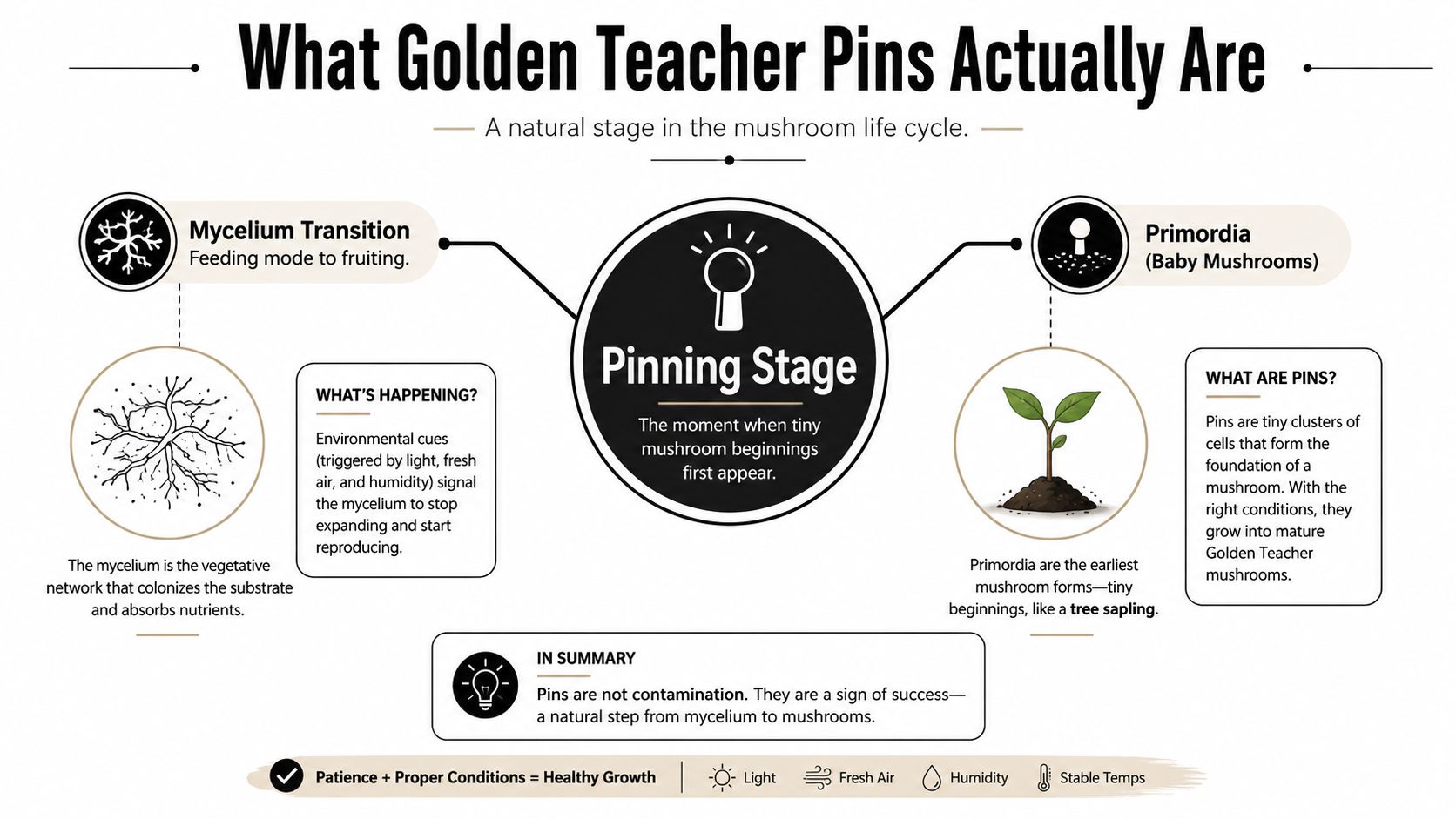
At the cellular level, pinning is the moment the fungus switches from vegetative growth to reproductive growth. The mycelium has already done the hidden work of colonizing the substrate. Now it starts forming primordia, which are the tiny bodies that become visible mushroom pins. A useful analogy is a tree sapling, not a full tree, the sapling has already committed to growing into a trunk and canopy, but it still looks compact and fragile.
How the transition happens
The shift usually begins at the substrate surface, where the mycelium senses the right combination of moisture, air movement, and light. In practical cultivation terms, high humidity is the main trigger, with guidance pointing to a relative humidity around 90% to 95%, and acceptable conditions up to 99% to help prevent pin abortion and support expansion. Humidity and pinning conditions
The pin itself starts as a tiny knot of tissue. It doesn't look like much at first, which is why beginners often miss it. A day later, the same point can lengthen into a recognizable mini-mushroom, still small, but clearly a fruit body rather than a patch of fuzz. That's where the term Golden Teacher pins becomes shorthand for a visible biological transition that growers can spot on sight.
A few conditions work together here:
- Humidity: the surface should stay moist without becoming soaked.
- Fresh air exchange: the developing pins need enough gas exchange to keep growing normally.
- Indirect light: not to “feed” the mushroom, but to help signal the day-night rhythm.
- Stable temperature: swings can slow or disrupt the fruiting signal.
Good pinning usually looks like a damp, balanced surface, not a wet one. Fine beads of moisture are a better sign than pooling water.
Once you see the pins, the rest of the cycle is faster than most new growers expect. That's why the stage draws so much attention in cultivation communities. It's the visible handshake between mycelium and mushroom.
Pins Versus Mature Golden Teacher Mushrooms
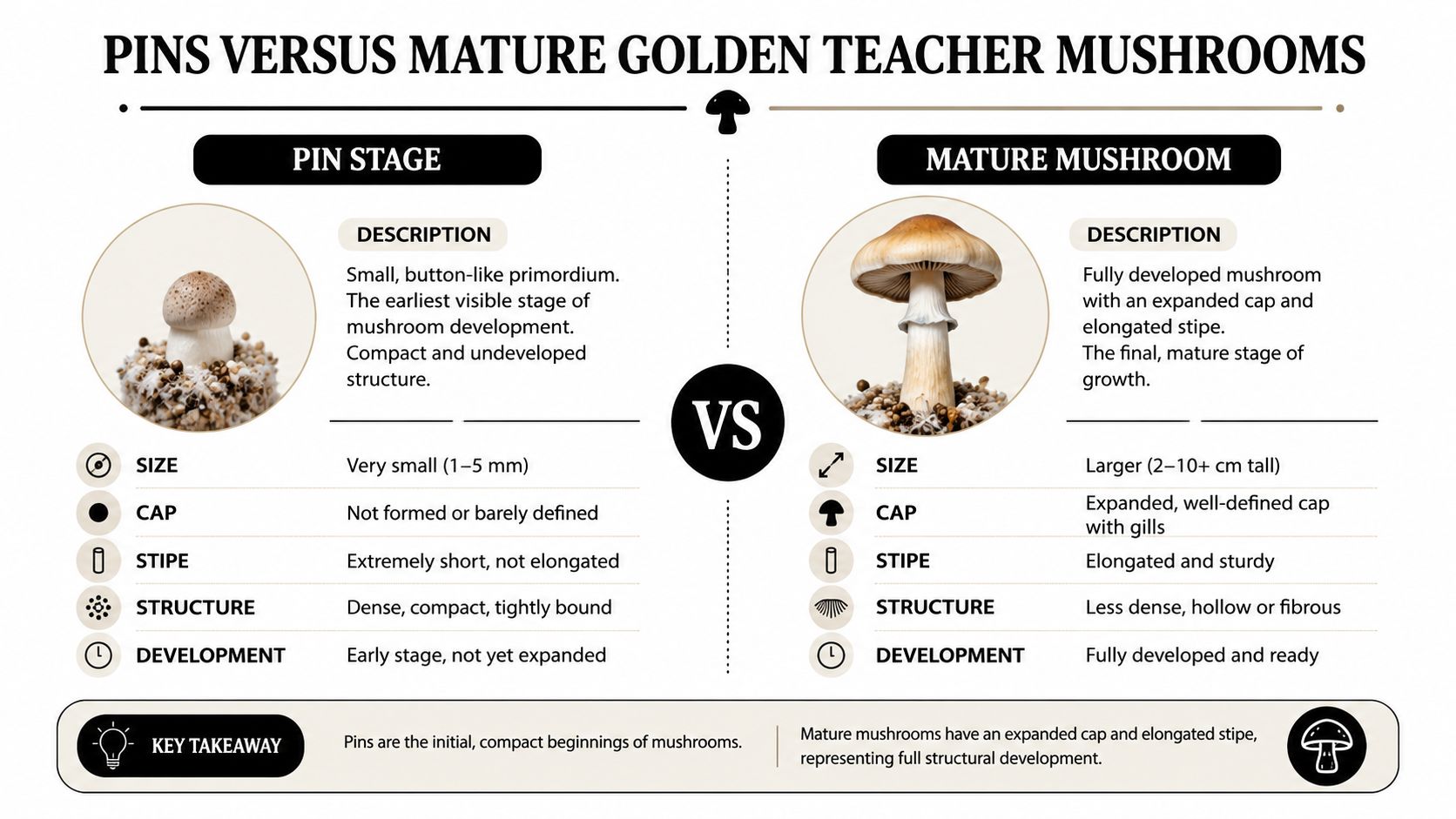
A pin and a mature mushroom are the same organism at different points in development, but they look and behave very differently. A pin is compact, undeveloped, and easy to overlook. A mature Golden Teacher has the familiar cap and stem structure commonly pictured when thinking about dried psilocybin mushrooms, with the cap opened enough to show the classic form of a full fruiting body.
Side by side, the difference is obvious
| Stage | What you see | Practical meaning |
|---|---|---|
| Pin stage | Tiny primordium, often button-like | Still fragile, still changing quickly |
| Mature mushroom | Expanded cap, elongated stem | Ready for harvest in cultivation, more familiar as a dried product |
That contrast matters because growers don't usually treat pins as the final product. They're a phase, not a retail format. Most consumer-facing dried mushrooms on the market come from mature flushes, because that's the point when the fruit body has developed enough to harvest, dry, and package consistently.
One cultivation source notes that Golden Teacher commonly produces 3 to 5 flushes from a single substrate, with later flushes usually smaller than earlier ones. Golden Teacher flush patterns and history That helps explain why growers watch the pin stage so closely. A strong first pin set can shape the whole grow, while a thin or stalled pin set may hint at environmental drift.
The visual difference also changes handling. Pins are delicate and easy to damage. Mature mushrooms are sturdier, but they're still sensitive to moisture, bruising, and rough drying. If you're a buyer looking at dried Golden Teacher products, you're usually seeing the end result of that whole progression, not the pin stage itself.
The video below gives another visual reference point for the development process.
Potency, Dosage, and What to Expect
A shopper standing in a Detroit-Ann Arbor dispensary and hearing the name Golden Teacher usually wants the same basic answer a grower does, how strong is it, and what does that mean in real use? Golden Teacher sits in the middle of the potency spectrum, which is part of why people talk about it so often. One source places its psilocybin level around 0.5% to 0.9% by dry weight, with some strain guides giving a narrower range around 0.6% to 0.7%. Potency and dosage overview
Why that middle range matters
Golden Teacher isn't a light option, and it also isn't the strongest shot on the shelf. The same source says total tryptamine content can reach about 0.8% to 0.9%, and that it sits below stronger cultivated strains such as Penis Envy, which is often described as two to three times more potent. Potency comparison with stronger strains
That middle position matters because it shapes expectations. Historical and cultivation sources describe Golden Teacher as strong enough to produce visible perceptual effects at 1.5 to 3 grams dried, but generally less extreme than high-potency varieties. Golden Teacher potency and typical dried range For a cautious adult consumer, that means the strain's reputation for balance is not just branding. It reflects a real place on the potency spectrum, much like a familiar house wine that still varies in effect from bottle to bottle.
If you are comparing products on a menu, the safer habit is to start low, weigh carefully, and avoid redosing in the same session. A product can feel familiar because of the name, yet the body responds to the actual amount taken, not the label. That is why precise measuring matters more than a strain's reputation.
For a dosage-focused walkthrough, Metro Mush's Golden Teacher dosage page gives a practical reference point for adults comparing dried mushrooms, chocolates, and drinkable formats.
A familiar strain name can make a product feel predictable. Your body does not care about the label, it responds to the actual amount you take.
Why Some Growers Stall and What That Teaches Buyers
A grower may have a jar or tub that looks ready, yet the first pins still refuse to show. That kind of stall usually says more about the grow room than about Golden Teacher itself. For buyers walking into a Detroit or Ann Arbor dispensary, the same lesson applies, a familiar name can suggest consistency, but the experience still depends on how the product was handled, dried, and stored before it reached the shelf.
The usual reasons pins don't appear
When a grow sits fully colonized with no pins, the most common causes are ordinary setup problems. Insufficient fresh air exchange, surface drying, overly wet substrate, and incomplete colonization can all slow fruiting. Those are basic environmental issues, not special Golden Teacher quirks, and they affect cubensis cultivation across the board.
A stalled tub often means the grower is chasing the wrong clue. If the surface is too dry, too wet, or starved for air, the mycelium can sit there without shifting into fruiting mode. Surface moisture that forms small beads and then slowly evaporates usually supports pinning better than heavy misting, and direct misting on pins is often discouraged because it can invite bacterial problems or slow development. Forum-driven troubleshooting discussion
If pins stall, check airflow and surface moisture first.
That matters for buyers because a stalled grow teaches a broader habit, look at handling conditions before you assume a product is unusually special or unusually weak. Pinning delay is a reminder that cultivated mushrooms respond to their environment, not just their name. Timelines also vary across grow guides, with some describing pins in about 4 to 7 days under ideal conditions and others describing a longer window, which shows how much room there is for normal variation. Golden Teacher pinning variability
For someone comparing dried products on a dispensary menu, the takeaway is practical. A branded label can still hide differences in dryness, storage, and age, just as a grow can stall even when the strain name sounds familiar. Freshness and storage conditions tell you more than folklore does. When product quality seems inconsistent, the safer response is to ask how it was dried, packaged, and kept, and to keep Metro Mush's harm reduction guide in mind as a basic reference for careful adult use.
Safe Handling, Storage, and Harm Reduction Basics
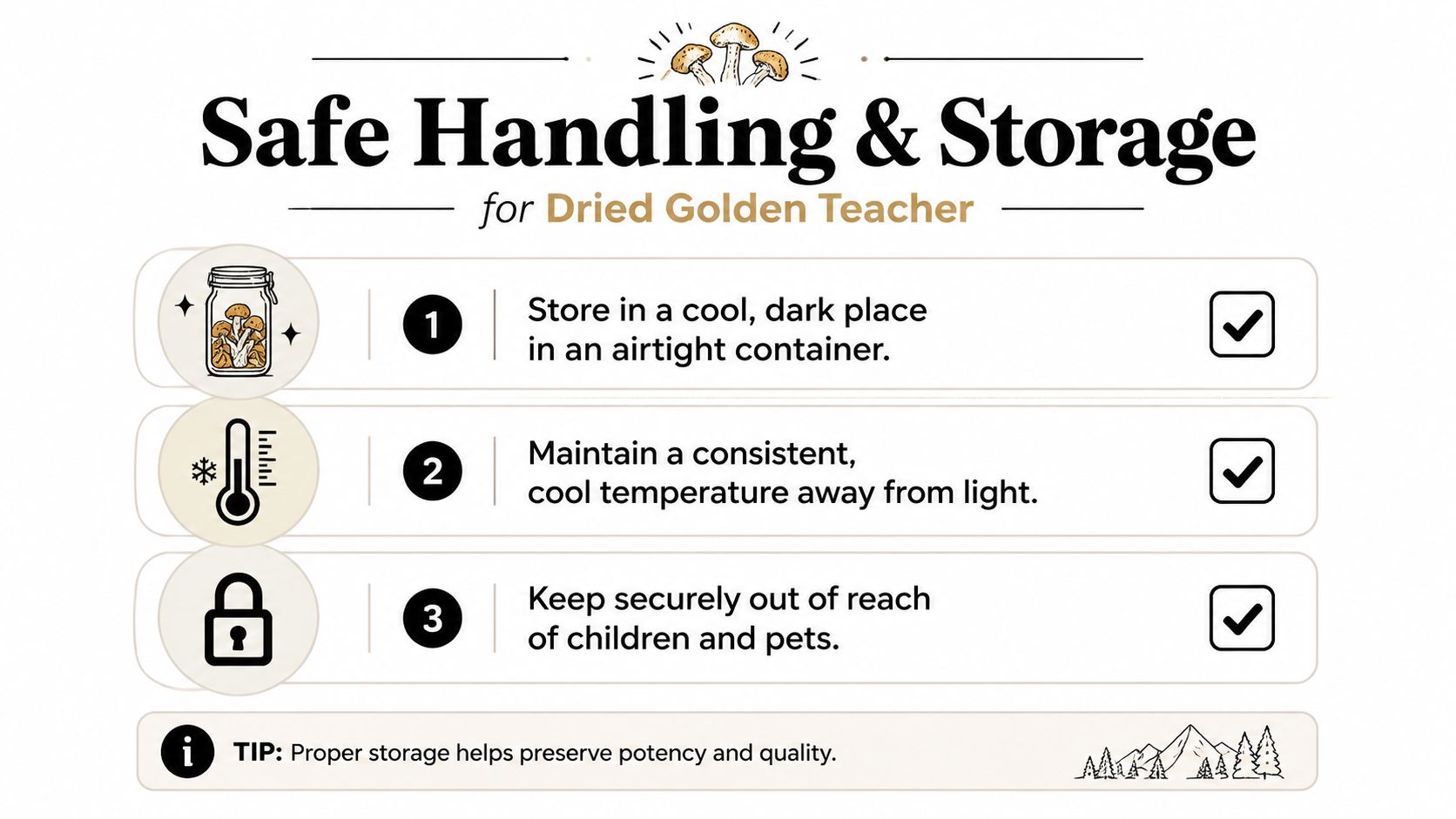
Once dried Golden Teacher mushrooms are in hand, the first job is storage, not celebration. Keep them in an airtight container, in a cool, dark place, and away from children and pets. Light, heat, and repeated exposure to air all work against stable storage, so the simplest setup is usually the best one.
A few habits make the difference
A reliable scale matters because eyeballing a dose is how people overshoot. So does knowing where the product came from. If a shop, delivery service, or friend can't tell you what you're holding, that uncertainty belongs in your decision, not in the back of your mind.
The basics are straightforward:
- Store securely: use an airtight jar or another sealed container.
- Keep conditions stable: avoid direct light and unnecessary temperature swings.
- Separate from household items: don't leave product near snacks, medicines, or anything a child could grab.
- Plan the setting: choose a calm place, clear your schedule, and think through who'll be around.
A sober sitter can make higher-dose experiences feel more contained, especially for first-time or cautious adults. It's also wise to avoid mixing psilocybin with alcohol or other substances, because combination use makes the experience less predictable. Set and setting still matter here, even when the product is familiar by name, because your mindset and environment shape how the session unfolds.
For a broader risk-aware framing, Metro Mush's harm reduction guide matches the kind of practical education cautious buyers usually need. It's the right mindset for someone who wants information before action, not hype after the fact.
Legal Context in Michigan and Where Metro Mush Fits
Michigan's legal picture is layered. Psilocybin remains illegal under federal law and Michigan state law, while Ann Arbor and Detroit have moved toward decriminalization, which lowers enforcement priority for personal use and possession without authorizing commercial sale. That distinction matters, because decriminalization changes risk, but it doesn't turn psilocybin into an ordinary retail category.
What decriminalization does and doesn't change
For an adult consumer, the practical effect is narrower than many people assume. Local decriminalization can reduce the likelihood that personal possession becomes the focus of police attention, but it does not create a licensed storefront model for psilocybin the way a regulated cannabis market works. So anyone shopping in Southeast Michigan still needs to understand the difference between local policy and legal sale.
That's where Metro Mush fits into the discussion as a Detroit–Ann Arbor delivery service and dispensary-style menu for adult consumers. It lists dried strains such as Penis Envy and Enigma, and also carries edibles and drinks like OuterSpore Milk Chocolate Bars, Mush Love Chocolate Bars, Rocket Fuel shroom drinks, and Moon Bars. One product line on the site also includes Golden Teacher Special Magic Mushrooms, which makes the strain relevant to this topic as a familiar consumer label, not just a grow-room term.
The useful part for buyers is clarity. Metro Mush describes menu browsing, store locations, and text ordering as part of the service model, which helps adults compare formats before they decide what fits their comfort level. In a market where strain names, pinning stages, and dried products can get conflated fast, that kind of structure can reduce confusion.
Sourcing Dried Golden Teacher Products From Metro Mush
If you're in the Detroit-Ann Arbor area and trying to make a careful choice, start with the menu, then work backward from the product format. Metro Mush lets adults browse online, check locations, and order by text through the Detroit Metro line at 734-691-6122 or the Ann Arbor Metro line at 734-280-2868. The service has a $75 minimum order, and it also runs Mix & Match Saturdays, where any three chocolate bars or drinks cost $100. Fire, police, and veterans get 10% off, and Discord members can get a 20% discount.
A practical buyer checklist
- Check the format first: dried mushrooms, chocolates, and drinks serve different preferences.
- Confirm the line you want to use: Detroit Metro or Ann Arbor Metro.
- Know the minimum: the $75 order floor matters if you're placing a small first order.
- Look at the specials: Mix & Match can be useful if you're comparing bars or drinks rather than a single dried item.
Golden Teacher pins matter because they show how a mushroom becomes a product, not just a name. For a buyer, that same logic helps separate strain familiarity, dose awareness, and the practical realities of storage and use.
If you want a clear, adult-focused way to shop for Golden Teacher and other mushroom products in Southeast Michigan, visit Metro Mush, review the menu, and compare the dried options, chocolates, and drinks with a harm-reduction mindset. The right purchase starts with understanding what the name means, what the dose means, and what kind of experience you want.