
Eighty-one percent of psychiatrists in a 2023 survey said psychedelics show meaningful therapeutic potential for mental health conditions. Public opinion has shifted too, with broad support for easier research access and regulated medical use. For a topic that was pushed to the margins for decades, that change is striking.
Interest, however, can outrun understanding.
Psychedelic therapy research studies a very specific intervention. It is not the same as recreational use, spiritual ceremony, or the flood of wellness claims now circulating online. In clinical research, the drug is only one part of the package. Screening, preparation, monitored dosing, and follow-up therapy shape the experience much like a surgical tool depends on the training, setting, and protocol around it.
That distinction matters for anyone trying to make sense of the headlines. A study result does not automatically tell you what will happen at a retreat, at home, or in an underground session. The compounds may be similar, but the context can change the outcome, the risks, and even what researchers mean when they say a treatment "worked."
If you want a consumer-friendly primer on the treatment model itself, this overview of what psychedelic therapy is is a useful starting point.
The goal here is to close the gap between academic papers and real-world curiosity. That means looking at what the research says, how strong the evidence is, and what it does and does not mean for someone considering psychedelics outside a clinical setting. Enthusiasm has a place. So do caution, context, and harm reduction.
The New Dawn of Psychedelic Science
What psychedelic-assisted therapy actually is
Psychedelic-assisted therapy is a treatment model, not just a drug experience. A person is screened first. Clinicians look for medical or psychiatric concerns that could make treatment risky. Then comes preparation, the dosing session itself, and later integration, which means working through what happened and translating it into daily life.
That's why it helps to separate the phrase into two parts. The psychedelic may open a temporary window of unusual perception, emotion, and mental flexibility. The therapy gives that window direction. Without the therapeutic frame, you don't have the same intervention being studied in clinics.
If you want a simple primer on the treatment model, this overview of what psychedelic therapy is gives a useful consumer-level starting point.
Why this research disappeared and returned
Researchers explored psychedelics seriously in the mid-20th century, then much of that work stalled during the prohibition era. For a long time, the topic became politically radioactive. That history matters because it explains why the current wave of studies feels both new and delayed. Scientists aren't chasing a novelty trend. In many ways, they're resuming questions that were left hanging.
What's different now is the quality of modern research. Today's studies use contemporary clinical trial methods, clearer diagnostic criteria, and more structured safety protocols. Institutions and medical journals are treating the subject as a legitimate area of psychiatric investigation.
Psychedelic therapy research earns credibility the same way any serious medical field does. Through controlled trials, careful follow-up, and repeated attempts to separate signal from hype.
What makes today's moment different
The current “renaissance” isn't just about interest. It's about convergence. Researchers are studying compounds like psilocybin and MDMA in ways that connect brain science, psychotherapy, and measurable clinical outcomes.
For the curious consumer, that creates a tricky situation. Headlines often jump straight to “breakthrough” language, while skeptics dismiss the entire field because of its cultural baggage. The evidence sits in the middle. Some findings are strong and clinically meaningful. Other questions are still open, especially around long-term mechanisms, who benefits most, and what safe access should look like.
A grounded way to read the field is this:
- Treat the setting as part of the intervention. Research studies don't test a pill in isolation.
- Separate compounds from each other. Psilocybin and MDMA aren't interchangeable.
- Look for controlled trial data. Personal stories can inspire questions, but they can't answer them.
- Expect uncertainty. A promising result isn't the same as a settled medical standard.
That mindset will save you from two common mistakes. The first is dismissing psychedelic therapy research because it sounds unusual. The second is believing it's a shortcut to healing.
How Psychedelics May Rewire the Brain
The ski hill analogy
A lot of people get stuck on the neuroscience because the terms sound abstract. Here's the plain-language version.
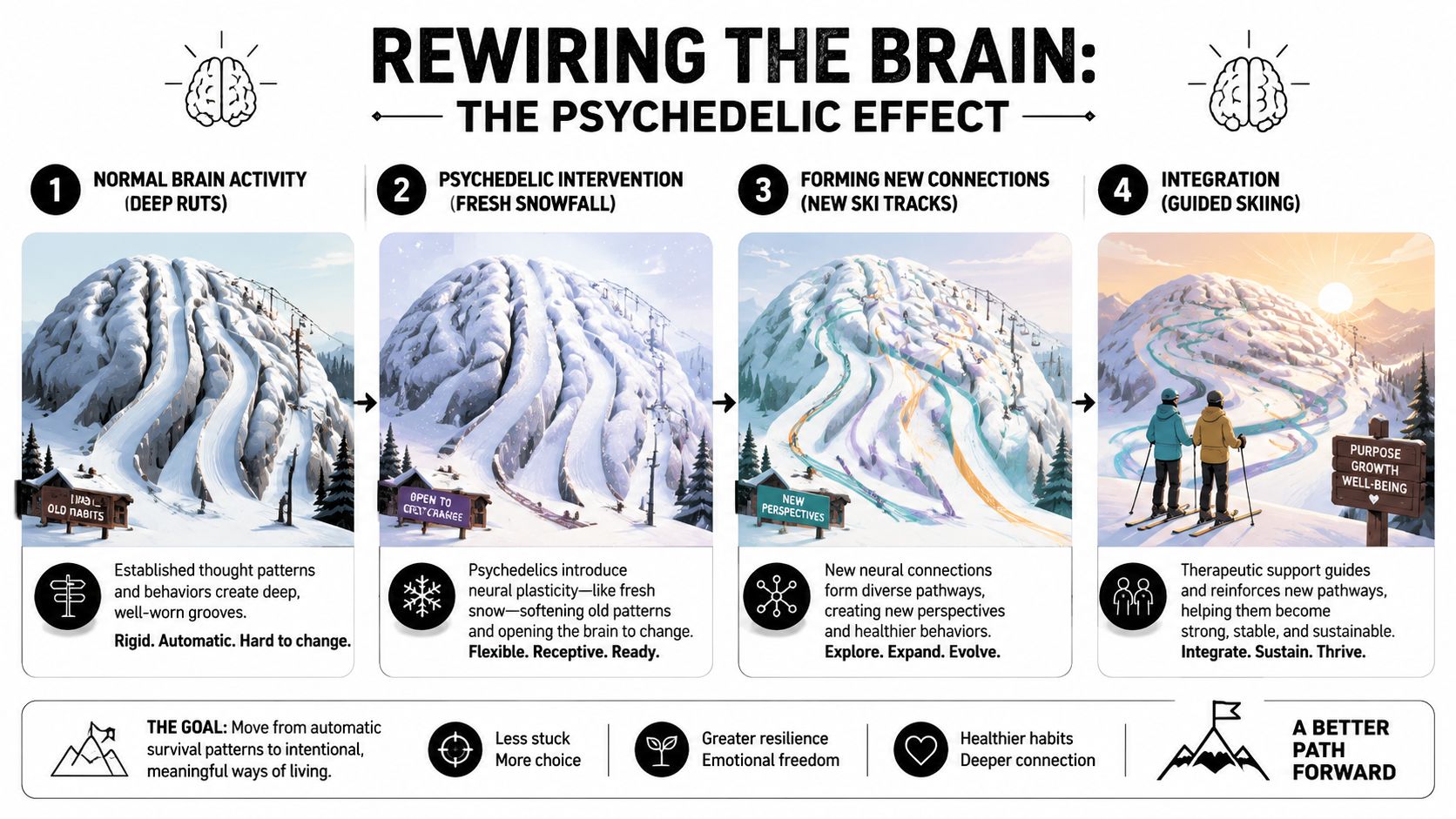
Think of the brain as a ski hill after a busy season. The more often skiers take the same route, the deeper those tracks become. Your mind can work in a similar way. Repeated habits of thought, especially rumination, fear, or self-criticism, can become the default route because it's familiar, not because it's helpful.
Psychedelics may temporarily act like a fresh snowfall over those old grooves. The old tracks don't vanish forever, but for a while the hill becomes more open. New routes become easier to try. In brain science, that flexibility is often discussed as neuroplasticity.
What's happening biologically
For psilocybin in depression trials, the effective dose is typically 25mg, and it acts as a partial agonist on the 5-HT2A receptor, inducing a state of neuroplasticity that may disrupt rigid negative thought patterns associated with Default Mode Network hyperactivity. MDMA doses of 127.5mg, often with a 64mg booster, act as a serotonin and norepinephrine releaser, enhancing empathy and reducing anxiety to facilitate therapy, according to this review in Neuropsychopharmacology.
That's a lot of jargon, so let's translate it.
The Default Mode Network, often shortened to DMN, is a set of brain regions active during inward-focused thinking. It's not bad. You need it for reflection, memory, and a sense of self. But when that inward focus turns rigid, people can get trapped in loops of worry, shame, or depressive rumination.
Psychedelics appear to loosen that rigidity. MDMA does it differently than psilocybin, but both may create a temporary state where entrenched patterns are easier to revisit, soften, and reshape.
For a deeper consumer-friendly explainer, this guide on psilocybin effects on the brain is helpful background reading.
Why therapy still matters
Fresh snow alone doesn't teach anyone how to ski better. That's where integration comes in.
A powerful experience can reveal something important, but insight isn't the same as change. If a person recognizes, for example, that they've been relating to trauma with constant avoidance, they still need help turning that realization into new behavior, new coping, and often a new story about themselves.
Practical rule: The drug may open the door. The therapeutic work determines whether anything lasting walks through it.
This is also why research findings shouldn't be casually copied into unsupervised use. Clinical studies are designed to support the vulnerable period during and after dosing. Outside that container, the same temporary flexibility can feel confusing, destabilizing, or wasted.
Major Breakthroughs in Clinical Trials
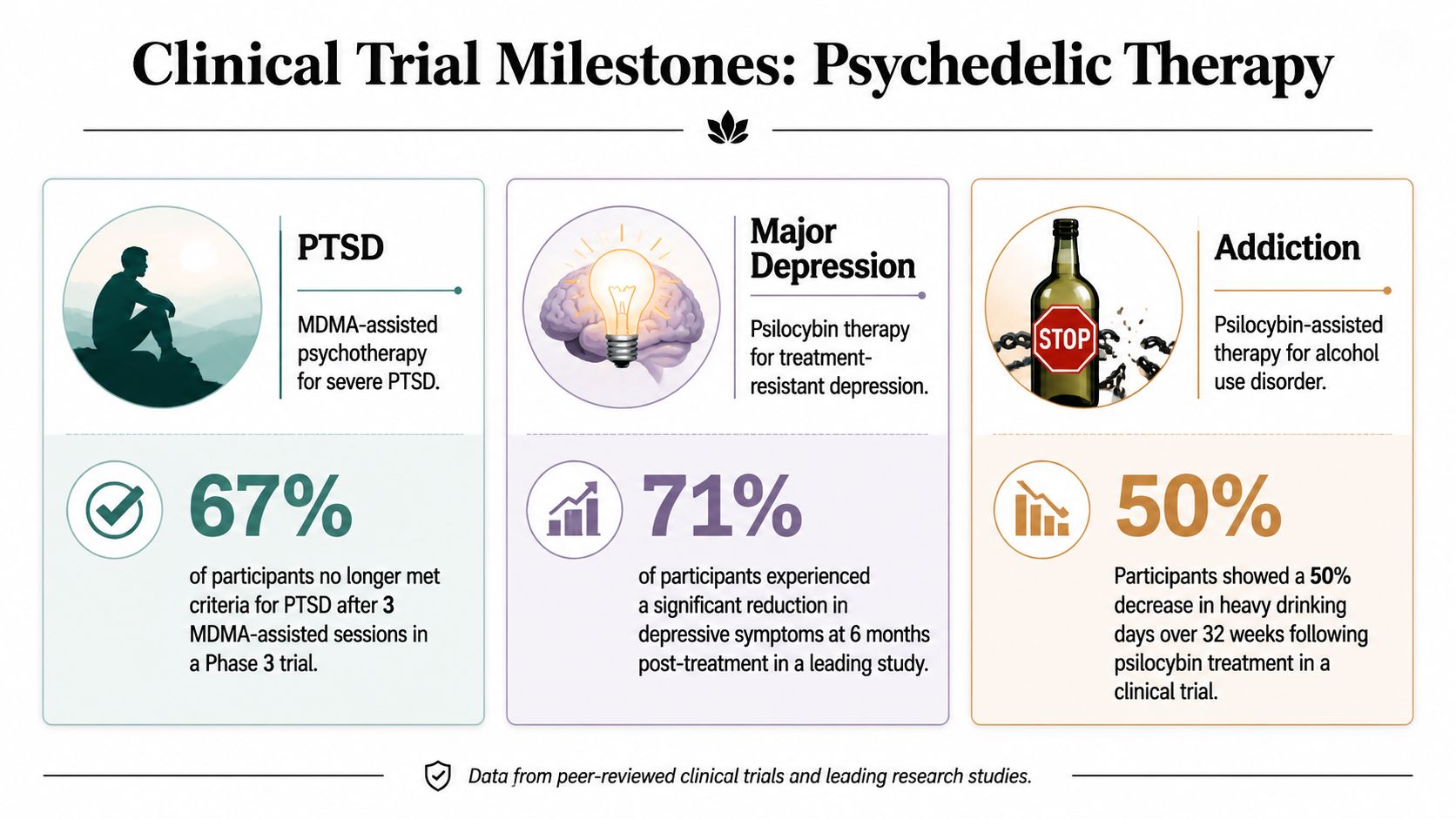
The strongest reason psychedelic therapy research gets so much attention is simple. Some trials have produced outcomes that are hard for psychiatry to ignore.
That doesn't mean every study is definitive, and it doesn't mean every condition has equally strong evidence. It does mean there are specific areas where the signal looks meaningful.
PTSD and MDMA
For people with moderate-to-severe PTSD, the core problem isn't just bad memories. It's that the nervous system often treats those memories like live danger. Therapy can help, but many patients struggle to stay engaged without becoming overwhelmed.
In a landmark Phase 3 randomized, placebo-controlled trial, MDMA-assisted therapy produced a CAPS-5 mean reduction of 22.03 points with a 95% confidence interval of -38.53 to -5.52, and at 18 weeks post-baseline the response rate was 86.5% versus 69.0% for placebo, while remission was 46.2% versus 21.4%, with p < .00001, according to the trial summary available through PubMed Central.
For a new reader, “response” and “remission” can sound similar. They aren't. Response usually means symptoms improved in a clinically meaningful way. Remission means symptoms fell much further, to the point that the disorder may no longer meet diagnostic thresholds. Both matter, but remission is the more demanding outcome.
Depression and psilocybin
Major depression often traps people in repetitive, negative thought loops. That's one reason the brain-flexibility model has attracted so much interest.
In psilocybin depression trials, 57% of recipients responded to treatment compared with 22% in controls, and the standardized mean difference in depression outcomes was -0.78 with a 95% confidence interval of -1.06 to -0.51, a result described in the same review as a large effect size.
A large effect size doesn't mean “miracle cure.” It means the difference between groups was substantial enough that clinicians take it seriously. In real life, that translates to this: enough people improved, and improved enough, that the signal is difficult to dismiss as a small placebo fluctuation.
A short overview can help make those findings feel less abstract:
What about addiction
Addiction is one of the most talked-about frontiers in psychedelic therapy research, but it's also where consumers need extra discipline in reading headlines.
Researchers are interested because these treatments may loosen rigid behavior patterns and create conditions for profound reappraisal. That's especially relevant in addiction, where people often describe feeling trapped in repetitive cycles even when they want to stop.
But here's the important boundary. The verified data provided for this article doesn't include trial numbers for addiction outcomes, so the responsible thing to say is qualitative: the area is promising, but it isn't the place to lean on oversimplified miracle stories. If you see dramatic claims online, treat them cautiously unless they point to specific controlled data.
How to interpret these milestones
A smart way to read trial results is to ask four questions:
| Question | Why it matters |
|---|---|
| Who was studied | Trial participants are screened. That may exclude some people who are common in real-world settings. |
| What support was included | Preparation and integration are often part of the treatment effect. |
| What outcome was measured | Response, remission, symptom reduction, and durability are related but not identical. |
| How long did benefits last | Short-term improvement is encouraging, but durability matters for real care. |
That last question leads to one of the biggest unresolved issues in the field.
Beyond the Big Three Other Promising Research
The question of durability
One of the biggest criticisms of mental health treatments is that many work only while you're actively taking them, or only for a short period after a major intervention. Psychedelic therapy research has drawn interest partly because some benefits may last longer than people expected.
A 2025 follow-up study from Johns Hopkins Medicine found that substantial antidepressant effects from a single psilocybin-assisted therapy session may persist for at least one year in some patients, according to the NCBI Bookshelf review. That's encouraging, but the same source also stresses a major research gap. Scientists still don't fully understand which biological and psychological mechanisms sustain those effects.
That uncertainty matters. If researchers can't tell what preserves benefit, clinicians can't confidently say who needs additional support, who may relapse, or how to optimize treatment over time.
End-of-life distress and meaning-making
Another important area involves people facing serious illness and existential distress. This line of work gets less mainstream attention than PTSD or depression, but it fits the same broad logic discussed earlier. A psychedelic experience may temporarily loosen rigid fear patterns and allow a different relationship to suffering, mortality, or identity.
For some patients, the key therapeutic outcome may not look like “happiness” in the everyday sense. It may look more like acceptance, reduced dread, or a felt sense that life still contains meaning even under difficult conditions.
Some of the most important outcomes in mental health aren't about eliminating emotion. They're about changing a person's relationship to the emotion.
Microdosing versus full-dose therapy
Consumers often get tripped up, as microdosing has become a popular cultural idea, especially for mood, focus, and creativity. But the strongest evidence base in psychedelic therapy research still centers on full-dose, guided therapeutic models, not low-dose self-experimentation.
That doesn't mean microdosing is meaningless. It means anecdote has outrun evidence. People report all kinds of benefits, but controlled research hasn't produced the same level of clarity seen in larger-dose therapy studies.
A practical distinction helps:
- Macrodose therapy research asks whether a profound, time-limited experience plus psychotherapy can create meaningful change.
- Microdosing culture often asks whether repeated sub-perceptual use can subtly improve daily functioning.
Those are different questions. They shouldn't be blended into one fuzzy promise.
Reading Between the Headlines A Reality Check
The FDA decision that changed the tone
If you only followed social media, you might think psychedelic medicine is marching in a straight line toward inevitable approval. It isn't.
In August 2024, the FDA declined to approve MDMA-assisted therapy for PTSD and required another Phase 3 trial, despite the strong efficacy data from the first trial, according to the Cleveland Clinic Journal of Medicine review. That moment mattered because it showed the field had reached a threshold where promising outcomes were no longer enough by themselves. Regulators also wanted unresolved concerns addressed.
For consumers, that's a healthy corrective. A treatment can be promising and still not be ready for broad approval. Those aren't contradictory statements.
Why clinical use and casual use are not the same thing
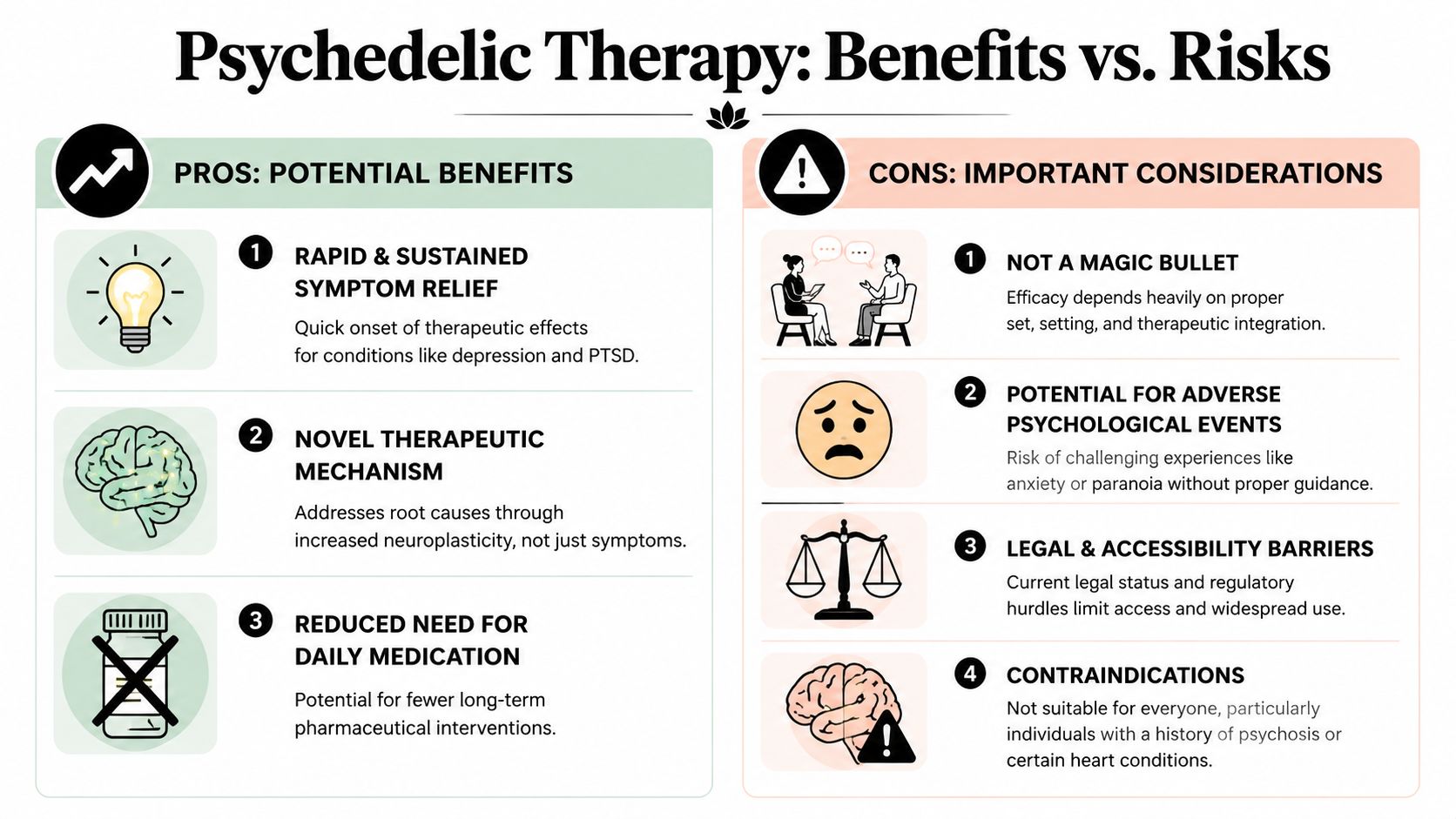
Research settings reduce risk in ways that are easy to underestimate if you've only seen inspirational testimonials online.
Here are some of the biggest differences:
- Screening changes the risk profile. Trials exclude some people because a history of psychosis, certain cardiovascular issues, or other vulnerabilities may raise the chance of harm.
- Dose is controlled. Researchers know what compound is being used and how much is given.
- Support is built in. Participants aren't left alone to interpret an intense emotional experience.
- Integration is part of the process. The days after the session matter, often as much as the session itself.
Outside a trial, people often lose most of those protections at once.
What harm reduction actually means
Harm reduction isn't anti-psychedelic. It's what responsible enthusiasm looks like.
It means respecting the possibility of challenging psychological experiences, including intense anxiety, confusion, or paranoia. It means understanding that “natural” doesn't equal safe for every person in every context. It means recognizing that some people are looking for healing but are in a fragile period where destabilization would carry real costs.
The verified research also notes that severe anxiety or derealization occur in approximately 4% of users when plasma concentrations cross problematic thresholds, while serious adverse events are rare in controlled clinical trials when preparation and integration are used. The takeaway isn't fear. It's context.
Reality check: The same experience that feels transformative in a well-supported setting can feel chaotic in an unsupported one.
Questions to ask before believing a headline
When you read a viral post or glowing article, pause and ask:
- Was this a controlled clinical trial or a personal story?
- Was the treatment paired with psychotherapy?
- Was the person screened for contraindications?
- Does the claim describe symptom improvement, remission, or just a dramatic subjective experience?
- Is anyone pretending the hard work of recovery can be replaced by one session?
That last one matters most. Psychedelics may help some people access emotion, memory, or perspective in a way that ordinary talk therapy doesn't. But they don't remove the need for support, behavior change, or sometimes ongoing care.
The Regulatory Landscape and Access Pathways
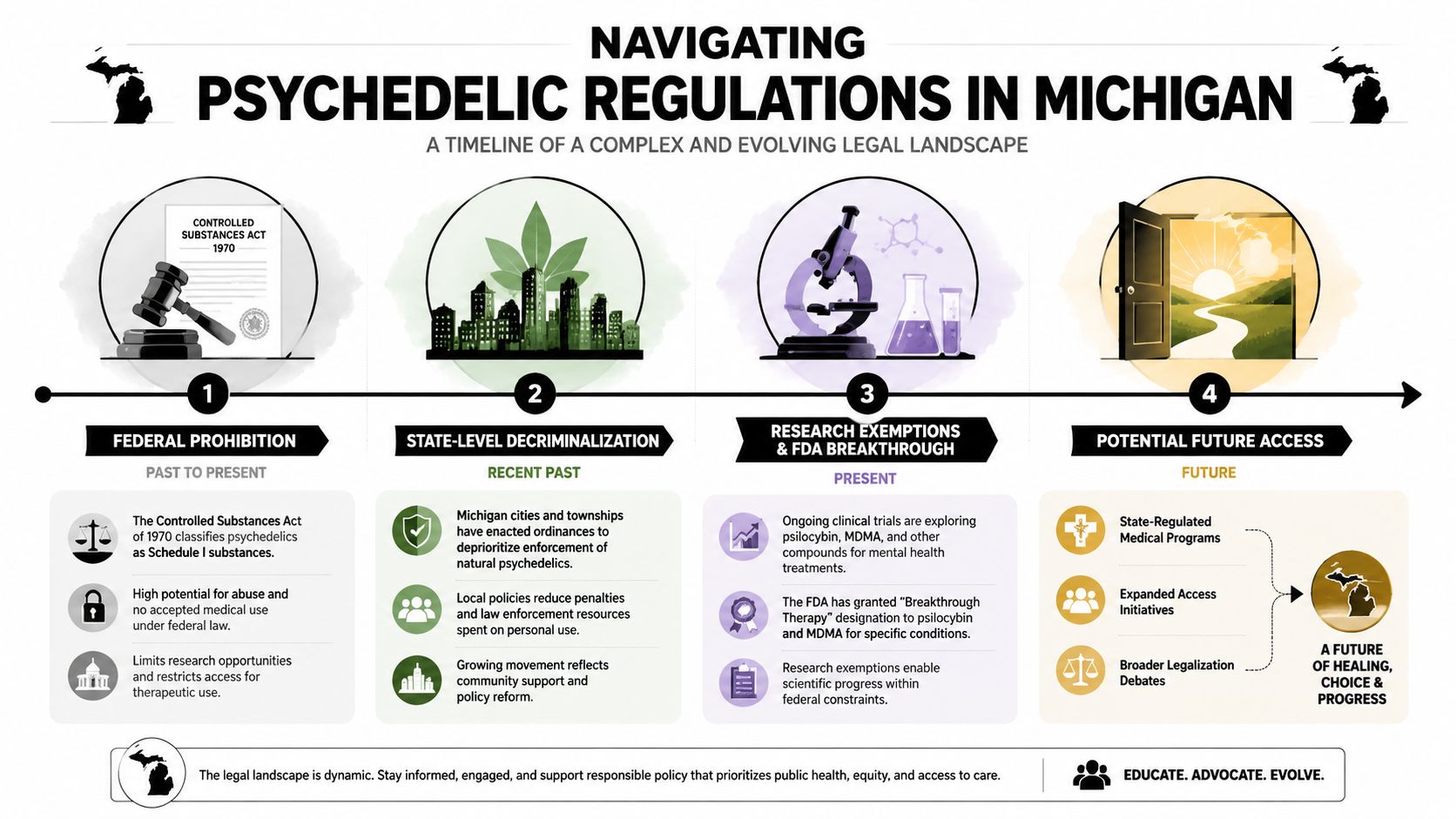
Public opinion has shifted faster than the rules. As noted earlier, major surveys show strong support for research and growing support for regulated therapeutic access. Interest from clinicians has grown too. That matters, but it does not create legal access on its own.
A better way to understand access is to picture three different doors. One leads to future FDA-approved care, one leads to clinical trials, and one leads to state or local systems that sit outside standard medical approval. Those doors may all involve the same broad category of substances, but the protections, costs, and risks are very different.
A practical framework for understanding access
| Pathway | What it means | What to keep in mind |
|---|---|---|
| Future FDA-approved care | A treatment reviewed for a specific condition, dose, and protocol | This would offer the clearest medical standard, but approval depends on more evidence, safety review, and regulator decisions |
| Clinical trials | Research participation under strict rules, screening, and follow-up | This is still the closest match to the model behind the strongest published evidence |
| Decriminalized or informal markets | Access shaped by local policy, underground networks, or retreat-style services | Lower risk of arrest in some places does not equal quality control, medical screening, or proven treatment standards |
For someone trying to make sense of the rules, the biggest source of confusion is that law operates in layers. Federal law, state law, city policy, professional licensing rules, and research exemptions can point in different directions at the same time. Michigan readers run into this often. A city may reduce enforcement, while state and federal law remain unchanged.
That is why a headline like “psychedelics are legal here” usually hides more than it explains.
If you want a concrete example of how a regulated service model differs from both medical approval and informal use, this guide to Oregon psychedelic therapy services is a useful comparison.
How to separate legitimate access from marketing noise
The safest pathways tend to share a few features.
- Screening comes first. A credible provider asks about medications, psychiatric history, heart health, and current stability before talking about benefits.
- Support is built into the process. Preparation and integration are part of the model, not optional extras added after payment.
- Claims stay narrow. Serious programs describe what they offer, for whom, and what is still uncertain.
- The legal status is stated clearly. If a facilitator is vague about whether a service is medical care, a state-licensed program, a retreat, or an underground session, that ambiguity is a warning sign.
For consumers, the key question is not just, “Can I get access?” It is, “What kind of system am I entering?” The difference is similar to buying a drug from a pharmacy, joining a research study, or ordering a mystery powder online. The category may sound similar. The level of oversight is not.
That distinction protects people from a common mistake. Curiosity about psychedelic therapy can easily slide into assuming any guided experience is close to what happens in a clinical study. In practice, the gap can be wide. Understanding that gap is one of the best harm-reduction tools you have.
The Future of Mental Healthcare and Your Role
Psychedelic therapy research has reached a point where no honest observer can dismiss it as a fringe curiosity. The clinical results in PTSD and depression have been strong enough to force a serious conversation, and the public mood has shifted with them. At the same time, the field has not earned a free pass from scrutiny. Regulatory setbacks, unanswered mechanism questions, and real safety concerns all still matter.
That tension is healthy. It's how medicine is supposed to work.
For consumers, the most useful stance is interested but disciplined. Learn the difference between a clinical model and a casual use scenario. Treat bold claims with skepticism, especially when they skip over screening, support, or integration. Remember that “promising” and “proven” are not synonyms.
A good next step is to keep building a short, reliable reading stack. Look for university research centers, peer-reviewed reviews, and clinician-led educational material. If you're considering psychedelics in any form, be especially cautious if you have a personal or family history of psychosis, serious cardiovascular concerns, or you're in an unstable mental health period.
The future of mental healthcare may include psychedelic-assisted treatments as a meaningful option for some people. Your role isn't to become a cheerleader or a cynic. It's to become the kind of informed adult who can tell the difference between evidence, possibility, and marketing.
If you're in Southeast Michigan and want to explore psilocybin products with a more informed, harm-reduction mindset, Metro Mush offers adult consumers in the Detroit and Ann Arbor areas a local way to browse curated mushroom strains, chocolates, and drinks while continuing to educate themselves about responsible use.