

A friend in Ann Arbor once asked me why one mushroom strain gets talked about like folklore while another gets discussed like a lab specimen. Thai Pink Buffalo is where those two worlds meet. It carries a memorable story, but what matters most for a real user is how to recognize it, how to approach it carefully, and what kind of experience it may offer.
Your Guide to the Thai Pink Buffalo Experience
Thai Pink Buffalo has one of those names that makes people stop and ask questions. That's part of its appeal. It sounds unusual, looks distinctive, and has become well known among people interested in Psilocybe cubensis varieties.
For a Michigan reader, especially someone trying to sort signal from hype, the useful question isn't whether the name is legendary. It's whether the strain makes sense for your goals. Some people want a gentle first exploration. Others want vivid visuals, emotional openness, or a more reflective headspace. Thai Pink Buffalo usually enters the conversation because people expect a balanced cubensis experience rather than something known mainly for intensity or novelty.
Why people get curious about it
The strain has a reputation for being memorable without being mysterious in the wrong way. In plain terms, that means people are drawn to it for a mix of reasons:
- The name stands out because it carries a Thai backstory and a strong visual identity.
- The morphology is recognizable to many experienced users who look for thick stems and darker caps.
- The experience profile is often described as rounded. Not just visual, not just cerebral, not just physical.
That combination makes it a strain people often ask about when they want something with personality, but not something selected purely for shock value.
Practical rule: If you're choosing between strains, start with the style of experience you want, not the coolest name on the menu.
The Legend of the Pink Buffalo Strain
The common story goes something like this. A Thai mushroom variety was found near a rare pink buffalo, and the unusual animal gave the strain its name. That story stuck because it's vivid, easy to remember, and tied to a real visual image rather than a sterile code name.

Where the folklore comes from
Thai Pink Buffalo is described as a Thai-origin strain of Psilocybe cubensis. One commonly repeated account ties the original collection to Thailand's Koh Samui region and attributes it to ethnomycologist John Allen. Another part of the folklore says the name comes from a rare Thai buffalo color variant. One source notes that about 1 in 10 Bubalis Bubalis buffalo are pink, linking the branding story to an actual biological rarity in Thailand, as described in this Thai Pink Buffalo background article.
That's the part many readers find confusing. The story may be rooted in real places and real animals, but that doesn't mean every detail has been scientifically documented to modern taxonomic standards.
What's solid and what isn't
In mycology, named cubensis strains often travel through cultivation circles long before they're discussed with formal scientific rigor. Thai Pink Buffalo fits that pattern. It's best understood as a named cubensis lineage associated with Thailand, not as some separate species with a tidy research history.
That distinction matters because people often mistake strain names for strict scientific categories. They aren't always that. A strain name can reflect origin lore, grower selection, visual traits, or community tradition.
Here's the grounded version:
- It belongs within Psilocybe cubensis as a recognized cultivated lineage.
- It has a Thai origin story that appears repeatedly in supplier and community descriptions.
- Its fame comes from dissemination, meaning a wild Southeast Asian collection became known outside Thailand through growers and microscopy sellers.
The myth gives the strain personality. The species identity tells you how to think about it responsibly.
Why the story still matters
Even if you strip away the romance, the name still tells you something useful. It points to a broader chapter in mushroom history where wild regional cubensis finds moved into international circulation and became named varieties with recognizable traits.
So when someone says Thai Pink Buffalo, they're usually referring to more than a random marketing label. They're referring to a specific cubensis lineage shaped by folklore, grower interest, and repeated recognition over time.
How to Identify Thai Pink Buffalo
If the legend pulls people in, the physical traits are what keep the conversation practical. You can't identify a mushroom by name with total certainty from looks alone, especially once products are dried, handled, or broken up. Still, Thai Pink Buffalo is commonly described with a few recurring features that help users know what they're likely looking at.
Visual traits people notice first
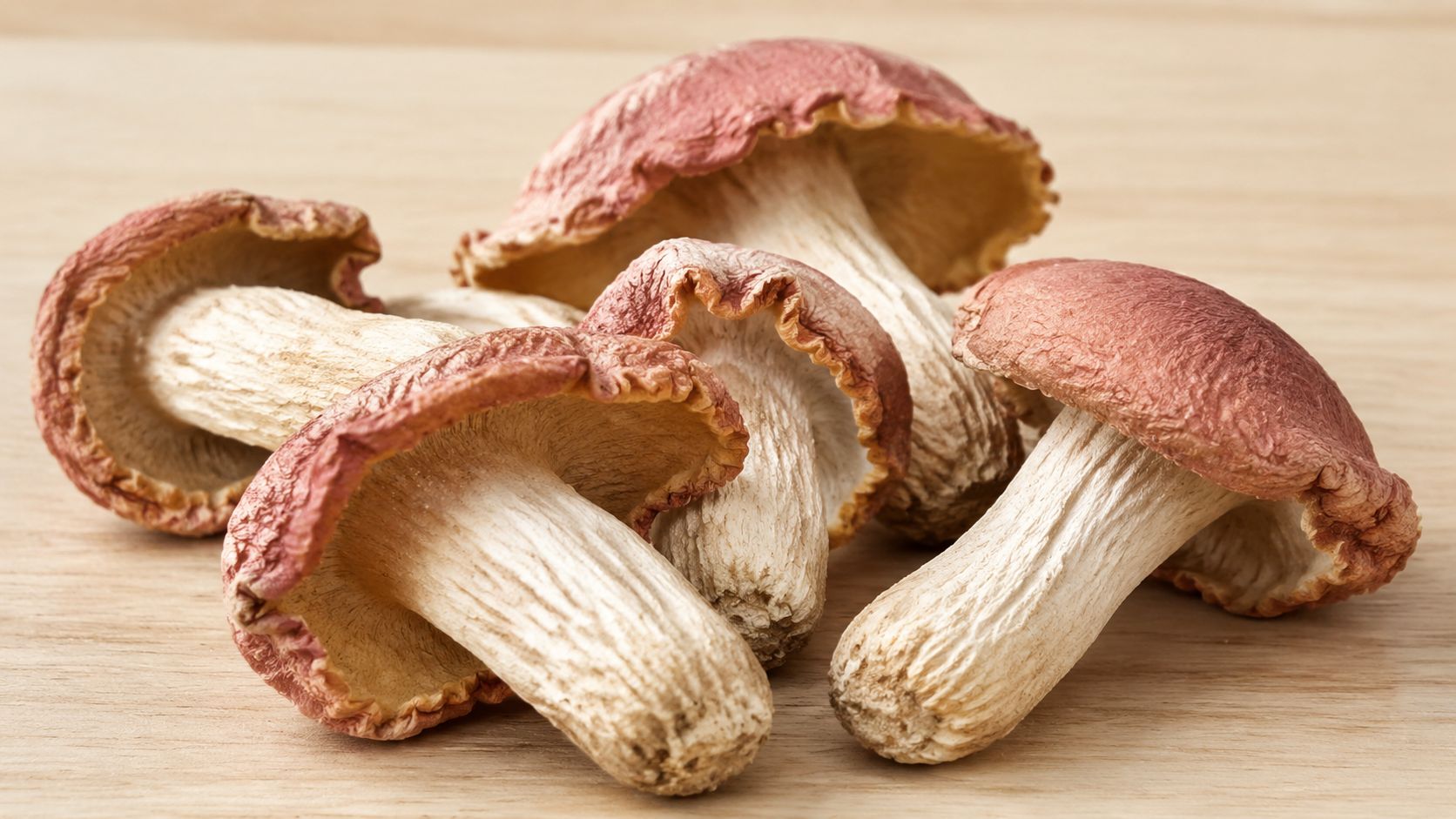
The easiest starting point is the cap. Thai Pink Buffalo is described as having large reddish-brown caps, often paired with sturdy stems. The stems are also noted for blue bruising, which is the visible reaction associated with oxidative conversion of psilocybin-related compounds in cubensis mushrooms, as described by this Pink Buffalo liquid culture listing.
For a user looking at dried material, those features often show up as:
- Cap color that leans tan to reddish-brown rather than very pale beige
- Stem structure that looks thick and fibrous instead of thin and delicate
- Blue bruising on damaged areas, cut points, or compressed tissue
Blue bruising causes a lot of confusion. It doesn't act like a precise potency meter. It indicates that the tissue has undergone the kind of chemical oxidation commonly associated with active cubensis material.
What to check without overthinking it
When people get nervous about authenticity, they often focus too much on one trait. A better approach is to look at the whole picture.
A practical checklist helps:
Check overall build
Thai Pink Buffalo is often described as sturdy. If the fruiting body looks unusually flimsy, that doesn't match the common description.Look at cap tone
Reddish-brown is the recurring cue. Dried mushrooms can vary, but a warmer brown cap is more in line with the strain description than a chalky pale top.Notice bruised areas
Blue marks from handling or pressure are common in active cubensis mushrooms. They support the ID picture, though they don't confirm a specific named strain by themselves.
If a seller claims exact strain identity from appearance alone, be cautious. Visual cues help, but named-line certainty usually depends on provenance, not just looks.
The microscopy side
For readers who like a little more precision, microscopy references for Pink Buffalo describe deep purple-brown, ellipsoid, smooth spores measuring about 12 to 13 µm by 8 µm, which is useful because that falls within the classic cubensis spore profile used in microscopy work, according to this Pink Buffalo spore morphology guide.
That detail is more relevant to microscopy than casual use, but it helps explain why this lineage is consistently treated as a cubensis type. In other words, the practical user sees caps, stems, and bruising. The microscopy-minded observer sees a familiar cubensis profile.
Potency and Typical Effects
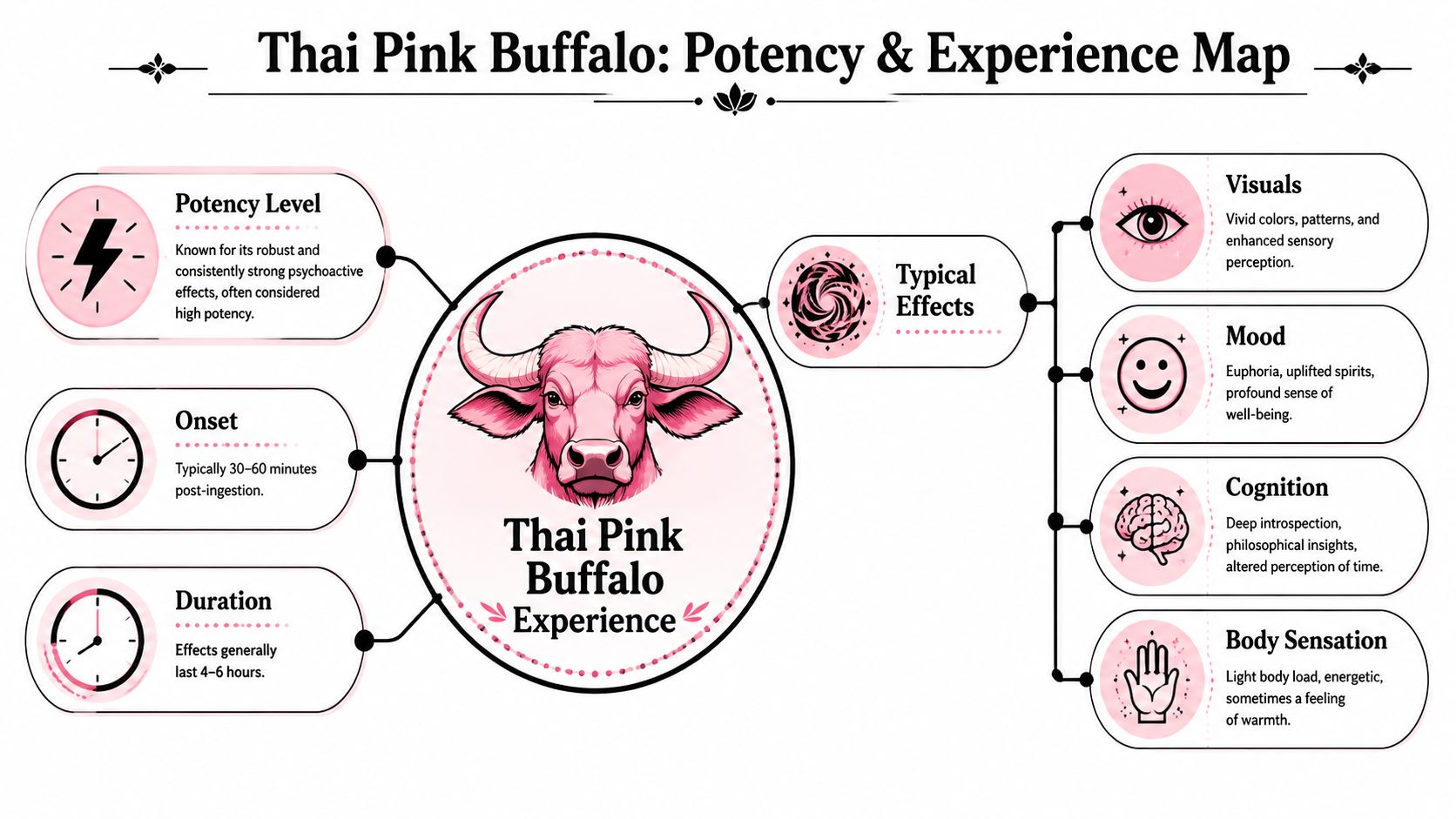
The core inquiry about Thai Pink Buffalo often concerns a feeling-based question. It seeks to understand whether it hits more like an emotionally warm cubensis, a highly visual one, or a strain that tends to turn the mind inward.
The honest answer is that individual response varies. Set, setting, dose, food intake, sleep, and emotional state all shape the experience. Still, Thai Pink Buffalo is often spoken about as a balanced cubensis. That usually means it doesn't get described in only one lane.
How the experience often unfolds
A simple way to understand the experience is by phases.
Early phase
The beginning often feels subtle. People may notice shifting body awareness, emotional softening, a slight sensory brightening, or a sense that ordinary thoughts are loosening their grip.
That's where first-timers sometimes get tripped up. They expect a dramatic switch. Cubensis usually doesn't announce itself like flipping a light on. It tends to arrive in layers.
Common early sensations may include:
- Physical alertness mixed with light heaviness
- Mood lift or anticipatory nervousness
- Sharper sensory interest, especially in music, texture, and color
Peak phase
At the peak, Thai Pink Buffalo is commonly discussed as offering a mix of visual enhancement, emotional openness, and introspection. Many users describe this kind of cubensis experience as one where color, pattern, memory, and meaning begin interacting in a more fluid way.
Some people become social and talkative. Others get quiet and contemplative. Both responses can happen with the same strain because mindset matters as much as chemistry.
A balanced peak often means:
| Experience area | What it may feel like |
|---|---|
| Visuals | Surfaces seem alive, colors feel richer, patterns become more noticeable |
| Emotions | Warmth, laughter, gratitude, tenderness, or occasional vulnerability |
| Thinking | Looser associations, personal reflection, creative leaps, unusual perspective shifts |
| Body | Mild buzzing, waves of warmth, restlessness, or the desire to stretch and move |
Why “potent” can be misleading
People use potency labels too loosely. One person says a strain is strong because visuals came on quickly. Another says it's strong because it brought up deep personal material. A third means body load. Those aren't the same thing.
So when someone says Thai Pink Buffalo is potent, it helps to ask what kind of strength they mean:
- Visual intensity
- Emotional depth
- Cognitive disruption
- Physical heaviness
Thai Pink Buffalo is often discussed as offering enough of each to feel substantial, without being defined by a single extreme trait. That's one reason experienced users may keep it in rotation.
A mushroom can be manageable and still be powerful. “Balanced” never means “casual.”
The landing phase
The later portion of the experience is often gentler. Visual intensity recedes, but thoughts may remain open and emotionally charged for a while. Some people feel tender, reflective, and calm. Others feel mentally tired and want quiet, water, and low stimulation.
That's why post-trip planning matters. Don't only prepare for the peak. Prepare for the hours after it, when your nervous system may still feel unusually open.
Recommended Dosing and Microdosing
Dosing advice gets messy fast because people want one chart that works for every body, every batch, and every intention. That chart doesn't exist. What does work is matching your dose to your goal and respecting that one person's “light” can be another person's “too much.”
Start lower than your ego wants to start. That's especially true if you're trying Thai Pink Buffalo for the first time, even if you've used other cubensis strains before.
Thai Pink Buffalo dosage guide
| Experience Level | Dosage (grams) | Expected Effects |
|---|---|---|
| Microdose | 0.05 to 0.25 | Subtle or sub-perceptual effects, mild mood or perspective shift, best approached on low-demand days first |
| Light dose | 0.5 to 1 | Gentle sensory lift, emotional softness, mild euphoria, light introspection |
| Standard dose | 1 to 2.5 | Clear psychedelic effects, stronger visual changes, deeper emotional and cognitive movement |
| High dose | 2.5 to 3.5 | Intense visuals, major perspective shifts, stronger body sensations, reduced ability to stay outwardly functional |
| Very high dose | 3.5 and up | For experienced users only, potentially immersive and disorienting, not suitable for casual settings |
How to think about the numbers
A microdose isn't supposed to feel like a mini-trip. If you clearly feel impaired, overstimulated, or distracted, that's probably not a true microdose for you. If you're exploring that route, this microdosing guide from Metro Mush gives a practical overview of mindset and routine.
A light dose makes more sense for someone who wants to remain relatively anchored. You may still feel altered, but usually not pulled fully into the experience.
A standard dose is where many people meet the classic cubensis territory. That's where set, setting, and emotional preparation become much more important.
What changes the experience
The same weight can feel different from one session to another. A few variables matter more than people expect:
- Empty vs full stomach changes onset feel and overall intensity.
- Stress level can turn excitement into tension very quickly.
- Your environment shapes whether the experience feels expansive or boxed in.
- Mixing substances can complicate a session and make it harder to read your own state.
If you're unsure, take the humble route. You can always choose a fuller experience another day. You can't untake a dose once it's active.
Comparing Thai Pink Buffalo to Other Strains
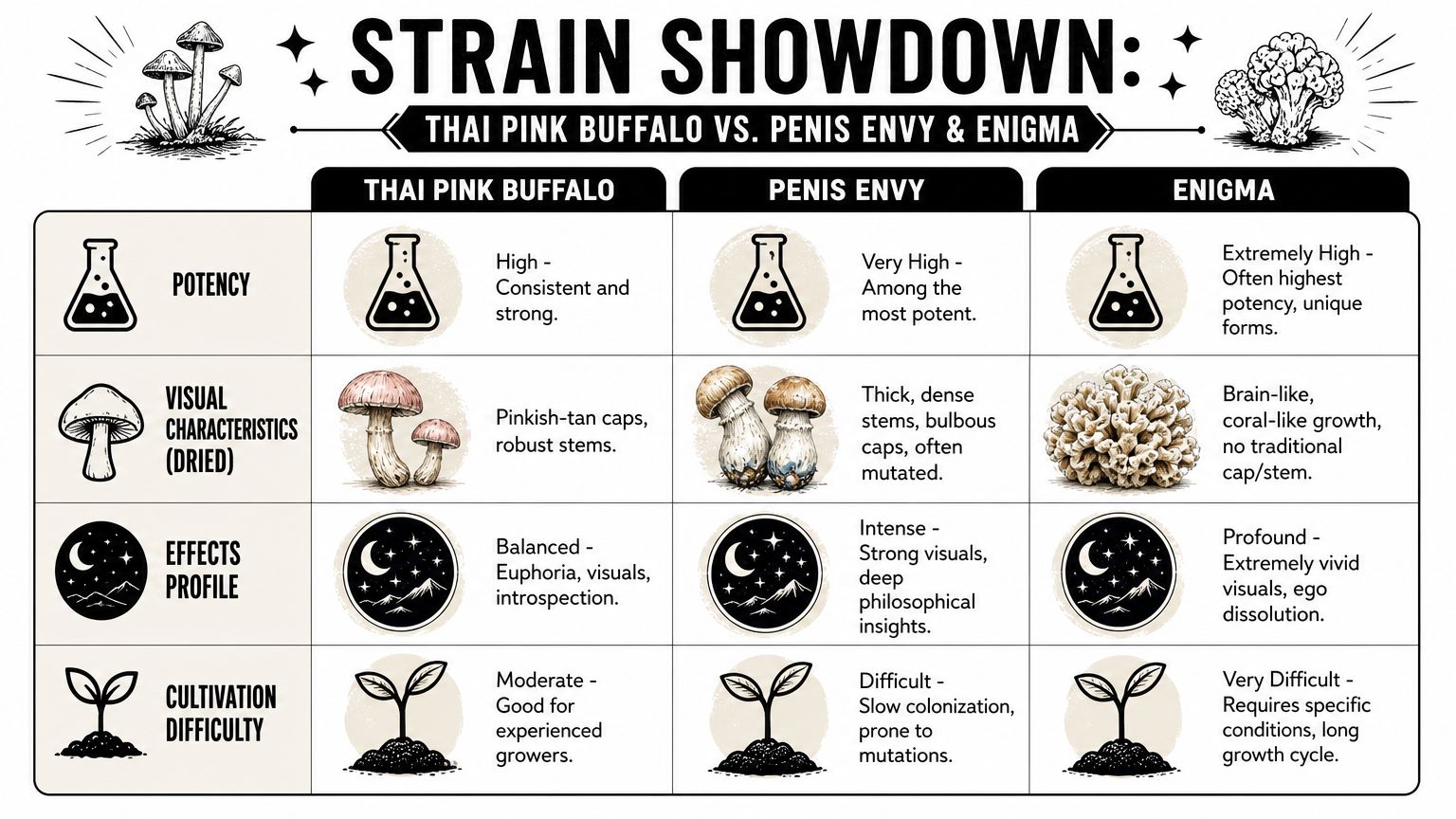
Strain comparisons get oversimplified. People often want a ranking, but what they usually need is a fit. Thai Pink Buffalo isn't just “less than” or “more than” another strain. It tends to appeal to a specific kind of user: someone who wants a recognizable cubensis experience with a blend of uplift, visuals, and introspection.
Thai Pink Buffalo and Penis Envy
The easiest comparison is with Penis Envy, because that strain often comes up whenever users ask for something “strong.” In everyday conversation, Penis Envy is usually treated as the more forceful option. Thai Pink Buffalo is more often framed as balanced.
That doesn't make Thai Pink Buffalo weak. It means the conversation around it tends to emphasize range rather than raw intensity.
A practical distinction looks like this:
- Thai Pink Buffalo often suits someone who wants a classic-feeling cubensis session with emotional openness and visuals in reasonable proportion.
- Penis Envy often attracts people seeking a heavier, more consuming, and less casual ride.
If you want a broader primer on cubensis lineage and strain families, this Psilocybe cubensis strain guide from Metro Mush is a useful reference point.
Thai Pink Buffalo and Enigma
Enigma sits in a different category in the minds of many experienced users because it's often discussed as unusual both in form and in the kind of journey people expect from it. Thai Pink Buffalo, by contrast, is easier to place within familiar cubensis expectations.
That matters for decision-making. Some users don't want novelty in morphology and intensity at the same time. They want something they can mentally map.
| Strain | General feel | Best fit for |
|---|---|---|
| Thai Pink Buffalo | Rounded, expressive, often emotionally and visually balanced | Users who want a classic but memorable cubensis experience |
| Penis Envy | Heavier, more immersive, often chosen for intensity | Experienced users aiming for depth and strength |
| Enigma | More unconventional in reputation and expectation | Experienced explorers comfortable with less predictability |
How to choose between them
Choose Thai Pink Buffalo if your question is, “What strain gives me a full psychedelic experience without choosing purely for extremity?”
Choose Penis Envy if your question is, “What if I want the session to be the main event?”
Choose Enigma if you already know you're comfortable navigating strong, distinctive territory and don't need your experience to feel familiar.
Safe Use Storage and Local Availability
A good psychedelic session starts long before ingestion. It starts with honesty. Are you calm enough for this today? Is the space right? Do you have obligations later? Is there someone you trust nearby if things get emotionally intense?
Those questions matter more than strain mythology.
Set and setting in real life
“Set” means your internal state. Mood, stress, fear, expectation, unresolved conflict, and intention all matter. “Setting” means your environment. Noise, privacy, lighting, temperature, and the people around you all shape the trip.
For a practical home setup, keep it simple:
- Choose a calm space where you won't need to perform, hide, or explain yourself.
- Clear your schedule so the end of the trip doesn't collide with errands, driving, or social demands.
- Prepare basics first like water, comfortable clothes, a blanket, music options, and easy snacks for later.
- Use a sober sitter when needed if you're new, anxious, or planning a stronger experience.
The safest session usually looks boring from the outside. Quiet room, trusted company, no pressure, no surprises.
Storage that protects quality
Poor storage ruins mushrooms faster than many people realize. Heat, moisture, light, and repeated air exposure all work against stability.
Your dried mushrooms should stay:
- Dry
- Cool
- Away from direct light
- Sealed from humid air
If you want a more detailed breakdown of containers, moisture control, and common mistakes, this guide on the best way to store shrooms covers the practical basics well.
A few common errors are worth avoiding:
Bathroom storage
Humidity fluctuates too much.Loose bag storage for long periods
Frequent air exchange can degrade quality over time.Hot car storage
Heat exposure is a bad idea even for short periods.
Local access for Michigan adults
For people in Southeast Michigan, availability matters almost as much as education. Adult consumers in the Detroit and Ann Arbor areas often aren't just asking what Thai Pink Buffalo is. They're asking how to access quality products without guessing, without sketchy sourcing, and without turning a simple decision into a scavenger hunt.
The practical move is to buy from a source that clearly lists products, ordering steps, and contact details. Transparency matters. So does consistency. If a shop gives you clear communication, a readable menu, and straightforward local service, you're already in better shape than someone chasing rumor-based sourcing.
The same goes for product format. Not everyone wants dried mushrooms. Some adults prefer low-dose edibles or drinks because they feel more familiar or easier to portion. Others want classic dried fruiting bodies because they prefer direct control over dose and form.
What matters most is that your choice fits your experience level, your intention, and your comfort with onset and duration.
Metro Mush offers a practical option for adult consumers in Southeast Michigan who want a clear menu, local delivery, and straightforward ordering for psilocybin products. You can browse strains and edibles through Metro Mush, and if you're in the Detroit Metro or Ann Arbor Metro areas, you can place orders by text through the numbers listed on the site.