You’re standing in a familiar place. Maybe you’ve tried a low-dose chocolate, maybe a drink, maybe a dried strain with a name that sounded half myth and half science. The experience did what good mushroom experiences often do. It didn’t just leave you with feelings. It left you with questions.
What exactly is a fungus? Why do some mushrooms feed forests, some feed people, and some alter consciousness? Why do books on mycology feel either too academic, too vague, or totally disconnected from what a curious adult in Southeast Michigan wants to know?
That gap is real. A lot of people don’t need a dense lab manual. They need a solid, safety-minded guide that helps them understand fungi without talking down to them. They want the bigger picture, but they also want practical answers. What should I read first? What kind of book fits my goal? Which books help with identification, cultivation, or context, and which ones are mostly storytelling?
Good mycology books can do something a quick search usually can’t. They slow you down in the best way. They help you learn the language, spot the patterns, and build respect for an organism group that is far larger and stranger than most of us were ever taught.
Your Mushroom Journey Starts with Curiosity
A lot of people enter mycology through experience, not through biology class. You try a mushroom product, or you hear a friend talk about foraging, microdosing, or cultivation, and suddenly the mushroom stops being just a product. It becomes a doorway.
That’s a healthy starting point. Curiosity is often how real learning begins.
For many adults, the first question isn’t “What’s the best textbook?” It’s more like, “What am I even looking at?” You see words like mycelium, fruiting body, spores, species, substrate, and taxonomy, and it can feel like you walked into the middle of a conversation everyone else already understands.
Why books still matter
Books on mycology help because they give your curiosity a shape. They take scattered facts and turn them into a path. Instead of bouncing between random posts and conflicting opinions, you get a more grounded way to learn.
A good mushroom book can help you:
- Understand basic fungal biology so terms stop sounding abstract
- Learn safe identification habits instead of guessing from photos online
- See the cultural and ecological context behind the species people talk about
- Build better judgment around what you know, and what you definitely don’t know yet
Practical rule: The best beginner mycology book doesn’t try to impress you. It helps you notice clearly, ask better questions, and avoid careless mistakes.
There’s also a deeper reason this matters. Fungi aren’t a tiny corner of nature. They’re one of its major organizing forces. Once you begin reading seriously, you start noticing them everywhere. In soil, on trees, in compost, in medicine, in fermentation, in decay, in symbiosis, in food, and in the long human history of ritual and healing.
Books as trail maps, not homework
People sometimes hear “books on mycology” and imagine dry diagrams and impossible vocabulary. Some books are like that. Many aren’t.
The right book feels more like a trail map than a school assignment. It helps you orient yourself. It tells you what to look for and what not to assume. It gives your experience a wider frame.
If you’re mushroom-curious in a place like Southeast Michigan, that matters even more. You’re not just looking for abstract knowledge. You’re looking for understanding you can carry into real life. Maybe that means safer foraging. Maybe it means appreciating the organism behind a wellness practice. Maybe it just means finally understanding why mushrooms seem to break all the rules you learned about plants and animals.
That’s the beginning of mycology for many. Not certainty. Interest.
Decoding the Different Types of Mycology Books
Walk into a bookstore and “mycology” can look like one shelf. In practice, it’s more like a small library. Different books serve different jobs, and buying the wrong type is one of the fastest ways to get frustrated.
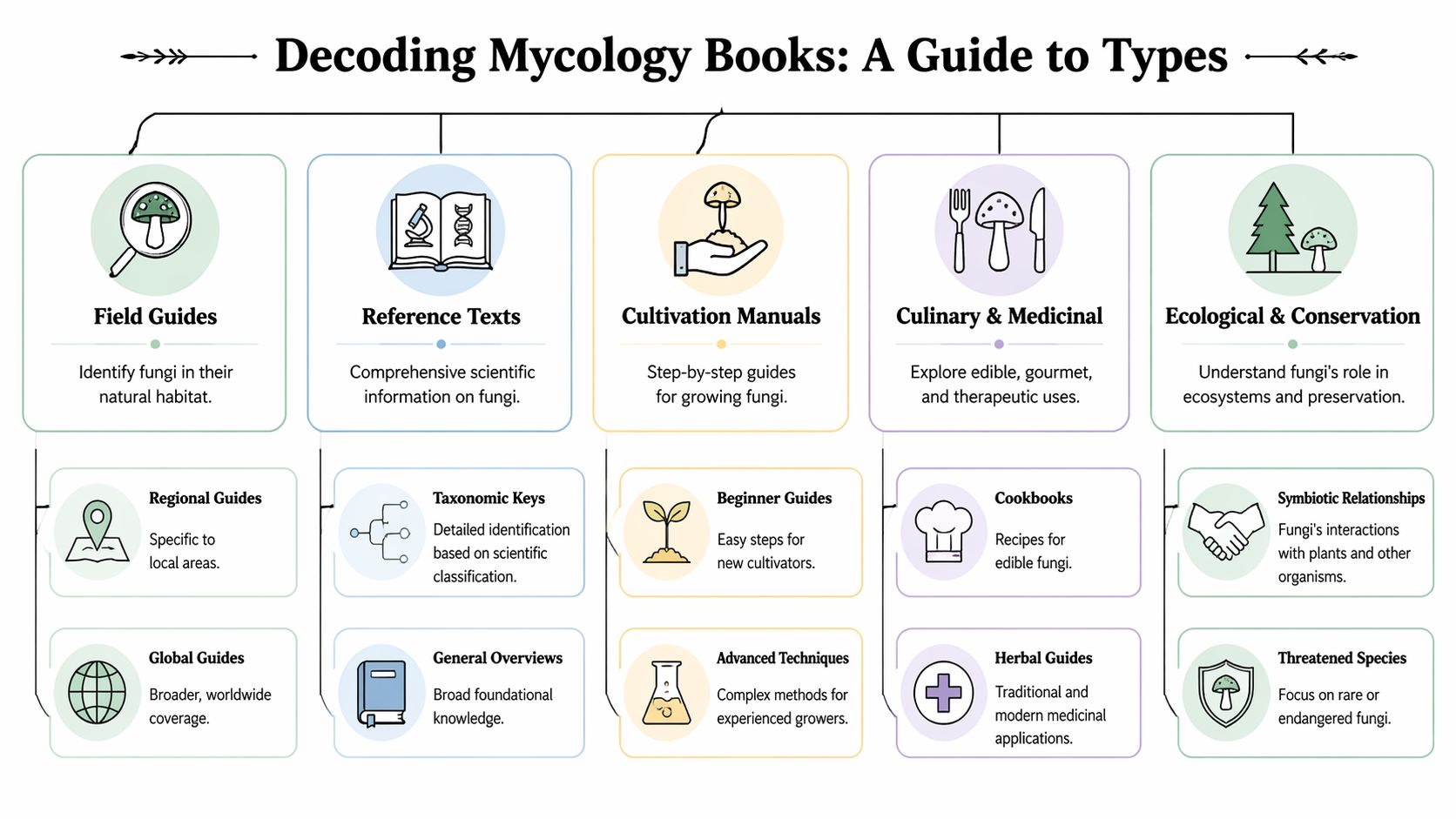
One reason this matters is that formal education often leaves fungi underexplained. A 2023 UK study of 82 children’s books about fungi found that 56% barely mentioned fungi at all. That helps explain why many adults arrive at mushroom learning with big curiosity but weak foundations.
Field guides
Field guides are the atlases of the mushroom world. They help you identify fungi you might encounter outdoors.
These books usually focus on visible traits such as cap shape, gills, pores, bruising, spore print color, habitat, season, and tree association. A strong field guide also warns you about look-alikes and uncertainty.
If you’re interested in wild mushrooms, regional books matter more than broad global ones. A guide built for your area is usually more useful than a giant all-world reference.
Look for:
- Regional focus so the species match your local woods and parks
- Clear photos showing multiple growth stages
- Identification keys that teach you how to narrow options
- Toxic look-alike notes that force caution, not confidence theater
If local identification is your interest, it also helps to browse educational material on mushroom identification basics.
Cultivation manuals
Cultivation books are the cookbooks and workshop manuals of mycology. They teach process.
These books explain substrate, sterilization, contamination, fruiting conditions, humidity, airflow, and harvest timing. Some are beginner-friendly. Others assume you’re already comfortable with lab-style technique.
A cultivation book is useful even if you never plan to grow anything. Why? Because it teaches how fungi live. You stop thinking of a mushroom as a static object and start seeing it as one phase in a life cycle.
Scientific references
Scientific texts are the encyclopedias. They’re where you go when you want taxonomy, fungal structure, ecology, pathology, or formal terminology.
These books can be amazing, but they’re often a bad starting point for casual readers. They may use dense language, assume background knowledge, and focus more on classification than on lived experience.
That doesn’t mean they’re only for specialists. It means they work best once you’ve already learned the basics somewhere more approachable.
Use scientific books when you want precision. Use beginner books when you want orientation.
Psychedelic and ethnobotanical books
These books are the cultural histories and context maps. They tend to explore human relationships with psychoactive fungi, ceremony, history, belief, and meaning.
Some are thoughtful and grounded. Some drift into myth, overclaiming, or vague spiritual language. The best ones balance respect for cultural context with practical caution. They don’t treat mushrooms as magic shortcuts. They treat them as organisms with biological reality and human history.
Narrative and myco-philosophy books
Then there are the story books. These are works of narrative nonfiction, ecology writing, and big-picture reflection. They’re often the most readable and the least technical.
A narrative mycology book can make you fall in love with fungi. It can teach through metaphor, field experience, and wonder. What it often won’t do is help you identify a wild specimen with confidence or troubleshoot cultivation contamination.
That’s why it helps to think in combinations.
| Book type | Best for | Not enough for |
|---|---|---|
| Field guide | Local identification practice | Broad fungal theory |
| Cultivation manual | Growing techniques and life cycle understanding | Regional foraging confidence |
| Scientific reference | Deep accuracy and taxonomy | Easy beginner entry |
| Ethnobotanical text | Cultural and psychedelic context | Identification and legal nuance |
| Narrative nonfiction | Inspiration and ecological perspective | Hands-on decision making |
One generally benefits from one practical book and one inspiring book. One teaches your hands and eyes. The other keeps your curiosity alive.
How to Choose the Right Mycology Book for You
Choosing among books on mycology gets easier when you stop asking, “What’s the best book?” and start asking, “What am I trying to do?”
That small shift changes everything. The right book for a forager is often the wrong book for a microdoser. The right book for someone who loves fungal ecology may bore a person who wants cultivation detail.
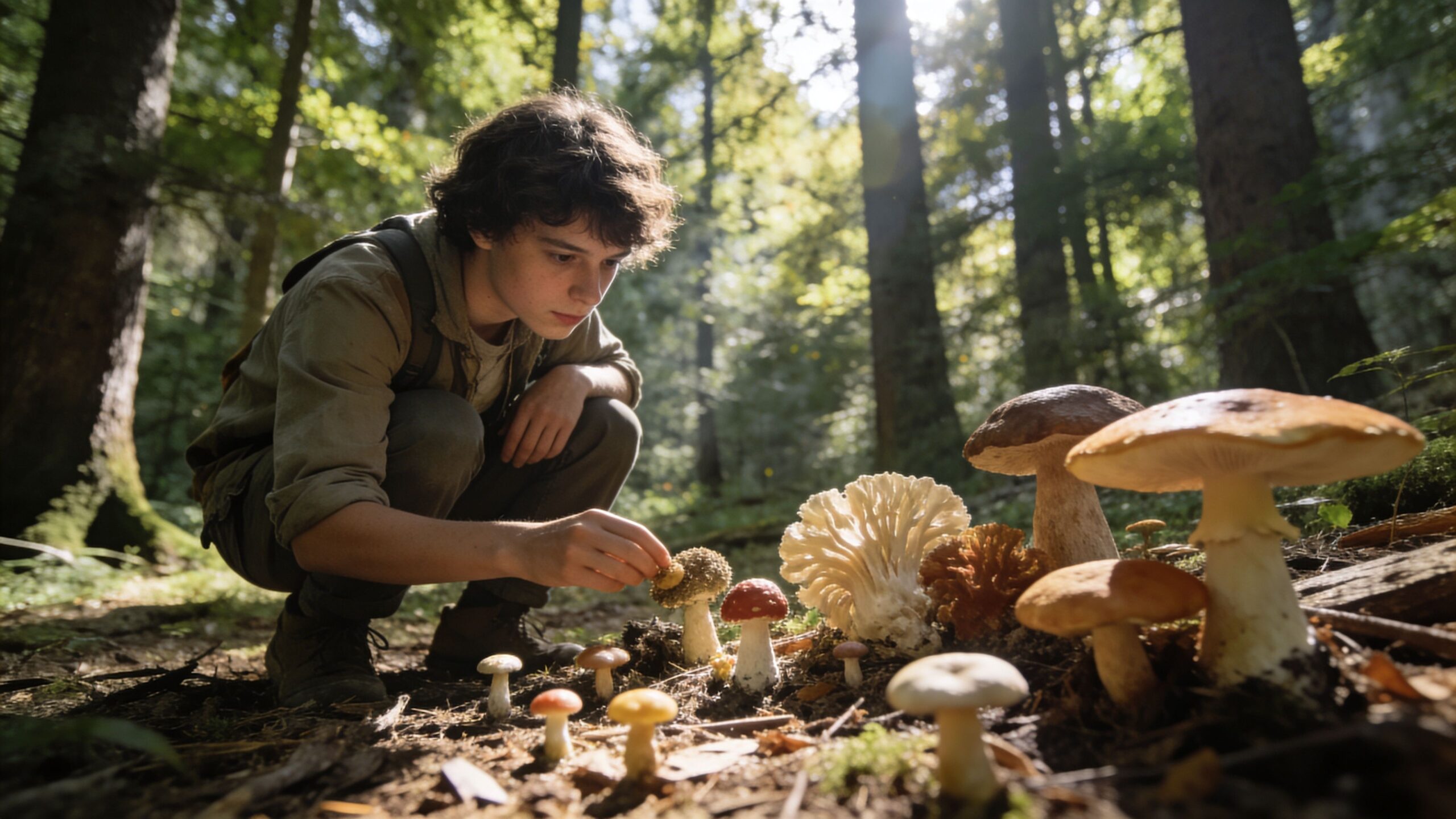
The scale of the subject also matters. Fungi may account for about 40% of all species on Earth, with up to six million fungal species within an estimated 15 million species inhabiting Earth, as discussed in Independent Publisher’s coverage of Radical Mycology. When a kingdom is that vast, no single book can do every job.
If you want to forage
The aspiring forager should start with a regional field guide and a second source that explains identification logic in plain language.
You need books with photos, habitat notes, seasonal cues, and warnings about toxic look-alikes. You don’t need broad philosophical writing first. You need a book that helps you slow down and observe.
A useful way to judge a field guide is to flip to a species entry and ask, “Could I compare a real mushroom to this without fooling myself?” If the photos are tiny, the language is vague, or the warning notes are weak, put it back.
If you want to understand how mushrooms grow
The home cultivator should lean toward a cultivation manual first, then add either a general overview or narrative ecology book later.
Cultivation books are good for practical minds. They explain cause and effect. Too much moisture causes one problem. Poor airflow causes another. Contamination isn’t bad luck. It’s usually a process issue.
That mindset is useful beyond growing. It teaches patience, observation, and humility.
If you want psychedelic context
The psychedelic explorer often needs a blend, not a single title. One book should offer cultural or historical context. Another should cover basic fungal biology. Without both, it’s easy to end up with either mystification or reductionism.
Some readers swing too far into reverence and forget that mushrooms are organisms. Others swing too far into chemistry and forget that set, setting, intention, and culture shape how people relate to fungi.
The strongest reading path combines biology, history, and harm reduction. Leaving out any one of those can skew your judgment.
If you’re a curious naturalist
Maybe you don’t want to forage or cultivate. You just want to understand the weirdness. This reader should start with narrative nonfiction or a broad general overview.
These books are often the best entry point for people who love nature but dislike textbook language. They help you grasp big ideas like decomposition, symbiosis, underground networks, and fungal diversity without drowning you in terminology.
If you’re safety-conscious and experimenting with low doses
This reader needs books that are calm, sober, and specific. Look for texts that don’t glamorize mushrooms, don’t treat personal anecdotes as universal truth, and don’t blur legal, medical, and identification boundaries.
Here’s a quick way to sort your options:
- Choose your main goal. Foraging, cultivation, ecology, or psychedelic context.
- Choose your tolerance for technical language. Beginner, intermediate, or dense.
- Check the book’s actual job. Inspiration, identification, process, or reference.
- Look for humility in the writing. Good mushroom authors respect uncertainty.
- Pair one practical title with one broader title. That combination usually sticks.
A smart small library beats one oversized “everything” book you never finish.
Illustrative Books to Start Your Library
A starter library doesn’t need to be huge. It needs to be balanced.
The strongest books on mycology tend to do one thing well. They either teach identification, teach cultivation, offer scientific grounding, or widen your sense of what fungi are. Problems usually begin when readers expect one title to cover all of that at once.
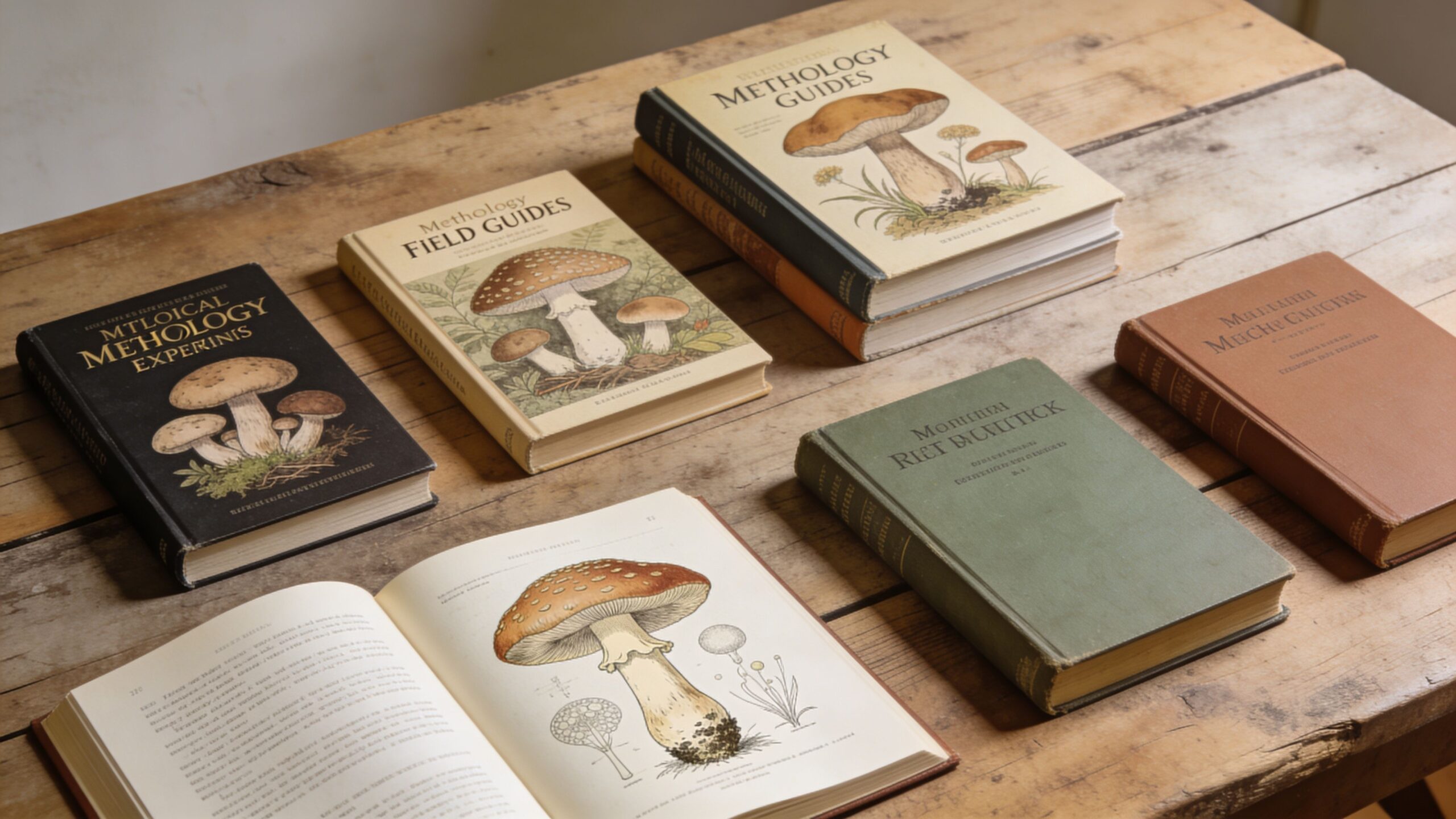
There’s another wrinkle for today’s readers in places like Detroit and Ann Arbor. A lot of current literature still doesn’t speak directly to modern psilocybin-curious adults. On Goodreads’ popular mycology shelf, 80% of top books focus on general ecology or non-psychedelic medicine, which leaves a clear gap for readers seeking psilocybin-specific practical guidance, as noted on the Goodreads mycology shelf.
A few useful starting points
For broad fungal literacy
Radical Mycology by Peter McCoy is often a strong fit for readers who want range. It speaks to cultivation, ecology, uses of fungi, and the wider cultural imagination around mushrooms. It’s ambitious, and that’s part of its appeal. You may not agree with every framing choice, but it gives curious readers a large map.
For cultivation
Paul Stamets’ Growing Gourmet and Medicinal Mushrooms remains one of the most commonly discussed cultivation books. It’s practical and process-oriented. Even if your interest is mostly educational, it helps you understand how growers think about substrate, contamination, and fruiting conditions.
For narrative wonder
Merlin Sheldrake’s Entangled Life is often the book people hand to a friend who says, “I want to understand why fungi matter, but I don’t want a textbook.” It’s less a manual than an invitation into fungal thinking.
For serious foundations
Texts like Introductory Mycology or Introduction to Fungi are better once you’ve already built some comfort with the basic language. They can be excellent references, but many readers should arrive at them second, not first.
A practical shelf by reader type
| Reader | Good first type | Example direction |
|---|---|---|
| Weekend naturalist | Narrative overview | Start with a readable ecology book |
| Beginner forager | Regional field guide | Choose local species coverage over prestige |
| Process-minded learner | Cultivation manual | Learn the fungal life cycle through growing |
| Context seeker | Ethnobotanical plus general biology | Pair cultural history with basic science |
| Deep diver | Academic reference | Use after a more approachable first book |
A local field guide deserves its own note. For someone in the Great Lakes region, a region-specific mushroom guide is often more useful than a famous national title. Local woods, seasons, and tree species shape what you’re likely to encounter.
This short video can also help you get a feel for how people talk about beginner-friendly mushroom books and learning paths before you buy.
Where the current shelf still falls short
If you’re specifically looking for a book that speaks to modern adult psilocybin use in a decriminalized city, you’ll notice a gap quickly. Many books are either strongly academic, strongly ecological, or strongly historical. Fewer books combine practical fungal literacy with contemporary harm reduction and grounded everyday decision-making.
That doesn’t mean there are no useful books. It means you may need to build your own stack.
A smart stack might include:
- One field guide for visual literacy and humility outdoors
- One cultivation or biology book for understanding how fungi live
- One narrative or cultural text for context and meaning
- A notebook for your own observations, questions, and corrections
A personal mycology library works best when it teaches both wonder and restraint.
That last part matters. The best reading list isn’t the one that makes you feel like an expert fast. It’s the one that makes you harder to fool.
Practicing Safe and Legal Mycology in Michigan
Mycology gets risky when people confuse interest with competence. Reading helps. It does not make you bulletproof.
The first absolute rule is simple. Never eat a wild mushroom unless you have positively identified it with confidence and cross-checked that identification carefully. “Looks close enough” is how people get poisoned.
The rule for wild mushrooms
A mushroom isn’t identified by one photo or one feature. Cap color alone won’t save you. Neither will shape. Mushrooms change with age, weather, and damage. Some dangerous species also mimic edible ones well enough to trick beginners.
If you’re learning outdoors, keep these habits:
- Use multiple traits such as gills, pores, bruising, habitat, smell, and spore print
- Assume look-alikes exist until proven otherwise
- Keep specimens separate so you don’t mix uncertain finds with known ones
- Walk away when uncertain because no meal is worth a bad guess
For region-specific caution and context, it helps to review resources on wild mushrooms in Michigan.
If there’s doubt, the mushroom stays out of your body.
Decriminalized isn’t the same as fully legal
Readers often get confused. In some Michigan communities, enforcement priorities have shifted around personal entheogenic use. That does not automatically mean every activity involving psilocybin is fully legal under every layer of law.
Decriminalized generally means local enforcement may treat certain conduct as a low priority. It does not mean a free-for-all. It does not erase broader legal frameworks. It also doesn’t guarantee that every city, officer, or setting will treat the issue the same way.
Because laws and enforcement can change, readers should treat legal information as something to verify regularly through current local policy and qualified legal guidance. Books can give context. They can’t replace up-to-date legal checking.
Safety for psilocybin-curious adults
Books are especially useful here because they encourage patience. That’s a major safety tool.
If you’re exploring mushrooms for wellness or creativity, a safety-minded approach includes:
- Know what question you’re asking. Are you looking for biology, personal meaning, or use guidance? Don’t expect one source to do all three.
- Avoid hero narratives. The person who says they know everything about mushrooms usually doesn’t.
- Respect set and setting. Mood, environment, and company shape outcomes.
- Treat low-dose and high-dose experiences as different categories. They call for different expectations and preparation.
- Don’t mix learning with bravado. Fungi reward attention, not swagger.
A healthy mushroom community isn’t built on dares. It’s built on careful observation, honest uncertainty, and people correcting one another before mistakes become emergencies.
Grow Your Knowledge with Community Resources
Books are powerful, but mycology really comes alive when reading turns into conversation. You notice a term in a book, then hear someone use it in the woods. You see a photo in a guide, then compare it to a specimen at a club meeting. That’s when the knowledge starts sticking.
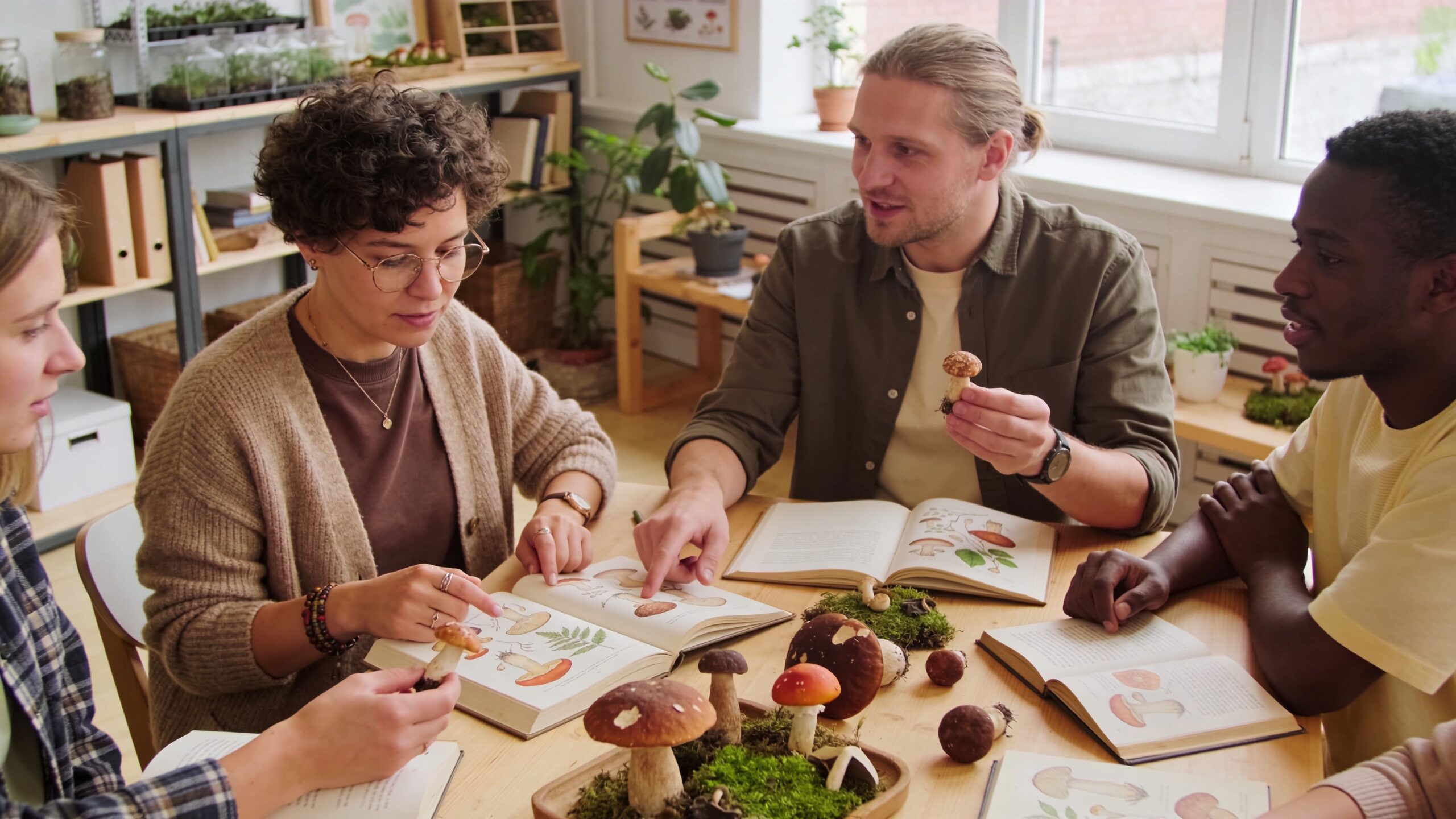
That matters because some needs still aren’t well served by books alone. One underserved area in mycology literature is the connection between fungi, urban wellness, and community-based discussion. The source material behind a review of The Hidden Kingdom of Fungi notes demand tied to psilocybin microdosing searches growing 40% in Midwest markets like Detroit, alongside interest in community spaces that help people discuss low-dose use more practically.
Local and online places to learn
The best community resources don’t replace books. They help you use them better.
A few good places to look:
- Local mushroom clubs where people compare finds, trade book recommendations, and model careful identification habits
- Public libraries and indie bookstores where you can sample several styles before buying
- Online forums where beginners can read old discussions and learn what experienced people still debate
- Regional nature groups that teach habitat awareness, not just mushroom names
If you like structured reading, it’s also worth browsing ongoing articles and topic pages related to mycology education and fungal learning.
Why community makes books better
A book can tell you what a spore print is. A group can tell you when your spore print was too faint, your specimen too old, or your confidence too high.
A book can describe habitat. A local naturalist can tell you which parks produce what you’re reading about.
That kind of correction is valuable. It keeps mushroom learning from turning into private myth-making.
Good mushroom communities don’t reward the loudest person. They reward the most careful observer.
A simple learning rhythm
If you want a steady way to grow without getting overwhelmed, try this rhythm:
- Read one chapter
- Look at real specimens or high-quality photos
- Write down what confused you
- Ask another human before assuming you’ve mastered it
That loop works for foraging, cultivation, ecology, and psychedelic context alike.
Books on mycology give you vocabulary. Community gives you calibration. One without the other can leave blind spots. Together, they create something better than information. They create judgment.
Begin Your Mycology Reading Journey Today
If you’ve made it this far, you probably don’t need more convincing that fungi are worth your attention. You need a starting point that fits your real life.
That’s the whole trick with books on mycology. Don’t begin with the most famous title or the most intimidating one. Begin with the one that matches your question. If you want to forage, get a regional field guide. If you want to understand life cycles, get a cultivation book. If you want to feel the wonder first, start with narrative nonfiction.
Keep your expectations grounded. No single book will hand you mastery. What a good book can do is sharpen your eyes, slow your assumptions, and help you build respect for an organism group that most of us were barely taught to notice.
You also don’t have to choose between practical learning and deeper meaning. The best reading journeys usually include both. One book teaches what fungi are doing. Another helps you appreciate why that matters. Together, they make you a steadier learner.
Start small. Borrow before you buy if that helps. Mark pages. Compare authors. Notice where different books agree, and where they don’t. That habit alone will make you a better reader and a safer mushroom student.
Most of all, stay curious and stay humble. Those two qualities will take you farther in mycology than trying to sound advanced.
If you’re exploring mushrooms as an adult in Southeast Michigan and want a grounded next step, Metro Mush offers a local entry point with a curated menu, approachable options for different comfort levels, and a community connection through Discord for updates, discussion, and new drops.