
You might be in a familiar spot. You've had meaningful experiences with psilocybin, read enough to know there's more to it than “set and setting,” and now you're wondering what responsible guidance looks like as a profession.
For a lot of people in Detroit and Ann Arbor, that curiosity starts informally. Maybe you've talked with friends about intention, integration, or emotional safety. Maybe you've read about what psychedelic therapy involves and noticed a big gap between personal interest and professional practice. That gap is where most confusion begins.
A course can teach concepts. A licensed facilitator path asks more of you. It asks whether you can hold boundaries, support someone without steering them, work within law and regulation, and complete supervised practice under real standards. That difference matters.
Embarking on the Path of Psychedelic Guidance
A person in Southeast Michigan might start with a simple question: “I'm already interested in psilocybin. What would it take to help others work with it safely?” That's not the same as asking how to have a better personal experience. It's asking whether this could become a serious, service-oriented role.
The answer is more layered than often assumed. The public often treats psychedelic guidance as something halfway between wellness coaching, therapy, and ceremonial support. In regulated settings, it's becoming more defined than that. A facilitator isn't just someone who knows psilocybin well. A facilitator is someone trained to prepare clients, support sessions responsibly, and help with post-session integration inside a legal framework.
That shift from interest to profession changes the stakes. Once another person's safety, expectations, and vulnerability are in your hands, good intentions stop being enough. You need training that covers ethics, communication, screening, adverse situations, and legal limits.
A lot of readers think the first decision is “Which course should I take?”
The real first decision is “Am I prepared for a profession built on responsibility, supervision, and law?”
That's why psilocybin facilitator training deserves a slower look. If you live in Michigan, the topic is even more nuanced. You can learn the field now, build skills now, and connect with the community now. But learning the field and entering a licensed profession are not yet the same thing locally.
What a Psilocybin Facilitator Actually Does
A psilocybin facilitator is best understood as a guide for inner terrain. Think of the role like a mountain guide. The guide doesn't hike the mountain for you, and doesn't decide what the summit means to you. The guide helps you prepare, stay oriented, and move through difficult moments with greater safety.

Not a therapist, not a trip sitter
The following distinction often confuses readers. A facilitator can overlap with therapeutic skills, but the role is not identical to psychotherapy. A therapist diagnoses and treats mental health conditions within a clinical scope. A facilitator supports a person through a psilocybin process within the rules of the jurisdiction where they work.
A facilitator also isn't just an informal trip sitter. A trip sitter may offer presence and reassurance, but formal facilitation involves structured preparation, safety protocols, clear boundaries, documentation requirements in regulated systems, and follow-up support.
Here's a simple comparison:
| Role | Main function | Scope |
|---|---|---|
| Psychotherapist | Treats mental health conditions | Clinical license and clinical care |
| Trip sitter | Provides casual support | Informal, usually unregulated |
| Facilitator | Prepares, supports, and integrates psilocybin sessions | Defined by state rules where legal |
Core tasks in real practice
Most of the work happens before and after the acute experience.
- Preparation work: The facilitator helps the client clarify intentions, review expectations, and understand the session environment.
- Set and setting support: The facilitator helps create physical and emotional conditions that reduce avoidable risk.
- Non-directive presence: During the experience, the facilitator supports without taking over. That means listening, grounding, and staying steady.
- Integration support: Afterward, the facilitator helps the client process what came up and connect it to daily life.
Colorado shows how formal this role is becoming. In that framework, the path includes 150+ hours of education, a state-issued Training License, then 40+ hours of supervised practicum and 40 hours of consultation, which makes clear that this profession goes well beyond a short course, as described by Synthesis Institute's overview of facilitator requirements.
Seeing the role in action makes the distinction easier to grasp.
The human skill at the center
The hardest part of the role isn't explaining psilocybin science. It's learning how to be calm, ethical, observant, and useful when someone is emotionally open and psychologically vulnerable.
Practical rule: If a training program mainly teaches ideas but gives little attention to boundaries, safety, and supervised skill-building, it's teaching interest, not readiness.
That's why the profession is moving toward structured training rather than charisma, personal experience, or spiritual branding alone.
Inside the Curriculum What Facilitator Training Teaches
Strong psilocybin facilitator training doesn't revolve around one big insight. It builds competence across several different areas that all matter at once. Someone may know a lot about mushrooms and still be unprepared to screen clients, manage boundaries, or support integration responsibly.
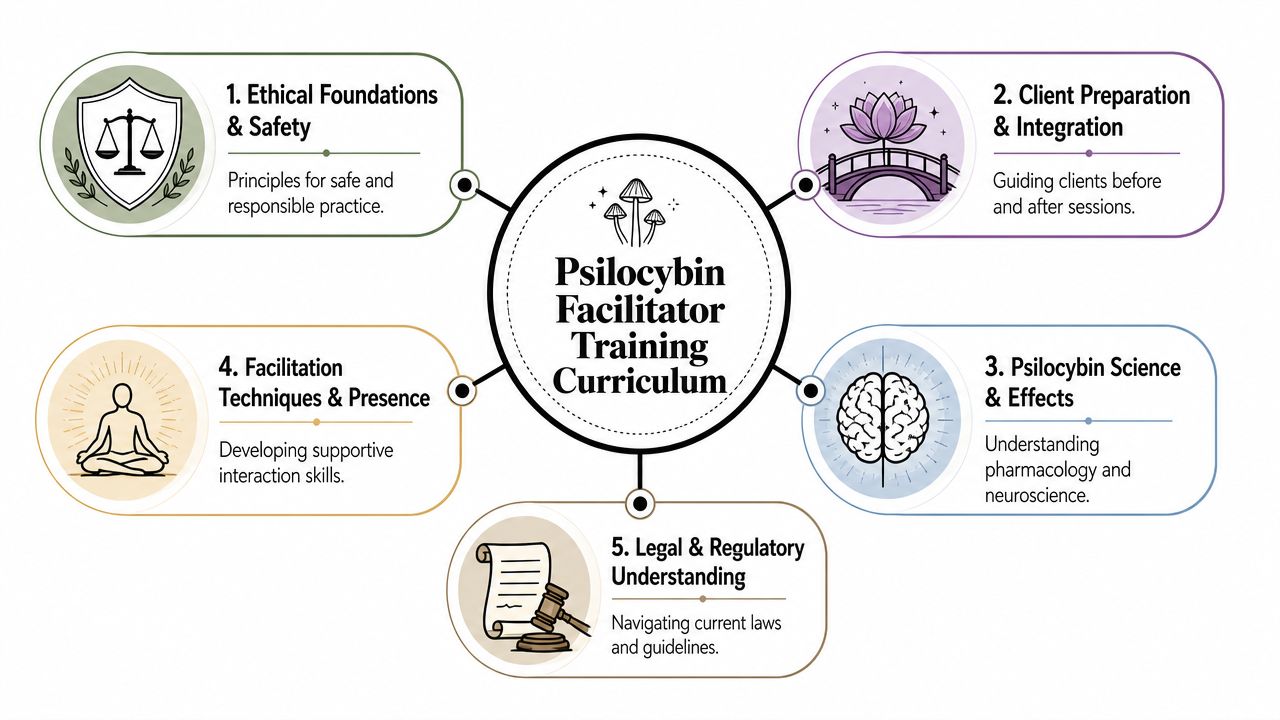
The five pillars most programs revolve around
Ethics and safety
This is the foundation. Facilitators work with people in unusually open states, so training has to address consent, boundaries, power dynamics, and emergency response.Preparation and integration
Good sessions are shaped long before the medicine session starts and long after it ends. Preparation helps establish expectations and safety. Integration helps people translate experience into real-life choices.Psilocybin science and effects
Trainees need a grounded understanding of how psilocybin affects perception, emotion, and cognition. If you want a plain-language primer before diving into professional study, Metro Mush has a useful overview of psilocybin effects on the brain.Facilitation skills and presence
Participants learn to listen well, communicate clearly, and avoid becoming controlling or suggestive.Law and regulation
A person can be thoroughly educated and still not qualify for legal practice. That's why regulated-market training includes legal literacy, documentation expectations, and state-specific requirements.
Why the curriculum is so long
Short courses sound appealing, but they usually leave out repetition. Repetition matters because facilitation isn't just knowledge. It's judgment under pressure.
Benchmark programs reflect that reality. According to CIIS program information, top-tier facilitator programs cluster around 140-150+ instructional hours plus supervised fieldwork, and CIIS uses an 8-weekend plus 6-day retreat format. That design signals something important. Readiness is being treated more like an intensive helping skill than a casual certificate.
What readers usually underestimate
Many applicants assume the science will be the hard part. Usually, the more demanding material is relational.
Consider a few examples:
- Screening: You need to know when a person should be referred elsewhere rather than accepted into a session.
- Trauma-informed communication: You need language that supports rather than overwhelms.
- Boundary management: You need to understand how dependency, idealization, or emotional projection can show up.
- Integration: You need to help people organize meaning without telling them what their experience “really” meant.
Training isn't only about what psilocybin does. It's about what you do when another person is disoriented, emotional, silent, ecstatic, frightened, or uncertain.
Curriculum quality questions worth asking
When reviewing a program, look for evidence that it teaches application, not just theory.
- Does it teach safety skills clearly? You want more than broad talk about healing.
- Does it address ethics in detail? Boundaries should be a major topic, not a side note.
- Does it include supervised practice preparation? Classroom learning alone won't carry you into licensure where regulation exists.
- Does it explain jurisdiction-specific requirements? A generic psychedelic course and a facilitator pathway are not the same thing.
A serious curriculum should leave you with more humility, not less. The more someone learns, the clearer it becomes that this work requires structure.
Navigating the Legal Landscape of Psilocybin Facilitation
Michigan readers often hear two words used as if they mean the same thing: legalized and decriminalized. They don't.
A regulated state model creates a formal path for training, licensure, oversight, and authorized practice. Decriminalization usually means enforcement priorities change around possession or use, but it does not automatically create a licensed profession.
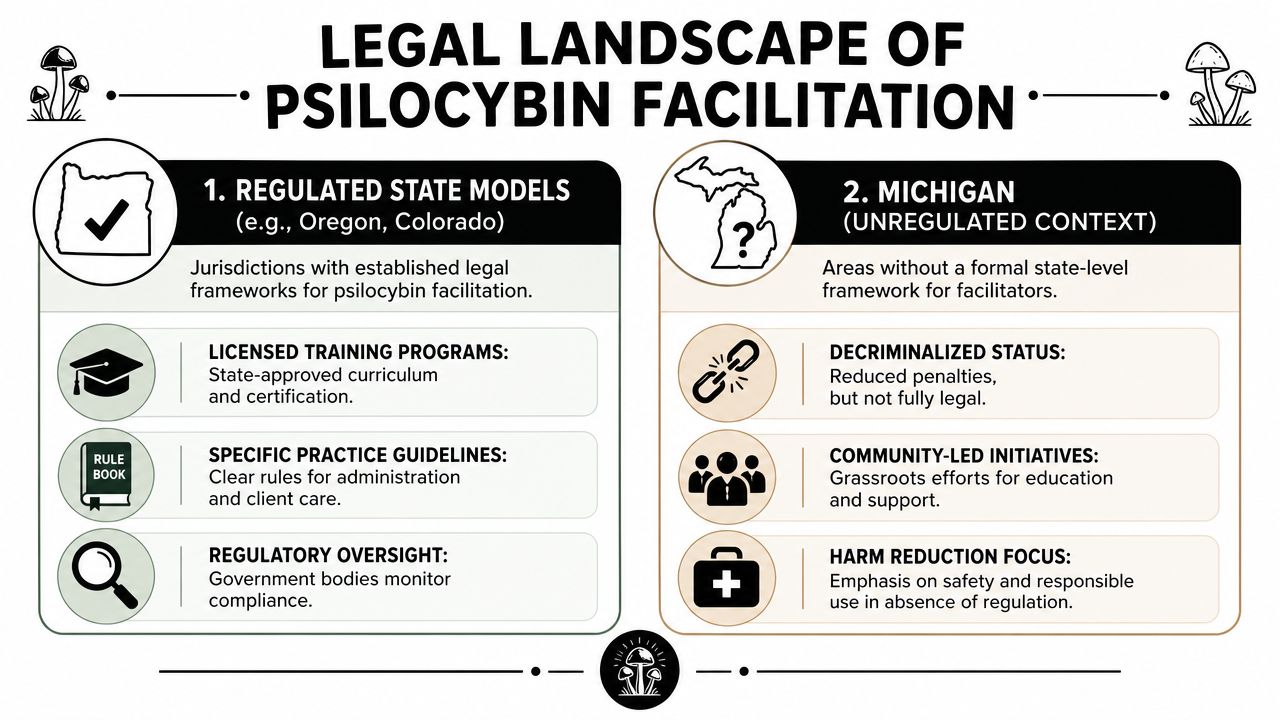
What regulated states look like
Oregon and Colorado are the clearest U.S. reference points. In those systems, the state defines training expectations and ties them to legal service delivery.
Colorado's model is especially useful for understanding how formalized the path has become. As reported in Marijuana Moment's summary of Colorado's framework, a facilitator must be 21 or older, have a high school diploma or equivalent, and complete 150 hours of coursework, 40 hours of supervised practicum, and 50 hours of consultation over six months. That's not a casual workshop path. It's a state-defined professional baseline.
What Michigan's environment means in practice
In Michigan, local decriminalization conversations have made many people more aware of psilocybin. But local shifts don't create a statewide licensed facilitator role the way Oregon or Colorado do.
That distinction affects three big decisions:
| Question | Regulated state | Michigan right now |
|---|---|---|
| Can you train? | Yes | Yes |
| Can you enter a state-defined facilitator licensure path? | In certain jurisdictions, yes | Not as a Michigan state pathway |
| Can you assume a course makes you a legally recognized professional locally? | Only if it aligns with state rules | No |
Why this matters before you enroll
A lot of programs market broadly across the country. That can mislead students into thinking a certificate travels cleanly into practice wherever they live. It usually doesn't.
If you live near Detroit or Ann Arbor, it's smart to treat education and licensure as separate questions:
- Education question: Do you want to learn the ethics, skills, and science of facilitation?
- Licensure question: In which jurisdiction could you qualify to practice under law?
Michigan readers should be careful with the phrase “becoming a facilitator.” You can study facilitation now. A state-regulated professional path is a different matter.
That's not bad news. It just means you need a more realistic plan. Training can still be valuable for personal development, harm reduction work, community education, or future readiness. It just shouldn't be confused with immediate in-state licensure.
How to Choose the Right Facilitator Training Program
The wrong way to choose a program is to ask which one sounds the most inspiring. The better question is which one matches your intended path, your budget, and the legal setting you may eventually work in.
Oregon's early market offers a useful reality check. A 2025 survey of 16 active training programs found tuition ranged from $4,500 to $12,000, with a median student spend of $9,500, and 79% of students said the cost created at least a moderate or severe financial strain, according to the Oregon facilitator workforce survey. That makes program selection a professional investment decision, not an impulse purchase.
Start with the end use
Before comparing schools, decide which of these best describes you:
- You want foundational education only: You're studying for personal knowledge, community literacy, or future opportunities.
- You want eventual licensure in a regulated state: You need a program aligned with that state's requirements.
- You're still unsure: You need a program that is transparent about what it can and cannot qualify you to do.
A course can be excellent and still not be the right choice if it doesn't connect to your actual goal.
Questions that reveal real program quality
Some questions cut through marketing quickly.
How does the program address practicum placement?
This is one of the most important questions because classroom hours alone may not complete the path.Who teaches it, and from what background?
Look for instructors with depth in ethics, trauma-informed support, regulation, and supervised practice.What is the training philosophy?
Some programs lean clinical. Others lean spiritual, community-based, or hybrid. None of those approaches is automatically best. Fit matters.How clear is the pricing?
Ask what tuition includes and what it doesn't. Travel, practicum, supervision, application fees, and consultation may sit outside the headline price.
A practical comparison framework
| What to compare | Why it matters |
|---|---|
| Regulatory alignment | A beautiful curriculum won't help with licensure if it doesn't meet state requirements |
| Practicum support | The supervision stage can become the real bottleneck |
| Instructor depth | This field requires more than psychedelic enthusiasm |
| Format and schedule | Intensive weekends and longer virtual formats suit different learners |
| Cost transparency | Hidden costs can change the total commitment substantially |
Warning signs worth noticing
Not every red flag is dramatic. Some are subtle.
- Vague promises: If a program implies broad career readiness without explaining jurisdictional limits, slow down.
- Thin ethics coverage: A serious program treats boundaries and safety as core material.
- No discussion of supervision: If there's little mention of practicum or consultation, you may be looking at education without a profession-linked pathway.
- Overreliance on personal transformation language: Personal growth can be part of training, but it can't replace skill development.
A strong training program should make the path look clearer. If the marketing leaves you more dazzled than informed, keep looking.
The best choice is often the one that feels less glamorous and more concrete.
From Certificate to Practice The Real Path to Facilitation
This is the part many applicants don't hear early enough. Finishing a course doesn't automatically make you a licensed facilitator.
In regulated systems, didactic training is only one phase. The profession usually requires supervised practice after the classroom portion ends. That's where the practical chasm appears.
Why a certificate is only one stage
Oregon and Colorado both tie licensure to more than coursework. According to the Oregon Health Authority training approval guidance, state licensure in regulated markets like Oregon and Colorado requires a completed 40-hour practicum after an approved training program. A classroom-only program may still be educationally valuable, but by itself it is insufficient for licensure.
That changes how you should evaluate every training option. You're not just buying instruction. You're entering a pipeline.
The supervision bottleneck
The bottleneck is simple to describe and hard to solve. More people may want training than there are approved supervisors, service settings, or practicum opportunities available.
For trainees, that can mean:
- You complete coursework but still can't finish the supervised phase quickly
- You need to travel for practicum placement
- You face additional costs after graduation
- Your timeline depends on supervisor availability, not just your own effort
This is the hidden middle of the profession. It sits between “I earned a certificate” and “I am legally licensed.”
What the path really asks of you
Think of the journey in stages rather than one enrollment decision:
- Learn the foundations
- Complete an approved training sequence where relevant
- Secure supervised practicum
- Complete consultation or other state-specific post-course requirements
- Apply for and maintain licensure where legal
The people who move through this path most smoothly usually plan for supervision early, not after graduation.
That's the most practical lesson for Michigan readers considering out-of-state training. If your long-term goal is practice in a regulated jurisdiction, ask about practicum logistics before you ever submit tuition.
Your Next Steps in the Detroit and Ann Arbor Area
If you live in Southeast Michigan, the smartest next move is not to pretend the licensing question is settled. It's to build a foundation that would still matter if laws shift later.
That means learning in a way that's grounded, community-aware, and realistic. Michigan doesn't currently offer the same state-regulated facilitator pathway as Oregon or Colorado. But you can still become much more informed, much safer, and much better prepared.
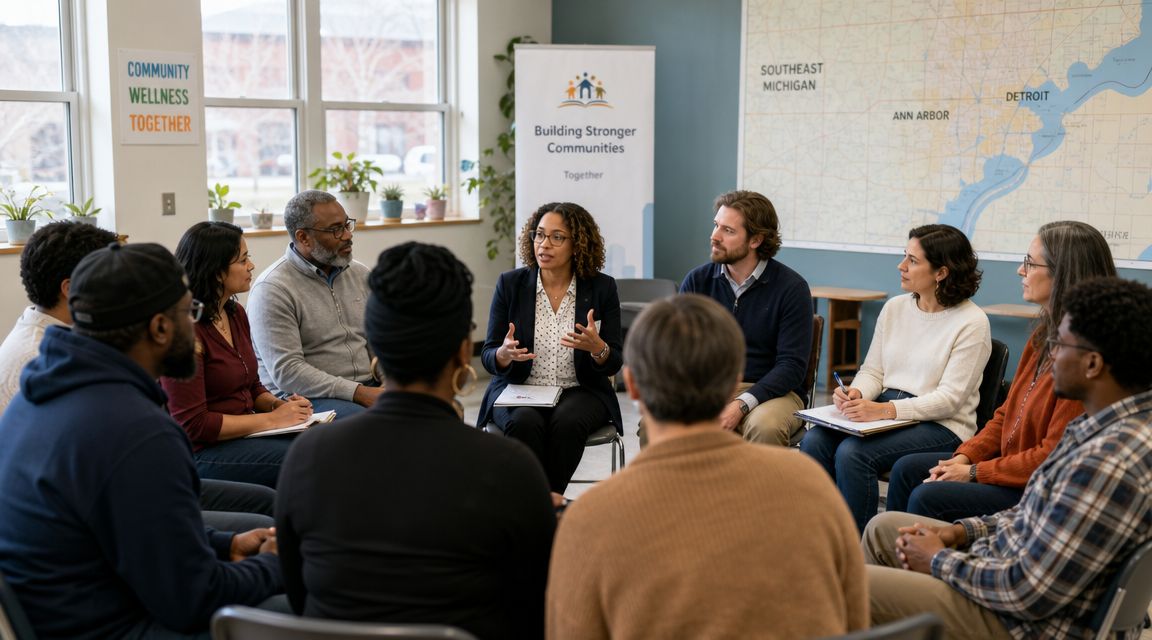
What you can do now
A useful local plan usually includes a mix of education, community, and harm reduction.
- Study the Michigan context carefully: Metro Mush has a straightforward overview of magic mushrooms in Michigan that helps clarify the local environment.
- Join community discussions: Psychedelic societies, reading groups, and local wellness communities can help you hear how people are thinking about ethics, access, and safety.
- Learn harm reduction language: This matters whether or not you ever pursue formal facilitation.
- Attend webinars from established training programs: You'll hear how serious programs talk about prerequisites, supervision, and legal fit.
- Keep notes on your goal: Are you exploring for personal growth, community education, future licensure elsewhere, or eventual therapeutic crossover work?
A Michigan-specific way to think about readiness
If you're local, it helps to separate three layers of development.
Personal literacy
Learn the basics well. Understand preparation, set and setting, integration, and legal boundaries. This alone can make you a safer and more thoughtful participant in community conversations.
Community responsibility
Many people become informally influential long before they become professionally trained. If friends already ask you questions, your job is to answer carefully, avoid overclaiming, and know when to point someone toward licensed mental health care or emergency support.
Professional preparation
If you think regulated-state licensure may matter later, begin collecting the right information now. Ask programs about jurisdiction alignment, practicum access, and whether they are preparing students for education only or for an actual legal pipeline.
You don't need to rush into the first course that looks reputable. In Michigan, patience is often part of responsible planning.
What good next steps feel like
Good next steps usually feel clarifying, not intoxicating. You should come away with a better sense of limits, not just possibilities.
A grounded learner in Detroit or Ann Arbor might spend the next few months reading, attending info sessions, speaking with training programs, and connecting with local community spaces. That may not feel as exciting as enrolling tomorrow. But it's often the wiser move. In a field this new, restraint is part of professionalism.
If you're in the Detroit or Ann Arbor area and want a trusted local place to continue your broader psilocybin education and product exploration, Metro Mush is a useful starting point. You can browse strains, edibles, and drinks, stay current on new drops, and connect with the local community through their Discord while you keep learning about this emerging space responsibly.